
Lekhana purchases rice from two farms and sells it in the market. She bought 84 kg of rice from one farm and 108 kg from the other farm. She wants the rice to be packed in bags, so each bag has rice from only one farm and all bags have the same weight that is a whole number of kg. If she wants to use as few bags as possible, what should the weight of each bag be?
Answer
Since each bag must have the same whole-number weight and rice from only one farm, the weight of each bag should be a common factor of 84 and 108. To use as few bags as possible, this weight should be the highest common factor, i.e., the HCF of 84 and 108.
Factors of 84 — 1, 2, 3, 4, 6, 7, 12, 14, 21, 28, 42, and 84.
Factors of 108 — 1, 2, 3, 4, 6, 9, 12, 18, 27, 36, 54, and 108.
The common factors of 84 and 108 are 1, 2, 3, 4, 6, and 12.
The highest common factor is 12.
Therefore, the rice should be packed in 12 kg bags.
Number of bags required:
First farm: 84 ÷ 12 = 7 bags
Second farm: 108 ÷ 12 = 9 bags
Hence, the weight of each bag should be 12 kg.
Do you remember the ‘Jump Jackpot’ game from Grade 6 (see the chapter ‘Prime Time’)? Grumpy places a treasure on a number and Jumpy chooses a jump size and tries to collect the treasure. In each case below, the two numbers upon which treasures are kept are given. Find the longest jump size (starting from 0) using which Jumpy can land on both the numbers having the treasure.
(a) 14 and 30
(b) 7 and 11
(c) 30 and 50
(d) 28 and 42
(i) Is the longest jump size for the numbers the same as their HCF? Explain why it is so.
Answer
Starting from 0, Jumpy lands on the multiples of the jump size. To land on both treasure numbers, the jump size must be a common factor of both numbers. The longest such jump size is their HCF.
(a) 14 and 30
Factors of 14: 1, 2, 7, 14
Factors of 30: 1, 2, 3, 5, 6, 10, 15, 30
Common factors: 1, 2
The highest common factor is 2.
Hence, the longest jump size is 2.
(b) 7 and 11
Factors of 7: 1, 7
Factors of 11: 1, 11
Common factor: 1
The highest common factor is 1
Hence, the longest jump size is 1.
(c) 30 and 50
Factors of 30: 1, 2, 3, 5, 6, 10, 15, 30
Factors of 50: 1, 2, 5, 10, 25, 50
Common factors: 1, 2, 5, 10
The highest common factor is 10.
Hence, the longest jump size is 10.
(d) 28 and 42
Factors of 28: 1, 2, 4, 7, 14, 28
Factors of 42: 1, 2, 3, 6, 7, 14, 21, 42
Common factors: 1, 2, 7, 14
The highest common factor is 14.
Hence, the longest jump size is 14.
(i)
Yes, the longest jump size is exactly the HCF of the two numbers.
Starting from 0, Jumpy lands only on the multiples of the chosen jump size. For Jumpy to land on a particular treasure number, that number must be a multiple of the jump size — in other words, the jump size must be a factor of the treasure number.
To land on both treasure numbers, the jump size must therefore be a factor of both numbers, that is, a common factor of the two numbers. The longest jump size is the greatest of these common factors, which is precisely the Highest Common Factor (HCF).
Hence, the longest jump size is the same as the HCF of the two numbers.
(i) Is 2 × 7 = 14 a factor of 840? Why or why not?
(ii) Is 2 × 2 × 2 a factor of 840? Why or why not?
(iii) Is 3 × 3 × 3 a factor of 840? Why or why not?
Answer
Recall that the prime factorisation of 840 is 2 × 2 × 2 × 3 × 5 × 7.
A number is a factor of 840 only if it can be formed as a ‘subpart’ (a product of some of these prime factors), using each prime no more times than it appears in 840.
(i) Is 2 × 7 = 14 a factor of 840?
840 contains at least one 2 and one 7 among its prime factors, so 2 × 7 can be taken as a subpart:
840 = (2 × 7) × (2 × 2 × 3 × 5) = 14 × 60
Hence, 2 × 7 = 14 is a factor of 840.
(ii) Is 2 × 2 × 2 a factor of 840?
840 contains exactly three 2s among its prime factors, so 2 × 2 × 2 can be taken as a subpart:
840 = (2 × 2 × 2) × (3 × 5 × 7) = 8 × 10⁵
Hence, 2 × 2 × 2 = 8 is a factor of 840.
(iii) Is 3 × 3 × 3 a factor of 840?
840 contains only one 3 among its prime factors. To have 3 × 3 × 3 as a subpart, we would need three 3s, but only one is available. So 3 × 3 × 3 cannot be formed as a subpart of 840.
Hence, 3 × 3 × 3 = 27 is not a factor of 840.
Find the factors of 225 using prime factorisation.
(i) Check that all the factors of 225 occur in this list.
Answer
Factorising 225 into its primes, we get:
225 = 5 × 5 × 3 × 3
Any ‘subpart’ of this factorisation gives a factor of 225. Let us systematically form all these subparts.
Prime factors: 3, 5.
Combination of two prime factors: 3 × 3 = 9, 5 × 5 = 25, 3 × 5 = 15.
Combination of three prime factors: 3 × 3 × 5 = 45, 3 × 5 × 5 = 75.
Combination of four prime factors: 3 × 3 × 5 × 5 = 225.
Adding 1 to this list, we get all the factors.
Hence, the factors of 225 are 1, 3, 5, 9, 15, 25, 45, 75, and 225.
(i) We check by dividing 225 by each number in the list. If the division is exact, the number is a factor.
225 ÷ 1 = 225
225 ÷ 3 = 75
225 ÷ 5 = 45
225 ÷ 9 = 25
225 ÷ 15 = 15
225 ÷ 25 = 9
225 ÷ 45 = 5
225 ÷ 75 = 3
225 ÷ 225 = 1
Each division leaves no remainder, so every number in the list is indeed a factor of 225. Notice also that the factors pair up neatly: (1, 225), (3, 75), (5, 45), (9, 25), and 15 pairs with itself.
Hence, all the factors of 225 — namely 1, 3, 5, 9, 15, 25, 45, 75, and 225 — occur in the list.
List all the factors of the following numbers:
(a) 90
(b) 105
(c) 132
(d) 360 (this number has 24 factors)
(e) 840 (this number has 32 factors)
Answer
For each number, we first find its prime factorisation and then form all possible subparts to obtain every factor.
(a) 90
90 = 2 × 3 × 3 × 5
Hence, the factors of 90 are 1, 2, 3, 5, 6, 9, 10, 15, 18, 30, 45, and 90. (12 factors)
(b) 105
105 = 3 × 5 × 7
Hence, the factors of 105 are 1, 3, 5, 7, 15, 21, 35, and 105. (8 factors)
(c) 132
132 = 2 × 2 × 3 × 11
Hence, the factors of 132 are 1, 2, 3, 4, 6, 11, 12, 22, 33, 44, 66, and 132. (12 factors)
(d) 360
360 = 2 × 2 × 2 × 3 × 3 × 5
Hence, the factors of 360 are 1, 2, 3, 4, 5, 6, 8, 9, 10, 12, 15, 18, 20, 24, 30, 36, 40, 45, 60, 72, 90, 120, 180, and 360. (24 factors)
(e) 840
840 = 2 × 2 × 2 × 3 × 5 × 7
Hence, the factors of 840 are 1, 2, 3, 4, 5, 6, 7, 8, 10, 12, 14, 15, 20, 21, 24, 28, 30, 35, 40, 42, 56, 60, 70, 84, 105, 120, 140, 168, 210, 280, 420, and 840. (32 factors)
Find the common factors and the HCF of the following numbers:
(a) 50, 60
(b) 140, 275
(c) 77, 725
(d) 370, 592
(e) 81, 243
Answer
(a) 50, 60
50 = 2 × 5 × 5
60 = 2 × 2 × 3 × 5
The common primes are 2 and 5, and their combination 2 × 5 = 10 is also a subpart of both. Along with 1, the common factors are 1, 2, 5, and 10.
Hence, the common factors of 50 and 60 are 1, 2, 5, and 10, and their HCF = 10.
(b) 140, 275
140 = 2 × 2 × 5 × 7
275 = 5 × 5 × 11
The only prime common to both factorisations is 5 (appearing at least once in each). Along with 1, the common factors are 1 and 5.
Hence, the common factors of 140 and 275 are 1 and 5, and their HCF = 5.
(c) 77, 725
77 = 7 × 11
725 = 5 × 5 × 29
There is no prime common to both factorisations, so there is no subpart common to both. Hence, 1 is the only common factor.
Hence, the only common factor of 77 and 725 is 1, and their HCF = 1.
(d) 370, 592
370 = 2 × 5 × 37
592 = 2 × 2 × 2 × 2 × 37
The common primes are 2 and 37, and their combination 2 × 37 = 74 is also a subpart of both. Along with 1, the common factors are 1, 2, 37, and 74.
Hence, the common factors of 370 and 592 are 1, 2, 37, and 74, and their HCF = 74.
(e) 81, 243
81 = 3 × 3 × 3 × 3
243 = 3 × 3 × 3 × 3 × 3
The only common prime is 3, appearing at least four times in both. Forming the common subparts, we get 3, 3 × 3 = 9, 3 × 3 × 3 = 27, and 3 × 3 × 3 × 3 = 81. Along with 1, the common factors are 1, 3, 9, 27, and 81.
Hence, the common factors of 81 and 243 are 1, 3, 9, 27, and 81, and their HCF = 81.
Find the HCF of the following numbers:
(a) 24, 180
(b) 42, 75, 24
(c) 240, 378
(d) 400, 2500
(e) 300, 800
Answer
(a) 24, 180
24 = 2 × 2 × 2 × 3
180 = 2 × 2 × 3 × 3 × 5
The common primes are 2 and 3. The minimum number of 2s is two, and the minimum number of 3s is one.
HCF = 2 × 2 × 3 = 12
Hence, the HCF of 24 and 180 is 12.
(b) 42, 75, 24
42 = 2 × 3 × 7
75 = 3 × 5 × 5
24 = 2 × 2 × 2 × 3
The only prime that appears in all three factorisations is 3 (appearing at least once in each). No other prime is common to all three.
HCF = 3
Hence, the HCF of 42, 75, and 24 is 3.
(c) 240, 378
240 = 2 × 2 × 2 × 2 × 3 × 5
378 = 2 × 3 × 3 × 3 × 7
The common primes are 2 and 3. The minimum number of 2s is one, and the minimum number of 3s is one.
HCF = 2 × 3 = 6
Hence, the HCF of 240 and 378 is 6.
(d) 400, 2500
400 = 2 × 2 × 2 × 2 × 5 × 5
2500 = 2 × 2 × 5 × 5 × 5 × 5
The common primes are 2 and 5. The minimum number of 2s is two, and the minimum number of 5s is two.
HCF = 2 × 2 × 5 × 5 = 100
Hence, the HCF of 400 and 2500 is 100.
(e) 300, 800
300 = 2 × 2 × 3 × 5 × 5
800 = 2 × 2 × 2 × 2 × 2 × 5 × 5
The common primes are 2 and 5. The minimum number of 2s is two, and the minimum number of 5s is two.
HCF = 2 × 2 × 5 × 5 = 100
Hence, the HCF of 300 and 800 is 100.
Consider the numbers 72 and 144. Suppose they are factorised into composite numbers as: 72 = 6 × 12 and 144 = 8 × 18. Seeing this, can one say that these two numbers have no common factor other than 1? Why not?
Answer
No. We cannot say that because 6 × 12 and 8 × 18 are composite factorisations and not prime factorisations. Therefore, they cannot be used to determine the common factors.
Writing the numbers as products of primes:
72 = 2 × 2 × 2 × 3 × 3
144 = 2 × 2 × 2 × 2 × 3 × 3
The common subpart is:
2 × 2 × 2 × 3 × 3 = 72
Thus, 72 is a common factor of both numbers.
Hence, 72 and 144 have common factors other than 1. We must use prime factorisation to find the common factors correctly.
Anshu and Guna make torans out of strips of cloth. Multiple strips are placed one next to another to make a toran. Anshu uses strips of length 6 cm and Guna uses strips of 8 cm length. If both have to make torans of the same length, what is the smallest possible length, the torans could be?
(i) What about the largest common multiple? Does such a number exist?
Answer
Anshu uses strips of 6 cm, so any toran he makes has a length that is a multiple of 6:
6, 12, 18, 24, 30, 36, 42, 48, … cm
Guna uses strips of 8 cm, so any toran he makes has a length that is a multiple of 8:
8, 16, 24, 32, 40, 48, … cm
For both to make torans of the same length, the length must be a common multiple of 6 and 8.
The common multiples are:
24, 48, …
The smallest common multiple is 24.
Hence, the smallest possible length of the toran that both Anshu and Guna can make is 24 cm.
(i) No. A largest common multiple does not exist because there are infinitely many common multiples of 6 and 8, such as 24, 48, 72, 96, ….
A sweet shop gives out free gajak to school children on Mondays. Today is a Monday and Kabamai enjoyed eating the gajak. But she visits the sweet shop once every 10 days. When is the next time she would be able to get free gajak from Sweet shop? (Answer in number of days.)
Answer
The shop gives free gajak every Monday, i.e., after every 7 days. So free gajak is available on days that are multiples of 7:
7, 14, 21, 28, 35, 42, 49, 56, 63, 70, …
Kabamai visits the shop once every 10 days. So she comes to the shop on days that are multiples of 10:
10, 20, 30, 40, 50, 60, 70, …
Kabamai will get free gajak only on a day that is common to both lists, i.e., a common multiple of 7 and 10.
The first common multiple of 7 and 10 is 70.
Hence, Kabamai will next be able to get free gajak after 70 days.
Do you remember the ‘Idli-Vada’ game from Grade 6 (see chapter ‘Prime Time’)? Two numbers are chosen and whenever players come to their multiples, ‘idli’ or ‘vada’ should be called out depending on whose multiple the number is. If the number happens to be a common multiple, then ‘idli-vada’ should be called out. In each problem below, the two numbers corresponding to ‘idli’ and ‘vada’ are given. Find the first number for which ‘idli-vada’ will be called out:
(a) 4 and 6
(b) 7 and 11
(c) 14 and 30
(d) 15 and 55
(i) Is the answer always the LCM of the two numbers? Explain.
Answer
‘Idli-vada’ is called out at the first number that is a multiple of both the given numbers, i.e., their first (smallest) common multiple.
(a) 4 and 6
Multiples of 4:
4, 8, 12, 16, 20, …
Multiples of 6:
6, 12, 18, 24, …
The first common multiple is 12.
Hence, the first number for which ‘idli-vada’ is called out is 12.
(b) 7 and 11
Multiples of 7:
7, 14, 21, 28, 35, 42, 49, 56, 63, 70, 77, …
Multiples of 11:
11, 22, 33, 44, 55, 66, 77, …
The first common multiple is 77.
Hence, the first number for which ‘idli-vada’ is called out is 77.
(c) 14 and 30
Multiples of 14:
14, 28, 42, 56, 70, 84, 98, 112, 126, 140, 154, 168, 182, 196, 210, …
Multiples of 30:
30, 60, 90, 120, 150, 180, 210, …
The first common multiple is 210.
Hence, the first number for which ‘idli-vada’ is called out is 210.
(d) 15 and 55
Multiples of 15:
15, 30, 45, 60, 75, 90, 105, 120, 135, 150, 165, …
Multiples of 55:
55, 110, 165, …
The first common multiple is 165.
Hence, the first number for which ‘idli-vada’ is called out is 165.
(i) Yes. The first number for which ‘idli-vada’ is called out is the first common multiple of the two numbers. This is the Lowest Common Multiple (LCM).
Find the LCM of 14 and 35.
(i) Is 2 × 3 × 5 × 7 also a common multiple?
(ii) What is the lowest among all the common multiples of 14 and 35?
Answer
Writing the prime factorisation of each number:
14 = 2 × 7
35 = 5 × 7
Every common multiple must contain 2 × 7 as a subpart (so that it is a multiple of 14) and 5 × 7 as a subpart (so that it is a multiple of 35). The smallest number that contains both subparts uses each prime the greatest number of times it appears in either factorisation:
- 2 appears once (in 14) ⇒ take one 2
- 5 appears once (in 35) ⇒ take one 5
- 7 appears once in each ⇒ take one 7
LCM = 2 × 5 × 7 = 70
Hence, the LCM of 14 and 35 is 70.
(i)
For a number to be a common multiple of 14 and 35, it must contain 14 = 2 × 7 as a subpart and 35 = 5 × 7 as a subpart.
Consider 2 × 3 × 5 × 7 = 210.
- It contains 2 × 7, so it is a multiple of 14 (210 = 14 × 15).
- It contains 5 × 7, so it is a multiple of 35 (210 = 35 × 6).
Since 2 × 3 × 5 × 7 is a multiple of both 14 and 35, it is indeed a common multiple. (It is not the lowest common multiple, however, since it carries an extra factor of 3.)
Hence, 2 × 3 × 5 × 7 = 210 is a common multiple of 14 and 35.
(ii)
Every common multiple of 14 and 35 must contain 14 = 2 × 7 and 35 = 5 × 7 as subparts. The smallest such number is
2 × 5 × 7 = 70.
This is the lowest common multiple because 2 × 5 × 7 already contains both 14 = 2 × 7 and 35 = 5 × 7, and removing any prime from it would leave a number that is no longer a multiple of both 14 and 35.
Hence, the lowest among all the common multiples of 14 and 35 is 70.
Find the LCM of 96 and 360.
(i) How many 2s should the LCM contain?
(ii) How many 3s should the LCM contain?
(iii) How many 5s should the LCM contain?
Answer
Writing the prime factorisation of each number:
96 = 2 × 2 × 2 × 2 × 2 × 3
360 = 2 × 2 × 2 × 3 × 3 × 5
The prime factors appearing are 2, 3 and 5. For the LCM, each prime is taken the maximum number of times it occurs in either factorisation:
- 2 occurs five times in 96 and three times in 360 ⇒ take five 2s
- 3 occurs once in 96 and twice in 360 ⇒ take two 3s
- 5 does not occur in 96 and occurs once in 360 ⇒ take one 5
LCM = 2 × 2 × 2 × 2 × 2 × 3 × 3 × 5 = 1440
Hence, the LCM of 96 and 360 is 1440.
(i)
The factorisation of 96 contains 2 × 2 × 2 × 2 × 2 (five occurrences of 2)
The factorisation of 360 contains 2 × 2 × 2 (three occurrences of 2).
To be a multiple of both numbers, the LCM must contain enough 2s to cover the larger count.
Hence, the LCM should contain five 2s.
(ii)
The factorisation of 96 contains a single 3 (one occurrence of 3)
The factorisation of 360 contains 3 × 3 (two occurrences of 3).
To be a multiple of both numbers, the LCM must contain enough 3s to cover the larger count.
Hence, the LCM should contain two 3s.
(iii)
The factorisation of 96 has no 5s
The factorisation of 360 has one occurrence of 5.
To be a multiple of both numbers, the LCM must contain enough 5s to cover the larger count.
Hence, the LCM should contain one 5.
Find the LCM of the following numbers:
(a) 30, 72
(b) 36, 54
(c) 105, 195, 65
(d) 222, 370
Answer
To find the LCM, we write the prime factorisation of each number and, for every prime, take the maximum number of times it occurs in any one factorisation.
(a) 30, 72
30 = 2 × 3 × 5
72 = 2 × 2 × 2 × 3 × 3
Taking the greatest count of each prime: three 2s (from 72), two 3s (from 72), and one 5 (from 30):
LCM = 2 × 2 × 2 × 3 × 3 × 5 = 360
Hence, the LCM of 30 and 72 is 360.
(b) 36, 54
36 = 2 × 2 × 3 × 3
54 = 2 × 3 × 3 × 3
Taking the greatest count of each prime: two 2s (from 36) and three 3s (from 54):
LCM = 2 × 2 × 3 × 3 × 3 = 108
Hence, the LCM of 36 and 54 is 108.
(c) 105, 195, 65
105 = 3 × 5 × 7
195 = 3 × 5 × 13
65 = 5 × 13
Taking the greatest count of each prime: one 3, one 5, one 7 and one 13:
LCM = 3 × 5 × 7 × 13 = 1365
Hence, the LCM of 105, 195 and 65 is 1365.
(d) 222, 370
222 = 2 × 3 × 37
370 = 2 × 5 × 37
Taking the greatest count of each prime: one 2, one 3, one 5 and one 37:
LCM = 2 × 3 × 5 × 37 = 1110
Hence, the LCM of 222 and 370 is 1110.
The HCF of 6 and 18 is 6, which is one of the two given numbers.
Find more such number pairs where the HCF is one of the two numbers. How can we describe such pairs of numbers?
Answer
The HCF of two numbers turns out to be one of the numbers exactly when the smaller number is a factor of the larger number (equivalently, the larger number is a multiple of the smaller).
Some such pairs are:
- 4 and 12 → HCF = 4
- 5 and 25 → HCF = 5
- 9 and 27 → HCF = 9
- 7 and 42 → HCF = 7
In each pair, one number divides the other. So all the common factors of the pair are simply the factors of the smaller number, and the greatest of these is the smaller number itself.
Hence, the HCF of two numbers is one of the numbers precisely when one number is a factor (divisor) of the other.
For number pairs satisfying this property (i.e., one of the numbers is the HCF),
(a) if m is a number, what could be the other number?
(b) if 7k is a number, what could be the other number?
Answer
For the HCF to be one of the two numbers, that number must be a factor of the other. So the "other" number has to be a multiple of the given number.
(a) If m is a number, the other number could be any multiple of m — that is, 2m, 3m, 4m, … , or in general pm for some positive integer p. Then m is a factor of pm, so their HCF is m.
(b) If 7k is a number, the other number could be any multiple of 7k — that is, 14k, 21k, 28k, … , or in general 7k × p for some positive integer p. Then 7k is a factor of the other number, so their HCF is 7k.
∴ In each case the other number must be a multiple of the given number, so that the given number is their HCF.
Make a general statement about the HCF for the following pairs of numbers. You could consider examples before coming up with general statements. Look for possible explanations of why they hold.
(a) Two consecutive even numbers
(b) Two consecutive odd numbers
(c) Two even numbers
(d) Two consecutive numbers
(e) Two co-prime numbers
Share your observations with the class.
Answer
(a) Two consecutive even numbers.
Examples: HCF(6, 8) = 2, HCF(10, 12) = 2, HCF(14, 16) = 2. Two consecutive even numbers can be written as 2n and 2(n + 1). Since n and n + 1 are consecutive, they are co-prime, so the only factor common to both numbers beyond the shared 2 is 1.
General statement: The HCF of two consecutive even numbers is always 2.
(b) Two consecutive odd numbers.
Examples: HCF(7, 9) = 1, HCF(15, 17) = 1, HCF(21, 23) = 1. Two consecutive odd numbers differ by 2. Any common factor must also divide their difference 2; but since both numbers are odd, 2 cannot be a common factor. So the only common factor is 1.
General statement: The HCF of two consecutive odd numbers is always 1 (they are co-prime).
(c) Two even numbers.
Examples: HCF(8, 12) = 4, HCF(10, 20) = 10, HCF(14, 20) = 2. Both numbers are multiples of 2, so 2 is always a common factor. The HCF is therefore even, and hence at least 2 (its exact value depends on the numbers).
General statement: The HCF of two even numbers is always even (a multiple of 2), and so is at least 2.
(d) Two consecutive numbers.
Examples: HCF(14, 15) = 1, HCF(20, 21) = 1.
Two consecutive numbers differ by 1. Any common factor must divide their difference 1, so the only common factor is 1.
General statement: The HCF of two consecutive numbers is always 1 (they are co-prime).
(e) Two co-prime numbers.
By definition, co-prime numbers share no common factor other than 1.
General statement: The HCF of two co-prime numbers is always 1.
The LCM of 3 and 24 is 24 (it is one of the two given numbers).
(a) Find more such number pairs where the LCM is one of the two numbers.
(b) Make a general statement about such numbers. Describe such number pairs using algebra.
Answer
(a) Some such pairs are: (4, 12), (5, 15), (6, 18), (7, 35), (9, 27). In each pair one number is a multiple of the other, and the LCM equals the larger number.
(b) The LCM of two numbers is one of the numbers exactly when one number is a factor of the other (so the larger is a multiple of the smaller). In that case the LCM is the larger number.
Algebraically, for a number n and a multiple kn (where k is a positive integer), LCM(n, kn) = kn.
Hence, when one number is a factor of the other, their LCM is the larger of the two numbers.
Make a general statement about the LCM for the following pairs of numbers. You could consider examples before coming up with these general statements. Look for possible explanations of why they hold.
(a) Two multiples of 3
(b) Two consecutive even numbers
(c) Two consecutive numbers
(d) Two co-prime numbers
Answer
(a) Two multiples of 3.
Examples: LCM(6, 9) = 18, LCM(12, 15) = 60, LCM(6, 12) = 12.
Since 3 is a factor of both numbers, it is a factor of every common multiple, and hence of their LCM.
General statement: The LCM of two multiples of 3 is always a multiple of 3.
(b) Two consecutive even numbers.
Examples: LCM(6, 8) = 24, LCM(4, 6) = 12, LCM(10, 12) = 60.
Two consecutive even numbers can be written as 2n and 2(n + 1). Since n and n + 1 are co-prime, the smallest number containing both factors is 2n(n + 1).
The product of the two numbers is 4n(n + 1), so their LCM is half their product.
General statement: The LCM of two consecutive even numbers is half their product, i.e., 2n(n + 1) for the numbers 2n and 2n + 2.
(c) Two consecutive numbers.
Examples: LCM(14, 15) = 210 = 14 × 15, LCM(8, 9) = 72 = 8 × 9.
Consecutive numbers are co-prime (HCF 1), so their LCM equals their product.
General statement: The LCM of two consecutive numbers equals their product.
(d) Two co-prime numbers.
Examples: LCM(4, 9) = 36 = 4 × 9, LCM(8, 15) = 120 = 8 × 15.
Co-prime numbers have HCF 1, so their LCM equals their product.
General statement: The LCM of two co-prime numbers equals their product.
Here are some more numbers where both numbers are multiples of the same number. Find their HCF:
(a) 18 × 10, 18 × 15
(b) 10 × 38, 10 × 21
(c) 5 × 13, 5 × 20
(d) 12 × 16, 12 × 20
(i) In which of these cases is the HCF the same as the common multiplier, like problem (b) where the HCF is 10? Explore a few more examples of this type to understand when this happens.
Answer
(a) 18 × 10 and 18 × 15
18 × 10 = 180 = 2 × 2 × 3 × 3 × 5
18 × 15 = 270 = 2 × 3 × 3 × 3 × 5
The common prime factors are: 2 × 3 × 3 × 5
HCF = 2 × 3 × 3 × 5 = 90
Hence, HCF = 90.
(b) 10 × 38 and 10 × 21
10 × 38 = 380 = 2 × 2 × 5 × 19
10 × 21 = 210 = 2 × 3 × 5 × 7
The common prime factors are: 2 × 5
HCF = 2 × 5 = 10
Hence, HCF = 10.
(c) 5 × 13 and 5 × 20
5 × 13 = 65 = 5 × 13
5 × 20 = 100 = 2 × 2 × 5 × 5
The common prime factor is: 5
Hence, HCF = 5.
(d) 12 × 16 and 12 × 20
12 × 16 = 192 = 2 × 2 × 2 × 2 × 2 × 2 × 3
12 × 20 = 240 = 2 × 2 × 2 × 2 × 3 × 5
The common prime factors are:
2 × 2 × 2 × 2 × 3
HCF = 2 × 2 × 2 × 2 × 3 = 48
Hence, HCF = 48.
(i)
The HCF equals the common multiplier only when the two remaining multipliers are co-prime (their HCF is 1). Looking back at the four cases:
- (a) multipliers 10 and 15 → HCF(10, 15) = 5 (not 1); HCF = 90 ≠ 18. No.
- (b) multipliers 38 and 21 → HCF(38, 21) = 1; HCF = 10 = common multiplier. Yes.
- (c) multipliers 13 and 20 → HCF(13, 20) = 1; HCF = 5 = common multiplier. Yes.
- (d) multipliers 16 and 20 → HCF(16, 20) = 4 (not 1); HCF = 48 ≠ 12. No.
So the HCF equals the common multiplier in cases (b) and (c). This is exactly when the two multipliers are co-prime, because then they contribute no extra common factor, and the whole HCF comes from the common multiplier alone.
Hence, the HCF equals the common multiplier only in cases (b) and (c), i.e., when the two multipliers are co-prime.
Try the prime factorization method for these pairs of numbers.
(a) 90 and 150
(b) 84 and 132
Answer
Using the efficient procedure, we divide both numbers by any convenient common factor until the remaining numbers have no common factor other than 1.
(a) 90 and 150
Both numbers are divisible by 30:
90 = 30 × 3
150 = 30 × 5
Since 3 and 5 are co-prime,
HCF = 30
LCM = 30 × 3 × 5 = 450
Hence, the HCF of 90 and 150 is 30, and their LCM is 450.
(b) 84 and 132
Both numbers are divisible by 12:
84 = 12 × 7
132 = 12 × 11
Since 7 and 11 are co-prime,
HCF = 12
LCM = 12 × 7 × 11 = 924
Hence, the HCF of 84 and 132 is 12, and their LCM is 924.
Which is greater — the LCM of two numbers or their product?
You could analyse the above statement using examples. Then try to reason or prove, why the LCM is never greater than the product of the numbers.
Answer
Let the two numbers be a and b.
The product a × b is a multiple of a (it equals a × b) and it is also a multiple of b (it equals b × a). So the product a × b is itself a common multiple of a and b.
The LCM is, by definition, the lowest among all the common multiples of a and b. Since the product a × b is one of these common multiples, the LCM cannot be larger than it.
LCM ≤ a × b
Hence, the LCM of two numbers is never greater than their product, because the product is always a common multiple and the LCM is the smallest common multiple.
Consider the numbers 105 and 95. Find their LCM.
Answer
Factorising both numbers into their primes:
105 = 3 × 5 × 7
95 = 5 × 19
The LCM must contain each prime the maximum number of times it occurs in either factorisation. The primes involved are 3, 5, 7 and 19, each occurring once:
LCM = 3 × 5 × 7 × 19 = 1995
Hence, the LCM of 105 and 95 is 1995.
Explore whether the LCM is a factor of the product in the following cases. If yes, identify the number that the LCM should be multiplied by to get the product. Do you see any pattern? Use these numbers:
(a) 45, 105
(b) 275, 352
(c) 222, 370
(i) Do you see that, in each case, the number by which the LCM is multiplied to get the product is actually the HCF?
(ii) Why does this happen? Can you give an explanation or proof?
[Hint: Consider the prime factorisation of the given numbers. Among their prime factors, some are common to both factorisations, and the rest occur in only one of them. Between the HCF and the LCM, see how the common and non-common prime factors get distributed. In the product, observe how these two kinds of prime factors occur. Compare them.]
(iii) Explore whether this property holds when 3 numbers are considered.
Answer
(a) 45 and 105
45 = 3 × 3 × 5
105 = 3 × 5 × 7
LCM = 3 × 3 × 5 × 7 = 315
Product = 45 × 105 = 4725
4725 = 315 × 15, so LCM is multiplied by 15.
(b) 275 and 352
275 = 5 × 5 × 11
352 = 2 × 2 × 2 × 2 × 2 × 11
LCM = 2 × 2 × 2 × 2 × 2 × 5 × 5 × 11 = 8800
Product = 275 × 352 = 96800
96800 = 8800 × 11, so LCM is multiplied by 11.
(c) 222 and 370
222 = 2 × 3 × 37
370 = 2 × 5 × 37
LCM = 2 × 3 × 5 × 37 = 1110
Product = 222 × 370 = 82140
82140 = 1110 × 74, so LCM is multiplied by 74.
In every case the LCM is a factor of the product. The multipliers obtained are 15, 11 and 74 — which are exactly the HCFs of the respective pairs.
Hence, in each case the LCM is a factor of the product, and the number it must be multiplied by to get the product is the HCF of the two numbers.
(i)
Yes. In each pair above, the multiplier turned out to be the HCF of the two numbers:
45, 105: multiplier = 15, HCF = 15
275, 352: multiplier = 11, HCF = 11
222, 370: multiplier = 74, HCF = 74
So the observation can be written as:
Product of the two numbers = LCM × HCF
Hence, the number by which the LCM is multiplied to get the product is indeed the HCF of the two numbers.
(ii)
The HCF contains the common prime factors with the smaller number of occurrences, while the LCM contains all the prime factors with the larger number of occurrences. Together, they contain exactly the same prime factors as the product of the two numbers.
Therefore, HCF × LCM = Product of the two numbers.
(iii)
Let us test the property with three numbers, say 12, 18 and 30.
12 = 2 × 2 × 3
18 = 2 × 3 × 3
30 = 2 × 3 × 5
HCF = 2 × 3 = 6
LCM = 2 × 2 × 3 × 3 × 5 = 180
Comparing:
HCF × LCM = 6 × 180 = 1080
Product = 12 × 18 × 30 = 6480
Since 1080 ≠ 6480, the property does not hold for three numbers in general.
Hence, the relation HCF × LCM = product does not hold for three numbers in general; it is a property specific to pairs of numbers.
In the two rows below, colours repeat as shown. When will the blue stars meet next?

Answer
Let us first find the repeating block of colours in each row.
In the top row, the colours repeat after every 6 stars: yellow, green, orange, blue, purple, grey. So a blue star appears at the 4th, 10th, 16th, … star — that is, once every 6 stars.
In the bottom row, the colours repeat after every 4 stars: green, orange, yellow, blue. So a blue star appears at the 4th, 8th, 12th, 16th, … star — that is, once every 4 stars.
Both rows already have a blue star at the 4th position. After this, a blue star in the top row falls at positions of the form (multiple of 6) and in the bottom row at positions of the form (multiple of 4) counted from that first meeting. So the blue stars will meet again after the lowest common multiple of 6 and 4.
6 = 2 × 3
4 = 2 × 2
LCM(6, 4) = 2 × 2 × 3 = 12
So the next meeting is 12 stars after the 4th star, i.e., at the 4 + 12 = 16th star.
∴ The blue stars meet next at the 16th star.
(a) Is 5 × 7 × 11 × 11 a multiple of 5 × 7 × 7 × 11 × 2?
(b) Is 5 × 7 × 11 × 11 a factor of 5 × 7 × 7 × 11 × 2?
Answer
We compare the prime factorisations. Recall that one number is a multiple of another when the prime factorisation of the second is a subpart of the first, and one number is a factor of another when its own prime factorisation is a subpart of the other.
(a) For 5 × 7 × 11 × 11 to be a multiple of 5 × 7 × 7 × 11 × 2, the whole of 5 × 7 × 7 × 11 × 2 must appear as a subpart of 5 × 7 × 11 × 11.
But 5 × 7 × 7 × 11 × 2 has two 7s and one 2, while 5 × 7 × 11 × 11 has only one 7 and no 2. So it cannot be a subpart.
Hence, 5 × 7 × 11 × 11 is not a multiple of 5 × 7 × 7 × 11 × 2.
(b) For 5 × 7 × 11 × 11 to be a factor of 5 × 7 × 7 × 11 × 2, the whole of 5 × 7 × 11 × 11 must appear as a subpart of 5 × 7 × 7 × 11 × 2.
But 5 × 7 × 11 × 11 has two 11s, while 5 × 7 × 7 × 11 × 2 has only one 11. So it cannot be a subpart.
Hence, 5 × 7 × 11 × 11 is not a factor of 5 × 7 × 7 × 11 × 2.
Find the HCF and LCM of the following (state your answers in the form of prime factorisations):
(a) 3 × 3 × 5 × 7 × 7 and 12 × 7 × 11
(b) 45 and 36
Answer
(a) 3 × 3 × 5 × 7 × 7 and 12 × 7 × 11
First, we write both numbers as products of primes:
3 × 3 × 5 × 7 × 7 (already in prime factors)
12 × 7 × 11 = 2 × 2 × 3 × 7 × 11
For the HCF, we take the common primes with the minimum number of occurrences.
The common primes are 3 (appearing once in the second number) and 7 (appearing once in the second number).
HCF = 3 × 7
For the LCM, we take every prime with the maximum number of occurrences: 2 (twice), 3 (twice), 5 (once), 7 (twice) and 11 (once).
LCM = 2 × 2 × 3 × 3 × 5 × 7 × 7 × 11
Hence, HCF = 3 × 7 and LCM = 2 × 2 × 3 × 3 × 5 × 7 × 7 × 11.
(b) 45 and 36
Prime factorisations:
45 = 3 × 3 × 5
36 = 2 × 2 × 3 × 3
For the HCF, the only common prime is 3, appearing twice in both.
HCF = 3 × 3
For the LCM, we take each prime with the maximum occurrences: 2 (twice), 3 (twice) and 5 (once).
LCM = 2 × 2 × 3 × 3 × 5
Hence, HCF = 3 × 3 and LCM = 2 × 2 × 3 × 3 × 5.
Find two numbers whose HCF is 1 and LCM is 66.
Answer
If the HCF of two numbers is 1, the numbers are co-prime, and then
Product of the two numbers = HCF × LCM = 1 × 66 = 66.
So we need two co-prime numbers whose product is 66. Factorising,
66 = 2 × 3 × 11.
Splitting these prime factors into two groups with no prime in common, one convenient choice is 6 and 11:
6 = 2 × 3, 11 = 11.
They share no common prime factor, so HCF = 1, and their LCM = 2 × 3 × 11 = 66.
Hence, one such pair is 6 and 11. (Other valid pairs are 2 and 33, 3 and 22, and 1 and 66.)
A cowherd took all his cows to graze in the fields. The cows came to a crossing with 3 gates. An equal number of cows passed through each gate. Later at another crossing with 5 gates again an equal number of cows passed through each gate. The same happened at the third crossing with 7 gates. If the cowherd had less than 200 cows, how many cows did he have? (Based on the folklore mathematics from Karnataka.)
Answer
Since an equal number of cows passed through each of the 3 gates, the total number of cows is divisible by 3. Similarly, it is divisible by 5 (at the 5-gate crossing) and by 7 (at the 7-gate crossing).
So the number of cows is a common multiple of 3, 5 and 7. As these are all prime,
LCM(3, 5, 7) = 3 × 5 × 7 = 105.
The number of cows must be a multiple of 105.
The multiples of 105 are 105, 210, 315, … .
Since the cowherd had fewer than 200 cows, the only possibility is 105.
Hence, the cowherd had 105 cows.
The length, width, and height of a box are 12 cm, 18 cm, and 36 cm respectively. Which of the following sized cubes can be packed in this box without leaving gaps?
(a) 9 cm
(b) 6 cm
(c) 4 cm
(d) 3 cm
(e) 2 cm
Answer
For a cube to pack the box without gaps, its side must divide each dimension exactly. So the side of the cube must be a common factor of 12, 18 and 36.
12 = 2 × 2 × 3
18 = 2 × 3 × 3
36 = 2 × 2 × 3 × 3
The common factors of 12, 18 and 36 are 1, 2, 3 and 6 (their HCF being 2 × 3 = 6).
Checking each option:
(a) 9 : 12 ÷ 9 is not exact ⇒ No
(b) 6 : 12 ÷ 6 = 2, 18 ÷ 6 = 3, 36 ÷ 6 = 6 ⇒ Yes
(c) 4 : 18 ÷ 4 is not exact ⇒ No
(d) 3 : 12 ÷ 3 = 4, 18 ÷ 3 = 6, 36 ÷ 3 = 12 ⇒ Yes
(e) 2 : 12 ÷ 2 = 6, 18 ÷ 2 = 9, 36 ÷ 2 = 18 ⇒ Yes
Hence, cubes of side (b) 6 cm, (d) 3 cm and (e) 2 cm can be packed without leaving gaps.
Among the numbers below, which is the largest number that perfectly divides both 306 and 36?
(a) 36
(b) 612
(c) 18
(d) 3
(e) 2
(f) 360
Answer
The largest number that perfectly divides both 306 and 36 is their HCF.
Prime factorisations:
306 = 2 × 3 × 3 × 17
36 = 2 × 2 × 3 × 3
The common primes with the minimum number of occurrences are 2 (once) and 3 (twice).
HCF = 2 × 3 × 3 = 18
Hence, the largest number that perfectly divides both 306 and 36 is (c) 18.
Find the smallest number that is divisible by 3, 4, 5 and 7, but leaves a remainder of 10 when divided by 11.
Answer
A number divisible by 3, 4, 5 and 7 must be a multiple of their LCM.
Prime factorisations:
3 = 3
4 = 2 × 2
5 = 5
7 = 7
Taking the maximum number of occurrences of each prime factor,
LCM(3, 4, 5, 7) = 3 × 2 × 2 × 5 × 7 = 420
So the number is one of 420, 840, 1260, 1680, 2100, … .
We now check the remainder each leaves on division by 11:
420 = 11 × 38 + 2 ⇒ remainder 2
840 = 11 × 76 + 4 ⇒ remainder 4
1260 = 11 × 114 + 6 ⇒ remainder 6
1680 = 11 × 152 + 8 ⇒ remainder 8
2100 = 11 × 190 + 10 ⇒ remainder 10
The remainder increases by 2 at each step, reaching 10 at 2100.
Hence, the smallest such number is 2100.
Children are playing ‘Fire in the Mountain’. When the number 6 was called out, no one got out. When the number 9 was called out, no one got out. But when the number 10 was called out, some people got out. How many children could have been playing initially?
(a) 72
(b) 90
(c) 45
(d) 3
(e) 36
(f) None of these
Answer
Since no one got out when 6 and 9 were called, the number of children is divisible by both 6 and 9.
Prime factorisations:
6 = 2 × 3
9 = 3 × 3
Taking the maximum number of occurrences of each prime factor,
LCM(6, 9) = 2 × 3 × 3 = 18
So the number of children must be a multiple of 18.
Also, when 10 was called, some people got out, so the number of children is not divisible by 10.
Checking the options:
(a) 72 : 72 = 18 × 4 (÷6 and ÷9 exact), 72 ÷ 10 not exact ⇒ Valid
(b) 90 : 90 ÷ 6, 90 ÷ 9 exact, but 90 ÷ 10 = 9 exact (no one out) ⇒ Not valid
(c) 45 : 45 ÷ 6 not exact ⇒ Not valid
(d) 3 : 3 ÷ 6 not exact ⇒ Not valid
(e) 36 : 36 = 18 × 2 (÷6 and ÷9 exact), 36 ÷ 10 not exact ⇒ Valid
Hence, the number of children could be (a) 72 or (e) 36.
Tick the correct statement(s). The LCM of two different prime numbers (m, n) can be:
(a) Less than both numbers
(b) In between the two numbers
(c) Greater than both numbers
(d) Less than m × n
(e) Greater than m × n
Answer
Two different primes have no common factor other than 1, so they are co-prime. Hence their LCM is simply their product:
LCM(m, n) = m × n.
Since each prime is at least 2, multiplying m by n makes the result larger than both m and n. Also, the LCM is exactly equal to m × n — neither less nor greater.
(a) Less than both ⇒ False
(b) In between the two ⇒ False
(c) Greater than both ⇒ True
(d) Less than m × n ⇒ False (it equals m × n)
(e) Greater than m × n ⇒ False (it equals m × n)
Hence, only statement (c) is correct.
A dog is chasing a rabbit that has a head start of 150 feet. It jumps 9 feet every time the rabbit jumps 7 feet. In how many leaps does the dog catch up with the rabbit?
Answer
In each leap, the dog covers 9 feet while the rabbit covers 7 feet, so the gap between them shrinks by
9 − 7 = 2 feet per leap.
The dog has to make up a head start of 150 feet, so the number of leaps needed is
Check: after 75 leaps the dog has moved 75 × 9 = 675 feet, and the rabbit is at 150 + 75 × 7 = 675 feet — they are level.
Hence, the dog catches up with the rabbit in 75 leaps.
What is the smallest number that is a multiple of 1, 2, 3, 4, 5, 6, 8, 9, 10? Do you remember the answer from Grade 6, Chapter 5?
Answer
The smallest number that is a multiple of all of them is their LCM.
Prime factorisations:
2 = 2
3 = 3
4 = 2 × 2
5 = 5
6 = 2 × 3
8 = 2 × 2 × 2
9 = 3 × 3
10 = 2 × 5
Taking the maximum number of occurrences of each prime factor:
2 occurs three times (from 8),
3 occurs two times (from 9),
5 occurs one time (from 5 or 10).
Therefore, LCM = 2 × 2 × 2 × 3 × 3 × 5 = 360
(Every one of 1, 2, 3, 4, 5, 6, 8, 9, 10 divides 360.)
Hence, the smallest number that is a multiple of 1, 2, 3, 4, 5, 6, 8, 9 and 10 is 360.
Here is a problem posed by the ancient Indian Mathematician Mahaviracharya (850 C.E.). Add together , , , and . What do you get? How can we find this sum efficiently?
Answer
To add the fractions efficiently, we find a single common denominator — the LCM of all the denominators.
Factorising the denominators:
15 = 3 × 5
20 = 2 × 2 × 5
36 = 2 × 2 × 3 × 3
63 = 3 × 3 × 7
21 = 3 × 7
Taking the maximum number of occurrences of each prime factor,
LCM = 2 × 2 × 3 × 3 × 5 × 7 = 1260
Now we rewrite each fraction with denominator 1260:
Adding the numerators:
Thus, the sum is 1.
Finding the LCM of the denominators gives a common denominator and makes the addition of fractions easy.
Hence, the sum is .
Mystery Colours!
You might have noticed and wondered about these different circle designs around the page numbers on each page! The picture below shows all the designs for the numbers from 1 to 100.
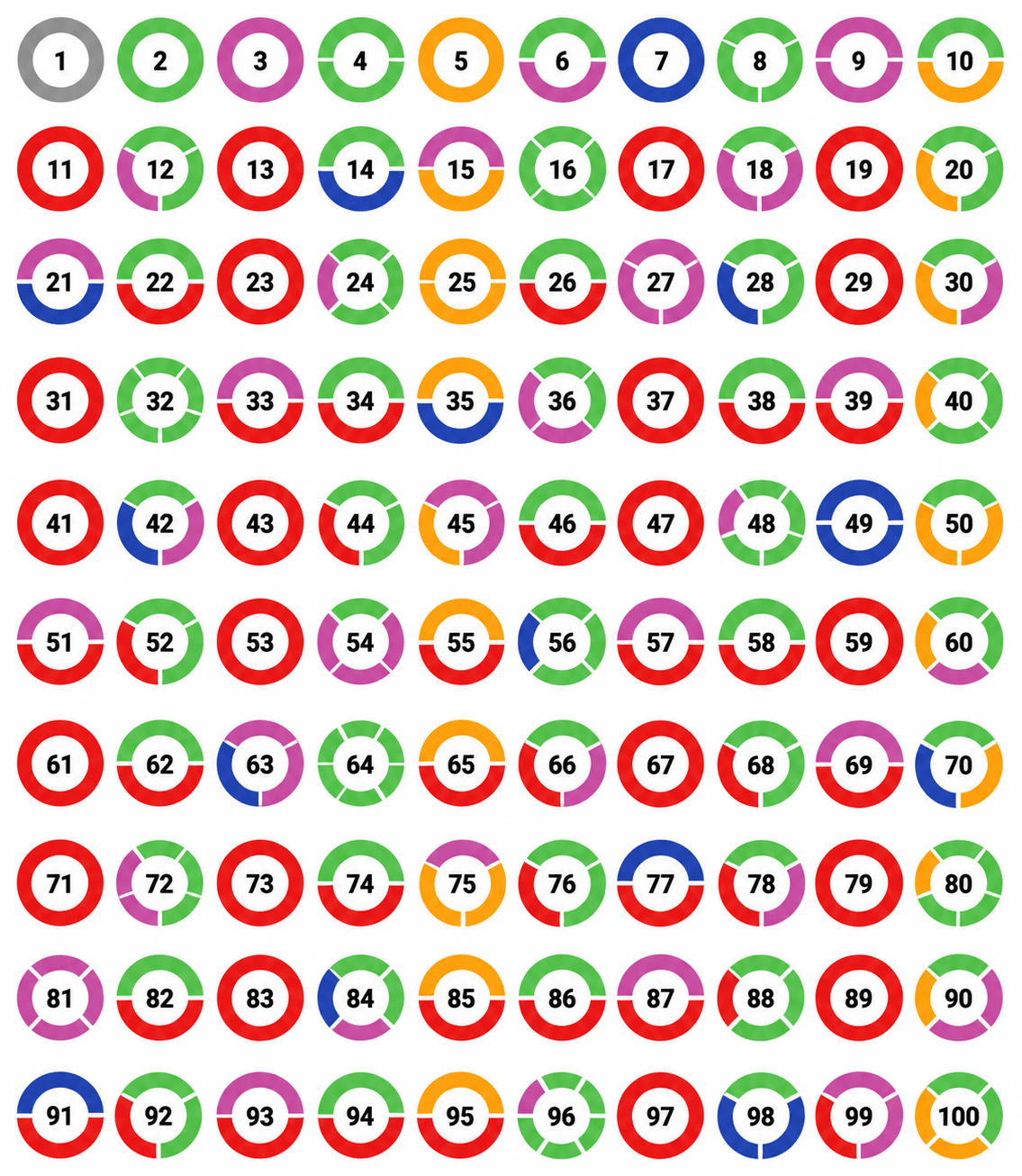
Try to decode the colour scheme for each number. There are several interesting patterns here. Share your observations with your classmates. Extending this scheme, colour the page numbers from 101 – 110.
Answer
Decoding the scheme. The coloured ring around each page number is a picture of that number’s prime factorisation. The ring is divided into as many equal arcs as the number has prime factors (counting repetitions), and each prime is always shown in its own fixed colour. Reading the designs for 1–10 makes the rule clear:
1 → plain (single-colour) ring — no prime factors
2 → one arc (a prime — its own colour, e.g. green)
3 → one arc (a prime — its own colour, e.g. purple)
4 = 2 × 2 → two arcs of the "2" colour
5 → one arc (a prime — its own colour, e.g. orange)
6 = 2 × 3 → one "2" arc and one "3" arc
8 = 2 × 2 × 2 → three arcs of the "2" colour
9 = 3 × 3 → two arcs of the "3" colour
10 = 2 × 5 → one "2" arc and one "5" arc
So, the number of arcs equals the total number of prime factors, and the colours tell you which primes appear. Some patterns worth noticing: every prime number has a single-colour ring; every power of 2 (2, 4, 8, 16, 32, 64) is made only of the “2” colour; even numbers always include the “2” colour, and multiples of 5 always include the “5” colour.
Extending to 101 – 110. Using the same rule, first find the prime factorisation of each number (this tells you how many arcs to draw and which colours to use):
101 = 101 → (prime — 1 arc)
102 = 2 × 3 × 17 → (3 arcs)
103 = 103 → (prime — 1 arc)
104 = 2 × 2 × 2 × 13 → (4 arcs)
105 = 3 × 5 × 7 → (3 arcs)
106 = 2 × 53 → (2 arcs)
107 = 107 → (prime — 1 arc)
108 = 2 × 2 × 3 × 3 × 3 → (5 arcs)
109 = 109 → (prime — 1 arc)
110 = 2 × 5 × 11 → (3 arcs)
Hence, each ring is coloured by dividing it into one arc per prime factor and colouring each arc with that prime’s colour; the factorisations above give the design for the page numbers 101–110.