
Carbohydrates are stored by plants in the form of:
- Starch
- Proteins
- Fats
- Glucose
Answer
Starch
Reason — Glucose is formed in leaves very rapidly during the photosynthesis and it cannot be transported to other parts with the same rapidity. So, several molecules of glucose join together to form insoluble starch for temporary storage.
Proteins are made of amino acids and are mainly used for growth, repair, and enzyme functions. They are not used by plants as a storage form of carbohydrates. Fats (or oils in plants) are another form of energy storage, especially in seeds (like sunflower or mustard), but they are not carbohydrates. Glucose is a simple sugar produced during photosynthesis. However, plants do not store glucose directly in large amounts because it is soluble and reactive. Instead, they convert glucose into starch for safe storage.
Stomata are present on the surface of:
- Leaves
- Roots
- Stem
- Flower petals
Answer
Leaves
Reason — Stomata are present on the surface of leaves to facilitate exchange of gases between the leaf and the atmosphere.
Roots absorb water and minerals from the soil. They do not have stomata because gas exchange is not their primary function. Some green stems may have stomata, but they are far fewer compared to leaves. In woody stems, gas exchange happens through lenticels instead. Petals are mainly for attracting pollinators and generally lack stomata or have very few that are not functionally significant.
Which one of the following is the immediate end-product of photosynthesis?
- Fructose
- Glucose
- Cellulose
- Lactose
Answer
Glucose
Reason — Fructose, Cellulose and lactose are polymers of glucose.
Fructose is a simple sugar, but it is not the primary product formed directly in photosynthesis. Cellulose is a structural carbohydrate used to build plant cell walls. It is made later from glucose, not produced directly in photosynthesis. Lactose is a sugar found in milk (animals), not in plants, so it is not related to photosynthesis.
The process by which green plants prepare their own food is known as :
- Photorespiration
- Photolysis
- Photosynthesis
- None of the above
Answer
Photosynthesis
Reason — Photosynthesis is the process by which green plants capture solar energy and use it to convert carbon dioxide and water into simple sugars (glucose).
Photorespiration is a wasteful process where oxygen is taken in and carbon dioxide is released. It does not produce food; instead, it reduces the efficiency of photosynthesis. Photolysis refers to the splitting of water molecules using light energy during photosynthesis. It is just a step within photosynthesis, not the whole process of making food.
In which of the following cellular structures does photosynthesis occur ?
- Chromoplast
- Chromosome
- Chloroplast
- Leukoplast
Answer
Chloroplast
Reason — Photosynthesis occurs in the mesophyll cells of the leaf. These cells contain numerous plastids called chloroplasts.
Chromoplasts are plastids that store pigments (like carotenoids) and give color to fruits and flowers. They do not carry out photosynthesis. Chromosomes are found in the nucleus and contain genetic material (DNA). They are not involved in photosynthesis. Leukoplasts are colorless plastids involved in storage of starch, oils, or proteins, not in photosynthesis.
Which of the following forms of carbohydrates is broken down during respiration ?
- Cellulose
- Glucose
- Starch
- Sucrose
Answer
Glucose
Reason — Respiration is the process in which glucose is broken down to release energy.
Cellulose is a structural carbohydrate found in plant cell walls. It is not used in respiration because most organisms cannot easily break it down. Starch is a storage form of carbohydrate. It must first be converted into glucose before it can be used in respiration. Sucrose is a transport sugar in plants. It is also broken down into glucose (and fructose) before entering respiration.
Which of the following is an immediate product of photosynthesis ?
- Glucose
- Starch
- Sucrose
- Cellulose
Answer
Glucose
Reason — During photosynthesis, the plants first form simple soluble carbohydrates (glucose), and later, form complex insoluble carbohydrates (starch).
Starch is a storage form of carbohydrate. It is made from glucose when there is excess food. Sucrose is a transport sugar in plants. It is synthesized from glucose (and fructose) and transported to different parts of the plant. Cellulose is a structural carbohydrate used to build cell walls. It is also formed from glucose, not produced directly.
Which of the following is an end product of anaerobic respiration in plants ?
- Ethane
- Ethylene
- Ethanol
- Lactic acid
Answer
Ethanol
Reason — Anaerobic respiration in plants produces ethanol and carbon dioxide as end products.
Ethane is a hydrocarbon gas and not produced during respiration in plants. Ethylene is a plant hormone involved in fruit ripening, not a product of respiration. Lactic acid is produced during anaerobic respiration in animal muscles and some bacteria, not in plants.
A glowing matchstick starts burning in the presence of :
- Carbon dioxide gas
- Nitrogen gas
- Carbon monoxide gas
- Oxygen gas
Answer
Oxygen gas
Reason — A glowing matchstick starts burning in the presence of oxygen gas.
Carbon dioxide does not support combustion. In fact, it is used to extinguish fires. Nitrogen is largely inert and does not support burning. Carbon monoxide is a combustible gas itself, but it does not support combustion of other substances like oxygen does.
Which of the following chemicals is used to identify the presence of starch ?
- Lime water
- Potassium hydroxide
- Iodine solution
- Methylated alcohol
Answer
Iodine solution
Reason — The chemical used to identify the presence of starch is Iodine solution.
Lime water is used to test for carbon dioxide. It turns milky in its presence, but it does not detect starch. Potassium hydroxide is a strong base used in various chemical reactions, but it is not used for starch detection. Methylated alcohol is used as a solvent or disinfectant, not for testing starch.
Assertion (A): Green plants are autotrophs and they use carbon dioxide and water as raw materials to prepare their own food.
Reason (R): Chlorophyll and sunlight are also essential in the process of photosynthesis but they are not utilized as raw materials.
- Both A and R are true and R is the correct explanation of A.
- Both A and R are true but R is not the correct explanation of A.
- A is true but R is false.
- A is false but R is true.
Answer
Both A and R are true and R is the correct explanation of A.
Reason — A is true as green plants are autotrophs, meaning they make their own food through photosynthesis. They use carbon dioxide (from air) and water (from soil) as raw materials.
R is true as Chlorophyll (present in chloroplasts) and sunlight are essential for photosynthesis, but they are not raw materials. Instead, they act as conditions or energy sources needed for the process.
Therefore, Both A and R are true and R is the correct explanation of A is the correct option.
Assertion (A): Stomata are tiny openings found mainly on the lower surface of the leaves.
Reason (R): They cannot be opened or closed for the process of photosynthesis when exposed to direct sunlight as guard cells become inactive in direct sunlight.
- Both A and R are true and R is the correct explanation of A.
- Both A and R are true but R is not the correct explanation of A.
- A is true but R is false.
- A is false but R is true.
Answer
A is true but R is false.
Reason — A is true as stomata are tiny pores mainly found on the lower surface of leaves in most plants. They help in gas exchange and transpiration.
R is false as stomata can open and close. They are controlled by guard cells, which regulate opening based on conditions like light, carbon dioxide levels, and water availability. Stomata often open in sunlight to allow carbon dioxide intake for photosynthesis, not become inactive.
Therefore, A is true but R is false is the correct option.
Assertion (A): The extensive network of veins within the leaf lamina supplies water and minerals in every cell and also helps in the translocation of prepared food to the other parts of the plant.
Reason (R): The flow of fluids in the veins of leaves or veins of our body, both are unidirectional.
- Both A and R are true and R is the correct explanation of A.
- Both A and R are true but R is not the correct explanation of A.
- A is true but R is false.
- A is false but R is true.
Answer
A is true but R is false.
Reason — A is true as the veins in a leaf form a network that supplies water and minerals to all cells via xylem and helps in transport of prepared food via phloem.
R is false as in plants, xylem transport is mainly unidirectional (upward), but phloem transport is bidirectional. In humans, blood flow is not simply unidirectional in all vessels, as circulation involves a loop system.
Therefore, A is true but R is false is the correct option.
Assertion (A): More energy is released (38 ATP) in the aerobic respiration as compared to anaerobic respiration during which only 2ATPs are produced by the breakdown of one molecule of glucose.
Reason (R): Complete oxidation of glucose occurs in presence of oxygen whereas glucose cannot be broken down completely in absence of oxygen. Hence, amount of energy produced varies between the two kinds of respiration.
- Both A and R are true and R is the correct explanation of A.
- Both A and R are true but R is not the correct explanation of A.
- A is true but R is false.
- A is false but R is true.
Answer
Both A and R are true and R is the correct explanation of A.
Reason — A is true as in aerobic respiration, one glucose molecule releases about 36–38 ATP, while in anaerobic respiration, only about 2 ATP are produced.
R is true as in the presence of oxygen, glucose undergoes complete oxidation into carbon dioxide and water, releasing a large amount of energy. In the absence of oxygen, glucose is incompletely broken down, leading to much less energy production.
Therefore, Both A and R are true and R is the correct explanation of A is the correct option.
Assertion (A): Photosynthesis occurs in the cells of leaves which contain chloroplasts whereas respiration occurs in all other cells which lack chloroplasts.
Reason (R): The pigment chlorophyll traps solar energy for the process of photosynthesis whereas it does not participate in the process of respiration.
- Both A and R are true and R is the correct explanation of A.
- Both A and R are true but R is not the correct explanation of A.
- A is true but R is false.
- A is false but R is true.
Answer
A is false but R is true.
Reason — A is false as photosynthesis mainly occurs in green parts of plants (especially leaves) because they contain chloroplasts. However, respiration occurs in all living cells, including leaf cells, stem cells, root cells, etc. It is not limited to cells without chloroplasts.
R is true as chlorophyll is the green pigment in chloroplasts that absorbs (traps) solar energy for photosynthesis. It does not take part in respiration, which occurs in mitochondria.
Therefore, A is false but R is true is the correct option.
Suppose we compare the leaf with a factory, match the items in Column A with those in Column B.
| Column A LEAF | Column B FACTORY |
|---|---|
| (i) Cells in the leaf | (a) Raw materials |
| (ii) Chloroplast | (b) Power |
| (iii) Sunlight | (c) Machinery |
| (iv) Oxygen and water | (d) End product |
| (v) Carbon dioxide and water | (e) By product |
| (vi) Glucose | (f) Work room |
Answer
| Column A LEAF | Column B FACTORY |
|---|---|
| (i) Cells in the leaf | (f) Work room |
| (ii) Chloroplast | (c) Machinery |
| (iii) Sunlight | (b) Power |
| (iv) Oxygen and water | (e) By product |
| (v) Carbon dioxide and water | (a) Raw materials |
| (vi) Glucose | (d) End product |
State whether the following statements are True or False:
- Green plants prepare their food by using two raw materials, oxygen and water.
- The chlorophyll enables the plants to use light energy.
- The free oxygen in the atmospheric air is the result of photosynthesis.
- Photosynthesis occurs only in chlorophyll-containing parts of the plant.
Answer
False
Corrected Statement — Green plants prepare their food by using two raw materials; Carbon dioxide and water.True
True
True
Which gas is taken in and which one is given out by a green leaf in bright sunlight?
- Taken in: ...............
- Given out: ...............
Answer
- Taken in: Carbon dioxide
- Given out: Oxygen
Name the following:
- The cells which surround the openings of stomata.
- The chemical energy stored in the cells.
- The pigment which traps solar energy for the process of photosynthesis.
- A non-chlorophyllous, unicellular plant that respires anaerobically.
- The process which maintains the coolness of the plant body.
Answer
- Guard cells
- Adenosine Triphosphate (ATP)
- Chlorophyll
- Yeast
- Transpiration
Note the relationship between the first two words and suggest a suitable word/ phrase for the fourth place :
- Photosynthesis : Day time :: Respiration : ...............
- Photo : light :: Synthesis : ...............
- Xylem : Water and minerals :: Phloem : ...............
- Palisade cells : Barrel-shaped :: Guard cells : ...............
- Photosynthesis : Chloroplast :: Respiration : ...............
Answer
- Photosynthesis : Day time :: Respiration : All day and night
- Photo : light :: Synthesis : combining
- Xylem : Water and minerals :: Phloem : Sucrose
- Palisade cells : Barrel-shaped :: Guard cells : Bean-shaped
- Photosynthesis : Chloroplast :: Respiration : All cells
Fill in the blanks :
- Plants release ............... gas as a by product during photosynthesis.
- Plants use ............... gas in the process of respiration during day time.
- ............... gas turns lime water milky.
- ............... is used to decolourise the leaf.
- Iodine solution turns ............... into blue-black colour.
Answer
- Oxygen
- Oxygen
- Carbon dioxide
- Alcohol
- Starch
Name :
- Two main modes of nutrition in the organisms.
- Four essential requirements for the process of photosynthesis.
- Two categories of cells in the mesophyll of leaves.
- Two types of tissues of vascular system.
- Two types of respiration in the organisms.
Answer
- Autotrophic nutrition and Heterotrophic nutrition
- Water, Carbon dioxide, Chlorophyll, Energy (from sunlight)
- Palisade mesophyll and Spongy mesophyll
- Xylem and Phloem
- Aerobic respiration and Anaerobic respiration
Define the following terms :
- Autotrophs
- Photosynthesis
- Respiration
- Vascular system
- Stomata
Answer
Autotrophs — Green plants can prepare their own food, hence they are called autotrophs.
Photosynthesis — Photosynthesis is the process by which green plants capture solar energy and use it to convert carbon dioxide and water into simple sugars.
Respiration — Respiration is the process in which glucose is broken down to release energy.
Vascular system — All plants have a transport system called vascular system made of xylem, which carries water and minerals from roots to leaves, and phloem, which transports glucose from leaves to other parts of the plant.
Stomata — Stomata are tiny openings found mainly on the lower surface of the leaves that allow gases to pass in and out.
Why do leaves generally look green?
Answer
Leaves generally look green because of the presence of chlorophyll, a pigment that imparts green colour to leaves.
What is the source of energy for photosynthesis?
Answer
The source of energy for photosynthesis is Sunlight.
Do the plants respire all day and night or only during the day? Give reasons.
Answer
Plants respire all day and night as plants require a constant supply of energy for all the different processes that go on inside the cells of the plant body. Energy is required for the growth of the plant, for root cells to penetrate the soil and absorb water and minerals and so many other such activities. Thus, Respiration occurs continuously in plants, during both day and night.
What happens to the energy liberated during respiration?
Answer
The energy liberated during respiration is utilized for all the different processes that go on inside the cells of the plant body. Energy is required for the growth of the plant, for root cells to penetrate the soil and absorb water and minerals.
What is the role of chlorophyll in photosynthesis?
Answer
Chlorophyll is found in mesophyll cells of leaf, inside the plastids called chloroplast. Chlorophyll is very important as it absorbs the sunlight which provides energy for the process of photosynthesis. This energy is used to split water molecules (H2O) into hydrogen ions (H+) and hydroxyl ions (OH-). Oxygen from the hydroxyl ion is released into the air and hydrogen ions combine with carbon dioxide to form glucose.
Do plants need oxygen? If so, what is its source?
Answer
Plants need oxygen for respiration. The source of oxygen is atmosphere.
Distinguish between the following pairs on the basis of the words indicated in the brackets []:
Photosynthesis and Respiration [Raw materials]
Answer
| Photosynthesis | Respiration |
|---|---|
| The raw materials required for Photosynthesis are — Water, Carbon dioxide, and energy (from sunlight). | The raw materials required for Respiration are — Glucose and Oxygen. |
Distinguish between the following pairs on the basis of the words indicated in the brackets []:
Aerobic and Anaerobic respiration in plants [End products]
Answer
| Aerobic respiration in plants | Anaerobic respiration in plants |
|---|---|
| The end-products of Aerobic respiration in plants are — Carbon dioxide, water, and energy. | The end-products of Anaerobic respiration in plants are — Ethanol, Carbon dioxide, and energy. |
Distinguish between the following pairs on the basis of the words indicated in the brackets []:
Green and Variegated leaves [Examples]
Answer
| Green leaves | Variegated leaves |
|---|---|
| Green leaves are uniformly colored green due to presence of chlorophyll. | Variegated leaves have multiple colors due to the presence of different pigments. |
| Examples- Spinach and Basil | Examples- Coleus and Croton. |
Distinguish between the following pairs on the basis of the words indicated in the brackets []:
Xylem and Phloem [Function]
Answer
| Xylem | Phloem |
|---|---|
| The xylem transports water and minerals upwards from roots to the leaves. | The phloem transports glucose made in the leaves to the other parts of the plant in the form of sucrose. |
Distinguish between the following pairs on the basis of the words indicated in the brackets []:
Glucose and Starch [Solubility in water]
Answer
| Glucose | Starch |
|---|---|
| Glucose is readily soluble in water. | Starch is generally insoluble. |
Draw a neat diagram of "opened and closed stomata" and answer the following questions :
- Label the following in the diagram : Guard cells, Stoma, Nucleus, Inner wall, Outer wall and Chloroplast.
- Mention the condition of guard cells during open and closed stomata.
- Write the specific location of these structures in the plant body.
- Name three important processes of plants in which the stomata are involved.
- Are the stomata open or closed during the day and night respectively ?
Answer
- Diagram of opened and closed stomata are given below:
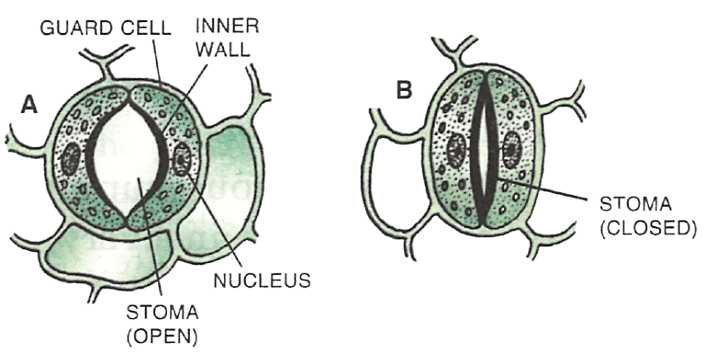
During open stomata, guard cells are turgid as they absorb water. Conversely, when stomata are closed, guard cells are flaccid as the water is drawn out.
Stomata are found mainly on the lower surface of the leaves.
Three important processes of plants in which the stomata are involved are :
- Photosynthesis
- Transpiration
- Respiration
Stomata are open during the day and closed at night.
The figure given below represents a process in plants. Study the same and answer the following questions :
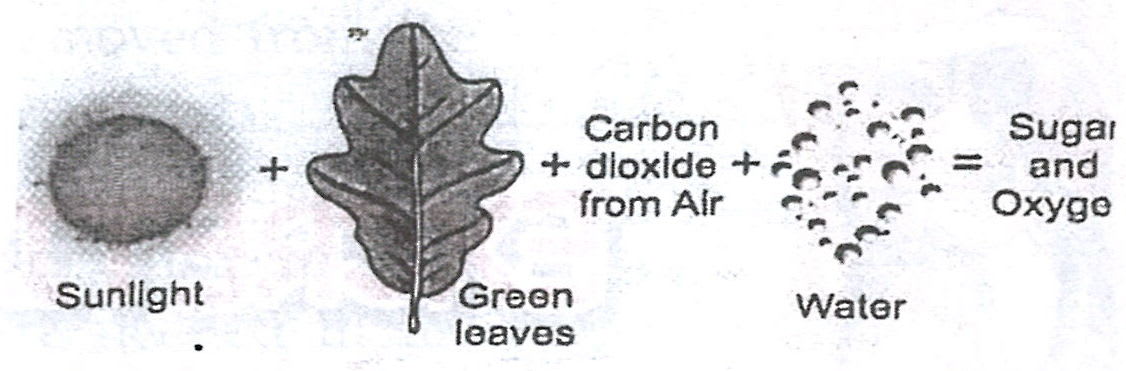
- Identify the process and define it.
- Write balanced equation depicting the entire process.
- Name the organelle and pigment responsible for the process.
- Mention two by-products of the process.
- What is the significance of the process ? State two points.
Answer
The given figure shows the process of Photosynthesis.
Photosynthesis is the process by which green plants capture solar energy and use it to convert carbon dioxide and water into simple sugars and oxygen.The balanced equation depicting Photosynthesis is given below:
Carbon dioxide + Water Glucose + Oxygen
The chloroplast is the organelle, and chlorophyll is the pigment, responsible for photosynthesis in plant cells. Chloroplasts contain chlorophyll, which captures light energy to convert carbon dioxide and water into glucose and oxygen.
Two by-products of Photosynthesis are Glucose (C6 H12 O6) and Water.
Photosynthesis is significant due to following reasons:
- Food for all — Plants prepare their own food by photosynthesis, and the plants in turn are eaten by the animals.
- Oxygen for respiration — All the free oxygen in the atmospheric air is the result of photosynthesis.
The experimental set-up shown alongside represents a process in plants. Study the same and answer the following questions :
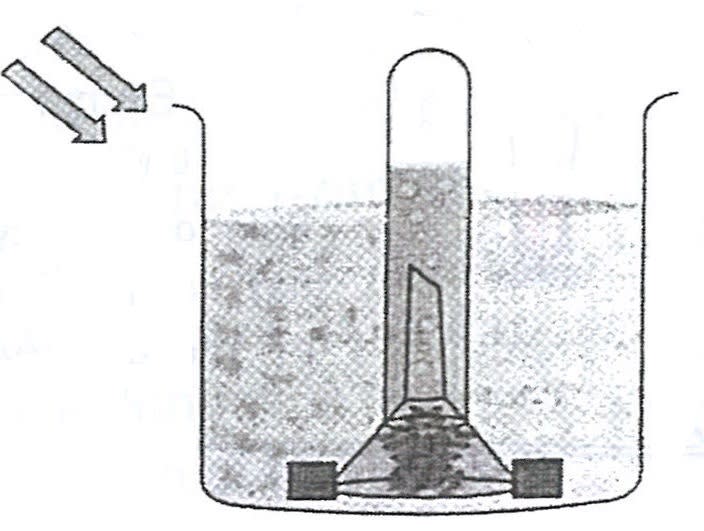
- What is the aim of this experiment ?
- Name a suitable plant which can be used for the experiment. What is the habitat of this plant mentioned by you ?
- What is importance of the gas formed, shown by the bubbles, for us ?
- How would you confirm the presence of the gas in the test tube ?
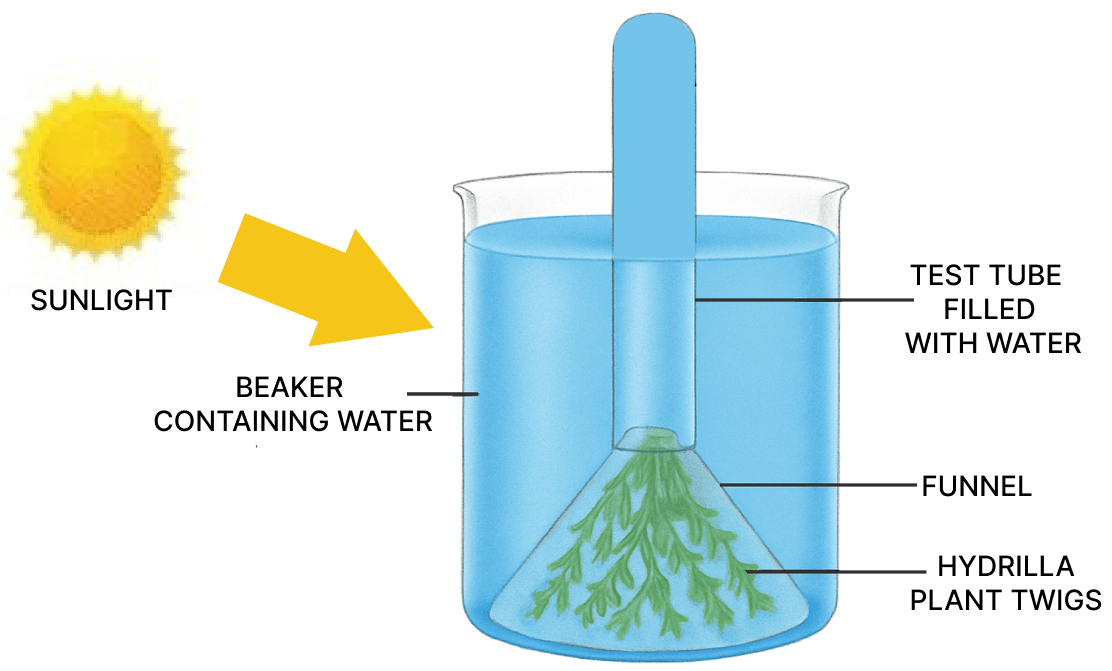
- Draw a neat and labelled diagram of the same experiment in its 'initial stage.'
Answer
The aim of this experiment is to show that Oxygen is given out during Photosynthesis.
Hydrilla plants can be used for the experiment. Hydrilla plants belong to freshwater Aquatic habitat.
The gas formed is Oxygen. Oxygen is essential for the respiration of most living organisms.
To confirm the presence of Oxygen in the test tube, I will remove the test tube with the gas carefully, and insert a glowing matchstick inside it. If the matchstick starts burning, the gas is Oxygen.
The labelled diagram of this experiment in its 'initial stage' is given below:
Write balanced equations for each of the following :
Photosynthesis.
Answer
6CO2 + 6H2O C6H12O6 + 6O2
Write balanced equations for each of the following :
Aerobic respiration in animals.
Answer
C6H12O6 + 6O2 6CO2 + 6H2O + 38 ATP (Energy)
Write balanced equations for each of the following :
Aerobic respiration in plants during daytime.
Answer
C6H12O6 + 6O2 6CO2 + 6H2O + 38 ATP (Energy)
Write balanced equations for each of the following :
Aerobic respiration in plants during night.
Answer
C6H12O6 + 6O2 6CO2 + 6H2O + 38 ATP (Energy)
Write balanced equations for each of the following :
Anaerobic respiration in plants.
Answer
C6H12O6 2C2H5OH (Ethanol) + 2CO2 + 2ATP (Energy)
Rimjhim decided to do a small plant experiment at home. She covered one leaf of a hibiscus plant with black paper for a week. When she removed the cover, she observed that the covered leaf had turned pale yellow and felt softer. The other leaves were still bright green and firm. She wondered why the leaf looked unhealthy despite watering the plant regularly.
(i) Which process could not occur in the covered leaf?
(ii) State one important role of sunlight in this process.
(iii) What is the purpose of this process in plants?
(iv) Name the specific cells in a leaf where this process occurs.
(v) Which cell organelle carries out the above process?
Answer
(i) The process that could not occur in the covered leaf is photosynthesis.
(ii) Sunlight provides the energy required for photosynthesis.
(iii) The purpose of this process is to manufacture food for the plant.
(iv) The specific cells in a leaf where this process occurs are the mesophyll cells (especially palisade mesophyll cells).
(v) The cell organelle that carries out this process is the chloroplast.