
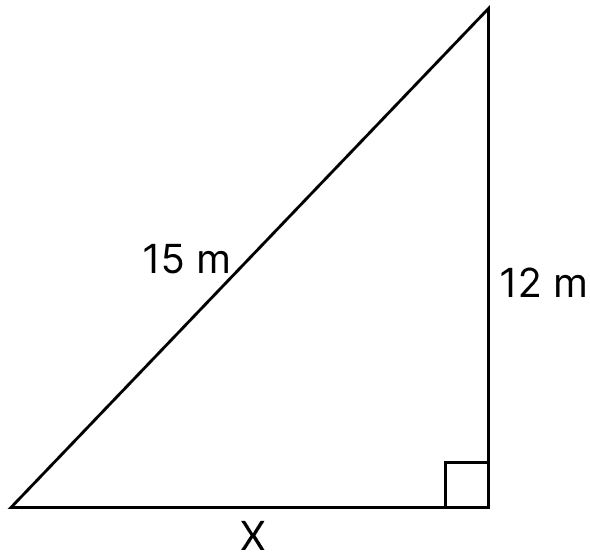
The value of x is:
10 m
9 m
16 m
none of these
Answer
In the given figure,
Base = x, Perpendicular = 12 m, Hypotenuse = 15 m
According to Pythagoras theorem :
⇒ Hypotenuse2 = Base2 + Perpendicular2
⇒ Base2 = Hypotenuse2 - Perpendicular2
⇒ x2 = 152 - 122
⇒ x2 = 225 - 144
⇒ x2 = 81
⇒ x = = 9 m
Hence, option 2 is the correct option.
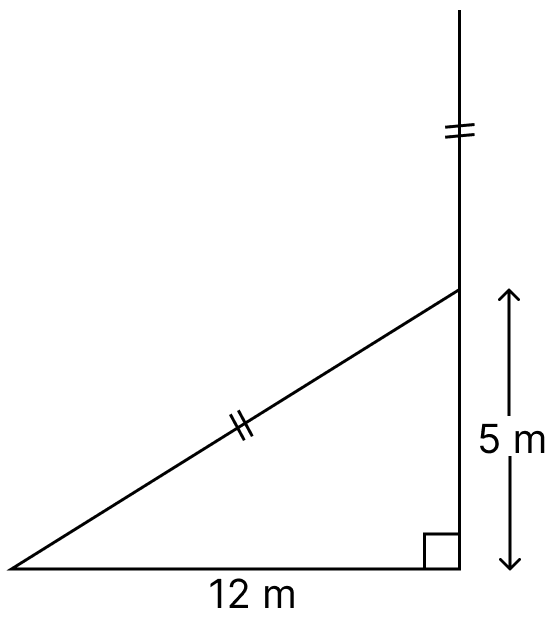
A tree is broken at a height of 5 m from the ground and its top touches the ground at a distance of 12 m from the base of the tree. The original height of the tree is:
13 m
27 m
18 m
20 m
Answer
The standing part of the tree is 5 m and the broken part (from the break to the top) touches the ground 12 m from the base, forming the hypotenuse of a right-angled triangle.
Let the broken part = h.
According to Pythagoras theorem :
⇒ h2 = 52 + 122
⇒ h2 = 25 + 144
⇒ h2 = 169
⇒ h = = 13 m
Original height of the tree = standing part + broken part = 5 m + 13 m = 18 m
Hence, option 3 is the correct option.
From a point P, a boy travels 12 km due east and then travels 9 km due north to point Q. The shortest distance between points P and Q is:
15 km
3 km
21 km
20 km
Answer
Since east and north are perpendicular directions, the shortest distance PQ is the hypotenuse of a right-angled triangle with legs 12 km and 9 km.
According to Pythagoras theorem :
⇒ PQ2 = 122 + 92
⇒ PQ2 = 144 + 81
⇒ PQ2 = 225
⇒ PQ = = 15 km
Hence, option 1 is the correct option.
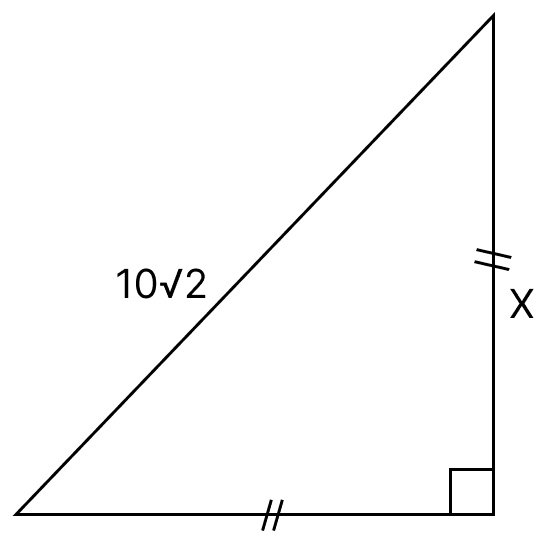
The value of x is:
5
10
6
Answer
The given triangle is an isosceles right-angled triangle in which the two equal sides (legs) are each x and the hypotenuse is .
According to Pythagoras theorem :
⇒ Hypotenuse2 = x2 + x2
⇒ 2 = 2x2
⇒ 200 = 2x2
⇒ x2 = 100
⇒ x = = 10
Hence, option 3 is the correct option.
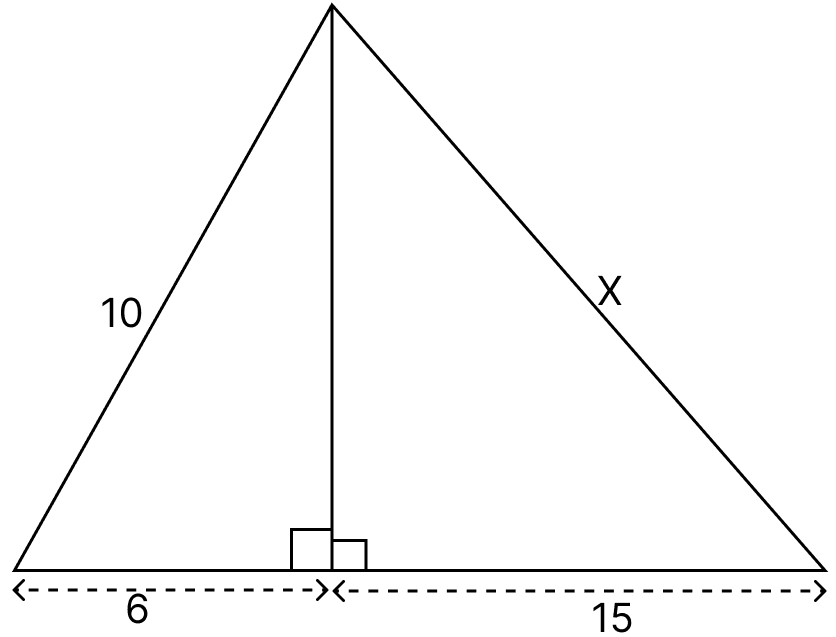
The value of x is:
15
21
23
17
Answer
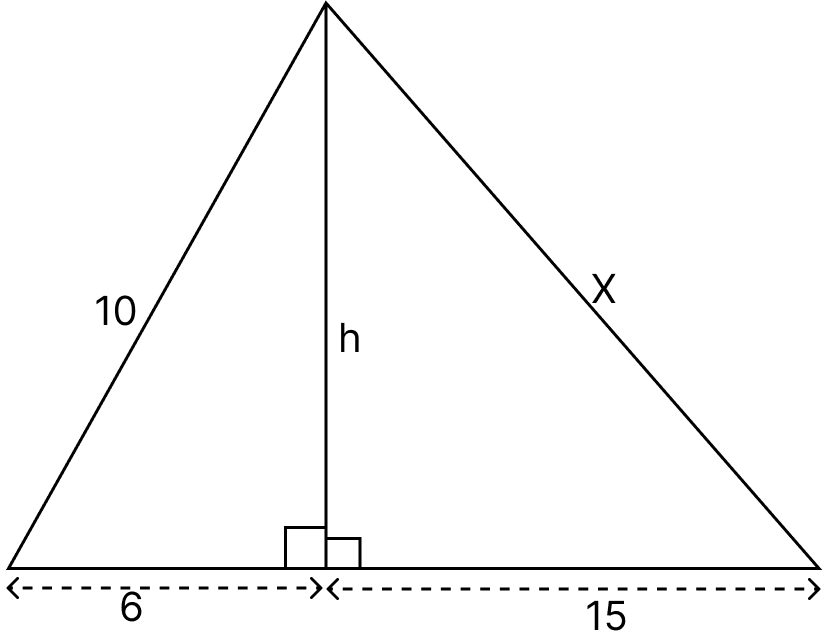
The altitude from the top vertex divides the base into two parts, 6 and 15, and is common to both right-angled triangles.
First, find the altitude h using the left right-angled triangle :
⇒ Hypotenuse2 = Perpendicular2 + Base2
⇒ 102 = 62 + h2
⇒ 100 = 36 + h2
⇒ h2 = 100 - 36
⇒ h2 = 64
⇒ h = = 8
Now, in the right-angled triangle on the right, x is the hypotenuse with base 15 and height (h = 8) :
⇒ x2 = 152 + 82
⇒ x2 = 225 + 64
⇒ x2 = 289
⇒ x = = 17
Hence, option 4 is the correct option.
The value of x is:
21
15
17
27
Answer
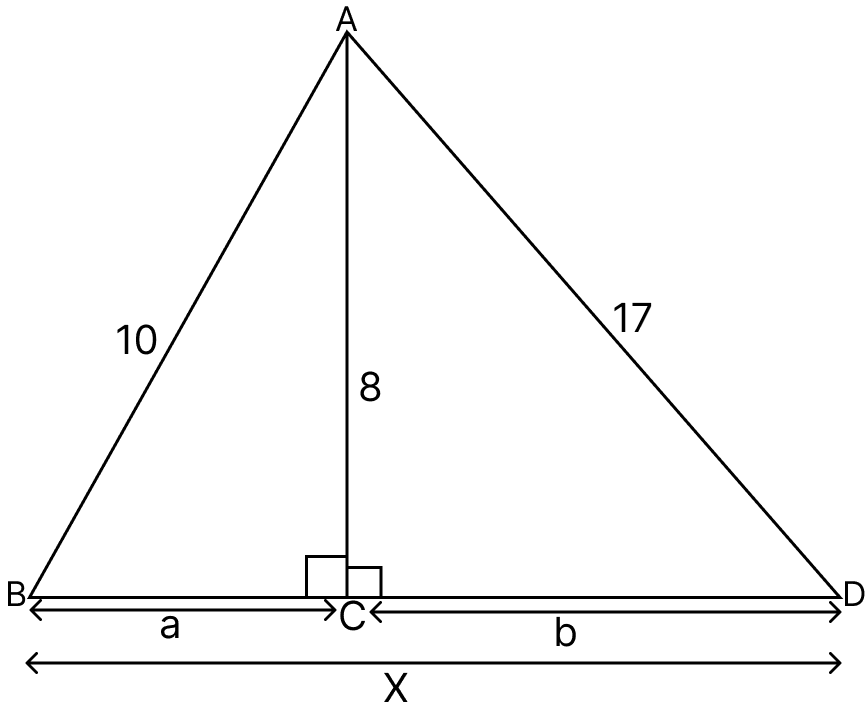
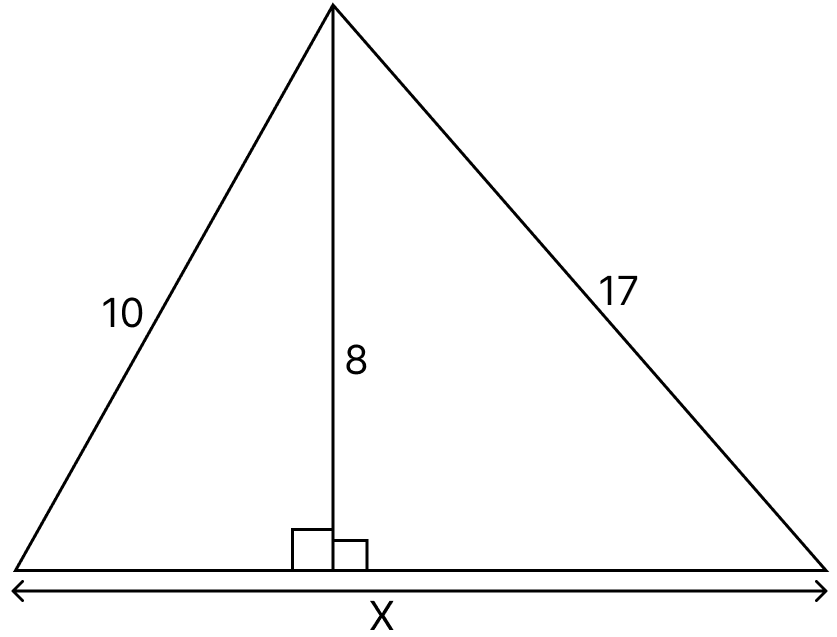
The altitude from the top vertex is 8 and is common to both right-angled triangles. AB = 10 and AD = 17. Base BD = x
Let BC be a units and CD be b units.
In right-angled triangle ACB,
⇒ AB2 = AC2 + BC2
⇒ 102 = 82 + a2
⇒ 100 = 64 + a2
⇒ a2 = 36
⇒ a = 6
In right-angled triangle ACD,
⇒ AD2 = AC2 + CD2
⇒ 172 = 82 + b2
⇒ 289 = 64 + b2
⇒ b2 = 225
⇒ b =
⇒ b = 15
x = a + b = 6 + 15 = 21
Hence, option 1 is the correct option.
The perimeter of quadrilateral (rhombus) ABCD is:
56 cm
40 cm
28 cm
none of these
Answer
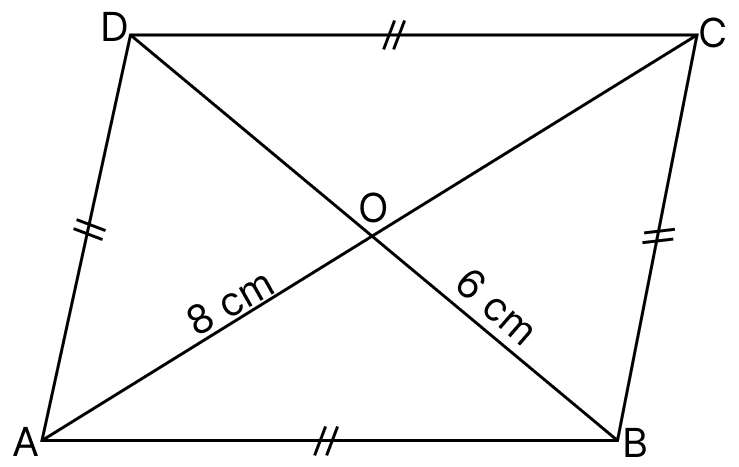
In a rhombus, the diagonals bisect each other at right angles at O.
AO = 8 cm and OB = 6 cm
In right-angled triangle AOB, AB is the hypotenuse :
⇒ AB2 = AO2 + OB2
⇒ AB2 = 82 + 62
⇒ AB2 = 64 + 36
⇒ AB2 = 100
⇒ AB = = 10 cm
Since all sides of a rhombus are equal,
Perimeter = 4 × 10 = 40 cm
Hence, option 2 is the correct option.
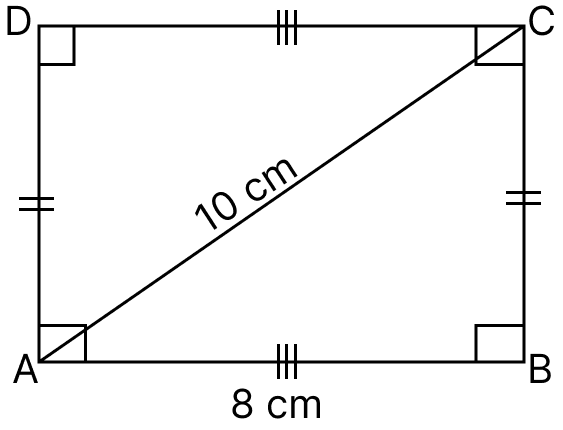
The perimeter of given rectangle ABCD is:
32 cm
36 cm
28 cm
38 cm
Answer
In rectangle ABCD, the diagonal AC = 10 cm and the side AB = 8 cm.
In right-angled triangle ABC, AC is the hypotenuse :
⇒ AC2 = AB2 + BC2
⇒ 102 = 82 + BC2
⇒ 100 = 64 + BC2
⇒ BC2 = 100 - 64
⇒ BC2 = 36
⇒ BC = = 6 cm
Perimeter = 2 × (AB + BC) = 2 × (8 + 6) = 2 × 14 = 28 cm
Hence, option 3 is the correct option.
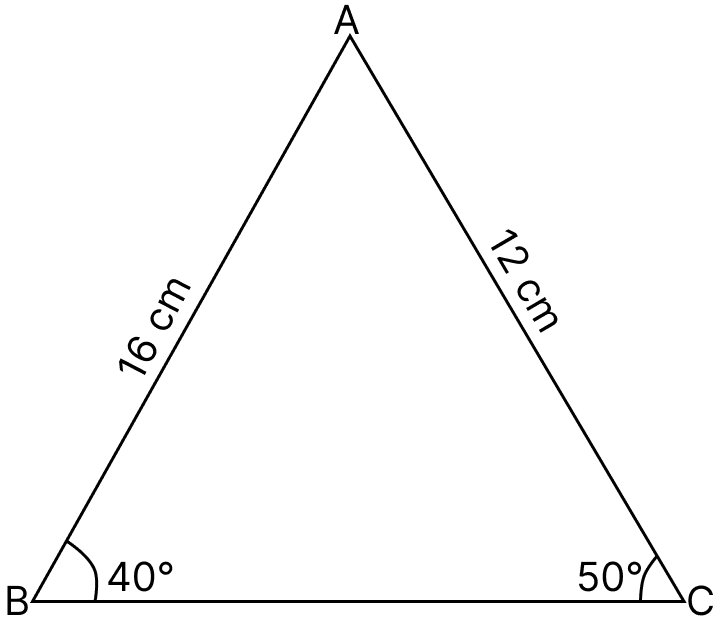
Length of BC is:
16 cm
28 cm
10 cm
20 cm
Answer
In triangle ABC, angle B = 40° and angle C = 50°.
Angle A = 180° - (40° + 50°) = 90°
So the triangle is right-angled at A and BC is the hypotenuse.
According to Pythagoras theorem :
⇒ BC2 = AB2 + AC2
⇒ BC2 = 162 + 122
⇒ BC2 = 256 + 144
⇒ BC2 = 400
⇒ BC = = 20 cm
Hence, option 4 is the correct option.