
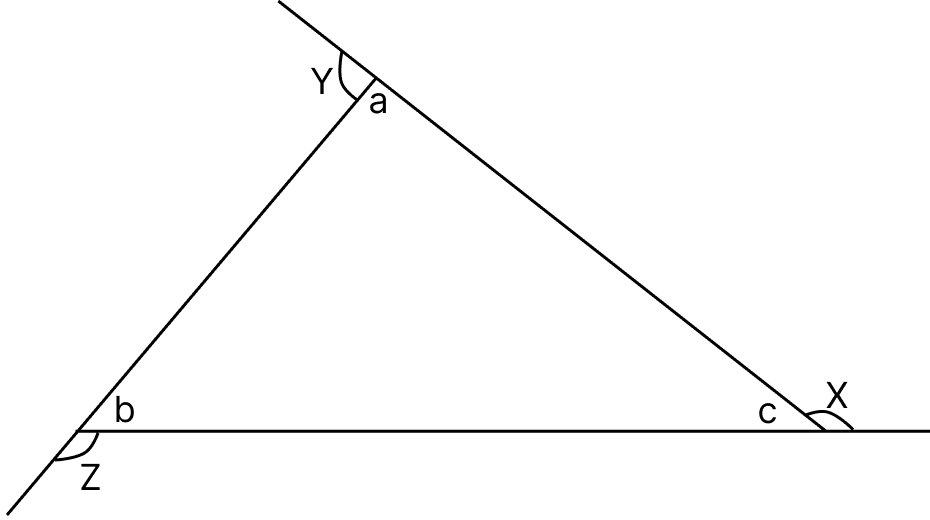
Assertion (A) : A triangle be formed with two interior angles 60°, 50° and with opposite exterior angle 120°.
Reason (R) : Exterior angle of a triangle is equal to the sum of interior opposite angles.
A is true, R is false.
A is false, R is true.
Both A and R are true.
Both A and R are false.
Answer
By the exterior angle property, the opposite exterior angle = 60° + 50° = 110°, not 120°. So, the Assertion (A) is false.
The Reason states the exterior angle property correctly, so the Reason (R) is true.
Hence, option 2 is the correct option.
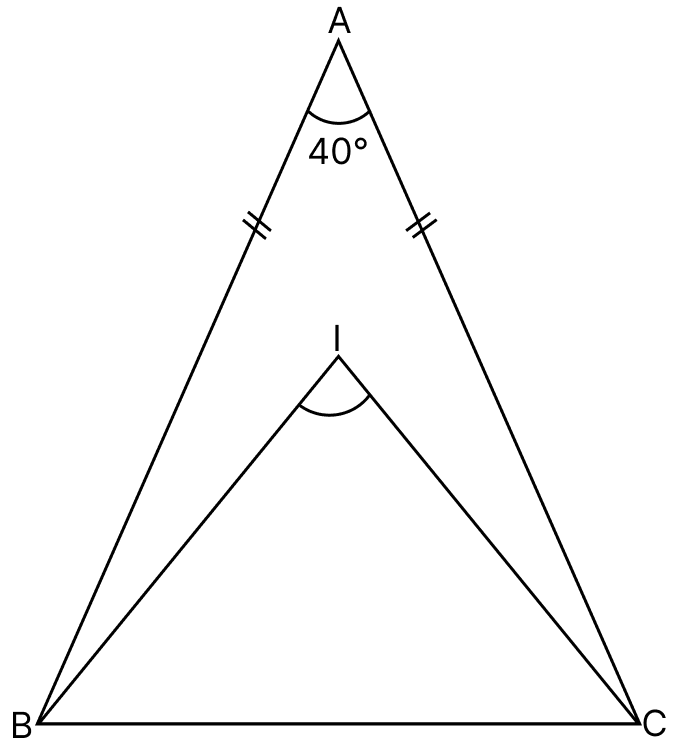
Assertion (A) : In the given figure, BI and CI are the bisectors of ∠ABC and ∠ACB respectively. Then △BIC is an obtuse angled triangle.
Reason (R) : If any two sides of a given triangle are equal, the angles opposite to these sides are also equal.
A is true, R is false.
A is false, R is true.
Both A and R are true.
Both A and R are false.
Answer
In triangle ABC,
AB = AC
∠ABC = ∠ACB
By angle sum property,
⇒ ∠ABC + ∠ACB + ∠A = 180°
⇒ 2∠ABC + 40° = 180°
⇒ 2∠ABC = 180° − 40° = 140°
⇒ ∠ABC = 70°
As, BI and CI are the bisectors of ∠ABC and ∠ACB.
⇒ ∠IBC + ∠ICB + ∠BIC = 180°
⇒ 35° + 35° + ∠BIC = 180°
⇒ ∠BIC = 180° − 70° = 110°, which is obtuse. So △BIC is an obtuse angled triangle, and the Assertion (A) is true.
The Reason correctly states the isosceles triangle property, so the Reason (R) is also true.
Hence, option 3 is the correct option.
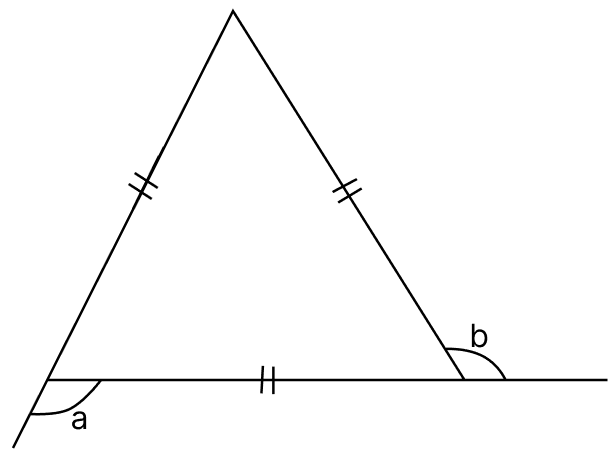
Assertion (A) : In the following figure, it is not possible to express a in terms of b.
Reason (R) : An equilateral triangle is always an isosceles triangle but the converse is not always true.
A is true, R is false.
A is false, R is true.
Both A and R are true.
Both A and R are false.
Answer
As, the given triangle is equilateral. Each angle is of 60°.
⇒ a = 180° − 60° = 120°
⇒ b = 180° − 60° = 120°
⇒ a = b
So it is possible to express a in terms of b, hence the Assertion (A) is false.
An equilateral triangle is always isosceles, but an isosceles triangle need not be equilateral. So, the reason (R) is true.
Hence, option 2 is the correct option.
Assertion (A) : In △ABC, ∠ABC is 145°. AC is the longest side of the triangle.
Reason (R) : The greater angle of a triangle has a greater side opposite to it.
A is true, R is false.
A is false, R is true.
Both A and R are true.
Both A and R are false.
Answer
∠ABC = 145° is the greatest angle of the triangle, and the side opposite it is AC. Hence AC is the longest side, so the Assertion (A) is true.
The Reason correctly states that the greater angle has a greater side opposite to it, so the Reason (R) is also true.
Hence, option 3 is the correct option.