
State, true or false :
(i) A line segment 4 cm long can have only 2000 points in it.
(ii) A ray has one end point and a line segment has two end-points.
(iii) A line segment is the shortest distance between any two given points.
(iv) An infinite number of straight lines can be drawn through a given point.
(v) Write the number of end points in
(a) a line segment AB
(b) a ray AB
(c) a line AB
(vi) Out of , which one has a fixed length ?
(vii) How many rays can be drawn through a fixed point O ?
(viii) How many lines can be drawn through three
(a) collinear points ?
(b) non-collinear points ?
(ix) Is 40° the complement of 60° ?
(x) Is 45° the supplement of 45° ?
Answer
(i) False. A line segment, however small, contains an infinite number of points in it.
(ii) True. A ray has only one end point (its starting point) and a line segment has two end points.
(iii) True. Of all the paths joining two given points, the line segment joining them is the shortest.
(iv) True. Through a single given point an infinite number of straight lines can be drawn.
(v) (a) A line segment AB has 2 end points.
(b) A ray AB has 1 end point.
(c) A line AB has 0 end points.
(vi) A line and a ray extend endlessly, so their lengths are not fixed. Only a line segment has a definite length.
Hence, has a fixed length.
(vii) Infinite. An infinite number of rays can be drawn through a fixed point O.
(viii) (a) Through three collinear points, only 1 line can be drawn.
(b) Through three non-collinear points, 3 lines can be drawn.
(ix) 40° + 60° = 100° ≠ 90°.
Hence, 40° is not the complement of 60°.
(x) 45° + 45° = 90° ≠ 180°.
Hence, 45° is not the supplement of 45°.
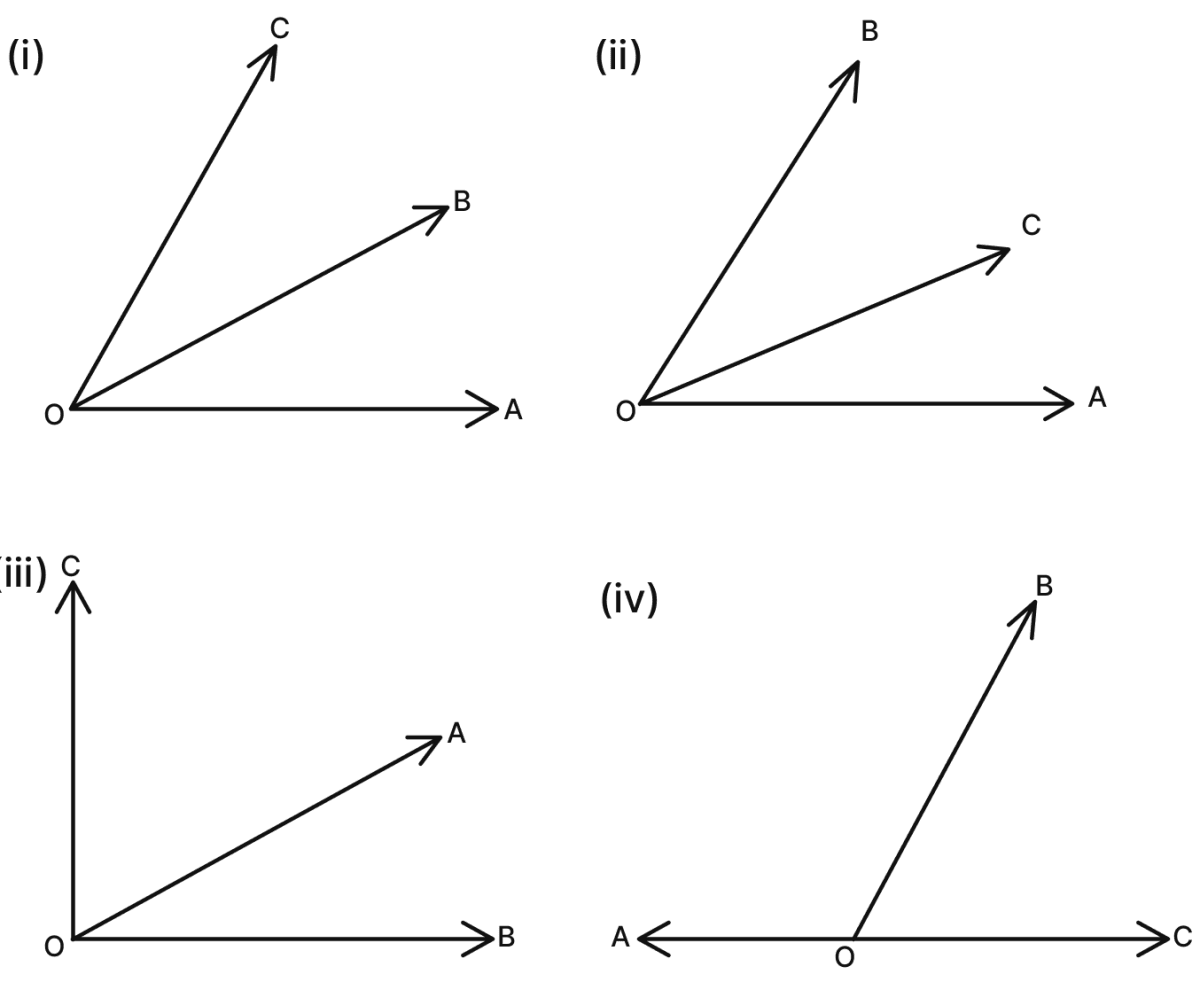
In which of the following figures, are ∠AOB and ∠AOC adjacent angles ? Give, in each case, reason for your answer.
Answer
Two angles are adjacent if they have a common vertex, a common arm and their other two arms lie on the opposite sides of the common arm.
In each figure, ∠AOB and ∠AOC have the common vertex O and the common arm OA.
(i) No; since arm OB and arm OC are not on opposite sides of the common arm OA.
(ii) No; since arm OB and arm OC are not on opposite sides of the common arm OA.
(iii) Yes; since arm OB and arm OC are on opposite sides of the common arm OA.
(iv) No; since arm OB and arm OC are not on opposite sides of the common arm OA.
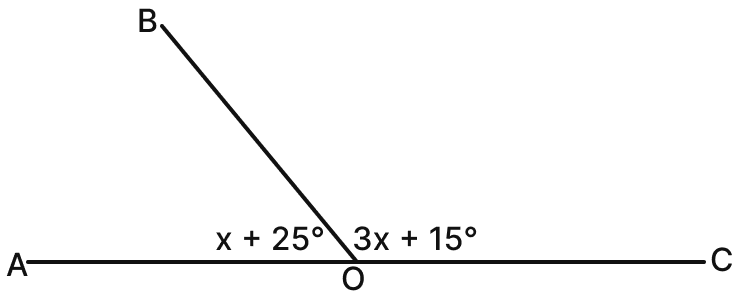
In the given figure, AC is a straight line. Find :
(i) x,
(ii) ∠AOB,
(iii) ∠BOC.
Answer
From the figure,
∠AOB = x + 25° and ∠BOC = 3x + 15°
(i) Since AC is a straight line, ∠AOB and ∠BOC form a linear pair.
⇒ ∠AOB + ∠BOC = 180°
⇒ x + 25° + 3x + 15° = 180°
⇒ 4x + 40° = 180°
⇒ 4x = 140°
⇒ x =
⇒ x = 35°
Hence, x = 35°.
(ii) ∠AOB = x + 25° = 35° + 25° = 60°
Hence, ∠AOB = 60°.
(iii) ∠BOC = 3x + 15° = 3 × 35° + 15° = 105° + 15° = 120°
Hence, ∠BOC = 120°.
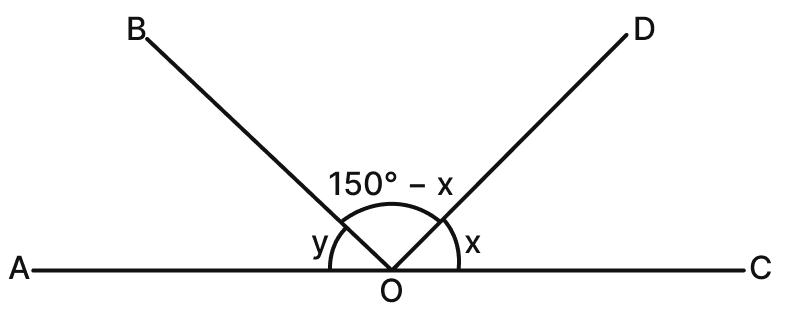
Find y in the given figure.
Answer
From the figure, AC is a straight line and the rays OB and OD stand on it. Thus, the sum of angles formed = 180°.
⇒ y + 150° − x + x = 180°
⇒ y + 150° = 180°
⇒ y = 30°
Hence, y = 30°.
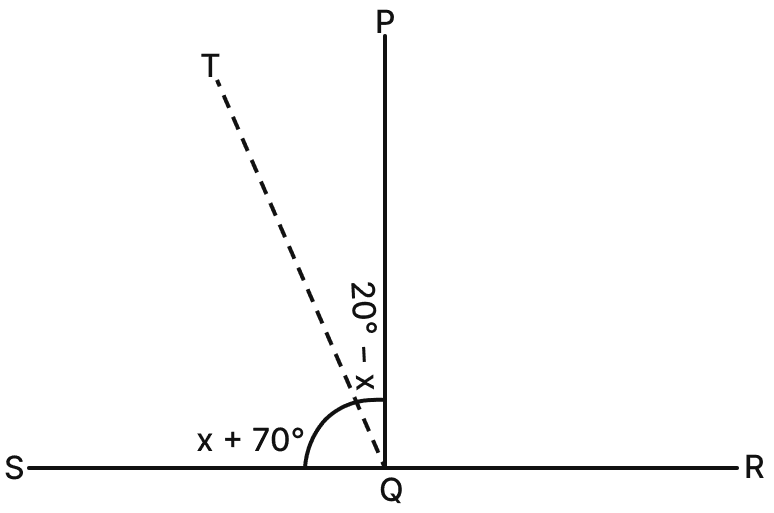
In the given figure, find ∠PQR.
Answer
From the figure, SR is a straight line and the rays QT and QP stand on it.
∠SQT = x + 70° and ∠TQP = 20° − x
⇒ ∠SQP = ∠SQT + ∠TQP
= x + 70° + 20° − x
= 90°
Since SR is a straight line, ∠SQP and ∠PQR form a linear pair.
⇒ ∠SQP + ∠PQR = 180°
⇒ 90° + ∠PQR = 180°
⇒ ∠PQR = 90°
Hence, ∠PQR = 90°.
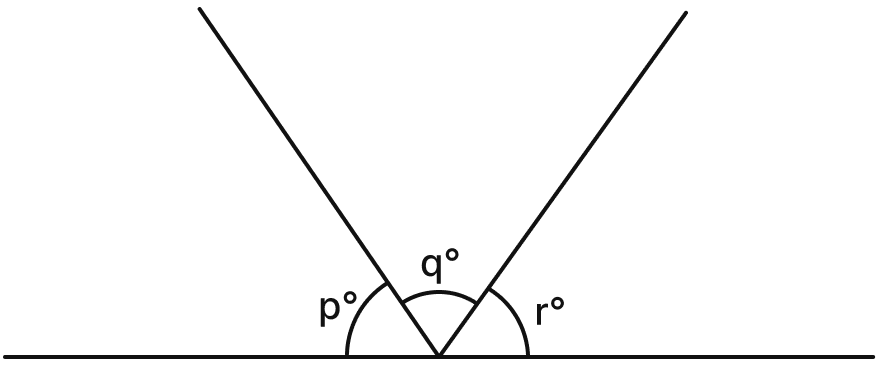
In the given figure, p° = q° = r°, find each.
Answer
From the figure, the rays stand on a straight line. Thus, the sum of angles formed = 180°.
⇒ p° + q° + r° = 180°
Given, p° = q° = r°
⇒ p° + p° + p° = 180°
⇒ 3p° = 180°
⇒ p° =
⇒ p° = 60°
Hence, p° = q° = r° = 60°.
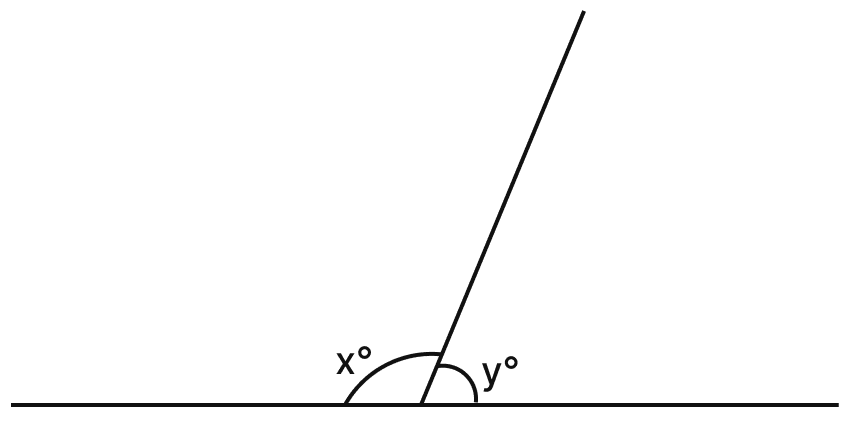
In the given figure, if x° = 2y°, find x° and y°.
Answer
From the figure, x° and y° are angles on a straight line and so they form a linear pair.
⇒ x° + y° = 180°
Given, x° = 2y°
Substituting values we get :
⇒ 2y° + y° = 180°
⇒ 3y° = 180°
⇒ y° =
⇒ y° = 60°
⇒ x° = 2y° = 2 × 60° = 120°
Hence, x° = 120° and y° = 60°.
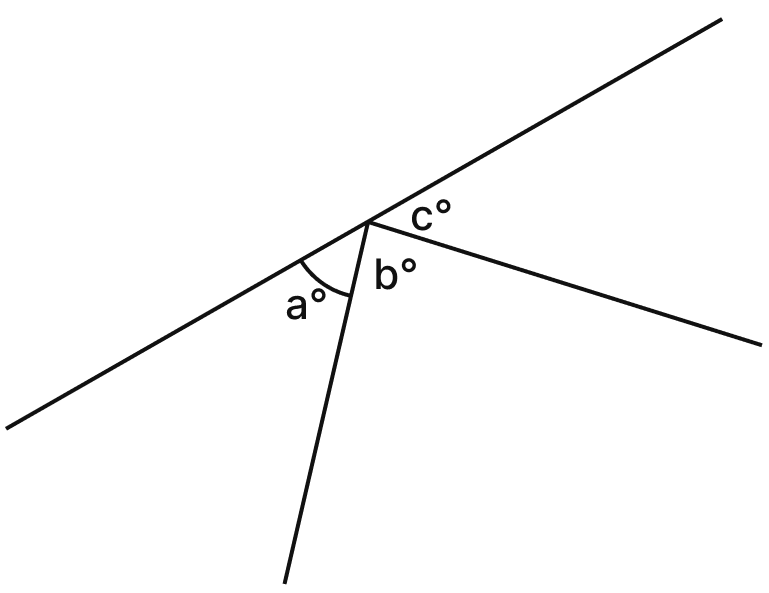
In the adjoining figure, if b° = a° + c°, find b.
Answer
Given,
b° = a° + c°
From the figure, the rays stand on a straight line.
⇒ a° + b° + c° = 180°
⇒ b° + (a° + c°) = 180°
⇒ b° + b° = 180°
⇒ 2b° = 180°
⇒ b° =
⇒ b° = 90°
Hence, b = 90°.
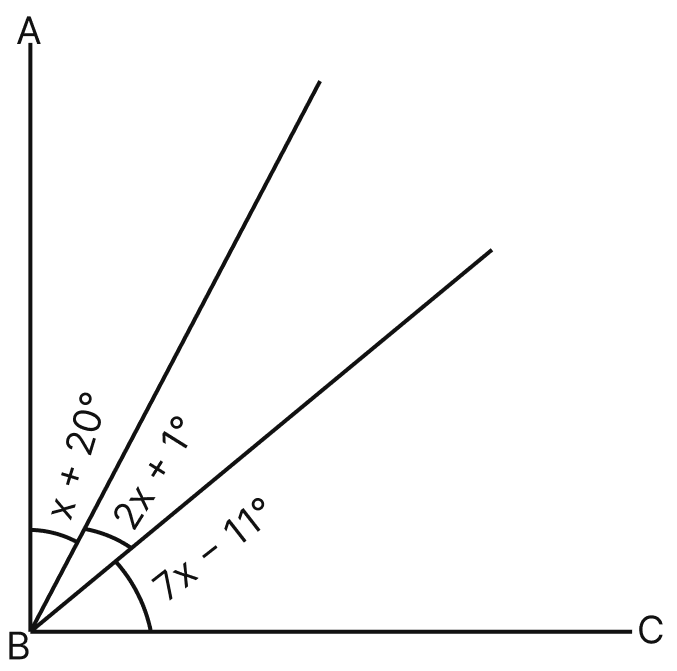
In the given figure, AB is perpendicular to BC at B.
Find :
(i) the value of x,
(ii) the complement of angle x.
Answer
(i) Since AB is perpendicular to BC at B,
⇒ ∠ABC = 90°
From the figure, the rays at B divide ∠ABC into three angles.
⇒ x + 20° + 2x + 1° + 7x − 11° = 90°
⇒ 10x + 10° = 90°
⇒ 10x = 80°
⇒ x =
⇒ x = 8°
Hence, x = 8°.
(ii) The complement of an angle = 90° − the angle.
Complement of x = 90° − x = 90° − 8° = 82°
Hence, the complement of angle x is 82°.
Write the complement of :
25°
Answer
The complement of an angle = 90° − the angle.
Complement of 25° = 90° − 25° = 65°
Hence, the complement is 65°.
Write the complement of :
90°
Answer
The complement of an angle = 90° − the angle.
Complement of 90° = 90° − 90° = 0°
Hence, the complement is 0°.
Write the complement of :
a°
Answer
The complement of an angle = 90° − the angle.
Complement of a° = 90° − a
Hence, the complement is 90° − a.
Write the complement of :
x + 5°
Answer
The complement of an angle = 90° − the angle.
Complement of x + 5° = 90° − x − 5°
= 85° − x
Hence, the complement is 85° − x.
Write the complement of :
30° − a
Answer
The complement of an angle = 90° − the angle.
Complement of 30° − a = 90° − 30° + a
= 60° + a
Hence, the complement is 60° + a.
Write the complement of :
of a right angle
Answer
The complement of an angle = 90° − the angle.
Complement of 45° = 90° − 45° = 45°
Hence, the complement is 45°.
Write the complement of :
of 180°
Answer
The complement of an angle = 90° − the angle.
Complement of 60° = 90° − 60° = 30°
Hence, the complement is 30°.
Write the complement of :
21° 17'
Answer
The complement of an angle = 90° − the angle.
Complement of 21° 17' = 90° − 21° 17'
= 89° 60' − 21° 17' [As 90° = 89° 60']
= 68° 43'
Hence, the complement is 68° 43'.
Write the supplement of :
100°
Answer
The supplement of an angle = 180° − the angle.
Supplement of 100° = 180° − 100° = 80°
Hence, the supplement is 80°.
Write the supplement of :
0°
Answer
The supplement of an angle = 180° − the angle.
Supplement of 0° = 180° − 0° = 180°
Hence, the supplement is 180°.
Write the supplement of :
x°
Answer
The supplement of an angle = 180° − the angle.
Supplement of x° = 180° − x
Hence, the supplement is 180° − x.
Write the supplement of :
x + 35°
Answer
The supplement of an angle = 180° − the angle.
Supplement of x + 35° = 180° − x − 35°
= 145° − x
Hence, the supplement is 145° − x.
Write the supplement of :
90° + a + b
Answer
The supplement of an angle = 180° − the angle.
Supplement of 90° + a + b = 180° − 90° − a − b
= 90° − a − b
Hence, the supplement is 90° − a − b.
Write the supplement of :
110° − x − 2y
Answer
The supplement of an angle = 180° − the angle.
Supplement of 110° − x − 2y = 180° − 110° + x + 2y
= 70° + x + 2y
Hence, the supplement is 70° + x + 2y.
Write the supplement of :
of a right angle
Answer
of a right angle =
The supplement of an angle = 180° − the angle.
Supplement of 18° = 180° − 18° = 162°
Hence, the supplement is 162°.
Write the supplement of :
80° 49' 25"
Answer
The supplement of an angle = 180° − the angle.
Supplement of 80° 49' 25" = 180° − 80° 49' 25"
= 179° 59' 60" − 80° 49' 25" [As 180° = 179° 59' 60"]
= 99° 10' 35"
Hence, the supplement is 99° 10' 35".
Are the following pairs of angles complementary ?
(i) 10° and 80°
(ii) 37° 28' and 52° 33'
(iii) x + 16° and 74° − x
(iv) 54° and of a right angle.
Answer
Two angles are complementary if their sum is 90°.
(i) 10° + 80° = 90°
Hence, Yes, the angles are complementary.
(ii) 37° 28' + 52° 33' = 89° 61' = 90° 1' [As 61' = 1° 1']
Since 90° 1' ≠ 90°,
Hence, No, the angles are not complementary.
(iii) x + 16° + 74° − x = 16° + 74° = 90°
Hence, Yes, the angles are complementary.
(iv) of a right angle =
54° + 36° = 90°
Hence, Yes, the angles are complementary.
Are the following pairs of angles supplementary ?
(i) 139° and 39°.
(ii) 26° 59' and 153° 1'.
(iii) of a right angle and of two right angles.
(iv) 2x° + 65° and 115° - 2x°.
Answer
Two angles are supplementary if their sum is 180°.
(i) 139° + 39° = 178° ≠ 180°
Hence, No, the angles are not supplementary.
(ii) 26° 59' + 153° 1' = 179° 60' = 180° [As 60' = 1°]
Hence, Yes, the angles are supplementary.
(iii) of a right angle =
of two right angles =
27° + 48° = 75° ≠ 180°
Hence, No, the angles are not supplementary.
(iv) (2x° + 65°) + (115° − 2x°) = 2x° + 65° + 115° − 2x° = 180°
Hence, Yes, the angles are supplementary.
If 3x + 18° and 2x + 25° are supplementary, find the value of x.
Answer
As the given angles are supplementary, their sum is 180°.
⇒ (3x + 18°) + (2x + 25°) = 180°
⇒ 5x + 43° = 180°
⇒ 5x = 137°
⇒ x =
⇒ x = 27.4°
Converting into degrees and minutes,
0.4° = 0.4 × 60' = 24'
⇒ x = 27° 24'
Hence, x = 27.4° = 27° 24'.
If two complementary angles are in the ratio 1 : 5, find them.
Answer
As the angles are in the ratio 1 : 5, let the angles be x and 5x.
As the given angles are complementary, their sum is 90°.
⇒ x + 5x = 90°
⇒ 6x = 90°
⇒ x =
⇒ x = 15°
So, the angles are x = 15° and 5x = 5 × 15° = 75°.
Hence, the angles are 15° and 75°.
If two supplementary angles are in the ratio 2 : 7, find them.
Answer
As the angles are in the ratio 2 : 7, let the angles be 2x and 7x.
As the given angles are supplementary, their sum is 180°.
⇒ 2x + 7x = 180°
⇒ 9x = 180°
⇒ x =
⇒ x = 20°
So, the angles are 2x = 2 × 20° = 40° and 7x = 7 × 20° = 140°.
Hence, the angles are 40° and 140°.
Three angles which add upto 180° are in the ratio 2 : 3 : 7. Find them.
Answer
As the angles are in the ratio 2 : 3 : 7, let the angles be 2x, 3x and 7x.
As the angles add upto 180°,
⇒ 2x + 3x + 7x = 180°
⇒ 12x = 180°
⇒ x =
⇒ x = 15°
So, the angles are :
2x = 2 × 15° = 30°
3x = 3 × 15° = 45°
7x = 7 × 15° = 105°
Hence, the angles are 30°, 45° and 105°.
20% of an angle is the supplement of 60°. Find the angle.
Answer
Supplement of 60° = 180° − 60° = 120°
Let the required angle be x.
As 20% of the angle is the supplement of 60°,
⇒ 20% of x = 120°
⇒
⇒
⇒ x = 600°
Hence, the required angle is 600°.
10% of x° is the complement of 40% of 2x°. Find x.
Answer
40% of 2x° =
Complement of
As 10% of x° is the complement of 40% of 2x°,
Hence, x = 100°.
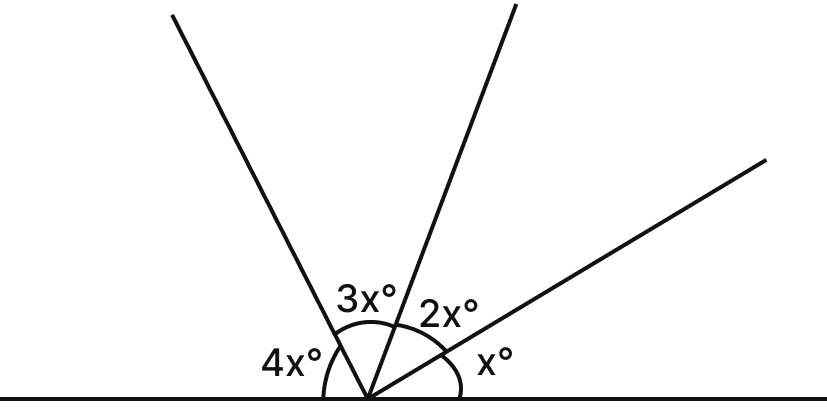
Use the adjacent figure, to find angle x° and its supplement.
Answer
From the figure,
The angles 4x°, 3x°, 2x° and x° are the angles made on one side of a straight line.
⇒ 4x° + 3x° + 2x° + x° = 180°
⇒ 10x° = 180°
⇒ x° =
⇒ x° = 18°
Supplement of x° = 180° − 18° = 162°
Hence, x° = 18° and its supplement = 162°.
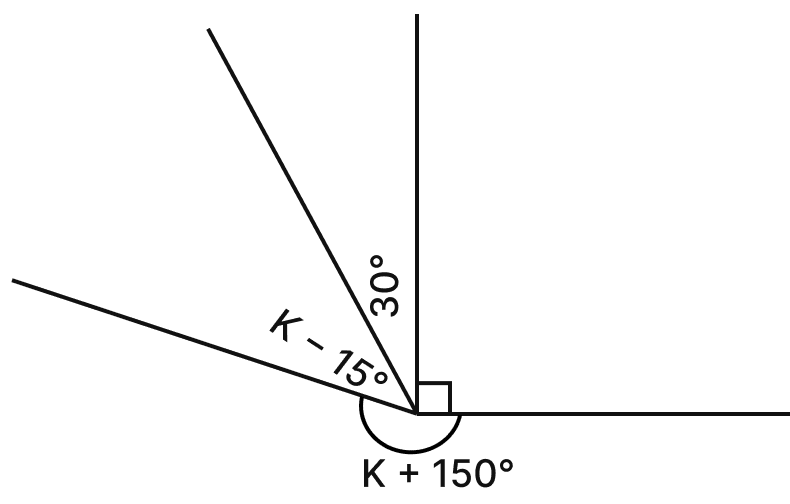
Find K in the given figure.
Answer
From the figure, the angles K − 15°, 30°, 90° and K + 150° are the angles at a point.
As the sum of the angles at a point is 360°,
⇒ K − 15° + 30° + 90° + K + 150° = 360°
⇒ 2K + 255° = 360°
⇒ 2K = 105°
⇒ K =
⇒ K = 52.5°
Converting into degrees and minutes,
0.5° = 0.5 × 60' = 30'
⇒ K = 52° 30'
Hence, K = 52.5° = 52° 30'.
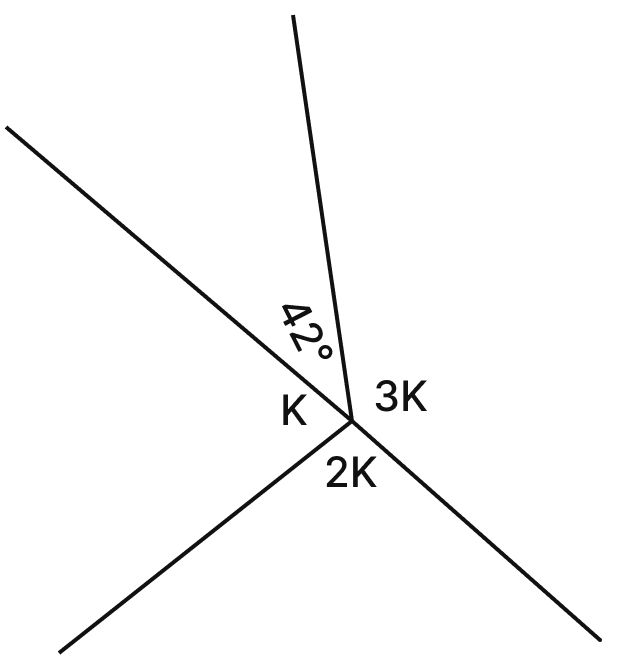
Find K in the given figure.
Answer
From the figure, the angles 42°, 3K, 2K and K are the angles at a point.
As the sum of the angles at a point is 360°,
⇒ 42° + 3K + 2K + K = 360°
⇒ 42° + 6K = 360°
⇒ 6K = 360° - 42°
⇒ 6K = 318°
⇒ K =
⇒ K = 53°
Hence, K = 53°.
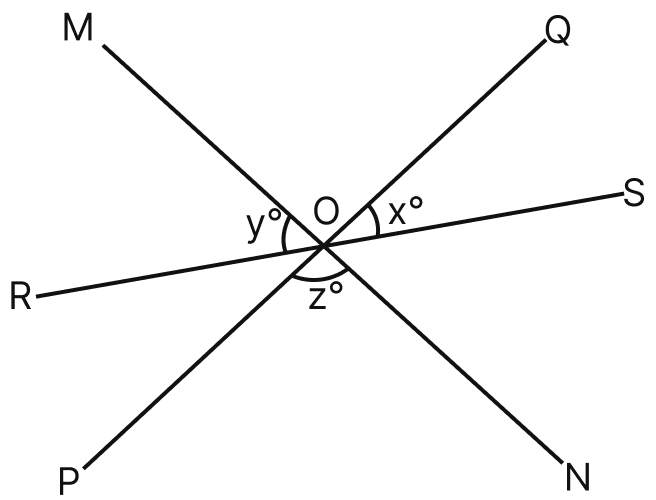
In the given figure, lines PQ, MN and RS intersect at O. If x : y = 1 : 2 and z = 90°, find ∠ROM and ∠POR.
Answer
As the ratio x : y = 1 : 2, let x = a and y = 2a.
From the figure, ∠MOQ and ∠PON (= z°) are vertically opposite angles.
⇒ ∠MOQ = z° = 90°
As RS is a straight line, the angles ∠ROM, ∠MOQ and ∠QOS lie on one side of it.
⇒ ∠ROM + ∠MOQ + ∠QOS = 180°
⇒ y° + 90° + x° = 180°
⇒ 2a° + a° = 90°
⇒ 3a° = 90°
⇒ a° =
⇒ a° = 30°
So, x° = a° = 30° and y° = 2a° = 2 × 30° = 60°.
⇒ ∠ROM = y° = 60°
From the figure, ∠POR and ∠QOS are vertically opposite angles.
⇒ ∠POR = ∠QOS = x° = 30°
Hence, ∠ROM = 60° and ∠POR = 30°.
In the given figure, find ∠AOB and ∠BOC.
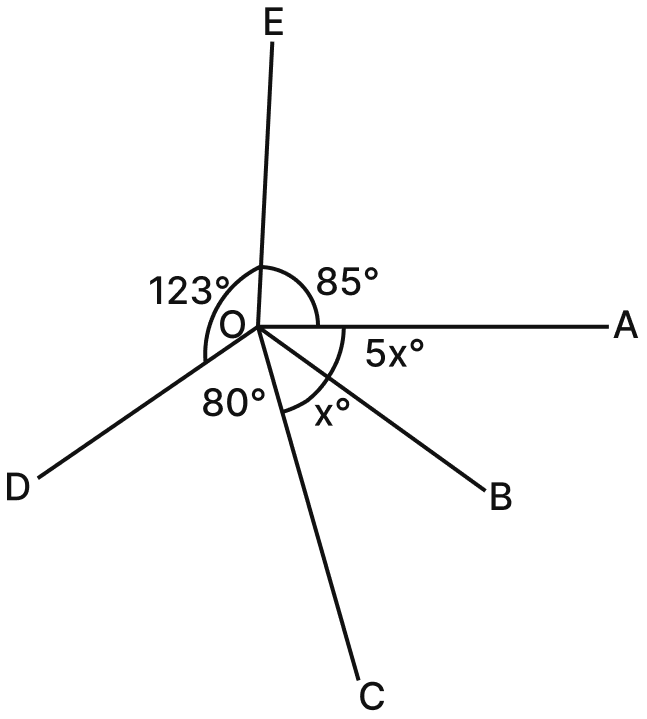
Answer
From the figure, the angles 123°, 85°, 5x°, x° and 80° are the angles at the point O.
As the sum of the angles at a point is 360°,
⇒ 123° + 85° + 5x° + x° + 80° = 360°
⇒ 6x° + 288° = 360°
⇒ 6x° = 360° - 288°
⇒ 6x° = 72°
⇒ x° =
⇒ x° = 12°
⇒ ∠AOB = 5x° = 5 × 12° = 60°
⇒ ∠BOC = x° = 12°
Hence, ∠AOB = 60° and ∠BOC = 12°.
Find each angle shown in the figure.
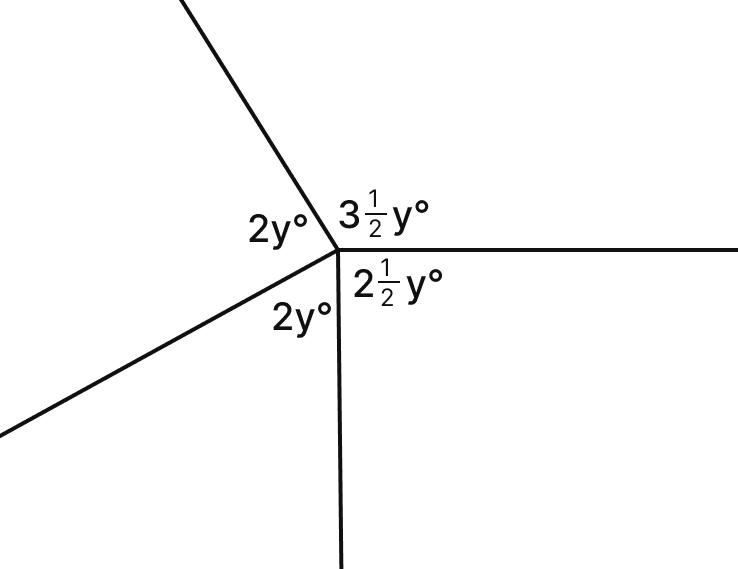
Answer
From the figure,
The angles are the angles at a point.
As the sum of the angles at a point is 360°,
So, the angles are :
Hence, the angles are 72°, 72°, 90° and 126°.
AB, CD and EF are three lines intersecting at the same point.
(i) Find x°, if y° = 45° and z° = 90°.
(ii) Find a°, if x° = 3a°, y° = 5x° and z° = 6x°.
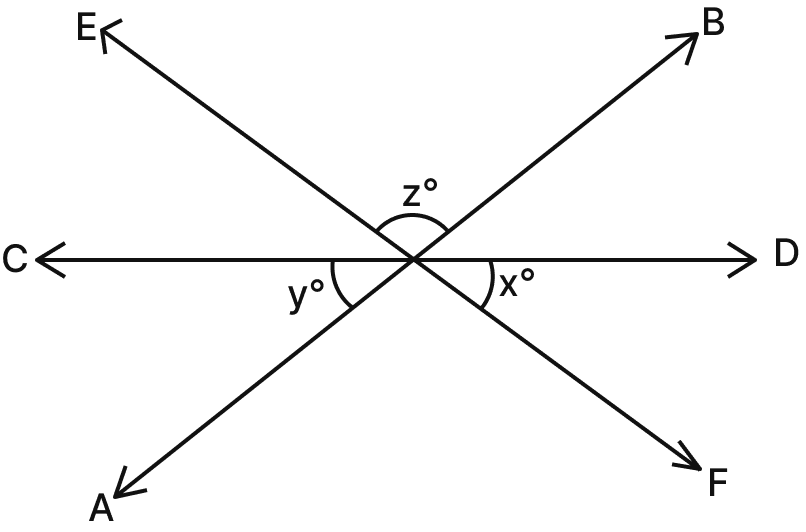
Answer
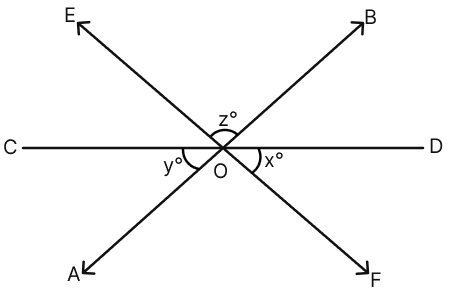
From the figure, EF and AB are intersecting lines,
⇒ ∠AOF = ∠EOB = z°
From figure,
⇒ ∠AOC + ∠AOF + ∠DOF = 180°
⇒ y° + z° + x° = 180°
(i) Given, y = 45° and z = 90°
⇒ 45° + 90° + x° = 180°
⇒ x° + 135° = 180°
⇒ x° = 180° - 135°
⇒ x° = 45°
Hence, x = 45°.
(ii) Given, x = 3a, y = 5x and z = 6x
⇒ y = 5x = 5 × 3a = 15a
⇒ z = 6x = 6 × 3a = 18a
As, x° + y° + z° = 180°
⇒ 3a + 15a + 18a = 180°
⇒ 36a = 180°
⇒ a =
⇒ a = 5°
Hence, a = 5°.