
Identify the given pairs of angles as corresponding angles, interior alternate angles, exterior alternate angles, adjacent angles, vertically opposite angles or allied angles :
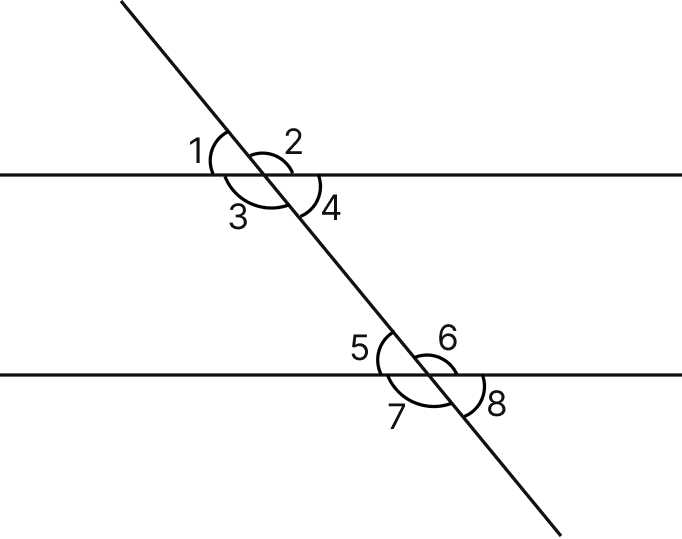
(i) ∠3 and ∠6
(ii) ∠2 and ∠4
(iii) ∠3 and ∠7
(iv) ∠2 and ∠7
(v) ∠4 and ∠6
(vi) ∠1 and ∠8
(vii) ∠1 and ∠5
(viii) ∠1 and ∠4
(ix) ∠5 and ∠7
Answer
(i) ∠3 and ∠6 lie between the two lines and on opposite sides of the transversal.
Hence, they are interior alternate angles.
(ii) ∠2 and ∠4 have a common vertex and a common arm, and they lie on opposite sides of the common arm.
Hence, they are adjacent angles.
(iii) ∠3 and ∠7 lie on the same side of the transversal and in matching positions at the two intersections.
Hence, they are corresponding angles.
(iv) ∠2 and ∠7 lie outside the two lines and on opposite sides of the transversal.
Hence, they are exterior alternate angles.
(v) ∠4 and ∠6 lie between the two lines and on the same side of the transversal.
Hence, they are co-interior angles.
(vi) ∠1 and ∠8 lie outside the two lines and on opposite sides of the transversal.
Hence, they are exterior alternate angles.
(vii) ∠1 and ∠5 lie on the same side of the transversal and in matching positions at the two intersections.
Hence, they are corresponding angles.
(viii) ∠1 and ∠4 are formed by two intersecting lines and lie opposite to each other at the common vertex.
Hence, they are vertically opposite angles.
(ix) ∠5 and ∠7 have a common vertex and a common arm, and lie on opposite sides of the common arm.
Hence, they are adjacent angles.
Identify the given pairs of angles as corresponding angles, interior alternate angles, exterior alternate angles, adjacent angles, vertically opposite angles or allied angles :
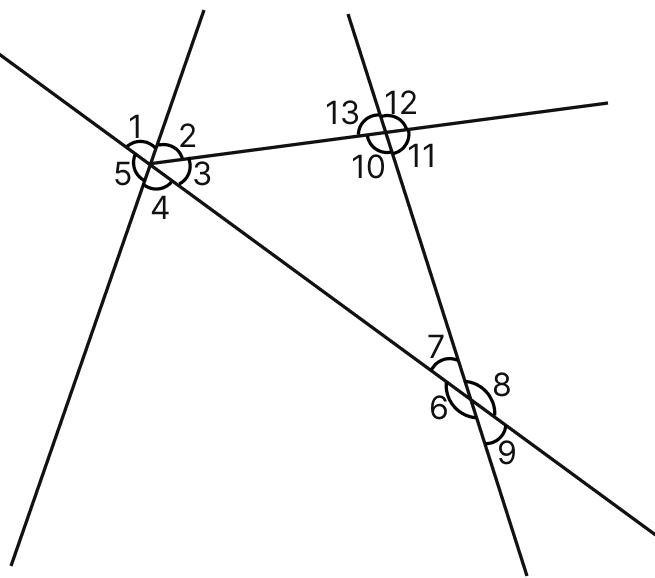
(i) ∠1 and ∠4
(ii) ∠4 and ∠7
(iii) ∠10 and ∠12
(iv) ∠7 and ∠13
(v) ∠6 and ∠8
(vi) ∠11 and ∠8
(vii) ∠7 and ∠9
(viii) ∠4 and ∠5
(ix) ∠4 and ∠6
(x) ∠6 and ∠7
(xi) ∠2 and ∠13.
Answer
(i) ∠1 and ∠4 are formed by two intersecting lines and lie opposite to each other at the common vertex.
Hence, they are vertically opposite angles.
(ii) ∠4 and ∠7 lie between the two lines and on opposite sides of the transversal.
Hence, they are interior alternate angles.
(iii) ∠10 and ∠12 are formed by two intersecting lines and lie opposite to each other at the common vertex.
Hence, they are vertically opposite angles.
(iv) ∠7 and ∠13 lie on the same side of the transversal and in matching positions at the two intersections.
Hence, they are corresponding angles.
(v) ∠6 and ∠8 are formed by two intersecting lines and lie opposite to each other at the common vertex.
Hence, they are vertically opposite angles.
(vi) ∠11 and ∠8 lie between the two lines and on the same side of the transversal.
Hence, they are co-interior angles.
(vii) ∠7 and ∠9 are formed by two intersecting lines and lie opposite to each other at the common vertex.
Hence, they are vertically opposite angles.
(viii) ∠4 and ∠5 have a common vertex and a common arm, and lie on opposite sides of the common arm.
Hence, they are adjacent angles.
(ix) ∠4 and ∠6 lie between the two lines and on the same side of the transversal.
Hence, they are co-interior angles.
(x) ∠6 and ∠7 have a common vertex and a common arm, and lie on opposite sides of the common arm.
Hence, they are adjacent angles.
(xi) ∠2 and ∠13 lie between the two lines and on the same side of the transversal.
Hence, they are co-interior angles.
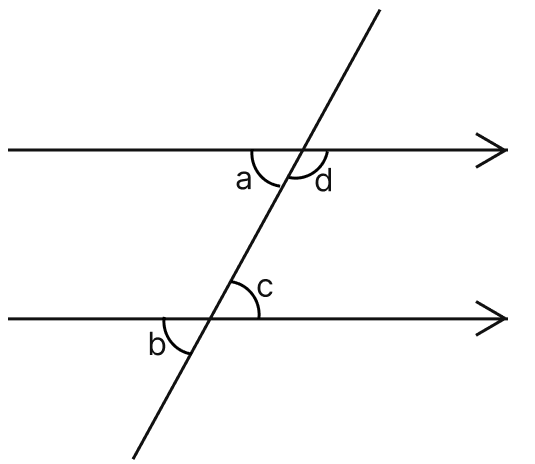
In the following figure, the arrows indicate parallel lines. State which angles are equal. Give reasons.
Answer
From figure,
∠a and ∠c are interior alternate angles, and the given lines are parallel.
⇒ ∠a = ∠c [Interior alternate angles are equal]
∠b and ∠c are vertically opposite angles.
⇒ ∠b = ∠c [Vertically opposite angles are equal]
Hence, ∠a = ∠b = ∠c.
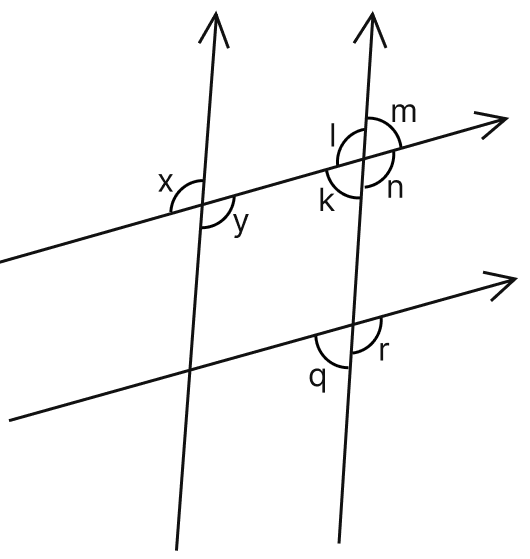
In the following figure, the arrows indicate parallel lines. State which angles are equal. Give reasons.
Answer
From figure,
∠x and ∠y are vertically opposite angles.
⇒ ∠x = ∠y [Vertically opposite angles are equal]
∠y and ∠l are interior alternate angles, and the given lines are parallel.
⇒ ∠y = ∠l [Interior alternate angles are equal]
∠l and ∠n are vertically opposite angles.
⇒ ∠l = ∠n [Vertically opposite angles are equal]
∠n and ∠r are corresponding angles, and the given lines are parallel.
⇒ ∠n = ∠r [Corresponding angles are equal]
⇒ ∠x = ∠y = ∠l = ∠n = ∠r
Again, ∠k and ∠m are vertically opposite angles.
⇒ ∠k = ∠m [Vertically opposite angles are equal]
∠k and ∠q are corresponding angles, and the given lines are parallel.
⇒ ∠k = ∠q [Corresponding angles are equal]
⇒ ∠k = ∠m = ∠q
Hence, ∠x = ∠y = ∠l = ∠n = ∠r and ∠k = ∠m = ∠q.
In the given figure, find the measure of the unknown angles :
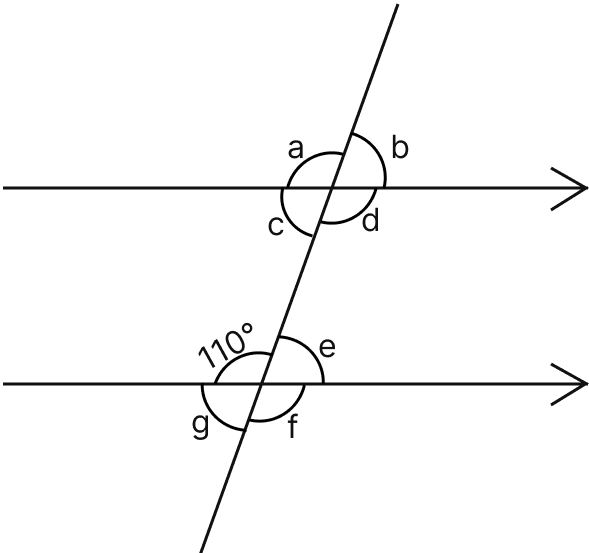
Answer
From the figure, the two given lines with arrow are parallel and the third line is a transversal.
The 110° angle and ∠e form a linear pair.
⇒ 110° + e = 180°
⇒ e = 70°
∠f is vertically opposite to the 110° angle.
⇒ f = 110° [Vertically opposite angles are equal]
∠g is vertically opposite to ∠e.
⇒ g = e = 70° [Vertically opposite angles are equal]
∠a and the 110° angle are corresponding angles.
⇒ a = 110° [Corresponding angles are equal]
∠a and ∠b form a linear pair.
⇒ b = 180° − 110° = 70°
∠c is vertically opposite to ∠b and ∠d is vertically opposite to ∠a.
⇒ c = b = 70° and d = a = 110° [Vertically opposite angles are equal]
Hence, a = 110°, b = 70°, c = 70°, d = 110°, e = 70°, f = 110° and g = 70°.
Which pair of the dotted line segments, in the following figures, are parallel. Give reason :
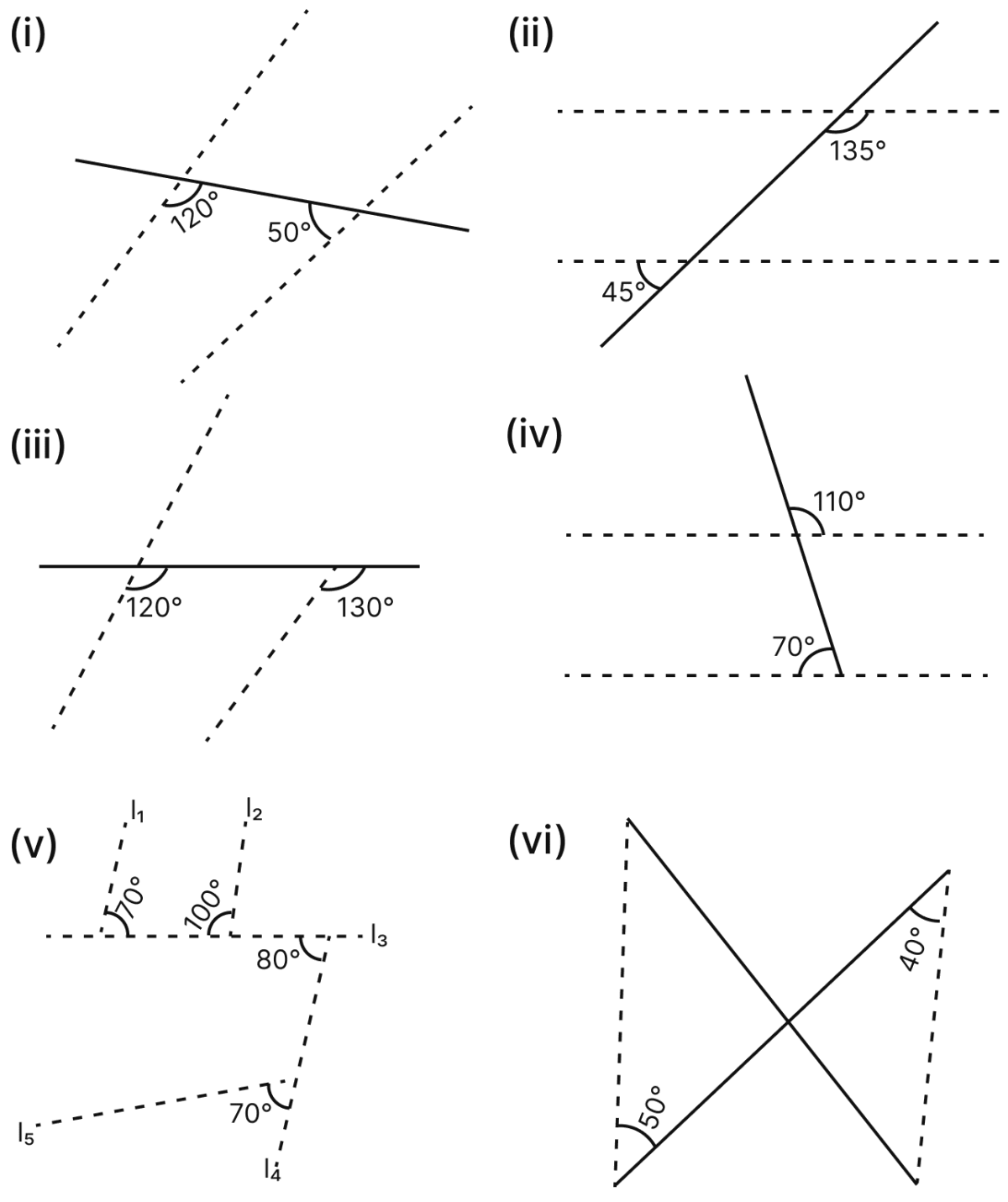
Answer
(i) The angles 120° and 50° are co-interior angles.
⇒ 120° + 50° = 170° ≠ 180°
Since the co-interior angles are not supplementary, the dotted line segments are not parallel.
(ii)
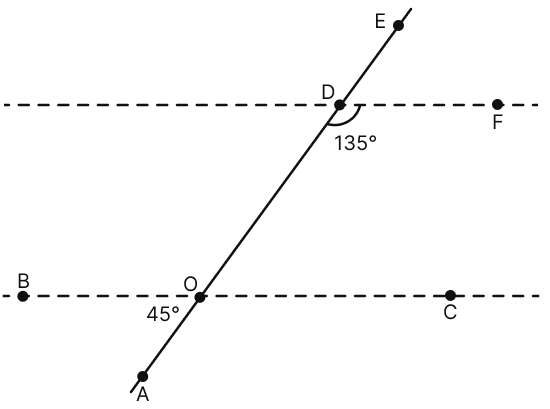
From the figure,
∠COD = ∠AOB = 45° (vertically opposite angles are equal)
The angles ∠FDO and ∠COD are co-interior angles.
⇒ 135° + 45° = 180°
Since the co-interior angles are supplementary, the dotted line segments are parallel.
(iii) The angles 120° and 130° are corresponding angles.
But 120° ≠ 130°
Since the corresponding angles are not equal, the dotted line segments are not parallel.
(iv)
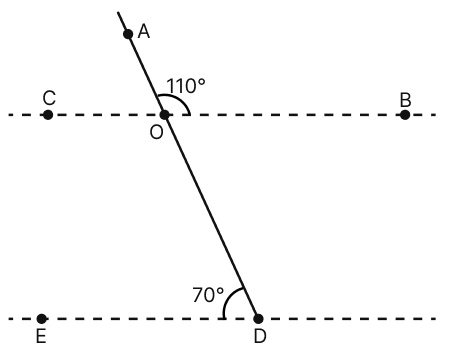
From the figure,
∠COD = ∠AOB = 110° (vertically opposite angles are equal)
The angles ∠EDO and ∠COD are co-interior angles.
⇒ 110° + 70° = 180°
Since the co-interior angles are supplementary, the dotted line segments are parallel.
(v)
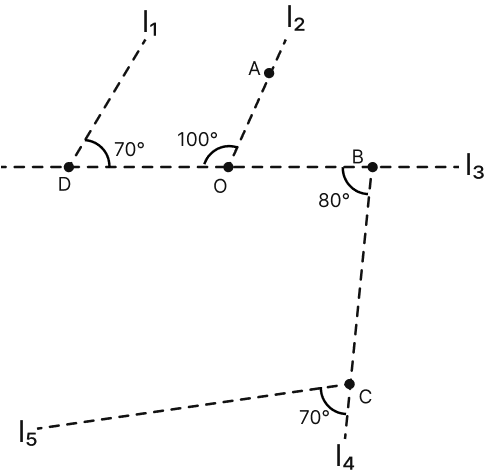
Taking l3 as the transversal, the angles 100° and 70° are co-interior angles.
⇒ 100° + 70° = 170° ≠ 180°
As, sum of co-interior angles is not 180°.
⇒ Line l1 and l2 are not parallel.
As, ∠AOD and ∠AOB forms a linear pair.
⇒ ∠AOD + ∠AOB = 180°
⇒ 100° + ∠AOB = 180°
⇒ ∠AOB = 180° - 100° = 80°
Taking l3 as the transversal,
⇒ ∠AOB and ∠OBC are interior alternate angles.
As, ∠AOB = ∠OBC = 80°
⇒ Line l2 and l4 are parallel.
Now taking l4 as a transversal.
70° ≠ 80°
⇒ Corresponding angles of line l3 and l5 are not equal.
⇒ Line l3 and l5 are not parallel.
Hence, only l2 and l4 are parallel.
(vi) The angles 50° and 40° are alternate angles.
But 50° ≠ 40°
Since the alternate angles are not equal, the dotted line segments are not parallel.
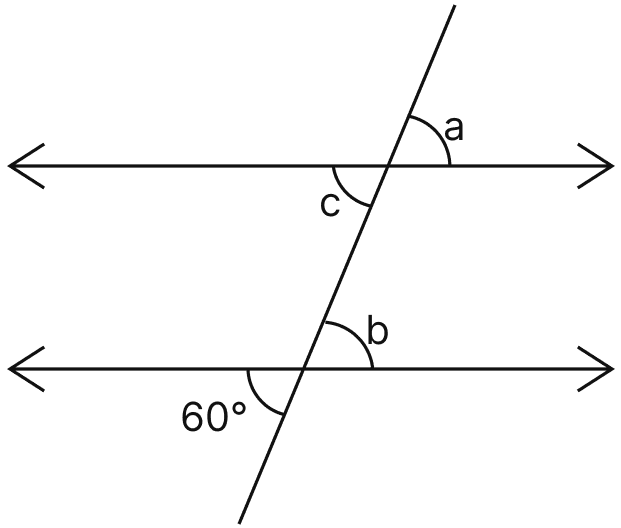
In the given figure, the directed lines are parallel to each other. Find the unknown angles.
Answer
From the figure,
⇒ b = 60° [Vertically opposite angles are equal]
⇒ a = b = 60° [Corresponding angles are equal]
⇒ c = a = 60° [Vertically opposite angles are equal]
Hence, a = 60°, b = 60° and c = 60°.
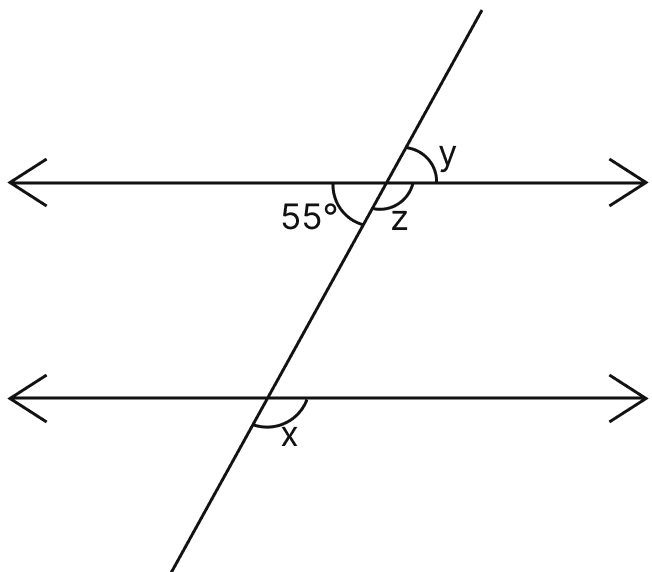
In the given figure, the directed lines are parallel to each other. Find the unknown angles.
Answer
From the figure,
⇒ y = 55° [Vertically opposite angles are equal]
⇒ 55° + z = 180° [Linear pair]
⇒ z = 180° - 55°
⇒ z = 125°
⇒ x = z = 125° [Corresponding angles are equal]
Hence, x = z = 125° and y = 55°.
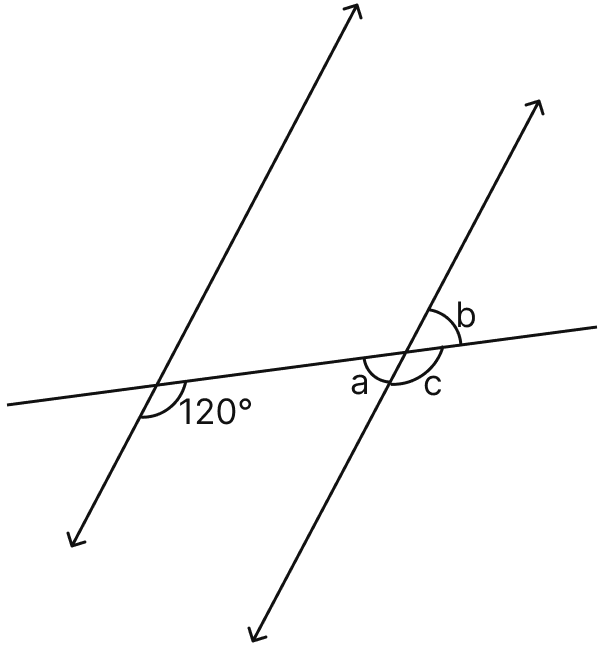
In the given figure, the directed lines are parallel to each other. Find the unknown angles.
Answer
From the figure,
⇒ a + 120° = 180° [Co-interior angles are supplementary]
⇒ a = 60°
⇒ b = a = 60° [Vertically opposite angles are equal]
⇒ b + c = 180° [Linear pair]
⇒ 60° + c = 180°
⇒ c = 180° − 60° = 120°
Hence, a = 60°, b = 60° and c = 120°.
In the given figure, the directed lines are parallel to each other. Find the unknown angles.
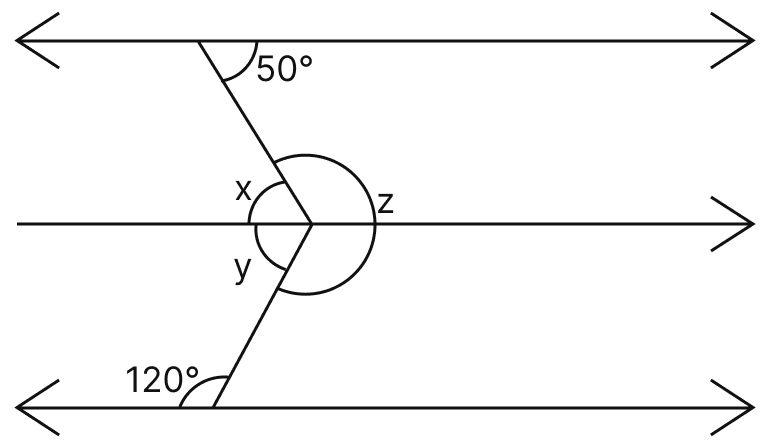
Answer
From the figure,
⇒ x = 50° [Interior alternate angles are equal]
⇒ y + 120° = 180° [Co-interior angles are supplementary]
⇒ y = 60°
As z is the reflex angle at the vertex,
⇒ z = 360° − (x + y)
⇒ z = 360° − (50° + 60°) = 360° − 110° = 250°
Hence, x = 50°, y = 60° and z = 250°.
In the given figure, the directed lines are parallel to each other. Find the unknown angles.
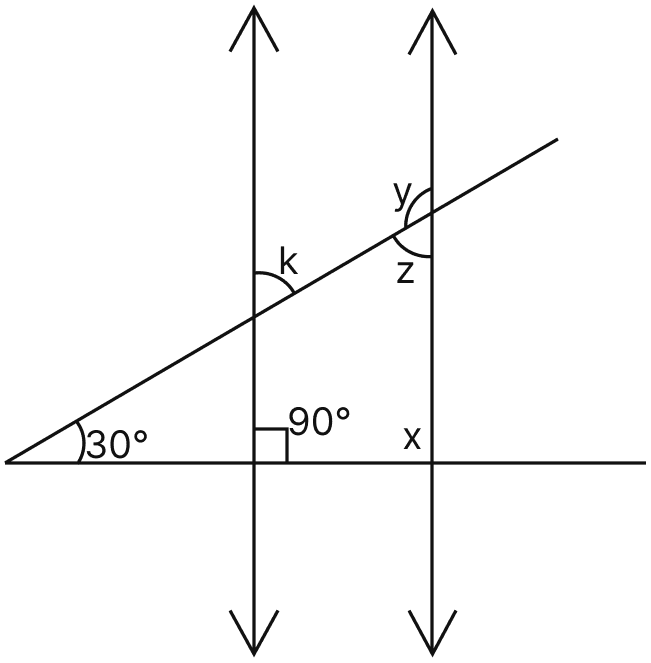
Answer
Since the two vertical lines are parallel and the first one is perpendicular to the horizontal line.
As, 90° and x are co-interior angles.
⇒ 90° + x = 180°
⇒ x = 90°
In the triangle formed by the horizontal line, the slant line and the second vertical line,
⇒ 30° + x + z = 180°
⇒ 30° + 90° + z = 180°
⇒ 120° + z = 180°
⇒ z = 180° − 120° = 60°
Now, z and k are alternate interior angles.
⇒ k = z = 60°
As, y and z are on the straight line, they form a linear pair.
⇒ y + z = 180°
⇒ y + 60° = 180°
⇒ y = 180° − 60° = 120°
Hence, k = 60°, x = 90°, y = 120° and z = 60°.
In the given figure, the directed lines are parallel to each other. Find the unknown angles.
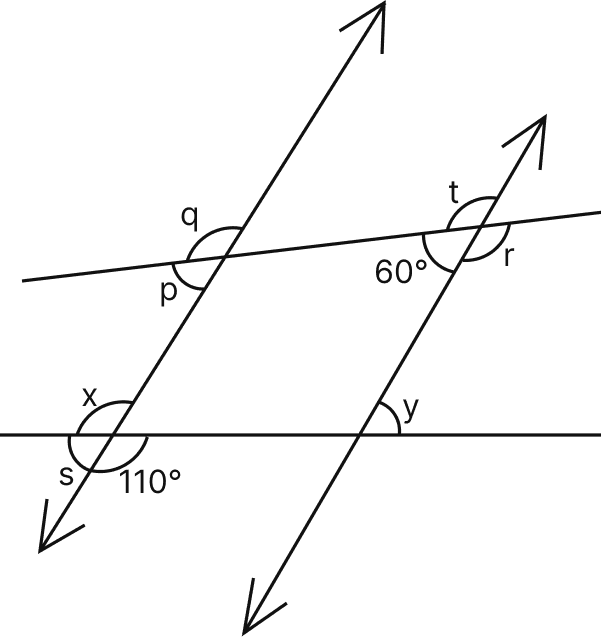
Answer
From the figure,
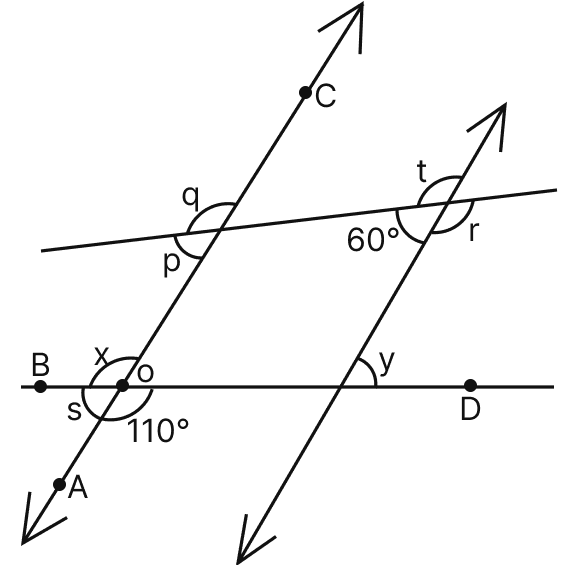
⇒ x = 110° [Vertically opposite angles are equal]
⇒ s + 110° = 180° [Linear pair]
⇒ s = 70°
⇒ s = ∠COD = 70° (vertically opposite angles are equal)
As, ∠COD and y are corresponding angles
⇒ y = 70° [Corresponding angles are equal]
⇒ p = 60° [Corresponding angles are equal]
⇒ p + q = 180° [Linear pair]
⇒ q = 180° − 60° = 120°
⇒ 60° + r = 180° [Linear pair]
⇒ r = 120°
⇒ t = r = 120° [Vertically opposite angles are equal]
Hence, x = 110°, s = 70°, y = 70°, p = 60°, q = 120°, r = 120° and t = 120°.
In the given figure, the directed lines are parallel to each other. Find the unknown angles.
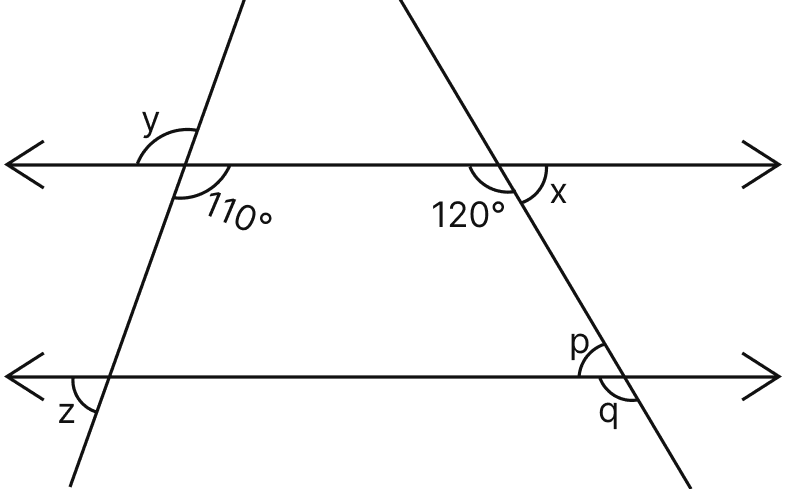
Answer
From the figure,
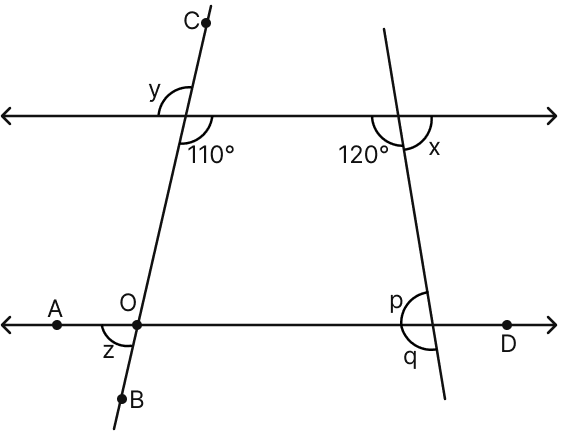
⇒ y = 110° [Vertically opposite angles are equal]
⇒ 110° + ∠COD = 180° [Co-interior angles are supplementary]
⇒ ∠COD = 70°
⇒ z = 70° [Vertically opposite angles are equal]
⇒ 120° + x = 180° [Linear pair]
⇒ x = 60°
⇒ p = x = 60° [alternate angles are equal]
⇒ p + q = 180° [Linear pair]
⇒ q = 180° − 60° = 120°
Hence, y = 110°, z = 70°, x = 60°, p = 60° and q = 120°.
In the given figure, the directed lines are parallel to each other. Find the unknown angles.
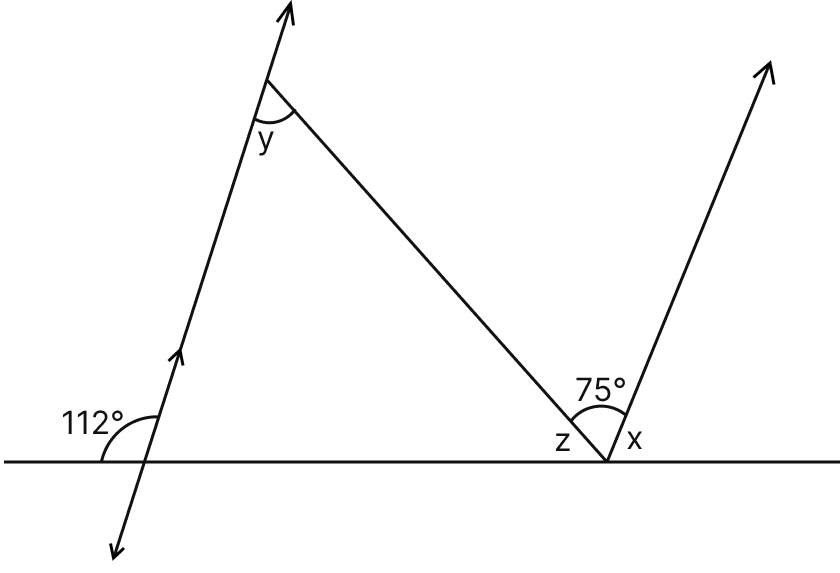
Answer
From the figure,
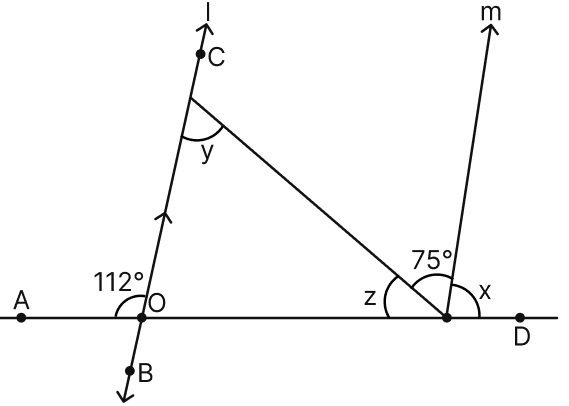
∠COD and ∠COA forms a linear pair,
⇒ ∠COD + ∠COA = 180°
⇒ ∠COD + 112° = 180°
⇒ ∠COD = 180° − 112° = 68°
Since, line l and m are parallel to each other,
⇒ x = ∠COD = 68° [Corresponding angles are equal]
The angles z, 75° and x lie on a straight line.
⇒ z + 75° + x = 180°
⇒ z + 75° + 68° = 180°
⇒ z + 143° = 180°
⇒ z = 180° − 143° = 37°
By the angle sum property of the triangle,
⇒ y + ∠COD + z = 180°
⇒ y + 68° + 37° = 180°
⇒ y + 105° = 180°
⇒ y = 180° − 105° = 75°
Hence, y = 75°, z = 37° and x = 68°.
In the given figure, the directed lines are parallel to each other. Find the unknown angles.
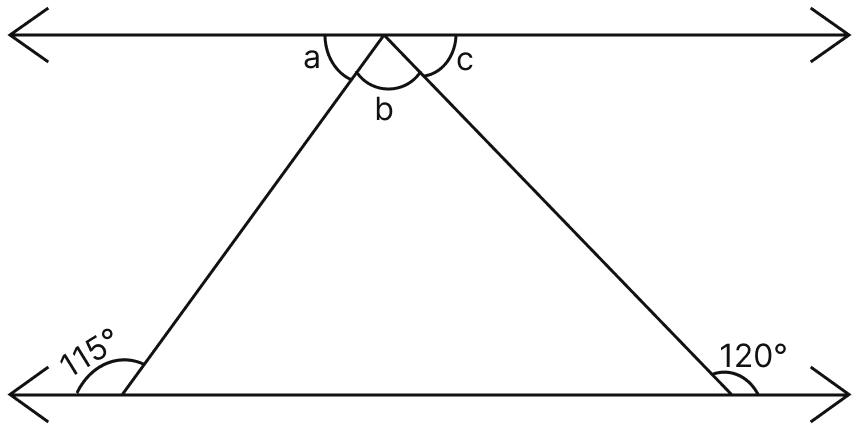
Answer
From the figure,
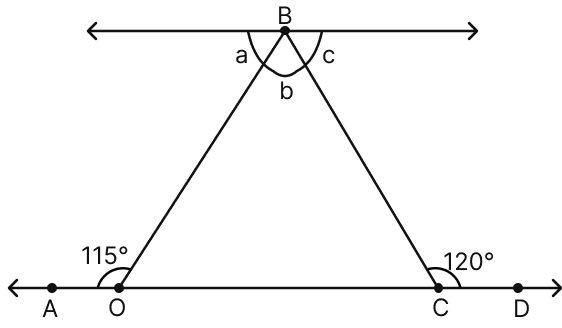
∠BOC and ∠BOA forms a linear pair,
⇒ ∠BOC + ∠BOA = 180°
⇒ ∠BOC + 115° = 180°
⇒ ∠BOC = 180° - 115° = 65°
∠BCO and ∠BCD forms a linear pair,
⇒ ∠BCO + ∠BCD = 180°
⇒ ∠BCO + 120° = 180°
⇒ ∠BCO = 180° − 120° = 60°
By the angle sum property of the triangle,
⇒ b + ∠BOC + ∠BCO = 180°
⇒ b + 65° + 60° = 180°
⇒ b = 180° − 125° = 55°
Since the two horizontal lines are parallel,
⇒ a = ∠BOC = 65° [Interior alternate angles are equal]
⇒ c = ∠BCO = 60° [Interior alternate angles are equal]
Hence, a = 65°, b = 55° and c = 60°.
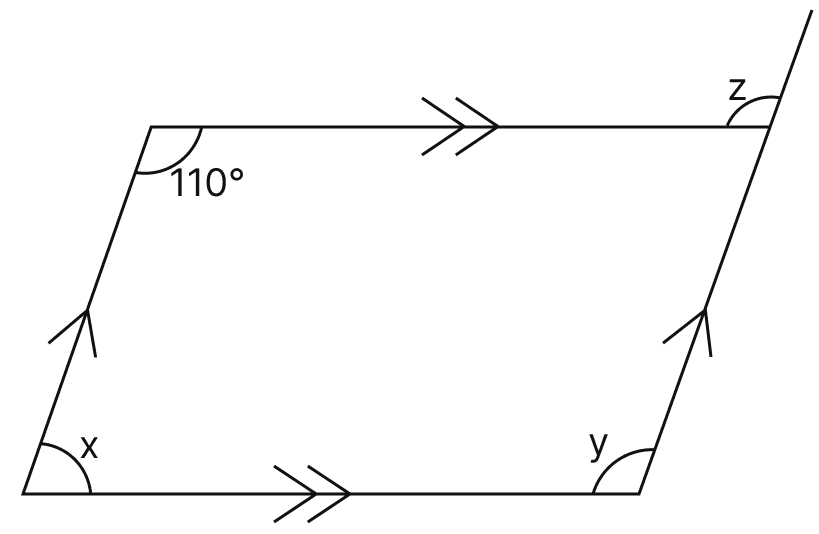
In the given figure, the directed lines are parallel to each other. Find the unknown angles.
Answer
From the figure, the opposite sides of the figure are parallel.
⇒ 110° + x = 180° [Co-interior angles are supplementary]
⇒ x = 70°
⇒ y = 110° [Opposite angles of a parallelogram are equal]
The interior angle at the top right vertex = x = 70° [Opposite angles of a parallelogram are equal]
⇒ z + 70° = 180° [Linear pair]
⇒ z = 110°
Hence, z = 110°, x = 70° and y = 110°.
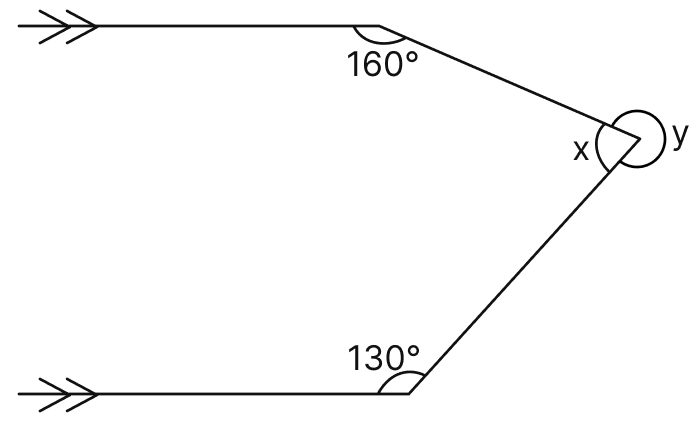
In the given figure, the directed lines are parallel to each other. Find the unknown angles.
Answer
Through the vertex where x is marked, draw a line parallel to the two given parallel lines.
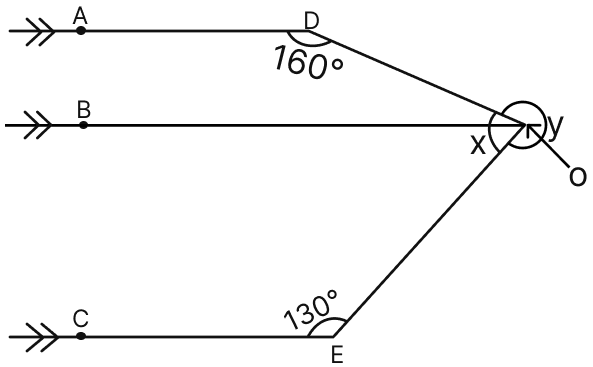
∠ADO and ∠DOB are co-interior angles,
⇒ ∠ADO + ∠DOB = 180° [Co-interior angles are supplementary]
⇒ 160° + ∠DOB = 180°
⇒ ∠DOB = 180° − 160° = 20°
∠CEO and ∠EOB are co-interior angles,
⇒ ∠CEO + ∠EOB = 180° [Co-interior angles are supplementary]
⇒ 130° + ∠EOB = 180°
⇒ ∠EOB = 180° − 130° = 50°
⇒ x = 20° + 50° = 70°
As y is the reflex angle at the same vertex,
⇒ y = 360° − x = 360° − 70° = 290°
Hence, x = 70° and y = 290°.
In the given figure, the directed lines are parallel to each other. Find the unknown angles.
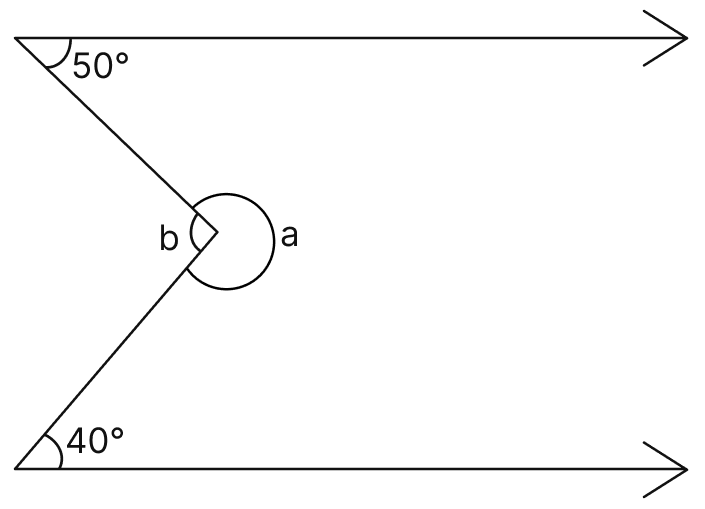
Answer
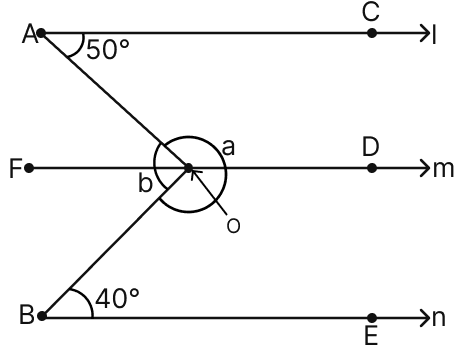
Through the vertex O, draw a line m parallel to the two given parallel lines l and n.
Since l ∥ m and AO is a transversal,
⇒ ∠CAO = ∠FOA [Alternate interior angles are equal]
⇒ ∠FOA = 50°
Since m ∥ n and BO is a transversal,
⇒ ∠EBO = ∠FOB [Alternate interior angles are equal]
⇒ ∠FOB = 40°
Now,
⇒ b = ∠FOA + ∠FOB
⇒ b = 50° + 40° = 90°
Since a is the reflex angle at O,
⇒ a = 360° − b
⇒ a = 360° − 90° = 270°
Hence, a = 270° and b = 90°.
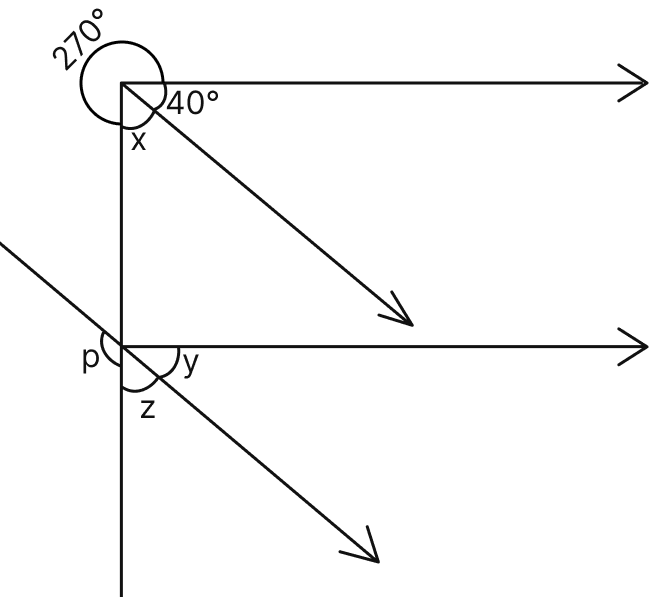
Find x, y, z and p in the given figure :
Answer
From the figure, the reflex angle at the upper vertex is 270°.
Sum of angles at a point = 360°
⇒ 270° + x + 40° = 360°
⇒ x + 310° = 360°
⇒ x = 360° - 310°
⇒ x = 50°
Since the two horizontal rays are parallel and the two slant rays are parallel,
⇒ y = 40° [Corresponding angles are equal]
⇒ z = x = 50° [Corresponding angles are equal]
As p and z are the angles on the straight slant line at the lower vertex,
⇒ p + z = 180° [Linear pair]
⇒ p + 50° = 180°
⇒ p = 180° − 50° = 130°
Hence, x = 50°, y = 40°, z = 50° and p = 130°.
Find x, y and p in the given figure :
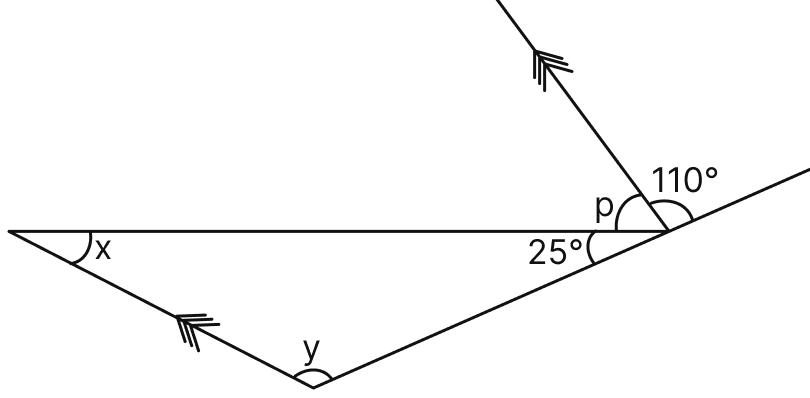
Answer
From the figure,
The angles 110°, p and 25° lie on one side of a straight line.
⇒ 110° + p + 25° = 180°
⇒ p + 135° = 180°
⇒ p = 45°
Since the two directed rays are parallel,
⇒ x = p = 45° [Interior alternate angles are equal]
By the angle sum property of the triangle,
⇒ x + 25° + y = 180°
⇒ 45° + 25° + y = 180°
⇒ 70° + y = 180°
⇒ y = 180° − 70° = 110°
Hence, x = 45°, y = 110° and p = 45°.
Find x in the given figure :
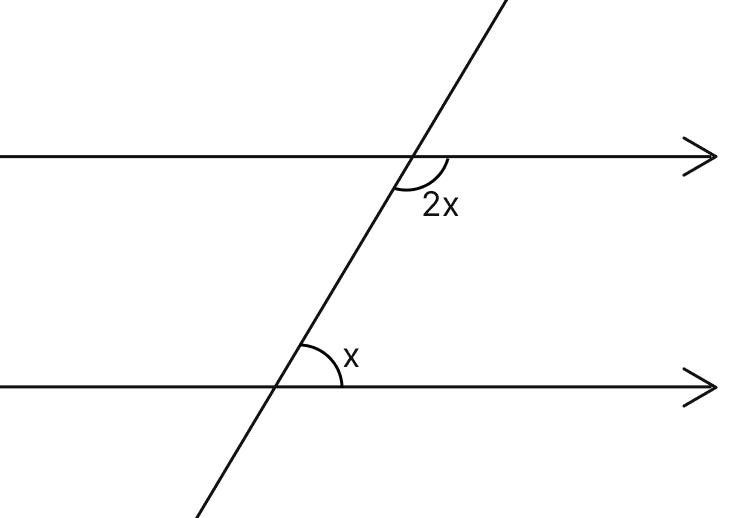
Answer
The angles 2x and x are co-interior angles.
⇒ 2x + x = 180° [Co-interior angles are supplementary]
⇒ 3x = 180°
⇒ x =
⇒ x = 60°
Hence, x = 60°.
Find x in the given figure :
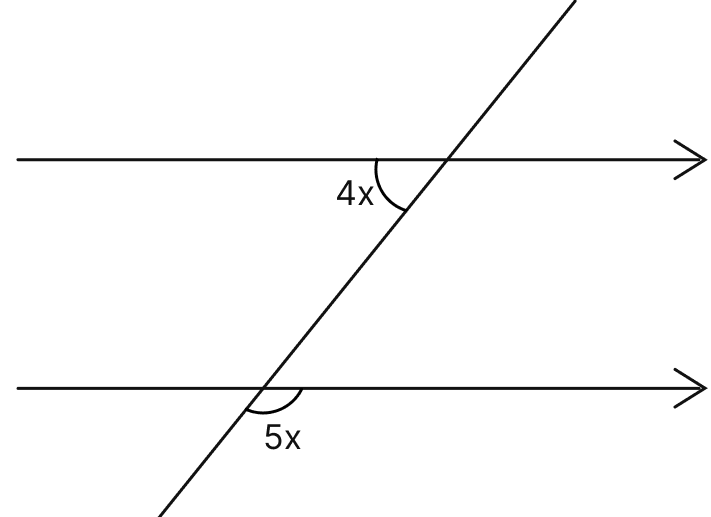
Answer
From the figure,
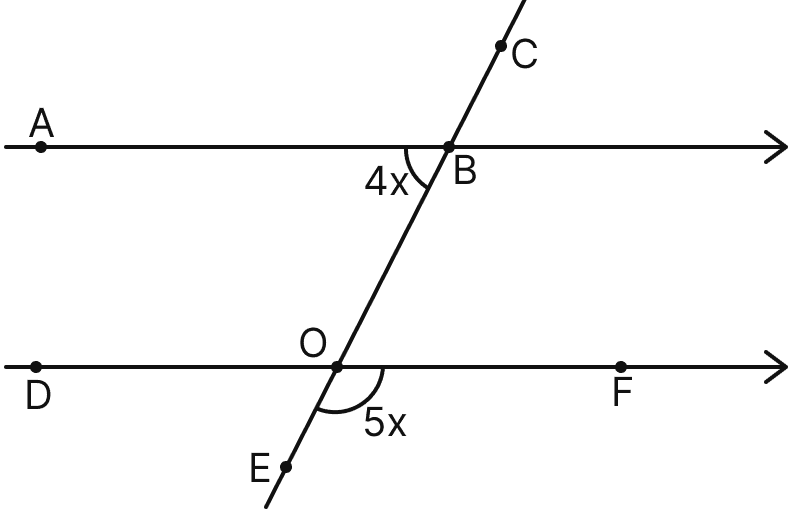
∠DOB = ∠EOF = 5x (vertically opposite angles are equal)
The angles ∠ABO and ∠DOB are co-interior angles.
⇒ ∠ABO + ∠DOB = 180° [Co-interior angles are supplementary]
⇒ 4x + 5x = 180°
⇒ 9x = 180°
⇒ x =
⇒ x = 20°
Hence, x = 20°.
Find x in the given figure :
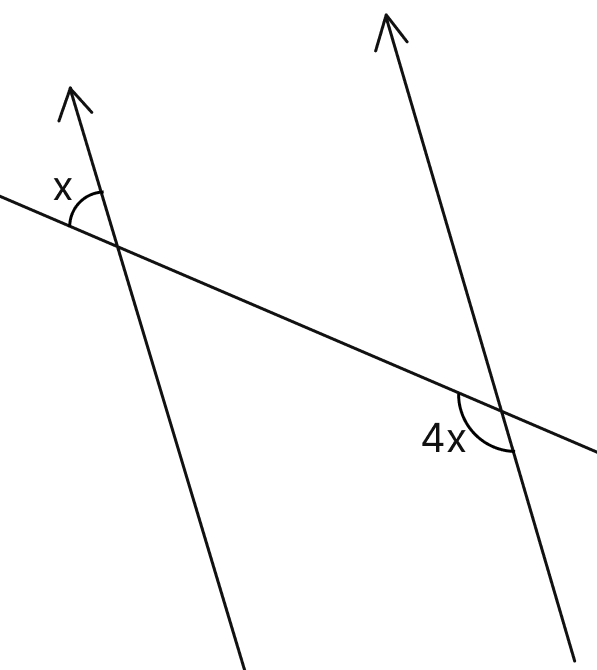
Answer
From the figure,
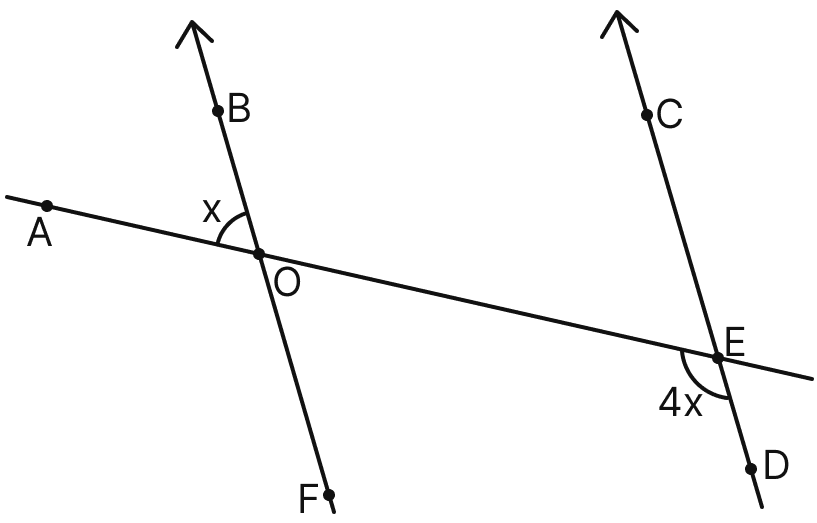
∠EOF = ∠AOB = x (vertically opposite angles are equal)
The angles ∠EOF and ∠DEO are co-interior angles.
⇒ ∠EOF + ∠DEO = 180° [Co-interior angles are supplementary]
⇒ x + 4x = 180°
⇒ 5x = 180°
⇒ x =
⇒ x = 36°
Hence, x = 36°.
Find x in the given figure :
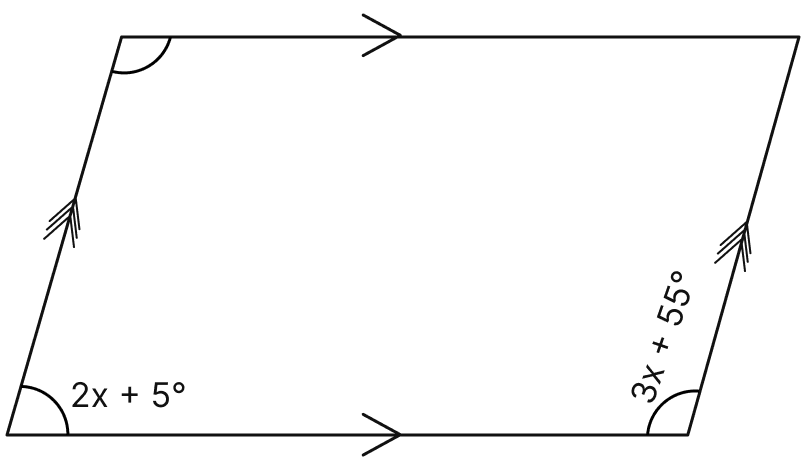
Answer
The angles 2x + 5° and 3x + 55° are co-interior angles.
⇒ 2x + 5° + 3x + 55° = 180° [Co-interior angles are supplementary]
⇒ 5x + 60° = 180°
⇒ 5x = 120°
⇒ x =
⇒ x = 24°
Hence, x = 24°.
Find x in the given figure :
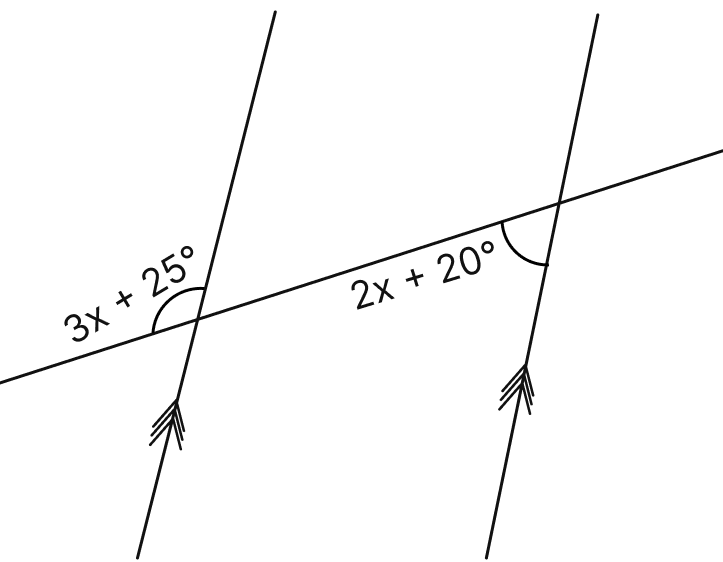
Answer
From the figure,
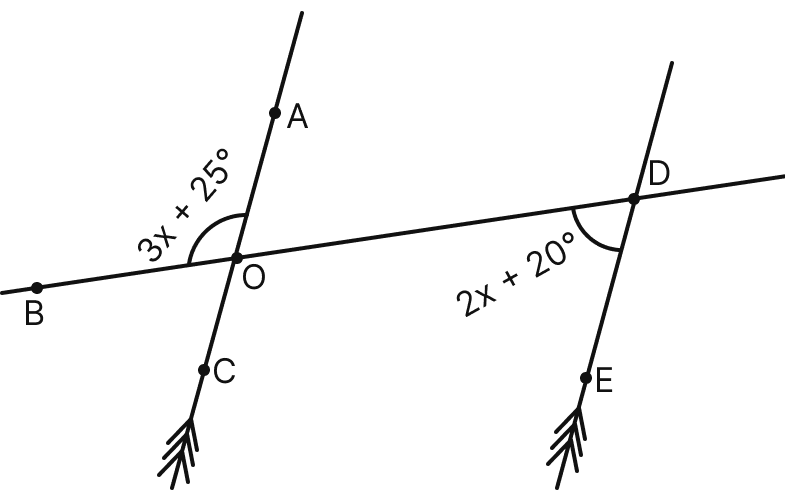
∠COD = ∠AOB = 3x + 25° (vertically opposite angles are equal)
The angles ∠COD and ∠EDO are co-interior angles.
⇒ ∠COD + ∠EDO = 180° [Co-interior angles are supplementary]
⇒ 3x + 25° + 2x + 20° = 180°
⇒ 5x + 45° = 180°
⇒ 5x = 135°
⇒ x =
⇒ x = 27°
Hence, x = 27°.
Find x in the given figure :
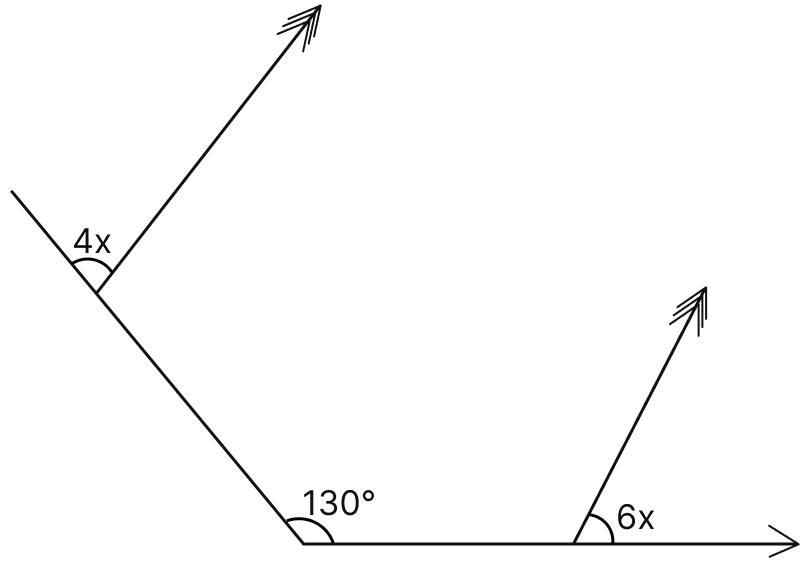
Answer
Through the vertex where 130° is marked, draw a line parallel to the two given parallel lines.
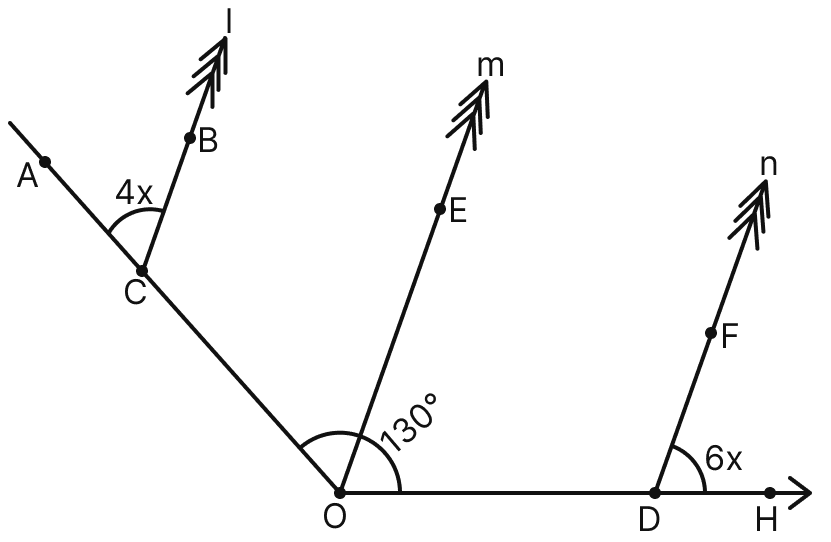
As, line l and m are parallel.
⇒ ∠ACB = ∠COE = 4x (corresponding angles are equal)
Now, line m and n are parallel.
⇒ ∠EOD = ∠FDH = 6x (corresponding angles are equal)
Since, ∠COD = ∠EOD + ∠EOC
⇒ 130° = 4x + 6x
⇒ 10x = 130°
⇒ x =
⇒ x = 13°
Hence, x = 13°.