
Two complementary angles are in the ratio 1 : 2, the smaller angle is :
60°
30°
120°
90°
Answer
As the angles are in the ratio 1 : 2, let the angles be x and 2x.
As the angles are complementary, their sum is 90°.
⇒ x + 2x = 90°
⇒ 3x = 90°
⇒ x =
⇒ x = 30°
So, the angles are 30° and 60°, and the smaller angle is 30°.
Hence, option 2 is the correct option.
Two angles 3x − 20° and 2x + 30° are supplementary, the value of x is :
34
38
50
10
Answer
As the angles are supplementary, their sum is 180°.
⇒ 3x − 20° + 2x + 30° = 180°
⇒ 5x + 10° = 180°
⇒ 5x = 170°
⇒ x =
⇒ x = 34°
Hence, option 1 is the correct option.
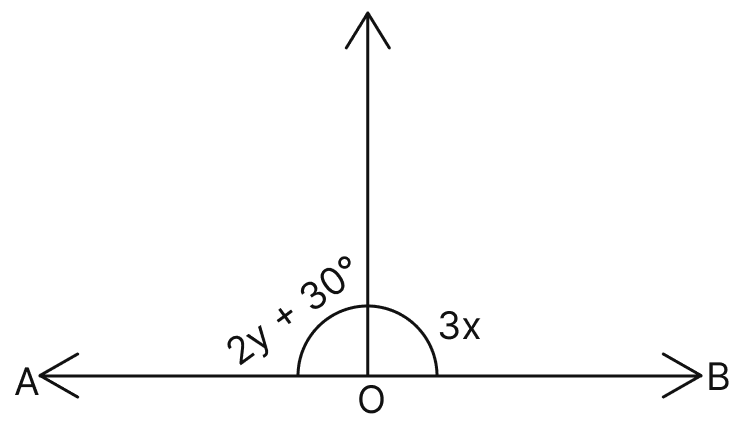
In the given figure, AOB is a straight line and y = 30°, the value of x is :
20°
70°
30°
60°
Answer
Given,
y = 30°
From the figure, AOB is a straight line.
⇒ 2y + 30° + 3x = 180° [Angles on a straight line]
⇒ 2 × 30° + 30° + 3x = 180°
⇒ 90° + 3x = 180°
⇒ 3x = 90°
⇒ x =
⇒ x = 30°
Hence, option 3 is the correct option.
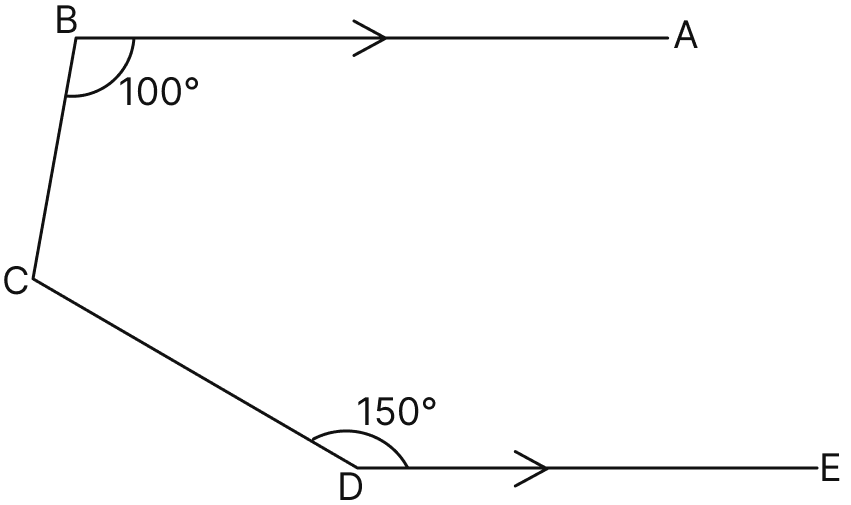
In the given figure, BA is parallel to DE, the ∠BCD is equal to :
70°
90°
110°
none of these
Answer
Through the point C, draw a line CF parallel to BA and DE.
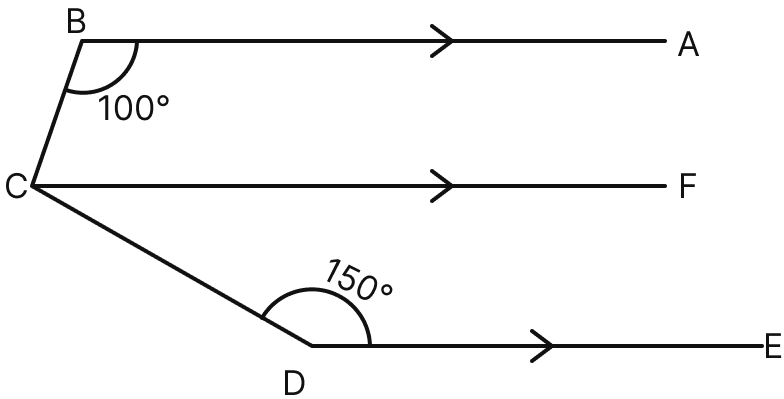
Since BA ∥ CF and BC is a transversal,
⇒ ∠BCF + ∠ABC = 180° [Co-interior angles are supplementary]
⇒ ∠BCF + 100° = 180°
⇒ ∠BCF = 80°
Since, CF ∥ DE and CD is a transversal,
⇒ ∠FCD + ∠CDE = 180° [Co-interior angles are supplementary]
⇒ ∠FCD + 150° = 180°
⇒ ∠FCD = 30°
⇒ ∠BCD = ∠BCF + ∠FCD = 80° + 30° = 110°
Hence, option 3 is the correct option.
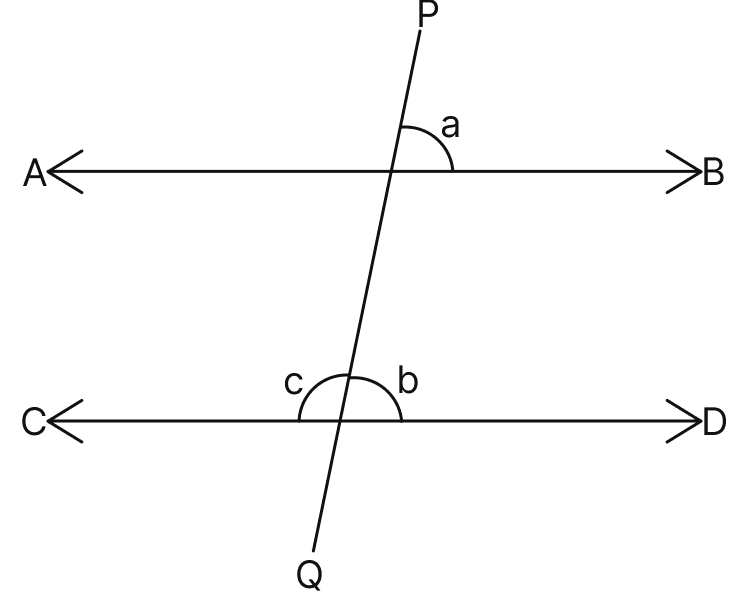
In the given figure, AB is parallel to CD and PQ is a transversal. If ∠a = 3x - 30° and ∠b = 2x + 10°; then the value of x is :
20°
40°
30°
50°
Answer
Since AB ∥ CD and PQ is a transversal,
⇒ ∠a = ∠b [Corresponding angles are equal]
⇒ 3x − 30° = 2x + 10°
⇒ 3x − 2x = 10° + 30°
⇒ x = 40°
Hence, option 2 is the correct option.
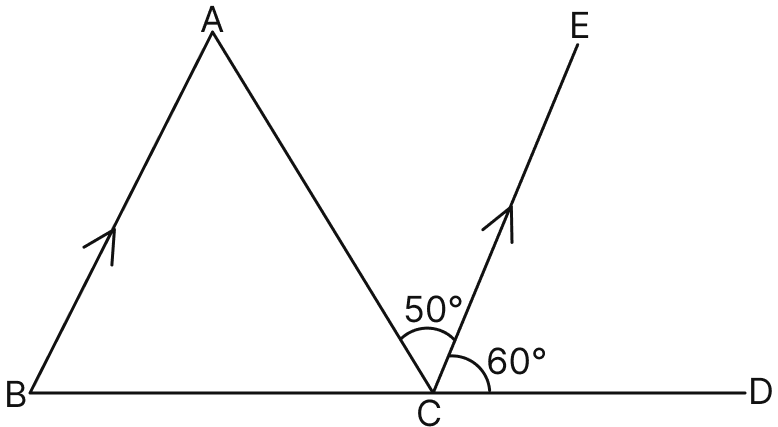
In the given figure, BA is parallel to CE. The angle ABC is :
50°
60°
70°
55°
Answer
Since BA ∥ CE and BD is a transversal,
⇒ ∠ABC = ∠ECD [Corresponding angles are equal]
⇒ ∠ABC = 60°
Hence, option 2 is the correct option.
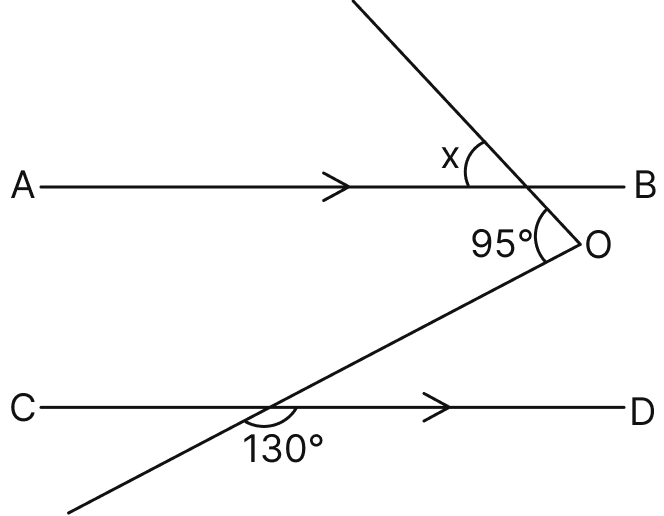
In the given figure, AB is parallel to CD. The value of x is :
50°
60°
55°
45°
Answer
Through the point O, draw a line EO parallel to AB and so parallel to CD.
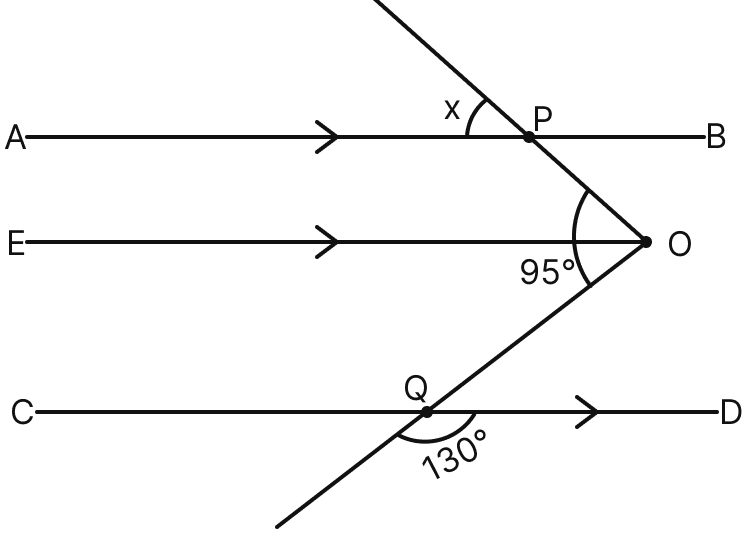
Let the ray from O meet AB at P and CD at Q.
From the figure, the angle marked 130° and ∠OQD form a linear pair.
⇒ ∠OQD + 130° = 180°
⇒ ∠OQD = 180° − 130° = 50°
Since the line through O is parallel to CD and OQ is a transversal,
⇒ ∠EOQ = ∠OQD = 50° [Interior alternate angles are equal]
Since the line OE is parallel to AB and OP is a transversal,
⇒ ∠EOP = x [corresponding angles are equal]
Now, the angle at O = 95°
⇒ ∠EOP + ∠EOQ = 95°
⇒ x + 50° = 95°
⇒ x = 45°
Hence, option 4 is the correct option.
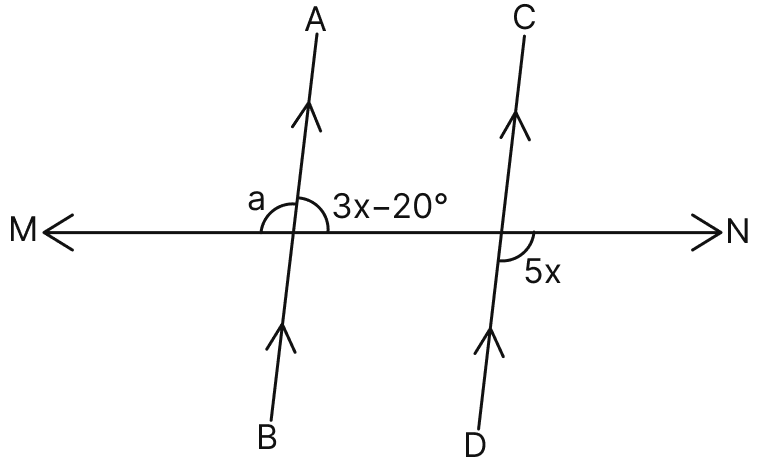
In the given figure, BA is parallel to DC and MN is a transversal, then ∠a is :
55°
125°
120°
60°
Answer
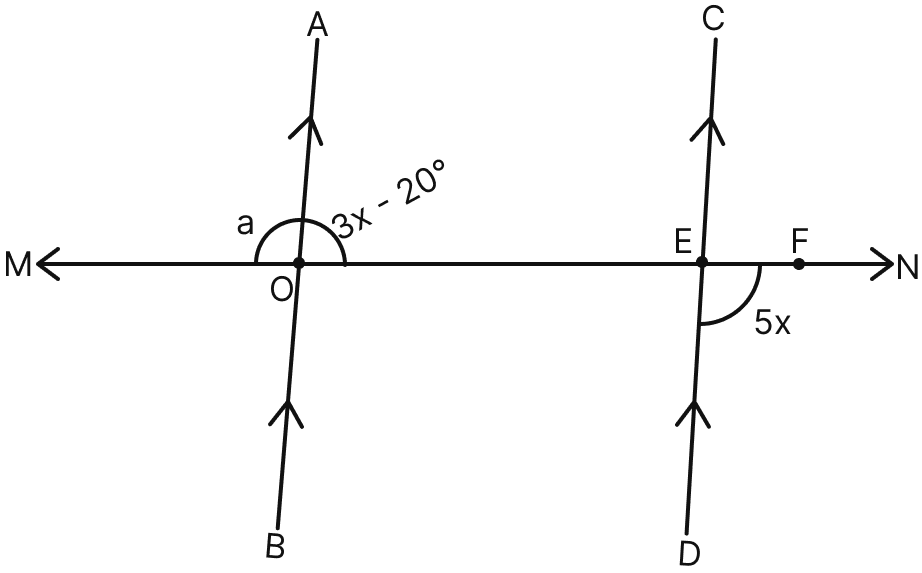
Since BA ∥ DC and MN is a transversal,
⇒ ∠CEO = ∠FED = 5x [Vertically opposite angles are equal]
As, BA ∥ DC and MN is a transversal,
⇒ ∠CEO = ∠a (Corresponding angles are equal)
⇒ ∠a = 5x
Also, ∠a and ∠AOE form a linear pair.
⇒ ∠a + 3x − 20° = 180°
⇒ 5x + 3x − 20° = 180°
⇒ 8x − 20° = 180°
⇒ 8x = 200°
⇒ x =
⇒ x = 25°
⇒ ∠a = 5x = 5 × 25° = 125°.
Hence, option 2 is the correct option.
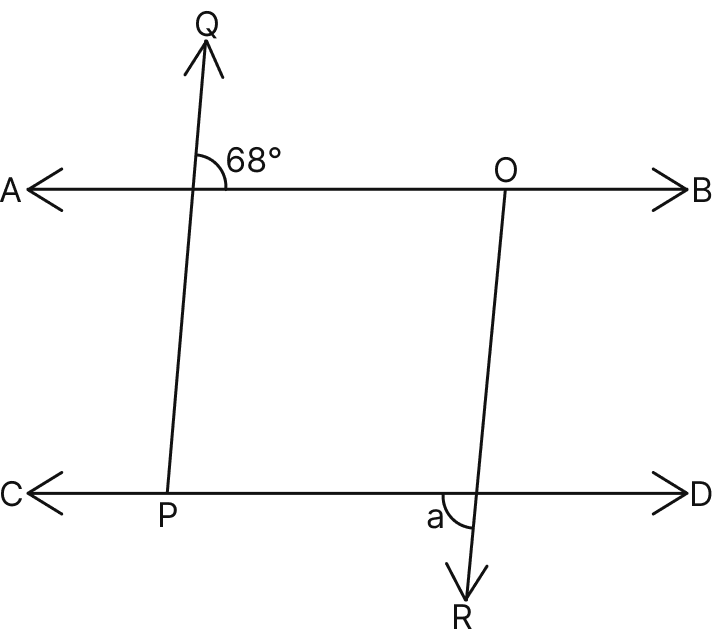
In the given figure, AB ∥ CD and PQ ∥ RO, then ∠a is :
68°
112°
158°
none of these
Answer
Since PQ ∥ RO and AB is a transversal,
⇒ ∠AOR = 68° [Alternate interior angles are equal]
Since AB ∥ CD and RO is a transversal,
⇒ ∠a = ∠AOR [Corresponding angles are equal]
⇒ ∠a = 68°
Hence, option 1 is the correct option.
The supplement of an angle is four times its complement. The angle is :
30°
40°
60°
36°
Answer
Let the angle be x.
Supplement of x = 180° − x and complement of x = 90° − x
As the supplement of the angle is four times its complement,
⇒ 180° − x = 4(90° − x)
⇒ 180° − x = 360° − 4x
⇒ 4x − x = 360° − 180°
⇒ 3x = 180°
⇒ x =
⇒ x = 60°
Hence, option 3 is the correct option.