
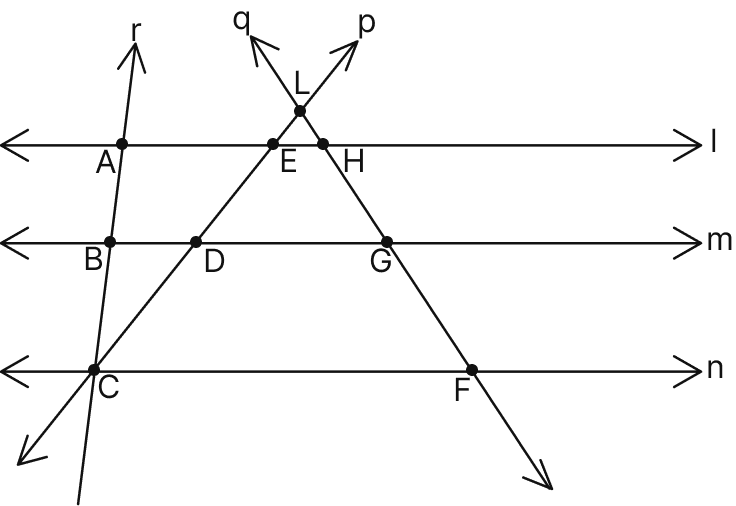
Statement 1 : In the following figure there is/are no line(s) so that four points are collinear.
Statement 2 : Three or more points in a plane are called collinear points if they all lie on the same straight line.
Which of the following options is correct ?
Both the statements are true.
Both the statements are false.
Statement 1 is true, and statement 2 is false.
Statement 1 is false, and statement 2 is true.
Answer
In the given figure, on the line q the four points L, H, G and F are lying, and on the line p the four points L, E, D and C are lying. So, there are two lines on which four points are collinear. So, Statement 1 is false.
Three or more points in a plane which lie on the same straight line are called collinear points. So, Statement 2 is true.
Hence, option 4 is the correct option.
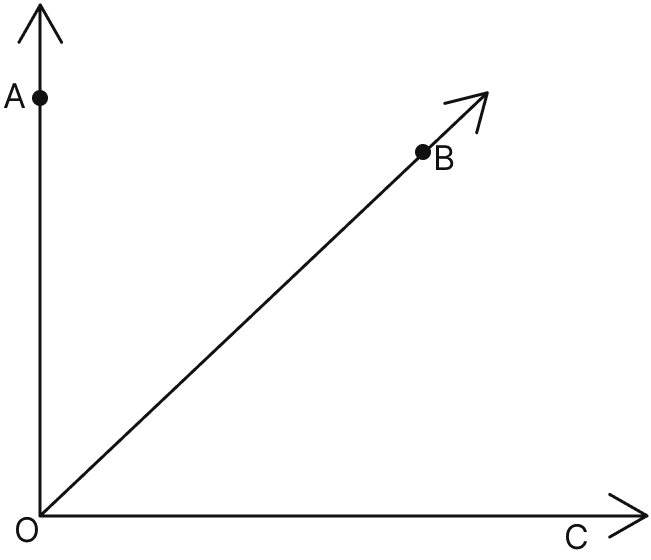
Statement 1 : In the following figure the two pairs of angles namely ∠AOB and ∠BOC are adjacent angles.
Statement 2 : Two angles are said to be adjacent if
(a) They have a common vertex
(b) They have a common arm.
(c) The other two arms of the angles lie on opposite or same side of the common arm.
Which of the following options is correct ?
Both the statements are true.
Both the statements are false.
Statement 1 is true, and statement 2 is false.
Statement 1 is false, and statement 2 is true.
Answer
In the given figure, ∠AOB and ∠BOC have the common vertex O, the common arm OB, and their other arms OA and OC lie on the opposite sides of the common arm OB. So, they are adjacent angles and Statement 1 is true.
For two angles to be adjacent, the other two arms must lie on the opposite sides of the common arm only, and not on the same side. So, Statement 2 is false.
Hence, option 3 is the correct option.