
Assertion (A) : 90° + a − b and b − a + 90° are supplementary angles.
Reason (R) : Two angles are called supplementary angles if their sum is 180°.
A is true, R is false.
A is false, R is true.
Both A and R are true.
Both A and R are false.
Answer
Sum of the given angles
= 90° + a − b + b − a + 90°
= 90° + 90°
= 180°
Since the sum is 180°, the angles are supplementary. So, Assertion (A) is true.
Two angles whose sum is 180° are called supplementary angles. So, Reason (R) is true.
Hence, option 3 is the correct option.
Assertion (A) : In the following diagram, value of x is 44°.
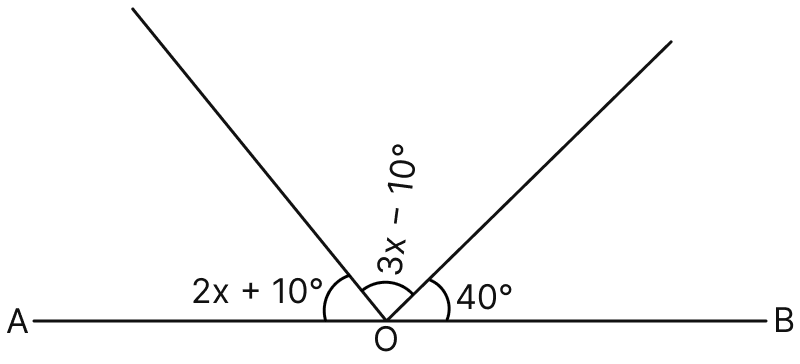
Reason (R) : If the adjacent angles are drawn in such a way that they form a straight line, then such angles are called linear pair and their sum is equal to 180°.
A is true, R is false.
A is false, R is true.
Both A and R are true.
Both A and R are false.
Answer
From the figure, AB is a straight line and the rays at O make the angles 2x + 10°, 3x − 10° and 40° on one side of it.
⇒ 2x + 10° + 3x − 10° + 40° = 180°
⇒ 5x + 40° = 180°
⇒ 5x = 140°
⇒ x =
⇒ x = 28°
Since x = 28° and not 44°, Assertion (A) is false.
Adjacent angles which form a straight line are called a linear pair and their sum is 180°. So, Reason (R) is true.
Hence, option 2 is the correct option.
Assertion (A) : In the following diagram ∠4 + ∠6 = 180° and ∠3 + ∠5 = 180°.
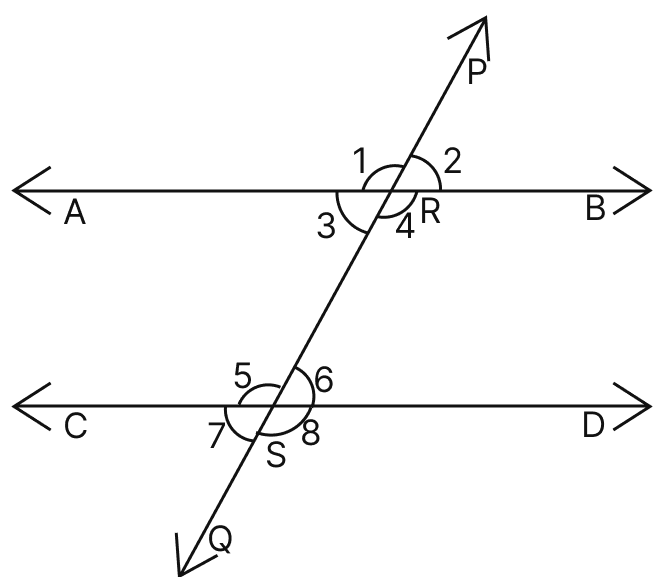
Reason (R) : Co-interior angles are supplementary ⇒ AB is parallel to CD.
A is true, R is false.
A is false, R is true.
Both A and R are true.
Both A and R are false.
Answer
From the figure, ∠4 and ∠6 lie between AB and CD and on the same side of the transversal PQ, so they are co-interior angles. Similarly, ∠3 and ∠5 are co-interior angles.
Since AB is parallel to CD,
⇒ ∠4 + ∠6 = 180° and ∠3 + ∠5 = 180° [Co-interior angles are supplementary]
So, Assertion (A) is true.
If a transversal cuts two lines such that the co-interior angles are supplementary, then the two lines are parallel. So, Reason (R) is true.
Hence, option 3 is the correct option.