
State, if a triangle is possible with the following angles :
20°, 70° and 90°
Answer
A triangle is possible only if the sum of its three angles is 180°.
Solving,
⇒ 20° + 70° + 90° = 180°.
Since the sum is 180°, such a triangle is possible.
Hence, a triangle with angles 20°, 70° and 90° can be formed.
State, if a triangle is possible with the following angles :
40°, 130° and 20°
Answer
A triangle is possible only if the sum of its three angles is 180°.
Solving,
⇒ 40° + 130° + 20° = 190° ≠ 180°.
Since the sum is not 180°, such a triangle is not possible.
Hence, a triangle with angles 40°, 130° and 20° cannot be formed.
State, if a triangle is possible with the following angles :
60°, 60° and 50°
Answer
A triangle is possible only if the sum of its three angles is 180°.
Solving,
⇒ 60° + 60° + 50° = 170° ≠ 180°.
Since the sum is not 180°, such a triangle is not possible.
Hence, a triangle with angles 60°, 60° and 50° cannot be formed.
State, if a triangle is possible with the following angles :
125°, 40° and 15°
Answer
A triangle is possible only if the sum of its three angles is 180°.
Solving,
⇒ 125° + 40° + 15° = 180°.
Since the sum is 180°, such a triangle is possible.
Hence, a triangle with angles 125°, 40° and 15° can be formed.
If the angles of a triangle are equal, find its angles.
Answer
Let each angle of the triangle be x.
By the angle sum property of a triangle,
⇒ x + x + x = 180°
⇒ 3x = 180°
⇒ x =
⇒ x = 60°
Hence, each angle of the triangle is 60°.
In a triangle ABC, ∠A = 45° and ∠B = 75°, find ∠C.
Answer
By the angle sum property of a triangle,
⇒ ∠A + ∠B + ∠C = 180°
⇒ 45° + 75° + ∠C = 180°
⇒ ∠C = 180° − 120° = 60°
Hence, ∠C = 60°.
In a triangle PQR, ∠P = 60° and ∠Q = ∠R, find ∠R.
Answer
Given ∠P = 60° and ∠Q = ∠R. Let ∠Q = ∠R = x.
By the angle sum property of a triangle,
⇒ ∠P + ∠Q + ∠R = 180°
⇒ 60° + x + x = 180°
⇒ 60° + 2x = 180°
⇒ 2x = 180° − 60°
⇒ 2x = 120°
⇒ x =
⇒ x = 60°
Hence, ∠R = 60°.
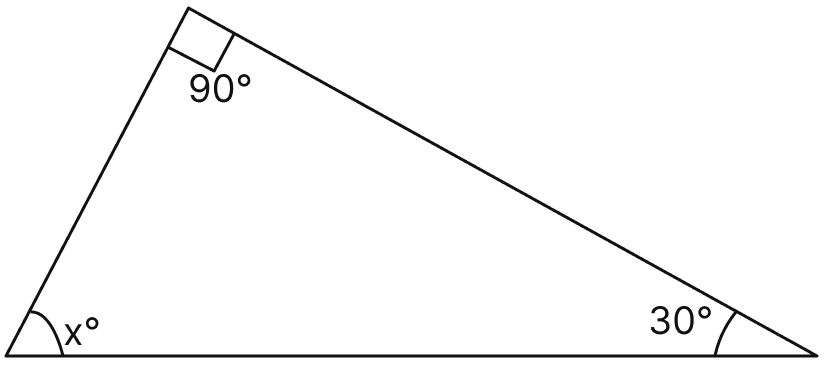
Calculate the unknown marked angles in figure :
Answer
By the angle sum property of a triangle,
⇒ x° + 90° + 30° = 180°
⇒ x° = 180° − 120° = 60°
Hence, x° = 60°.
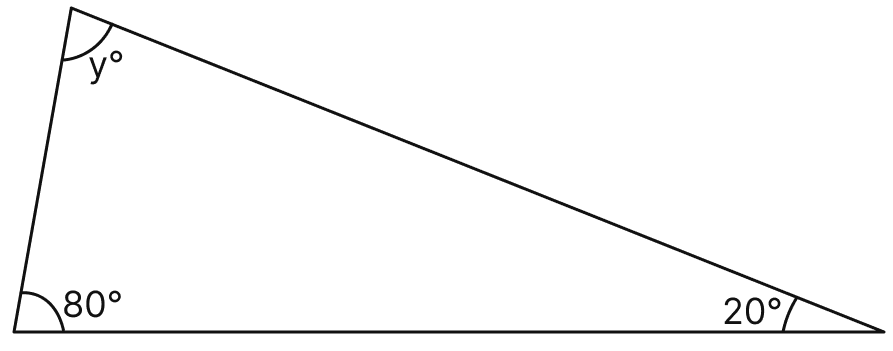
Calculate the unknown marked angles in figure :
Answer
By the angle sum property of a triangle,
⇒ y° + 80° + 20° = 180°
⇒ y° = 180° − 100° = 80°
Hence, y° = 80°.
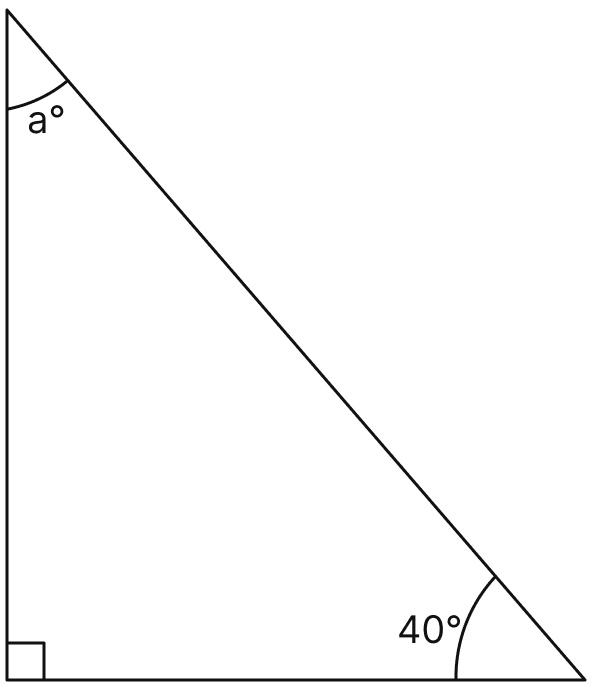
Calculate the unknown marked angles in figure :
Answer
By the angle sum property of a triangle,
⇒ a° + 90° + 40° = 180°
⇒ a° = 180° − 130° = 50°
Hence, a° = 50°.
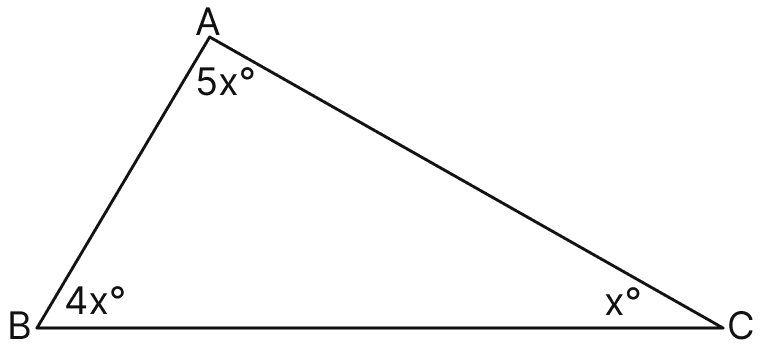
Find the value of each angle in the given figure :
Answer
By the angle sum property of a triangle,
⇒ 5x° + 4x° + x° = 180°
⇒ 10x° = 180°
⇒ x° =
⇒ x° = 18°
∴ ∠A = 5x° = 5 × 18° = 90°, ∠B = 4x° = 4 × 18° = 72° and ∠C = x° = 18°.
Hence, ∠A = 90°, ∠B = 72° and ∠C = 18°.
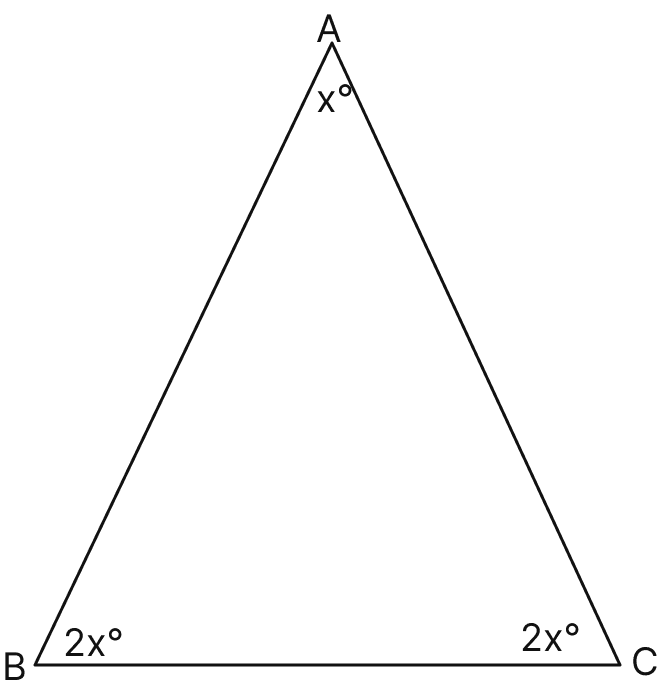
Find the value of each angle in the given figure :
Answer
By the angle sum property of a triangle,
⇒ x° + 2x° + 2x° = 180°
⇒ 5x° = 180°
⇒ x° =
⇒ x° = 36°
∴ ∠A = x° = 36°, ∠B = ∠C = 2x° = 2 × 36° = 72°.
Hence, ∠A = 36° and ∠B = 72° = ∠C.
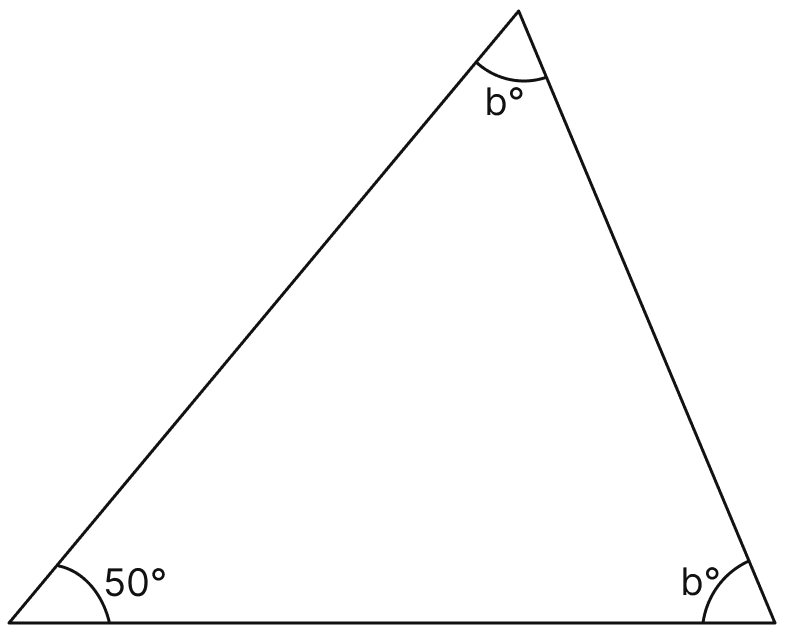
Find the unknown marked angles in the given figure :
Answer
From the figure, two angles of the triangle are each equal to b° and the third angle is 50°. By the angle sum property,
⇒ b° + 50° + b° = 180°
⇒ 2b° + 50° = 180°
⇒ 2b° = 180° − 50°
⇒ 2b° = 130°
⇒ b° =
⇒ b° = 65°
Hence, b° = 65°.
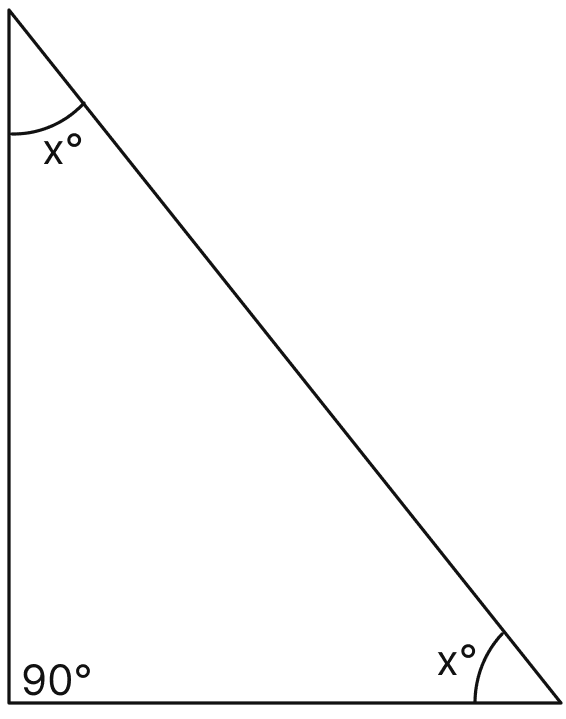
Find the unknown marked angles in the given figure :
Answer
From the figure, two angles of the triangle are each equal to x° and the third angle is 90°. By the angle sum property,
⇒ x° + 90° + x° = 180°
⇒ 2x° + 90° = 180°
⇒ 2x° = 180° − 90°
⇒ 2x° = 90°
⇒ x° =
⇒ x° = 45°
Hence, x° = 45°.
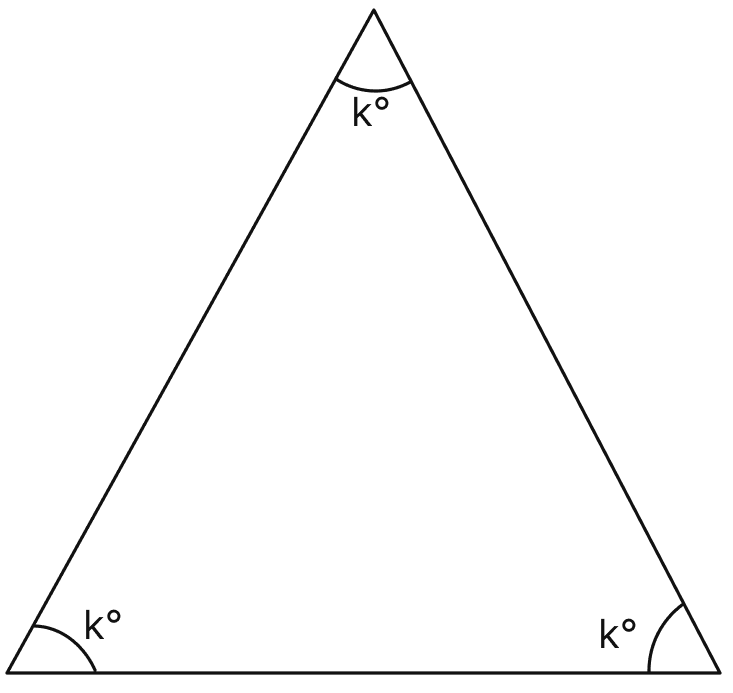
Find the unknown marked angles in the given figure :
Answer
Here all three angles of the triangle are equal to k°. By the angle sum property,
⇒ k° + k° + k° = 180°
⇒ 3k° = 180°
⇒ k° =
⇒ k° = 60°
Hence, k° = 60°.
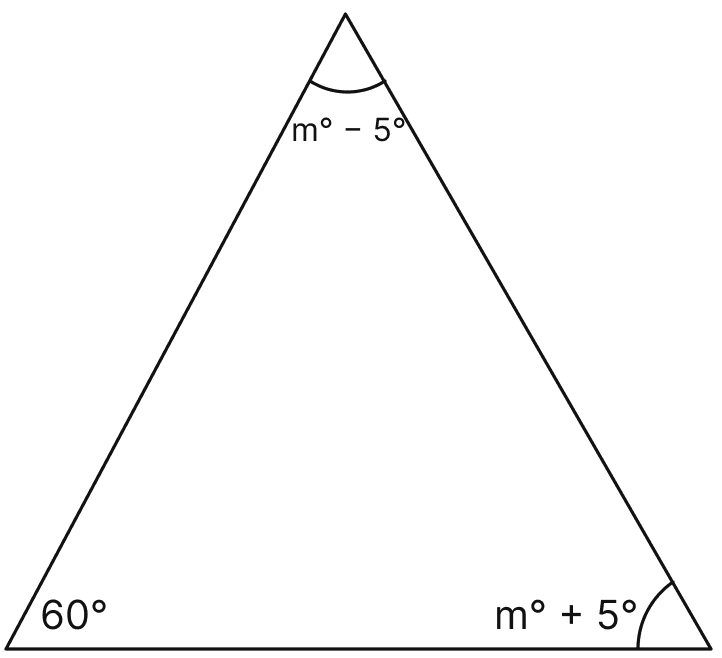
Find the unknown marked angles in the given figure :
Answer
The three angles of the triangle are (m° − 5°), 60° and (m° + 5°). By the angle sum property,
⇒ (m° − 5°) + 60° + (m° + 5°) = 180°
⇒ 2m° + 60° = 180°
⇒ 2m° = 180° − 60°
⇒ 2m° = 120°
⇒ m° =
⇒ m° = 60°
Hence, m° = 60°.
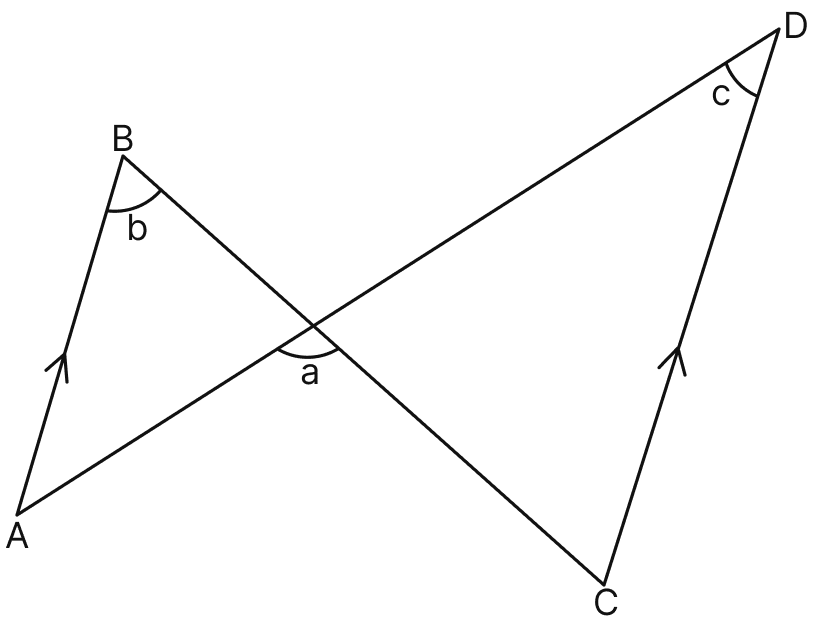
In the given figure, show that : ∠a = ∠b + ∠c.
(i) If ∠b = 60° and ∠c = 50°, find ∠a.
(ii) If ∠a = 100° and ∠b = 55°, find ∠c.
(iii) If ∠a = 108° and ∠c = 48°, find ∠b.
Answer
In the given figure, AB is parallel to CD. Let AD and BC intersect each other at the point O.
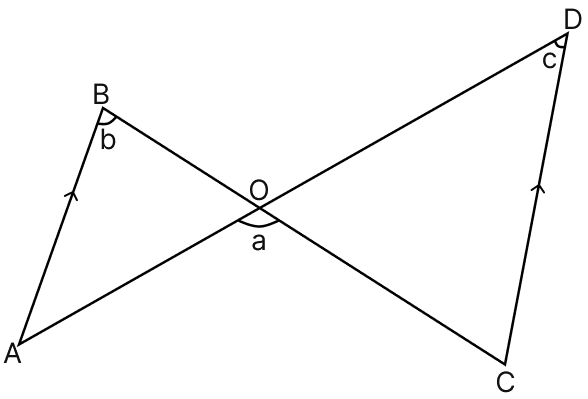
Since AB ∥ CD and BC is the transversal,
⇒ ∠BCD = ∠ABC = ∠b (alternate angles are equal)
In △OCD, the side DO is produced to A, so ∠AOC is the exterior angle at O.
⇒ ∠a = ∠AOC
By the exterior angle property, an exterior angle of a triangle is equal to the sum of its two interior opposite angles. Here the two interior opposite angles are ∠OCD (= ∠BCD) and ∠ODC (= ∠ADC).
∴ ∠a = ∠BCD + ∠ADC
⇒ ∠a = ∠b + ∠c
Hence, proved that ∠a = ∠b + ∠c.
(i) Solving,
⇒ ∠a = ∠b + ∠c = 60° + 50° = 110°.
Hence, ∠a = 110°.
(ii) Solving,
⇒ ∠a = ∠b + ∠c
⇒ 100° = 55° + ∠c
⇒ ∠c = 100° − 55° = 45°
Hence, ∠c = 45°.
(iii) Solving,
⇒ ∠a = ∠b + ∠c
⇒ 108° = ∠b + 48°
⇒ ∠b = 108° − 48° = 60°
Hence, ∠b = 60°.
Calculate the angles of a triangle, if they are in the ratio 4 : 5 : 6.
Answer
Let the three angles be 4x, 5x and 6x.
By the angle sum property of a triangle,
⇒ 4x + 5x + 6x = 180°
⇒ 15x = 180°
⇒ x =
⇒ x = 12°
∴ The angles are 4x = 4 × 12° = 48°, 5x = 5 × 12° = 60° and 6x = 6 × 12° = 72°.
Hence, the angles of the triangle are 48°, 60° and 72°.
One angle of a triangle is 60°. The other two angles are in the ratio of 5 : 7. Find the two angles.
Answer
Let the other two angles be 5x and 7x.
By the angle sum property of a triangle,
⇒ 60° + 5x + 7x = 180°
⇒ 60° + 12x = 180°
⇒ 12x = 180° − 60°
⇒ 12x = 120°
⇒ x =
⇒ x = 10°
∴ The two angles are 5x = 5 × 10° = 50° and 7x = 7 × 10° = 70°.
Hence, the two angles are 50° and 70°.
One angle of a triangle is 61° and the other two angles are in the ratio . Find these angles.
Answer
The ratio of the other two angles is
L.C.M. of 2 and 3 = 6
Multiplying both terms by 6,
Let the two angles be 9x and 8x.
By the angle sum property of a triangle,
⇒ 61° + 9x + 8x = 180°
⇒ 61° + 17x = 180°
⇒ 17x = 180° − 61°
⇒ 17x = 119°
⇒ x =
⇒ x = 7°
∴ The two angles are 9x = 9 × 7° = 63° and 8x = 8 × 7° = 56°.
Hence, these angles are 63° and 56°.
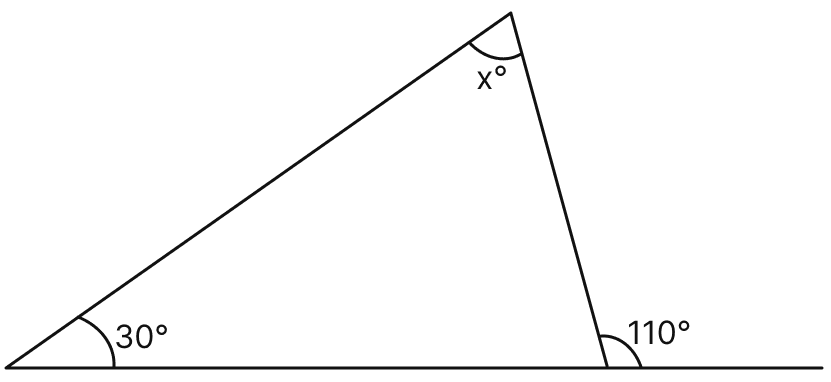
Find the unknown marked angles in the given figure.
Answer
By the exterior angle property, an exterior angle of a triangle is equal to the sum of its two interior opposite angles.
Here, 110° is the exterior angle, and x° and 30° are its two interior opposite angles.
⇒ x° + 30° = 110°
⇒ x° = 110° − 30°
⇒ x° = 80°
Hence, x° = 80°.
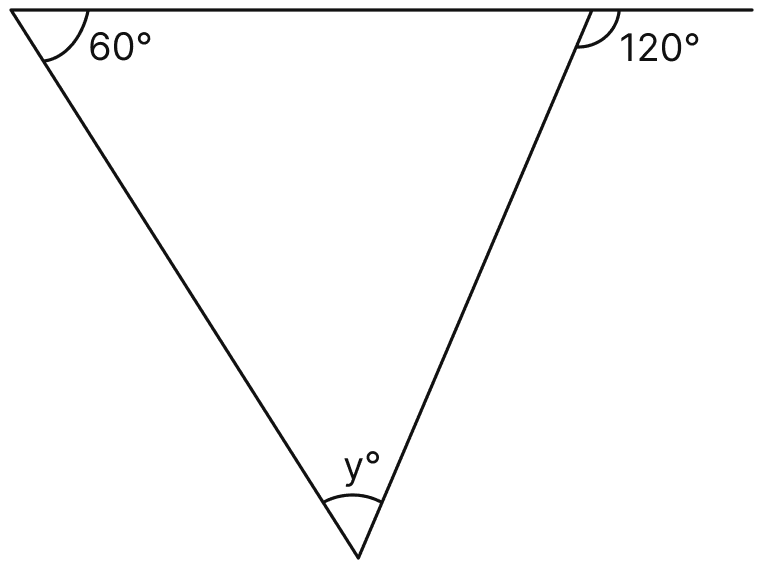
Find the unknown marked angles in the given figure.
Answer
By the exterior angle property, an exterior angle of a triangle is equal to the sum of its two interior opposite angles.
Here, 120° is the exterior angle, and y° and 60° are its two interior opposite angles.
⇒ y° + 60° = 120°
⇒ y° = 120° − 60°
⇒ y° = 60°
Hence, y° = 60°.
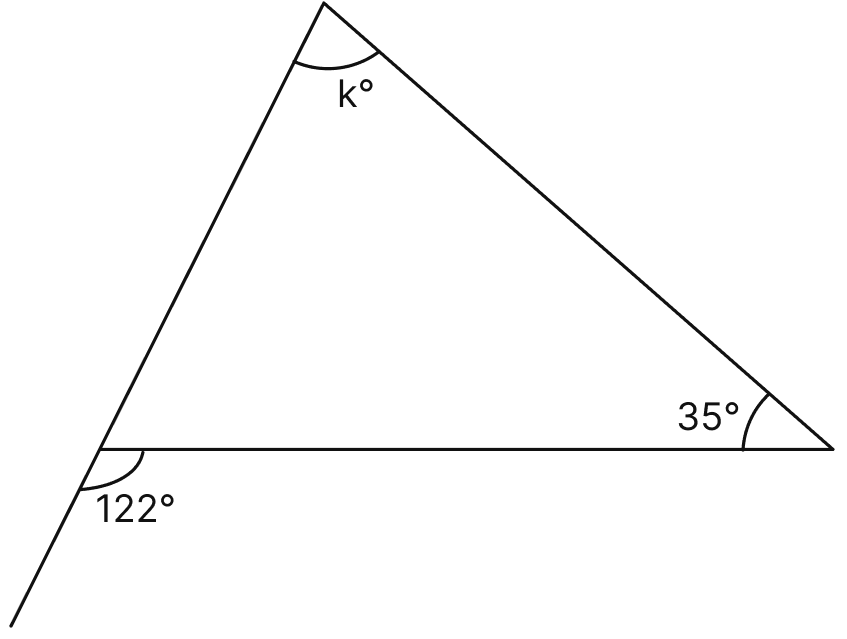
Find the unknown marked angles in the given figure.
Answer
By the exterior angle property, an exterior angle of a triangle is equal to the sum of its two interior opposite angles.
Here, 122° is the exterior angle, and k° and 35° are its two interior opposite angles.
⇒ k° + 35° = 122°
⇒ k° = 122° − 35°
⇒ k° = 87°
Hence, k° = 87°.
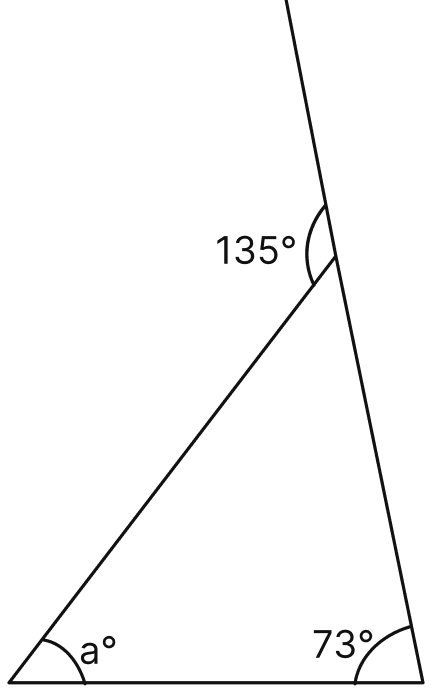
Find the unknown marked angles in the given figure.
Answer
By the exterior angle property, an exterior angle of a triangle is equal to the sum of its two interior opposite angles.
Here, 135° is the exterior angle, and a° and 73° are its two interior opposite angles.
⇒ a° + 73° = 135°
⇒ a° = 135° − 73°
⇒ a° = 62°
Hence, a° = 62°.
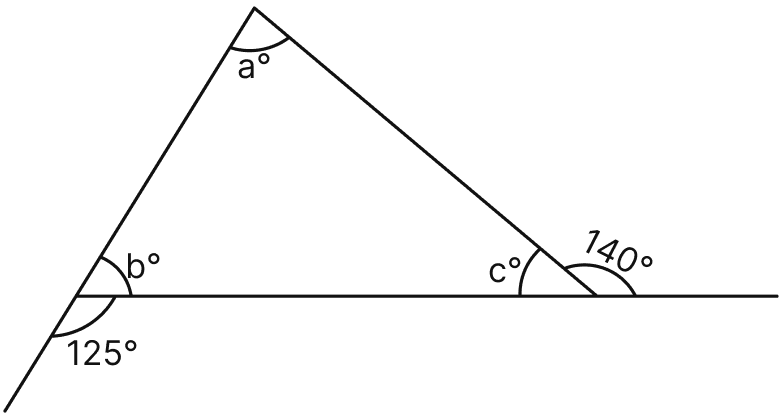
Find the unknown marked angles in the given figure.
Answer
By the exterior angle property, an exterior angle of a triangle is equal to the sum of its two interior opposite angles.
Here, 125° is the exterior angle at the vertex of b°, and a° and c° are its two interior opposite angles.
⇒ a° + c° = 125° ....(1)
Also, 140° is the exterior angle at the vertex of c°, and a° and b° are its two interior opposite angles.
⇒ a° + b° = 140° ....(2)
Adding (1) and (2),
⇒ 2a° + b° + c° = 125° + 140°
⇒ 2a° + b° + c° = 265° ....(3)
By the angle sum property,
⇒ a° + b° + c° = 180° ....(4)
Subtracting (4) from (3),
⇒ a° = 265° − 180°
⇒ a° = 85°
Substituting a° = 85° in (1),
⇒ 85° + c° = 125°
⇒ c° = 125° − 85°
⇒ c° = 40°
Substituting a° = 85° in (2),
⇒ 85° + b° = 140°
⇒ b° = 140° − 85°
⇒ b° = 55°
Hence, a° = 85°, b° = 55° and c° = 40°.
Find the unknown marked angles in the given figure.
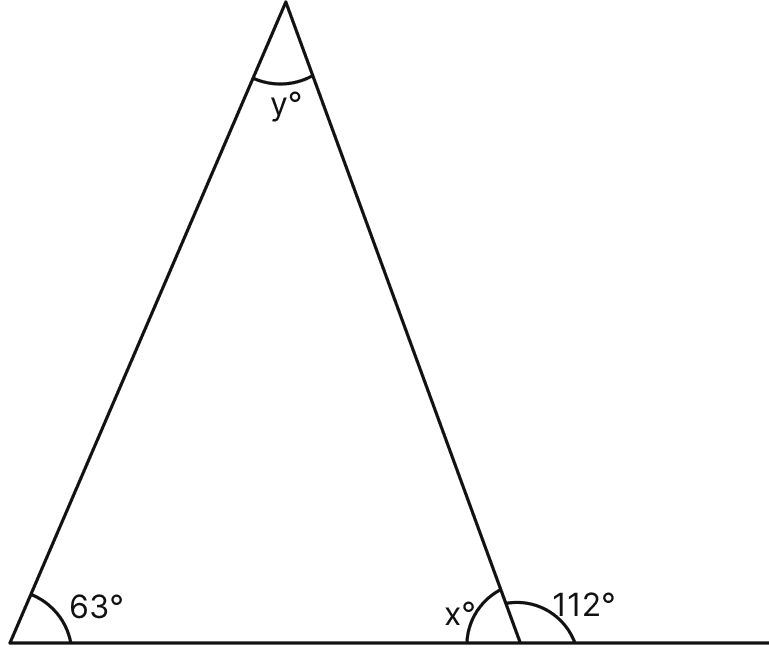
Answer
By the exterior angle property, an exterior angle of a triangle is equal to the sum of its two interior opposite angles.
Here, 112° is the exterior angle, and y° and 63° are its two interior opposite angles.
⇒ y° + 63° = 112°
⇒ y° = 112° − 63°
⇒ y° = 49°
Now x° and 112° form a linear pair.
⇒ x° + 112° = 180°
⇒ x° = 180° − 112°
⇒ x° = 68°
Hence, x° = 68° and y° = 49°.
Find the unknown marked angles in the given figure.
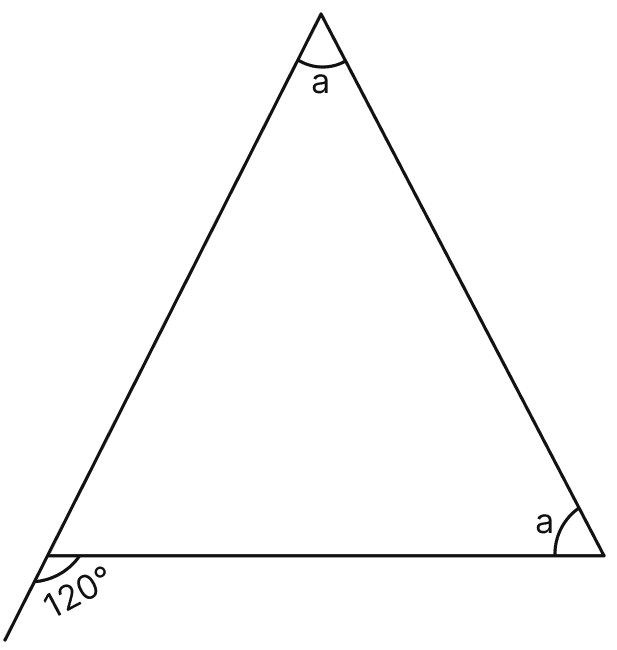
Answer
By the exterior angle property, an exterior angle of a triangle is equal to the sum of its two interior opposite angles.
Here, 120° is the exterior angle, and a° and a° are its two interior opposite angles.
⇒ a° + a° = 120°
⇒ 2a° = 120°
⇒ a° =
⇒ a° = 60°
Hence, a° = 60°.
Find the unknown marked angles in the given figure.
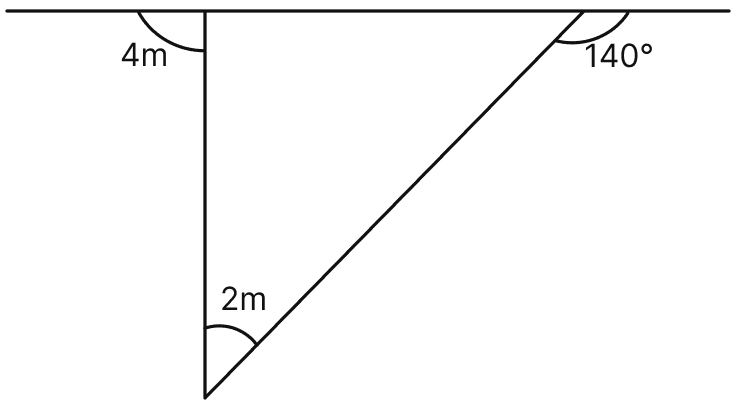
Answer
By the exterior angle property, an exterior angle of a triangle is equal to the sum of its two interior opposite angles.
The interior angle at the right vertex and 140° form a linear pair.
⇒ Interior angle at the right vertex = 180° − 140° = 40°
Here, 4m is the exterior angle at the top-left vertex, and 2m and 40° are its two interior opposite angles.
⇒ 4m = 2m + 40°
⇒ 4m − 2m = 40°
⇒ 2m = 40°
⇒ m =
⇒ m = 20°
Hence, m = 20°.
Find the unknown marked angles in the given figure.
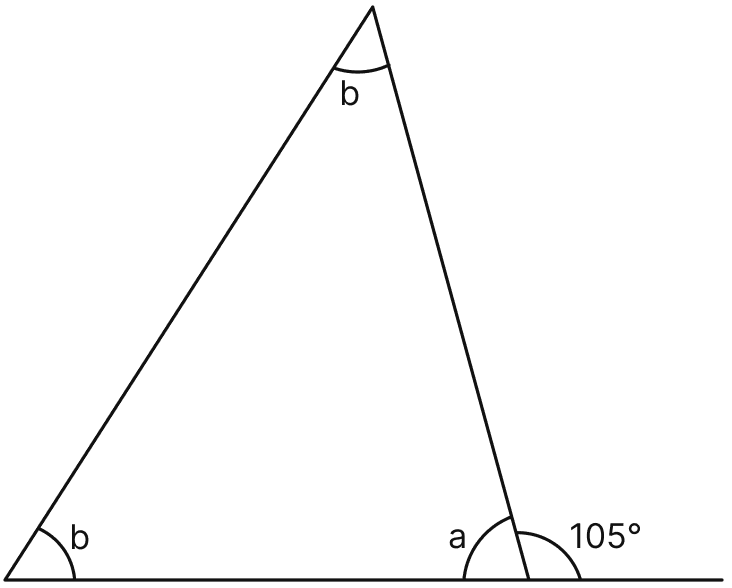
Answer
By the exterior angle property, an exterior angle of a triangle is equal to the sum of its two interior opposite angles.
The triangle is isosceles, so its two base angles are each equal to b°.
Here, 105° is the exterior angle, and b° and b° are its two interior opposite angles.
⇒ b° + b° = 105°
⇒ 2b° = 105°
⇒ b° =
⇒ b° = 52·5° = 52°30′
Now a° and 105° form a linear pair.
⇒ a° + 105° = 180°
⇒ a° = 180° − 105°
⇒ a° = 75°
Hence, a° = 75° and b° = 52·5° = 52°30′.