
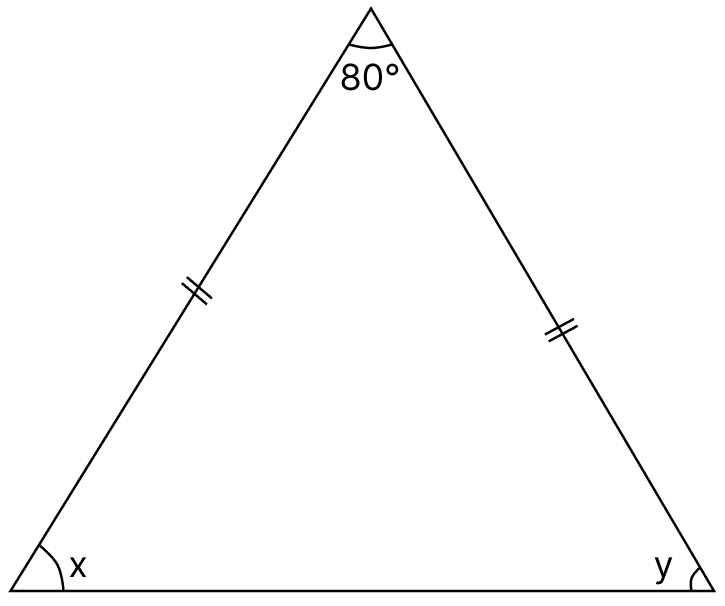
Find the unknown angles in the given figure :
Answer
The triangle is isosceles with the two equal sides, so the base angles x and y are equal. The vertical angle is 80°. By the angle sum property,
⇒ x + y + 80° = 180°
⇒ x + x + 80° = 180°
⇒ 2x + 80° = 180°
⇒ 2x = 180° − 80°
⇒ 2x = 100°
⇒ x =
⇒ x = 50°
∴ x = y = 50°.
Hence, x = 50° = y.
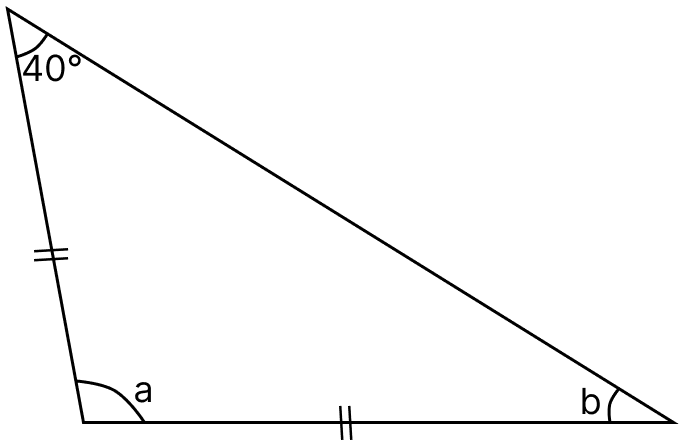
Find the unknown angles in the given figure :
Answer
The triangle is isosceles with the two equal sides, so the base angles 40° and b are equal, giving b = 40°. By the angle sum property,
⇒ a + 40° + b = 180°
⇒ a + 40° + 40° = 180°
⇒ a + 80° = 180°
⇒ a = 180° − 80°
⇒ a = 100°
Hence, a = 100° and b = 40°.
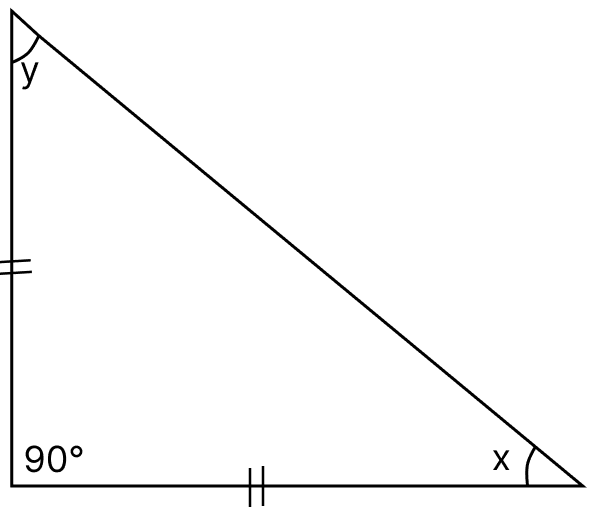
Find the unknown angles in the given figure :
Answer
The two equal sides meet at the right angle (90°), so the base angles x and y are equal. By the angle sum property,
⇒ 90° + x + y = 180°
⇒ 90° + 2x = 180°
⇒ 2x = 180° − 90°
⇒ 2x = 90°
⇒ x =
⇒ x = 45°
∴ x = y = 45°.
Hence, x = y = 45°.
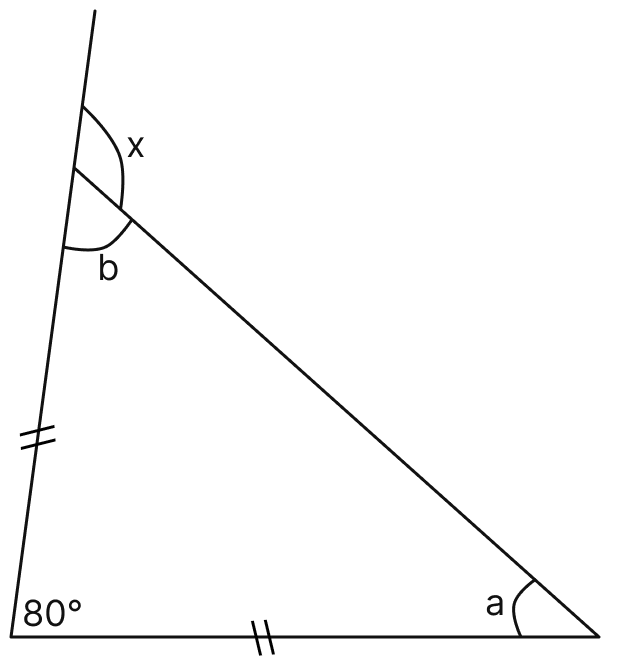
Find the unknown angles in the given figure :
Answer
The two equal sides meet at the 80° vertex, so the base angles a and b are equal. By the angle sum property,
⇒ 80° + a + b = 180°
⇒ 80° + 2a = 180°
⇒ 2a = 180° − 80°
⇒ 2a = 100°
⇒ a =
⇒ a = 50°
∴ a = b = 50°.
Now x is the exterior angle at the top vertex, so it forms a linear pair with the base angle b.
⇒ x = 180° − b = 180° − 50° = 130°
Hence, x = 130° and a = 50° = b.
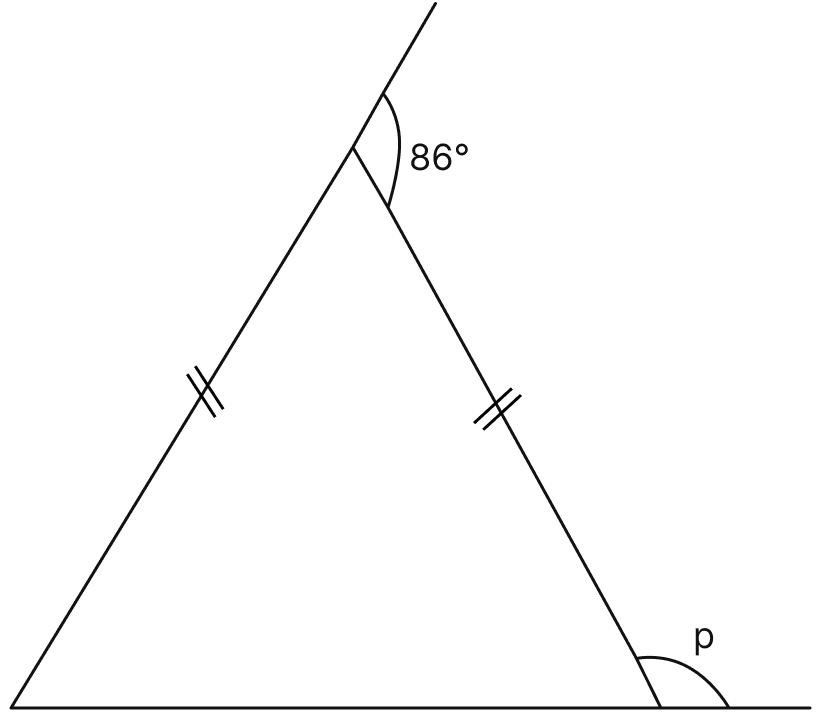
Find the unknown angles in the given figure :
Answer
In the given isosceles triangle,
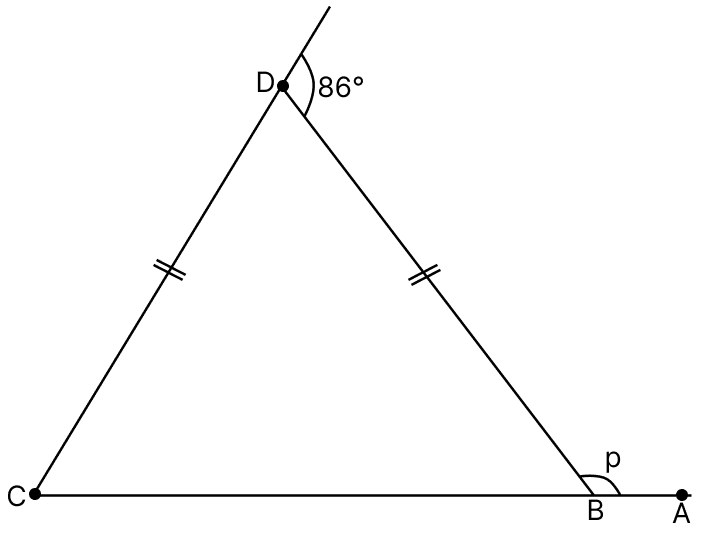
∠BDC and 86° form a linear pair.
⇒ ∠BDC + 86° = 180°
⇒ ∠BDC = 180° − 86° = 94°
Since, CD = BD
⇒ ∠BCD = ∠CBD [Angles opposite to equal sides in a triangle are equal]
By angle sum property,
⇒ ∠BDC + ∠BCD + ∠CBD = 180°
⇒ 94° + ∠BCD + ∠BCD = 180°
⇒ 2∠BCD = 180° − 94°
⇒ 2∠BCD = 86°
⇒ ∠BCD = = 43°
⇒ ∠BCD = ∠CBD = 43°
Now p and ∠CBD form a linear pair, so
⇒ p + ∠CBD = 180°
⇒ p = 180° − ∠CBD
⇒ p = 180° − 43° = 137°
Hence, p = 137°.
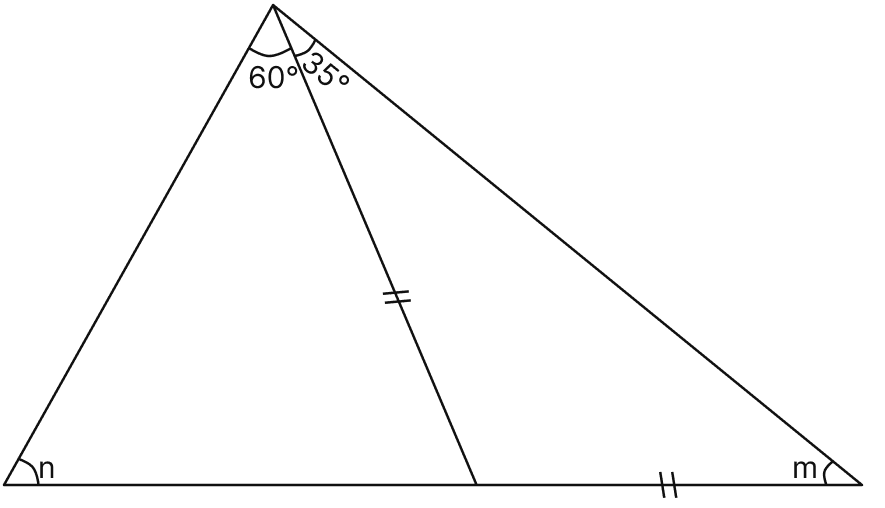
Find the unknown angles in the given figure :
Answer
In isosceles △ACD,
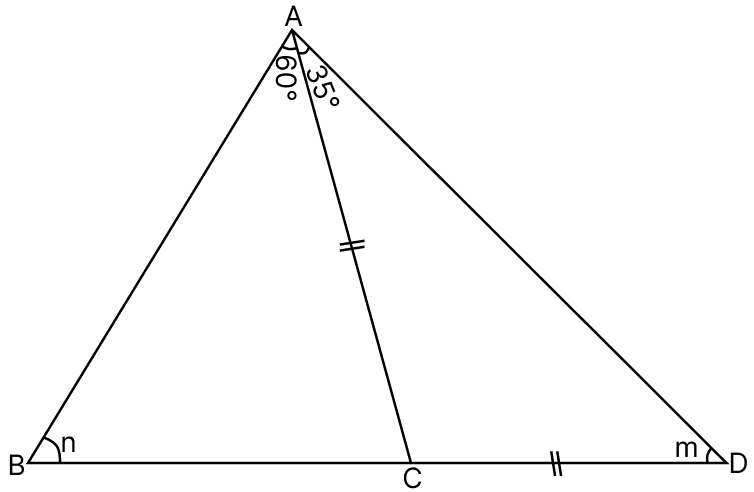
AC = CD
⇒ m = 35° [Angles opposite to equal sides in a triangle are equal]
Now, in △ABD,
∠A = 60° + 35° = 95°
By angle sum property,
⇒ ∠A + ∠B + ∠D = 180°
⇒ 95° + n + m = 180°
⇒ 95° + n + 35° = 180°
⇒ n + 130° = 180°
⇒ n = 180° − 130° = 50°
Hence, n = 50° and m = 35°.
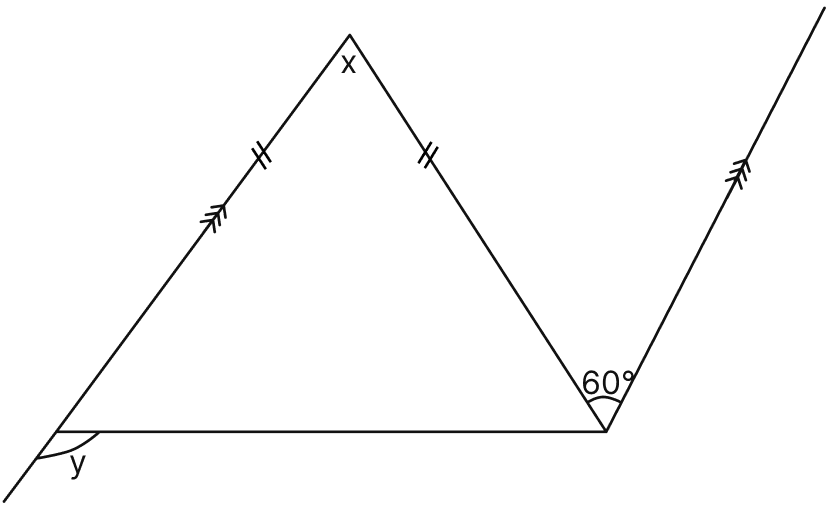
Find the unknown angles in the given figure :
Answer
In the given figure,
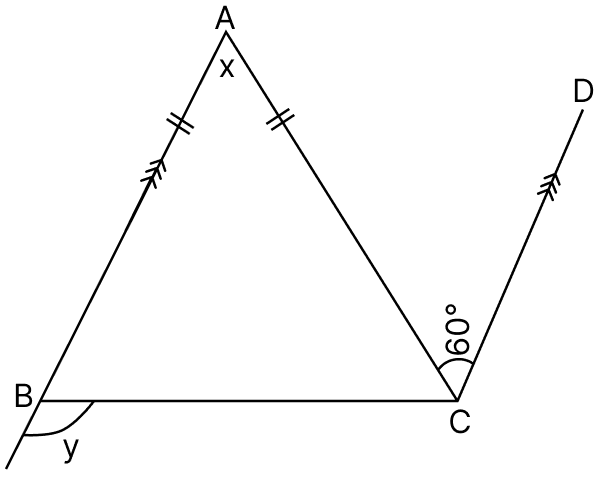
Since AB is parallel to DC,
⇒ x = 60° (Alternate angles are equal)
As, AB = AC
⇒ ∠ABC = ∠ACB [Angles opposite to equal sides in a triangle are equal]
By angle sum property,
⇒ ∠ABC + ∠A + ∠ACB = 180°
⇒ ∠ABC + x + ∠ABC = 180°
⇒ 2∠ABC + 60° = 180°
⇒ 2∠ABC = 180° − 60°
⇒ 2∠ABC = 120°
⇒ ∠ABC = = 60°
As y and ∠ABC form a linear pair,
⇒ y + ∠ABC = 180°
⇒ y + 60° = 180°
⇒ y = 120°
Hence, x = 60° and y = 120°.
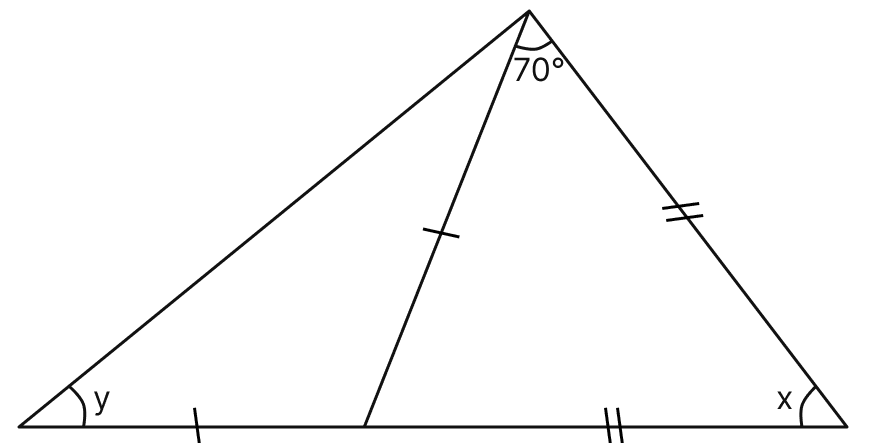
Apply the properties of isosceles and equilateral triangles to find the unknown angles in the given figure :
Answer
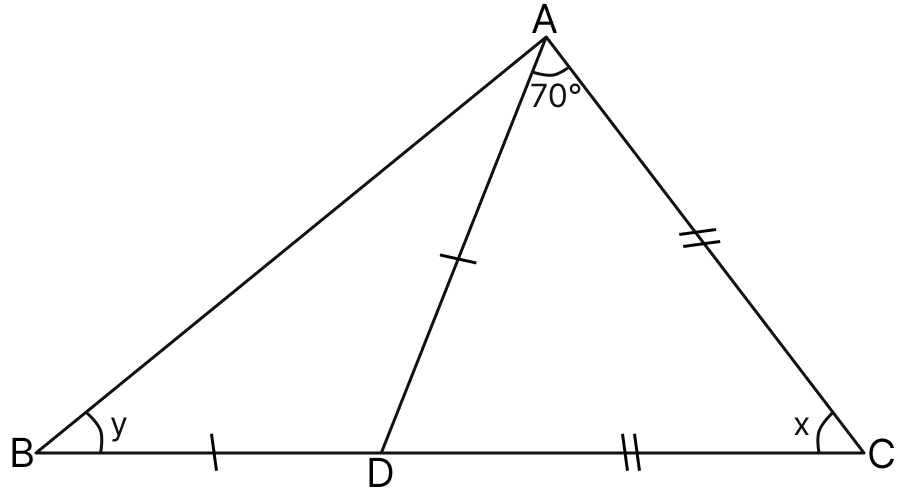
In isosceles △ADC, AC = DC
⇒ ∠CAD = ∠CDA = 70° (base angles of an isosceles triangle are equal)
By the angle sum property,
⇒ ∠C + ∠CAD + ∠CDA = 180°
⇒ x + 70° + 70° = 180°
⇒ x = 180° − 70° − 70° = 40°.
Now, ∠BDA + ∠CDA = 180° (linear pair)
⇒ ∠BDA = 180° − 70° = 110°
In isosceles △ADB, BD = AD
⇒ ∠DAB = ∠DBA = y (base angles of an isosceles triangle are equal)
By the angle sum property,
⇒ ∠DBA + ∠BAD + ∠BDA = 180°
⇒ y + y + 110° = 180°
⇒ 2y + 110° = 180°
⇒ 2y = 180° − 110°
⇒ 2y = 70°
⇒ y =
⇒ y = 35°
Hence, x = 40° and y = 35°.
Apply the properties of isosceles and equilateral triangles to find the unknown angles in the given figure :
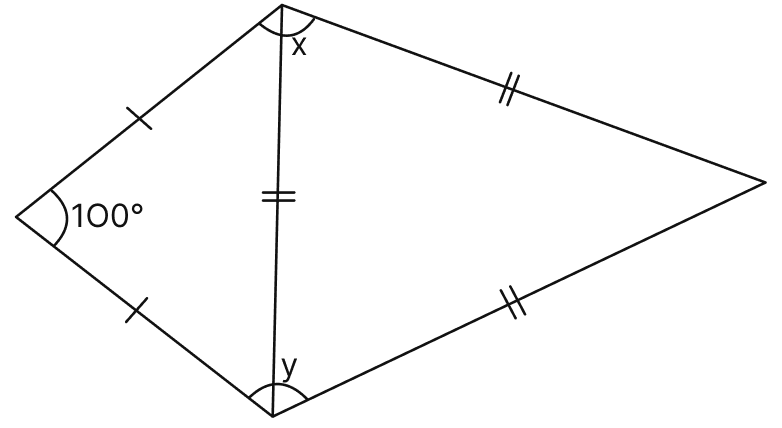
Answer
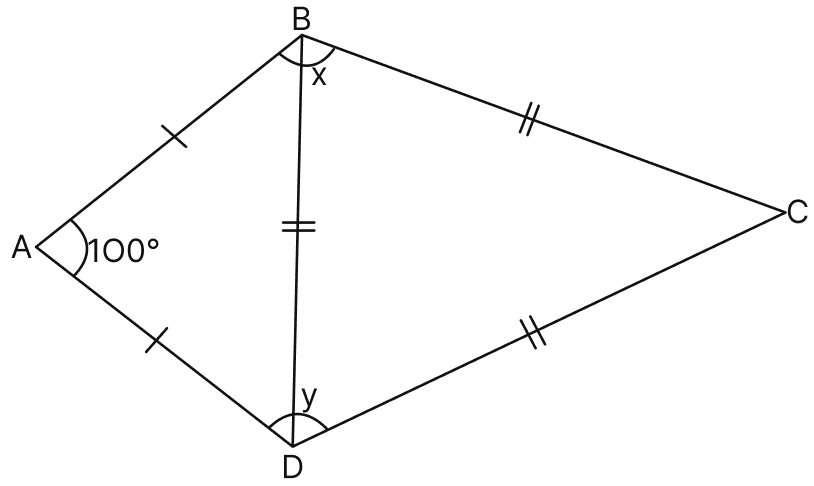
In isosceles △ABD, AB = AD
⇒ ∠ABD = ∠ADB (base angles of an isosceles triangle are equal)
By angle sum property,
⇒ ∠A + ∠ABD + ∠ADB = 180°
⇒ 100° + 2∠ABD = 180°
⇒ ∠ABD =
In equilateral △BCD, BC = CD = BD
⇒ ∠DCB = ∠CBD = ∠BDC
By angle sum property,
⇒ ∠DCB + ∠CBD + ∠BDC = 180°
⇒ 3∠DCB = 180°
⇒ ∠DCB =
⇒ ∠DCB = 60°
∴ x = ∠ABD + ∠CBD = 40° + 60° = 100°
and
y = ∠ADB + ∠BDC = 40° + 60° = 100°.
Hence, x = 100° = y.
Apply the properties of isosceles and equilateral triangles to find the unknown angles in the given figure :
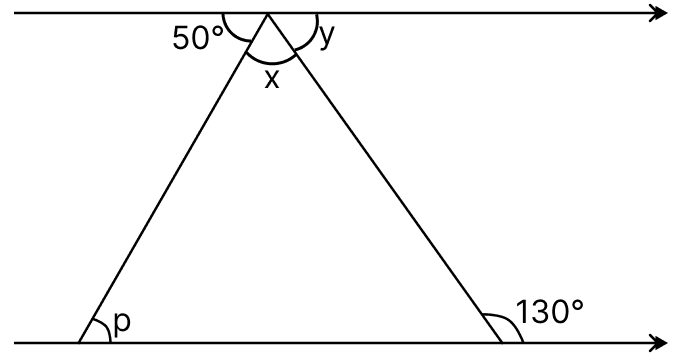
Answer
From the figure,
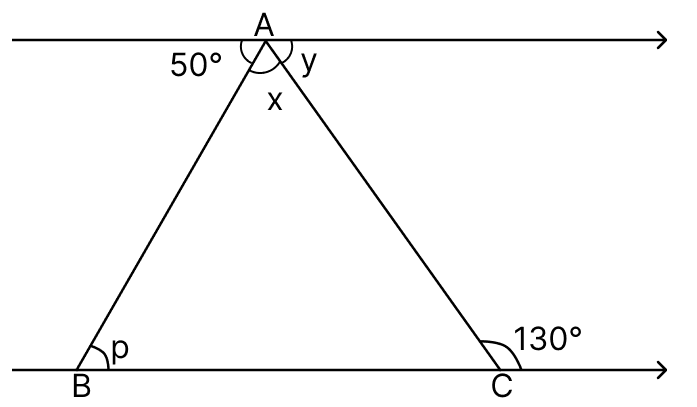
Since the horizontal lines are parallel. p and 50° are interior alternate angles.
⇒ p = 50° [Alternate interior angles are equal]
From figure,
⇒ ∠ACB + 130° = 180° (linear pair)
⇒ ∠ACB = 50°
In the △ABC, by the angle sum property,
⇒ ∠BAC + ∠ACB + ∠ABC = 180°
⇒ x + 50° + p = 180°
⇒ x + 50° + 50° = 180°
⇒ x + 100° = 180°
⇒ x = 80°
50°, x and y lie on a straight line.
⇒ 50° + x + y = 180°
⇒ 50° + 80° + y = 180°
⇒ y = 180° − 50° − 80° = 50°
Hence, x = 80°, p = 50° and y = 50°.
Apply the properties of isosceles and equilateral triangles to find the unknown angles in the given figure :
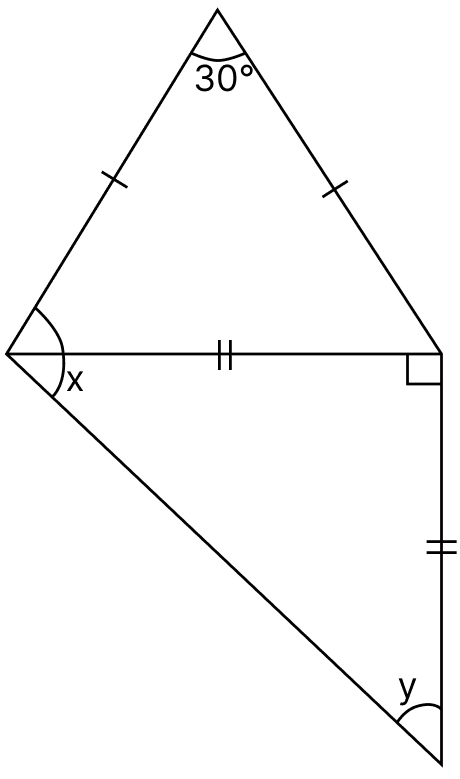
Answer
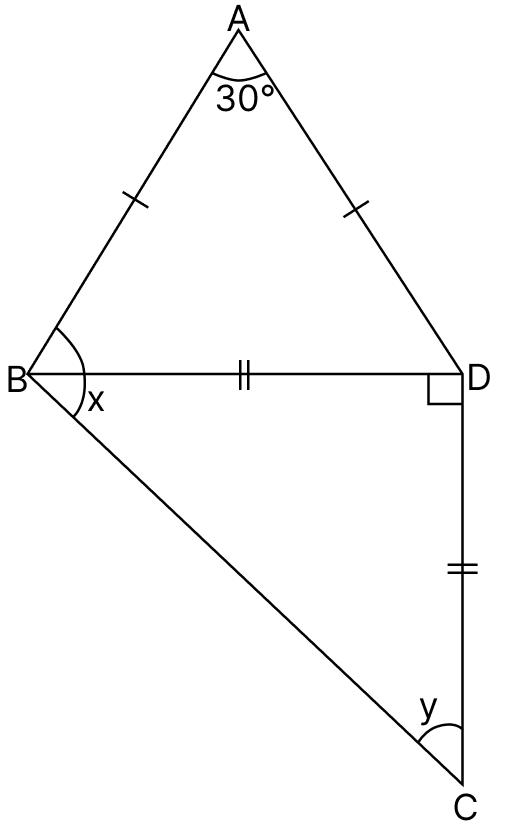
In △ABD, AB = AD
⇒ ∠ABD = ∠ADB [Angles opposite to equal sides in a triangle are equal]
By the angle sum property,
⇒ ∠A + ∠ABD + ∠ADB = 180°
⇒ 30° + 2∠ABD = 180°
⇒ ∠ABD = = 75°
In △BDC,
⇒ BD = CD
⇒ ∠DBC = ∠DCB [Angles opposite to equal sides in a triangle are equal]
By the angle sum property,
⇒ ∠DCB + ∠DBC + ∠BDC = 180°
⇒ 2∠DBC + 90° = 180°
⇒ ∠DBC = = 45°
∴ x = ∠ABD + ∠DBC = 75° + 45° = 120° and y = 45°.
Hence, x = 120° and y = 45°.
Apply the properties of isosceles and equilateral triangles to find the unknown angles in the given figure :
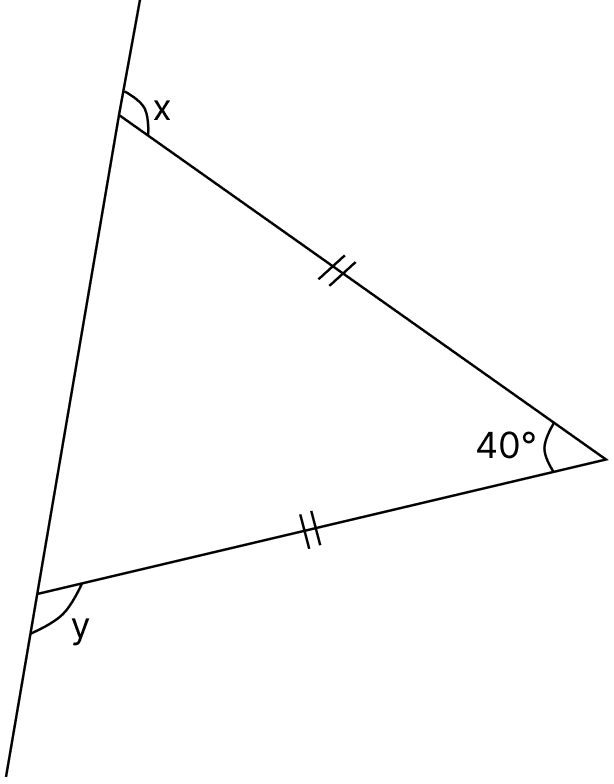
Answer
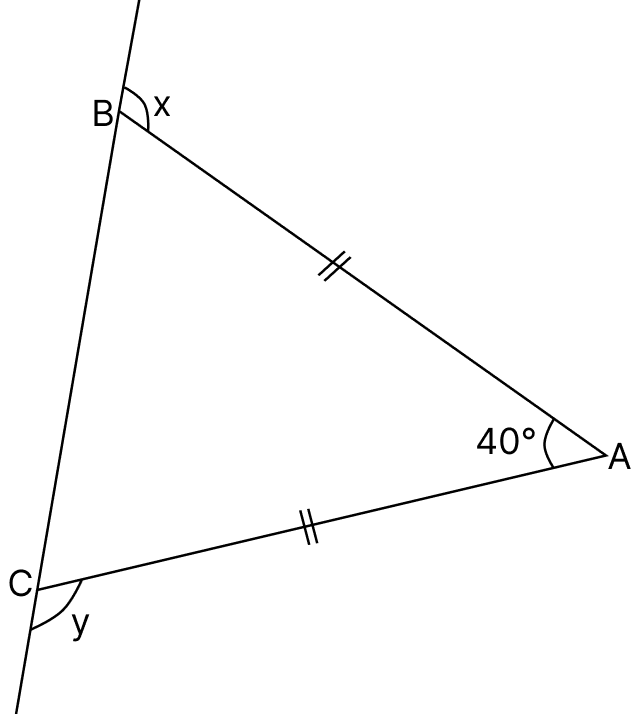
In △ABC, AB = AC
⇒ ∠ABC = ∠ACB [Angles opposite to equal sides in a triangle are equal]
By the angle sum property,
⇒ ∠ACB + ∠ABC + ∠A = 180°
⇒ 2∠ABC + 40° = 180°
⇒ ∠ABC
x and y are the exterior angles at the other two vertices, each forming a linear pair with a base angle :
⇒ x = 180° − 70° = 110° and y = 180° − 70° = 110°
Hence, x = 110° = y.
Apply the properties of isosceles and equilateral triangles to find the unknown angles in the given figure :
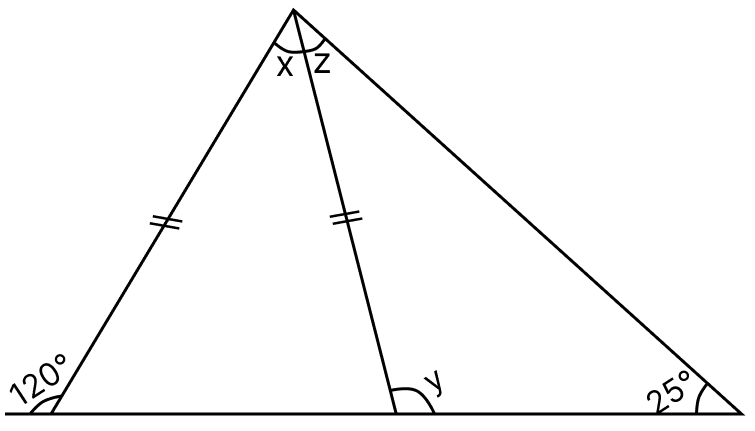
Answer
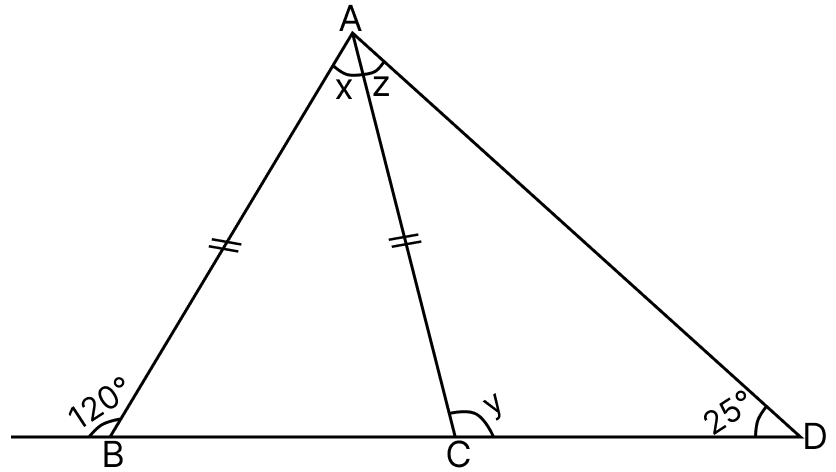
∠ABC + 120° = 180° (linear pair)
⇒ ∠ABC = 180° − 120° = 60°
In △ABC, AB = AC
⇒ ∠ABC = ∠ACB = 60° [Angles opposite to equal sides in a triangle are equal]
By the angle sum property,
⇒ ∠ACB + ∠ABC + ∠BAC = 180°
⇒ 60° + 60° + x = 180°
⇒ x = 180° − 60° − 60° = 60°
Now y and ∠ACB form a linear pair, so
⇒ y = 180° − 60° = 120°
In △ACD, by the angle sum property,
⇒ z + y + 25° = 180°
⇒ z + 120° + 25° = 180°
⇒ z = 35°
Hence, x = 60°, y = 120° and z = 35°.
The angle of vertex of an isosceles triangle is 100°. Find its base angles.
Answer
In an isosceles triangle the two base angles are equal. Let each base angle be x.
By the angle sum property of a triangle,
⇒ 100° + x + x = 180°
⇒ 100° + 2x = 180°
⇒ 2x = 180° − 100°
⇒ 2x = 80°
⇒ x =
⇒ x = 40°
Hence, the base angles are 40° and 40°.
One of the base angles of an isosceles triangle is 52°. Find its angle of vertex.
Answer
In an isosceles triangle the two base angles are equal, so the other base angle is also 52°. Let the vertex angle be x.
By the angle sum property of a triangle,
⇒ x + 52° + 52° = 180°
⇒ x = 180° − 104° = 76°
Hence, the angle of vertex is 76°.
In an isosceles triangle, each base angle is four times of its vertical angle. Find all the angles of the triangle.
Answer
Let the vertical angle be x. Then each base angle is 4x.
By the angle sum property of a triangle,
⇒ x + 4x + 4x = 180°
⇒ 9x = 180°
⇒ x =
⇒ x = 20°
∴ The vertical angle is 20° and each base angle is 4 × 20° = 80°.
Hence, the angles of the triangle are 20°, 80° and 80°.
The vertical angle of an isosceles triangle is 15° more than each of its base angles. Find each angle of the triangle.
Answer
Let each base angle be b. Then the vertical angle is (b + 15°).
By the angle sum property of a triangle,
⇒ b + b + (b + 15°) = 180°
⇒ 3b + 15° = 180°
⇒ 3b = 180° − 15°
⇒ 3b = 165°
⇒ b =
⇒ b = 55°
∴ Each base angle is 55° and the vertical angle is 55° + 15° = 70°.
Hence, the angles of the triangle are 55°, 55° and 70°.
The base angle of an isosceles triangle is 15° more than its vertical angle. Find its each angle.
Answer
Let the vertical angle be v. Then each base angle is (v + 15°).
By the angle sum property of a triangle,
⇒ (v + 15°) + (v + 15°) + v = 180°
⇒ 3v + 30° = 180°
⇒ 3v = 180° − 30°
⇒ 3v = 150°
⇒ v =
⇒ v = 50°
∴ The vertical angle is 50° and each base angle is 50° + 15° = 65°.
Hence, the angles of the triangle are 65°, 65° and 50°.
The vertical angle of an isosceles triangle is three times the sum of its base angles. Find each angle.
Answer
Let each base angle be b. The sum of the base angles is 2b, so the vertical angle is 3 × 2b = 6b.
By the angle sum property of a triangle,
⇒ b + b + 6b = 180°
⇒ 8b = 180°
⇒ b =
⇒ b = 22·5° = 22°30′
∴ Each base angle is 22°30′ and the vertical angle is 6 × 22·5° = 135°.
Hence, the angles of the triangle are 22°30′, 22°30′ and 135°.
The ratio between a base angle and the vertical angle of an isosceles triangle is 1 : 4. Find each angle of the triangle.
Answer
Let the base angle be x. Then the vertical angle is 4x. As the triangle is isosceles, the other base angle is also x.
By the angle sum property of a triangle,
⇒ x + x + 4x = 180°
⇒ 6x = 180°
⇒ x =
⇒ x = 30°
∴ Each base angle is 30° and the vertical angle is 4 × 30° = 120°.
Hence, the angles of the triangle are 30°, 30° and 120°.
In the given figure, BI is the bisector of ∠ABC and CI is the bisector of ∠ACB. Find ∠BIC.
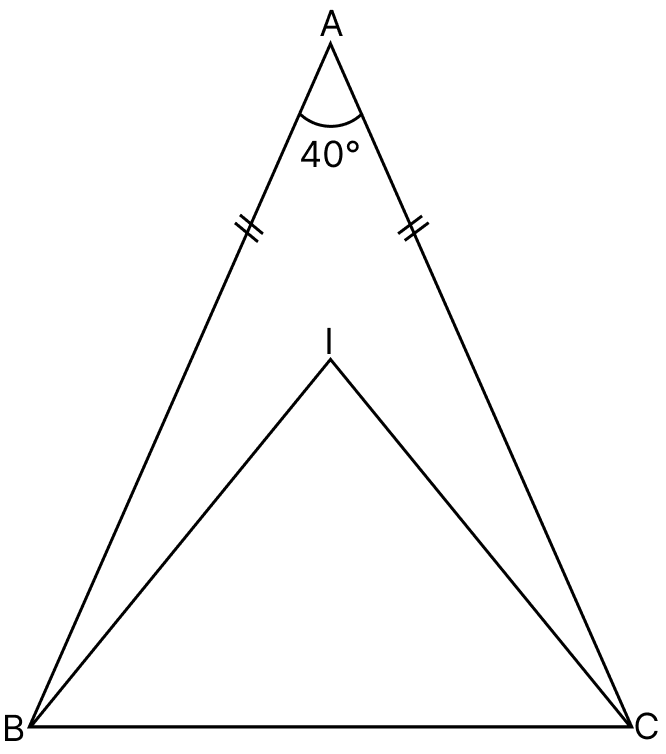
Answer
From the figure,
∠A = 40°
In △ABC, by the angle sum property,
⇒ ∠A + ∠ABC + ∠ACB = 180°
⇒ 40° + ∠ABC + ∠ACB = 180°
⇒ ∠ABC + ∠ACB = 180° − 40°
⇒ ∠ABC + ∠ACB = 140° ....(1)
Since BI is the bisector of ∠ABC,
⇒ ∠IBC = ∠ABC ....(2)
Since CI is the bisector of ∠ACB,
⇒ ∠ICB = ∠ACB ....(3)
Adding (2) and (3),
⇒ ∠IBC + ∠ICB = ∠ABC + ∠ACB
⇒ ∠IBC + ∠ICB = (∠ABC + ∠ACB)
Substituting the value of (∠ABC + ∠ACB) from (1),
⇒ ∠IBC + ∠ICB = × 140°
⇒ ∠IBC + ∠ICB = 70° ....(4)
In △BIC, by the angle sum property,
⇒ ∠BIC + ∠IBC + ∠ICB = 180°
Substituting the value of (∠IBC + ∠ICB) from (4),
⇒ ∠BIC + 70° = 180°
⇒ ∠BIC = 180° − 70°
⇒ ∠BIC = 110°
Hence, ∠BIC = 110°.
In the given figure, express a in terms of b.
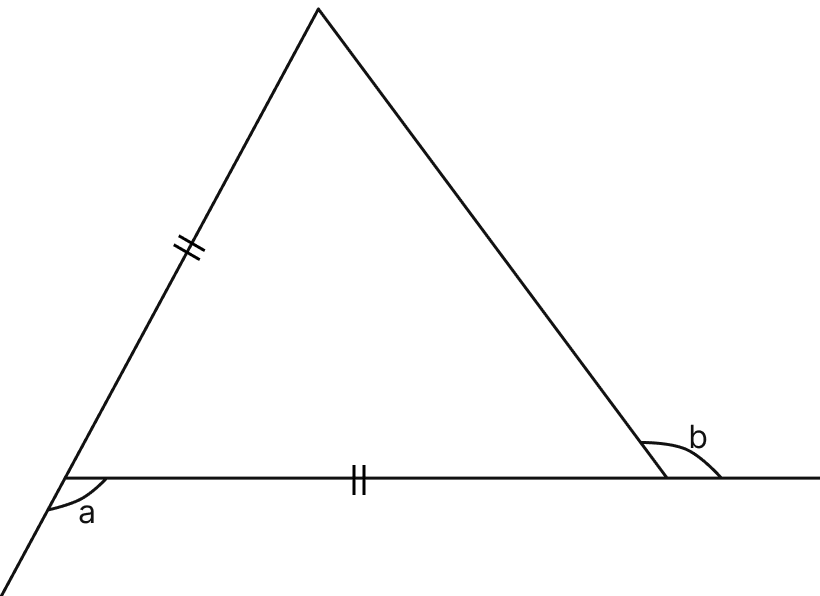
Answer
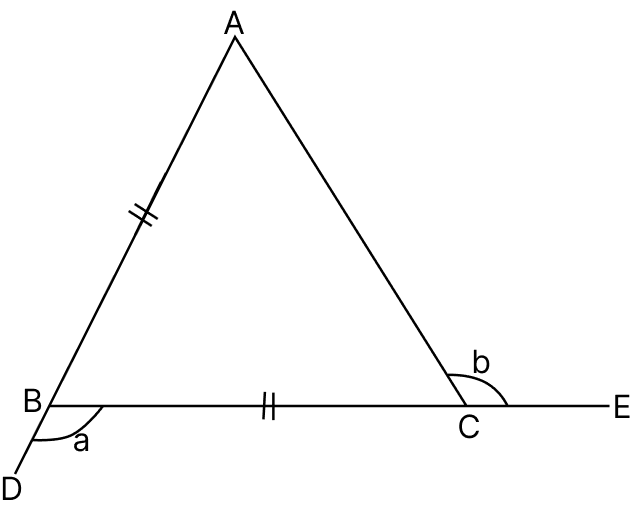
In the triangle ABC, the two marked sides BA and CB are equal, so the base angles ∠BAC and ∠BCA are equal.
Since ∠ACE and ∠BCA are on the same line, they form a linear pair.
⇒ ∠ACE + ∠BCA = 180°
⇒ b + ∠BCA = 180°
⇒ ∠BCA = 180° − b
As both base angles are equal,
⇒ ∠BAC = 180° − b
Since ∠DBC and ∠ABC are on the same line, they form a linear pair.
⇒ ∠DBC + ∠ABC = 180°
⇒ a + ∠ABC = 180°
⇒ ∠ABC = 180° − a
By the angle sum property of a triangle,
⇒ ∠ABC + ∠BCA + ∠BAC = 180°
⇒ (180° − a) + (180° − b) + (180° − b) = 180°
⇒ 540° − a − 2b = 180°
⇒ a = 360° − 2b
Hence, a = 360° − 2b.
In Figure (i) BP bisects ∠ABC and AB = AC. Find x.
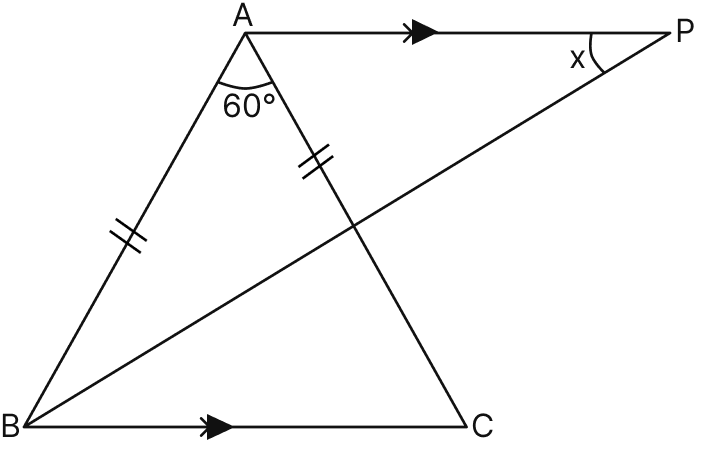
Answer
From the figure, ∠BAC = 60°.
In △ABC, AB = AC
⇒ ∠ABC = ∠ACB [Angles opposite to equal sides in a triangle are equal]
By the angle sum property,
⇒ ∠BAC + ∠ABC + ∠ACB = 180°
Substituting ∠ACB = ∠ABC,
⇒ 60° + ∠ABC + ∠ABC = 180°
⇒ 2∠ABC = 180° − 60°
⇒ 2∠ABC = 120°
⇒ ∠ABC =
⇒ ∠ABC = 60°
Since BP bisects ∠ABC,
⇒ ∠PBC = ∠ABC
⇒ ∠PBC =
⇒ ∠PBC = 30°
Since AP ∥ BC and BP is the transversal, x and ∠PBC are alternate angles.
⇒ x = ∠PBC (alternate angles are equal)
⇒ x = 30°
Hence, x = 30°.
Find x in Figure (ii).
Given : DA = DB = DC, BD bisects ∠ABC and ∠ADB = 70°.
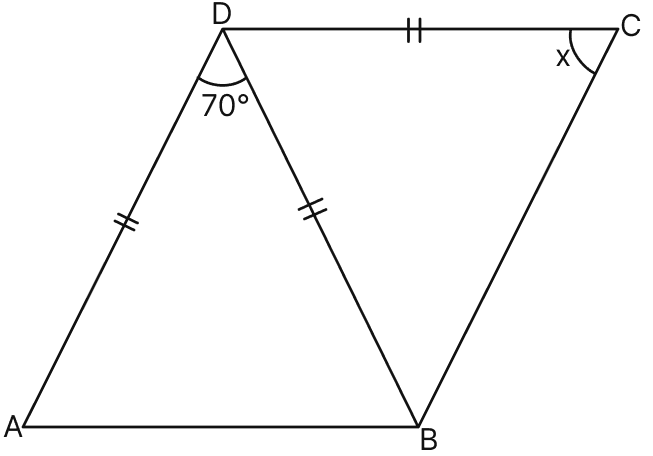
Answer
In △ADB, DA = DB
⇒ ∠DAB = ∠DBA [Angles opposite to equal sides in a triangle are equal]
Given, ∠ADB = 70°.
By the angle sum property,
⇒ ∠DAB + ∠DBA + ∠ADB = 180°
Substituting ∠DAB = ∠DBA,
⇒ ∠DBA + ∠DBA + 70° = 180°
⇒ 2∠DBA = 180° − 70°
⇒ 2∠DBA = 110°
⇒ ∠DBA =
⇒ ∠DBA = 55°
Since BD bisects ∠ABC,
⇒ ∠DBC = ∠DBA
⇒ ∠DBC = 55°
In △DBC, DB = DC
⇒ ∠DCB = ∠DBC [Angles opposite to equal sides in a triangle are equal]
⇒ ∠DCB = 55°
From the figure, x = ∠DCB.
⇒ x = 55°
Hence, x = 55°.
In the figure given below, ABCD is a square and △ BEC is an equilateral triangle.
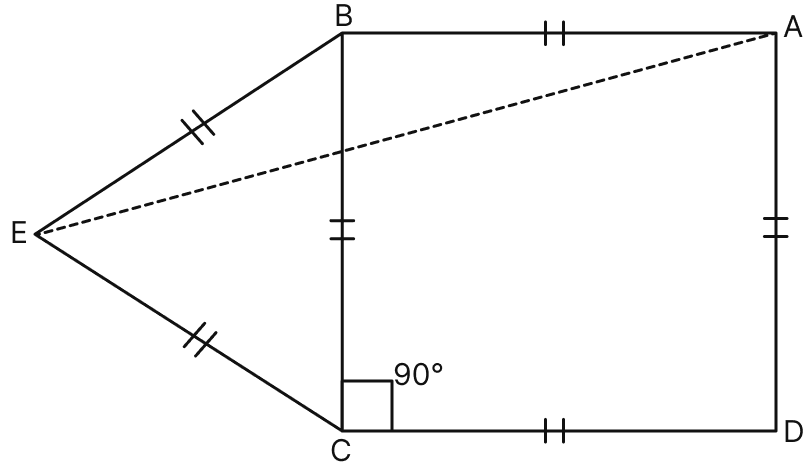
Find : (i) ∠ABE (ii) ∠BAE
Answer
Since ABCD is a square, each of its angles = 90° and all its sides are equal.
Since △BEC is an equilateral triangle, each of its angles = 60° and BE = BC = EC.
(i) From the figure, E lies outside the square, so ∠ABE = ∠ABC + ∠CBE.
⇒ ∠ABE = 90° + 60°
⇒ ∠ABE = 150°
Hence, ∠ABE = 150°.
(ii) Since AB = BC and BC = BE, we get AB = BE.
⇒ ∠BAE = ∠BEA [Angles opposite to equal sides in a triangle are equal]
In △ABE, by the angle sum property,
⇒ ∠BAE + ∠BEA + ∠ABE = 180°
⇒ 2∠BAE + 150° = 180°
⇒ 2∠BAE = 180° − 150°
⇒ 2∠BAE = 30°
⇒ ∠BAE =
⇒ ∠BAE = 15°
Hence, ∠BAE = 15°.
In the figure given below, ABCD is a square and △ BEC is an equilateral triangle.
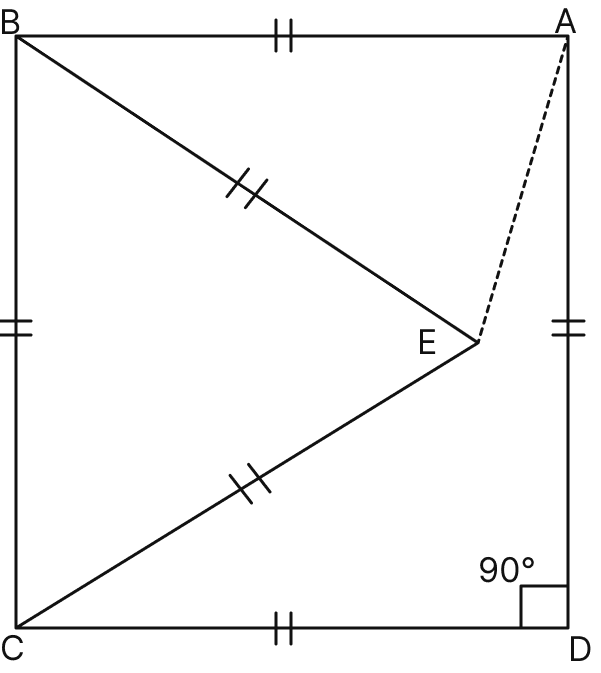
Find : (i) ∠ABE (ii) ∠BAE
Answer
Since ABCD is a square, each of its angles = 90° and all its sides are equal.
Since △BEC is an equilateral triangle, each of its angles = 60° and BE = BC = EC.
(i) From the figure, E lies inside the square, so ∠ABE = ∠ABC − ∠EBC.
⇒ ∠ABE = 90° − 60°
⇒ ∠ABE = 30°
Hence, ∠ABE = 30°.
(ii) Since AB = BC and BC = BE, we get AB = BE.
⇒ ∠BAE = ∠BEA [Angles opposite to equal sides in a triangle are equal]
In △ABE, by the angle sum property,
⇒ ∠BAE + ∠BEA + ∠ABE = 180°
⇒ 2∠BAE + 30° = 180°
⇒ 2∠BAE = 180° − 30°
⇒ 2∠BAE = 150°
⇒ ∠BAE =
⇒ ∠BAE = 75°
Hence, ∠BAE = 75°.
In △ ABC, BA and BC are produced. Find the angles a and b, if AB = BC.
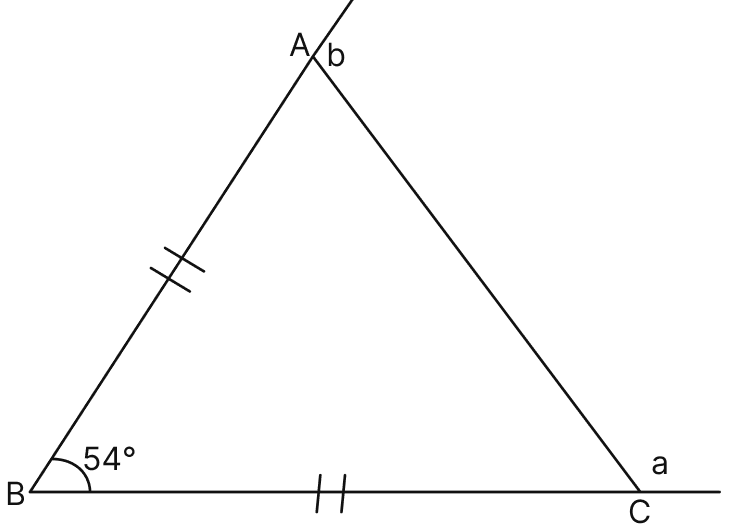
Answer
Since AB = BC, the base angles are equal :
⇒ ∠BAC = ∠BCA
By the angle sum property of ΔABC,
⇒ ∠BAC + ∠BCA + 54° = 180°
⇒ 2∠BCA + 54° = 180°
⇒ 2∠BCA = 180° − 54°
⇒ 2∠BCA = 126°
⇒ ∠BCA =
⇒ ∠BAC = ∠BCA = 63°
Now a is the exterior angle at C and b is the exterior angle at A, each forming a linear pair with a base angle :
⇒ a = 180° − ∠BCA = 180° − 63° = 117°
⇒ b = 180° − ∠BAC = 180° − 63° = 117°
Hence, a = b = 117°.