
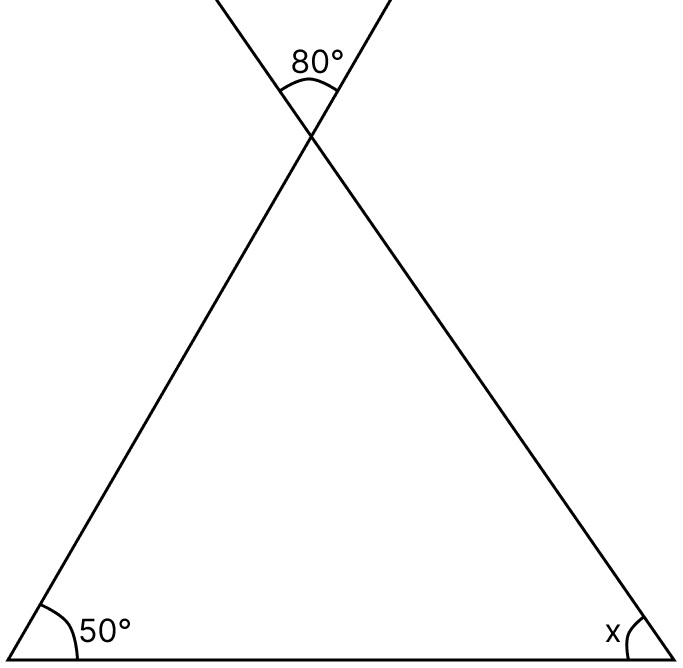
The value of angle x is :
30°
50°
40°
80°
Answer
In the figure,
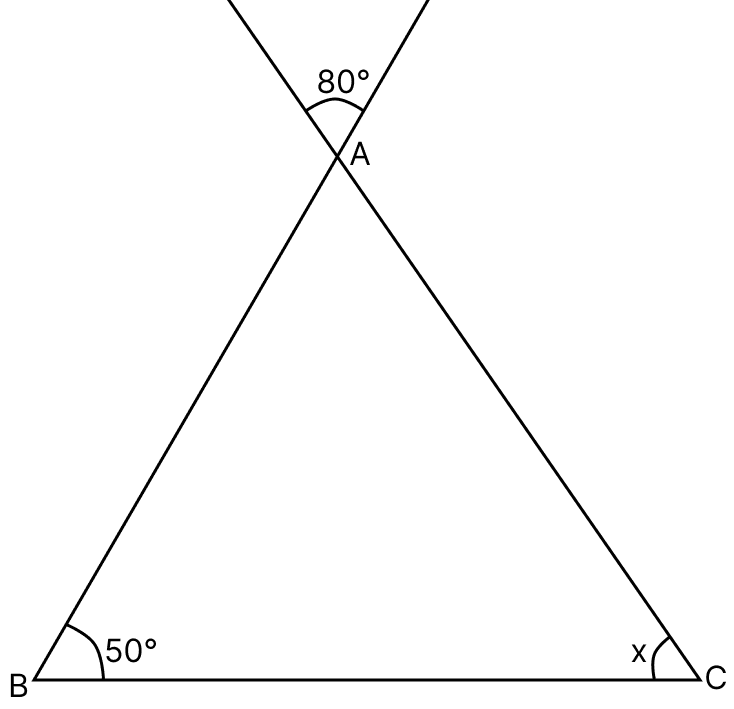
∠BAC = 80° (Vertically opposite angles are equal)
In triangle ABC, by the angle sum property,
⇒ 80° + 50° + x = 180°
⇒ 130° + x = 180°
⇒ x = 180° − 130°
⇒ x = 50°
Hence, option 2 is the correct option.
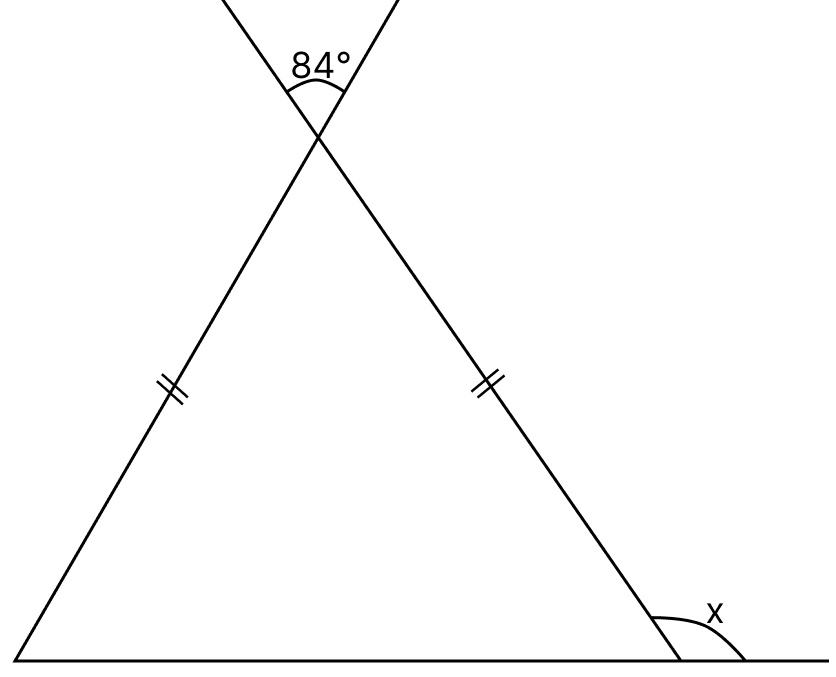
The value of angle x is :
84°
96°
132°
48°
Answer
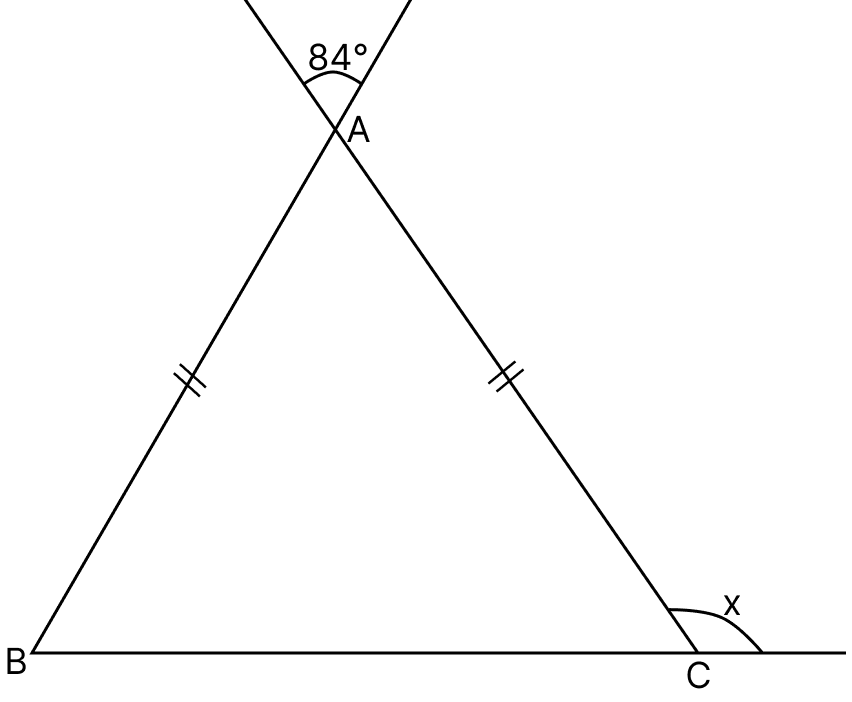
From figure,
∠BAC = 84° (Vertically opposite angles are equal)
Since ABC is an isosceles triangle, its base angles are equal.
∴ ∠ABC = ∠ACB
By angle sum property,
⇒ ∠BAC + ∠ABC + ∠ACB = 180°
⇒ ∠BAC + 2∠ACB = 180°
⇒ 84° + 2∠ACB = 180°
⇒ 2∠ACB = 180° − 84°
⇒ 2∠ACB = 96°
⇒ ∠ACB = = 48°
As x and ∠ACB form a linear pair,
⇒ x + ∠ACB = 180°
⇒ x + 48° = 180°
⇒ x = 180° − 48°
⇒ x = 132°
Hence, option 3 is the correct option.
One angle of a triangle is 60° and the other two angles are in the ratio 1 : 2; the bigger of these two angles is :
60°
90°
40°
80°
Answer
Let the other two angles be x and 2x.
⇒ 60° + x + 2x = 180°
⇒ 60° + 3x = 180°
⇒ 3x = 180° − 60°
⇒ 3x = 120°
⇒ x =
⇒ x = 40°
∴ The two angles are 40° and 80°, and the bigger one is 80°.
Hence, option 4 is the correct option.
The angles of a triangle are in the ratio 2 : 3 : 1; the smallest angle is :
30°
45°
60°
none of these
Answer
Let the angles be 2x, 3x and x.
⇒ 2x + 3x + x = 180°
⇒ 6x = 180°
⇒ x =
⇒ x = 30°
∴ The smallest angle is x = 30°.
Hence, option 1 is the correct option.
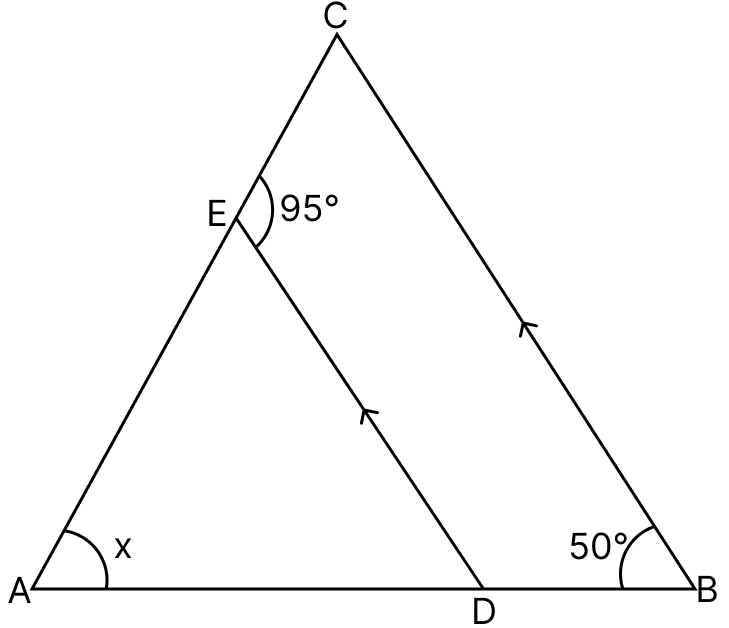
In the given figure, DE is parallel to BC. The value of x is :
50°
45°
40°
35°
Answer
∠AED and ∠CED form a linear pair, so ∠AED = 180° − 95° = 85°.
Since DE ∥ BC, ∠ADE = ∠ABC = 50° (corresponding angles).
In ΔADE, by the angle sum property,
⇒ x + 85° + 50° = 180°
⇒ x + 135° = 180°
⇒ x = 180° − 135°
⇒ x = 45°
Hence, option 2 is the correct option.
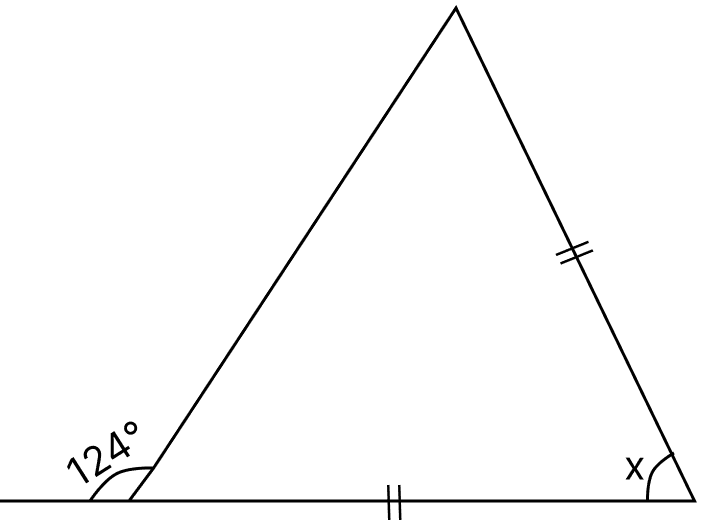
The value of angle x is :
76°
68°
56°
none of these
Answer
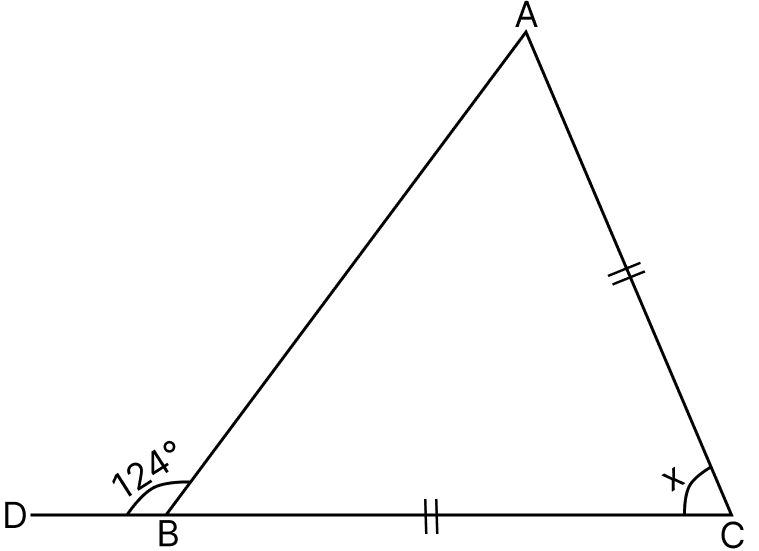
In the triangle ABC, the two marked sides CA and CB are equal, so the base angles ∠CAB and ∠CBA are equal.
Since ∠ABD and ∠CBA are on the same line, they form a linear pair.
⇒ ∠ABD + ∠CBA = 180°
⇒ 124° + ∠CBA = 180°
⇒ ∠CBA = 180° − 124°
⇒ ∠CBA = 56°
⇒ ∠CAB = ∠CBA = 56°
By the angle sum property,
⇒ ∠ACB + ∠CBA + ∠CAB = 180°
⇒ x + 56° + 56° = 180°
⇒ x + 112° = 180°
⇒ x = 180° − 112°
⇒ x = 68°
Hence, option 2 is the correct option.
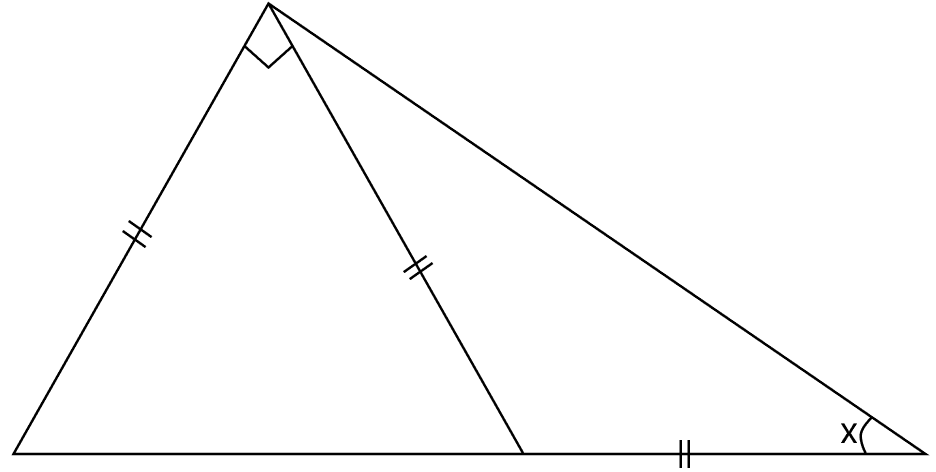
The value of angle x is :
45°
25°
30°
none of these
Answer
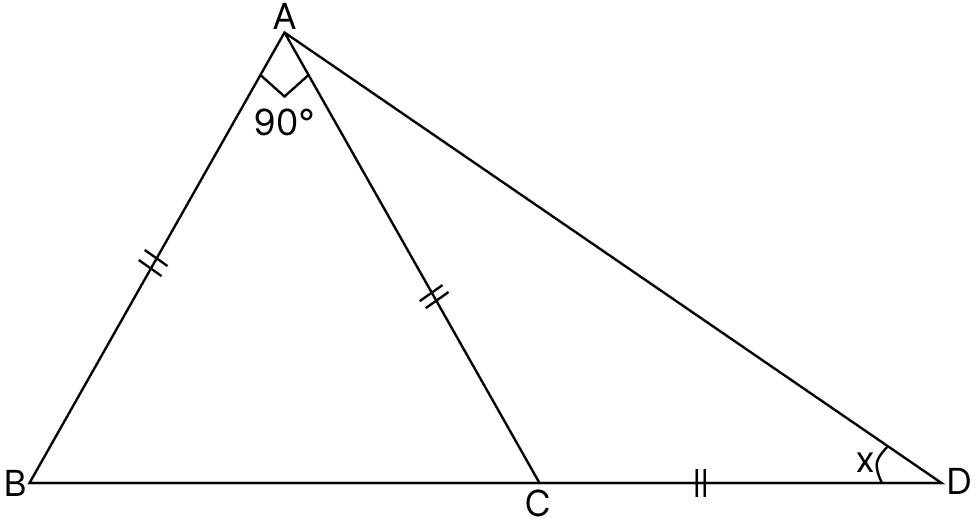
In △ABC, AB = AC
⇒ ∠B = ∠ACB
As ∠BAC = 90°,
By angle sum property,
⇒ ∠B + ∠ACB + ∠BAC = 180°
⇒ 2∠B + 90° = 180°
⇒ ∠B = = 45°
∠ACB + ∠ACD = 180°
45° + ∠ACD = 180°
∠ACD = 135°
In △ACD, AC = CD
⇒ ∠D = ∠CAD = x
By angle sum property,
⇒ ∠D + ∠ACD + ∠CAD = 180°
⇒ x + 135° + x = 180°
⇒ 2x = 180° − 135° = 45°
⇒ x = = 22·5° = 22°30′
Hence, option 4 is the correct option.
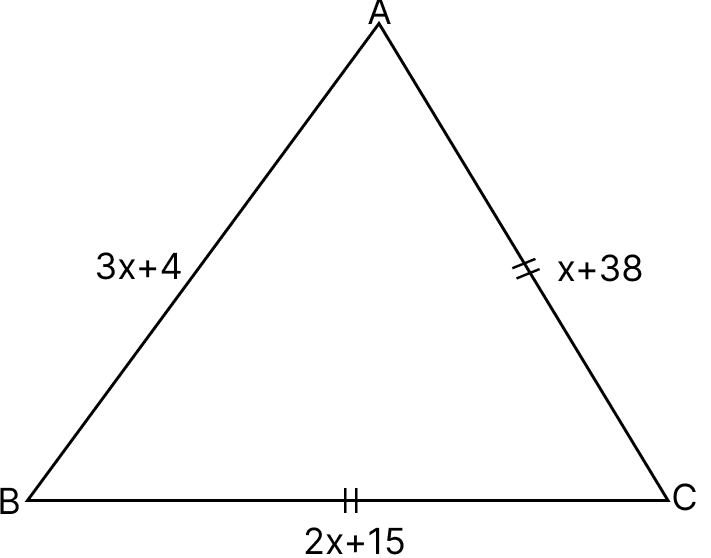
The length of AB is :
23 unit
46 unit
61 unit
73 unit
Answer
The two sides marked equal are AC and BC, so
⇒ x + 38 = 2x + 15
⇒ 38 − 15 = 2x − x
⇒ 23 = x
⇒ x = 23
From the figure, AB = 3x + 4.
Substituting x = 23,
⇒ AB = 3 × 23 + 4
⇒ AB = 69 + 4
⇒ AB = 73 unit
Hence, option 4 is the correct option.
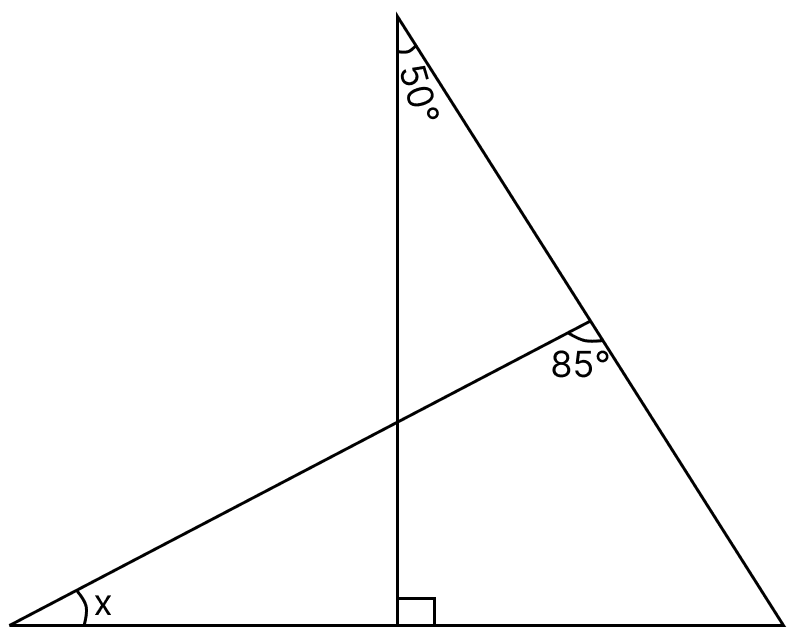
The value of angle x is :
35°
45°
55°
65°
Answer
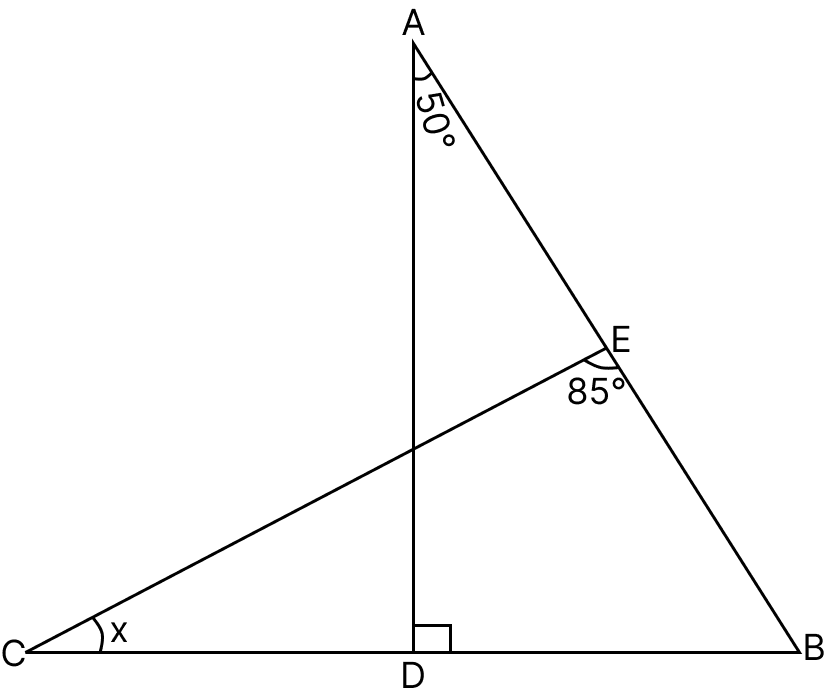
In △ADB, by angle sum property:
⇒ ∠A + ∠B + ∠D = 180°
⇒ 50° + ∠B + 90° = 180°
⇒ ∠B = 180° − 140° = 40°
In △BCE, by angle sum property:
⇒ ∠E + ∠B + ∠C = 180°
⇒ 85° + 40° + x = 180°
⇒ 125° + x = 180°
⇒ x = 180° − 125° = 55°
Hence, option 3 is the correct option.
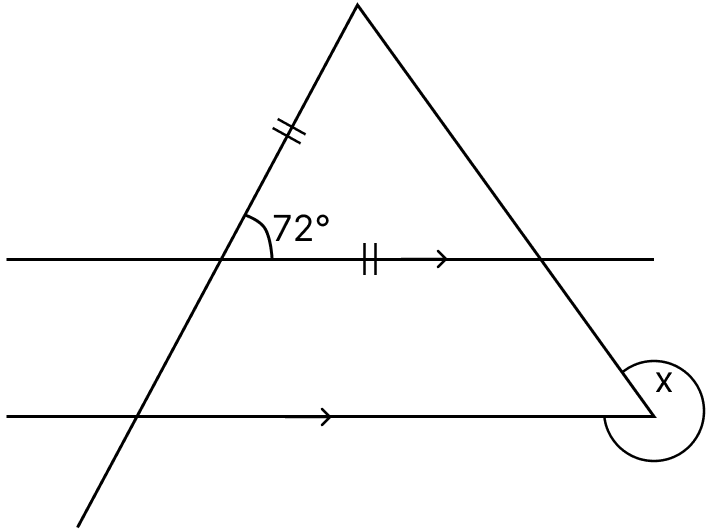
The value of angle x is :
54°
126°
108°
306°
Answer
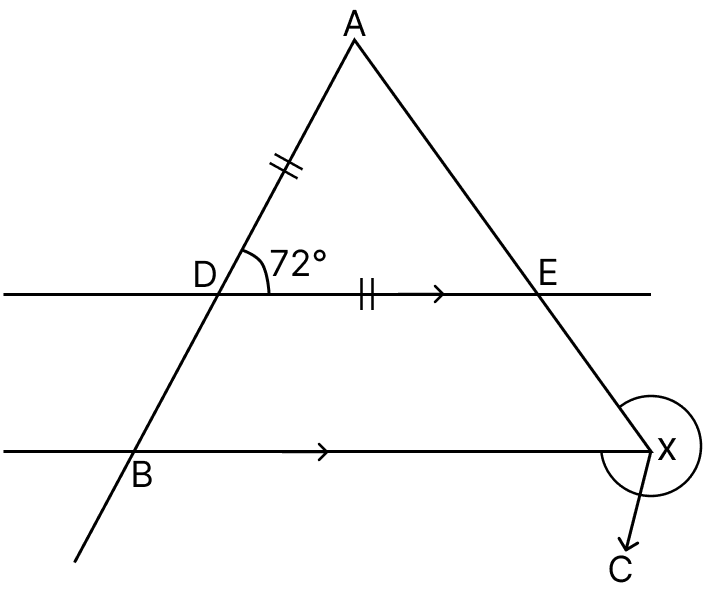
In isosceles triangle ADE,
DA = DE
⇒ ∠DEA = ∠DAE [Base angles of an isosceles triangle are equal]
By angle sum property,
⇒ ∠DAE + ∠DEA + ∠ADE = 180°
⇒ ∠DAE + ∠DAE + ∠ADE = 180°
⇒ 2∠DAE + 72° = 180°
⇒ ∠DAE =
Since DE is parallel to BC,
⇒ ∠B = ∠ADE = 72° (corresponding angles are equal)
Now, in triangle ABC,
By angle sum property,
⇒ ∠A + ∠B + ∠ACB = 180°
⇒ 54° + 72° + ∠ACB = 180°
⇒ ∠ACB = 180° − 126° = 54°
As, x is the reflex angle, so
⇒ x = 360° − ∠ACB = 360° − 54° = 306°
Hence, option 4 is the correct option.