
Which of the following are the low-lying countries of Europe that often get flooded due to a rise in sea level?
A. Luxembourg
B. Portugal
C. Greece
D. Netherlands
- B and C are correct.
- C and D are correct.
- A and D are correct.
- B and D are correct.
Answer
A and D are correct.
Reason — The Low Countries lie in the low-lying European plains in the north, where much of the land is either below sea level or slightly above it, so they often face the danger of floods. Among the given options, Luxembourg (A) and Netherlands (D) are Low Countries. Portugal and Greece are not among the Low Countries.
Which of the following are Nordic countries?
- Norway, UK, Netherlands
- Iceland, Finland, Norway
- Netherlands, Denmark, Sweden
- Iceland, Greenland, UK
Answer
Iceland, Finland, Norway
Reason — Nordic countries is a term used collectively for five countries in northern Europe — Norway, Sweden, Finland, Denmark and Iceland.
Eco-tourism conveys the following idea.
- Tourism that brings a lot of economic opportunities for the country.
- Tourist areas are rich in ecology but which needs protection.
- Maintaining the pristine environment and reducing the pressure of tourists.
- Tourism that harms the fragile ecological environment by being insensitive.
Answer
Maintaining the pristine environment and reducing the pressure of tourists.
Reason — Ecotourism is a specialised form of tourism in which tourists help maintain the serenity and sanctity of the environment. It is an effective way of maintaining a pristine environment and reducing the pressure of tourists on ecologically sensitive areas.
Which of the following isthmus connects Africa to Eurasia?
- the Isthmus of Panama
- the Isthmus of Suez
- the Isthmus of Corinth
- the Isthmus of Kra
Answer
the Isthmus of Suez
Reason — The Isthmus of Suez connects Africa to Eurasia, joining the two landmasses into one large stretch of land.
Which ocean is to the west of Europe?
- the Arctic Ocean
- the Indian Ocean
- the Atlantic Ocean
- the Pacific Ocean
Answer
the Atlantic Ocean
Reason — Europe is like an elongated peninsula surrounded by the Atlantic Ocean to the west. The Arctic Ocean lies to the north and the Mediterranean Sea to the south of Europe, while the Pacific Ocean does not border Europe at all.
Complete the relationship.
Germany : Berlin : : Finland : .................
- Budapest
- Riga
- Paris
- Helsinki
Answer
Helsinki
Reason — Berlin is the capital of Germany, so the analogy requires the capital of Finland, which is Helsinki.
Identify the major group of countries with the following clues.
- also known as Benelux Countries
- countries include Belgium, Netherlands and Luxembourg
- these countries often face the danger of floods
- British Isles
- Low Countries
- Nordic Countries
- Balkan States
Answer
Low Countries
Reason — The Low Countries, also known as the Benelux Countries, include Belgium, Netherlands and Luxembourg. As they lie in the low-lying European plains, they often face the danger of floods.
Fjords are very common in .................
- Norway
- Belarus
- Croatia
- Denmark
Answer
Norway
Reason — Fjords are very common in Norway. They are deep, narrow inlets of the sea with steep slopes, formed from submerged glaciated valleys.
Which of the following is a famous river of Italy?
- the Volga River
- the Po River
- the Rhine River
- the Rhone River
Answer
the Po River
Reason — The Po River is a major river of Italy.
Which of the following islands is NOT located in the Mediterranean Sea?
- Sicily
- Sardinia
- Crete
- Ireland
Answer
Ireland
Reason — Ireland lies in the Atlantic Ocean. Sicily, Sardinia and Crete are located in the Mediterranean Sea.
Which city in Switzerland is the headquarters of Europe's United Nations and the Red Cross?
- Zurich
- Geneva
- Basel
- Bern
Answer
Geneva
Reason — Geneva is the headquarters of Europe's United Nations and the Red Cross.
Assertion (A): European nations are in the forefront of fishing and trade.
Reason (R): Europe has a highly indented coastline.
- A is true but R is wrong.
- A is false but R is true.
- Both A and R are true but R is not the correct explanation of A.
- Both A and R are true and R is the correct explanation of A.
Answer
Both A and R are true and R is the correct explanation of A.
Explanation — Europe has a highly indented coastline with a long coastline and a number of natural harbours. This has given its people a tradition of seafaring and fishing and has placed European nations in the forefront of fishing and trade. Hence, R correctly explains A.
Assertion (A): European nations are at the forefront of international shipping and trade.
Reason (R): Europe has a highly indented coastline.
- A is true, but R is false.
- A is false, but R is true.
- Both A and R are true, but R is not the correct explanation of A.
- Both A and R are true, and R is the correct explanation of A.
Answer
Both A and R are true, and R is the correct explanation of A.
Explanation — Europe has a highly indented coastline with a long coastline and many natural harbours, which gave its people a tradition of seafaring. This enabled European explorers to discover and settle new lands and placed European nations at the forefront of international shipping and trade. Hence, R correctly explains A.
Assertion (A): The north-western highlands are drained by small and swift flowing rivers.
Reason (R): There are narrow estuaries along the coast.
- A is true, but R is false.
- A is false, but R is true.
- Both A and R are true, but R is not the correct explanation of A.
- Both A and R are true, and R is the correct explanation of A.
Answer
Both A and R are true, but R is not the correct explanation of A.
Explanation — The north-western highlands are indeed drained by small and swift flowing rivers because the surface of the highlands is undulating, and there are also narrow estuaries along the coast — so both statements are true. However, the estuaries are funnel-shaped openings formed by the drowning of river mouths due to sea-level rise; they do not cause the rivers to be small and swift. Hence, R does not explain A.
Assertion (A): Climate change has started affecting the number of tourists in Switzerland.
Reason (R): Skiing has been withdrawn from some of the glacial fields due to snow-deficient winters.
- A is true, but R is false.
- A is false, but R is true.
- Both A and R are true, but R is not the correct explanation of A.
- Both A and R are true, and R is the correct explanation of A.
Answer
Both A and R are true, and R is the correct explanation of A.
Explanation — Climate change and less snowfall have started affecting the number of tourists who visit Switzerland for skiing. Due to snow-deficient winters, skiing has been withdrawn from some glacial fields. Hence, R correctly explains A.
Name the following:
a. This connects Africa to Eurasia.
b. the largest country in the world in terms of area
c. A term used collectively for five countries in northern Europe.
d. the capital of Montenegro
e. the largest fjord in Norway
Answer
a. The Isthmus of Suez
b. Russia
c. Nordic countries
d. Podgorica
e. Sognefjord
Give reason — Spain is a Mediterranean country.
Answer
Spain is called a Mediterranean country because it borders the Mediterranean Sea and forms part of Mediterranean Europe.
Give reason — The North European Plains are made up of alluvial deposits.
Answer
The North European Plains have received deposits laid down by rivers as well as material brought in by glaciers. These deposits form much of the plains.
Give reason — Ecotourism is gaining popularity in Switzerland.
Answer
Tourism operates in a world of limited resources and a fragile environment that needs protection. Ecotourism helps maintain the serenity and sanctity of the environment and reduces the pressure of tourists on ecologically sensitive areas. Therefore, it is gaining popularity in Switzerland.
Define the following terms:
a. indented coastline
b. natural harbours
c. Nordic countries
d. estuaries
Answer
a. Indented coastline — A coastline that is broken by several inlets or creeks.
b. Natural harbours — A part of the sea, which is protected by land on three sides and deep enough to allow ships to anchor.
c. Nordic countries — A term used collectively for five countries in northern Europe, namely Norway, Sweden, Finland, Denmark and Iceland.
d. Estuaries — Funnel-shaped openings formed by the drowning of the mouths of rivers, usually due to a rise in sea level.
Describe the location of Europe with respect to seas and oceans.
Answer
Europe is like an elongated peninsula. It is surrounded by the Arctic Ocean to the north, the Atlantic Ocean to the west and the Mediterranean Sea to the south. In the east, it is joined to Asia, and the two continents together form a large, continuous stretch of land known as Eurasia.
What are the Balkan States? Name two countries which belong there.
Answer
The Balkan States comprise the countries lying to the south-east, near the coast of the Black Sea. Two countries which belong to the Balkan States are Serbia and Montenegro.
What is the extent of the North European Plain?
Answer
The North European Plains extend from the southern United Kingdom in the west to Russia in the east. The shallow North Sea, the Baltic Sea and the White Sea represent portions of the plains that have been submerged.
Name the major north-flowing rivers of Europe.
Answer
The major north-flowing rivers of Europe are the Seine, the Rhine, the Elbe, the Oder and the Vistula.
Describe the Central Uplands. Name the mountains found in the region.
Answer
The Central Uplands lie to the south of the North European Plain. They consist of old mountains that have been eroded to form small plateaus. These include the Meseta Central in Spain, the Massif Central in France and the Bohemian Plateau in the Czech Republic. The Vosges, Black Forest and Harz are some of the low mountains found in this region.
Write a short note on the Alpine system.
Answer
The Alpine system of young fold mountains lies to the south of the plateaus and low mountains of the Central Uplands. These young fold mountains include the Pyrenees, the Alps, the Carpathians and the Balkans. They extend in a general east-west direction and are continued across the Black Sea by the Caucasus Mountains. The Sierra Nevada in Spain, the Apennines in Italy, the Dinaric Alps spread across Serbia, Montenegro, Bosnia-Herzegovina, Slovenia, Croatia, Kosovo and Albania, and the Pindus Mountain in Greece are also a part of the Alpine system. These mountain ranges have high peaks, steep slopes, glacial valleys and narrow river valleys. Mount Elbrus (5,642 m) lies in the Caucasus Mountains, while Mont Blanc (4,807 m) lies in the Alps.
How does tourism help in developing a country's economy? Explain the concept of eco-tourism.
Answer
Tourism is a dominating service sector economy in the world. It helps in developing a country's economy in the following ways:
- It helps in creating jobs and entrepreneurship.
- It helps in protecting the heritage and cultural values of a nation.
- It collects huge foreign exchange and therefore contributes to the economic development of a country.
Eco-tourism — Ecotourism is a specialised form of tourism in which tourists help maintain the serenity and sanctity of the environment. It is an effective way of reducing the pressure of tourists on ecologically sensitive areas.
Name some of the major tourist destinations of Switzerland.
Answer
Some of the major tourist destinations of Switzerland are Basel, Bern, Geneva, Lucerne and Zurich.
Look at the given picture and answer the following questions.
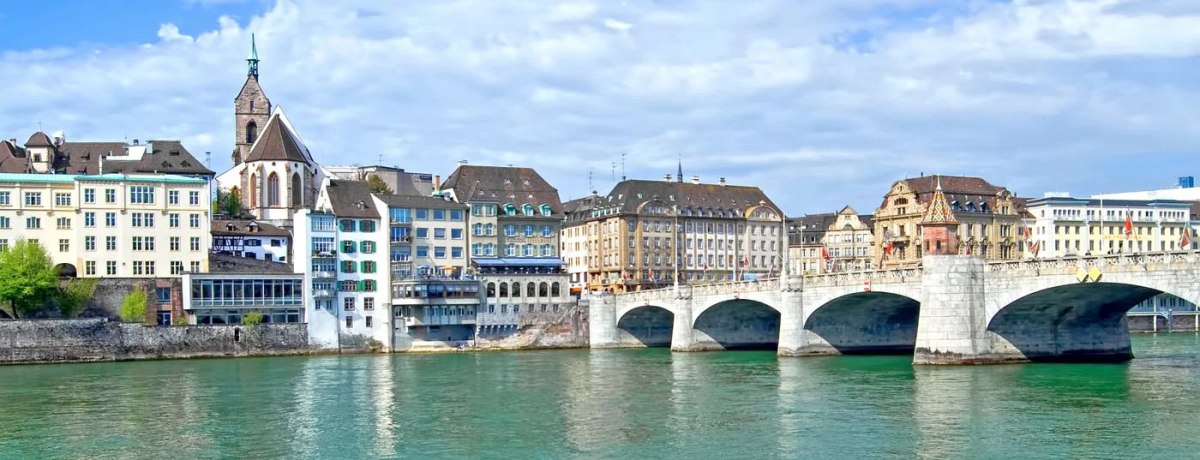
a. Where is this city located in Switzerland?
b. Along which river does it lie?
c. Name a major tourist attraction of this city.
Answer
a. This city is Basel, which is located in north-western Switzerland.
b. It lies along the Rhine River.
c. The Basel Minster, which is built of red sandstone, is a major tourist attraction of this city.
Read the passage given below and answer the questions that follow:
Switzerland is a small, landlocked Alpine country. Its political and economic stability, highly specialised labour force, well-distributed network of transport and communication, cool climate and the enchanting beauty of landscape, play an important role in its growth as a tourist hub.
Some of the attractive factors contributing to the success of the tourism industry in Switzerland are as follows:
a. The scenic beauty of the landscape especially those offered by the Swiss Alps and the numerous lakes
b. An interesting place for skiers, mountaineers and lovers of winter sports.
c. Best hotel and hospitality services along with excellent infrastructure of roads and railways
However nowadays, climate change and less snowfall have started affecting the number of tourists who visit this country for skiing. Less snowfall also leads to water scarcity. Skiing has been withdrawn from some of the glacial fields due to snow-deficient winters.
i. Which scenic features of Switzerland make it an attractive tourist destination?
ii. Which winter sport is Switzerland known for?
iii. Why are less number of tourists visiting the country nowadays?
Answer
i. The scenic beauty of the landscape, especially that offered by the Swiss Alps and the numerous lakes, makes Switzerland an attractive tourist destination.
ii. Switzerland is known for skiing.
iii. Climate change and less snowfall have reduced opportunities for skiing. Skiing has been withdrawn from some glacial fields due to snow-deficient winters, so fewer tourists are visiting the country for skiing.