
On an outline map of the world, mark and name the following:
(i) The country which is the largest producer of coal.
(ii) A country in North America that has rich reserves of oil.
(iii) An oil-producing nation in the Middle-east.
(iv) A country that leads in wind energy generation in Europe.
(v) A country which is one of the highest coal-producing regions in Europe.
Answer
The required countries are marked on the world map as shown below:
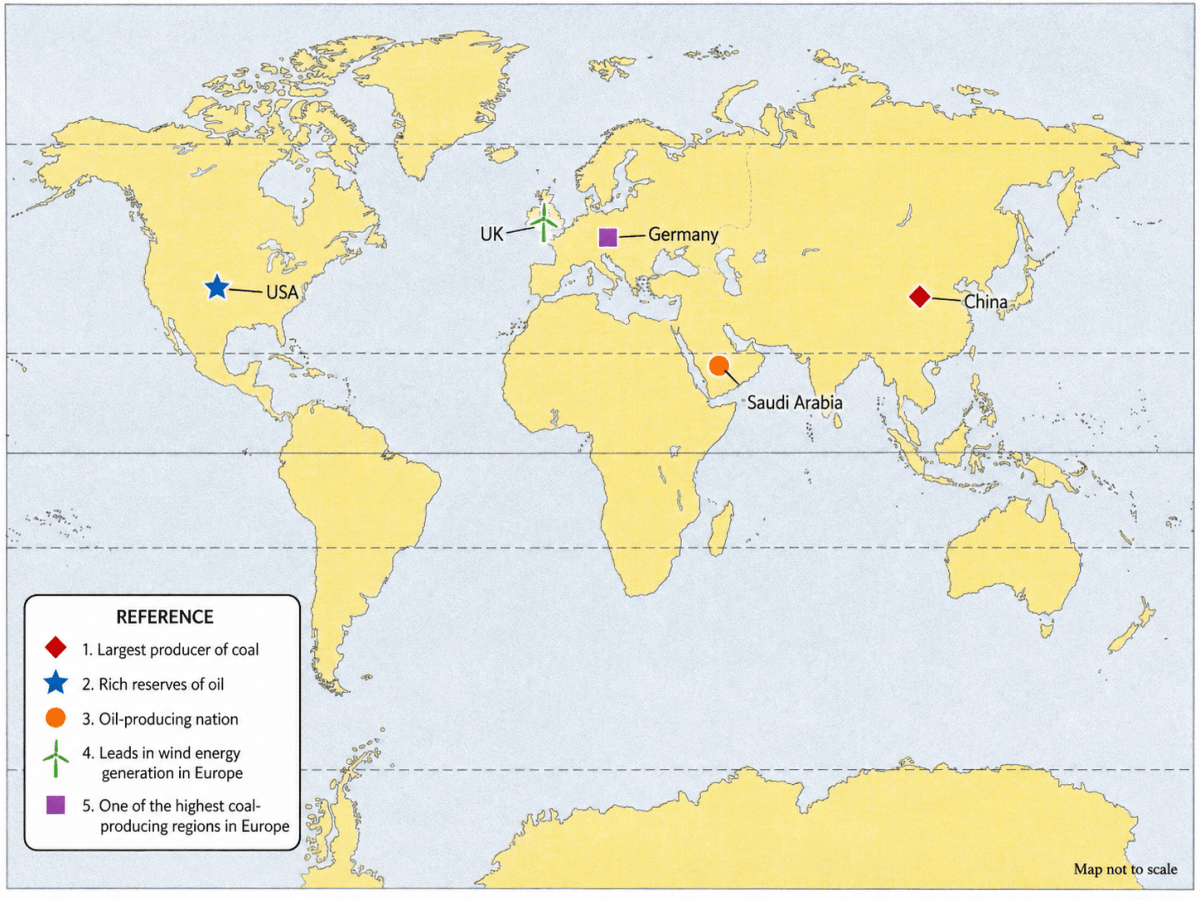
(i) Largest producer of coal — China.
(ii) A country in North America with rich reserves of oil — the USA.
(iii) An oil-producing nation in the Middle-east — Saudi Arabia.
(iv) A country that leads in wind energy generation in Europe — UK.
(v) A country which is one of the highest coal-producing regions in Europe — Germany.
On an outline map of India, mark and name the following:
(i) a thermal power station in Odisha
(ii) a hydroelectric power station in Karnataka
(iii) A state that has immense potential for solar energy production.
(iv) The river that has the Krishnaraj Sagar Dam.
(v) The state where the Nagarjuna Sagar Dam is located.
Answer
Outline map of India with the marked places is as shown below:
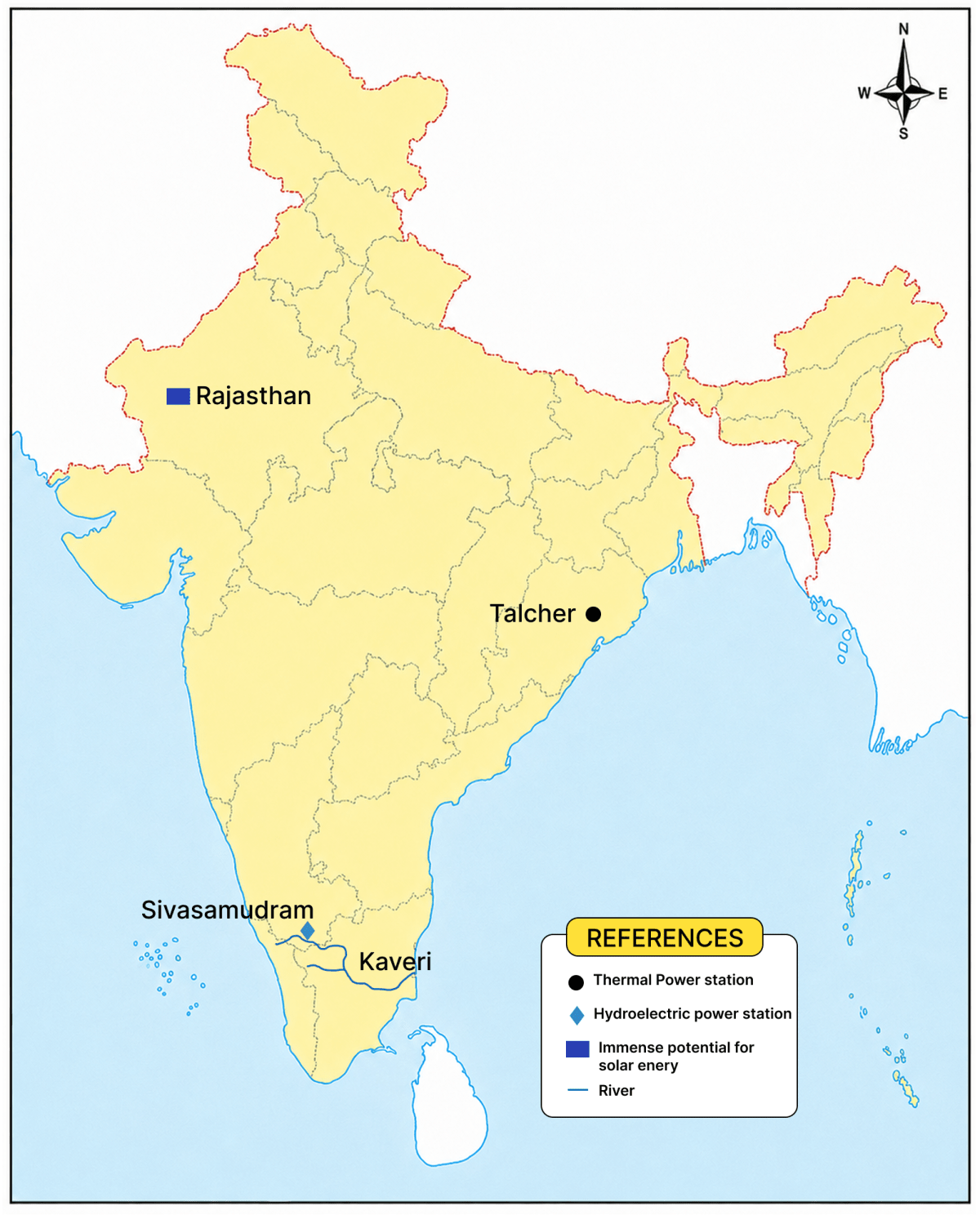
(i) A thermal power station in Odisha — Talcher.
(ii) A hydroelectric power station in Karnataka — Sivasamudram.
(iii) A state with immense potential for solar energy production — Rajasthan.
(iv) The river that has the Krishnaraj Sagar Dam — the Kaveri (Cauvery) River.
(v) The state where the Nagarjuna Sagar Dam is located — Andhra Pradesh. The dam lies on the present Telangana–Andhra Pradesh border.
Differentiate between large-scale and small-scale industries.
Answer
| Large-scale Industries | Small-scale Industries |
|---|---|
| They are set up with a huge capital investment. | They work on a minimum scale of production and require little capital. |
| They employ a large labour force. | They have fewer employees, and labour is often cheap and easily available. |
| They require vast amounts of raw materials and power and involve large-scale production of goods. | They have a lower rate of production. |
| Examples: iron and steel, aluminium and automobile industries. | Examples: oil mills and sugar mills. |
Distinguish between agro-based and mineral-based industries.
Answer
| Agro-based Industries | Mineral-based Industries |
|---|---|
| They derive their raw materials from agriculture or are plant-based. | They derive their raw materials from minerals to produce finished goods. |
| Examples: cotton textiles, dairy, sugar mills, jute mills, oil mills and flour mills. | Examples: iron and steel, cement, aluminium, fertiliser and petrochemicals. |
Why are industries needed? Give any three reasons.
Answer
Industries are needed for the following reasons:
- Industries meet the growing demands of people for finished goods that make life more comfortable. Thus, for a better quality of life, more and more industries are required.
- An industry helps in large-scale employment. Therefore, an industrialised nation is an economically stronger nation.
- Industries manufacture products for all sectors such as transport, infrastructure, communication, trade, banking, health, education, agriculture and fishing. Thus, they contribute to the harmonious growth and development of a nation.
Explain any three factors that are important for the localisation of an industry.
Answer
Three factors important for the localisation of an industry are:
Raw materials — Industries that require large amounts of bulky or perishable raw materials should ideally be located near the source of raw materials. This reduces transport costs and allows perishable materials to be processed quickly. Steel plants are ideally located close to coalfields or iron ore deposits because these bulky raw materials are needed in large quantities.
Power — Industries require an uninterrupted supply of power to run machinery. Coal has influenced the location of many industrial belts; where coal is unavailable, power may be supplied from sources such as mineral oil, natural gas or hydroelectricity.
Market — Industries producing heavy and bulky finished goods are often located close to areas of consumption. Automobile, cement and electronic-goods industries are examples.
Give two reasons why there is an urgent need to rely more on renewable energy resources.
Answer
There is an urgent need to rely more on renewable energy resources for the following two reasons:
- Non-renewable resources such as coal and petroleum are gradually getting exhausted and their reserves are limited, so they cannot meet the growing energy demands of the future.
- Non-renewable resources release greenhouse gases on burning and pollute the environment, whereas renewable resources are clean and non-polluting.
Name two offshore and two onshore oilfields in India. Which is the oldest oilfield of our country?
Answer
Two offshore oilfields — Mumbai High and Bassein.
Two onshore oilfields — Digboi (in Assam) and Ankleshwar (in Gujarat).
The oldest oilfield of our country is Digboi in Assam, which is the first ever oil well dug in India.
State some of the major uses of solar power.
Answer
Some of the major uses of solar power are:
- Solar power is used for lighting streets, homes and lighthouses in ports, and for operating traffic signals.
- It is used to heat water in cold countries and to heat ovens.
- Solar cookers, solar batteries and solar-powered watches are widely used.
- Spacecraft also use solar energy.
- Modern energy-efficient school buildings, banks and other commercial buildings use solar energy for heating and lighting.
Enumerate some disadvantages of harnessing wind energy.
Answer
Some disadvantages of harnessing wind energy are:
- The availability of wind energy is not constant.
- Wind energy farms are very localised, as only sheltered coastal areas are ideal for energy generation.
- The initial costs of setting up a wind farm are huge.
- The rotating blades of a wind turbine are a threat to birds.
Why is Australia called an island continent?
Answer
Australia is called an island continent because it is a continent that is surrounded by water bodies on all sides — the Indian Ocean lies to its west and south, while the Pacific Ocean lies to its east and north. In terms of area, it is the smallest continent and the sixth largest country in the world.
Who was James Cook?
Answer
James Cook was the captain of an English expedition who landed on the east coast of Australia in 1770 and found the land suitable for habitation.
Name the six physical divisions of Australia.
Answer
The six physical divisions of Australia are:
- the Western Plateau
- the Central Lowland
- the Eastern Highlands
- the Great Artesian Basin
- the Great Barrier Reef
- the Rift Valley of Australia
Write three sentences about the Great Artesian Basin.
Answer
- The Great Artesian Basin lies between the Eastern Highlands and the Central Lowland, and is one of the largest and deepest artesian basins in the world, covering about one-fifth of the Australian continent.
- It is formed on a base of sandstone, covered by a layer of marine sedimentary rock.
- It is the major source of water in this relatively dry area — wells are bored in the ground from where groundwater rushes out automatically due to high water pressure, without needing to be pumped out.