
Metamorphic rocks have the following characteristics.
- foliations
- stratified structure
- fossil presence
- large mineral grains
Answer
foliations
Reason — Metamorphic rocks are identified by foliations (sheet-like layering) and crystal formations. A stratified structure and the presence of fossils are characteristics of sedimentary rocks, while large mineral grains are characteristic of intrusive igneous rocks such as granite.
Rocks formed due to compaction and cementation of materials.
- slate and graphite
- basalt and granite
- sandstone and limestone
- limestone and marble
Answer
sandstone and limestone
Reason — Sedimentary rocks are formed when sediments are compacted and cemented. Sandstone and limestone are both sedimentary rocks. Slate and graphite are metamorphic rocks, basalt and granite are igneous rocks, and marble is a metamorphic rock.
Soil can be conserved by one of the following methods:
- crop rotation
- grazing cattle in one plot
- deforestation
- growing same crop again and again
Answer
crop rotation
Reason — Crop rotation helps replenish soil fertility and conserve the soil. Grazing cattle continuously in one plot can lead to overgrazing, deforestation leaves the soil loose and exposed, and growing the same crop repeatedly depletes the soil and increases the risk of erosion.
Weathering refers to one of the following natural actions:
- Rock debris are washed away by rivers.
- Sediments are deposited in the river bed.
- Wind blows away the loose soil.
- Rocks break down into pieces.
Answer
Rocks break down into pieces.
Reason — Weathering is the crumbling, disintegration and decomposition of rocks that occurs in situ, i.e., at the place where the rock lies, so rocks breaking down into pieces is weathering. Rock debris being washed away by rivers and wind blowing away loose soil are examples of erosion, which involves transportation by natural agents, while the deposition of sediments in the river bed is aggradation.
Match Column I with Column II and select the correct answer using the codes given below:
| Column I | Column II |
|---|---|
| A. marble | 1. metamorphosed coal |
| B. humus | 2. minute mineral grains |
| C. graphite | 3. metamorphosed limestone |
| D. basalt | 4. makes the soil fertile |
- A-4, B-3, C-2, D-1
- A-3, B-4, C-1, D-2
- A-1, B-4, C-2, D-3
- A-3, B-2, C-1, D-4
Answer
A-3, B-4, C-1, D-2
Reason — Marble is metamorphosed limestone, humus makes the soil fertile, graphite is metamorphosed coal, and basalt is an extrusive igneous rock with minute mineral grains. Therefore, the correct matching is A-3, B-4, C-1, D-2.
The word 'igneous' is derived from ignis, which means ...............
- air
- fire
- soil
- water
Answer
fire
Reason — The word 'igneous' is derived from ignis, which means fire. Igneous rocks are formed when hot molten magma or lava cools and solidifies.
Choose the correctly matched pair.
- mechanical – sandstone
- chemical–conglomerate
- organic–gypsum
- igneous rock–granite
Answer
igneous rock–granite and mechanical – sandstone are correctly matched pair.
Reason — Granite is an intrusive igneous rock, so 'igneous rock–granite' is correctly matched. Sandstone is also a mechanically formed sedimentary rock, so option 1 'mechanical–sandstone' is also a correct match. Conglomerate is a mechanically formed sedimentary rock (not chemical) and gypsum is a chemically formed sedimentary rock (not organic), so options 2 and 3 are wrongly matched.
Which of the following is the original rock of marble?
- sandstone
- limestone
- granite
- basalt
Answer
limestone
Reason — Marble is a metamorphic rock formed from limestone, which is a sedimentary rock. Sandstone metamorphoses into quartzite, granite into gneiss and basalt into schist, so none of these is the original rock of marble.
Match Column A with Column B and choose the correct option.
| Column A | Column B |
|---|---|
| A. intrusive igneous rock | 1. shale |
| B. extrusive igneous rock | 2. marble |
| C. sedimentary rock | 3. basalt |
| D. metamorphic rock | 4. granite |
- A.1. B.2. C.3. D.4.
- A.4. B.3. C.2. D.1.
- A.4. B.3. C.1. D.2.
- A.3. B.4. C.2. D.1.
Answer
A.4. B.3. C.1. D.2.
Reason — Granite is an intrusive igneous rock, basalt is an extrusive igneous rock, shale is a sedimentary rock and marble is a metamorphic rock. Therefore, the correct matching is A.4. B.3. C.1. D.2.
Complete the relationship.
igneous rock : hard and resistant :: sedimentary rock : ...............
- crystallised
- foliated
- soft
- stratified
Answer
stratified
Reason — Just as igneous rocks are described as hard and resistant, sedimentary rocks are described by their clearly visible stratified (layered) structure. Crystallised and foliated describe metamorphic rocks, and though sedimentary rocks are relatively soft, the defining structural feature listed alongside 'hard and resistant' for igneous rocks is the stratified structure.
Which of the following regions experience exfoliation?
- forest areas
- desert areas
- lakes
- oceans
Answer
desert areas
Reason — Desert areas experience large daily variations in temperature. Repeated heating and cooling cause the outer layers of rocks to expand and contract, leading to exfoliation.
Which part of the soil has humus?
- bedrock
- parent rock
- subsoil
- uppermost part
Answer
uppermost part
Reason — Humus is found in the uppermost enriched layer of soil called the topsoil. Below it lies the subsoil, followed by partly weathered bedrock, while solid bedrock or parent rock forms the base.
Which of the following is NOT a soil conservation method?
- afforestation
- crop rotation
- overgrazing
- contour ploughing
Answer
overgrazing
Reason — Overgrazing leaves the soil bare and leads to soil erosion. Afforestation, crop rotation and contour ploughing help conserve soil.
Assertion (A): Each rock type differs in its texture, colour, hardness, mode of occurrence and composition.
Reason (R): Rocks form the basis of soil and determine the nature of landform.
- A is true, but R is false.
- A is false, but R is true.
- Both A and R are true, but R is not the correct explanation of A.
- Both A and R are true, and R is the correct explanation of A.
Answer
Both A and R are true, but R is not the correct explanation of A.
Explanation — Each rock type differs in its texture, colour, hardness, mode of occurrence and composition because the combination of minerals is unique for each rock, so A is true. It is also true that rocks form the basis of soil and determine the nature of landform, so R is true. However, R describes the role that rocks play in forming soil and landforms and does not explain why each rock type differs in its properties. Hence R is not the correct explanation of A.
Assertion (A): Igneous rocks are formed due to the cooling and solidification of hot molten magma.
Reason (R): Rocks are hard and resistant.
- A is true, but R is false.
- A is false, but R is true.
- Both A and R are true, but R is not the correct explanation of A.
- Both A and R are true, and R is the correct explanation of A.
Answer
A is true, but R is false.
Explanation — The Assertion is true because igneous rocks are formed by the cooling and solidification of hot molten magma or lava. The Reason is false because all rocks are not hard and resistant; sedimentary rocks are softer than igneous rocks.
Assertion (A): Soil takes thousands of years to form.
Reason (R): Soil is prone to erosion by winds, rivers, glaciers, waves and human activities.
- A is true, but R is false.
- A is false, but R is true.
- Both A and R are true, but R is not the correct explanation of A.
- Both A and R are true, and R is the correct explanation of A.
Answer
Both A and R are true, but R is not the correct explanation of A.
Explanation — Soil formation is a very slow process, and it may take a thousand years to form only a few centimetres of soil, so A is true. Soil is also prone to erosion by winds, rivers, glaciers, waves and human activities, so R is true. However, R explains why soil needs to be conserved rather than why soil takes thousands of years to form. Hence R is not the correct explanation of A.
Give example — an intrusive igneous rock
Answer
Granite
Give example — a chemically formed sedimentary rock
Answer
Rock salt
Give example — a precious stone associated with extreme metamorphism
Answer
Diamond
Give example — an animal that assists in biological weathering
Answer
Rodents (burrowing animals)
Give example — a type of farming that helps to conserve soil on hill slopes
Answer
Terrace farming
Give reason — Intrusive igneous rocks have large mineral grains.
Answer
Intrusive igneous rocks cool slowly beneath the Earth's surface. Slow cooling gives the mineral grains more time to grow; therefore, they have large mineral grains that are usually crystalline.
Give reason — Fossils are found only in sedimentary rocks.
Answer
Sedimentary rocks are formed when sediments are deposited in layers over a long period of time and then compacted and cemented. Plant and animal remains may become trapped between these layers and get preserved as fossils. Igneous and metamorphic rocks are not formed by such layered deposition.
Give reason — Rocks containing iron compounds are prone to chemical weathering.
Answer
Rainwater contains oxygen from the air, which often acts on rocks that are rich in iron compounds. This leads to the formation of iron oxide that produces rust, which weakens the rock and eventually causes its disintegration. This process, known as oxidation, is why rocks containing iron compounds are prone to chemical weathering.
Give reason — Soil is called a non-renewable resource.
Answer
Soil formation is extremely slow, and a few centimetres of soil may take about a thousand years to form. Since soil gets exhausted with use and cannot be replaced quickly, it is called a non-renewable resource.
Give reason — Sedimentary rocks have a clearly visible stratified structure.
Answer
Sedimentary rocks are formed from sediments deposited in layers over a long period of time. These layers later become compacted and cemented into rock. Therefore, their layered or stratified structure is clearly visible.
Give reason — Bare rock surfaces are prone to faster weathering.
Answer
Plant cover shields rocks from the elements of weathering. Bare rock surfaces have no such protection and are directly exposed to rain, frost, wind and fluctuations in temperature, so they weather faster.
Give reason — Exfoliation domes are common in desert areas.
Answer
Desert areas have large daily variations in temperature. The outer layers of rocks repeatedly expand during the day and contract at night. Over time, these layers loosen and peel off concentrically, producing rounded features called exfoliation domes.
Give reason — Soil is a non-renewable resource.
Answer
Soil formation is extremely slow, and a few centimetres of soil may take about a thousand years to form. Since soil gets exhausted with use and cannot be replaced quickly, it is called a non-renewable resource.
Distinguish between — igneous and metamorphic rocks
Answer
| Igneous Rocks | Metamorphic Rocks |
|---|---|
| They are formed due to the cooling and solidification of hot molten magma. | They are formed due to the application of extreme heat and pressure on pre-existing rocks under the surface of the Earth. |
| The rocks are hard and resistant. | The rocks are crystallised and foliated. |
| Intrusive rocks such as granite have large crystals while extrusive rocks such as basalt have small crystals. | Examples include hard rock formations such as schist, diamond, marble and graphite. |
Distinguish between — thermal and dynamic metamorphism
Answer
| Thermal Metamorphism | Dynamic Metamorphism |
|---|---|
| It occurs due to intense heat. | It takes place due to intense pressure exerted especially during the Earth's movements. |
Distinguish between — weathering and erosion
Answer
| Weathering | Erosion |
|---|---|
| It is a static process that involves the crumbling, disintegration and decomposition of rock masses due to elements of weather such as rain, frost, wind and fluctuations in temperature. | It refers to the wearing away or denudation of rocks and the transportation of rock sediments by natural agents such as running water, winds, glaciers and waves. |
| It occurs in situ, i.e., at the place where the rock lies. | It involves the transportation of rock sediments away from their place of origin. |
| It is a static process. | It is a dynamic process. |
Distinguish between — physical and chemical weathering
Answer
| Physical Weathering | Chemical Weathering |
|---|---|
| It involves the physical disintegration of rock without any change in its chemical composition. | It involves the decomposition and disintegration of rocks due to chemical reactions, i.e., the chemical decomposition of rock-forming minerals. |
| No new minerals are formed. | New minerals may be formed in the process. |
| It is active in rocky deserts or plateaus with a high daily range of temperature, through processes such as granular disintegration, block disintegration, exfoliation and frost action. | It takes place through processes such as carbonation, oxidation and solution. |
Arrange the following under the correct category:
quartzite, schist, basalt, gypsum, shale, granite, marble, rock salt
| Igneous Rocks | Sedimentary Rocks | Metamorphic Rocks |
|---|---|---|
Answer
| Igneous Rocks | Sedimentary Rocks | Metamorphic Rocks |
|---|---|---|
| basalt, granite | gypsum, shale, rock salt | quartzite, schist, marble |
Define the following terms:
a. in situ
b. carbonation
c. oxidation
d. humus
Answer
a. in situ — It means at the place where the rock lies. Weathering occurs in situ, without transportation of the weathered material.
b. carbonation — It is the process in which rainwater containing carbon dioxide forms weak carbonic acid that acts on rocks such as limestone or chalk, dissolving calcium carbonate and weakening the rock.
c. oxidation — It is the process in which oxygen present in rainwater reacts with iron compounds in rocks to form iron oxide or rust, weakening the rock.
d. humus — Humus is decayed plant and animal matter present in the topsoil. It enriches the soil and makes it fertile.
Explain the formation of igneous rocks. Why are they known as 'primary rocks'?
Answer
Igneous rocks are formed when hot molten magma or lava cools and solidifies. They are of two types:
- Intrusive igneous rocks: Magma cools and solidifies slowly beneath the Earth's surface. Therefore, the mineral grains formed are large and are usually crystalline. Granite is an example.
- Extrusive igneous rocks: Lava cools rapidly on the Earth's surface. Therefore, the mineral grains formed are minute in size. Basalt is an example.
Igneous rocks are known as 'primary rocks' because they were the first rocks to be formed.
Describe the formation of sedimentary rocks and mention the feature that makes this type of rock easily distinguishable.
Answer
Sedimentary rocks are formed from sediments deposited by rivers in river beds or along their banks and also in the beds of seas and lakes. The sediments consist of eroded particles of different rocks. Over a long period of time, these sediments are deposited in layers and become compacted and cemented, sometimes along with decomposed plant and animal remains, to form sedimentary rocks. Sandstone, shale, limestone and rock salt are common examples.
Their most easily distinguishable feature is their clearly visible stratified or layered structure.
Explain the formation of metamorphic rocks. State one distinguishable feature of metamorphic rocks.
Answer
Igneous and sedimentary rocks lying deep beneath the crust may undergo changes in appearance, texture and colour due to great heat and pressure. This process forms metamorphic rocks and may occur during volcanic or tectonic activities or due to plate movements. Marble, slate, graphite, schist and diamond are examples of metamorphic rocks.
One distinguishable feature of metamorphic rocks is that they are crystallised and commonly foliated.
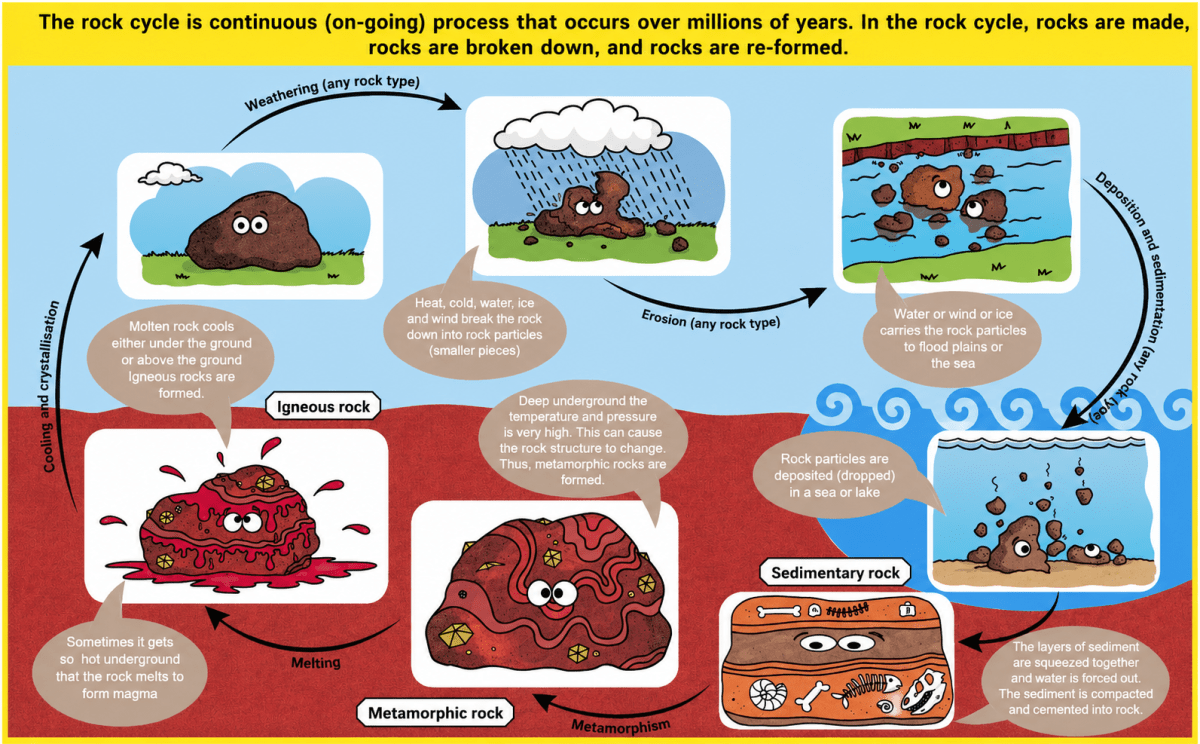
Explain the rock cycle with a suitable illustration of the same.
Answer
Rock formation is a cyclical process. Magma reaches the Earth's surface as lava and cools and solidifies to form igneous rocks. Rock masses are weathered and eroded to form sediments. These sediments are transported, deposited and compacted to form sedimentary rocks. Pre-existing rocks may change into metamorphic rocks under heat and pressure. Under the intense heat of the Earth's interior, metamorphic rocks may melt and form magma again. The magma may again cool and solidify, and the cycle continues. These changes may take millions of years.
Name the factors that affect the process of weathering. Explain the human activities that contribute to the process of weathering.
Answer
The factors that affect the process of weathering are:
- Climate
- Type of rocks
- Topography
- Presence of vegetation
- Human activities
Human activities that contribute to weathering — Building roads, deforestation, construction of buildings, mining, quarrying and blasting for road construction or mineral exploration expose rocks to the elements of weather and further lead to their breakdown. Thus, these activities make rocks more susceptible to weathering.
What do we mean by block disintegration?
Answer
Sometimes, due to the continuous expansion and contraction of rocks caused by the rise and fall of temperature, cracks appear on the rocks and blocks of rocks get dismantled. This breaking up of rocks into blocks is known as block disintegration.
Explain the process of exfoliation.
Answer
Continuous expansion and contraction weakens and loosens the thin outer layer of a rock mass because this layer absorbs and loses heat the most. With time, several outer layers may peel off concentrically, like the layers of an onion, reducing the size of the rock. This process is known as exfoliation. In desert areas with daily extremes of temperature, it may produce small rounded features called exfoliation domes.
Draw a neat, labelled diagram of the soil profile. Mention the most important soil layer responsible for life on Earth.
Answer
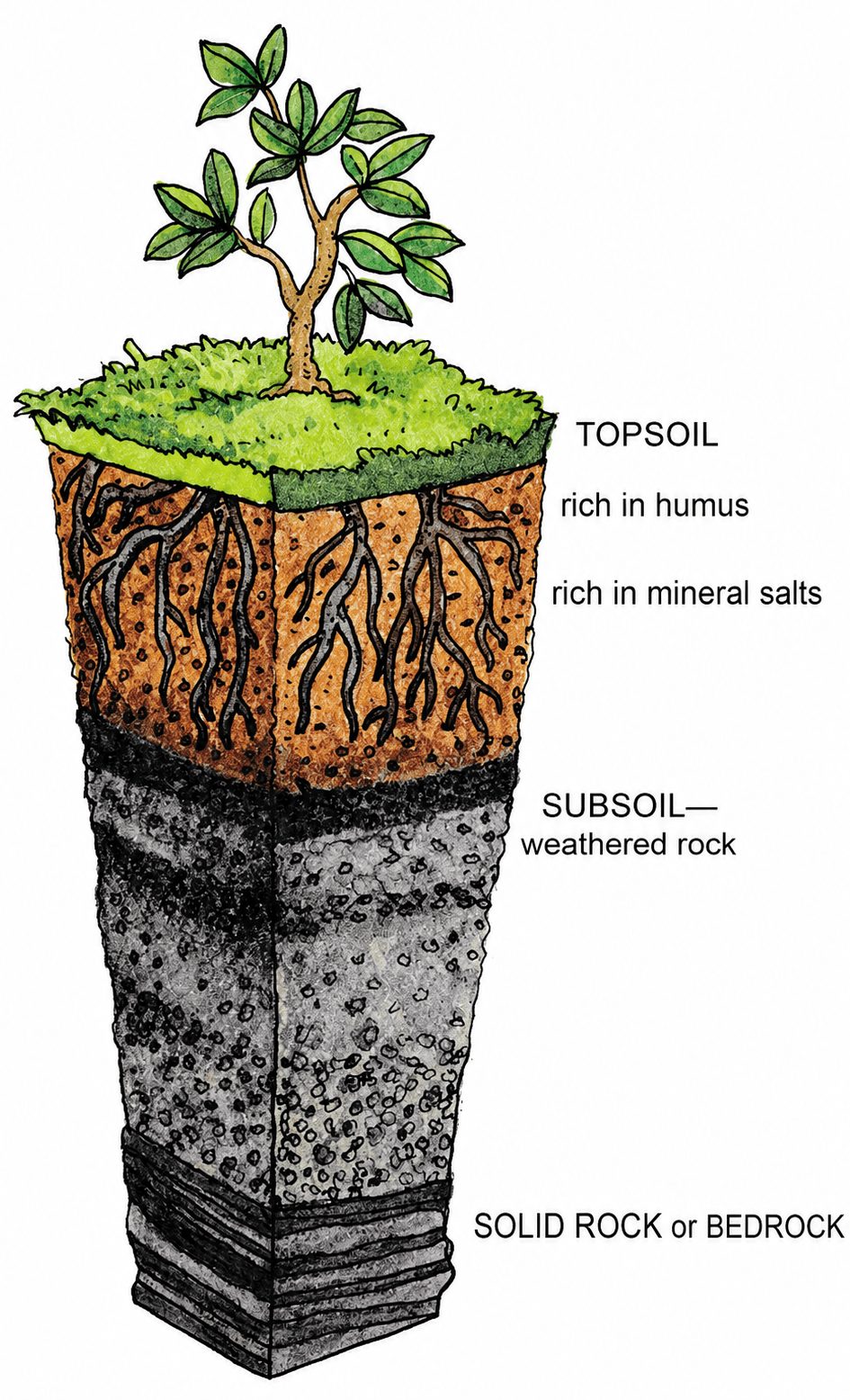
The most important soil layer responsible for life on Earth is the topsoil. It is the uppermost, enriched layer that is rich in humus and mineral salts. Being the most fertile layer, it contains the most organic, nutrient-rich materials and supports plant life.
Define soil erosion. Why is soil conservation a necessity?
Answer
Soil erosion is defined as the wearing away of topsoil by natural agents such as running water, wind and ice.
Soil conservation is necessary because soil is the medium for plant growth and is vital for the existence of living beings. All crops grow on soil, and it is also home to numerous creatures. Soil is prone to erosion by winds, rivers, glaciers, waves and human activities. Faulty agricultural techniques, deforestation, pressure of population on land and urbanisation also lead to its destruction and degradation. Since soil takes thousands of years to form, it needs to be conserved.
Look at the given picture and answer the following questions.
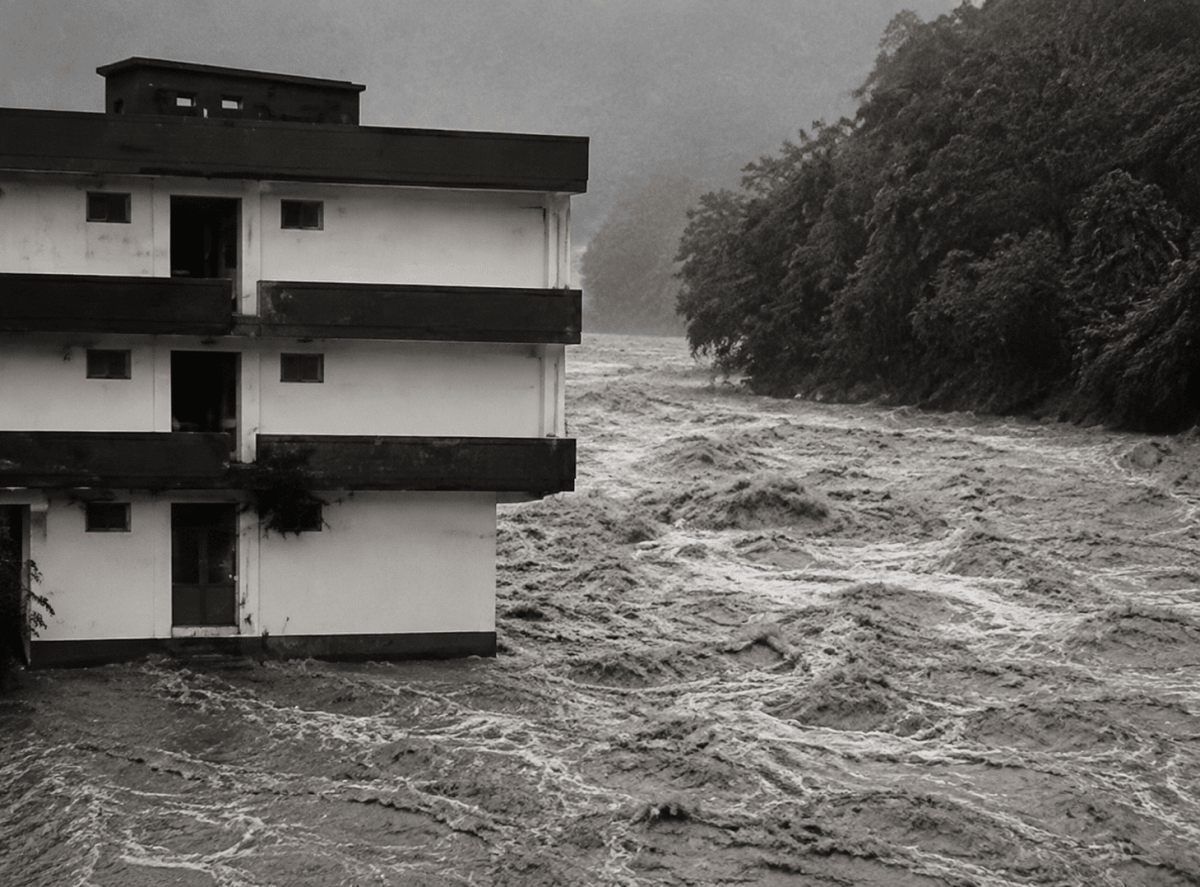
a. Identify the agent of erosion shown in the picture.
b. Choose the correct soil conservation measure for the problem shown in the picture.
- afforestation
- building an embankment
- building a dam
- all of the above
Answer
a. The agent of erosion shown in the picture is water (running water in the form of a river in flood).
b. all of the above
Look at the given picture and answer the following questions.
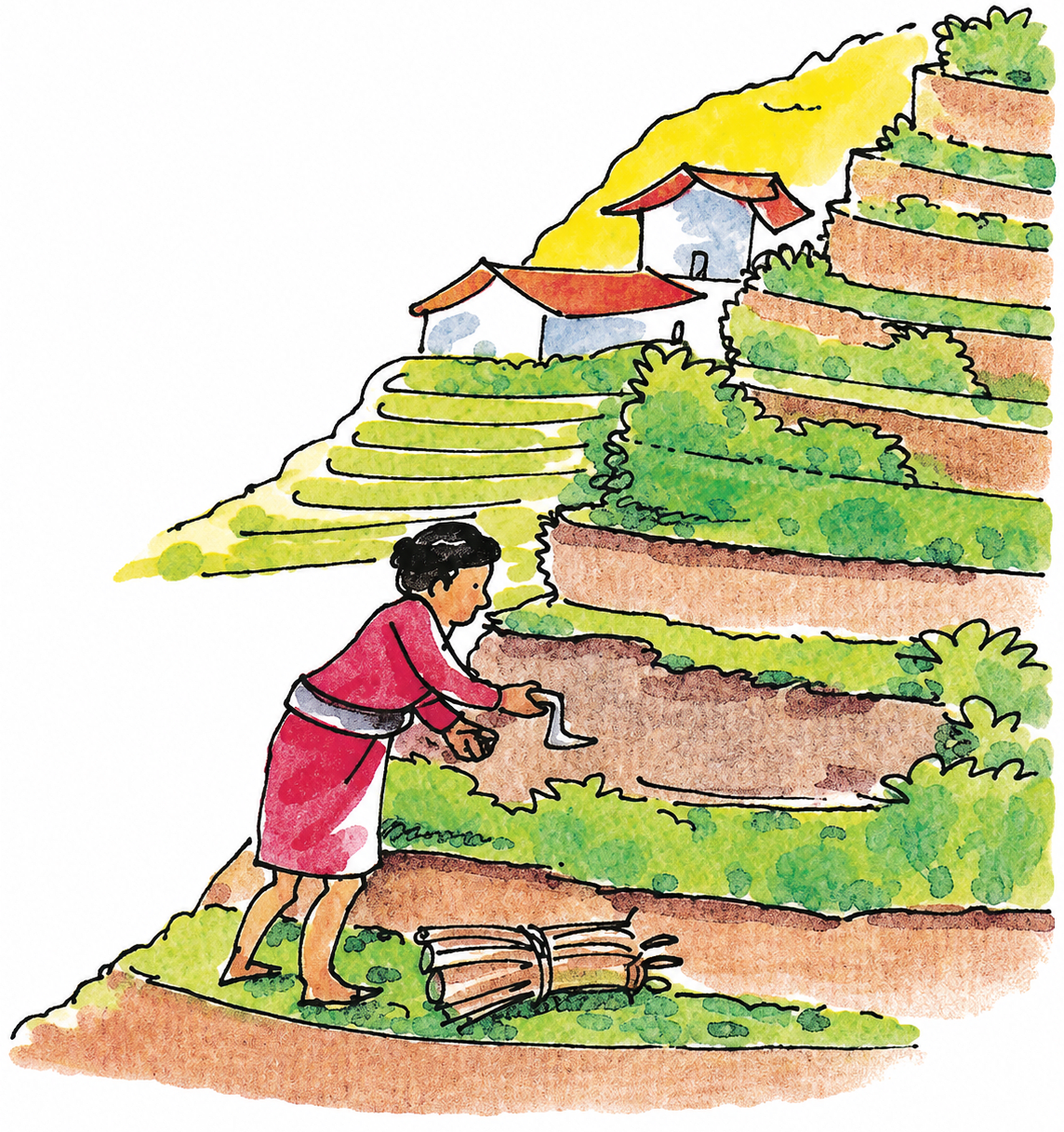
a. Which method of soil conservation is shown here?
b. How does it help in conserving soil?
Answer
a. The method of soil conservation shown here is terrace farming.
b. Terrace farming creates broad steps on hill slopes. These terraces check the flow of rainwater and prevent soil from being washed down the slope, thereby reducing soil erosion.
Read the passage given below and answer the questions that follow:
Two major processes are responsible for the shaping of the Earth's landforms and bringing about changes on its surface. These two processes are known as degradation and aggradation. Aggradation and degradation are together referred to as gradation. They act simultaneously and maintain equilibrium on the Earth's surface. Degradation means the lowering of the relief due to the removal of rocks and other materials responsible for the formation of land surface. Weathering and erosion are primarily responsible for the degradation of land. Aggradation means the raising of the Earth's surface at a certain place due to the deposition of sediments transported by the natural agents. Often natural hollows and depressions are filled up in this way.
(a) How is degradation different from aggradation?
(b) How are the two processes important with regard to the Earth's surface?
(c) Name the two factors that help in degradation.
Answer
(a) Degradation means the lowering of relief due to the removal of rocks and other materials from the land surface. Aggradation means the raising of the Earth's surface at a place due to the deposition of sediments transported by natural agents. Thus, degradation lowers the land surface, while aggradation raises it.
(b) Aggradation and degradation together are referred to as gradation. They act simultaneously and help maintain equilibrium on the Earth's surface.
(c) Weathering and erosion are the two processes that help in degradation.