
Which of these statements does not apply to the Khaljis?
- The Khaljis were of Turkish origin.
- They had been living in Afghanistan for a long time.
- Alauddin was the first Khalji sultan in India.
Answer
Alauddin was the first Khalji sultan in India.
Reason — The Khaljis were of Turkish origin and had been settled in Afghanistan for a long time, so statements 1 and 2 are true. However, Alauddin Khalji was not the first Khalji sultan in India. Jalaluddin Firuz Khalji was the first Khalji sultan, declared sultan of Delhi by the nobility. Alauddin Khalji ascended the throne in 1296 CE after treacherously murdering his uncle, Jalaluddin Firuz Khalji.
Complete the given table.
| Alauddin's Market Reforms | Alauddin's Military Reforms |
|---|---|
| Price control measures | ? |
- Introduced the system of dagh
- Introduced the system of jizyah
- Prohibited drinking of wine
Answer
Introduced the system of dagh.
Reason — Among Alauddin's military reforms, he introduced the system of dagh, which was the system of branding horses to prevent borrowing or exchange of them. He also maintained a detailed description of each soldier called chehra. The prohibition on drinking wine was a measure to control the nobility, not a military reform. Jizyah was a tax on non-Muslims and not a military reform; it was also not introduced by Alauddin Khalji.
Alauddin kept in touch with the army when it was on the move, through an elaborate system of ............... .
- barids
- dak chauki
- dagh
Answer
dak chauki.
Reason — Alauddin kept in touch with the army when it was on the move through an elaborate system of dak chauki, which was a postal system that functioned with the help of foot runners and horses. Barids were intelligence officers appointed to watch over market prices, and dagh was the system of branding horses.
The following historical building was not built by Alauddin Khalji:
- The Palace of Thousand Pillars
- The Siri Fort
- The Agra Fort
Answer
The Agra Fort.
Reason — Alauddin Khalji built the Alai Darwaza (entrance to Qutb Minar), the Palace of Thousand Pillars, the Siri Fort and a madrasa near the Qutb Minar. The Agra Fort was not built by Alauddin Khalji; it was built much later by the Mughal emperors.
Complete the given analogy.
Alauddin ascended the throne: 1296 CE :: Alauddin Khalji's death: ?
- 1310 CE
- 1316 CE
- 1320 CE
Answer
1316 CE.
Reason — Alauddin Khalji ascended the throne of Delhi in 1296 CE and ruled till his death in 1316 CE. The year 1320 CE marks the end of the Khalji dynasty when the last Khalji ruler, Qutbuddin Mubarak Shah, was murdered.
Jalaluddin Firuz Khalji : First Khalji Sultan :: Alauddin Khalji :
- Founder of the Tughlaq dynasty
- Murderer of Malik Kafur
- Successor of Jalaluddin Firuz Khalji
- Compiler of Padmavat
Answer
Successor of Jalaluddin Firuz Khalji.
Reason — Jalaluddin Firuz Khalji was the first Khalji Sultan, and Alauddin Khalji was his successor. Alauddin was the nephew of Jalaluddin and ascended the throne after treacherously murdering him in 1296 CE. The Tughlaq dynasty was founded by Ghiyasuddin Tughlaq, and Padmavat was composed by Malik Muhammad Jayasi in the 16th century.
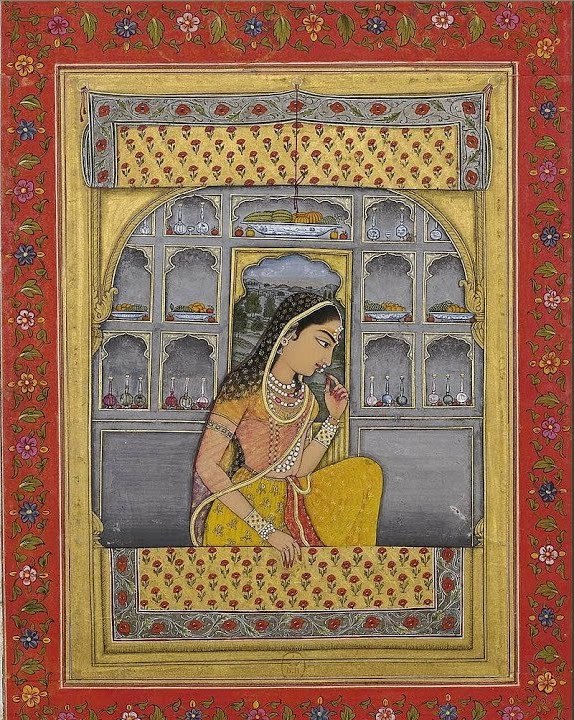
Observe this 18th-century painting of Padmini. Which of the following statements about oral traditions in history is best illustrated by the context of this painting?
- Oral traditions are always verifiable through contemporary written sources.
- Stories like that of Rani Padmini were passed down through generations, even if not found in written historical sources of their time.
- Paintings are the earliest form of historical documentation for legendary queens.
- Oral traditions primarily focus on military strategies and conquests.
Answer
Stories like that of Rani Padmini were passed down through generations, even if not found in written historical sources of their time.
Reason — The story of Rani Padmini cannot be found in the historical sources of her time. Such stories were passed down orally from one generation to another and are therefore known as 'oral histories'. The earliest written mention of the legend appears in Padmavat by Malik Muhammad Jayasi, written in the 16th century, long after the events were said to have occurred.
Which event indicates Alauddin Khalji's long-term success in securing the Sultanate's borders?
- Beginning of the Khalji dynasty
- Alauddin Khalji's accession to the throne
- Alauddin Khalji's defeat of the Mongols
- End of the Khalji dynasty
Answer
Alauddin Khalji's defeat of the Mongols.
Reason — The Mongols were a constant threat to the Delhi Sultanate's borders. Alauddin took several steps to deal with the Mongol menace — he reorganised the defences in western Punjab, repaired old forts and built new ones, placed the frontier province of Dipalpur under Ghiyasuddin Tughlaq and raised a powerful, centralised standing army. In 1305–06 CE, his army inflicted a crushing defeat on the Mongols, indicating his long-term success in securing the Sultanate's borders.
Match the following Khalji administrative measures with their purpose:
| Column A | Column B |
|---|---|
| 1. Market control | a. Prevent army corruption |
| 2. Dagh and Chehra | b. Check price rise and hoarding |
| 3. Building Siri Fort | c. Defence from Mongols |
Options:
- 1a, 2b, 3c
- 1b, 2a, 3c
- 1c, 2a, 3b
- 1b, 2c, 3a
Answer
1b, 2a, 3c.
Reason — Market control measures were introduced to check price rise and hoarding; market officers like shahna-i-mandi and barids were appointed and hoarders were severely punished. Dagh (branding of horses) and Chehra (detailed description of each soldier) were introduced to prevent army corruption such as fake enrolment and exchange of horses. The Siri Fort was built as part of defensive measures against the Mongols.
Assertion (A): Alauddin Khalji controlled the prices of necessary goods in Delhi.
Reason (R): This measure was introduced to lower the cost of maintaining a huge army, as soldiers could buy goods even at a lower salary.
- A is true, but R is false.
- R is the reason for A.
- Both A and R are false.
- Only R is true, and A is false.
Answer
R is the reason for A.
Explanation — Both A and R are true. Historians such as Ziauddin Barani and Ibn Battuta have indicated that Alauddin introduced price control measures in order to lower the cost of maintaining an army. He controlled the prices of necessary goods so that his soldiers could buy goods and food even at a lower salary. Hence, R correctly explains A.
Assertion (A): Alauddin Khalji introduced Dagh and Chehra to brand horses and maintain soldiers' records.
Reason (R): This system ensured that fake soldiers could not be enrolled to claim salaries and prepared the army to face Mongol invasions.
- A is true, but R is false.
- R is the reason for A.
- A is false, but R is true.
- Both A and R are false.
Answer
R is the reason for A.
Explanation — Both A and R are true. Alauddin introduced the system of dagh (branding of horses) to prevent borrowing or exchange of horses and maintained chehra (a detailed description of each soldier) to prevent the enrolment of fake soldiers who could claim salaries. These measures helped Alauddin maintain a powerful and centralised standing army that was capable of facing the Mongol invasions effectively. Therefore, R is the reason for A.
Explain each of the following terms:
- Jauhar
- Shahna-i-mandi
- Dagh
- Dak chauki
Answer
Jauhar — Jauhar was a ritual suicide committed by Rajput women to avoid capture and dishonour at the hands of invaders. According to legend, the women of the palace at Chittor, along with Queen Padmini, performed jauhar and burnt themselves to death before Alauddin's army could enter the fort.
Shahna-i-mandi — Shahna-i-mandi was a market officer appointed by Alauddin Khalji to keep a strict watch on the prices and weights in the markets of Delhi, in order to enforce his price control measures and prevent hoarding and cheating.
Dagh — Dagh was the system of branding horses introduced by Alauddin Khalji as a part of his military reforms. The practice was meant to prevent the borrowing or exchange of horses by soldiers.
Dak chauki — Dak chauki was a postal system introduced and organised by Alauddin Khalji, which functioned with the help of foot runners and horses. It allowed Alauddin to keep in touch with the army when it was on the move.
What do we learn from oral traditions such as the story of Padmini that has been passed down from one generation to another? You can choose multiple options.
- Eyewitnesses to events orally contribute various viewpoints and perspectives that fill in the gaps in documented history, sometimes correcting or even contradicting the written record.
- Oral traditions help us understand how individuals and communities experienced what happened in history.
- Oral histories are a sure-shot way of gaining factually incorrect information because it is not based on the truth.
Answer
The correct options are:
- Eyewitnesses to events orally contribute various viewpoints and perspectives that fill in the gaps in documented history, sometimes correcting or even contradicting the written record.
- Oral traditions help us understand how individuals and communities experienced what happened in history.
Oral traditions like the story of Padmini are valuable as they preserve the memories, perspectives and experiences of people that may not be recorded in written historical sources. They give us a window into how communities perceived events emotionally and culturally. Option 3 is incorrect because oral histories are not necessarily factually incorrect; they often carry essential truths about people's experiences, even if specific details may vary across versions.
Among the Khalji kings, Alauddin Khalji followed an aggressive policy of territorial expansion. In this context, answer the following questions:
- Name any two places in Rajasthan that were conquered by Alauddin Khalji.
- What was Alauddin's Deccan policy?
- What were the steps taken by Alauddin to tackle the Mongol menace?
Answer
Two places in Rajasthan that were conquered by Alauddin Khalji are Ranthambore and Chittor.
Alauddin's Deccan policy was commendable for its far-sightedness. After conquering the Deccan, Alauddin did not annex it, as he realised the impracticality of ruling and controlling the south from the north. His chief aim was to amass enough wealth to pay for the maintenance of a huge army and the administration of his territories. The conquered kingdoms had to accept the supremacy of the sultan and pay a heavy annual tribute as a sign of their submission to his overlordship. The Deccan expedition of Alauddin was led by Malik Kafur.
The steps taken by Alauddin to tackle the Mongol menace are:
- He reorganised the defences in western Punjab.
- He repaired the old forts and built new ones.
- The frontier province of Dipalpur was placed under Ghiyasuddin Tughlaq, the most able of all his generals.
- He raised a powerful and centralised standing army, and equipped it for all offensive and defensive purposes.
Read the paragraph and answer the questions that follow.
Alauddin set up an elaborate and efficient spy system. Every movement of the nobles was watched and reported. He regulated marriages among the nobles. They were not allowed to forge any matrimonial alliances without his permission. No gatherings could be organised by the nobles without the prior consent of the sultan.
- What steps did Alauddin take to curtail the power of the nobles?
- Which rule about marriage did Alauddin apply to the nobles?
- What did the nobles have to do to hold a gathering?
Answer
The steps taken by Alauddin to curtail the power of the nobles are:
- He set up an elaborate and efficient spy system, through which every movement of the nobles was watched and reported.
- He prohibited the drinking of wine and set an example by breaking his own wine vessels.
- He regulated marriages among the nobles. They were not allowed to forge any matrimonial alliances without his permission.
- No gatherings could be organised by the nobles without the prior consent of the sultan.
- He revised the taxation system in order to reduce the surpluses of the prosperous classes. The land grants issued by him did not make the new landholders owners of the land.
Alauddin ruled that the nobles were not allowed to forge any matrimonial alliances among themselves without the prior permission of the sultan.
To hold a gathering, the nobles had to obtain the prior consent of the sultan. No gathering could be organised without his permission.
With reference to the reforms undertaken by Alauddin Khalji, answer the following questions:
- State Alauddin's market reforms. Why did he introduce these reforms?
- Write a short note on the military reforms carried out by Alauddin Khalji.
- State the features of Alauddin's revenue policy.
Answer
Alauddin's market reforms were based on price control measures. The main features of his market reforms were:
- He controlled the prices of necessary goods so that his soldiers could buy goods and food even at a lower salary.
- He set up three markets in Delhi — one for food grains, the second for cloth and the third for horses, slaves and cattle.
- State warehouses were set up and stocked with food grains, which were released whenever there was a famine or shortage.
- Market officers such as shahna-i-mandi and barids (intelligence officers) were appointed to keep a strict watch on the prices and weights.
- The prices of all commodities were fixed. The prices of essential items were fixed at low rates.
- Weights and measures were effectively standardised, and those caught hoarding and cheating were severely punished.
Historians such as Ziauddin Barani and Ibn Battuta have indicated that Alauddin introduced these measures in order to lower the cost of maintaining a huge army.
Alauddin realised the important role of a strong military force in maintaining the vast empire. He was the first sultan of Delhi to have a permanent standing army. The main features of his military reforms were:
- Alauddin introduced the system of branding horses, known as the system of dagh, to prevent the borrowing or exchange of horses.
- He maintained a detailed description of each soldier, called chehra, to prevent the enrolment of fake soldiers.
- Nobles were not allowed to maintain an army of their own.
- The army was paid in cash and directly recruited by the sultan.
- Alauddin kept in touch with the army when it was on the move, through an elaborate system of dak chauki (postal system using foot runners and horses).
The features of Alauddin's revenue policy are:
- Land was measured and the share of the State was fixed.
- Land revenue was increased from one-third to half of the produce.
- Special revenue officers were appointed to collect taxes.
- The tax was collected in cash.
These reforms ensured the flow of adequate revenue to meet the cost of maintaining a large army and to facilitate the administration of a vast empire.
This was an entrance to the Qutb Minar.
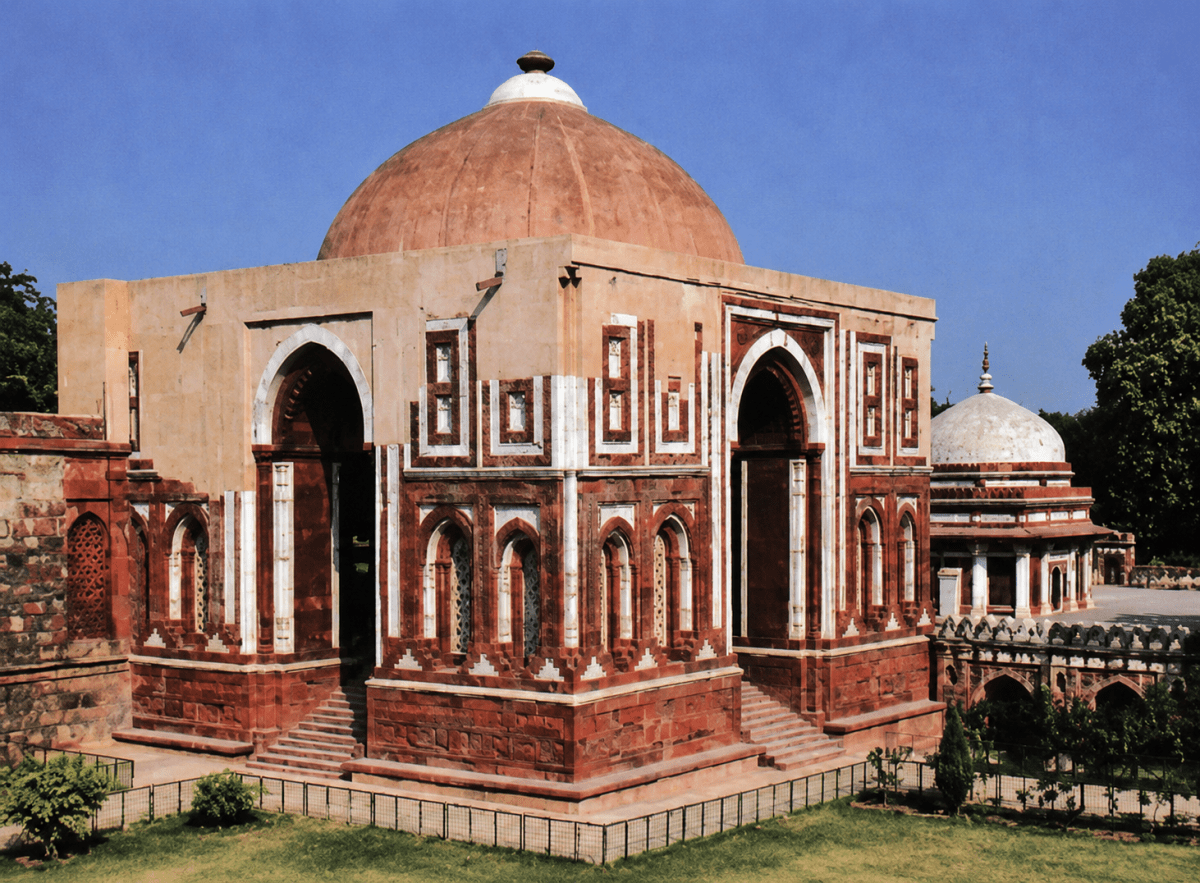
a. Who built this entrance?
b. What is the name of this monument?
Answer
a. This entrance was built by Alauddin Khalji.
b. The name of this monument is the Alai Darwaza. It was added as an entrance door to the Qutb Minar and is a beautiful specimen of Turkish architecture.
Look at the given picture, and answer the following questions:
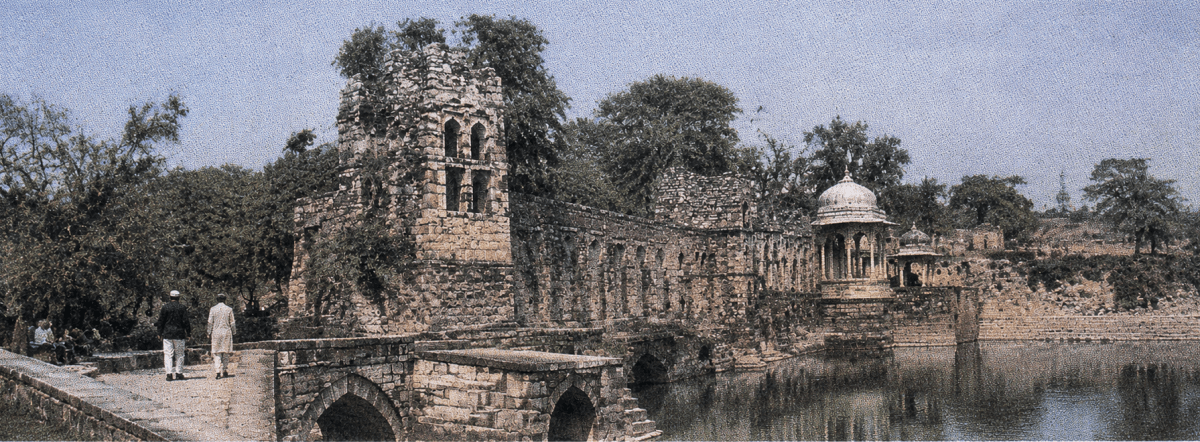
a. What is the name of the legendary queen to whom this palace belonged?
b. According to the legend, what was the queen's plan to rescue Rawal Ratan Singh from Alauddin Khalji's camp?
c. Name the 'earliest source' that mentions the legend of Padmini.
Answer
a. The palace belonged to the legendary queen Rani Padmini, the wife of Rawal Ratan Singh of Chittor.
b. According to the legend, Rani Padmini cleverly planned to rescue her husband Rawal Ratan Singh from the clutches of Alauddin Khalji's camp and bring him back to the safety of the Chittor fort. The story has been passed down orally from generation to generation as part of folk tradition.
c. The earliest source that mentions the legend of Padmini is Padmavat, an epic poem written by Malik Muhammad Jayasi in the 16th century.
Alauddin Khalji, after ascending the throne, implemented a series of aggressive policies. He not only expanded his territory significantly, especially in the north and south, but also introduced stringent administrative and economic reforms. He aimed to curb the power of the nobility, maintain a strong military and ensure a stable revenue flow. His Deccan policy, in particular, showed foresight by not annexing the conquered regions directly, but rather extracting tribute.
Based on the case study answer the following questions:
- Name two regions in North India conquered by Alauddin Khalji.
- What was the primary reason for Alauddin Khalji's Deccan policy of not annexing the conquered territories?
- What was the term used for the detailed description of each soldier maintained by Alauddin?
Answer
Two regions in North India conquered by Alauddin Khalji are Gujarat and Rajasthan (which included Ranthambore and Chittor). His conquests in North India also included Mandu, Ujjain, Chanderi and Malwa.
The primary reason for Alauddin Khalji's Deccan policy of not annexing the conquered territories was that he realised the impracticality of ruling and controlling the south from the north. Instead, his chief aim was to amass wealth from these regions through heavy annual tribute, which would help him pay for the maintenance of a huge army and the administration of his vast empire. The conquered kingdoms had to accept the supremacy of the sultan as a sign of submission.
The term used for the detailed description of each soldier maintained by Alauddin was chehra. Along with dagh (the system of branding horses), chehra helped prevent corruption in the army by ensuring that fake soldiers could not be enrolled to claim salaries.