
Which major setback did Muhammad bin Tughlaq face due to increased taxation in the Ganga-Yamuna Doab region? Choose the most appropriate option.
- There was famine in the region.
- The farmers abandoned their fields and ran away into the jungle.
- Agricultural production suffered a blow, which in turn affected revenue collection.
Answer
Agricultural production suffered a blow, which in turn affected revenue collection.
Reason — Muhammad bin Tughlaq increased the land revenue in the fertile Ganga-Yamuna Doab region to support his army. However, this coincided with a widespread famine (1335 CE to 1342 CE). The ruthless tax collectors forced peasants to abandon their lands and flee to the jungles. Although the sultan later opened free kitchens, distributed grain, and granted loans, these relief measures came too late. As a result, agricultural production suffered a major blow, which in turn affected revenue collection. This was the most encompassing setback as it affected the very purpose of the increased taxation.
Which of the following statements does not apply to Firoz Shah Tughlaq?
- Jizyah (a religious tax on non-Muslims) was levied upon the people.
- A token currency was introduced.
- In the Ganga-Yamuna Doab region, all loans given during the famine were cancelled.
Answer
A token currency was introduced.
Reason — Token currency was introduced by Muhammad bin Tughlaq, not Firoz Shah Tughlaq. Firoz Shah Tughlaq levied the Jizyah on non-Muslims as part of his attempt to govern in conformity with Islamic law. He also cancelled all loans given during the famine in the Ganga-Yamuna Doab region as part of his economic reforms.
Timur was a ____________ conqueror.
- Persian
- Afghan
- Mongol
Answer
Mongol
Reason — As stated in the chapter, Timur was a Mongol conqueror who began his Indian expedition by attacking the reigning sultan of the Tughlaq dynasty, Nasiruddin Mahmud, with the intention of acquiring the wealth of the Delhi Sultanate.
Complete the given table by choosing the correct option.
| First Ruler of Sayyid Dynasty | First Ruler of Lodi Dynasty |
|---|---|
| Khizr Khan | ? |
- Bahlul Lodi
- Sikandar Lodi
- Ibrahim Lodi
Answer
Bahlul Lodi
Reason — The Lodi dynasty, the last ruling family of the Delhi Sultanate, was of Afghan origin. The first Lodi ruler was Bahlul Lodi, who captured the throne of Delhi in 1451 CE and took the title of Sultan Abul Muzaffar Bahlul Shah Ghazi.
In the First Battle of Panipat, ____________ defeated Ibrahim Lodi and established the Mughal rule in India.
- Babur
- Humayun
- Akbar
Answer
Babur
Reason — In the First Battle of Panipat, which took place in 1526 CE, Babur defeated Ibrahim Lodi and established the Mughal rule in India. This battle marked the end of the Delhi Sultanate period.
Muhammad bin Tughluq : Capital shift to Daulatabad :: Sikandar Lodi : ____________
- Token currency
- Foundation of Agra
- Battle of Panipat
- Timur's invasion
Answer
Foundation of Agra
Reason — Just as Muhammad bin Tughlaq is associated with the shifting of the capital to Daulatabad, Sikandar Lodi is associated with the foundation of the city of Agra. He was the founder of the historical city of Agra, and made it his capital.
Which of the following statements about Ibn Battuta's role in history is best illustrated by his presence in this illustration?

- He was primarily a military strategist for the sultans.
- He was an influential poet in the Delhi Sultanate court.
- He was a renowned traveller whose accounts provided insights into various cultures.
- He was a key figure in the Tughlaq dynasty's administration, serving as a revenue collector.
Answer
He was a renowned traveller whose accounts provided insights into various cultures.
Reason — Ibn Battuta was a Moroccan traveller and contemporary historian. When he reached Delhi, Muhammad bin Tughlaq, impressed with his knowledge and wisdom, appointed him as the qazi (judge) of Delhi. His accounts, including those of the transfer of capital to Daulatabad, provide valuable insights into the medieval Indian society and culture.
In 1414 CE, a loyal governor of Timur entered Delhi and overthrew the last Tughluq Sultan. He then ruled without striking coins in his name. Who was he?
- Bahlul Lodi
- Sikandar Lodi
- Khizr Khan
- Firuz Shah Tughluq
Answer
Khizr Khan
Reason — Before leaving Delhi, Timur appointed Khizr Khan as his viceroy. In 1414 CE, Khizr Khan overthrew Mahmud Shah, the last Tughlaq ruler, and established the rule of the Sayyid dynasty.
The tomb in the given picture shows octagonal domes with Afghan simplicity. This reflects which dynasty's architecture?
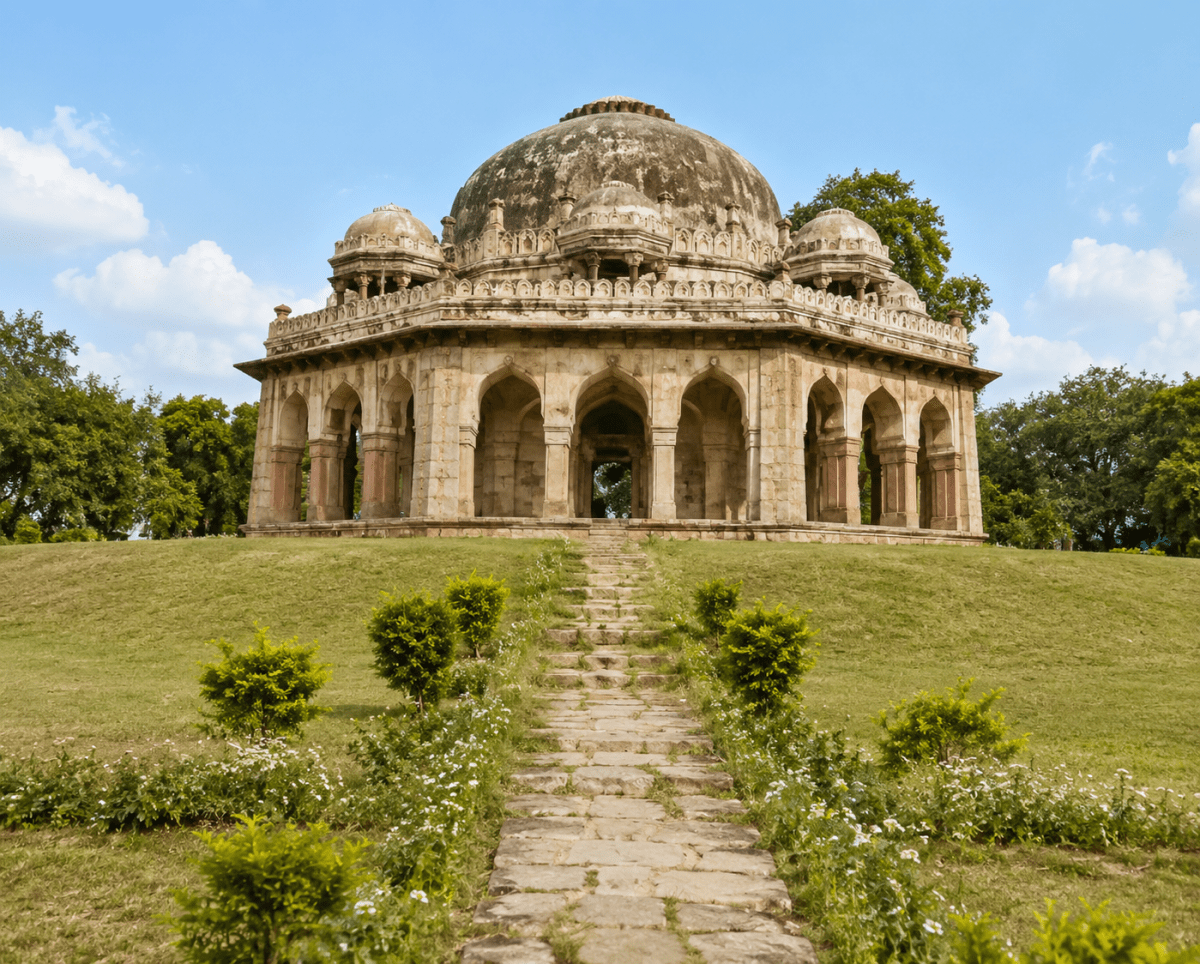
- Sayyid
- Lodi
- Tughluq
- Khalji
Answer
Lodi
Reason — The Lodi dynasty was of Afghan origin. Although their rule was brief, it was not bereft of architectural activities. They introduced the style of building tombs in gardens (such as those seen in Lodi Gardens in Delhi), which was later adopted by the Mughals. The octagonal domes with Afghan simplicity are a characteristic feature of Lodi architecture.
Assertion (A): Muhammad bin Tughlaq's introduction of token currency led to severe dislocation of the economy.
Reason (R): He took no steps to ensure that the minting of coins remained the monopoly of the government, leading to widespread counterfeiting.
- A is true, but R is false.
- R is the reason for A.
- Both A and R are false.
- Only R is true, and A is false.
Answer
R is the reason for A.
Explanation — Both the Assertion and the Reason are true. The introduction of token currency (copper coins carrying the same value as gold and silver coins) did lead to severe dislocation of the economy. This happened precisely because Muhammad bin Tughlaq took no steps to ensure that the minting of coins remained the monopoly of the government. As a result, counterfeiting became common since people knew how to make coins from alloys of copper and brass. Foreign merchants refused to accept the token currency, trade came to a standstill, and fake coins were used to pay taxes. Thus, R correctly explains A.
Assertion (A): Muhammad bin Tughluq shifted his capital from Delhi to Daulatabad.
Reason (R): He wanted to protect Delhi from Mongol attacks and gain control over the Deccan.
- A is true, but R is false.
- R is the reason for A.
- A is false, but R is true.
- Both A and R are false.
Answer
R is the reason for A.
Explanation — Both the Assertion and the Reason are true. Muhammad bin Tughlaq did shift his capital from Delhi to Daulatabad (Deogiri) in the Deccan. The two main reasons for this shift were: (i) to keep the capital safe from repeated Mongol attacks, and (ii) to be in a more central location to control the repeated rebellions in the south (Deccan). Thus, R correctly explains A.
Number the following events to put them in the correct chronological order.
- Timur's invasion of India
- Muhammad bin Tughlaq became the sultan
- Ibrahim Lodi succeeded Sikandar Lodi
- Bahlul Lodi died
- Khizr Khan overthrew Mahmud Shah
Answer
The correct chronological order is:
| Event | Order | Year |
|---|---|---|
| Muhammad bin Tughlaq became the sultan | 1 | 1324 CE |
| Timur's invasion of India | 2 | 1398 CE |
| Khizr Khan overthrew Mahmud Shah | 3 | 1414 CE |
| Bahlul Lodi died | 4 | 1489 CE |
| Ibrahim Lodi succeeded Sikandar Lodi | 5 | 1517 CE |
So the numbering of the given events is:
- Timur's invasion of India — 2
- Muhammad bin Tughlaq became the sultan — 1
- Ibrahim Lodi succeeded Sikandar Lodi — 5
- Bahlul Lodi died — 4
- Khizr Khan overthrew Mahmud Shah — 3
Do the statements below outline an impact of Timur's invasion in India? Tick 'Yes' or 'No' for each of the given options.
| Statement | Yes | No |
|---|---|---|
| Huge loss of wealth of the Delhi Sultanate | ||
| Widespread massacre | ||
| It exposed the weakness of the Delhi Sultanate. | ||
| It also exposed the vulnerability of Indian frontiers and invited further foreign invasions. | ||
| It bought an end to the Sayyid dynasty. |
Answer
| Statement | Yes | No |
|---|---|---|
| Huge loss of wealth of the Delhi Sultanate | ✓ | |
| Widespread massacre | ✓ | |
| It exposed the weakness of the Delhi Sultanate. | ✓ | |
| It also exposed the vulnerability of Indian frontiers and invited further foreign invasions. | ✓ | |
| It bought an end to the Sayyid dynasty. | ✓ |
Explanation — Timur's invasion led to huge loss of wealth, widespread massacre, exposed the weakness of the Delhi Sultanate, and exposed the vulnerability of Indian frontiers, inviting further foreign invasions. However, it did not bring an end to the Sayyid dynasty — in fact, the Sayyid dynasty was founded after Timur's invasion when his viceroy Khizr Khan overthrew the last Tughlaq ruler in 1414 CE.
Who was the last Khalji ruler?
Answer
Mubarak Shah was the last Khalji ruler. He was murdered in 1320 CE by his favourite general Khusrau Khan, a former slave.
Who founded the Tughlaq dynasty?
Answer
Ghiyasuddin Tughlaq founded the Tughlaq dynasty in 1320 CE. He established the Tughlaq rule in the Indian subcontinent after replacing Nasiruddin Khusrau Shah.
Which Tughlaq king is believed to have been a 'mixture of opposites'?
Answer
Muhammad bin Tughlaq is believed to have been a 'mixture of opposites'. Although he was a talented and learned ruler, he gained a reputation for taking controversial measures such as the transfer of capital to Daulatabad and the introduction of token currency.
To which place did Muhammad bin Tughlaq shift his capital from Delhi?
Answer
Muhammad bin Tughlaq shifted his capital from Delhi to Daulatabad (originally called Deogiri or Devagiri), a place in the Deccan.
Who built a new town called Firuzpur?
Answer
Firuz Shah Tughlaq built a new town called Firuzpur (in present-day Punjab). He also built a magnificent new capital near Delhi and another important town called Hissar Firuzah (in present-day Haryana).
Who did Timur appoint as his viceroy when he left Delhi?
Answer
Before leaving Delhi, Timur appointed Khizr Khan as his viceroy. In 1414 CE, Khizr Khan overthrew Mahmud Shah, the last Tughlaq ruler, and established the Sayyid dynasty.
Who invited Babur to oust Ibrahim Lodi?
Answer
Daulat Khan Lodi, the uncle of Ibrahim Lodi and the governor of Punjab, invited Babur to India to oust Ibrahim Lodi. This led to the First Battle of Panipat in 1526 CE, in which Babur defeated Ibrahim Lodi and established the Mughal rule in India.
Write a note on Ghiyasuddin Tughlaq.
Answer
Ghiyasuddin Tughlaq was the founder of the Tughlaq dynasty in 1320 CE. The key points about him are:
- He came to power after replacing Nasiruddin Khusrau Shah, who had murdered the last Khalji ruler, Mubarak Shah.
- He was an efficient administrator and a capable military commander, who was able to restore peace and stability in the Delhi Sultanate.
- He built the fortified town of Tughlaqabad, the third historic city of Delhi. It has over 6 km of fortification in an irregular rectangle and has two parts — the citadel and palaces forming one unit, and the city the other.
- He died in an accident, which was rumoured to have been engineered by his own son.
- He was succeeded by his son, Juna Khan, who took the title of Muhammad bin Tughlaq.
Why did Muhammad Tughlaq's taxation of the Ganga-Yamuna Doab fail?
Answer
Muhammad bin Tughlaq's taxation of the Ganga-Yamuna Doab failed due to the following reasons:
- Need for revenue — He planned to increase the land revenue in the Ganga-Yamuna Doab region, the most fertile region of his kingdom, to support a strong and powerful army. However, the timing of this decision was poor.
- Widespread famine — From 1335 CE to 1342 CE, there was a widespread famine in this region, and the people refused to pay taxes as they had no means to do so.
- Ruthless tax collectors — The tax collectors were often ruthless and showed no mercy to the poor peasants who were already suffering from famine.
- Peasants abandoned lands — The peasants abandoned their lands and fled to the jungles to escape the coercive practices of tax collection.
- Relief measures came too late — When the sultan learnt about the serious problem, he opened free kitchens, distributed free grain, and granted loans to farmers. However, these relief measures came too late.
- Decline in production — Agricultural production suffered a major blow, which in turn affected revenue collection — the very purpose of the increased taxation was defeated.
Muhammad bin Tughlaq issued copper coins or tokens. Why did he do that? What problems did this measure cause?
Answer
Why he introduced token currency:
The prolonged famine in the Ganga-Yamuna Doab region and the expensive wars (such as the Khurasan expedition and the Himachal expedition) had severely strained the exchequer (royal treasury). To resolve this financial crisis, Muhammad bin Tughlaq introduced copper coins or tokens that carried the same value as gold and silver coins.
Problems caused by this measure:
- Lack of government monopoly — He took no steps to ensure that the minting of coins remained the monopoly of the government.
- Counterfeiting became common — People knew how to make coins from alloys of copper and brass. As a result, counterfeit coins were produced in large numbers, causing severe dislocation of the economy.
- Refusal by foreign merchants — Foreign merchants refused to accept the token currency, which brought trade to a standstill.
- Loss to the treasury — Fake coins were used by people to pay taxes to the government, causing further loss to the royal treasury.
- Withdrawal of the token currency — Eventually, the sultan was forced to withdraw the token currency, leading to a massive financial loss.
Compare the rule of Muhammad bin Tughlaq with that of Alauddin Khalji.
Answer
Both Muhammad bin Tughlaq and Alauddin Khalji were authoritarian rulers who introduced many reforms. However, there were significant differences in their policy implementation:
| Aspect | Alauddin Khalji | Muhammad bin Tughlaq |
|---|---|---|
| Approach to nobles | Dealt with nobles with an iron hand. Reduced the surpluses of the prosperous classes through a revised taxation system. | Had a more aggressive but less practical approach. His policies often opened opportunities for nobles to proclaim independence. |
| Taxation and revenue | Took efficient measures such as measuring the land and fixing the land revenues at half of the produce. | Increased land revenue in the Ganga–Yamuna Doab region during a widespread famine, forcing peasants to abandon their lands. |
| Military reforms | Nobles were not allowed to maintain an army. The army was recruited by the sultan himself and paid in cash. | He also had a standing army but his attempts to conquer Khurasan and the Himachal region failed and depleted the treasury. |
| Foreign policy | Pragmatic — defended his Sultanate against the Mongols with his permanent standing army. | Aggressive — defeated the Mongols and extended his empire till Peshawar, but his Khurasan expedition failed. |
| Administrative measures | Successfully implemented market policies; controlled prices; standardised weights and measures; stocked state warehouses against famine. | Became notorious for ill-advised policy experiments such as shifting the capital from Delhi to Daulatabad and introducing copper coins without effective regulation. The term Tughlaqi became synonymous with stubborn eccentricity. |
| Approach to religion | Did not let Islamic theologians dictate administrative processes during his reign. | Although learned, his policies were more controversial; however, it was Firuz Shah Tughlaq (his successor) who attempted to govern in conformity with Islamic law. |
| Approach to the Deccan | Conquered the Deccan but did not annex it because it was impractical to rule the south from the north. | Attempted to bring the Deccan under his direct rule by shifting the capital to Daulatabad, which failed. |
In summary, Alauddin Khalji's policies were largely pragmatic and successful, while Muhammad bin Tughlaq's well-intentioned but impractical policies often failed and weakened the Sultanate.
Why did Firuz Shah Tughlaq gain the reputation of being a benevolent king? Explain in your own words.
Answer
Firuz Shah Tughlaq gained the reputation of being a benevolent king because of the many public welfare measures he undertook during his reign (1351 CE to 1388 CE). He took steps to develop agriculture, promote employment, and secure the prosperity of the Sultanate. The key reasons for his reputation are:
- Humanitarian reforms —
- He set up an employment department to provide jobs to unemployed people.
- The poor and needy were given financial assistance, and a separate department was set up to look after the slaves.
- A charity department was established for the benefit of widows, orphans, and other needy people.
- Economic reforms —
- In the Ganga-Yamuna Doab region, all loans given during the famine were cancelled. This brought great relief to the farmers who were earlier burdened by Muhammad bin Tughlaq's harsh taxation policies.
- Many taxes were abolished and land revenue was reduced.
- The existing canals were repaired and new canals were built. Many wells were dug and a number of dams were built to support agriculture.
- Construction works — He is credited with the construction of many towns, mosques, colleges, reservoirs, dams, hospitals, public baths and bridges. He built a magnificent new capital near Delhi and the two important towns of Hissar Firuzah (in present-day Haryana) and Firuzpur (in present-day Punjab).
- Patron of architecture and learning — He removed two gigantic monolithic pillars of Emperor Ashoka and set them up in Delhi. He also ordered the translation of a number of Sanskrit books into Persian and repaired the Qutb Minar in Delhi.
Through these welfare measures and reforms, Firuz Shah Tughlaq earned the love and gratitude of his subjects, which gave him the reputation of being a benevolent king.
Look at the given picture, and answer the following questions:
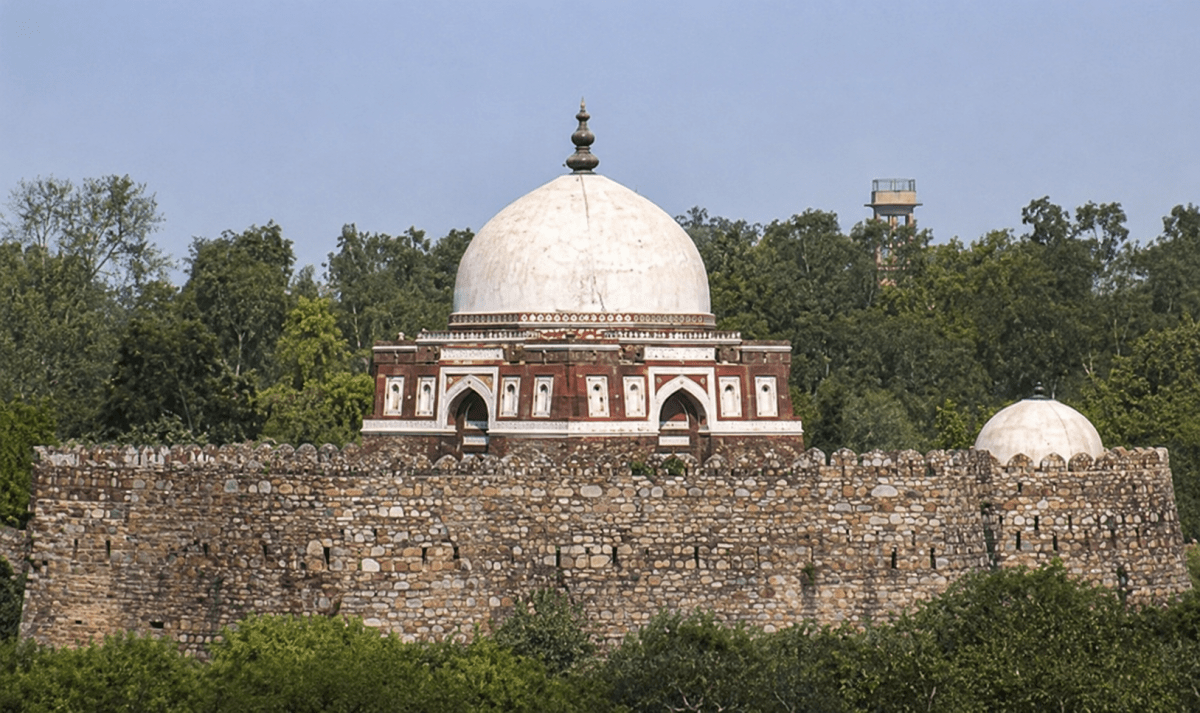
a. Whose tomb is shown in the given picture?
b. Which fortified town, the third historic city of Delhi, is associated with Ghiyasuddin Tughlaq?
c. Write briefly about the architectural features of this structure.
Answer
a. The picture shows the tomb of Ghiyasuddin Tughlaq, the founder of the Tughlaq dynasty. The tomb is located within the Tughlaqabad Fort in Delhi.
b. The fortified town of Tughlaqabad is the third historic city of Delhi associated with Ghiyasuddin Tughlaq. He built this town as the new capital after establishing the Tughlaq dynasty.
c. Architectural features of the structure:
- The tomb is located inside the fortified town of Tughlaqabad, which has over 6 km of fortification in an irregular rectangle.
- The fort has two parts — the citadel and palaces forming one unit, and the city the other.
- The citadel and the walls of the palaces still remain, though the city portion is in an advanced state of ruin.
- The tomb itself displays the sturdy, fort-like architectural style typical of the Tughlaq period, with sloping walls, a prominent dome, and the use of red sandstone with white marble.
- The structure reflects the military character of Tughlaq architecture, with strong, solid walls suited to a period when defence was a major concern.
The Sultan ordered the entire population of Delhi to move to Daulatabad in the Deccan. People suffered greatly on the long journey, and many died. Eventually, the Sultan was forced to bring them back to Delhi.
Based on the case study answer the following questions:
a. Why did Muhammad bin Tughluq shift his capital from Delhi to Daulatabad?
b. Mention one major consequence of this decision.
c. What does this decision reveal about the Sultan's administration?
Answer
a. Muhammad bin Tughlaq shifted his capital from Delhi to Daulatabad (originally Deogiri) for two main reasons:
- He wanted to shift the capital to a more central place, keeping in view the repeated rebellions in the south (Deccan region).
- He wanted to keep his capital safe from the repeated Mongol attacks that threatened Delhi from the north-west.
b. One major consequence of this decision was the great suffering of the people. The journey from Delhi to Daulatabad was 1,500 km long and arduous. Despite the elaborate arrangements made by the sultan — a broad road lined with trees, temporary shelters along the way, and free food and drinks during the journey — many people perished on the long march to Daulatabad. The entire operation was a total failure, and the sultan was eventually forced to order the return of the population to Delhi. This caused enormous loss of life, wealth, and trust in the sultan's authority.
c. This decision reveals that Muhammad bin Tughlaq's administration was marked by:
- Impractical and hasty decision-making — Although he was a learned ruler, his policies often lacked practical wisdom and proper planning.
- Mixture of opposites — Despite good intentions and elaborate preparations, his policies ended in failure, which is why historians describe him as a 'mixture of opposites'.
- Failure to assess ground realities — He underestimated the difficulties faced by ordinary people and the unwillingness of his ministers, courtiers and soldiers to stay in Daulatabad.
- Notorious for ill-advised policy experiments — The term Tughlaqi became a synonym for stubborn eccentricity, reflecting the impracticality of his major policy decisions.