
How many social groups was the society divided into during the Sultanate period?
- Four
- Five
- Six
Answer
Four
Reason — The society during the Sultanate period was divided into four main social groups, namely the Aristocracy, the Priestly class, the Town dwellers and the Peasantry.
Complete the given mind map.
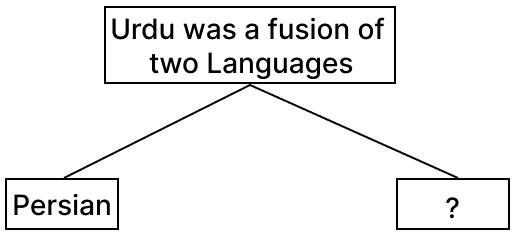
- Sanskrit
- Tamil
- Hindi
Answer
Hindi
Reason — Urdu was a new language that was born from the fusion of two languages — Hindi and Persian.
Which of the following statements does not reflect the developments that took place in the field of dance and music?
- Qawwali, a new form of singing in chorus, became popular.
- A new dance form, Kathak, emerged.
- Sanskrit remained an important language.
Answer
Sanskrit remained an important language.
Reason — The popularity of Qawwali and the emergence of Kathak were developments in the fields of music and dance. Sanskrit remaining an important language was a development in the field of language, not dance and music.
The following new architectural feature was introduced in India in the Sultanate period:
- Courtyard
- Dome
- Pillar
Answer
Dome
Reason — The dome (along with the pointed or true arch) was one of the two new architectural features introduced during the Sultanate period. Courtyards and pillars were already a part of existing Indian architecture.
In Indo-Islamic style of architecture, this traditional motif was used to decorate Islamic buildings:
- Lotus
- Lily
- Rose
Answer
Lotus
Reason — Local Indian craftsmen implemented some of their own ideas, and soon traditional motifs, such as the lotus, found their way into Islamic buildings.
Observe the folio from a 16th-century manuscript of Amir Khusrau's 'Khamsa'. This image represents the artistic achievements of the Sultanate period. Which of the following statements about the development of painting during this era is best described by the context of such manuscripts?

- Painting primarily focused on religious murals in mosques.
- Indian painters were influenced by Persian styles, and miniature painting flourished.
- The focus was entirely on abstract art with no human figures.
- European Renaissance artists heavily influenced Indian painting during this time.
Answer
Indian painters were influenced by Persian styles, and miniature painting flourished.
Reason — Miniature painting flourished during the Sultanate period. Indian painters were influenced by the Persian style of painting, and making portraits of the sultans became popular.
Sati, child marriage and purdah became widely prevalent during the Sultanate period. Identify the reason for the widespread prevalence of these social practices:
- The influence of newly introduced Islamic customs
- A continued rigidity within the existing Hindu social structures
- Measures implemented by the sultans to control the population
- A general decline in all religious practices across society
Answer
A continued rigidity within the existing Hindu social structures
Reason — During the Sultanate period, the caste system among Hindus continued to be rigid and inter-caste marriages continued to be discouraged. It was within this existing and continuing rigidity of the Hindu social structure that practices like sati, child marriage and purdah became widely prevalent.
Which of the following was NOT a new architectural feature introduced during the Sultanate period?
- The dome
- The pointed or true arch
- Use of red sandstone
- Intricate temple spires
Answer
Intricate temple spires
Reason — The dome, the pointed or true arch, and the use of red sandstone were features associated with the architecture introduced during the Sultanate period. Intricate temple spires belonged to the pre-existing traditional Indian temple architecture and were not a new introduction of this period.
Consider the following cultural developments: Spread of Persian language, rise of Urdu, emergence of Hindustani music, flourishing of miniature painting. Which development illustrates the 'fusion between the Indian and Islamic cultures'?
- Spread of Persian language as court language
- The rise of Urdu, combining Hindi and Persian
- The use of red sandstone in buildings
- The strict adherence to the purdah system
Answer
The rise of Urdu, combining Hindi and Persian
Reason — Urdu was born from the fusion of Hindi (an Indian language) and Persian (the language of the Islamic rulers). This blending of the two best illustrates the fusion between the Indian and Islamic cultures.
Assertion (A): Regional languages flourished during the Sultanate period.
Reason (R): Bhakti saints preached in the language of the people, making their teachings accessible.
- A is true, but R is false.
- R is the reason for A.
- Both A and R are false.
- Only R is true, and A is false.
Answer
R is the reason for A.
Explanation — Both the Assertion and the Reason are true. Regional languages such as Bengali, Punjabi, Marathi, Oriya, Kannada, Telugu and Tamil flourished during the Sultanate period precisely because the Bhakti saints preached in the language of the common people. Hence, R correctly explains A.
Assertion (A): The Sultanate period saw the introduction of the dome and the pointed or true arch in Indian architecture.
Reason (R): These were features of the Arabic and Persian styles of architecture that merged with existing Indian styles.
- A is true, but R is false.
- R is the reason for A.
- A is false, but R is true.
- Both A and R are false.
Answer
R is the reason for A.
Explanation — Both the Assertion and the Reason are true. The dome and the pointed or true arch were introduced during the Sultanate period because the Arabic and Persian styles of architecture rose in India and merged with the existing Indian styles to form a distinctive Indo-Islamic style. Hence, R correctly explains A.
Write what each of the following mean in a sentence:
- Qazi
- Raga
- Khamsa
- Double Dome
Answer
- Qazi — The qazi was the chief judge during the Sultanate period, who acted as the sultan's advisor on religious issues.
- Raga — A raga is a melody; Amir Khusrau, the poet and musician, produced several ragas during the Sultanate period.
- Khamsa — A khamsa is a quintet of poems, that is, a group of five poems.
- Double Dome — The double dome is a style of architecture, introduced by the Persians, in which a building had two layers of ceiling to form a big bulbous dome.
Write 'F' for a fact and 'O' for an opinion for the following statements.
a. It is claimed that Amir Khusrau gave impetus to the development of the Urdu language, under the guidance of a Sufi saint, Hazrat Nizamuddin Auliya.
b. Many qawwalis that preached the Sufi message were written in Urdu, so that they could be understood by the masses.
c. Thoughts could be expressed more beautifully in Urdu than in Persian.
Answer
a. F
b. F
c. O
'The Indo-Islamic style was unique to the Indian subcontinent.' Support this statement with reasons and examples.
Answer
The Indo-Islamic style was unique to the Indian subcontinent because it grew out of the blending of the existing Indian styles of architecture with the Arabic and Persian styles that rose during the Sultanate period. The two had many common features, which allowed them to merge into a distinctive new style that was not found anywhere else. For example, both the temple and the mosque had large open courtyards. New features such as the dome and the pointed or true arch were introduced, while traditional Indian motifs, such as the lotus, found their way into Islamic buildings. Local Indian craftsmen were trained in Persian styles of art and combined them with their own ideas. Red sandstone was used to add colour to the buildings, and verses from the Koran were engraved on the walls alongside Indian decorative designs. This unique fusion of Indian and Islamic elements is what made the style special to the Indian subcontinent.
How was society divided during the Sultanate period? Explain in your own words.
Answer
The society during the Sultanate period was divided into four main social groups:
- Aristocracy — This was the powerful ruling class. It comprised the sultan, his relatives, nobles, Hindu princes and landlords.
- Priestly class — This group included the ulemas, maulvis, qazis and brahmanas. The ulemas and brahmanas held important positions in the administration. The ulemas were the chief advisors of the sultan, while the qazi, or the chief judge, was the sultan's advisor on religious issues.
- Town dwellers — This group consisted of officials, artisans, craftspersons, merchants, slaves and domestic servants. Their occupations were largely hereditary.
- Peasantry — The peasants were exploited and had to pay heavy taxes. The tax paid by them was the chief source of revenue for the government.
Write a short note on the development of literature and language during the Sultanate period.
Answer
The rise of the Persian-speaking sultans resulted in the spread of the Persian language in India, and Persian became the court language of the Sultanate. Amir Khusrau, a noted writer of the period, wrote about Indian events in Persian. In addition, Hindi and Persian fused together to give birth to a new language called Urdu, which was also called a 'camp language' as it developed in the army camps. While Sanskrit continued to remain an important language, regional languages such as Bengali, Punjabi, Marathi, Oriya, Kannada, Telugu and Tamil flourished because the Bhakti saints preached in the language of the people. Literature consisted of both translations and original works. The Ramayana and the Mahabharata were translated into different regional languages, and other Sanskrit works were translated into Persian, Arabic, as well as various regional languages.
Write about the developments in the field of music during the Sultanate period.
Answer
The Indo-Islamic fusion greatly enriched music during the Sultanate period, and the north Indian or Hindustani music came into being. Amir Khusrau, the poet and musician in the court of many medieval rulers, produced several ragas, or melodies. Qawwali, a new form of singing in chorus, became popular. New musical instruments, such as the tabla, sitar and sarangi, were also developed during this time.
Explain the distinctive features of the Sultanate architecture.
Answer
The Sultanate period saw the rise of the Arabic and Persian styles of architecture in India, which blended with the existing Indian styles to transform into a distinctive Indo-Islamic style. Two new architectural features — the dome and the pointed or true arch — were introduced. Both the temple and the mosque had large open courtyards. The extensive use of bricks enabled builders to construct larger structures covering more area, and the use of red sandstone added colour to the buildings. Local Indian craftsmen, trained in Persian styles of art, decorated the structures and also added their own ideas, so that traditional motifs such as the lotus found their way into Islamic buildings. Verses from the Koran were engraved on the walls of some buildings, and elaborate use was made of calligraphy and geometrical designs. The Lodi dynasty later introduced the new concept of the double dome.
Read the paragraph and answer the questions that follow.
During the Tughlaq period, the style of architecture was less decorative, and more simple and austere. The Sayyids and the Lodis in turn brought about more lavish styles, with the latter introducing the new concept of the double dome.
- What were the distinguishing features of the architecture during the Tughlaq period?
- How did the style of architecture change from the Tughlaqs to the Sayyids and Lodis?
- Which architectural feature was introduced by the Lodi dynasty?
Answer
- During the Tughlaq period, the style of architecture was less decorative, and more simple and austere.
- The style of architecture changed from the simple and austere style of the Tughlaqs to the more lavish styles brought about by the Sayyids and the Lodis.
- The Lodi dynasty introduced the new concept of the double dome.
These are the pictures of a tomb belonging to the Sultanate period from two different angles.
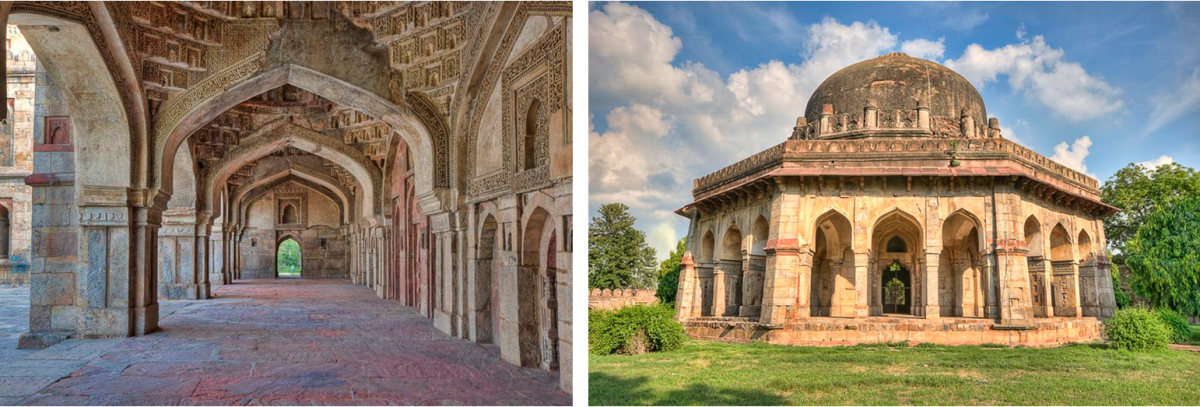
a. Name the two architectural features introduced during the Sultanate period that you notice in these pictures.
Answer
a. The two architectural features introduced during the Sultanate period that can be noticed in these pictures are the dome and the pointed or true arch.
This image depicts a famous 13th–14th century poet, musician and scholar of the Delhi Sultanate, known for his eloquence and cultural contributions.
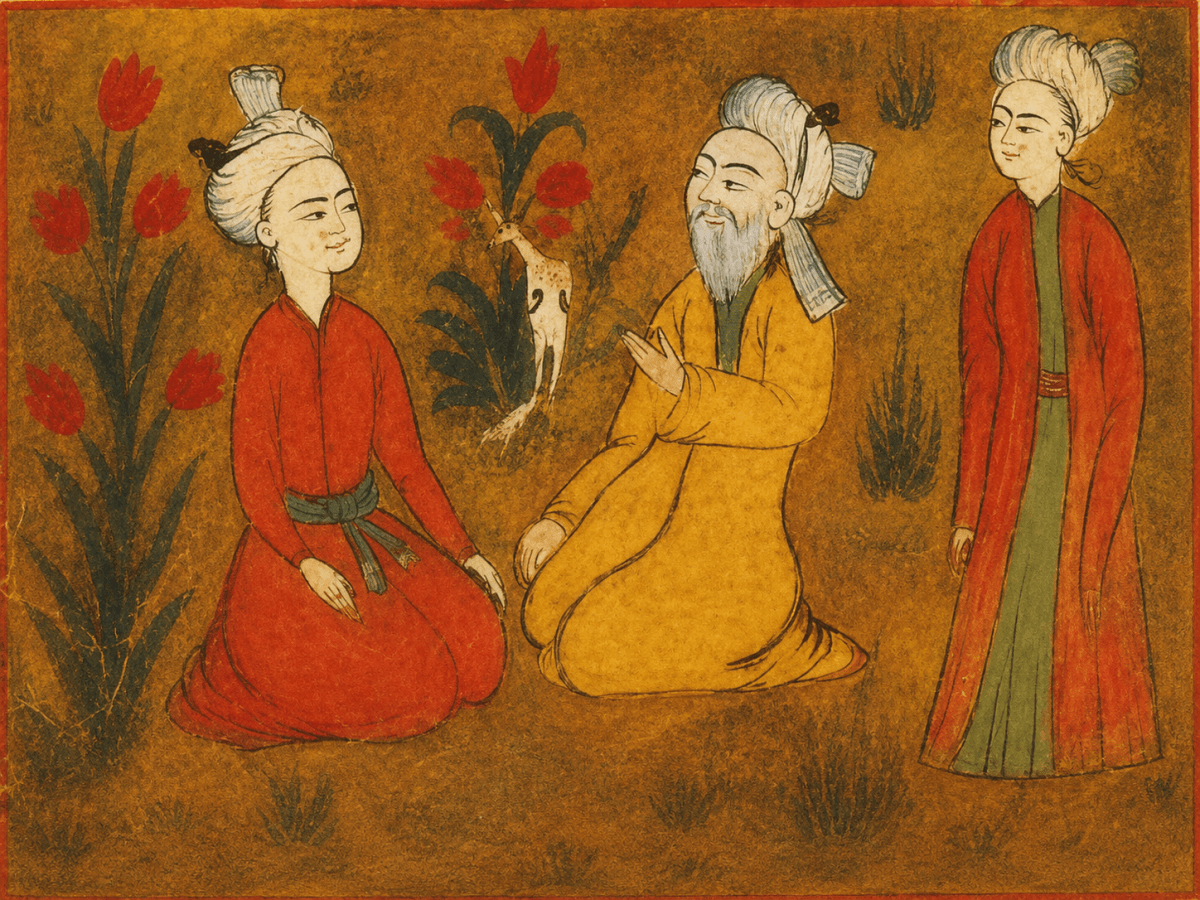
a. Identify the scholar in the given image.
b. Mention two of his contributions to the cultural life of the Delhi Sultanate.
c. How did his works reflect Indo-Islamic culture?
Answer
a. The scholar in the given image is Amir Khusrau.
b. Two of his contributions to the cultural life of the Delhi Sultanate are:
- He gave impetus to the development of the Urdu language and wrote about Indian events in Persian.
- As a poet and musician, he produced several ragas, or melodies, enriching Hindustani music.
c. His works reflected Indo-Islamic culture because he wrote about Indian events and themes in the Persian language, and is credited with giving impetus to Urdu — itself a fusion of Hindi and Persian. He also blended Indian and Islamic elements in the field of music by producing new ragas, thereby bringing together the two cultures.
Amir Khusrau was a prominent literary figure of the Delhi Sultanate period, known for his versatile contributions in poetry and prose. He enjoyed the patronage of several rulers, including Jalaluddin Khalji, Alauddin Khalji and Ghiyasuddin Tughlaq. His works, such as Tughlaqnama and Miftah-ul-Futuh, documented military campaigns, while Nuh Sipihr is considered a vital source for understanding medieval India. His writings reflected a blend of Persian language and Indian culture.
Based on the case study answer the following questions:
a. Name two rulers who patronised Amir Khusrau.
b. Which of Amir Khusrau's prose works describes the military expeditions of Alauddin Khalji?
c. What is considered Amir Khusrau's most remarkable work, important for understanding medieval India?
Answer
a. Two rulers who patronised Amir Khusrau were Alauddin Khalji and Ghiyasuddin Tughlaq. (Jalaluddin Khalji was also one of his patrons.)
b. Amir Khusrau's prose work that describes the military expeditions of Alauddin Khalji is Miftah-ul-Futuh.
c. Amir Khusrau's most remarkable work, considered a vital source for understanding medieval India, is Nuh Sipihr.