
Which of the following statements does not apply to the Vijayanagara Empire?
- It was based in the Deccan Plateau.
- The empire lasted for more than 200 years.
- Mahmud Gawan was an important ruler of the empire.
Answer
Mahmud Gawan was an important ruler of the empire.
Reason — Mahmud Gawan was the Prime Minister of the Bahmani kingdom, not a ruler of the Vijayanagara Empire. The other two statements are correct, as the Vijayanagara Empire was based in the Deccan Plateau and lasted for more than 200 years.
Complete the given table by choosing the correct option.
| Provinces in Vijayanagara Empire | Commander in Vijayanagara Empire |
|---|---|
| Rajyas or mandalams | ? |
- Dandanayaka
- Afaqi
- Nadu
Answer
Dandanayaka
Reason — The Vijayanagara Empire was divided into six provinces called rajyas or mandalams. Each province was placed under a commander known as a dandanayaka. (Nadu was a district, and Afaqi referred to a group of nobles in the Bahmani kingdom.)
The Bahmani kingdom was founded by:
- Alauddin Hasan
- Muhammad Shah I
- Muhammad Shah II
Answer
Alauddin Hasan
Reason — The Bahmani kingdom was founded by Alauddin Hasan in 1347 CE. After ascending the throne, he assumed the title of Alauddin Bahman Shah.
Bahman Shah was succeeded by his son:
- Muhammad Shah I
- Muhammad Shah II
- Muhammad Shah III
Answer
Muhammad Shah I
Reason — Bahman Shah was succeeded by his son Muhammad Shah I (1358 CE–1375 CE), who defeated the rulers of Warangal and Vijayanagara and captured the fort of Golconda.
Which of the following statements about the Jami Masjid at Gulbarga is not true?
- It was built by the Bahmani sultans.
- Krishnadeva Raya called craftspersons from Persia to build it.
- It was built by the same dynasty that built the Chand Minar at Daulatabad.
Answer
Krishnadeva Raya called craftspersons from Persia to build it.
Reason — The Jami Masjid at Gulbarga was built by the Bahmani sultans, who employed architects and craftspersons from Persia. Krishnadeva Raya was a ruler of the Vijayanagara Empire and had no role in building it.
Vijayanagara Empire : Harihara I and Bukka Raya I :: Bahmani Kingdom :
- Muhammad bin Tughlaq
- Krishnadeva Raya
- Alauddin Hasan
- Mahmud Gawan
Answer
Alauddin Hasan
Reason — Just as the Vijayanagara Empire was founded by Harihara I and Bukka Raya I, the Bahmani kingdom was founded by Alauddin Hasan. The analogy connects each kingdom with its founder(s).
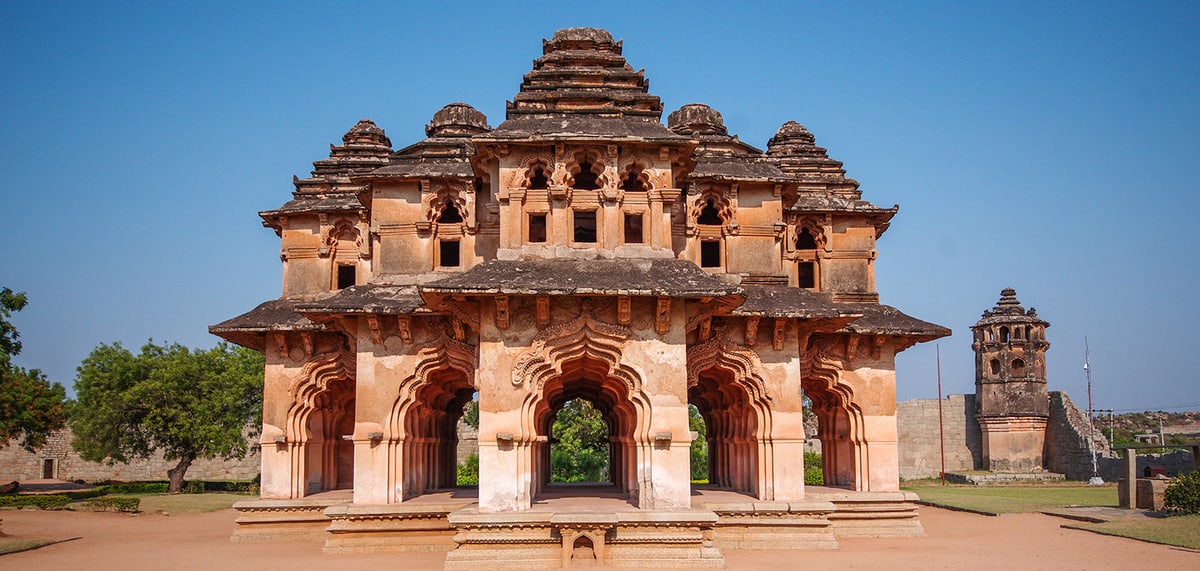
This temple complex was a hub of religion, art and royal ceremonies. Which historical event most directly led to its plunder and decline?
- Arrival of Portuguese traders in Goa
- Battle of Talikota (1565 CE) against Deccan Sultanates
- Invasion by Maratha Confederacy
- Rise of the Chola Navy in the 11th century
Answer
Battle of Talikota (1565 CE) against Deccan Sultanates
Reason — After the Battle of Talikota in 1565 CE, the combined Deccan Sultanates defeated Vijayanagara and razed its capital city (Hampi) to the ground, plundering and destroying its temples and bringing about the decline of the empire.
Which of the following factors best explains the frequent conflicts between Vijayanagara Empire and the Bahmani Kingdom?
- Trade rivalry in the Arabian Sea
- Fertility of the Raichur Doab
- Religious conversion policies
- Succession disputes in Delhi
Answer
Fertility of the Raichur Doab
Reason — The Raichur Doab, the fertile agricultural region lying between the Krishna and Tungabhadra rivers, was a prized territory. Both the Vijayanagara Empire and the Bahmani kingdom wished to control it, which led to frequent conflicts between them.
Which event marks a turning point in the fortunes of the Vijayanagara Empire?
- Founding of Vijayanagara Empire
- Founding of Bahmani Kingdom
- Beginning of Krishnadeva Raya's reign
- Battle of Talikota
Answer
Battle of Talikota
Reason — The Battle of Talikota (1565 CE) was a turning point because the alliance of the five Deccan kingdoms defeated and killed Rama Raya and razed the capital city of Vijayanagara to the ground, marking the decline of the empire.
Assertion (A): Muhammad bin Tughlaq was responsible for the decline of the Tughlaq Empire.
Reason (R): His transfer of capital and failed attempt to conquer Khurasan brought misery and made him unpopular.
- A is true, but R is false.
- R is the reason for A.
- Both A and R are false.
- Only R is true, and A is false.
Answer
R is the reason for A.
Explanation — Both A and R are true. Muhammad bin Tughlaq's transfer of the capital, introduction of token currency and failed attempt to conquer Khurasan brought great misery to the people and made him unpopular among his subjects. This directly contributed to the decline of the Tughlaq Empire, so R correctly explains A.
Assertion (A): The Battle of Talikota (1565 CE) led to the decline of Vijayanagara.
Reason (R): The battle resulted in the combined Deccan Sultanates plundering Hampi and destroying its temples.
- A is true, but R is false.
- R is the reason for A.
- A is false, but R is true.
- Both A and R are false.
Answer
R is the reason for A.
Explanation — Both A and R are true. After the Battle of Talikota, the allied Deccan Sultanates defeated Vijayanagara and razed its capital city to the ground, plundering Hampi and destroying its temples. This destruction directly caused the decline of the empire, so R correctly explains A.
Number the following to put them in the correct chronological order.
- The Battle of Talikota
- Alauddin Hasan assumed the title of Alauddin Bahman Shah.
- The city of Vijayanagara was established.
- Mahmud Gawan served as the Prime Minister of the Bahmani kingdom.
- Beginning of the Islamic contact with south India.
Answer
- The Battle of Talikota — 5
- Alauddin Hasan assumed the title of Alauddin Bahman Shah. — 3
- The city of Vijayanagara was established. — 2
- Mahmud Gawan served as the Prime Minister of the Bahmani kingdom. — 4
- Beginning of the Islamic contact with south India. — 1
The correct chronological order is: Beginning of the Islamic contact with south India (7th century CE) → The city of Vijayanagara was established (1336 CE) → Alauddin Hasan assumed the title of Alauddin Bahman Shah (1347 CE) → Mahmud Gawan served as the Prime Minister of the Bahmani kingdom (1463–1481 CE) → The Battle of Talikota (1565 CE).
'The geographic location of Hampi was favourable for its development.' Support this example with reasons.
Answer
The geographic location of Hampi was indeed favourable for its development, for the following reasons:
- Hampi was situated on the southern banks of the Tungabhadra River. The river provided a steady supply of water for drinking, for irrigation and for agriculture, which helped the city and the surrounding region prosper.
- The area was surrounded by rocky hills and huge boulders, which formed a strong natural fortification. This protected the city from enemy attacks and made it easy to defend.
- The fertile land near the river supported large-scale farming and a thriving agricultural economy, which formed the backbone of the empire.
- Its location helped Hampi grow into a major centre of trade and pilgrimage. Over time, it developed into a mighty imperial city said to be larger than Rome, Paris or Lisbon.
'Towards the end, backbone of the Bahmani kingdom was its Prime Minister and not the ruler.' Do you agree with this statement? Give reasons for your answer.
Answer
Yes, I agree with this statement. Towards the end, the real strength of the Bahmani kingdom lay in its Prime Minister, Mahmud Gawan, rather than in the ruler. The reasons are:
- It was under the leadership of Mahmud Gawan, the Prime Minister of Muhammad Shah III, that the kingdom reached its zenith and expanded considerably.
- Mahmud Gawan was a gifted administrator and a skilled general. He captured Goa and Dabhol, which were of strategic importance, and also plundered Kanchipuram.
- He strengthened the power of the sultan, curbed the power of the nobles, improved the land revenue system and encouraged education by building a college at Bidar.
- After Mahmud Gawan was executed by treachery in 1481 CE, the kingdom rapidly weakened and gradually split into five independent kingdoms. This shows that the kingdom's stability depended largely on its Prime Minister and not on the ruler.
What were the reasons for the downfall of the Tughlaq dynasty?
Answer
The reasons for the downfall of the Tughlaq dynasty were:
- Muhammad bin Tughlaq was greatly responsible for the decline. His transfer of the capital, introduction of the token currency and failed attempt to conquer Khurasan brought great misery to the people and made him unpopular.
- He created a large number of enemies, which led to the outbreak of many revolts throughout the empire.
- His successor, Firuz Shah, was weak and not known for his martial skills. He could neither reconquer the lost territories nor take any action against the Vijayanagara and Bahmani kingdoms.
- Firuz Shah made the offices of the army hereditary, which eventually made the army inefficient and lethargic. His religious policy, including the imposition of jizyah, made him unpopular among non-Muslims.
- The final blow came with Timur's invasion. The way Delhi was plundered and massacred completely shook the foundation of the Tughlaq Empire.
Name the articles of import and export in the Vijayanagara Empire.
Answer
The main articles of export were cotton, spices, jewels, ivory, precious stones and aromatic products such as perfumes. These were exported to China, Burma and Persia.
The chief articles of import were copper, quicksilver (mercury), saffron, coral, gold and silver, along with horses from Persia and silk from China.
Write a note on the Vijayanagara architecture.
Answer
The Vijayanagara architecture is a vibrant combination of the Chalukya, Hoysala, Pandya and Chola styles. Its legacy of sculpture, architecture and painting continued to influence the arts long after the empire came to an end. The hallmarks of the style include the ornate, pillared kalyanamandapa (marriage hall), the vasanthamandapa (open-pillared entrance hall) and the rayagopura (tower). Fine examples include the Virupaksha Temple built by Bukka Raya I and the Hazara Rama Temple built by Deva Raya I. At Hampi, the Vitthala Temple, with its intricately carved pillars, is a good example of this style. The secular character of Vijayanagara architecture is evident from the fact that many structures include Islamic features. Other architectural wonders at Hampi include the two-storey Lotus Mahal and the famous stone chariot.
What was the condition of social life in the Vijayanagara Empire?
Answer
The social life in the Vijayanagara Empire had the following features:
- The caste system was prevalent and was followed rigidly. Untouchability was a part of the caste system. However, the caste system did not prevent distinguished people belonging to different castes from being promoted to high ranks in the army or in the administration. Brahmanas enjoyed a high status in society.
- Women were respected but did not enjoy much freedom. Some upper-class women, however, enjoyed a high status and were actively involved in administration, trade and the fine arts.
- Child marriage and sati were common practices in the society.
Give two features of the Bahmani administration.
Answer
Two features of the Bahmani administration were:
- The king was all-powerful, but in practice he depended greatly on the strength of his army. Since the nobles were very strong, the king had to be stronger to maintain his position.
- For effective administration, the empire was divided into provinces, each placed under a governor. The governors collected revenue as well as supplied troops to the king.
Name the kingdoms that the Bahmani kingdom split into.
Answer
After the death of Mahmud Gawan, the Bahmani kingdom gradually split into five independent kingdoms — Berar, Bidar, Bijapur, Ahmadnagar and Golconda.
With reference to the key figures of the Vijayanagara and Bahmani kingdoms, write short notes on the following:
- Krishnadeva Raya as the most successful ruler of the Vijayanagara Empire
- Mahmud Gawan and his achievements
Answer
1. Krishnadeva Raya as the most successful ruler of the Vijayanagara Empire
Krishnadeva Raya (1509 CE–1530 CE) was one of the ablest and most accomplished rulers of Vijayanagara. He won a series of outstanding victories and extended the boundaries of his empire, proving himself to be a brilliant general. He was also a wise and shrewd statesman who understood the importance of overseas trade and naval power, and he encouraged foreign trade with the Portuguese, who had set up trade centres on the Malabar Coast. He was a great patron of art and architecture — he donated large sums of money to temples, built many magnificent palaces, constructed dams for irrigation and took measures to improve agriculture. A great Telugu and Sanskrit scholar, he gave the Telugu language his patronage, under which it reached its peak. During his reign, the city of Vijayanagara was at the height of its prosperity.
2. Mahmud Gawan and his achievements
Mahmud Gawan was the Prime Minister of the Bahmani ruler Muhammad Shah III, and it was during his time that the kingdom reached its zenith. He was a gifted administrator as well as a skilled general, and the kingdom expanded under his leadership. He captured Goa and Dabhol, which were of strategic importance to the Vijayanagara kingdom, and also plundered Kanchipuram. He strengthened the power of the sultan and curbed the power of the nobles, and the land revenue system improved under his supervision. He encouraged education and spent almost his entire wealth in building a college (madrasa) at Bidar. As a newcomer (Afaqi), it was difficult for him to win the confidence of the Deccani nobles, who, jealous of him, got him executed by treachery in 1481 CE.
This structure was built in one of the kingdoms that broke away from the Bahmani kingdom.
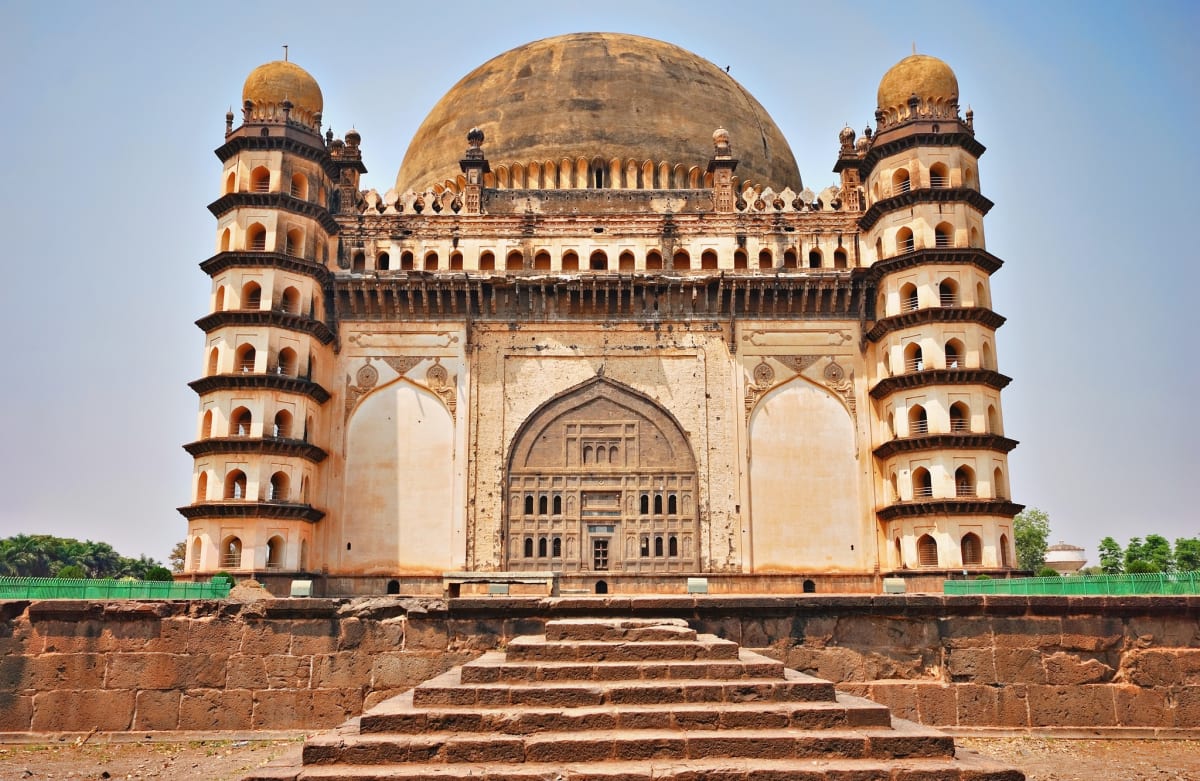
a. What is the name of this monument?
b. State one interesting feature of this monument.
Answer
a. This monument is the Gol Gumbaz, located in Bijapur. (Bijapur was one of the five kingdoms that broke away from the Bahmani kingdom.)
b. The Gol Gumbaz has one of the largest domes in the world, and the dome stands independent of pillars. It is famous for its acoustic system — it is said that the faintest whisper in the dome is carried around it and returned to the person ten times. (At its four corners are minaret-like towers that house staircases leading up to the dome.)
Based on the picture given here, answer the following:
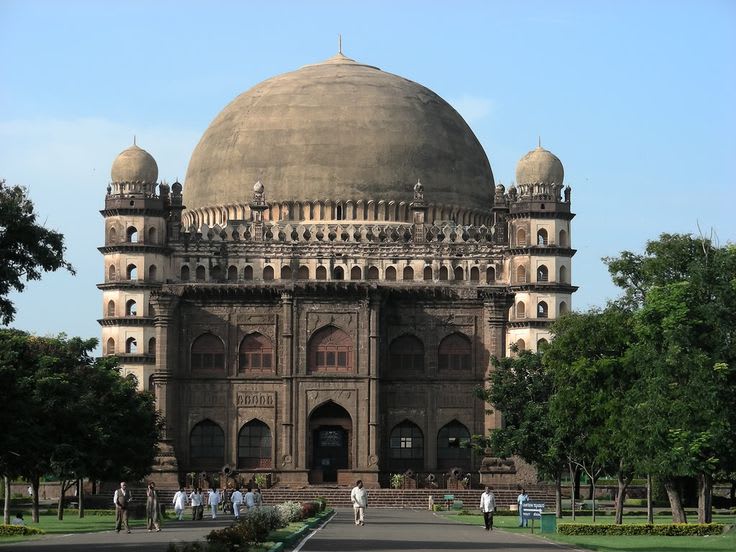
a. Identify the monument. Where is it located?
b. Who built this monument?
c. State two important architectural features of this monument.
Answer
a. The monument is the Gol Gumbaz. It is located in Bijapur. (Bijapur was one of the five kingdoms that broke away from the Bahmani kingdom.)
b. It was built in the sultanate of Bijapur and is the tomb of Muhammad Adil Shah, the ruler of Bijapur.
c. Two important architectural features of this monument are:
- It has one of the largest domes in the world, and the dome stands independent of pillars.
- It is famous for its acoustic system — the faintest whisper in the dome is carried around it and returned to the person ten times. At its four corners are minaret-like towers that house staircases leading up to the top dome.
The city of Vijayanagara, the heart of the empire, was described by foreign visitors as a thriving business centre, particularly for gold and precious gems. Domingo Paes, a Portuguese traveller, meticulously detailed its markets, filled with various commodities—from rubies and diamonds to clothes, fruits and grains. The city was well-stocked with provisions, and its streets were bustling with activity, including presence of countless oxen. The empire's economy was primarily agricultural, with robust cotton production supporting a vibrant textile industry.
Based on the case study answer the following questions:
a. Name two precious items specifically mentioned as being traded in the markets of Vijayanagara.
b. According to Domingo Paes, which agricultural product was less common in Vijayanagara compared to other grains?
c. What was the main reason for the rise of a vibrant textile industry in the empire?
Answer
a. Two precious items specifically mentioned as being traded in the markets of Vijayanagara were rubies and diamonds. (Emeralds and pearls were also mentioned.)
b. According to Domingo Paes, wheat was less common than the other grains, since no one ate it except the Moors.
c. The main reason for the rise of a vibrant textile industry in the empire was the large-scale production of cotton.