
Study the given picture and answer the following questions
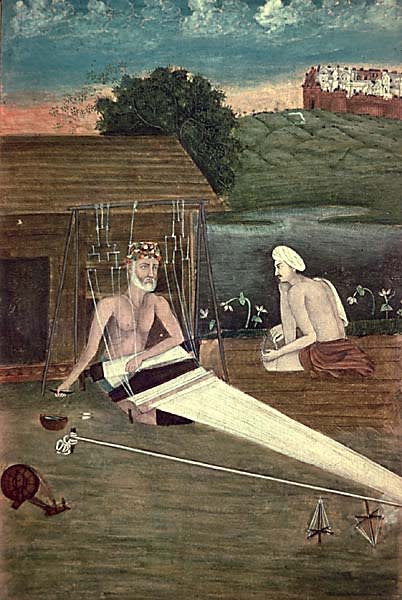
(i) Who is shown in the picture?
(ii) Whom was he a disciple of?
(iii) What were the different names he used to refer to God?
(iv) What are his poems also known as?
Answer
(i) The picture shows Kabir, a prominent saint of the Bhakti Movement.
(ii) Kabir was a disciple of Ramananda.
(iii) Kabir preached that there was only one God with different names. He referred to God by several names, such as Govinda, Hari, Sain, Sahib, Allah and Rama.
(iv) His poems are also known as dohas.
Differentiate between Fundamental Rights and Directive Principles of State Policy.
| Fundamental Rights | Directive Principles of State Policy |
|---|---|
Answer
| Fundamental Rights | Directive Principles of State Policy |
|---|---|
| Fundamental Rights are justiciable. | Directive Principles are non-justiciable. |
| These rights protect the civil liberties of the people. | Directive Principles lay down our economic ideals and social order in order to create a welfare state. |
| Fundamental Rights indicate what the State should not do. Rights are, therefore, negative in character. | Directive Principles are positive directions to the State. They tell the State what to do. |
State whether the following statements are true or false. Correct the false statements.
- Primary education has been made free and compulsory in most of the government owned/aided schools.
- The operation of the economic system should result in the concentration of wealth with the government.
- Workers should be allowed to participate in the management of industries and other organisations.
- The Directive Principles do not deal with international security.
- The State should ensure free legal aid to the poor and needy.
Answer
True.
False.
Correct Statement — The operation of the economic system should not result in the concentration of wealth.True.
False.
Correct Statement — The Directive Principles deal with the promotion of international peace and security.True.