
Which of the following statements does not apply to the Directive Principles of State Policy?
- These are guidelines to the government to create a social order characterised by social, economic and political justice to promote the welfare of the people.
- These principles are to be kept in mind while framing the policies and laws of the country.
- These principles can be legally enforced.
Answer
These principles can be legally enforced.
Reason — The Directive Principles are non-justiciable, which means they cannot be legally enforced in a court of law. The other two statements correctly describe the Directive Principles.
Documents from which of the following countries have inspired the Directive Principles of State Policy of India?
- Ireland, France, USA
- Ireland, France, Canada
- Britain, France, Canada
Answer
Ireland, France, USA
Reason — The Directive Principles were inspired by the Directive Principles of the Irish Constitution (Ireland), the French Declaration of the Rights of Man and of the Citizen (France), and the American Bill of Rights (USA).
The Directive Principles laid down in the Constitution are ________.
- non-justiciable
- justiciable
- enforceable
Answer
non-justiciable
Reason — Being non-justiciable, the Directive Principles are not enforceable in a court of law; an aggrieved party cannot go to court if a Directive is not carried out.
The State should try to secure a ________ Civil Code for its citizens.
- Divergent
- Unanimous
- Uniform
Answer
Uniform
Reason — A Uniform Civil Code means the same set of civil laws used to govern people of all religions, castes and tribes throughout the country. It is listed among the general principles of the Directive Principles.
________ Reform Acts have been enacted with the aim to prevent the exploitation of landless peasants.
- Property
- Land
- Home
Answer
Land
Reason — Along with the abolition of the zamindari system, Land Reform Acts have been enacted with the aim to prevent the exploitation of landless peasants.
Fundamental Rights : Justiciable : : Directive Principles : ________
- Enforceable
- Negative in character
- Non-justiciable
- Mandatory for citizens
Answer
Non-justiciable
Reason — Just as Fundamental Rights are justiciable (enforceable in a court of law), the Directive Principles are non-justiciable (not enforceable in a court of law).
Observe the given picture and identify the correct context of the picture:

- Mid Day Meal Scheme
- Free and compulsory education till 14 years
- Prohibition on child labour
- Empowering girls
Answer
Free and compulsory education till 14 years
Reason — The Gandhian principle in the Directive Principles states that the State should provide free and compulsory education to children up to 14 years of age. The chapter's photographs of school children are captioned accordingly.
A welfare state guarantees free or low-cost basic education, health services and housing provided by the state. Identify the impact of these provisions on the citizens:
- Increased financial burden on the government
- Reduction in the overall quality of services
- Improvement in the standard of living and equal opportunities for citizens
- Greater reliance on private sector services
Answer
Improvement in the standard of living and equal opportunities for citizens
Reason — By guaranteeing free or low-cost basic education, health services and housing, a welfare state raises the standard of living and ensures equality of opportunity for its citizens.
Which of the following is NOT listed as a source of inspiration for the Directive Principles of State Policy?
- Directive Principles of the Irish Constitution
- The social and economic ideals of Mahatma Gandhi
- The British Magna Carta
- United Nations Declaration of Human Rights
Answer
The British Magna Carta
Reason — The sources of the Directive Principles are the Irish Constitution, the ideals of Mahatma Gandhi, the French Declaration of the Rights of Man and of the Citizen, the American Bill of Rights and the UN Declaration of Human Rights. The British Magna Carta is not among them.
Assertion (A): The Directive Principles of State Policy cannot be legally enforced in a court of law.
Reason (R): They are considered fundamental in the governance of the country and it is the duty of the state to apply them while making laws.
- A is true, but R is false.
- R is the reason for A.
- Both A and R are false.
- Only R is true, and A is false.
Answer
A is true, but R is false.
Explanation — Assertion (A) is true because the Directive Principles of State Policy are non-justiciable, meaning they cannot be enforced in a court of law. Reason (R) is false because, although the Directive Principles guide the State in policymaking, they are not legally binding obligations that the State must apply while making laws in every situation. Their implementation depends on the government's policies and available resources. Therefore, A is true, but R is false.
Assertion (A): India's foreign policy condemns all acts of aggression.
Reason (R): India's foreign policy is framed keeping in view the ideals of the Directive Principles, which include promoting international peace and security.
- A is true, but R is false.
- R is the reason for A.
- A is false, but R is true.
- Both A and R are false.
Answer
R is the reason for A.
Explanation — Both A and R are true, and R correctly explains A. India's foreign policy is framed keeping in view the ideals of the Directive Principles, which direct the State to promote international peace and security. It is for this reason that India condemns all acts of aggression and supports the UN's peacekeeping activities.
Match the items in Column I with those in Column II.
Column I
- Principles promoting economic equality
- General principles
- Gandhian principles
- Uniform Civil Code
- Cottage industry
Column II
a. Same set of civil laws for all people b. Free and compulsory education for children up to 14 years of age c. Manufacturing done at home d. Protection of childhood and youth against exploitation e. Safeguarding of forests and wildlife
Answer
- Principles promoting economic equality — d. Protection of childhood and youth against exploitation
- General principles — e. Safeguarding of forests and wildlife
- Gandhian principles — b. Free and compulsory education for children up to 14 years of age
- Uniform Civil Code — a. Same set of civil laws for all people
- Cottage industry — c. Manufacturing done at home
Why is cottage industry important for our country? Why should it be promoted? Give examples of some cottage industries in your city.
Answer
A cottage industry refers to manufacturing or business activity done at home, usually using simple tools and local skills. It is important for our country because it provides employment to a large number of people, especially in rural areas, and helps in eradicating poverty. It encourages self-reliance, makes use of locally available materials and skills, and helps preserve our traditional crafts and handicrafts.
Cottage industries should be promoted, particularly in the rural areas, because they create jobs close to people's homes, reduce migration to cities, and bring extra income to families with very little investment. This is also one of the Gandhian principles included in the Directive Principles of State Policy.
Some examples of cottage industries are handloom and silk weaving, pottery, handicrafts and wood carving, incense (agarbatti) making, and the making of papad, pickles and other home-based food products. (Students should mention cottage industries actually found in their own city.)
'The State has been successful in implementing certain Directive Principles.' Do you agree with this statement? Give reasons for your answer.
Answer
Yes, I agree with this statement to a large extent. The State has taken several steps to implement the Directive Principles of State Policy:
- Primary education has been made free and compulsory in most government-owned/aided schools.
- Seats are reserved for the Scheduled Castes and Scheduled Tribes in government services and educational institutions.
- The government has been promoting and giving aid to cottage and small-scale industries.
- The Panchayati Raj System has been implemented all over the country.
- The zamindari system has been abolished and Land Reform Acts have been enacted to protect landless peasants.
- The Minimum Wages Act has been enacted to prevent the exploitation of workers.
These efforts show that the State has been successful in implementing many of the Directive Principles. However, India has not yet fully become the welfare state that the framers of the Constitution dreamt of, so greater cooperation between the State and its people is still needed.
What are the Directive Principles of State Policy?
Answer
The Directive Principles of State Policy are guidelines laid down by the members of the Constituent Assembly for the government to create a social order characterised by social, economic and political justice to promote the welfare of the people. These principles are to be kept in mind while framing the policies and laws of the country. However, they cannot be legally enforced.
State the features of a welfare state.
Answer
The features of a welfare state are:
- The government plays a crucial role in the protection and promotion of the economic and social well-being of citizens.
- Its principles are equality of opportunity, equitable distribution of wealth and social insurance for those who do not possess the minimum resources for a good life.
- It guarantees free or low-cost basic education, health services and housing provided by the State.
- In some countries, it also includes employment and control of consumer prices.
- Anti-poverty programmes may also be considered a feature of a welfare state.
What are the sources of the Directive Principles of State Policy?
Answer
The Directive Principles of State Policy have been inspired by the following documents:
- The Directive Principles of the Irish Constitution.
- The social and economic ideals of Mahatma Gandhi.
- The French Declaration of the Rights of Man and of the Citizen, following the French Revolution.
- The American Bill of Rights, after the American War of Independence.
- The United Nations Declaration of Human Rights, adopted by the UN General Assembly on 10 December 1948.
State the principles of the Directive Principles that promote economic equality.
Answer
The principles promoting economic equality are:
- The State should ensure that citizens, men and women equally, have adequate means of livelihood.
- The ownership and control of the material resources of the community are to be distributed as best to serve the common good.
- The operation of the economic system should not result in the concentration of wealth.
- Childhood and youth should be protected against exploitation and against moral and material abandonment.
- Equal pay for equal work should be ensured for both men and women.
- The State should make provisions for ensuring just and humane conditions of work for workers.
- Workers should be allowed to participate in the management of industries and other organisations.
State any four general principles of the Directive Principles of State Policy.
Answer
Four general principles of the Directive Principles of State Policy are:
- The State should take steps to separate the judiciary from the executive.
- The State should try to secure a Uniform Civil Code for its citizens.
- The State should ensure equal justice and free legal aid to the needy.
- The State must protect and improve the environment and safeguard forests and wildlife.
State the principles included in the Directive Principles of State Policy that are based on the Gandhian philosophy.
Answer
The Gandhian principles included in the Directive Principles of State Policy are:
- The State should provide free and compulsory education to children up to 14 years of age.
- The State should look after the interests of the weaker sections of the community, particularly the Scheduled Castes and Scheduled Tribes.
- To eradicate poverty, cottage industries must be promoted in the country, particularly in the rural areas.
- The State should actively organise the village panchayats which would enable them to function as units of self-government.
Write briefly about the foreign policy of India.
Answer
India's foreign policy is framed keeping in view the ideals of the Directive Principles of State Policy. India condemns all acts of aggression and supports the United Nations' peacekeeping activities. In keeping with the Directive Principles, India's policy also aims to promote international peace and security, foster respect for international law, and settle international disputes by arbitration.
Give two differences between the Fundamental Rights and Directive Principles of State Policy.
Answer
| Fundamental Rights | Directive Principles of State Policy |
|---|---|
| Fundamental Rights are justiciable, that is, they can be enforced in a court of law. | Directive Principles are non-justiciable, that is, they cannot be enforced in a court of law. |
| Fundamental Rights indicate what the State should not do and are, therefore, negative in character. | Directive Principles are positive directions to the State, telling the State what to do, and lay down our economic ideals and social order to create a welfare state. |
This is the picture of a historical monument in India.
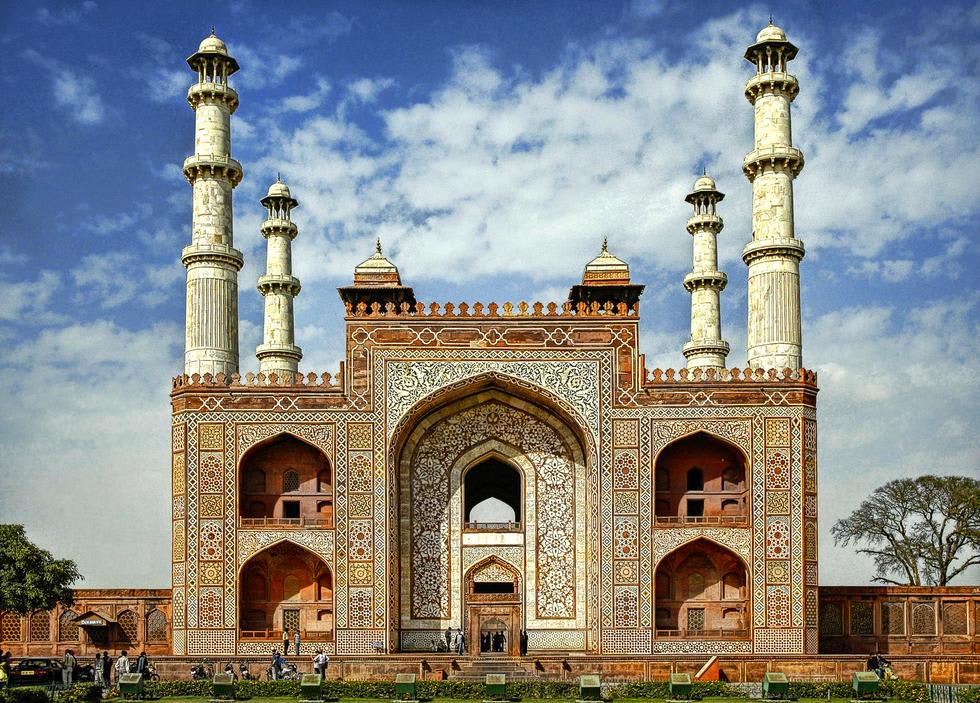
a. What does the Directive Principle related to national monuments outline?
b. Do you think that our government has been successful in implementing this Directive Principle? Why or why not?
Answer
(a) The Directive Principle related to national monuments outlines that the State must protect every monument or object of artistic and historical importance. It is one of the general principles of the Directive Principles of State Policy.
(b) Yes, the government has been successful in implementing this Directive Principle to a large extent. Through bodies such as the Archaeological Survey of India, the government identifies, protects and maintains monuments of historical and artistic importance, declaring many of them protected monuments. However, the success is only partial, as several monuments still suffer from neglect, encroachment and damage caused by pollution, so greater efforts are needed for their full protection. (This part calls for the student's own reasoned opinion.)
Look at the given picture and answer the questions that follow.
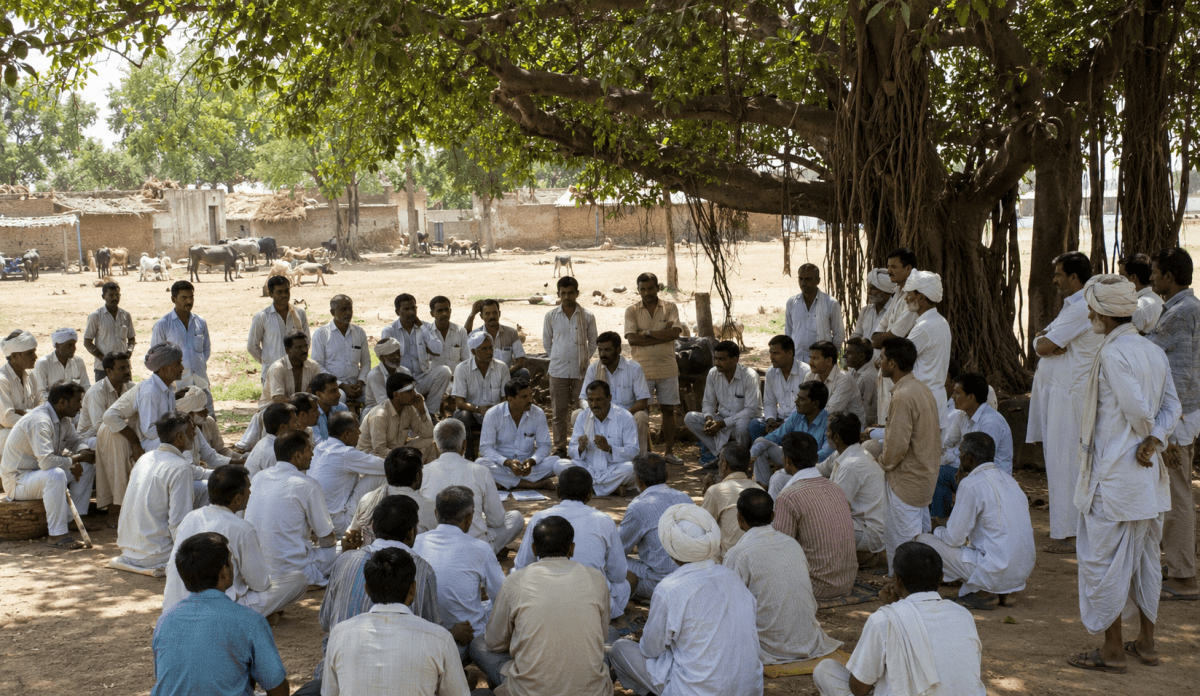
a. What do you think is happening in this image?
b. Why is this process necessary for a democracy?
Answer
(a) The image shows a village panchayat meeting in progress, where the members of the village have gathered together to discuss and decide on local matters as a unit of self-government.
(b) This process is necessary for a democracy because it allows people at the grassroots level to participate directly in governance and decision-making. The Panchayati Raj System enables villages to function as units of self-government, helps solve the everyday problems of villagers, and strengthens democracy by giving ordinary people a voice in how their affairs are managed.
Over the years, the Indian state has made efforts to implement various Directive Principles. For instance, primary education has been made free and compulsory in most government-owned/aided schools. Reservations are provided for Scheduled Castes and Scheduled Tribes in government services and educational institutions to look after the interests of weaker sections. To eradicate poverty and promote self-reliance, the government encourages cottage and small-scale industries. The Panchayati Raj System has been implemented nationwide to function as units of self-government. Additionally, the zamindari system has been abolished, and the Minimum Wages Act has been enacted to prevent exploitation.
Based on the case study answer the following questions:
A. Name two ways the government has tried to promote economic equality based on the Directive Principles.
B. How has the government addressed the Gandhian Principle of promoting village self-governance?
C. What measure has been taken to prevent the exploitation of landless peasants?
D. What is the primary aim of the Minimum Wages Act, as explained in the text?
Answer
A. Two ways the government has tried to promote economic equality are: (i) the abolition of the zamindari system, and (ii) the enactment of the Minimum Wages Act to prevent the exploitation of workers.
B. The government has addressed the Gandhian Principle of promoting village self-governance by implementing the Panchayati Raj System all over the country, so that village panchayats function as units of self-government.
C. To prevent the exploitation of landless peasants, the zamindari system has been abolished (and Land Reform Acts have been enacted).
D. The primary aim of the Minimum Wages Act is to prevent exploitation by setting the minimum wages that must be given to employees for a fixed period of work.