
Which amendment brought changes to the Preamble to the Constitution of India?
- 42nd
- 43rd
- 44th
Answer
42nd
Reason — The words 'socialist' and 'secular' were incorporated in the Preamble through the 42nd Amendment Act passed in 1976.
'Every law enacted by the Indian government must conform to the Constitution.' This statement is:
- True
- Partly true
- False
Answer
True
Reason — The Constitution lays down the framework and fundamental political principles of the country. Hence, every law enacted by the Indian government must conform to it.
Complete the given table.
| The Drafting Committee for the Constitution was set up | The Constitution of India came into force |
|---|---|
| 29 August 1947 | ? |
- 20 January 1950
- 24 January 1950
- 26 January 1950
Answer
26 January 1950
Reason — The members of the Drafting Committee signed the Constitution on 24 January 1950, and two days later the Constitution of India came into force on 26 January 1950.
The Preamble to the Constitution of India begins with:
- 'We, the people...'
- 'I, the citizen of India...'
- 'Us, together...'
Answer
'We, the people...'
Reason — The Preamble begins with 'We, the people...', signifying that power is ultimately vested in the hands of the people of India.
Preamble : Introduction to Constitution :: Directive Principles :
- enforceable rights of citizens
- guidelines for governance
- legal penalties for crimes
- historical background of India
Answer
guidelines for governance
Reason — Just as the Preamble serves as an introduction to the Constitution, the Directive Principles serve as guidelines for the government to follow while framing laws and policies.
Given below are statements about the features of the Preamble to the Indian Constitution. Select the combinations that accurately describe the nature of the Indian state:
i. Sovereign: India is free from any foreign control and internally free to formulate policies.
ii. Socialist: India ensures a fair distribution of wealth and equality before the law.
iii. Secular: India has a state religion and promotes religious instruction in all schools.
iv. Democratic: The head of the state is elected indirectly for a fixed term.
- i. and iii.
- ii. and iv.
- i. and ii.
- i., ii. and iv.
Answer
i. and ii.
Reason — Statement i correctly describes a sovereign state and statement ii correctly describes a socialist state. Statement iii is wrong because India has no state religion and imparts no religious instruction in government or government-aided schools. Statement iv is wrong because electing the head of the state indirectly for a fixed term is a feature of a republic, not a democratic state.
Which of the following is NOT an objective of the Constitution as laid out in the Preamble?
- Justice (social, economic, and political)
- Liberty (of thought, expression, belief, faith and worship)
- Equality (of status and opportunity)
- Promoting hereditary rule for the head of state
Answer
Promoting hereditary rule for the head of state
Reason — The objectives laid out in the Preamble are justice, liberty, equality and fraternity. The post of the President (head of the state) is not hereditary, so promoting hereditary rule is not an objective of the Constitution.
Which of the following statements is NOT a function performed by the Constituent Assembly?
- Enacting of ordinary laws.
- Adoption of the national flag
- Election of the prime minister of India
- Election of Dr Rajendra Prasad as the first president of India
Answer
Election of the prime minister of India
Reason — The functions of the Constituent Assembly included enacting ordinary laws, adopting the national flag, the national anthem and the national song, and electing Dr Rajendra Prasad as the first President of India. It did not elect the prime minister of India.
Assertion (A): The Constitution of India came into force on 26 January 1950.
Reason (R): The members of the Drafting Committee signed the Constitution on 24 January 1950.
- A is true, but R is false.
- R is the reason for A.
- Both A and R are false.
- Only R is true, and A is false.
Answer
R is the reason for A.
Explanation — Both the assertion and the reason are true. The members of the Drafting Committee added their signatures to the Constitution on 24 January 1950, and two days later, on 26 January 1950, the Constitution of India came into force.
Assertion (A): India is a sovereign country.
Reason (R): India is externally free from any foreign control and internally free to formulate its domestic and foreign policies.
- A is true, but R is false.
- R is the reason for A.
- A is false, but R is true.
- Both A and R are false.
Answer
R is the reason for A.
Explanation — Both the assertion and the reason are true. India is a sovereign country, which means it is externally free from any foreign control and internally free to formulate its domestic and foreign policies. Thus, R correctly explains A.
State whether the following statements are true or false:
- Anyone can interpret the Constitution.
- Dr B R Ambedkar was the chairman of the Drafting Committee.
- India is a sovereign country.
- In India, the post of the President is hereditary.
- The Preamble advocates social, economic and political justice for all.
Answer
- False
Correct Statement — Anyone cannot interpret the Constitution. The power to interpret the Constitution lies with the Supreme Court, which is the highest court in India. - True
- True
- False
Correct Statement — In India, the post of the President is not hereditary. The President is elected indirectly through an electoral college for a fixed term of 5 years. - True
Has the Constitution of India made the life of the people in India better? Give reasons to support your answer.
Answer
Yes, the Constitution of India has made the life of the people better. The reasons are:
- It guarantees Fundamental Rights, such as the right to equality and the right to liberty, to all citizens.
- It provides for justice — social, economic and political — for all.
- Through Universal Adult Suffrage, every citizen aged 18 years and above has the right to vote and choose their government.
- As a secular state, it allows every person to practise and preach any religion of their choice without any discrimination.
- It advocates equality before the law and prohibits discrimination on grounds of caste, colour, sex, religion and language.
- The Directive Principles guide the government to work for the welfare and well-being of the people.
What does the term 'constitution' mean?
Answer
The term 'constitution' is defined as a set of basic laws or principles for a country that describe the rights and duties of its citizens and the way in which it is governed.
Why was the Cabinet Mission sent to India in 1946?
Answer
Before India gained independence in 1947, at the initiative of the then British Prime Minister Clement Attlee, the Cabinet Mission was sent to India in 1946. Its purpose was to discuss and finalise plans for the transfer of power from the British Government to India.
What were the functions performed by the Constituent Assembly?
Answer
The functions performed by the Constituent Assembly were:
- Enacting of ordinary laws.
- Adoption of the national flag.
- Adoption of the national anthem and the national song.
- Election of Dr Rajendra Prasad as the first President of India.
Explain the nature of the Indian State as advocated by the Preamble.
Answer
The Preamble describes India as a Sovereign Socialist Secular Democratic Republic.
- Sovereign — India is an independent country. It is externally free from any foreign control and internally free to formulate its domestic and foreign policies.
- Socialist — India tries to bridge the gap between the rich and the poor and tries to ensure a fair distribution of wealth.
- Secular — India has no State religion. Every person has the right to practise and preach any religion of his or her choice, and the government cannot discriminate against any religion.
- Democratic — India is a democracy. The people of India elect their governments at all levels — Union, state and local.
- Republic — The head of the State, that is, the President of India, is elected indirectly, and the post is not hereditary.
State the objectives of the Constitution of India.
Answer
The objectives of the Constitution of India, as laid out in the Preamble, are:
- Justice — social, economic and political justice for all.
- Liberty — of thought, expression, belief, faith and worship.
- Equality — of status and of opportunity.
- Fraternity — developing brotherhood, assuring the dignity of the individual and the unity and integrity of the nation.
Write the features of each of the following:
- Sovereign State
- Socialist State
- Democratic State
Answer
- The features of a Sovereign State are:
- India is an independent or free country.
- It is externally free from any foreign control.
- It is internally free to formulate its domestic and foreign policies.
- The features of a Socialist State are:
- India tries to bridge the gap between the rich and the poor.
- It tries to ensure a fair distribution of wealth.
- The Constitution of India advocates equality before the law and prohibits any discrimination on grounds of caste, colour, sex, religion and language.
- The State endeavours to make opportunities available to its citizens, so that each citizen has the right to improve his/her condition.
- The features of a Democratic State are:
- India is a democracy. The people of India elect their governments at all levels — Union, state and local.
- The Preamble accepts the principles of democracy — 'For the people' (the government exists for the benefit of the people), 'Of the people' (the government is made of the people who are citizens) and 'By the people' (the government is elected by the people who are citizens).
This is a picture of Rajendra Prasad with Jawaharlal Nehru.
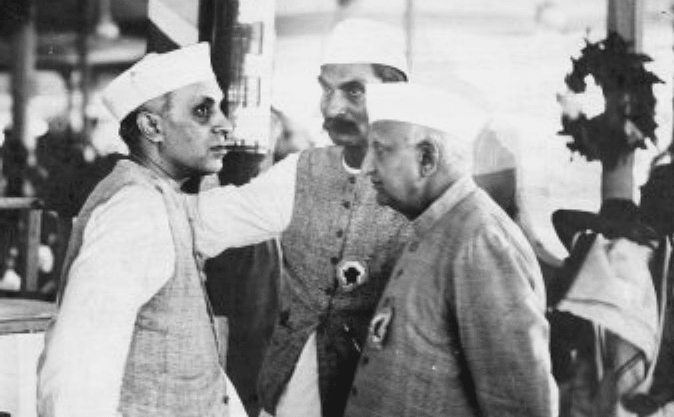
a. Which assembly were they a part of?
b. Which British mission laid down the procedures to be followed by this assembly?
Answer
(a) They were a part of the Constituent Assembly.
(b) The Cabinet Mission laid down the procedures to be followed by this assembly.
Look at the given picture, and answer the following questions:
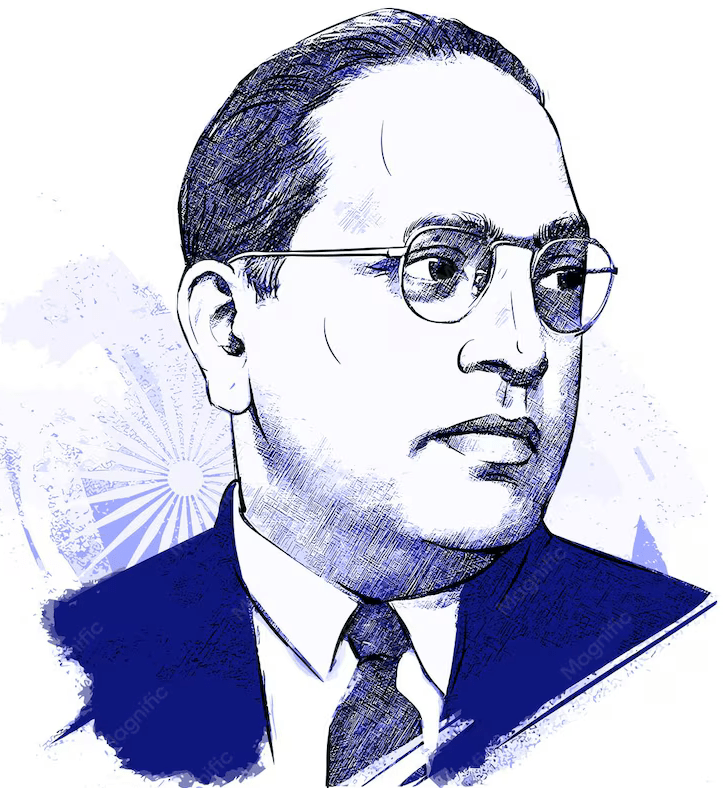
a. What is the name of the person shown in the given picture who helped draft the Constitution?
b. What was his role in the making of the Indian Constitution?
c. Mention any two features of the Indian Constitution that make it unique in the world.
Answer
(a) The person shown in the picture is Dr B R Ambedkar.
(b) Dr B R Ambedkar was the chairman of the Drafting Committee of the Constitution. He is regarded as the chief architect of the Indian Constitution.
(c) Two features of the Indian Constitution that make it unique are:
- It is the longest written constitution among all the countries of the world.
- It grants Universal Adult Suffrage and contains the Fundamental Rights, Directive Principles and Fundamental Duties of the citizens.
The Constitution of India is the longest written constitution among all countries of the world. The only constitution that exceeds its length is the Constitution of Alabama, which belongs to a state, not a country.
Based on the given text, answer the following questions:
a. What claim does the text make about the Constitution of India in comparison to other countries' constitutions?
b. What is the one exception mentioned that exceeds its length?
c. Based on this information, what characteristic would you associate with the detailed nature of the Indian Constitution?
Answer
(a) The text claims that the Constitution of India is the longest written constitution among all the countries of the world.
(b) The one exception mentioned is the Constitution of Alabama, which exceeds the length of the Indian Constitution. However, it belongs to a state, not a country.
(c) The detailed and lengthy nature of the Indian Constitution shows that it is comprehensive and elaborate, covering a wide range of provisions, rights, duties and procedures in great detail.