
Two statements are given below as Assertion (A) and Reasoning (R). Read the statements and choose the correct option.
Assertion (A): Some Jews did not support the Roman rule.
Reasoning (R): Roman people believed in many Gods.
- Both (A) and (R) are true and (R) is the correct explanation for (A).
- Both (A) and (R) are true but (R) is not the correct explanation for (A).
- Only (A) is true and (R) is false.
- Only (R) is true and (A) is false.
Answer
Both (A) and (R) are true and (R) is the correct explanation for (A).
Explanation — The Roman religion was polytheistic, whereas the Jews believed in the existence of one God. From the time of Augustus, the emperor also assumed the title of the chief priest, which the Jews were unhappy with. This religious difference was a key reason why some Jews did not support the Roman rule.
Which apostle was believed to have brought Christianity to India?
- John
- Peter
- Thomas
Answer
Thomas
Reason — Thomas was one of the twelve apostles chosen by Jesus. It is believed that he travelled to India and brought Christianity to the country.
Two statements are given below as Assertion (A) and Reasoning (R). Read the statements and choose the correct option.
Assertion (A): Abbasids were completely overthrown during the 11th century CE.
Reasoning (R): They were attacked by both Mongols and Turks.
- Both (A) and (R) are true and (R) is the correct explanation for (A).
- Both (A) and (R) are true but (R) is not the correct explanation for (A).
- Only (A) is true and (R) is false.
- Only (R) is true and (A) is false.
Answer
Only (R) is true and (A) is false.
Explanation — The Abbasids were not overthrown in the 11th century. Their political power declined considerably after the Mongols sacked Baghdad in 1258 CE (the 13th century), following which they fled to Egypt, where they were ultimately overthrown by the Turks. So the assertion is false, while the reasoning — that they were attacked by both the Mongols and the Turks — is true.
Balban built many new forts because:
- he wanted to protect the empire from Mongol invasion.
- he believed in divine kingship and wanted to always live in forts.
- he wanted to be known for his forts.
Answer
he wanted to protect the empire from Mongol invasion.
Reason — Balban built new forts and repaired the old ones in the region between the river Indus and the city of Delhi in order to protect the empire from Mongol invasions.
Which of the following statements about revenue administration during Alauddin's regime is false?
- Land was measured and the share of the State was fixed.
- Land revenue was one-third of the produce.
- Taxes were collected in cash.
Answer
Land revenue was one-third of the produce.
Reason — This statement is false because Alauddin increased the land revenue from one-third to half of the produce. The other two statements are true.
What actions did Alauddin take to curtail the power of the nobles?
i. He ensured that no one drank wine in his presence.
ii. He employed many spies.
iii. He allowed nobles to marry only with his permission.
- Only ii
- i and iii
- All of the above
Answer
All of the above
Reason — To curtail the power of the nobles, Alauddin prohibited the drinking of wine, set up an elaborate spy system to watch and report every movement of the nobles, and regulated their marriages so that they could not forge any matrimonial alliances without his permission.
Jizyah, a religious tax on ..............., was levied upon the people.
- Muslims
- non-Muslims
- nobles
Answer
non-Muslims
Reason — Jizyah was a religious tax that was levied upon the non-Muslims.
This language saw an emergence in the Indian subcontinent during the period of the Delhi Sultanate.
- Arabic
- Sanskrit
- Persian
Answer
Persian
Reason — With the rise of the Persian-speaking sultans, the Persian language saw an emergence in the Indian subcontinent and became the court language of the Delhi Sultanate.
Two statements are given below as Assertion (A) and Reasoning (R). Read the statements and choose the correct option.
Assertion (A): Urdu is known as 'camp language'.
Reasoning (R): It was mainly the soldiers at the army camp who spoke a mix of Hindi and Persian and created a new language, Urdu.
- Both (A) and (R) are true and (R) is the correct explanation for (A).
- Both (A) and (R) are true but (R) is not the correct explanation for (A).
- Only (A) is true and (R) is false.
- Only (R) is true and (A) is false.
Answer
Both (A) and (R) are true and (R) is the correct explanation for (A).
Explanation — Hindi and Persian fused together in the army camps, where the soldiers spoke a mix of the two languages, and this gave birth to a new language called Urdu. Since it developed in the army camps, Urdu came to be known as the 'camp language'.
He transferred his capital from Gulbarga to Bidar:
- Muhammad Shah II
- Ahmad Shah I
- Alauddin Bahman Shah
Answer
Ahmad Shah I
Reason — Ahmad Shah I, a ruler of the Bahmani kingdom, transferred the capital from Gulbarga to Bidar.
Give reasons for the following statements:
- Good Friday and Easter are celebrated three days apart.
- Jesus is known as Jesus Christ.
- Though Mahmud was an independent ruler, he swore allegiance to the Abbasid Caliph.
- Muhammad Ghori could not enter Gujarat.
Answer
Good Friday marks the day of Jesus's crucifixion, while Easter celebrates his resurrection. His followers believe that Jesus rose from the dead on the third day after his crucifixion. Hence, the two are observed three days apart.
Jesus's followers accepted him as the messiah and referred to him as Jesus Christ. The word 'Christ' came from christos, the Greek word for 'messiah'.
In spite of being an independent ruler, Mahmud swore allegiance to the Abbasid Caliph in Baghdad for political reasons. In return, the Caliph recognised him as the legitimate ruler of the land and encouraged him in his conquests.
Muhammad Ghori attempted to enter Gujarat by crossing the Rajputana desert. However, he was completely routed by the Vaghela ruler of Gujarat, Bhima II. Therefore, he could not enter Gujarat.
With reference to the teachings of Islam, answer the following questions:
- People who follow the Islamic religion are polytheistic. Is it true or false?
- What were the duties laid down as mandatory for all practising Muslims called?
- Name all five duties.
- What is their holy month called?
Answer
False. Islam is a monotheistic religion; its main teaching is that there is only one God, Allah.
The duties laid down as mandatory for all practising Muslims were called the Pillars of Islam (the Five Pillars of Islam).
The five duties are Faith, Prayer, Zakat, Fasting and Hajj.
Their holy month is called Ramadan.
The following year, Ghori assembled a large army and once again invaded the kingdom of Ajmer. This time the Kanauj ruler did not help Ajmer. The Ajmer ruler, though supported by many Rajput rulers, was defeated and killed in the Second Battle of Tarain. Muhammad Ghori marched towards Ajmer unchallenged. Other Rajput kingdoms were captured without any difficulty. Finally, his forces advanced towards Delhi, capturing it soon after. Muhammad Ghori soon controlled many areas.
- The ruler of which kingdom did not help Ajmer?
- During which battle was the ruler of Ajmer killed?
Answer
The ruler of the kingdom of Kanauj did not help Ajmer.
The ruler of Ajmer was killed during the Second Battle of Tarain.
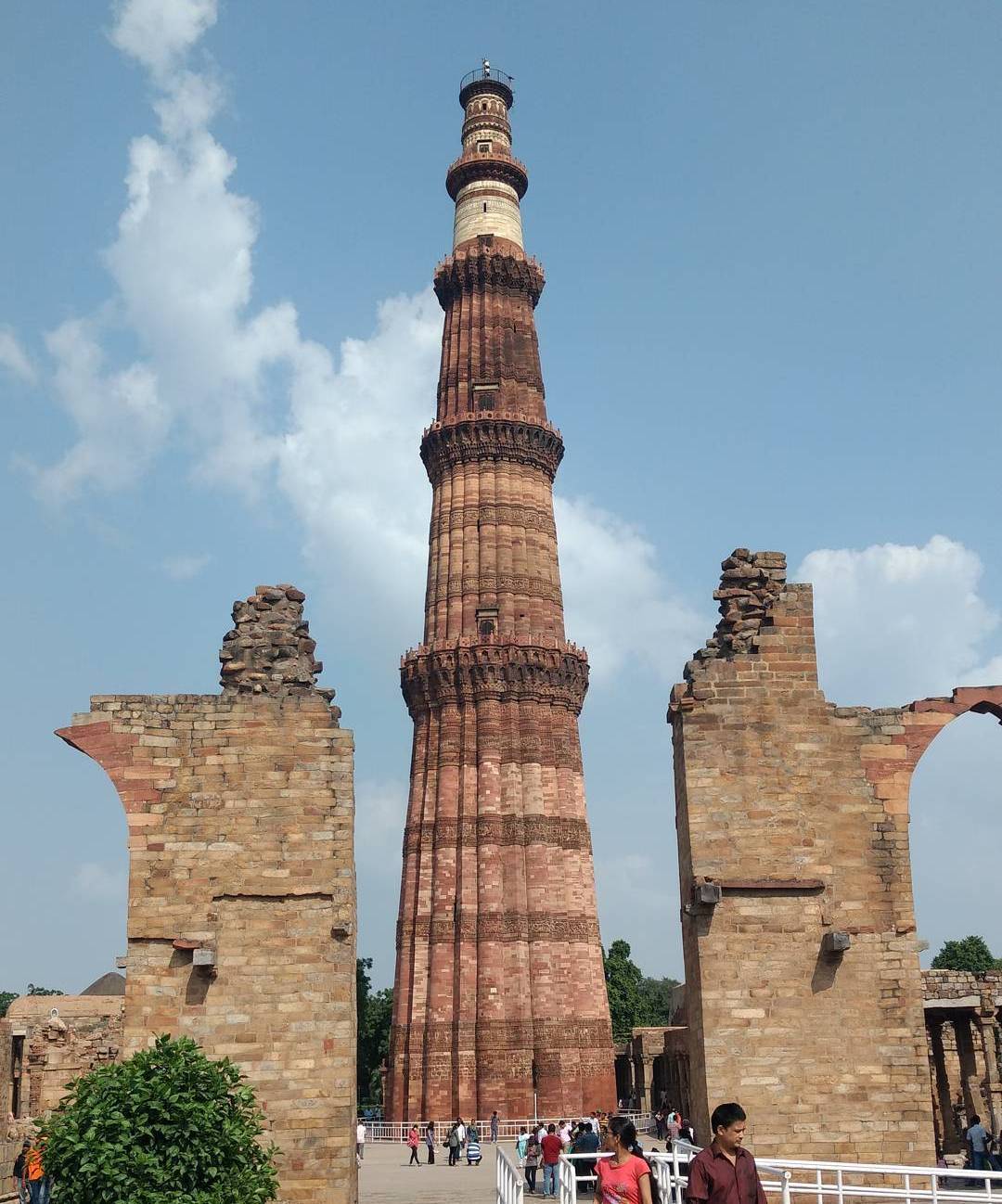
- Identify the monument in the picture.
- Where is it located?
- What materials was it made of?
- Who contributed to its construction?
- Specify one architectural feature on it.
Answer
The monument in the picture is the Qutb Minar.
It is located in Delhi.
It was made of red sandstone and marble.
Several rulers contributed to its construction. Qutbuddin Aibak laid the foundation of the minar, Iltutmish added three storeys to it, Alauddin Khalji added the Alai Darwaza as an entrance to it, and Firuz Shah Tughlaq later repaired it.
It is decorated with bands of intricate carvings of Islamic calligraphy.
With reference to the Gol Gumbaz, answer the following questions:
- Where is it located?
- It is the tomb of ............... .
- The dome of Gol Gumbaz is dependent on four pillars. Is this true or false?
- How big is the dome?
- Specify a significant feature of the building.
Answer
It is located in Bijapur.
It is the tomb of Muhammad Adil Shah, who ruled the sultanate of Bijapur.
False. The dome of the Gol Gumbaz stands independent of pillars.
It is one of the largest domes in the world. The Gol Gumbaz, with its enormous dome, covers an area of 1703.56 square metres.
A significant feature of the building is its acoustic system — the dome carries the faintest whisper around it and returns it to the person ten times. (At its four corners are minaret-like towers that house staircases leading to the top dome.)