
This provided a golden opportunity to Babur, who sought to conquer territories in India:
- the rivalry between the Sayyid and Lodi rulers
- disintegration of the Delhi Sultanate under weak Lodi rulers
- the defeat of the Mongols
Answer
disintegration of the Delhi Sultanate under weak Lodi rulers
Reason — The disintegration of the Delhi Sultanate under weak Lodi rulers, along with factionalism among the Rajputs, offered a golden opportunity to the Central Asian ruler Babur to invade and conquer territories in India.
Complete the given mind map.
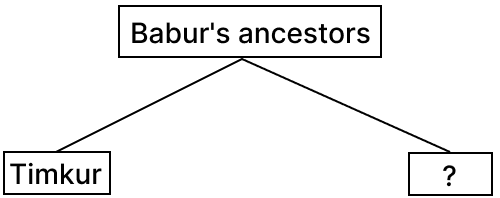
- Genghis Khan
- Ibrahim Lodi
- Iltutmish
Answer
Genghis Khan
Reason — Babur was a descendant of Amir Timur and Genghis Khan. Since Timur is already shown in the mind map, the other missing ancestor is Genghis Khan.
What is the main source of information about Babur's life?
- Humayunama
- Akbarnama
- Tuzk-i-Baburi
Answer
Tuzk-i-Baburi
Reason — The main source of information about Babur's life is his memoirs, the Tuzk-i-Baburi (also known as the Baburnama), which he wrote himself in the Turkish language.
Humayun was the ............... Mughal emperor.
- second
- third
- fourth
Answer
second
Reason — Humayun succeeded his father Babur, the first Mughal emperor, in 1530 CE. He was therefore the second Mughal emperor.
Complete the given analogy.
Battle of Khanwa: Babur and Rana Sanga :: Battle of Chanderi: ?
- Babur and Medini Rai
- Babur and Nusrat Shah
- Babur and Sher Shah
Answer
Babur and Medini Rai
Reason — Just as the Battle of Khanwa was fought between Babur and Rana Sanga, the Battle of Chanderi was fought between Babur and Medini Rai, the Rajput chief who held the fort of Chanderi in Malwa.
Babur's biggest long-term contribution to Indian history was:
- Ending Sultanate architecture
- Establishing Mughal dynasty with gunpowder warfare
- Writing poetry in Persian
- Introducing silver coin
Answer
Establishing Mughal dynasty with gunpowder warfare
Reason — Babur's victory at the First Battle of Panipat, won by demonstrating the power of gunpowder artillery for the first time in India, ended the Delhi Sultanate and laid the foundation of the Mughal Empire, which shaped Indian history for centuries to come.
Given below are statements about the results of the Battle of Panipat. Select the one that is accurate:
i. It marked the end of the Mughal rule in India.
ii. Babur's troops demonstrated the power of artillery.
iii. It strengthened the Indian rulers against invaders.
iv. It led to the establishment of the Sur dynasty in India.
- Only i.
- Only ii.
- iii. and iv.
- i. and iii.
Answer
Only ii.
Reason — At the First Battle of Panipat, Babur's troops demonstrated the power of artillery for the first time in India. Statement (i) is wrong because the battle marked the beginning of Mughal rule, not its end; statement (iii) is wrong because the battle actually exposed the weakness of Indian rulers; and statement (iv) is wrong because the Sur dynasty was established later, after the Battle of Kanauj (1540 CE).
Identify the historical figure and select the statement that is most accurate about him:
- Ibrahim Lodi – Defeated Babur at Panipat using elephants
- Babur – Introduced gunpowder artillery and wrote Baburnama
- Sher Shah Suri – Built the Grand Trunk Road and introduced rupaiya
- Humayun – Lost to Sher Shah and spent years in exile in Persia
Answer
Babur – Introduced gunpowder artillery and wrote Baburnama
Reason — Babur introduced gunpowder artillery, the power of which his troops demonstrated for the first time in India at Panipat, and he wrote his memoir, the Baburnama — so this statement is wholly accurate with no qualification, making it the most accurate choice. Option 1 is false because Ibrahim Lodi was defeated and killed by Babur at Panipat, not the other way round. Options 3 and 4 do contain true facts (Sher Shah built the Grand Trunk Road and introduced the rupaya, and Humayun did lose to Sher Shah and take shelter in Persia), but option 4 overstates Humayun's case — he spent about fifteen years wandering in exile and sheltered in Persia for only part of that time — so Babur's statement remains the single best answer.
Assertion (A): The Battle of Khanwa was more significant than the Battle of Panipat for Babur.
Reason (R): It removed a major obstacle, the Rajputs, to the establishment of Mughal rule in India.
- A is true, but R is false.
- R is the reason for A.
- Both A and R are false.
- Only R is true, and A is false.
Answer
R is the reason for A.
Explanation — Both A and R are true. The Battle of Khanwa was more significant than the Battle of Panipat because, by defeating Rana Sanga and the Rajputs, Babur removed the major obstacle to the establishment of Mughal rule in India. Hence, R correctly explains A.
Assertion (A): Humayun's initial attempt to conquer Bengal was unsuccessful, and he eventually lost control of it.
Reason (R): His brother Hindal abandoned him and declared himself emperor, distracting Humayun and weakening his position.
- A is true, but R is false.
- R is the reason for A.
- A is false, but R is true.
- Both A and R are false.
Answer
R is the reason for A.
Explanation — Both A and R are true, and R explains A. Although Humayun reached Gaur, he could not hold Bengal because his 19-year-old brother Hindal abandoned him, withdrew to Agra and declared himself emperor. This forced Humayun to leave Gaur with only a small garrison and march back to Agra, allowing Sher Shah's troops to reclaim Gaur. Thus, Hindal's betrayal directly weakened Humayun's position and led to the loss of Bengal.
Explain each of the following terms:
- Heliocentric model
- Jagirdari system
- Patta system
- Qabuliyat
Answer
- Heliocentric model — A model of the solar system in which the Sun is at the centre with the planets revolving around it. It was put forward by Copernicus, who established that the planets, including the Earth, orbit the Sun.
- Jagirdari system — The system in which land is given to a local lord in return for military and other services. Sher Shah discouraged this system.
- Patta system — The system of issuing the patta, which was the title deed of the peasants. It was introduced by Sher Shah as part of his revenue reforms.
- Qabuliyat — The qabuliyat was the document of agreement between the State and the peasant. It too was introduced by Sher Shah to improve the revenue system.
What does the Baburnama tell us about the kind of ruler Babur was? Explain with examples.
Answer
The Baburnama, written by Babur himself in the Turkish language, reveals him to be a capable and many-sided ruler. It shows that he possessed the qualities of a strong leader — he was not only a brilliant general but also a great swordsman who could correctly judge the strengths and weaknesses of his opponents, and he was a man of extraordinary energy. He was a patron of architecture, who began building a series of structures that mixed the Hindu style of intricately carved details with the traditional Islamic designs used by the Persians and Turks. He was deeply fascinated by nature and created exquisite gardens in every palace and province, trying to recreate the beautiful gardens of Kabul; his memoirs describe the flora and fauna of his empire in great detail. Although he was an orthodox Muslim, he followed a policy of religious tolerance towards people of other faiths. Thus, the Baburnama portrays Babur as a brave warrior, a lover of art, nature and learning, and a tolerant ruler.
'Sher Shah provided a good administrative-structural base for the Mughals to build upon.' Justify this statement with examples.
Answer
Sher Shah was not only a great conqueror but also a brilliant administrator who laid the foundation of an effective administrative system that was later modified and improved by Akbar. This can be justified with many examples:
- Central administration — The king was the head of the system, and the government was divided into departments, each under a minister assisted by officials. He set up an efficient espionage system and went on regular tours of inspection.
- Provincial administration — He divided his empire into 47 sarkars (provinces), which were further subdivided into parganas (districts) administered by the shiqdar-i-shiqdaran (law and order) and the munsif-i-munsifan (revenue and civil cases). Officials were transferred periodically to prevent corruption.
- Revenue administration — Land was surveyed and measured every year, revenue was fixed at one-third of the produce (payable in cash or kind), land was classified by fertility, and the patta and qabuliyat systems were introduced. These reforms improved the condition of the peasants.
- Military organisation — He maintained a strong standing army and revived the dagh (branding of horses) and chehra (descriptive roll of soldiers) systems.
- Transport, trade and currency — He built the Grand Trunk Road with sarais and dak chaukis, introduced new weights and measures, and standardised the silver rupaya.
Since Akbar later adopted and refined many of these measures, it is clear that Sher Shah provided a good administrative-structural base for the Mughals to build upon.
Read the paragraph and answer the questions that follow.
Soon after, the governor of the Punjab, Daulat Khan Lodi, invited Babur to invade India and to help him oust Ibrahim Lodi, the then sultan of Delhi. Babur seized this opportunity to conquer new territories and to establish himself as the ruler of India.
- Who invited Babur to invade India?
- Given this opportunity, what did Babur do?
- Which was the battle that Babur fought when he invaded India?
Answer
- Babur was invited to invade India by Daulat Khan Lodi, the governor of the Punjab.
- Babur seized this opportunity to conquer new territories and to establish himself as the ruler of India.
- When he invaded India, Babur fought the First Battle of Panipat (1526 CE) against Ibrahim Lodi.
Why is the Battle of Khanwa considered more significant than the Battle of Panipat?
Answer
Although the Battle of Panipat ended the Delhi Sultanate, the Rajputs under Rana Sanga of Mewar remained a serious menace and were determined to drive Babur out of India. At Khanwa, Babur defeated Rana Sanga with his superior artillery and cavalry. By doing so, he removed the major obstacle — the Rajputs — to the establishment of Mughal rule in India. For this reason, the Battle of Khanwa is considered more significant than the Battle of Panipat.
Who were the two major rivals of Humayun when he ascended the throne?
Answer
When Humayun ascended the throne, his two major rivals were Sultan Bahadur Shah of Gujarat and Sher Shah Suri (Sher Khan) of Bihar.
In the court of which emperor did Humayun take shelter when he was in exile?
Answer
During his exile, Humayun took shelter in the court of the Persian emperor (the Shah of Persia).
Who built the Humayun's tomb?
Answer
Humayun's Tomb at Delhi was built by his widow (Bega Begum, also known as Haji Begum). It is often regarded as a precursor to the Taj Mahal in design.
Give an account of Humayun's battle against Sher Shah in your own words.
Answer
Humayun's first task as emperor was to confront Sher Shah. He attacked Chunar, a stronghold of Sher Shah, but had to abandon the offensive halfway in order to deal with the threat from Bahadur Shah of Gujarat; Sher Shah was allowed to keep the fort in return for his loyalty. While Humayun was busy in Gujarat, Sher Shah strengthened his hold over Bengal and Bihar, captured the capital Gaur and looted its wealth. At the Battle of Chausa (1539 CE), fought on the banks of the Ganga, Sher Shah suddenly attacked the Mughal army after three months of peace negotiations and completely routed it; Humayun barely survived and returned to Agra. The two met again at the Battle of Kanauj (1540 CE), east of Agra, where Humayun once more made tactical errors and was completely defeated. Sher Shah then became the master of Delhi and Agra, and the Mughal Empire founded by Babur was replaced by the Afghan rule of the Sur dynasty. These defeats forced Humayun into exile for the next fifteen years.
With reference to Sher Shah, answer the following questions:
- Who won the Battle of Chausa that was fought between Sher Shah and Humayun in 1539 CE?
- After winning which battle did Sher Shah become the master of Delhi and Agra?
- Who looked after the law and order and general administration of districts during Sher Shah's rule?
- Describe the military organisation during Sher Shah's reign.
- What measures did Sher Shah take to improve the transport and communication system?
- What happened after Sher Shah's death?
Answer
- Sher Shah (Sher Khan) won the Battle of Chausa in 1539 CE, completely routing the Mughal army.
- Sher Shah became the master of Delhi and Agra after winning the Battle of Kanauj (1540 CE).
- The shiqdar-i-shiqdaran looked after the law and order and the general administration of the districts (parganas), while the munsif-i-munsifan looked after revenue collection and civil cases.
- Sher Shah organised an efficient, strong and large standing army. He personally appointed the soldiers and fixed their salaries according to their skill and ability. He revived the systems of dagh (branding of horses) and chehra (descriptive roll of soldiers), which had been started by Alauddin Khalji. The army was divided into units placed under commanders and included a trained infantry, cavalry and a well-equipped artillery.
- Sher Shah built an excellent network of roads, the longest and most important being the Grand Trunk Road, which connected Sonargaon (in Bengal) in the east to Peshawar in the north-west. Trees were planted on both sides of the roads, and rest houses (sarais) and wells were built at regular distances for travellers. The sarais were also used as dak chaukis to deliver post from one part of the country to another.
- Sher Shah died accidentally in a gunpowder explosion in 1545 CE. He was succeeded by his son Islam Shah, who died in 1554 CE. These two deaths weakened the Afghan (Sur) dynasty. Taking advantage of the situation, Humayun returned to India and recaptured Delhi and Agra in 1555 CE.
Study the given picture. Answer the questions that follow.
This ruler lay the foundation of the Mughal dynasty in India.
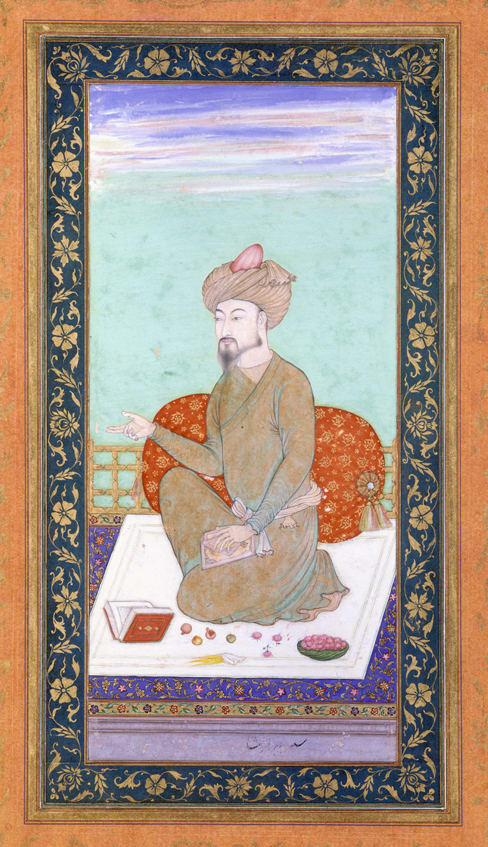
a. Can you name the ruler in the picture?
b. Do you know the name of his grandson who was a great Mughal ruler? Find out.
Answer
a. The ruler in the picture is Babur, who laid the foundation of the Mughal dynasty in India.
b. Babur's grandson who was a great Mughal ruler was Akbar. (Babur was succeeded by his son Humayun, who was in turn succeeded by his son Akbar.)
Look at the given picture, and answer the following questions:
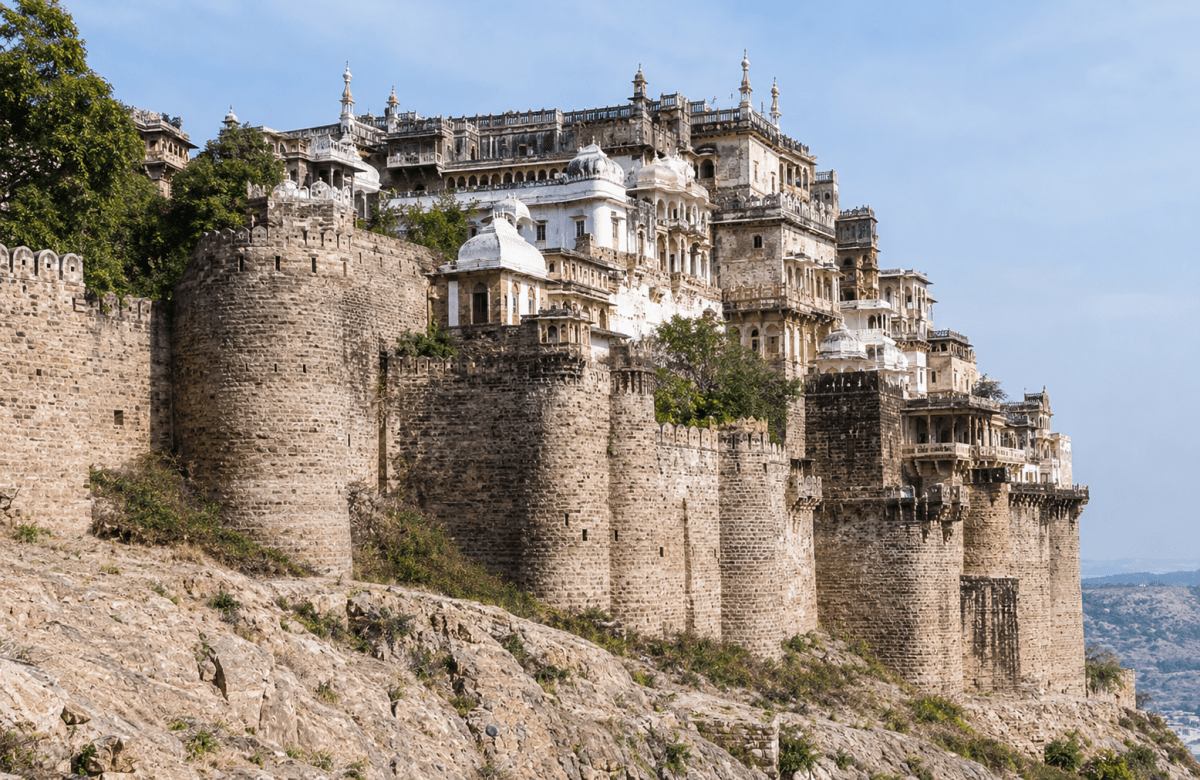
a. Which is the monument seen in the given image?
b. Which emperor's strategic stronghold was this monument?
c. Who attacked it and why?
Answer
a. The monument seen in the image is Chunar Fort, located in the Mirzapur district of Uttar Pradesh.
b. It was a strategic stronghold of Sher Shah (Sher Khan) of Bihar.
c. Humayun attacked Chunar Fort. As the newly crowned emperor, his first task was to confront Sher Shah and curb his growing power, so he attacked his stronghold. However, Humayun had to abandon the offensive halfway to tackle the threat from Bahadur Shah of Gujarat, and Sher Shah was allowed to keep the fort in return for his loyalty.
Babur, a descendant of Amir Timur and Genghis Khan, laid the foundation of the Mughal dynasty in India after losing his ancestral principality. His victory at the First Battle of Panipat against Ibrahim Lodi, using superior military tactics and artillery, marked the end of the Delhi Sultanate. He further solidified his rule by defeating the Rajputs at Khanwa and Chanderi, and the Afghans at Ghagra. His memoirs, Baburnama, provide a rich account of his life, his fascination with nature and his policy of religious tolerance.
Based on the case study answer the following questions:
a. Which two major battles did Babur fight and win against the Rajputs?
b. What was the main military advantage Babur utilised to defeat Ibrahim Lodi at Panipat?
c. What characteristic of Babur's gardens reflect his personality and interests?
d. In Baburnama, what aspects of his empire did Babur describe in great detail?
Answer
a. Babur fought and won two major battles against the Rajputs — the Battle of Khanwa (1527 CE) against Rana Sanga, and the Battle of Chanderi (1528 CE) against Medini Rai.
b. The main military advantage Babur utilised at Panipat was his superior military tactics and the use of gunpowder artillery, supported by a small but disciplined and well-organised cavalry. His troops demonstrated the power of artillery for the first time in India, which gave him a decisive edge over Ibrahim Lodi's much larger army.
c. Babur created exquisite gardens in every palace and province, trying to recreate the beautiful gardens of Kabul, which he believed were the most beautiful in the world. This reflects his deep love and fascination for nature and beauty.
d. In the Baburnama, Babur described the flora and fauna (the plants and animals) of his empire in great detail.