
Which of these statements does not apply to Akbar?
- The names Jalaluddin Muhammad Akbar and Akbar the Great refer to the same person.
- Akbar is considered to be the greatest of the Mughal emperors in terms of his benevolence, liberal attitude and military conquests.
- Akbar was the sixth Mughal emperor.
Answer
Akbar was the sixth Mughal emperor.
Reason — Akbar was the third Mughal emperor, not the sixth. He succeeded his father Humayun (Babur → Humayun → Akbar), so this statement does not apply to him.
Complete the given table.
| Bairam Khan | Hemu |
|---|---|
| Akbar's regent | ? |
- chief minister and general of Akbar
- chief minister and general of Adil Shah
- Both 1 and 2
Answer
chief minister and general of Adil Shah
Reason — Hemu was the chief minister and general of Adil Shah, who ruled the area from Chunar to the border of Bengal. He captured Agra, occupied Delhi and declared himself emperor of India after Humayun's death.
The age at which Akbar became the emperor:
- 13
- 14
- 15
Answer
13
Reason — Akbar was only 13 years old when his father, Humayun, died in 1556 CE. With no other claimants to the throne, he was proclaimed emperor.
The forces of Rana Pratap and Akbar met at the famous battlefield of ________.
- Jhansi
- Tarain
- Haldighati
Answer
Haldighati
Reason — The forces of Rana Pratap and Akbar met at the famous battlefield of Haldighati in 1576 CE, where the Mughal army under Raja Man Singh's command defeated the Rajputs.
Which of these Rajput chiefs fought against Akbar?
- Maharana Pratap
- Raja Todar Mal
- Raja Man Singh
Answer
Maharana Pratap
Reason — Maharana Pratap of Mewar fought against Akbar at the Battle of Haldighati. Raja Todar Mal and Raja Man Singh, on the other hand, were given high posts in Akbar's army and administration and served him.
Akbar was born in 1542 CE in a Rajput fort in Amarkot, making him Indian by birth. At what age did he ascend the throne after his father Humayun's death?
- 10 years old
- 13 years old
- 16 years old
- 18 years old
Answer
13 years old
Reason — Akbar was born to Hamida Banu in 1542 CE in a Rajput fort in Amarkot. He was only 13 years old when his father, Humayun, died in 1556 CE, after which he ascended the throne.
Observe the given picture. Identify the 'Raga' associated with it.
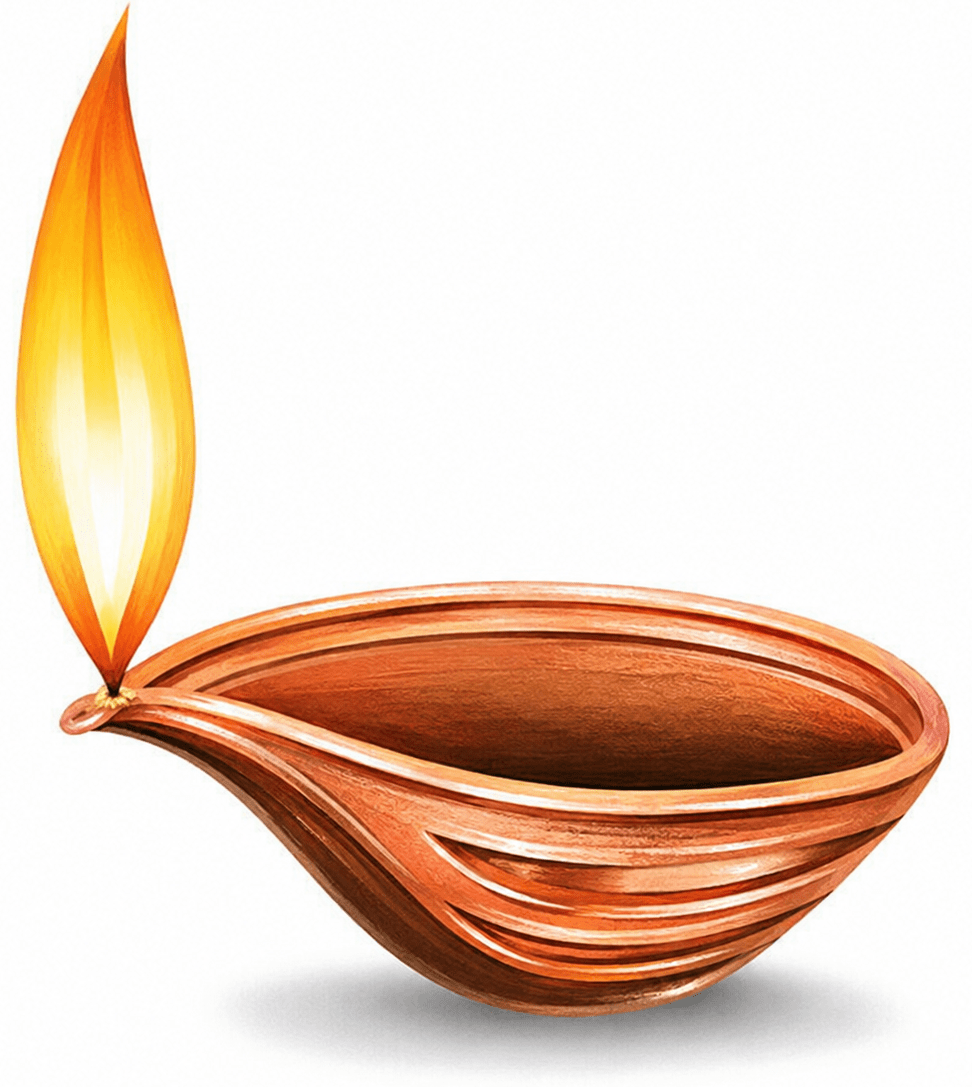
- Megh Malhar
- Dhrupada
- Darbari
- Deepak
Answer
Deepak
Reason — The picture depicts lamps (diyas) lighting up. Legend has it that whenever Tansen, the most famous musician at Akbar's court, sang the Raga Deepak, the diyas of the palace would light up. Hence, the raga associated with the picture is Deepak.
Given below are statements about the outcome of the Second Battle of Panipat. Select the one that is accurate:
i. It led to the rise of Afghan power in India.
ii. Hemu declared himself emperor after the battle.
iii. It removed the threat to Akbar's throne and crushed Afghan power.
iv. It marked the end of the regency of Bairam Khan.
- Only i.
- Only ii.
- Only iii.
- Only iv.
Answer
Only iii.
Reason — The Second Battle of Panipat crushed the Afghan power and removed the threat to Akbar's throne. Statement i is wrong because the battle crushed (not raised) Afghan power; statement ii is wrong because Hemu had declared himself emperor before the battle and was defeated and killed in it; and statement iv is wrong because Bairam Khan's regency ended in 1560 CE when Akbar dismissed him, not at Panipat in 1556 CE.
After the Battle of Haldighati (1576), which immediate political outcome was most likely?
- Rana Pratap captured Agra
- Rajput resistance weakened and Mughal influence increased in Mewar
- Akbar abandoned Rajput policy
- Din-i Ilahi was imposed on all Rajputs
Answer
Rajput resistance weakened and Mughal influence increased in Mewar
Reason — At Haldighati, the Mughal army under Raja Man Singh's command defeated the Rajputs. This weakened Rajput resistance and increased Mughal influence in Mewar.
Assertion (A): Akbar abolished the jizyah and pilgrimage tax.
Reason (R): He followed a policy of Sulh-i-Kul (universal peace) and religious tolerance.
- A is true but R is false.
- R is the reason for A.
- Both A and R are false.
- Only R is true, and A is false.
Answer
R is the reason for A.
Explanation — Both A and R are true, and R correctly explains A. Akbar remitted the pilgrimage tax and later abolished the jizyah, the tax on non-Muslims, as part of his policy of Sulh-i-Kul (universal peace) and religious tolerance towards all communities.
Assertion (A): The Mansabdari system helped Akbar strengthen the Mughal administration.
Reason (R): It combined military ranks with jagir assignments, ensuring loyalty and efficiency.
- A is true, but R is false.
- R is the reason for A.
- A is false, but R is true.
- Both A and R are false.
Answer
R is the reason for A.
Explanation — Both A and R are true, and R explains A. The mansabdari system gave ranks (mansabs) to both military and civil officials, fixing their salary, status and the number of cavalry, horses and elephants they had to maintain. Salaries were at times paid in the form of jagirs, and all appointments, promotions and dismissals were in the hands of the emperor. This combination ensured loyalty and efficiency and thus strengthened the Mughal administration.
Explain each of the following terms:
- Doha
- Sulh-i-kul
- Navaratnas at Akbar's court
- Din-i-ilahi
Answer
- Doha — A doha is a couplet which has two rhyming lines. Abdul Rahim Khan-e-Khana, one of the navaratnas at Akbar's court, was popularly known for his dohas.
- Sulh-i-kul — Sulh-i-Kul was Akbar's policy of 'peace with all' or universal peace, which brought about cordial relations among all communities. It was based on tolerance for all religions.
- Navaratnas at Akbar's court — The navaratnas, or nine gems, were the nine great scholars who adorned Akbar's court. They included Abul Fazl, Faizi, Todar Mal, Tansen, Birbal, Abdur Rahim Khan-i-Khanan and Raja Man Singh, to name a few.
- Din-i-ilahi — Din-i-Ilahi, or 'divine faith', was a new religious order created by Akbar to reconcile the differences between various religions. It incorporated the virtues of all religions. Its main features were belief in one God, recognition of the emperor as God's representative on Earth, and emphasis on piety, kindness and purification of the soul. It had neither sacred scriptures nor a priestly hierarchy and was rather a code of moral conduct. It never became popular and came to an end with Akbar's death.
Why is Akbar known for having tolerance for all religions? Choose from the reasons given below. You can select multiple options.
- His policy of Sulh-i-Kul was based on tolerance.
- Akbar built the Ibadat Khana at his new capital.
- He created a new religious order called Din-i-Ilahi or divine faith, which incorporated the virtues of all religions.
Answer
All the given options — 1, 2 and 3 — are correct.
Akbar is known for his tolerance for all religions because his policy of Sulh-i-Kul was based on tolerance, he built the Ibadat Khana at his new capital where scholars of all religions held discussions, and he created a new religious order called Din-i-Ilahi which incorporated the virtues of all religions.
Do you agree that the Mughal empire flourished in all aspects under Akbar? Why or why not?
Answer
Yes, the Mughal empire flourished in almost all aspects under Akbar.
- Territorial expansion — Akbar consolidated his power and brought northern and central India under his rule, annexing Malwa, Gondwana, Chittor, Ranthambore, Gujarat, Bengal, Kabul, Kashmir, Kandahar and parts of the Deccan.
- Administration — He set up a strong centralised as well as an efficient provincial administration. The empire was divided into subas, sarkars and parganas, and he introduced the mansabdari system to organise the army and officials.
- Revenue — Raja Todar Mal's revenue reforms, known as Todar Mal's Bandobast, made the revenue system fair and systematic.
- Religious policy — His policy of Sulh-i-Kul promoted religious tolerance. He abolished the jizyah and pilgrimage tax and built the Ibadat Khana for religious discussions.
- Cultural development — Literature, translation, music, painting and architecture flourished, and the navaratnas (nine gems) adorned his court.
Thus, the Mughal empire flourished militarily, administratively, economically and culturally under Akbar, which is why he is remembered as Akbar the Great.
With reference to the battles fought and territorial expansion undertaken during Akbar's time, answer the following questions:
- In which year did the Second Battle of Panipat take place?
- Who was the ruler of Gondwana when Akbar attacked it in 1564 CE?
- Which two Rajput clans opposed Akbar the most?
- Which place in the Deccan did Akbar annex?
Answer
- The Second Battle of Panipat took place in 1556 CE.
- Gondwana was under the rule of a brave queen, Durgavati, who was ruling as a regent of her minor son when Akbar attacked it in 1564 CE.
- The two Rajput clans that opposed Akbar the most were the Sisodiyas of Mewar and the Chauhans of Ranthambore.
- Akbar annexed Khandesh in the Deccan and captured the fort of Ahmadnagar.
Give a detailed account of the features of the revenue administration under Akbar.
Answer
Land was the main source of revenue for the Mughal Empire. Raja Todar Mal was in charge of the revenue administration, and his revenue reforms were known as Todar Mal's Bandobast. The main features of Akbar's revenue administration were as follows:
- Land was surveyed and measured with a measuring rod known as a jarib.
- Land was divided into good, bad and middling.
- The average produce over the past 10 years was calculated, and the revenue was fixed on the basis of this average.
- One-third of the produce was fixed as the revenue, which could be paid in cash or kind.
- Revenue officers were instructed to treat the peasants with kindness. If the crops failed due to natural calamities, the revenue payment was cancelled.
- Loans were granted to the peasants, which could be paid back in easy instalments.
Apart from land, trade was another important source of revenue. Both internal and external trade were facilitated by the conquest of several kingdoms, and crafts and industries flourished under Akbar, with imperial factories taking a lead in production. Akbar issued a gold coin known as the mohur, while silver and copper coins were also used.
Write in detail about the cultural development that took place during Akbar's reign.
Answer
Akbar's reign witnessed great cultural enrichment in the fields of literature, music, painting and architecture.
- Navaratnas — Akbar's court was adorned by nine great scholars known as the navaratnas (nine gems). These included Abul Fazl, Faizi, Todar Mal, Tansen, Birbal, Abdur Rahim Khan-i-Khanan and Raja Man Singh.
- Literature and translations — Faizi was commissioned by Akbar to translate a number of Sanskrit works into Persian. Abul Fazl wrote the Akbarnama, an enduring record of the emperor's reign. The Atharva Veda, the Mahabharata, the Ramayana and works such as the Panchatantra were translated into Persian. Akbar also patronised Hindu poets — Tulsidas's Ramcharitmanas and Rahim's dohas were written during his time.
- Music — Akbar was very fond of music and, according to Abul Fazl, there were 36 musicians in his court. The most famous among them was Tansen, who composed many ragas or melodies, including Miyan ki Malhar, Raga Darbari and Raga Deepak.
- Painting — Akbar patronised painting and fine arts. A new style of painting evolved, where colours such as red and blue were used. The paintings had varied themes, a majority of which depicted scenes from Akbar's life.
- Architecture — A fusion of Indian and Persian styles of architecture was developed. Some of the architectural splendours of his reign were the Agra Fort and Fatehpur Sikri. The Buland Darwaza, Panch Mahal and Jodha Bai's Palace at Fatehpur Sikri are beautiful specimens of this style.
This picture is of a gate made by Akbar. It was built to commemorate a victory.
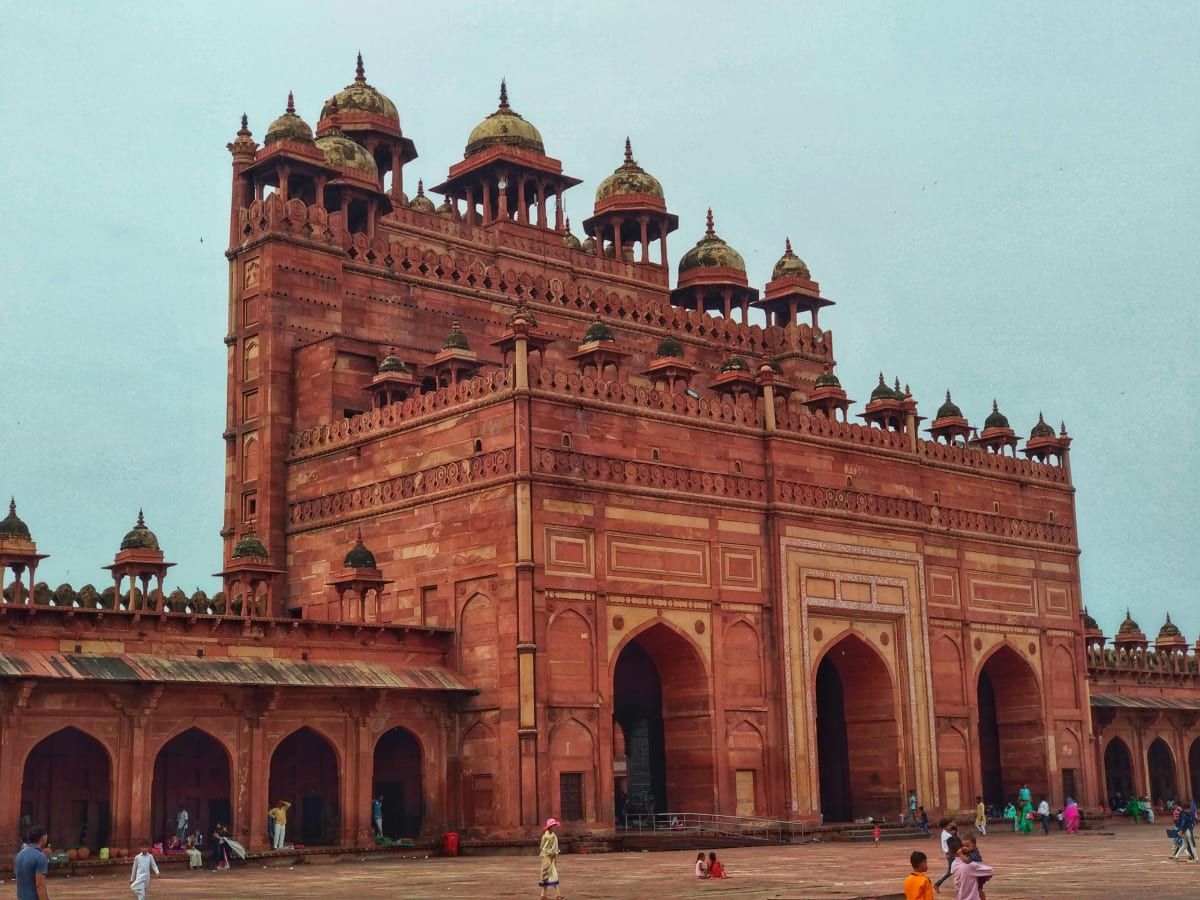
a. Where is this gate located?
b. Which victory did this monument commemorate?
Answer
a. This gate, the Buland Darwaza, is located at Fatehpur Sikri.
b. It was built to commemorate Akbar's victory over Gujarat, which he conquered in 1572 CE.
The picture shows a palace complex built by Akbar. Based on this information, answer the following:
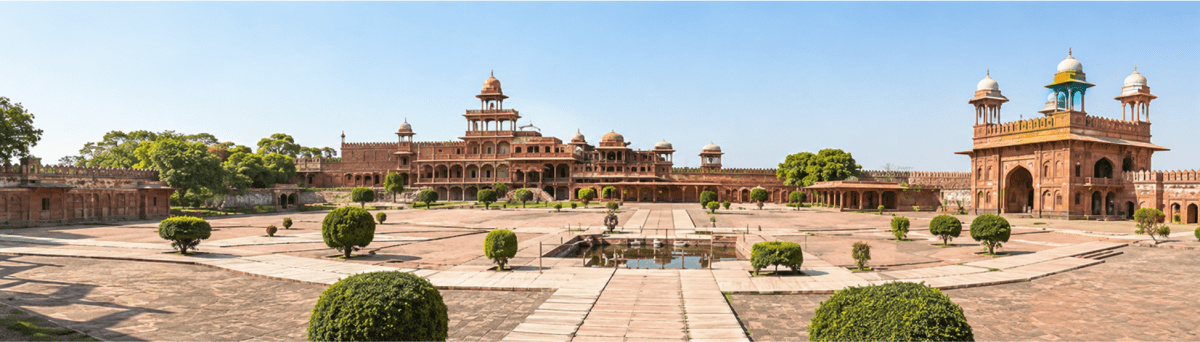
a. What is the name of this new city?
b. Name the famous gate here that commemorates his victory over Gujarat.
Answer
a. The name of this new city is Fatehpur Sikri, founded by Akbar about 23 miles from Agra.
b. The famous gate here that commemorates his victory over Gujarat is the Buland Darwaza.
Jalaluddin Muhammad Akbar, known as Akbar the Great, ruled the Mughal Empire from 1556 CE to 1605 CE. Though young when he ascended the throne, his reign marked a period of significant expansion and consolidation. The Second Battle of Panipat secured his position, and he spent two decades bringing northern and central India under his rule. He understood the importance of Rajput support, strengthening ties through matrimonial alliances, assigning high posts to Rajput chiefs like Raja Todar Mal and Man Singh, and abolishing the jizyah and pilgrimage tax.
Based on the case study answer the following questions:
A. How old was Akbar when he became emperor?
B. What was the immediate effect of the Second Battle of Panipat on Akbar's throne?
C. Name two prominent Rajput chiefs who were given high posts in Akbar's administration.
Answer
A. Akbar was 13 years old when he became emperor.
B. The Second Battle of Panipat crushed the Afghan power and removed the threat to Akbar's throne, thereby securing his position as emperor.
C. Two prominent Rajput chiefs who were given high posts in Akbar's administration were Raja Todar Mal and Raja Man Singh.