
Nur-ud-din Muhammad Jahangir was also known as:
- Prince Salim
- Prince Khurram
- Prince Khusrau
Answer
Prince Salim
Reason — Nur-ud-din Muhammad Jahangir was also known as Prince Salim in Indian history. He was the eldest surviving son of the Mughal emperor Akbar and ruled the Mughal Empire from 1605 CE to 1627 CE.
Complete the given analogy.
Jahangir : Nur Jahan :: Shah Jahan : ?
- Arjumand Banu Begum
- Mumtaz Mahal
- Both of them
Answer
Both of them
Reason — Jahangir's queen was Nur Jahan, and Shah Jahan's queen was Arjumand Banu Begum, who was also known as Mumtaz Mahal. Since both names refer to the same person, the correct option is 'Both of them'.
Complete the given mind map.
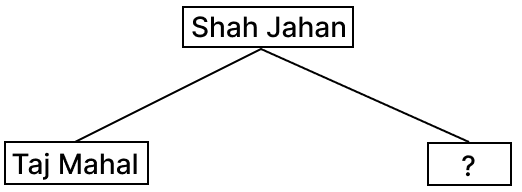
- Golden 'chain of justice'
- Peacock Throne
- Both of them
Answer
Peacock Throne
Reason — The mind map shows objects associated with Shah Jahan, one of which is the Taj Mahal. The golden 'chain of justice' was associated with Jahangir, while the Peacock Throne was built for Shah Jahan and housed in the diwan-i-khas of the Red Fort. Hence, the missing item is the Peacock Throne.
Which of these was not a conquest of Shah Jahan?
- Ahmadnagar
- Hugli
- The fort of Kangra
Answer
The fort of Kangra
Reason — The fort of Kangra was captured during the reign of Jahangir, not Shah Jahan. Ahmadnagar was annexed by Shah Jahan in 1633 CE, and Hugli was captured from the Portuguese by Shah Jahan.
In which year did Shah Jahan die?
- 1666 CE
- 1658 CE
- 1669 CE
Answer
1666 CE
Reason — Shah Jahan was put under house arrest in the Agra Fort by his son Aurangzeb and spent his last days in prison until his death in 1666 CE. The year 1658 CE marked the end of his reign.
Nur Jahan : Political influence :: Mumtaz Mahal : ______
- Military achievements
- Cultural inspiration
- Religious reforms
- Administrative reforms
Answer
Cultural inspiration
Reason — Just as Nur Jahan is remembered for her political influence during Jahangir's reign, Mumtaz Mahal is remembered as a cultural inspiration, since the Taj Mahal — one of the greatest works of Mughal architecture — was built by Shah Jahan as a tomb in her memory.
Look at the given picture. The image's depiction primarily symbolises:
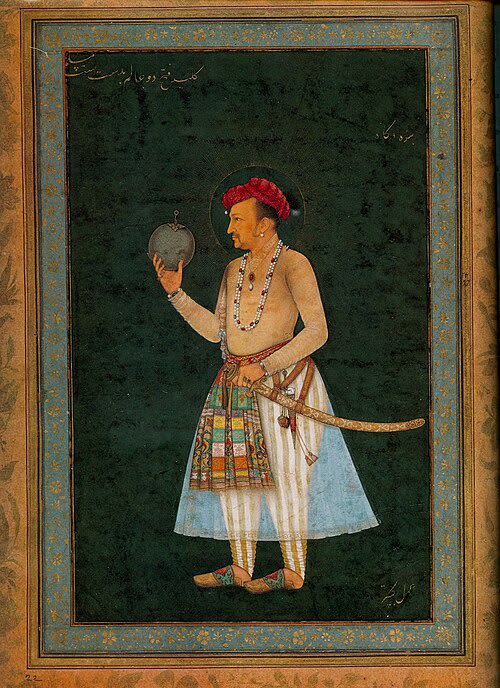
- Jahangir's interest in astronomy and celestial bodies
- Jahangir's global trading ambitions and connections with Europe
- Jahangir's perception of himself as a world-conqueror or universal sovereign
- Jahangir's personal collection of rare artefacts from different continents
Answer
Jahangir's perception of himself as a world-conqueror or universal sovereign
Reason — The picture shows Jahangir holding a globe. The globe represents the world, and the name 'Jahangir' itself means 'Conqueror of the World'. Holding the globe therefore symbolises his perception of himself as a world-conqueror or universal sovereign.
Despite being expected to march towards Kandahar to take care of the siege, Prince Khurram refused to proceed. Identify the reason for his refusal:
- He was already engaged in a campaign in the Deccan.
- He feared court intrigues would relegate him to a less powerful position during his absence.
- He believed the Persian forces were too strong to defeat.
- He had already formed an alliance with the Persians against Jahangir.
Answer
He feared court intrigues would relegate him to a less powerful position during his absence.
Reason — When the Persians besieged Kandahar, Prince Khurram refused to march towards it because he thought the campaign would be drawn out for long, and that during his absence court intrigues would relegate him to a less powerful position.
Shah Jahan's reign is most notably remembered for its significant contributions to Mughal architecture. Which of the following monuments is a direct representation of his architectural legacy?
- Shalimar Bagh in Kashmir
- Humayun's Tomb in Delhi
- Moti Masjid in Agra
- Akbar's Tomb at Sikandra
Answer
Moti Masjid in Agra
Reason — The Moti Masjid in Agra was built during the reign of Shah Jahan. The Shalimar Bagh in Kashmir is associated with Jahangir and Nur Jahan, while Humayun's Tomb and Akbar's Tomb at Sikandra were built before Shah Jahan's reign.
Assertion (A): The execution of Guru Arjan Dev marked the beginning of a long struggle between the Sikhs and the Mughals.
Reason (R): Jahangir ordered his execution due to his blessings and supposed monetary help to Prince Khusrau.
- A is true, but R is false.
- R is the reason for A.
- Both A and R are false.
- Only R is true, and A is false.
Answer
R is the reason for A.
Explanation — Both statements are true. The execution of the fifth Sikh Guru, Arjan Dev, did mark the beginning of a long-drawn struggle between the Sikhs and the Mughals (A is true). Jahangir ordered his execution because Guru Arjan Dev had given his blessings and supposed monetary help to Prince Khusrau (R is true), which explains why the execution took place. Hence, R is the reason for A.
Assertion (A): Shah Jahan's reign is considered the "Golden Age of Mughal Architecture."
Reason (R): He built the Taj Mahal, Red Fort, Jama Masjid, and Peacock Throne.
- A is true, but R is false.
- R is the reason for A.
- A is false, but R is true.
- Both A and R are false.
Answer
R is the reason for A.
Explanation — Both statements are true. Shah Jahan's reign is indeed considered the 'Golden Age of Mughal Architecture' (A is true). This is because he erected magnificent structures such as the Taj Mahal, the Red Fort and the Jama Masjid, and the celebrated golden Peacock Throne was made for him (R is true). The splendid monuments he built are the reason his reign is regarded as the Golden Age of Mughal architecture. Hence, R is the reason for A.
Write 'F' for fact and 'O' for opinion for the following statements.
- Before being awarded the title of Nur Jahan (Light of the World), Mehr-un-Nisa was called Noor Mahal (Light of the Palace).
- Nur Jahan assisted Jahangir in the layout and design of beautiful gardens, such as the Shalimar Bagh in Kashmir.
- Jahangir kept himself aloof from the affairs of the State, which made Nur Jahan the virtual ruler of the Mughal Empire.
Answer
- F (Fact)
- F (Fact)
- O (Opinion) — This is a contested view. The chapter states that according to some historians Jahangir kept himself aloof, making Nur Jahan the virtual ruler, but this has been contested by others.
'Jahangir's relationship with Sikhs was tensed to say the least.' Justify this statement with examples.
Answer
Jahangir's relationship with the Sikhs was indeed strained, as shown by the following examples:
- Jahangir ordered the execution of the fifth Sikh Guru, Arjan Dev, for giving his blessings and supposed monetary help to the rebel Prince Khusrau. This marked the beginning of a long-drawn struggle between the Sikhs and the Mughals.
- Jahangir continued his hostility towards the Sikhs by imprisoning Guru Hargobind, the successor of Guru Arjan Dev, for several years.
Read the paragraph and answer the questions that follow.
Jahangir was fascinated by art and architecture. He liked paintings and collected many of them. Paintings created during his reign were closely catalogued, dated and even signed, providing scholars with fairly accurate ideas about when and in what context many of these fine pieces were created.
- What was Jahangir fascinated by?
- Which aspect of Jahangir's fascination with paintings has particularly helped historians?
Answer
- Jahangir was fascinated by art and architecture.
- The paintings created during his reign were closely catalogued, dated and even signed. This has particularly helped historians by providing them with fairly accurate ideas about when and in what context many of these fine pieces were created.
Write a note on the military successes under Jahangir in your own words.
Answer
Jahangir achieved the following military successes during his reign:
- He ended the almost century-long struggle against Mewar. Rana Amar Singh of Mewar, who had refused to submit to the Mughal emperor, was defeated and forced to accept Jahangir's suzerainty.
- In the Deccan, he sent Prince Khurram (later Shah Jahan) to recapture the fort of Ahmadnagar, and Khurram successfully recaptured it.
- He sent an expedition to capture the fort of Kangra, which was captured after a short siege.
- In Bengal, he posted Ismal Khan, who handled the rebellions with much alacrity and brought the eastern part of Bengal firmly under Mughal power.
What role did Nur Jahan play during Jahangir's reign?
Answer
Nur Jahan played an important role during the reign of Jahangir:
- She was ambitious and soon became one of the power centres in the Mughal court. According to some historians, Jahangir kept himself aloof from the affairs of the State, which made her the virtual ruler of the Mughal Empire. While this has been contested, she undoubtedly had considerable influence on Jahangir and on certain matters of the Mughal court and the royal household.
- She used her position to have her father, brother and other relatives appointed to important posts in the administration. Her brother's daughter, Mumtaz Mahal, was married to Prince Khurram.
- She was a patron of art and architecture and shared Jahangir's interest in fine arts. She assisted Jahangir in the layout and design of beautiful gardens, such as the Shalimar Bagh on the bank of Dal Lake in Kashmir.
State Jahangir's contribution in the fields of literature and art.
Answer
In the field of literature, Jahangir was an excellent writer and a lover of nature. He wrote his autobiography, the Tuzk-i-Jahangiri (also referred to as the Jahangirnama), in which he recorded details of the flora and fauna from all over India. He was a curious and scientific observer of the minute details of various species of animals and plants.
In the field of art, Jahangir was fascinated by art and architecture. He liked paintings and collected many of them. The paintings created during his reign were closely catalogued, dated and even signed, which has provided scholars with fairly accurate ideas about when and in what context these fine pieces were created.
Describe the conquests of Shah Jahan.
Answer
The conquests and campaigns of Shah Jahan were as follows:
- In the Deccan, Shah Jahan sent an expedition against Ahmadnagar in 1633 CE, and it was finally annexed to the Mughal Empire. He also subdued the kingdoms of Bijapur and Golconda; however, instead of annexing them, he forced them to pay annual tributes and accept Mughal suzerainty.
- He sent a large army into Central Asia to revive Timur's empire, but in spite of some initial success, the campaign ended in failure.
- The Mughals had lost Kandahar to the Shah of Persia during Jahangir's reign. Shah Jahan made many attempts to recover it but was ultimately unsuccessful.
- When Shah Jahan found that the Portuguese were using their base at Hugli for piracy in the Bay of Bengal, he sent Mughal forces to defeat and expel them from Hugli.
Name any three architectural splendours built during the reign of Shah Jahan. Why is his reign considered to be the Golden Age of Mughal architecture?
Answer
Three architectural splendours built during the reign of Shah Jahan are the Taj Mahal at Agra, the Red Fort at Delhi, and the Jama Masjid at Delhi.
Shah Jahan's reign is considered to be the Golden Age of Mughal architecture because he erected many splendid monuments. The most famous of these is the Taj Mahal, one of the Seven Wonders of the World, built as a tomb for his beloved wife Mumtaz Mahal. Made of pure white marble and decorated with semi-precious stones and lace-like screens, it is an octagonal monument with a splendid dome and four slender minarets, set in a beautiful garden. He also built the Red Fort and the Jama Masjid in Delhi and the Moti Masjid in Agra, and founded the city of Shahjahanabad. The grandeur, beauty and large number of these monuments make his reign the Golden Age of Mughal architecture.
This is a painting of the Red Fort in watercolour.
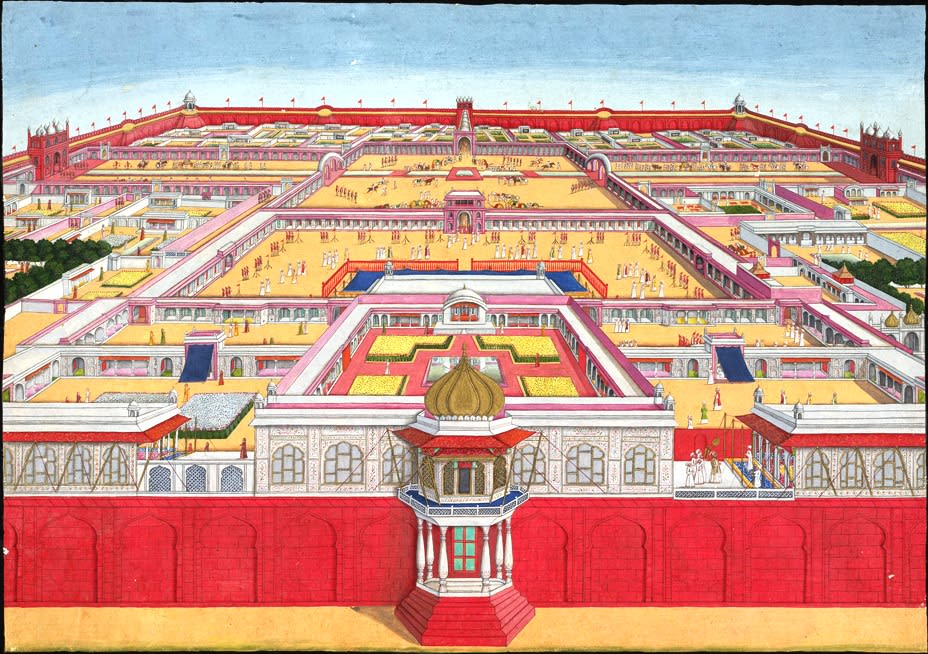
a. During the rule of which ruler was the Red Fort at Delhi built?
b. On the banks of which river is the Red Fort located?
c. Write about a modern-day use of this monument.
Answer
(a) The Red Fort at Delhi was built during the rule of Shah Jahan.
(b) The Red Fort is located on the banks of the river Yamuna.
(c) In modern times, the Red Fort is a monument of great national importance. Every year on Independence Day (15 August), the Prime Minister of India hoists the national flag at the Red Fort and addresses the nation. It is also a popular tourist destination and a UNESCO World Heritage Site.
The picture shows the world-famous Mughal mausoleum, built entirely of white marble. Based on this information, answer the following questions:
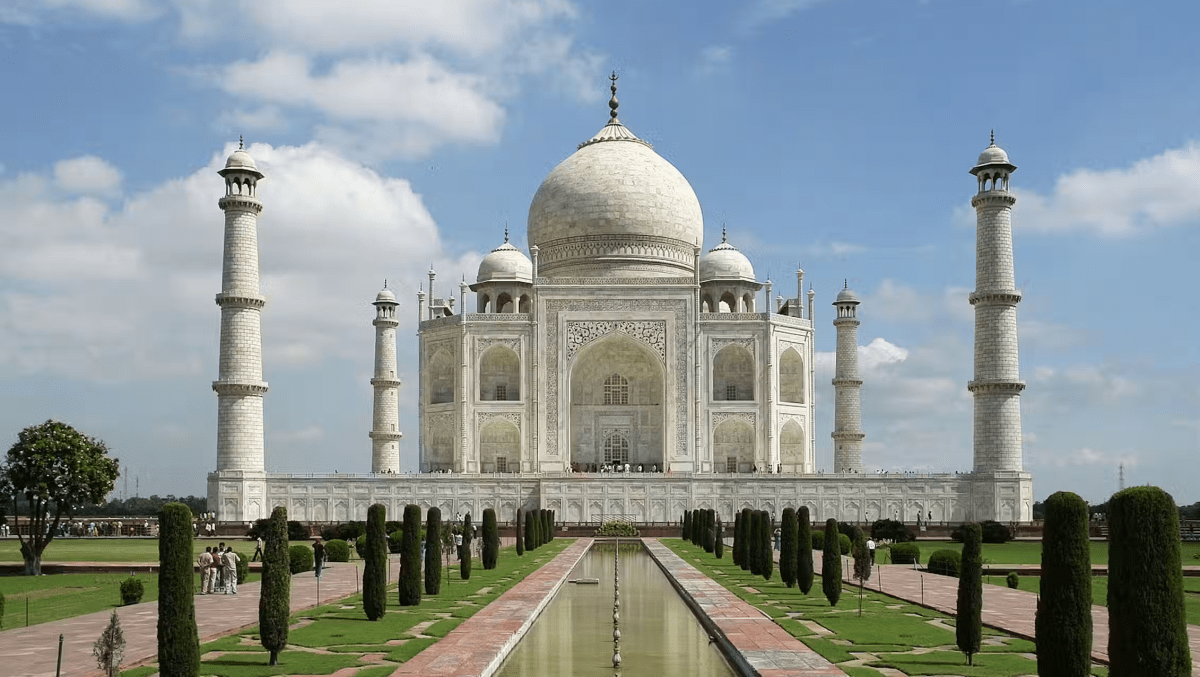
a. Name the monument and discuss the original style of garden that surrounded this structure.
b. What was a disadvantage of the original garden layout in terms of viewing the monument?
c. What style of gardens surround the monument today, and who introduced this style?
d. Mention a few architectural features of the monument.
Answer
(a) The monument is the Taj Mahal. Originally, it was surrounded by a dense garden with many ornamental and fruit trees — a particular style of garden cultivated by the Mughals.
(b) The disadvantage of the original garden layout was that the dense garden blocked the full view of the Taj Mahal.
(c) Today, the Taj Mahal is surrounded by colonial-style gardens. This style was introduced by the British, who preferred fewer trees and expansive lawns, making it possible to see the full structure of the monument.
(d) The Taj Mahal is made of pure white marble and decorated with semi-precious stones and lace-like screens. It is an octagonal monument with a splendid dome and four slender minarets, set in a beautiful garden. It was built on a rectangular grid, with Ustad Ahmad Lahori as its chief architect, and the calligrapher Amanat Khan worked on the marble inlaid with Koranic texts.
"He caused a chain of bells to be hung in front of the Agra Fort, so that the oppressed might appeal for justice."
Based on the given lines answer the following questions:
A. Identify the ruler described in the passage.
B. What was this chain called?
C. Why was this step significant in Mughal administration?
Answer
(A) The ruler described in the passage is Jahangir.
(B) This chain was called the 'chain of justice'.
(C) This step was significant because the chain served as a direct link between the emperor and his subjects. It was a golden chain with sixty bells, installed outside the fort of Agra, and any oppressed person could pull or ring it to request a personal hearing with Jahangir himself to seek justice. It reflected Jahangir's concern for justice and gave the common people direct access to the emperor, without depending on court officials.