
Rebellions during Aurangzeb's reign took place among groups such as:
- The Pathans
- The Jats
- Both of them
Answer
Both of them
Reason — Aurangzeb faced rebellions from many sections. The Pathans revolted near Peshawar in 1667 CE, and the Jats around Mathura revolted in 1667 CE. Since both these groups rose against him, the correct option is "Both of them".
Complete the given table.
| Aurangzeb annexed Bijapur | Aurangzeb annexed Golconda |
|---|---|
| 1686 CE | ? |
- 1687 CE
- 1690 CE
- 1695 CE
Answer
1687 CE
Reason — As part of his Deccan policy, Aurangzeb annexed Bijapur in 1686 CE and Golconda in 1687 CE.
Which son of Shivaji did Aurangzeb execute?
- Sambhaji
- Shahu
- Bhirbhan
Answer
Sambhaji
Reason — In his attempt to subdue the Marathas, Aurangzeb captured and executed Sambhaji, the son of Shivaji, in 1689 CE.
Where did Aurangzeb die?
- Delhi
- Kandahar
- Ahmadnagar
Answer
Ahmadnagar
Reason — Aurangzeb died in Ahmadnagar in 1707 CE.
Ahmad Shah Abdali was from:
- Iran
- Afghanistan
- Persia
Answer
Afghanistan
Reason — Ahmad Shah Abdali was an invader from Afghanistan, whereas Nadir Shah was from Iran.
Aurangzeb : Khalsa Resistance :: ? : Maratha Resistance
- Akbar : Rajput Rebellion
- Shah Jahan : Portuguese Rebellion
- Aurangzeb : Chhatrapati Shivaji Maharaj
- Babur : Afghan Resistance
Answer
Aurangzeb : Chhatrapati Shivaji Maharaj
Reason — Just as the Khalsa resistance (the militarised Sikhs under Guru Gobind Singh) rose against Aurangzeb, the Maratha resistance against Aurangzeb was led by Chhatrapati Shivaji Maharaj. The Marathas under Shivaji declared war against the Mughals and proved to be a menace to the Mughal army in the Deccan.
Observe the depiction of Chhatrapati Shivaji Maharaj at the court of Aurangzeb. Chhatrapati Shivaji Maharaj was put under house arrest by Aurangzeb because:
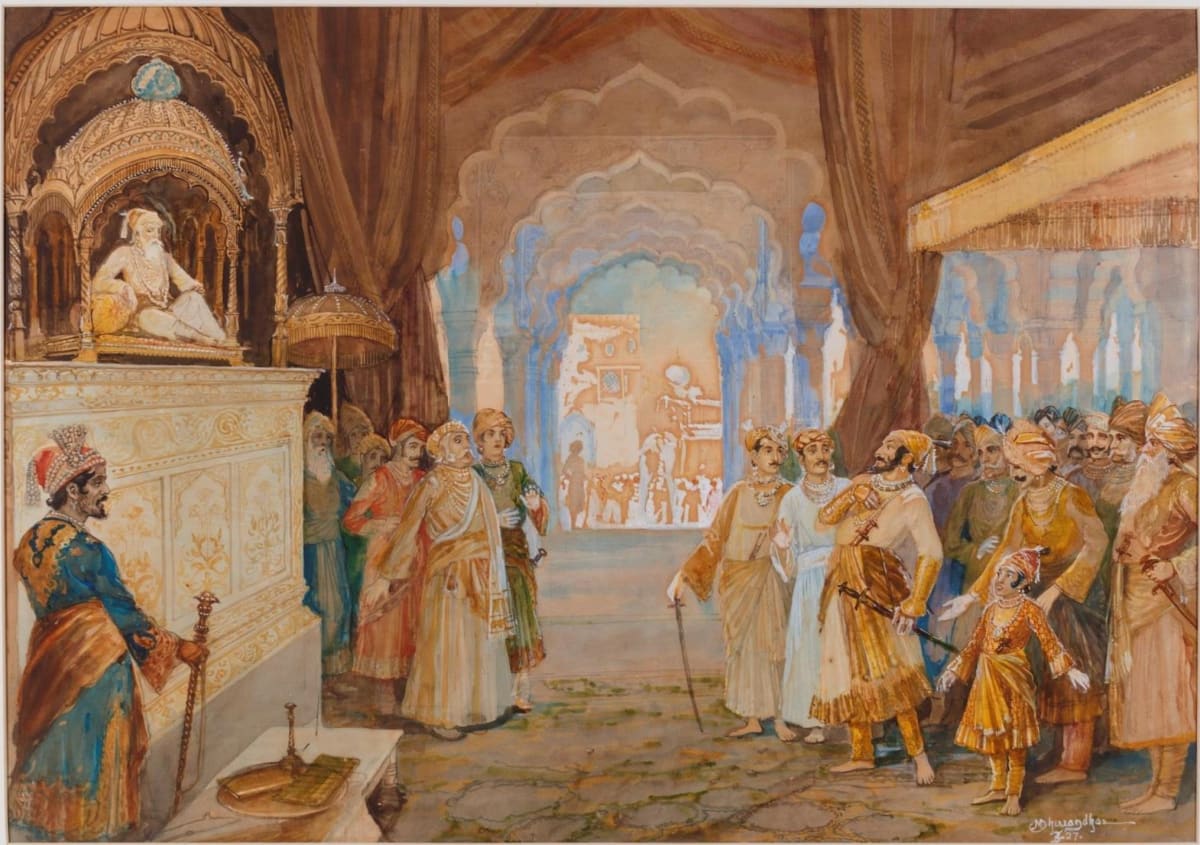
- He attempted to assassinate Aurangzeb in the court.
- He refused to present any gifts to the Emperor.
- He was treated dishonourably and showed a lack of reverence for the Mughal court.
- He tried to incite a rebellion among the courtiers.
Answer
He was treated dishonourably and showed a lack of reverence for the Mughal court.
Reason — When Shivaji visited the court of Aurangzeb, he was treated in a dishonourable manner and left the court in fury. Enraged at his lack of reverence for the Mughal court, Aurangzeb put him under house arrest.
Given below are details of rebellions faced by Aurangzeb. Select the combinations that accurately identify a key figure and their role:
i. Jats: Revolted around Mathura
ii. Satnamis: Led by Bhirbhan near Delhi
iii. Sikhs: Reconstituted by Guru Gobind Singh after Guru Tegh Bahadur's execution
iv. Rajputs: Conflict over succession after Maharaja Jaswant Singh of Jodhpur died
- i. and iii.
- ii. and iv.
- i., ii. and iii.
- i., ii., iii. and iv.
Answer
i., ii., iii. and iv.
Reason — All four combinations are correct. The Jats revolted around Mathura (1667 CE); the Satnamis, concentrated in an area near Delhi, revolted under the leadership of Bhirbhan (1672 CE); after Aurangzeb executed Guru Tegh Bahadur, his son Guru Gobind Singh reconstituted the Sikhs (1675 CE); and after Maharaja Jaswant Singh of Jodhpur died, the Rajputs rebelled over the question of succession (1679 CE).
Which policy of Aurangzeb directly led to the rise of Sikh militarisation under Guru Gobind Singh?
- Annexation of Bijapur
- Execution of Guru Tegh Bahadur
- Enforcement of jizya
- Alliance with the Rajputs
Answer
Execution of Guru Tegh Bahadur
Reason — In 1675 CE, Aurangzeb executed the ninth Sikh guru, Guru Tegh Bahadur. This infuriated the Sikhs, and in response his son and successor, the tenth guru, Guru Gobind Singh, reconstituted the Sikhs and established the Khalsa, a military brotherhood. Thus, the execution directly led to the militarisation of the Sikhs.
Assertion (A): The annexation of Bijapur and Golconda proved harmful to the Mughal Empire under Aurangzeb.
Reason (R): It made the empire too vast and unwieldy to administer from Delhi, and brought Mughals into direct conflict with the Marathas.
- A is true, but R is false.
- R is the reason for A.
- Both A and R are false.
- Only R is true, and A is false.
Answer
R is the reason for A.
Explanation — The annexation of Bijapur and Golconda did prove harmful to the Mughal Empire (A is true). This was because the empire became too vast and unwieldy to administer from Delhi, and it brought the Mughals into direct conflict with the Marathas (R is true). Hence, R correctly explains A.
Assertion (A): Aurangzeb's execution of Guru Tegh Bahadur infuriated the Sikhs.
Reason (R): In response, Guru Tegh Bahadur's son, Guru Gobind Singh, reconstituted the Sikhs and established the Khalsa, a military brotherhood.
- A is true, but R is false.
- R is the reason for A.
- A is false, but R is true.
- Both A and R are false.
Answer
R is the reason for A.
Explanation — Aurangzeb's execution of the ninth guru, Guru Tegh Bahadur, did infuriate the Sikhs (A is true). In response, his son and successor Guru Gobind Singh reconstituted the Sikhs and established the Khalsa, a military brotherhood (R is true). Both statements are factually correct and directly connected, as R describes the Sikhs' response that flowed from the anger caused by the execution.
Which foreign interventions led to the decline of the Mughal Empire? You can choose multiple options. Give reasons for your answer.
- Nadir Shah's invasion
- Ahmad Shah Abdali's invasion
- The English East India Company's policies
Answer
All three foreign interventions — Nadir Shah's invasion, Ahmad Shah Abdali's invasion and the English East India Company's policies — led to the decline of the Mughal Empire.
- Nadir Shah's invasion — Nadir Shah of Iran invaded in 1739 CE. The Mughals were defeated, and he carried away the Peacock Throne and the Koh-i-Noor diamond, which exposed the weakness of the empire.
- Ahmad Shah Abdali's invasion — Ahmad Shah Abdali of Afghanistan invaded in 1761 CE. His invasion not only shattered the Mughal Empire but also destroyed the Maratha confederacy, and the Mughals could never recover from it.
- The English East India Company's policies — The plunder by Nadir Shah alerted the EEIC to the acute weakness of the Mughal Empire and the political vacuum in the region. The Company expanded its power, the weak Mughal rulers could not stand against it, and finally, in 1857 CE, the last Mughal emperor, Bahadur Shah Zafar, was deported to Rangoon, formally ending Mughal rule.
Aurangzeb was the second longest reigning Mughal emperor. Who was the longest reigning monarch?
Answer
Akbar was the longest reigning Mughal monarch. Aurangzeb was the second longest reigning emperor after him.
Who established the Khalsa?
Answer
The Khalsa was established by Guru Gobind Singh, the tenth Sikh guru.
What was the other name of the Alamgiri Mosque built by Aurangzeb in Lahore?
Answer
The other name of the Alamgiri Mosque built by Aurangzeb in Lahore is the Badshahi Masjid.
Who succeeded Aurangzeb to the throne?
Answer
Aurangzeb was succeeded by his son Bahadur Shah I.
Why was Khalsa established?
Answer
The Khalsa was established as a response to the execution of the ninth Sikh guru, Guru Tegh Bahadur, by Aurangzeb in 1675 CE. This execution infuriated the Sikhs. In response, Guru Tegh Bahadur's son and successor, the tenth guru, Guru Gobind Singh, reconstituted the Sikhs and established the Khalsa, a military brotherhood, to organise and strengthen the community.
Write briefly about the rebellion of Jodhpur in 1679 CE.
Answer
In 1679 CE, Maharaja Jaswant Singh of Jodhpur died, and a conflict arose over who would be the next Raja. Aurangzeb's choice — a grandson of the former Maharaja's elder brother — was not accepted by the other members of Jaswant Singh's family. As a result, the Rajputs rebelled. Although Aurangzeb brought the rebellion under control, the sporadic warfare continued for quite some time.
Describe Aurangzeb's Deccan policy. What were its consequences?
Answer
Aurangzeb spent the latter half of his reign in the Deccan, trying to conquer the independent kingdoms in the south. He annexed Bijapur in 1686 CE and Golconda in 1687 CE. He then attempted to subdue the Marathas and captured and executed Sambhaji, the son of Shivaji, in 1689 CE. However, the Marathas continued their struggle under Sambhaji's son, Shahu, and successfully repelled Mughal attacks. Aurangzeb could not subdue the Marathas completely.
The consequences of Aurangzeb's Deccan policy were:
- The annexation of Bijapur and Golconda did not benefit the Mughal Empire, as these kingdoms were difficult to administer from Delhi.
- Aurangzeb's entanglement with the Marathas drained the resources of the State and wasted his valuable time.
- Owing to the long absence of Aurangzeb and his advisors, administration suffered in the north, which resulted in the outbreak of a number of revolts.
What happened after Aurangzeb's death?
Answer
Aurangzeb died in Ahmadnagar in 1707 CE. After his death, his son Bahadur Shah I ascended the throne. Soon after, the Mughal Empire entered a period of decline owing to Bahadur Shah I's weak military and leadership qualities. Within a hundred years of Aurangzeb's death, the Mughal emperor had little control over areas beyond Delhi.
Explain the reasons behind the decline of the Mughal Empire.
Answer
There were several causes for the decline of the Mughal Empire:
- Weak successors of Aurangzeb — Bahadur Shah I, who succeeded Aurangzeb, was weak and inefficient. His successors were all incompetent and could not manage the huge empire. Soon, the governors of the distant states declared themselves independent.
- Vastness of the empire — The Mughal Empire stretched across northern India and even included territories in the south. The cost of administering such a vast empire was huge, and the weak successors were incapable of managing it.
- Wars of succession — The Mughals did not have a clear succession policy. The rulers ascended the throne through bloodshed, which tarnished the image of the Mughal rulers.
- Policies of Aurangzeb — According to some historians, Aurangzeb's rigid religious policy alienated many people and led to serious revolts by the Rajputs, Sikhs, Jats and Satnamis. His entanglement in the Deccan also turned the northern part of his empire into a centre of revolts.
- Powerful nobility — The nobles acquired both prominence and power under the Later Mughals. They took advantage of the weak rulers to control the administration, and in some cases carved out their own empires by declaring themselves independent.
- Defects in the mansabdari system — The hereditary nature of the mansabdari system led to corruption and factionalism, which contributed to the downfall of the empire.
- Foreign invasions and the establishment of the English East India Company — Invaders such as Nadir Shah (1739 CE) and Ahmad Shah Abdali (1761 CE) ravaged the empire. The English East India Company took advantage of the weakness and political vacuum to expand its power, and the weak Mughal rulers could not resist it.
Study the given picture. Answer the questions that follow.
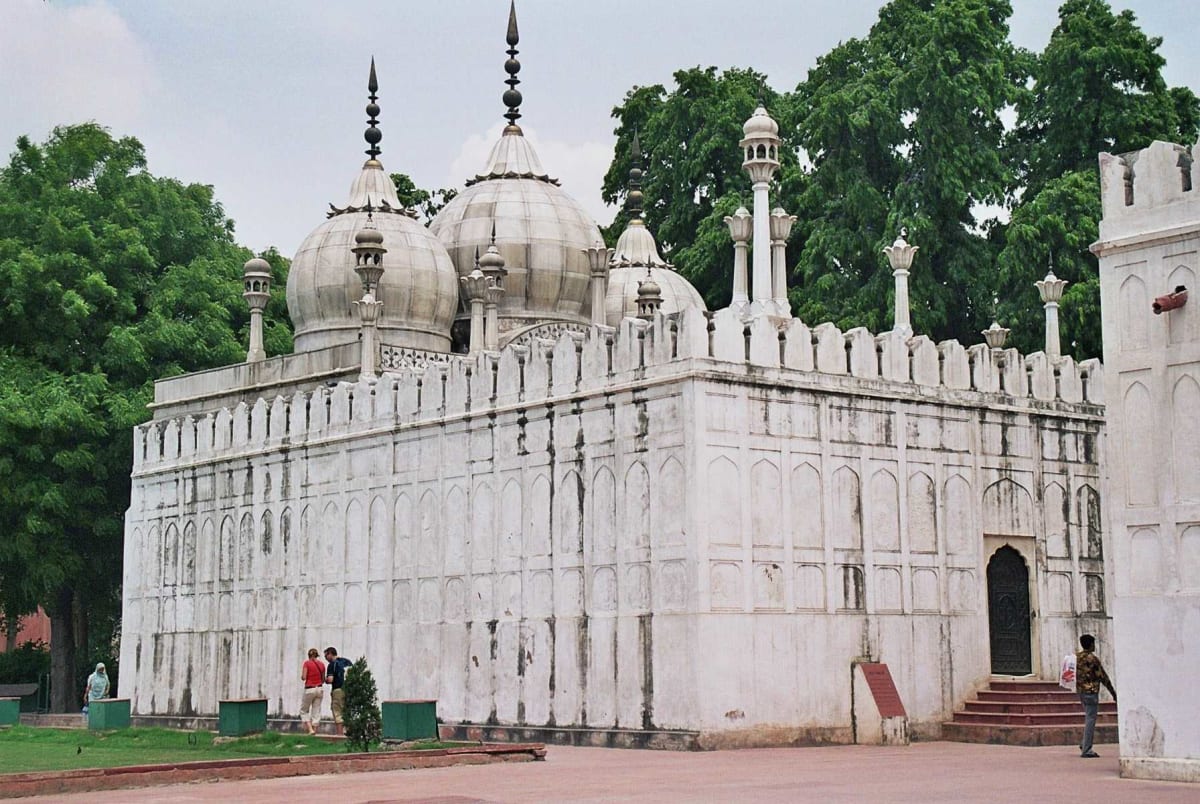
a. Identify this mosque built by Aurangzeb.
b. Where did he build it?
c. You read about another mosque of the same name in the previous chapter. Who built it and where?
Answer
(a) The mosque is the Moti Masjid (Pearl Mosque), a small white marble mosque.
(b) Aurangzeb built it within the Red Fort complex in Delhi.
(c) Another mosque of the same name, the Moti Masjid, was built by Shah Jahan in the Agra Fort, Agra.
Look at the given picture, and answer the following questions:
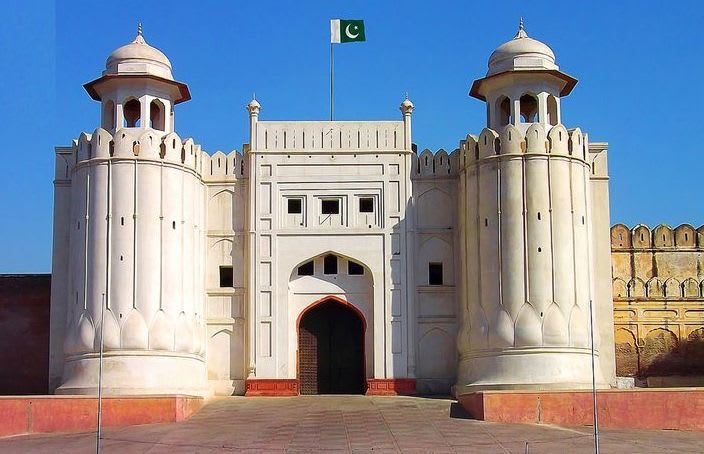
a. Identify the gate in the picture. Where is it placed?
b. Where is the monument located now? Who built it?
c. What do you think is the purpose of this construction?
Answer
(a) It is the massive gate (Alamgiri Gate) that Aurangzeb added to the Lahore Fort. It is placed at the entrance of the Lahore Fort.
(b) The monument is now located in Lahore, Pakistan. It was built by Aurangzeb.
(c) The purpose of this construction was to serve as a grand, fortified entrance gateway to the Lahore Fort, reflecting the power and grandeur of the Mughal Empire.
Chhatrapati Shivaji Maharaj, known for his daring acts, was put under house arrest by Emperor Aurangzeb in Agra in 1666 CE, after being treated dishonourably at the Mughal court. He was furious at this treatment, devised an escape plan. He feigned illness and began sending out enormous baskets filled with fruits, purportedly for distribution among the poor as penance. On August 17, 1666, unnoticed by the guards, these baskets carried not only fruits but also him and his young son. By the time the subterfuge was discovered, he was already on his way back to his kingdom, where he received a thundering welcome.
Based on the case study answer the following questions:
A. Why was Chhatrapati Shivaji Maharaj placed under house arrest by Aurangzeb in Agra?
B. Which tactics were used by Chhatrapati Shivaji Maharaj to escape from the house arrest?
Answer
A. Chhatrapati Shivaji Maharaj was placed under house arrest because, when he visited Aurangzeb's court in Agra in 1666 CE, he was treated in a dishonourable manner. He was furious at this treatment, and Aurangzeb, enraged at Shivaji's lack of reverence for the Mughal court, put him under house arrest.
B. To escape, Chhatrapati Shivaji Maharaj feigned illness and began sending out enormous baskets filled with fruits, supposedly meant for distribution among the poor as penance. On 17 August 1666, hidden inside these baskets along with his young son, he slipped past the guards unnoticed and made his way back to his kingdom.