
This was an important event in Medieval Europe:
- The growth and spread of Christianity
- The invention of wheel
- The rise of Islam
Answer
The growth and spread of Christianity
Reason — An important event in Medieval Europe was the growth and spread of Christianity. It eventually became the state religion of almost the whole of Europe.
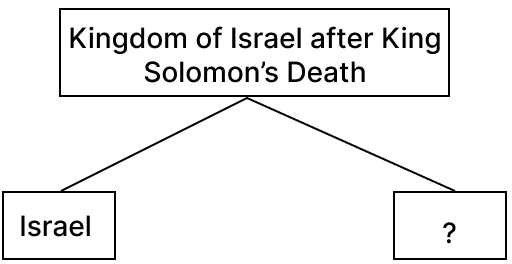
Complete the given mind map.
- Judaea
- Judah
- Bethlehem
Answer
Judah
Reason — Following King Solomon's death, the kingdom of Israel got divided into two kingdoms — Israel and Judah.
Why did Jesus travel across Judaea and Galilee?
- To preach his ideas
- To trade
- To graze his cattle
Answer
To preach his ideas
Reason — From 30 CE to 33 CE, Jesus travelled across Judaea and Galilee, preaching his ideas. His simple teachings appealed to the masses and drew large crowds wherever he went.
The life and teachings of Jesus are recorded in the ............... canonical Gospels.
- three
- four
- five
Answer
four
Reason — The life and teachings of Jesus are recorded in the four canonical Gospels — Matthew, Mark, Luke and John.
Complete the given analogy.
Constantine I: Made Christianity legal in the Roman Empire :: Theodosius I: ?
- Made Christianity legal again in the Roman Empire
- Banned Christianity in the Roman Empire
- Made Christianity the official religion of the Roman Empire
Answer
Made Christianity the official religion of the Roman Empire
Reason — While Constantine I issued the Edict of Milan in 313 CE to make Christianity legal within the Roman Empire, Theodosius I, in 392 CE, made Christianity the official religion of the Roman Empire.
Bethlehem : Birth of Jesus :: Jerusalem : ...............
- Crucifixion of Jesus
- Conversion of Paul
- First Council of Nicaea
- Edict of Milan
Answer
Crucifixion of Jesus
Reason — Jesus was born in the town of Bethlehem in Judaea, and was executed by crucifixion in Jerusalem on the orders of the Roman prefect Pontius Pilate.
Choose the reason Jesus was crucified by the Roman authorities.
- He was a political leader.
- He tried to become the emperor.
- His teachings were anti-Roman.
- His growing influence was seen as a threat to Roman control and Jewish authorities.
Answer
His growing influence was seen as a threat to Roman control and Jewish authorities.
Reason — Jesus's simple teachings appealed to the masses, and he drew large crowds wherever he went. This concerned some Jewish religious leaders whose ideas clashed with those of Jesus. They turned hostile and convinced the Roman prefect, Pontius Pilate, to execute Jesus on the pretext that he was a threat to the political authority of the Romans.
When Edict of Milan was issued in 313 CE, which event was least likely after that?
- Churches were openly built
- Christians were forced into hiding
- Constantine supported bishops
- Public worship became legal
Answer
Christians were forced into hiding
Reason — The Edict of Milan, issued in 313 CE by Constantine I, made Christianity legal within the Roman Empire. After this, Christians could openly practice their religion, build churches and worship publicly. Hence, they were not forced into hiding.
What significant action did Emperor Theodosius I take in 392 CE regarding religion in the Roman Empire?
- He declared Judaism the official religion of the Roman Empire
- He made Christianity the official religion of the Roman Empire
- He banned all religious practices in the Roman Empire
- He established the Pantheon as the religious headquarter
Answer
He made Christianity the official religion of the Roman Empire
Reason — In 392 CE, Emperor Theodosius I made Christianity the official religion of the Roman Empire. St. Peter's Basilica in Rome became the religious headquarters, and the Pope became the spiritual leader of the Christians.
Assertion (A): The teachings of Jesus appealed to many people in the Roman Empire.
Reason (R): His message focused on wealth and military strength.
- Both A and R are true, but R is not the correct explanation of A.
- Both A and R are true, and R is the correct explanation of A.
- Both A and R are false.
- Only A is true, and R is false.
Answer
Only A is true, and R is false.
Explanation — The teachings of Jesus indeed appealed to many people because they were simple and different from the existing norms. However, his message did not focus on wealth and military strength. Instead, he advocated unconditional love for God and true love for one's neighbour, including one's enemies.
Assertion (A): Constantine played a major role in the rise of Christianity in the Roman Empire.
Reason (R): He converted to Christianity and granted religious freedom to Christians.
- Both A and R are true, but R is not the correct explanation of A.
- Both A and R are true, and R is the correct explanation of A.
- Both A and R are false.
- Only A is true, and R is false.
Answer
Both A and R are true, and R is the correct explanation of A.
Explanation — Constantine I played a major role in the rise of Christianity in the Roman Empire. Around 312 CE, he adopted Christianity, and in 313 CE, he issued the Edict of Milan, which made Christianity legal in the Roman Empire. He also supported the church financially, built basilicas, granted privileges to the clergy and promoted Christians to high offices.
Explain each of the following terms:
- Medieval
- New Testament
- Crucifixion
- Monasteries
Answer
Medieval — The word 'medieval' is derived from the Latin word medium aevum, which means 'middle age'. It refers to the period of history belonging to the Middle Ages, i.e., the period between the Ancient and the Modern Period. In Europe, the period from about 500 CE to 1500 CE is traditionally known as the Medieval Period.
New Testament — The New Testament is the second part of the Christian Bible that tells about the life and teachings of Christ and his earliest followers. The first four books of the New Testament, known as the four canonical Gospels — Matthew, Mark, Luke and John — record the life and teachings of Jesus.
Crucifixion — Crucifixion is a very old form of execution that involved binding a person to a cross and nailing him/her. Jesus was executed by crucifixion in Jerusalem on the orders of the Roman prefect Pontius Pilate. The day of crucifixion of Jesus is observed by Christians as Good Friday.
Monasteries — Monasteries were religious communities of Christian monks. A monastery was a building, usually strong and large, surrounded by gardens and orchards, which served as the residence and workplace of monks. Monasteries also had a chapel or a church where the residents prayed. They became centres of religious and secular learning, and served as shelters for travellers.
'The Roman emperor had a symbiotic relationship with Christianity'. Justify this statement with examples from Constantine I's reign.
Answer
A symbiotic relationship is one in which both parties benefit from each other. The reign of Constantine I clearly demonstrates such a relationship between the Roman emperor and Christianity:
What Constantine did for Christianity:
- Around 312 CE, Constantine I adopted Christianity, becoming the first Roman emperor to openly promote the religion.
- In 313 CE, he issued the Edict of Milan, which made Christianity legal within the Roman Empire.
- He supported the church financially and built various basilicas.
- He granted privileges (exemption from certain taxes) to the clergy.
- He promoted Christians to high offices and returned confiscated property to the church.
- Between 324 CE and 330 CE, he built a new imperial capital at Byzantium (Constantinople), which included churches employing a Christian style of architecture.
What Christianity did for Constantine:
- Christianity provided religious legitimacy to Constantine's rule.
- It established a precedent for the position of a Christian emperor in the church. The emperor considered himself answerable to God, which made him responsible for the health of his subjects.
- The religion gave the emperor a unifying force to bind his subjects together. His role was to enforce the doctrine and uphold religious unity.
Thus, the relationship between Constantine I and Christianity was mutually beneficial, justifying the statement that the Roman emperor had a symbiotic relationship with Christianity.
Are the teachings of Jesus relevant in today's world? Discuss in the class.
Answer
Yes, the teachings of Jesus continue to be highly relevant in today's world. Some of the reasons are:
Unconditional love and forgiveness — Jesus taught people to love and forgive from the heart, including their enemies. In today's world, full of conflicts, hatred and intolerance, this message can help bring peace and harmony.
Love for one's neighbour — Jesus said, 'You shall love your neighbour as yourself'. This teaching promotes empathy, kindness and concern for others, which are essential values in a society where people are often divided by religion, race or nationality.
Mercy and compassion — Jesus said, 'Blessed are the merciful, for they shall obtain mercy'. This teaching encourages people to be compassionate towards those who are suffering, poor, sick or in need.
Non-judgement — Jesus taught, 'Do not judge, or you too will be judged'. This is relevant in our world where people often pass quick judgements based on appearance, background or beliefs.
Turning away from sins — His message of repentance and moral living encourages people to lead an honest and ethical life.
Therefore, the teachings of Jesus continue to inspire millions of people across the world and remain timeless guiding principles for a peaceful, just and compassionate society.
Christianity is a religion based on the life and teachings of Jesus, who is acknowledged as the only Son of God by all Christians. In this context, answer the following questions:
- Which part of the Christian Bible tells us about the life and teachings of Christ and his earliest followers?
- What was the name of the town in Judaea where Jesus was born?
- Name the Roman prefect of Judaea who ordered the execution of Jesus.
Answer
- The New Testament, which is the second part of the Christian Bible, tells us about the life and teachings of Christ and his earliest followers. The first four books of the New Testament are the four canonical Gospels — Matthew, Mark, Luke and John.
- Jesus was born in the town of Bethlehem in Judaea.
- The Roman prefect of Judaea who ordered the execution of Jesus was Pontius Pilate.
Read the paragraph and answer the questions that follow.
Early Christianity retained as well as rejected some of the doctrines and practices of the 1st century Jewish religion, known as Judaism. Over a period of time, Christian teachings were compiled to form the biblical canon. The biblical canon is a set of books regarded as divine by the Christians. It constitutes the Bible. The Bible contains both the Old Testament and the New Testament.
- What is the 1st century Jewish religion known as?
- What is meant by the biblical canon?
- What contains both the Old Testament and the New Testament?
Answer
- The 1st century Jewish religion is known as Judaism.
- The biblical canon is a set of books regarded as divine by the Christians. It was formed over a period of time by compiling Christian teachings, and it constitutes the Bible.
- The Bible contains both the Old Testament and the New Testament. The Old Testament tells about the ancient Hebrew people, their beliefs and relationship with God before the birth of Christ, while the New Testament tells about the life and teachings of Christ and his earliest followers.
Name the imperial capital at Byzantium built by Constantine I.
Answer
The imperial capital at Byzantium built by Constantine I was named Constantinople.
Discuss the impact of the 'barbarian invasions' on the Roman Empire.
Answer
The 'barbarian invasions' had a major impact on the Roman Empire:
- The repeated raids of non-Christian Germanic tribes — the Visigoths, Vandals and Franks — weakened the Roman Empire considerably.
- The Goths and other Germanic peoples, fleeing from the Huns, took refuge within the Roman borders, where they came into conflict with the Romans and broke into revolts, weakening the Roman state.
- Germanic groups penetrated deep into the western part of the Roman Empire and plundered it. The city of Rome was sacked a number of times.
- The Visigoths and the Vandals set up semi-independent states within the Empire on the western side. Eventually, the 'Romans' and 'Germans' mixed to become new cultural groups.
- A succession of weak Western Roman emperors led the Romano-German groups to ignore Rome and become independent, resulting in the formation of modern-day states such as France, Germany and Britain.
- The invasions ultimately led to the fall of Rome in 476 CE, when the last Roman emperor of the Western Roman Empire, Romulus Augustulus, was deposed by the Germanic chieftain Odoacer, who became the first 'King of Italy'.
What happened to the Roman Empire after the death of Theodosius I?
Answer
Following the death of Theodosius I in 395 CE, the Roman Empire was divided into two parts — the Eastern Roman Empire and the Western Roman Empire. The Western Roman Empire suffered from repeated barbarian invasions and finally came to an end in 476 CE, when Romulus Augustulus, the last Roman emperor of the Western Roman Empire, was deposed by Odoacer. In the East, however, the Roman Empire continued in the form of the Byzantine Empire, with its capital at Constantinople. The Byzantine Empire became the seat of the Orthodox Church, whereas the Roman Catholic Church continued operating from the city of Rome in the West.
By what name were the women who devoted their life to God in Christianity known as?
Answer
The women who devoted their life to God in Christianity were known as nuns.
What were monasteries? How did they influence the life of people?
Answer
Monasteries were religious communities of Christian monks. A monastery was a building, usually strong and large, surrounded by gardens and orchards, that served as the residence and workplace of monks. Monasteries also had a chapel or church where the residents prayed.
Monasteries influenced the life of people in the following ways:
- They became centres of both religious and secular learning. Subjects as diverse as philosophy, medicine, history, astrology and botany were studied here. Some of these monasteries later developed into famous universities, such as the University of Oxford and the University of Cambridge.
- Monasteries provided shelter to travellers, and food and clothing to the poor. Nuns educated the children and treated the sick and wounded. Sometimes, monks and nuns ran schools and hospitals.
- Monasteries evolved as centres of production. Stained glass painting, mural painting and wood carving developed in these monasteries.
- Monasteries were responsible for the spread of Christianity to other regions. Monks and nuns served as missionaries and spread the message of Jesus Christ.
With reference to the Crusades, answer the following questions:
- What were the Crusades?
- How many major Crusades were fought between the armies of the Pope and Turkish Muslims?
- State the consequences of the Crusades.
Answer
The Crusades were a series of holy wars fought between the armies of the Pope and the Turkish Muslims, in order to occupy the Holy Land of Jerusalem and the lands of the Christian emperor of Constantinople. They were waged between the 11th and 13th centuries CE. The year 1096 CE is usually taken as the beginning of the First Crusade.
Eight major Crusades were fought between the armies of the Pope and Turkish Muslims.
The consequences of the Crusades were:
- The Crusaders, in the course of their expeditions, came in contact with Greek culture and education, and acquired knowledge of rich civilisation. This assimilation eventually paved the way for the Renaissance.
- The Crusaders learnt the use of gunpowder and guns from the Turks, which changed the old military system present in Medieval Europe.
- New trade routes were opened to cater to the newly acquired tastes of the Crusaders. As trade flourished, the European economy improved.
- The power of the king also increased, as the traders and manufacturers paid taxes for improved law and order. The king started maintaining a big army.
- The Crusades also led to the emergence of new cities.
This is the picture of the apostle after whom the religious headquarters of Christianity at Rome was erected.
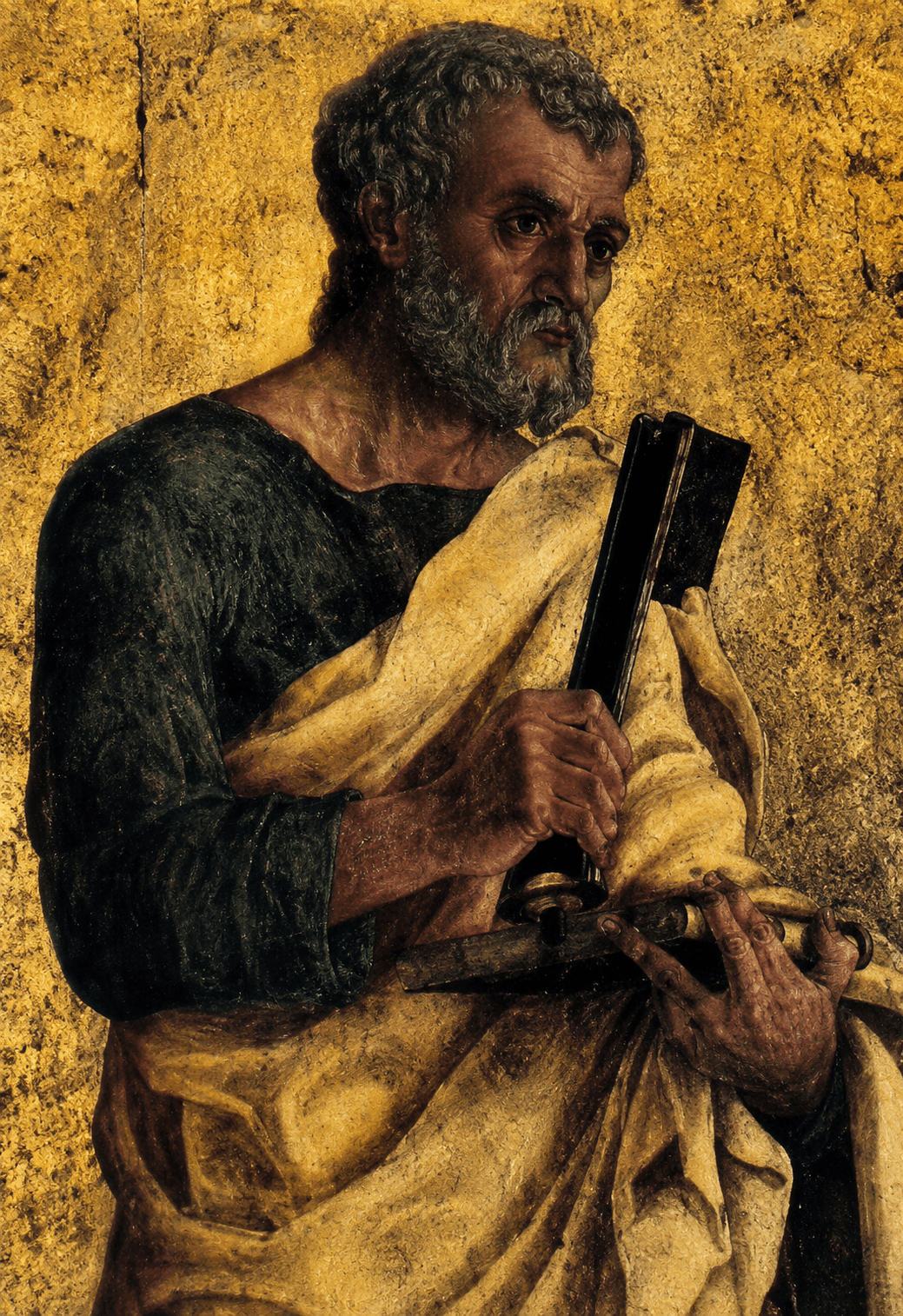
a. Who were apostles?
b. Can you name the apostle? Name a few others besides the one shown in the picture.
Answer
a. Apostles were the twelve disciples chosen by Jesus Christ from among his followers. He named them 'apostles', and they travelled to distant lands to spread the teachings of Jesus.
b. The apostle shown in the picture is St. Peter, after whom the religious headquarters of Christianity at Rome — St. Peter's Basilica (now known as Old St. Peter's Basilica) — was erected. A few other apostles besides St. Peter were James, John and Thomas.
The given picture portrays the taking of Jerusalem by the Crusaders.
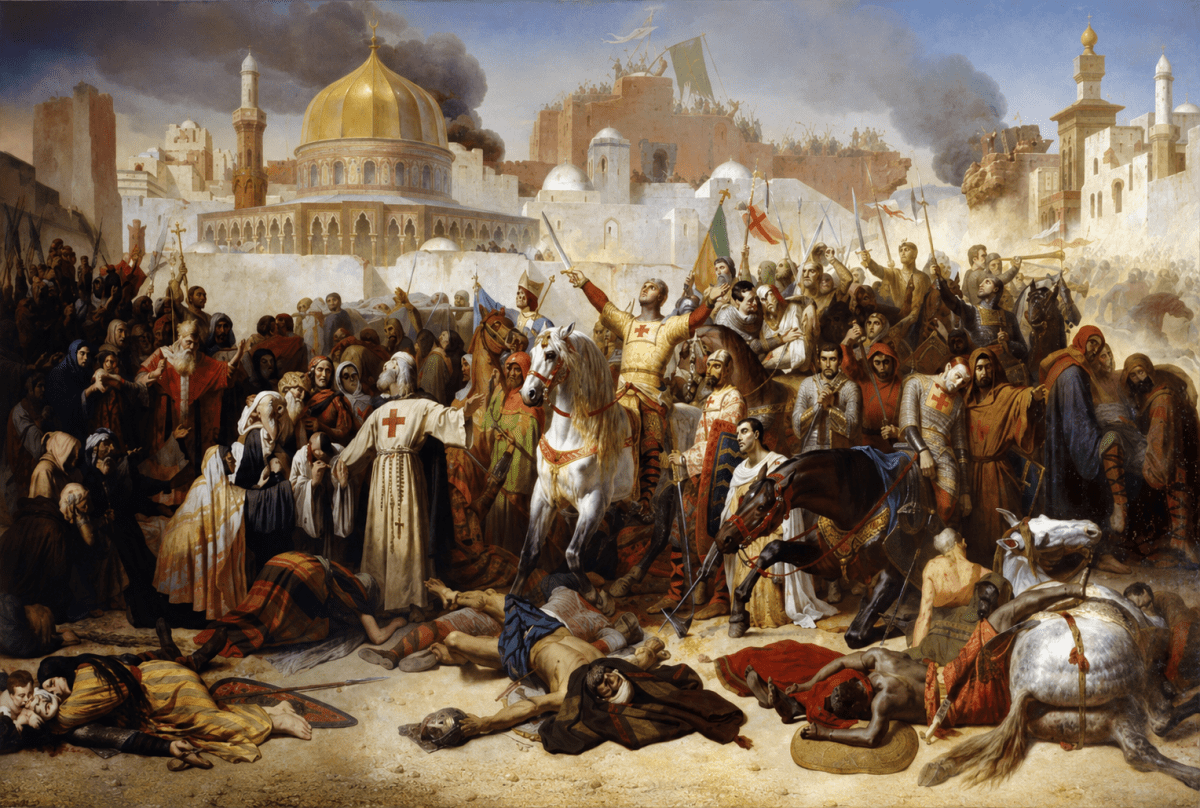
a. Who were the Crusaders and why were they fought?
b. How did the capture of Jerusalem affect the Christians?
c. Did religion play an important role in the minds of the Crusaders?
Answer
a. The Crusaders were the Christian soldiers who fought a series of holy wars known as the Crusades against the Turkish Muslims, between the 11th and 13th centuries CE. The Crusades were fought because, in the 11th century CE, the Turks conquered the Holy Land of Jerusalem and attacked the ruler of Constantinople. Hence, the Pope organised armies to reoccupy the Holy Land.
b. The capture of Jerusalem allowed the Christians to hold the Holy Land for nearly a century, and they also gained other strongholds in the Near East. However, in spite of this success, the Crusades failed to establish a permanent Christian kingdom in the Holy Land.
c. Yes, religion played a very important role in the minds of the Crusaders. The Crusades were called 'Holy Wars' because they were fought with the religious objective of reclaiming the Holy Land of Jerusalem for Christianity. The wars were waged by the armies of the Pope, the spiritual leader of the Christians. The religious zeal motivated thousands of Christians to undertake the long and dangerous journeys to fight in these wars.
The Byzantine Empire, with its capital at Constantinople, was a major centre of Christian power and culture. It stood for over 1000 years, even as the Western Roman Empire fell. In 1453, the city was conquered by the Ottoman Turks. This event marked the end of the Byzantine Empire and the rise of Muslim power in the region. Many Greek scholars fled to the West, bringing ancient Greek and Roman texts with them, which helped spark the Renaissance in Europe.
Based on the case study answer the following questions:
A. What effect did the fall of Constantinople have on European learning and culture?
B. How did the movement of Greek scholars to the West after 1453 influence the Renaissance?
Answer
A. The fall of Constantinople in 1453 had a major effect on European learning and culture. Before its fall, the Byzantine Empire, with Constantinople as its capital, had preserved a vast collection of ancient Greek and Roman texts, art and knowledge. When the city was conquered by the Ottoman Turks, many Greek scholars fled to the West, carrying these ancient texts with them. This influx of classical knowledge enriched European learning and culture, and helped spark a revival of art, literature, philosophy and science in Europe, which came to be known as the Renaissance.
B. The movement of Greek scholars to the West after 1453 played a significant role in influencing the Renaissance in the following ways:
- The Greek scholars brought with them ancient Greek and Roman texts that had been preserved in the Byzantine Empire for centuries. These texts reintroduced classical learning to Europe.
- They shared their knowledge of classical Greek language, literature and philosophy with European scholars, which inspired a revival of interest in the classical traditions.
- Their teachings led to fresh thinking in fields like art, literature, science and philosophy, encouraging European thinkers to look beyond medieval religious thought.
- This assimilation of classical Greek and Roman ideas paved the way for the Renaissance — literally meaning 'rebirth' — which marked the revival of European art and literature between the 14th and 16th centuries.