
Which of these statements does not apply to the life in Arabia before the rise of Islam?
- There was a notable absence of large-scale political organisations.
- People primarily practised monotheism.
- The tribe had an obligation to protect its members.
Answer
People primarily practised monotheism.
Reason — In pre-Islamic Arabia, people primarily practised polytheism, not monotheism, though some tribes had also embraced Judaism and Christianity.
Complete the given table.
| Christianity | The Bible |
|---|---|
| Islam | ? |
- The Old Testament
- The New Testament
- The Koran
Answer
The Koran
Reason — The Koran is the sacred book of Islam, which reveals the will of Allah. Allah is believed to have revealed its teachings to his messenger, Prophet Muhammad.
The age at which Muhammad is said to have been visited by angel Gabriel:
- 30
- 40
- 50
Answer
40
Reason — At the age of 40, Muhammad is said to have been visited by angel Gabriel, who revealed the divine message and urged him to preach it to the people.
The migration of Prophet Muhammad from Mecca to Medina in 622 CE is known as:
- hijrat
- hijab
- hajj
Answer
hijrat
Reason — In 622 CE, Prophet Muhammad migrated from Mecca to Medina, and this migration is known as hijrah or hijrat.
The Abbasids were known for their ............... .
- autocracy
- benevolence
- tyranny
Answer
benevolence
Reason — The Abbasids were benevolent rulers who took several measures for the well-being of their subjects, including constructing roads, promoting trade and encouraging cultural enrichment.
What was one key reason Mecca remained a spiritual centre even after the spread of Islam to faraway lands?
- It was the city of the Abbasid Caliphs.
- It housed the Quran's original manuscript.
- The Kaaba became the central point of pilgrimage and prayer.
- It had the largest library in the Islamic world.
Answer
The Kaaba became the central point of pilgrimage and prayer.
Reason — The Kaaba at Mecca is one of the most sacred places for the Muslims. The Hajj, the fifth pillar of Islam, requires Muslims to make a pilgrimage to Mecca at least once in their lifetime, making it the central point of pilgrimage and prayer.
Prophet Muhammad's message challenged the existing social order in Mecca. How did this happen?
- By encouraging idol worship
- By focussing purely on trade
- By promoting social equality and belief in one God
- By supporting the tribal autocracy
Answer
By promoting social equality and belief in one God
Reason — Muhammad preached a monotheistic message, which antagonised the orthodox people. He aimed at bringing about a sense of brotherhood and a bond of faith among his followers, forbade idol worship, and stressed the importance of good and kind behaviour.
The ............... is a centre of religious and community life for the Muslims.
- Temple
- Hijrah
- Mosque
- Church
Answer
Mosque
Reason — A mosque is a centre of religious and community life for the Muslims. The Prophet's mosque in Medina is one of the most important places of worship for Muslims.
The given image is an example of Islamic architecture. Which of the following best explains its historical and religious significance?
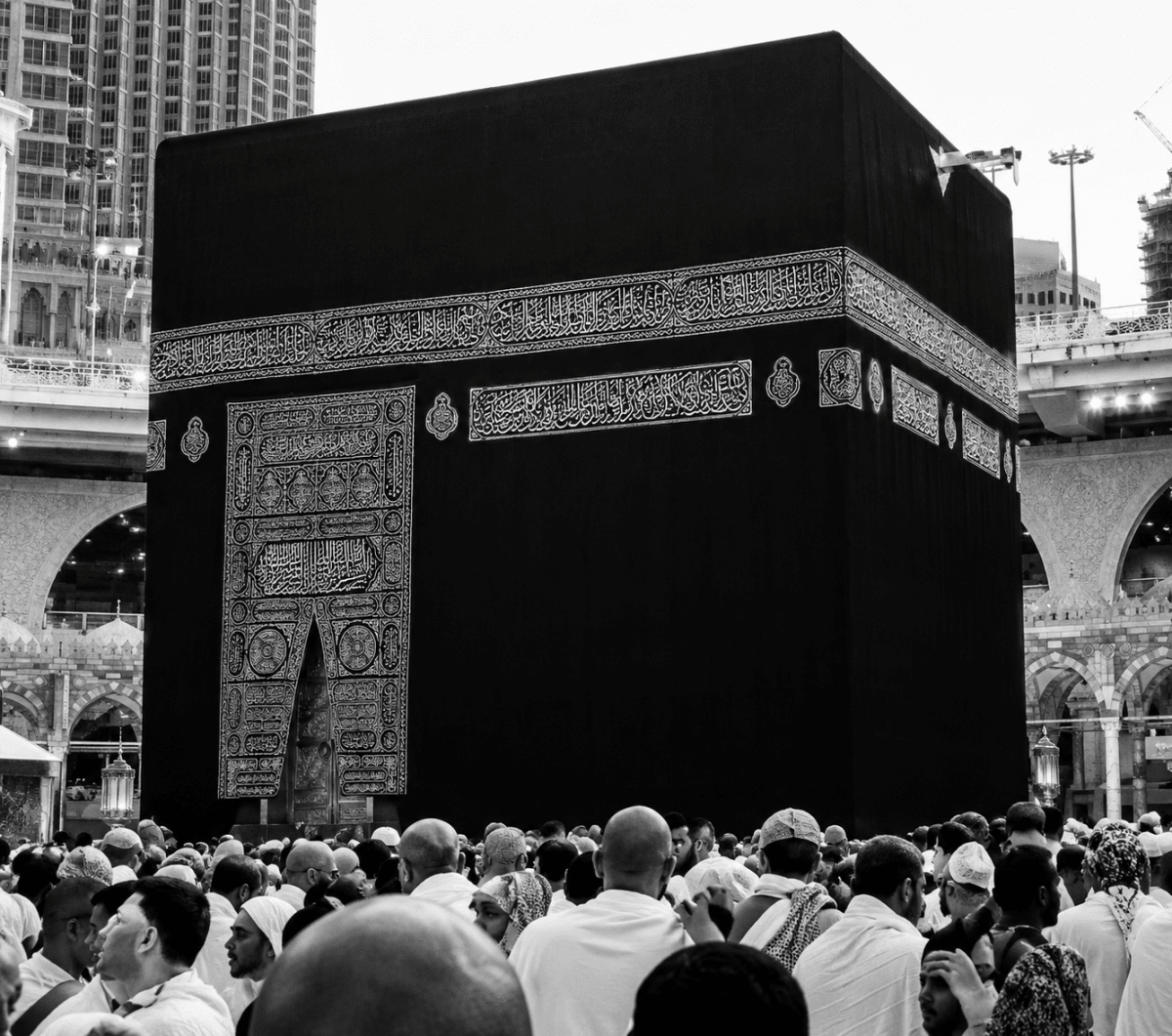
- It is the Kaaba in Mecca, housing the Black Stone, the focal point of Islamic prayer and Hajj.
- It is the Prophet's Mosque in Medina, built as the first centre of Islamic learning.
- It is the Dome of the Rock in Jerusalem, marking Muhammad's Night Journey.
- It is a Zoroastrian fire temple converted into a mosque after the conquest of Persia.
Answer
It is the Kaaba in Mecca, housing the Black Stone, the focal point of Islamic prayer and Hajj.
Reason — The image shows the Kaaba in Mecca, one of the most sacred places for Muslims. It is the focal point of Islamic prayer and the destination of the Hajj pilgrimage. Muslims around the world face the Kaaba while offering their prayers.
Assertion (A): Islam spread rapidly across Asia, Africa and parts of Europe after the death of Prophet Muhammad.
Reason (R): The message of equality and justice attracted many people from different regions.
- Both A and R are true, but R is not the correct explanation of A.
- Both A and R are true, and R is the correct explanation of A.
- Both A and R are false.
- Only A is true, and R is false.
Answer
Both A and R are true, and R is the correct explanation of A.
Explanation — After the death of Prophet Muhammad, the Arab armies under the Caliphs went far and wide to spread the message of Islam. The Arab empire stretched over Iran, Syria, Central Asia, North Africa and even Spain. The message of brotherhood, equality and belief in one God attracted many people from different regions, which led to the rapid spread of Islam.
Assertion (A): The early Islamic empire made significant progress in the fields of science, medicine and mathematics.
Reason (R): The Islamic rulers discouraged education and learning.
- Both A and R are true, but R is not the correct explanation of A.
- Both A and R are true, and R is the correct explanation of A.
- Both A and R are false.
- Only A is true, and R is false.
Answer
Only A is true, and R is false.
Explanation — The early Islamic empire indeed made significant progress in science, medicine and mathematics. Al-Khwarizmi introduced the Hindu-Arabic numerals and the concepts of algebra, great advances were made in astronomy and geometry, and scholars like Ibn Sina and Muhammad al-Razi made remarkable contributions. However, the Islamic rulers, especially the Abbasids, actually encouraged education and learning, leading to great intellectual and cultural achievements.
Explain each of the following terms:
- Kaaba
- Mosque
- Caliphate
- Ramadan
Answer
- Kaaba — The Kaaba at Mecca is one of the most sacred places for the Muslims. It is the focal point of Islamic prayer and the destination of the Hajj pilgrimage.
- Mosque — A mosque is a centre of religious and community life for the Muslims. The Prophet's mosque in Medina is one of the most important mosques in Islam.
- Caliphate — The Caliphate refers to the rule of a Muslim leader known as the Caliph. The Caliphs were the successors of Prophet Muhammad and exercised power on behalf of the Prophet.
- Ramadan — Ramadan is the holy month of Islam during which Muslims observe fasting. Fasting is the fourth pillar of Islam. Fasting begins at dawn and ends at sunset. Eid is celebrated at the end of the holy month of Ramadan.
Why did tribes play a crucial role in pre-Islamic Arabian life? Choose from the reasons given below. You can select multiple options.
- With the exception of Yemen in the south-west, no part of the Arabian peninsula had any government at any time.
- The Arabs derived security not from a State but from their descent groups.
- The primarily sedentary agriculturalist life kept the tribes together.
Answer
The correct options are:
- With the exception of Yemen in the south-west, no part of the Arabian peninsula had any government at any time.
- The Arabs derived security not from a State but from their descent groups.
Since there was an absence of any political organisation across most of the Arabian peninsula, the Arabs were organised in tribes and derived security from their descent groups rather than from a State. The third option is incorrect because the land was mostly arid and only suitable for nomadic pastoralism, not sedentary agriculture.
Are the Five Pillars of Islam relevant among the followers of the religion today?
Answer
Yes, the Five Pillars of Islam continue to be highly relevant among the followers of the religion today. They form the core of Islamic practice and remain mandatory duties for all practising Muslims. Muslims around the world continue to:
- Profess their faith in one God, Allah, and accept Muhammad as His messenger.
- Perform the five daily prayers (namaz or salaah) at set times of the day.
- Give Zakat, a portion of their wealth as alms, to the poor and needy each year.
- Observe fasting during the holy month of Ramadan, from dawn to sunset.
- Undertake the Hajj pilgrimage to Mecca at least once in their lifetime, if they can.
These pillars continue to unite Muslims worldwide and reinforce values of devotion, charity, self-discipline and community.
What does the word 'Islam' mean?
Answer
The Arabic word 'Islam' literally means 'surrender' or 'submission to the will of Allah'. It illuminates the fundamental religious idea of Islam — absolute submission to one God, Allah.
By what name are the believers of Islam known?
Answer
The believers of Islam are known as Muslims. The word 'Muslim' means 'one who has submitted'.
Give an account of the early life of Prophet Muhammad.
Answer
Prophet Muhammad was born in c. 570 CE in Mecca. He was orphaned at an early age and was brought up by his uncle, who was a merchant. He accompanied his uncle on trading ventures in caravans. Subsequently, Muhammad spent his time in prayer and meditation. At the age of 40, he is said to have been visited by angel Gabriel, who revealed the divine message and urged him to preach it to the people.
What are the Five Pillars of Islam? Explain each of them in a sentence.
Answer
The Five Pillars of Islam are:
- Faith — The basic statement of Islamic faith is that there is no God but Allah, and Muhammad is His messenger.
- Prayer — Muslims are required to perform five daily prayers, also called namaz or salaah, at five set times of the day.
- Zakat — Muslims are required to annually give a portion of their wealth as alms to the poor and the needy.
- Fasting — Muslims are required to fast during the holy month of Ramadan, from dawn to sunset.
- Hajj — Muslims are prescribed to undertake a pilgrimage to Mecca at least once in their lifetime.
Which dynasty took over after the first four successors of Prophet Muhammad?
Answer
After the immediate successors of Prophet Muhammad (the first four Caliphs), the Umayyad dynasty took over the Caliphate Empire in 661 CE. Their capital was Damascus.
By the time Prophet Muhammad died, almost all of Arabia had embraced Islam, and after his death, Arab armies under the Caliphs went far and wide to spread the message of Islam. In this context, answer the following questions:
- Who were the first four Caliphs that succeeded Prophet Muhammad?
- When did India's first tryst with Islam take place?
Answer
- The first four Caliphs who succeeded Prophet Muhammad were Abu Bakr, Umar I, Uthman and Ali. They inspired the Arab people and their armies to carry the message of Allah throughout the world.
- India's first tryst with Islam took place in the 7th century CE, when Arab traders came to the Malabar Coast of India and began to settle there. Later on, the arrival of Muslim invaders from Central Asia increased India's contact with the Islamic culture.
There was significant cultural and economic enrichment during the rule of the Abbasids. In this context, answer the following questions:
- Write a note on trade under the Abbasid rule.
- Which book has immortalised the court of Harun al-Rashid, the fifth Caliph of the Abbasid dynasty?
Answer
- Trade flourished significantly under the Abbasid rule. The Abbasids constructed a network of roads for the promotion of trade and commerce. The new trade routes gave access to different countries. Maritime trade also took a great leap as they controlled the sea routes in the Indian Ocean and the Gulf region. Industries flourished under their rule, and as a result, new cities and towns came into existence.
- The book The Thousand and One Nights (also known as The Arabian Nights) has immortalised the wealth and luxury of the court of Harun al-Rashid, the fifth Caliph of the Abbasid dynasty. He was a great patron of the arts and a connoisseur of music and poetry, who gave lavish gifts to distinguished poets and musicians.
State the achievements of the Islamic Empire in each of the given fields.
- Science
- Literature
- Art and architecture
Answer
- Science — The Islamic Empire made remarkable contributions to various sciences. The major works of Al-Khwarizmi introduced the Hindu-Arabic numerals and the concepts of algebra to the European world. Great advances were made in geometry and astronomy. The Arabs learnt the art of making paper from China and used rags of linen and hemp instead of tree pulp. They introduced new techniques in glass-making and used variants of the mariner's compass for navigation. The civilisation also produced great scholars such as Ibn Sina and Muhammad al-Razi.
- Literature — Famous literary works such as Rubaiyat by Omar Khayyam and The Arabian Nights were written during this period. The cultural contribution by the Islamic civilisation has, thus, been quite significant.
- Art and architecture — In art, architecture and calligraphy, the Islamic Empire reached great heights of excellence. Several palaces, mosques, tombs and learning centres were built. New features, such as the minaret and the dome, were introduced in architecture. These architectural structures were decorated with mosaics and calligraphy.
This is a picture of one of the most sacred sites for Muslims.
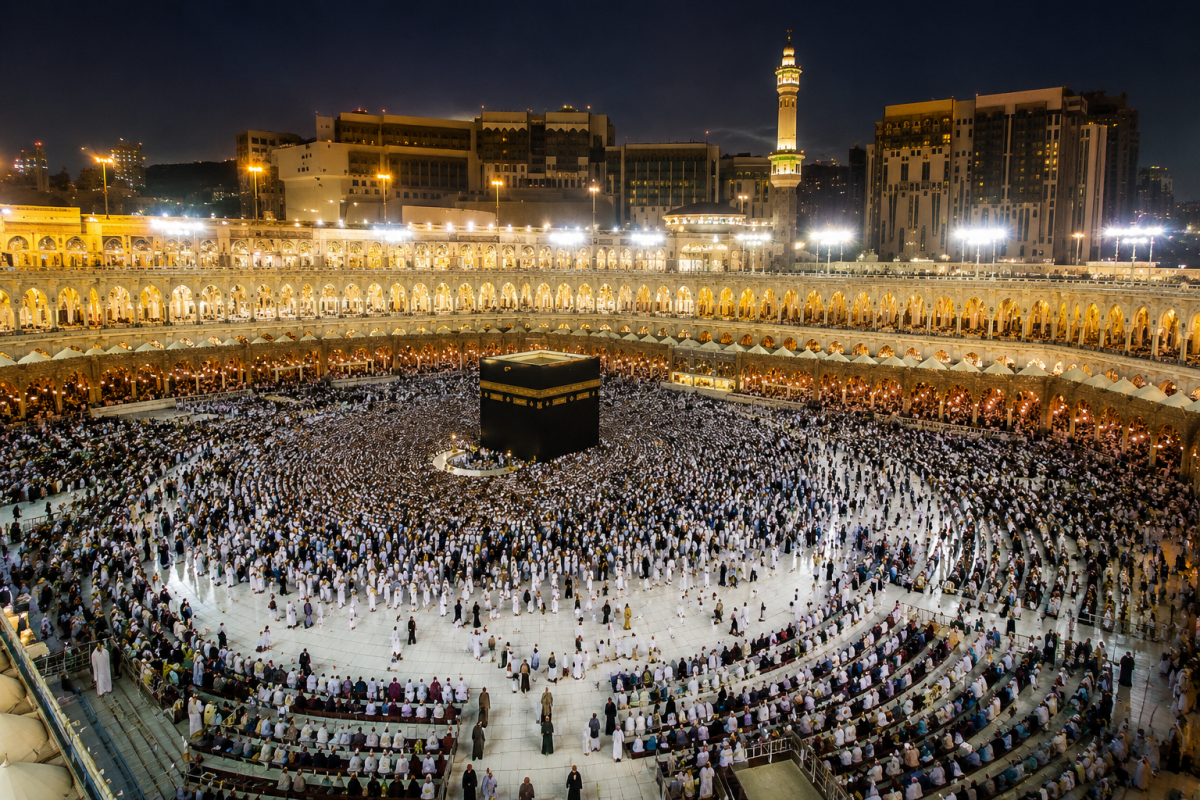
a. Do you recognise this place?
b. Where is it located?
c. Why is it significant?
Answer
a. Yes, this is the Kaaba.
b. The Kaaba is located in the city of Mecca, in present-day Saudi Arabia.
c. The Kaaba is one of the most sacred places for the Muslims. It is the central point of pilgrimage and prayer for Muslims around the world. The Hajj, which is the fifth pillar of Islam, requires Muslims to undertake a pilgrimage to Mecca at least once in their lifetime. Muslims around the world also face the Kaaba while offering their daily prayers.
The given picture portrays the Islamic architecture.
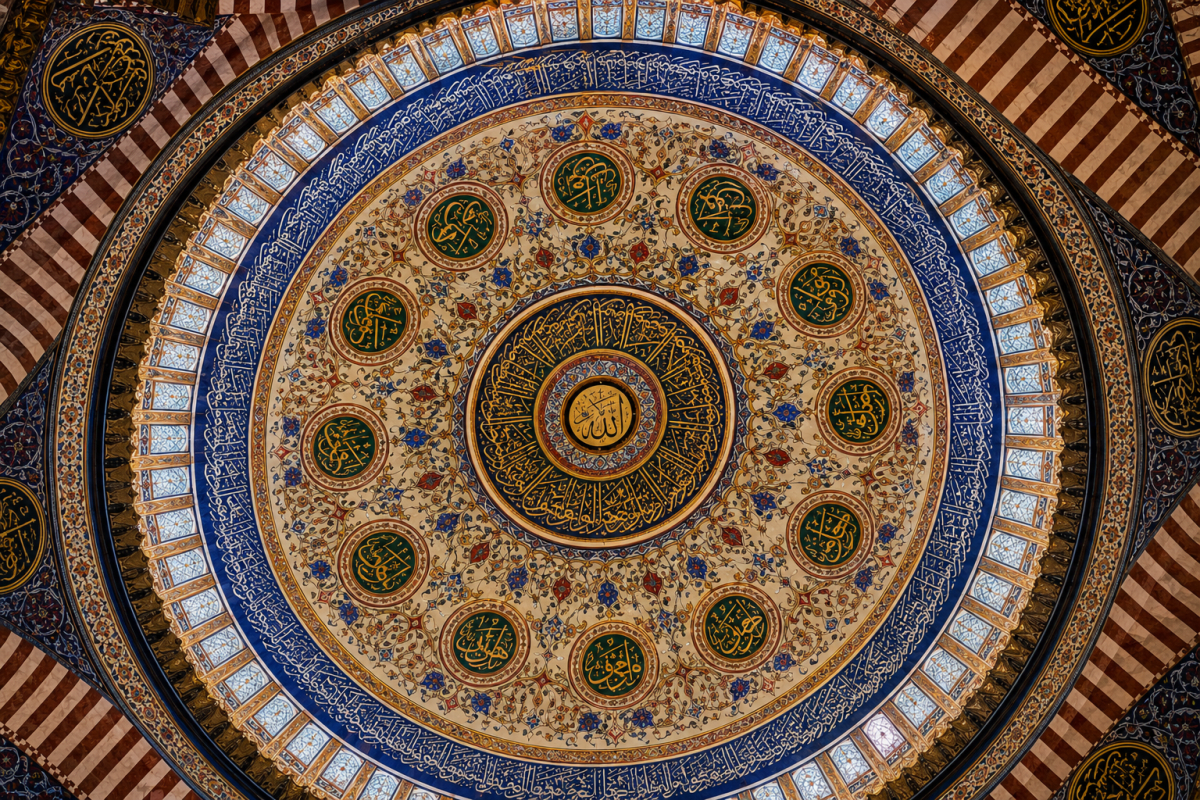
a. Mention any three features of Islamic architecture.
b. What were mosaics and calligraphy?
Answer
a. Three features of Islamic architecture are:
- The introduction of the minaret — a tall tower, traditionally part of a mosque.
- The use of the dome — a roof shaped like the top half of a ball.
- The decoration of architectural structures with mosaics and calligraphy, which added beauty and intricacy to the buildings such as palaces, mosques, tombs and learning centres.
b. Mosaics were patterns made by putting together little pieces of stone and tiles. Calligraphy was the art of beautiful writing done using special pens and brushes. Both mosaics and calligraphy were used extensively to decorate Islamic architectural structures.
In 622 CE, Prophet Muhammad and his followers left Mecca for Medina. This event, called the Hijrat, marked the beginning of the Islamic calendar. In Medina, the Prophet built the first mosque and established a community based on equality and faith.
Based on the case study answer the following questions:
a. Which year marks the beginning of the Islamic calendar?
b. What was the first mosque built by the Prophet in Medina called?
c. State one significance of this migration in the spread of Islam.
Answer
a. The year 622 CE marks the beginning of the Islamic calendar. This is the year in which Prophet Muhammad migrated from Mecca to Medina, an event known as the Hijrat.
b. The first mosque built by the Prophet in Medina is known as the Prophet's Mosque (Masjid an-Nabawi). It became another important sacred place for Muslims, along with the Kaaba at Mecca.
c. The migration to Medina was highly significant in the spread of Islam. In Medina, Prophet Muhammad was welcomed by his followers, where his teachings were increasingly accepted, and many people converted to Islam. The Prophet established a community based on equality, brotherhood and faith. This laid a strong foundation for Islam, which gradually spread throughout Arabia and later to different parts of the world.