
Which of the following statements does not apply to Mahmud of Ghazni:
- Mahmud of Ghazni was an efficient administrator and a promising statesman.
- He swore allegiance to the Abbasid Caliph in Baghdad for political reasons.
- He fought two major battles with Prithviraj Chauhan, the ruler of Ajmer.
Answer
He fought two major battles with Prithviraj Chauhan, the ruler of Ajmer.
Reason — It was Muhammad Ghori, and not Mahmud of Ghazni, who fought two major battles with Prithviraj Chauhan, known in history as the Battles of Tarain (1191 CE and 1192 CE). Mahmud of Ghazni was indeed an efficient administrator and a promising statesman, and he did swear allegiance to the Abbasid Caliph in Baghdad for political reasons.
Complete the given table by choosing the correct option.
| Mahmud of Ghazni | Muhammad Ghori |
|---|---|
| A son of Sabuktigin | ? |
- A son of Mahmud of Ghazni
- A vassal of Ghazni
- The second son of Sabuktigin
Answer
A vassal of Ghazni
Reason — The Ghorids began as the vassals of Ghazni, but later they declared their independence from the Ghaznavid Empire. Muhammad Ghori was neither related to Mahmud of Ghazni nor a son of Sabuktigin.
Muhammad Ghori was completely routed by the Vaghela ruler ............... .
- Jayapala
- Bhima I
- Bhima II
Answer
Bhima II
Reason — When Muhammad Ghori attempted to enter Gujarat by crossing the Rajputana desert, he was completely routed by the Vaghela ruler of Gujarat, Bhima II.
The most trusted general of Muhammad Ghori was:
- Qutubuddin Aibak
- Bakhtiyar Khalji
- Jaichand
Answer
Qutbuddin Aibak
Reason — Qutbuddin Aibak was a Turkish slave and one of Muhammad Ghori's most trusted generals. Before leaving for Ghazni, Ghori appointed him as his regional governor of northern India.
What was the most important effect of Ghori's victory in India? Choose the most appropriate option.
- He expanded the Ghorid territories.
- He defeated some Rajput kingdoms.
- His conquests led to the establishment of the Delhi Sultanate in India.
Answer
His conquests led to the establishment of the Delhi Sultanate in India.
Reason — The most important effect of Ghori's conquests was the establishment of the Delhi Sultanate in India in 1206 CE by Qutbuddin Aibak. The Sultanate lasted for centuries and had a great impact on the life and culture of the Indian subcontinent.
Mahmud of Ghazni : Plunder of temples :: Muhammad Ghori : ...............
- Trade with India
- Political conquest of North India
- Temple construction
- Establishment of local kingdoms
Answer
Political conquest of North India
Reason — While Mahmud of Ghazni's raids were primarily aimed at plundering the wealth of Indian temple towns to fund his ambitions in Central Asia, Muhammad Ghori's invasions were aimed at the political conquest of North India, which eventually led to the establishment of the Delhi Sultanate.
Observe the miniature painting depicting Firdausi and Mahmud of Ghazni. Firdausi, the poet-laureate, composed the epic poem Shahnama. What was the primary reason for his disappointment with Sultan Mahmud's reward?
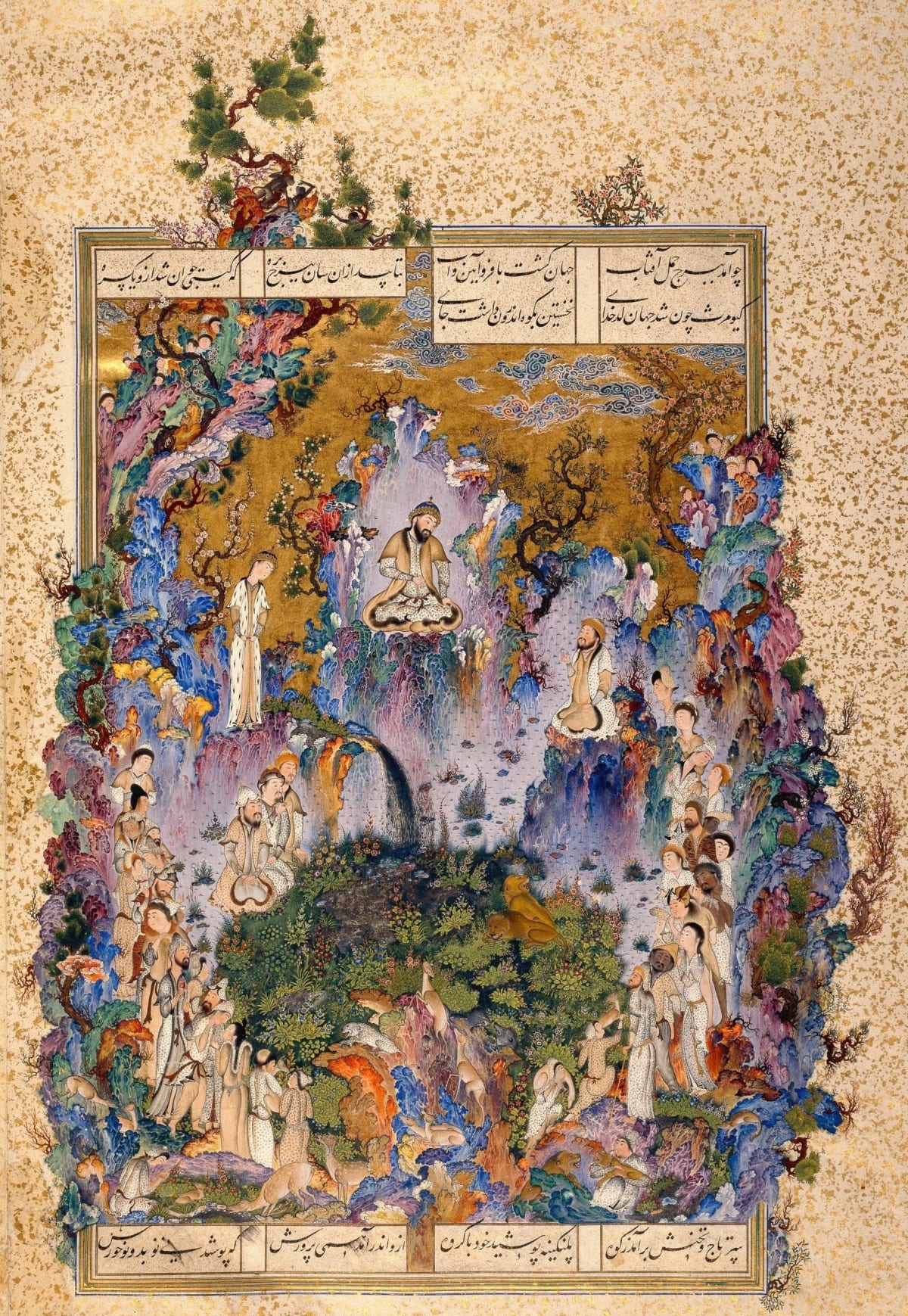
- The Shahnama was not well-received by the court.
- He was expecting a much larger sum than the 20,000 dirhams received.
- Mahmud of Ghazni demanded further revisions to the poem.
- The reward was in gold coins, not silver.
Answer
He was expecting a much larger sum than the 20,000 dirhams received.
Reason — According to the legend, Firdausi was highly disappointed when he received only 20,000 dirhams as reward from Sultan Mahmud for Shahnama. It was much less than what he had expected. Upset, he divided the paltry sum between a bath attendant and a seller of sherbet.
Match the following:
| Column A | Column B |
|---|---|
| 1. Mahmud of Ghazni | A. Battle of Tarain |
| 2. Muhammad Ghori | B. Plundered Somnath |
| 3. Prithviraj Chauhan | C. Defeated in Second Tarain |
- 1-B, 2-A, 3-C
- 1-C, 2-A, 3-B
- 1-B, 2-C, 3-A
- 1-A, 2-C, 3-B
Answer
1-B, 2-A, 3-C
Reason — Mahmud of Ghazni's most ambitious and profitable expedition was the attack on the Somnath Temple in Kathiawar (c. 1025 CE). Muhammad Ghori fought the two Battles of Tarain (1191 CE and 1192 CE) with Prithviraj Chauhan. Prithviraj Chauhan, though supported by many other Rajput rulers, was defeated and killed in the Second Battle of Tarain.
Assertion (A): The Second Battle of Tarain (1192 CE) was a watershed moment in the history of India.
Reason (R): It led to the defeat of Prithviraj Chauhan and facilitated Muhammad Ghori's advance into the heart of India, eventually leading to the establishment of the Delhi Sultanate.
- A is true, but R is false.
- R is the reason for A.
- Both A and R are false.
- Only R is true, and A is false.
Answer
R is the reason for A.
Explanation — Both A and R are true, and R correctly explains why the Second Battle of Tarain is considered a watershed moment. In this battle, Prithviraj Chauhan was defeated and killed, after which Muhammad Ghori marched towards Ajmer unchallenged. Other Rajput kingdoms were captured without difficulty, Delhi was soon taken, and within a year Ghori controlled north Rajasthan and the northern part of the Ganga–Yamuna Doab. This eventually led to the establishment of the Delhi Sultanate in 1206 CE, which lasted for centuries and shaped the subsequent history of India.
Assertion (A): India was politically divided, with small kingdoms constantly fighting, at the time of the Turkish invasions.
Reason (R): This disunity made it easy for the Turks to defeat the Indian rulers and establish their dominance.
- A is true, but R is false.
- R is the reason for A.
- A is false, but R is true.
- Both A and R are false.
Answer
R is the reason for A.
Explanation — Both A and R are true and closely related. At the time of the Turkish invasions, India was politically divided into many small kingdoms that were constantly fighting with one another. Because political unity could not be achieved, the Turks were able to defeat the Indian rulers one by one and establish their dominance. Thus, the political disunity of India was directly linked to the success of the Turkish invasions.
Number the following events to put them in the correct chronological order.
- The Second Battle of Tarain
- Mahmud of Ghazni's attack on the Somnath Temple
- Muhammad Ghori became the governor of Ghazni
- Mahmud of Ghazni's war against Anandapala
- Mahmud of Ghazni ascended the throne of Ghazni
Answer
The correct chronological order is:
- Mahmud of Ghazni ascended the throne of Ghazni (998 CE)
- Mahmud of Ghazni's war against Anandapala (1008–09 CE)
- Mahmud of Ghazni's attack on the Somnath Temple (c. 1025 CE)
- Muhammad Ghori became the governor of Ghazni (1173 CE)
- The Second Battle of Tarain (1192 CE)
Both Mahmud of Ghazni and Muhammad Ghori fought wars with Indian rulers. What was the most basic difference between them?
Answer
The most basic difference between Mahmud of Ghazni and Muhammad Ghori lay in the aim of their invasions. Mahmud of Ghazni was a gifted soldier, but he did not want to establish an empire in the Indian subcontinent. His interest lay in territorial expansion in Central Asia, and he invaded Indian temple towns mainly to plunder their great wealth and fulfil his monetary needs. He only annexed the Punjab to use it as a base for attacking Indian territories. In contrast, Muhammad Ghori's aim was to expand the Ghorid territories and to establish political control over North India. His conquests were not just raids for wealth but campaigns of political conquest, which finally led to the establishment of the Delhi Sultanate in India.
'Mahmud of Ghazni may have raided and destroyed parts of India, however, he also contributed to Persian culture.' Discuss this statement with the help of examples.
Answer
Although Mahmud of Ghazni is remembered for his ruthless raids on Indian temple towns like Nagarkot, Thanesar, Mathura, Kanauj, Meerut and Somnath, he also made significant contributions to Persian culture by patronising leading Persian scholars and poets at his court at Ghazni.
- He patronised the renowned Persian poet Firdausi, who was the poet-laureate at his court. Firdausi composed the great epic poem Shahnama (The Book of Kings) during the first decade of the 11th century. The Shahnama became one of the most celebrated works of Persian literature and remains a primary source of information about Persian history from the mythical times to the mid-7th century.
- He also patronised the Persian historian and scholar Al-Biruni. Al-Biruni translated many Sanskrit texts into Arabic and wrote Kitab al-Hind, a detailed Arabic account of the Indian subcontinent, which remains a veritable source for historians studying that period.
Thus, in spite of his destructive raids, Mahmud's court became a major centre of Persian learning, literature and scholarship.
In which century did the Gupta Empire disintegrate?
Answer
The Gupta Empire disintegrated in the 6th century CE.
What was the name of Yasovarman's kingdom?
Answer
Yasovarman's kingdom was Kanauj. After Harsha, Yasovarman rose to power in Kanauj, where he defeated the Gaudas and also won Magadha.
Name the two main kingdoms that the Turks established following the decline of the Abbasid Caliphate.
Answer
The two main kingdoms established by the Turks following the decline of the Abbasid Caliphate were Ghazni and Ghor.
Who did Mahmud of Ghazni swear allegiance to for political reasons?
Answer
Mahmud of Ghazni swore allegiance to the Abbasid Caliph in Baghdad for political reasons. In return, the Caliph recognised him as the legitimate ruler of the land and encouraged him in his conquests.
How many times did Mahmud attack India?
Answer
Mahmud of Ghazni attacked India 17 times during his lifetime.
With reference to the Battles of Tarain, answer the following questions:
- State the years when the Battles of Tarain took place.
- Between whom were the Battles of Tarain fought?
- What happened in the Second Battle of Tarain?
Answer
- The Battles of Tarain took place in 1191 CE (First Battle of Tarain) and 1192 CE (Second Battle of Tarain) at the town of Tarain near Thanesar in present-day Haryana.
- The Battles of Tarain were fought between Muhammad Ghori, the Turkish ruler of Ghazni, and Prithviraj Chauhan, the Rajput ruler of Ajmer.
- In the Second Battle of Tarain (1192 CE), Muhammad Ghori assembled a large army and once again invaded the kingdom of Ajmer. This time, Jaichand of Kanauj, the powerful Rajput ruler, did not help Ajmer. Prithviraj Chauhan, though supported by many other Rajput rulers, was defeated and killed. After this victory, Muhammad Ghori marched towards Ajmer unchallenged. Other Rajput kingdoms were captured without any difficulty, and his forces soon advanced towards Delhi and captured it. Within a year, Muhammad Ghori controlled north Rajasthan and the northern part of the Ganga–Yamuna Doab.
Compare and contrast the raids and conquests of Mahmud of Ghazni and Muhammad Ghori in India. Give specific examples of the rulers they fought against.
Answer
Similarities between the raids and conquests of Mahmud of Ghazni and Muhammad Ghori:
- Both Mahmud of Ghazni and Muhammad Ghori were Turkish rulers who launched a series of invasions into the Indian subcontinent.
- Both used well-equipped armies, with swift and agile horses, to defeat the Indian rulers.
- Both took advantage of the political disunity of India to achieve military success.
Differences between the raids and conquests of Mahmud of Ghazni and Muhammad Ghori:
- Aim — Mahmud of Ghazni's main aim was to plunder the wealth of Indian temple towns to fund his ambitions of territorial expansion in Central Asia. He did not want to establish an empire in India. Muhammad Ghori, on the other hand, aimed at the political conquest of North India and the expansion of the Ghorid territories.
- Number of attacks — Mahmud of Ghazni attacked India 17 times during his lifetime, mostly as plundering raids. Muhammad Ghori's campaigns were fewer but more focused, aimed at establishing political control.
- Rulers fought against — Mahmud of Ghazni fought against the Shahi rulers of the Punjab, namely Jayapala (1001 CE) and his son Anandapala (1008–09 CE at Waihind). He also subdued Multan. Muhammad Ghori fought against the Vaghela ruler Bhima II of Gujarat (who completely routed him), and most importantly against Prithviraj Chauhan of Ajmer in the two Battles of Tarain (1191 CE and 1192 CE). Jaichand of Kanauj did not assist Prithviraj.
- Major campaigns — Mahmud of Ghazni plundered Nagarkot (1009 CE), Thanesar (1014 CE), Mathura (1018 CE), Kanauj, Meerut, attacked Gwalior (1022 CE) and the Somnath Temple in Kathiawar (c. 1025 CE). Muhammad Ghori conquered Multan, Uchch, Peshawar, Sialkot, Lahore, Ajmer, Delhi and the northern Ganga–Yamuna Doab.
- Lasting impact — Mahmud of Ghazni only annexed the Punjab to use it as a base for further attacks; he did not establish an empire in India. Muhammad Ghori's conquests led to the establishment of the Delhi Sultanate in 1206 CE by Qutbuddin Aibak, which lasted for centuries and had a deep impact on the life and culture of the Indian subcontinent.
Discuss the reasons for the success of the Turkish invasions in India.
Answer
The Turkish invasions of India were successful due to the following reasons:
- Political division of India — India was politically divided at the time of the Turkish invasions. Small kingdoms were constantly fighting with one another. Thus, political unity could not be achieved, and it became easy for the Turks to defeat the Indian rulers one by one. For example, Jaichand of Kanauj did not assist Prithviraj Chauhan in the Second Battle of Tarain.
- Superior war tactics and cavalry — In war tactics, India was far behind the Turks. The Turkish horses were more swift and agile than the Indian elephants on the battlefield. The cavalry archers of the Turkish armies were highly effective, as seen in Mahmud's victory over Anandapala at Waihind.
- Weak administrative system — The prevailing administrative system in India weakened the position of the king. The king was dependent on the local chiefs, who supplied men for his army. Thus, the king did not have a strong centralised army, while the Turks fought as a well-organised, unified force.
This is a picture of a Persian historian who has been mentioned in this chapter.
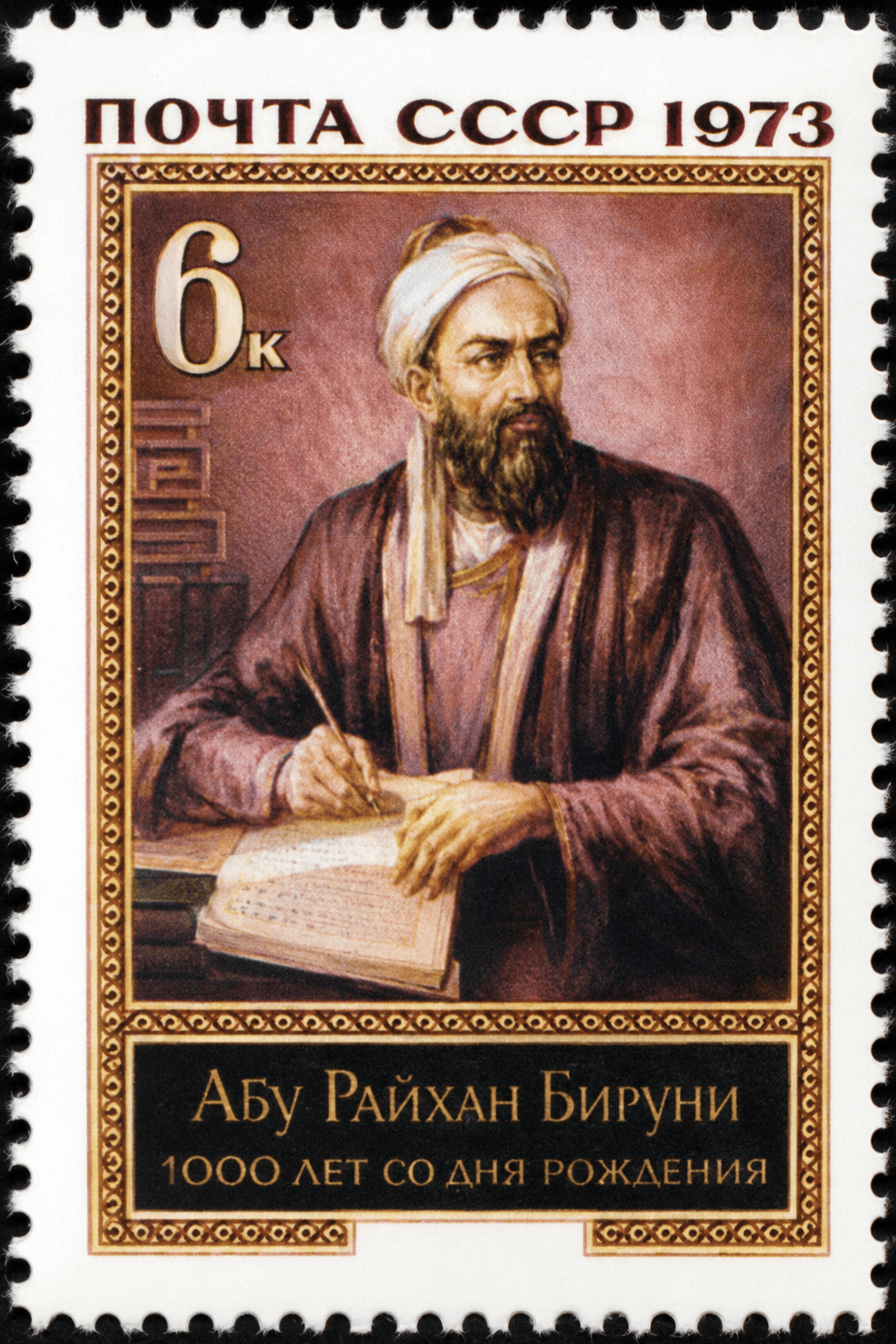
- Which Turkish sultan patronised him?
- Name a book written by him on India.
Answer
- The Persian historian shown in the picture is Al-Biruni. He was patronised by Sultan Mahmud of Ghazni.
- Al-Biruni wrote Kitab al-Hind, an Arabic account of the Indian subcontinent, which remains a veritable source for historians. He also translated many Sanskrit texts into Arabic.
Based on the given picture, answer the following questions:
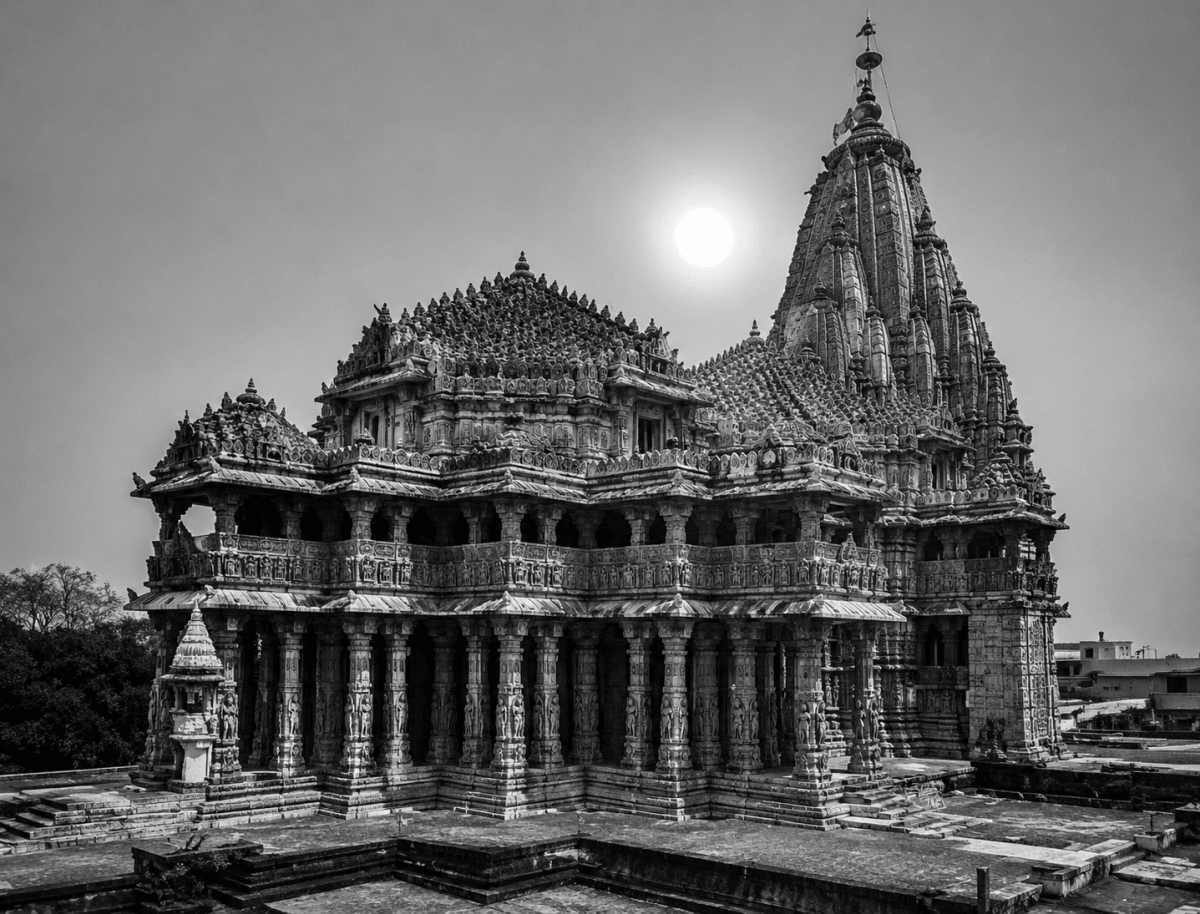
- This temple was a target of which Turkish invader?
- What historical claim did a British Governor-General make regarding the gates of this temple centuries later?
- What does the repeated targeting of such temples by invaders like Mahmud of Ghazni suggest about their motivations?
Answer
- The Somnath Temple in Kathiawar was a target of the Turkish invader Mahmud of Ghazni. His attack on the Somnath Temple in c. 1025 CE was his most ambitious and profitable expedition.
- In 1842 CE, the British Governor-General Ellenborough claimed that he had bought back the 'gates of the Somnath Temple' from Ghazni. This claim was made eight centuries after Ghazni's invasion of the temple. These so-called 'gates of the Somnath Temple' can now be seen in one of the rooms of the Agra Fort.
- The repeated targeting of temples like Somnath by invaders such as Mahmud of Ghazni suggests that their main motivation was the plunder of wealth rather than religious or political conquest. Indian temple towns were known for their great wealth, which could fulfil the monetary needs of the invaders. Mahmud of Ghazni, in particular, used this plundered wealth to build a large and well-equipped army and to fund his ambitions of territorial expansion in Central Asia. The repeated attacks also indicate that the invaders did not intend to settle in India but treated such raids as a quick means of acquiring riches.
In 1191 CE, Muhammad Ghori invaded the territory of Prithviraj Chauhan of Ajmer, a powerful Rajput ruler. The First Battle of Tarain ensued, in which Prithviraj Chauhan decisively defeated Muhammad Ghori. However, the following year, Ghori assembled a much larger army and returned, leading to the Second Battle of Tarain in 1192 CE. This time, despite support from many Rajput rulers, Prithviraj Chauhan was defeated and killed. Notably, Jai Chand of Kanauj, another powerful Rajput ruler, did not offer assistance to Ajmer. This victory enabled Muhammad Ghori to march unchallenged towards Ajmer and subsequently capture Delhi, marking a significant turning point.
Based on the case study answer the following questions:
- Who were the two main adversaries in the Battles of Tarain?
- What was the outcome of the First Battle of Tarain?
- What immediate territorial gains did Muhammad Ghori achieve after his victory in the Second Battle of Tarain?
Answer
- The two main adversaries in the Battles of Tarain were Muhammad Ghori, the Turkish ruler of Ghazni, and Prithviraj Chauhan, the Rajput ruler of Ajmer.
- In the First Battle of Tarain (1191 CE), Prithviraj Chauhan decisively defeated Muhammad Ghori.
- After his victory in the Second Battle of Tarain (1192 CE), Muhammad Ghori marched towards Ajmer unchallenged and captured it. Other Rajput kingdoms were captured without any difficulty. His forces then advanced towards Delhi and captured it soon after. Within a year, Muhammad Ghori controlled north Rajasthan and the northern part of the Ganga–Yamuna Doab.