
ABCD is a square of side 24 cm. EF is parallel to BC and AE = 15 cm. By how much does
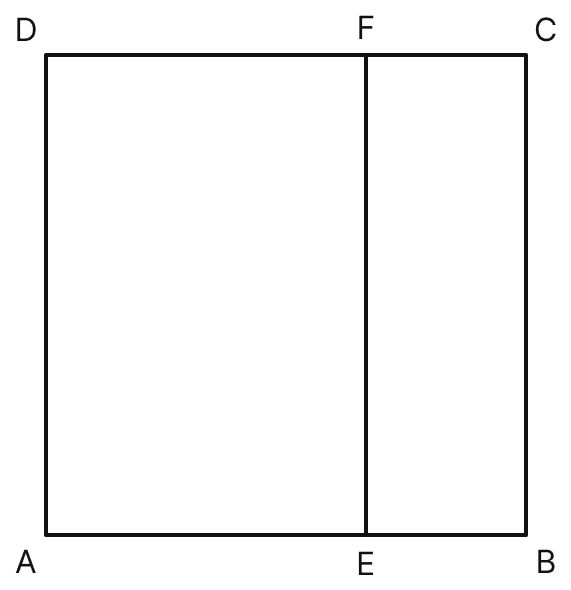
(i) the perimeter of AEFD exceed the perimeter of EBCF?
(ii) the area of AEFD exceed the area of EBCF?
Answer
Given,
Side of the square ABCD = 24 cm
AE = 15 cm
∴ EB = AB - AE = 24 cm - 15 cm = 9 cm
Since EF is parallel to BC, AEFD and EBCF are rectangles with EF = AD = BC = 24 cm.
(i) As we know,
Perimeter of rectangle = 2(length + breadth)
Perimeter of rectangle AEFD = 2 (AE + EF)
= 2 (15 + 24) cm
= 2 x 39 cm
= 78 cm
Perimeter of rectangle EBCF = 2 (EB + BC)
= 2 (9 + 24) cm
= 2 x 33 cm
= 66 cm
∴ Perimeter of AEFD - perimeter of EBCF = 78 cm - 66 cm = 12 cm
Hence, the perimeter of AEFD exceeds the perimeter of EBCF by 12 cm.
(ii) As we know,
Area of rectangle = length x breadth
Area of rectangle AEFD = AE x EF
= 15 cm x 24 cm
= 360 cm2
Area of rectangle EBCF = EB x BC
= 9 cm x 24 cm
= 216 cm2
∴ Area of AEFD - area of EBCF = 360 cm2 - 216 cm2 = 144 cm2
Hence, the area of AEFD exceeds the area of EBCF by 144 cm2.
Nagma runs around a rectangular park 180 m long and 120 m wide at the rate of 7.5 km/hour. In how much time will she complete five rounds?
Answer
Given,
Length of the park = 180 m
Breadth of the park = 120 m
Speed of Nagma = 7.5 km/hour
Distance covered by Nagma in one round of the park = perimeter of the park
= 2 (length + breadth)
= 2 (180 m + 120 m)
= 2 x 300 m
= 600 m
∴ Distance covered in five rounds = 5 x 600 m = 3000 m
Speed of running = 7.5 km/hour = 7.5 x 1000 m/hour = 7500 m/hour
∴ Time taken by Nagma in covering 3000 m =
Hence, Nagma will complete five rounds in 24 minutes.
The area of a rectangular plot is 540 m2. If its length is 27 m, find its breadth and perimeter.
Answer
Given,
Area of the plot = 540 m2
Length of the plot () = 27 m
Let the breadth of the plot be m.
As we know,
Area of a rectangle = length x breadth
⇒ 27 x = 540
⇒ = 20
∴ Breadth of the plot = 20 m
Perimeter of the plot =
= 2 (27 + 20) m
= 2 x 47 m
= 94 m
Hence, the breadth of the plot is 20 m and its perimeter is 94 m.
The perimeter of a rectangular field is 151 m. If its breadth is 32 m, find its length and area.
Answer
Given,
Perimeter of the field = 151 m
Breadth of the field () = 32 m
Let the length of the field be m.
As we know,
Perimeter of a rectangle =
∴ Length of the field = 43.5 m
Area of the field = length x breadth
= 43.5 m x 32 m
= 1392 m2
Hence, the length of the field is 43.5 m and its area is 1392 m2.
The area of a rectangular plot is 340 m2 and its breadth is 17 m. Find the cost of surrounding the plot with a fence at ₹350 per metre.
Answer
Given,
Area of the plot = 340 m2
Breadth of the plot () = 17 m
Rate of fencing = ₹ 350 per metre
Let the length of the plot be m.
As we know,
Area of a rectangle = length x breadth
⇒ x 17 = 340
⇒ = 20
∴ Length of the plot = 20 m
Perimeter of the plot =
= 2 (20 + 17) m
= 2 x 37 m
= 74 m
Cost of fencing the plot = Perimeter x rate of fencing
= 74 x ₹ 350
= ₹ 25,900
Hence, the cost of surrounding the plot with a fence is ₹ 25,900.
The area of a square park is the same as that of a rectangular park. If the side of the square park is 60 m and the length of the rectangular park is 90 m, find the breadth of the rectangular park.
Answer
Given,
Side of the square park = 60 m
Length of the rectangular park = 90 m
Area of the square park = (side)2
= 60 m x 60 m
= 3600 m2
As the area of the rectangular park = area of the square park
⇒ area of the rectangular park = 3600 m2
Let the breadth of the rectangular park be m.
Area of the rectangular park = length x breadth
⇒ 90 x = 3600
⇒ = 40
Hence, the breadth of the rectangular park is 40 m.
A wire is in the shape of a rectangle. Its length is 40 cm and breadth is 22 cm. If the same wire is rebent in the shape of a square, what will be the measure of each side? Also find which shape encloses more area and by how much?
Answer
Given,
Length of the rectangle = 40 cm
Breadth of the rectangle = 22 cm
Length of the wire = perimeter of the rectangle
= 2 (length + breadth)
= 2 (40 + 22) cm
= 2 x 62 cm
= 124 cm
As the wire is rebent into the shape of a square,
perimeter of the square = length of the wire = 124 cm
As we know,
Perimeter of a square = 4 x side
⇒ 4 x side = 124
⇒ side = cm = 31 cm
Area of the rectangle = length x breadth = 40 cm x 22 cm = 880 cm2
Area of the square = (side)2 = 31 cm x 31 cm = 961 cm2
∴ Area of the square - area of the rectangle = 961 cm2 - 880 cm2 = 81 cm2
Hence, each side of the square is 31 cm and the square encloses more area by 81 cm2.
A door of breadth 1 m and height 2 m is fitted in a wall. The length of the wall is 4.5 m and the height is 3.6 m. Find the cost of white washing the wall, if the rate of white washing the wall is ₹400 per m2.
Answer
Given,
Length of the wall = 4.5 m
Height of the wall = 3.6 m
Breadth of the door = 1 m
Height of the door = 2 m
Area of the wall (including the door) = length x height = 4.5 m x 3.6 m = 16.2 m2
Area of the door = breadth x height = 1 m x 2 m = 2 m2
∴ Area of the wall to be white washed = 16.2 m2 - 2 m2 = 14.2 m2
Cost of white washing the wall = Area x rate of white washing
= 14.2 x ₹ 400
= ₹ 5,680
Hence, the cost of white washing the wall is ₹ 5,680.
A rectangular park is 45 m long and 30 m wide. A path 2.5 m wide is constructed outside the park. Find the area of the path.
Answer
Given,
Length of the park = 45 m
Breadth of the park = 30 m
Width of the path = 2.5 m
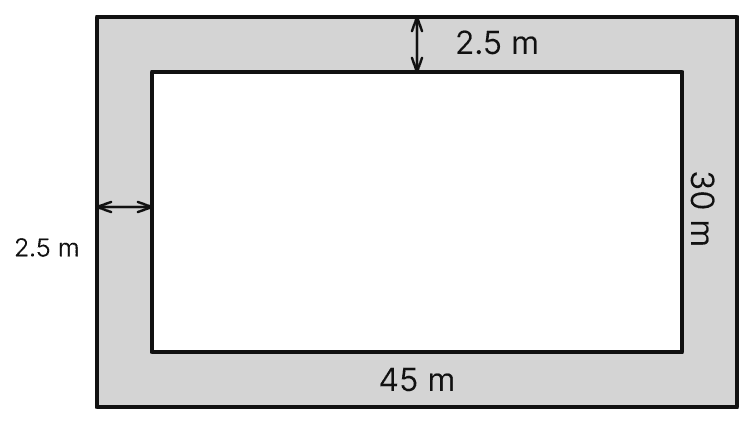
In the adjoining figure, the shaded portion shows the path.
Area of the park = length x breadth = 45 m x 30 m = 1350 m2
Length of the outer rectangle = 45 m + 2.5 m + 2.5 m = 50 m
Breadth of the outer rectangle = 30 m + 2.5 m + 2.5 m = 35 m
∴ Total area of the park and the path = length x breadth of the outer rectangle = 50 m x 35 m = 1750 m2
∴ Area of the path = total area of the park and the path - area of the park = 1750 m2 - 1350 m2 = 400 m2
Hence, the area of the path is 400 m2.
A carpet of size 5 m × 2 m has 25 cm wide red border. The inner part of the carpet is blue in colour. Find the area of blue portion. What is the ratio of the areas of red portion to blue portion?
Answer
Given,
Length of the carpet = 5 m
Breadth of the carpet = 2 m
Width of the red border = 25 cm = m = 0.25 m
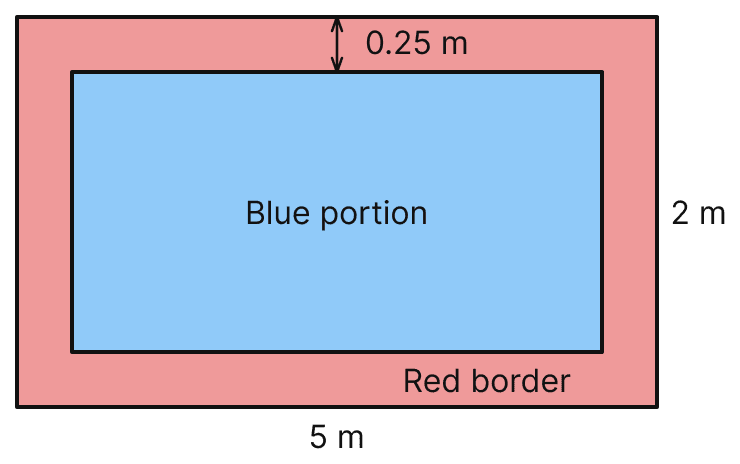
Area of the carpet = length x breadth = 5 m x 2 m = 10 m2
Length of the blue (inner) portion = 5 m - 0.25 m - 0.25 m = 4.5 m
Breadth of the blue (inner) portion = 2 m - 0.25 m - 0.25 m = 1.5 m
∴ Area of the blue portion = length x breadth = 4.5 m x 1.5 m = 6.75 m2
Area of the red portion = Area of the carpet - area of the blue portion
= 10 m2 - 6.75 m2
= 3.25 m2
∴ Ratio of the areas of red portion to blue portion = 3.25 : 6.75
= 325 : 675
= 13 : 27
Hence, the area of the blue portion is 6.75 m2 and the ratio of the areas of red portion to blue portion is 13 : 27.
A verandah of width 2.25 m is constructed all along outside a room which is 5.5 m long and 4 m wide. Find:
(i) the area of the verandah.
(ii) the cost of cementing the floor of the verandah at the rate of ₹200 per m2.
Answer
Given,
Length of the room = 5.5 m
Breadth of the room = 4 m
Width of the verandah = 2.25 m
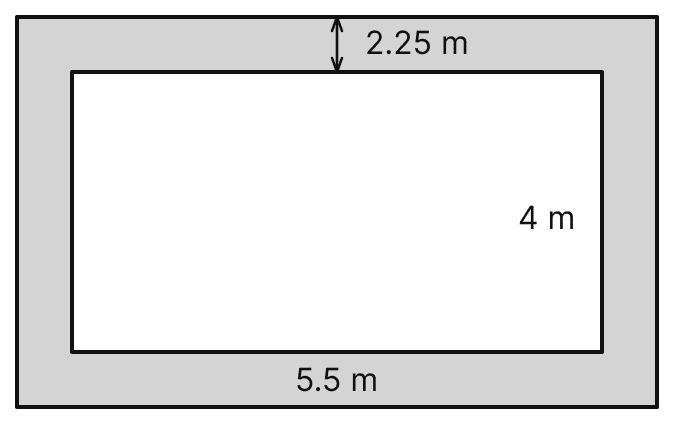
(i) In the adjoining figure, the shaded portion shows the verandah.
Area of the room = length x breadth = 5.5 m x 4 m = 22 m2
Length of the outer rectangle = 5.5 m + 2.25 m + 2.25 m = 10 m
Breadth of the outer rectangle = 4 m + 2.25 m + 2.25 m = 8.5 m
∴ Total area of the room and the verandah = length x breadth of the outer rectangle = 10 m x 8.5 m = 85 m2
∴ Area of the verandah = total area of the room and the verandah - area of the room = 85 m2 - 22 m2 = 63 m2
Hence, the area of the verandah is 63 m2.
(ii) Cost of cementing the floor of the verandah = Area x rate of cementing
= 63 x ₹ 200
= ₹ 12,600
Hence, the cost of cementing the floor of the verandah is ₹ 12,600.
Two cross roads, each of width 5 m, run at right angles through the centre of a rectangular park of length 70 m and breadth 45 m and parallel to its sides. Find the area of the roads. Also find the cost of constructing the roads at the rate of ₹105 per m2.
Answer
Given,
Length of the park = 70 m
Breadth of the park = 45 m
Width of each road = 5 m
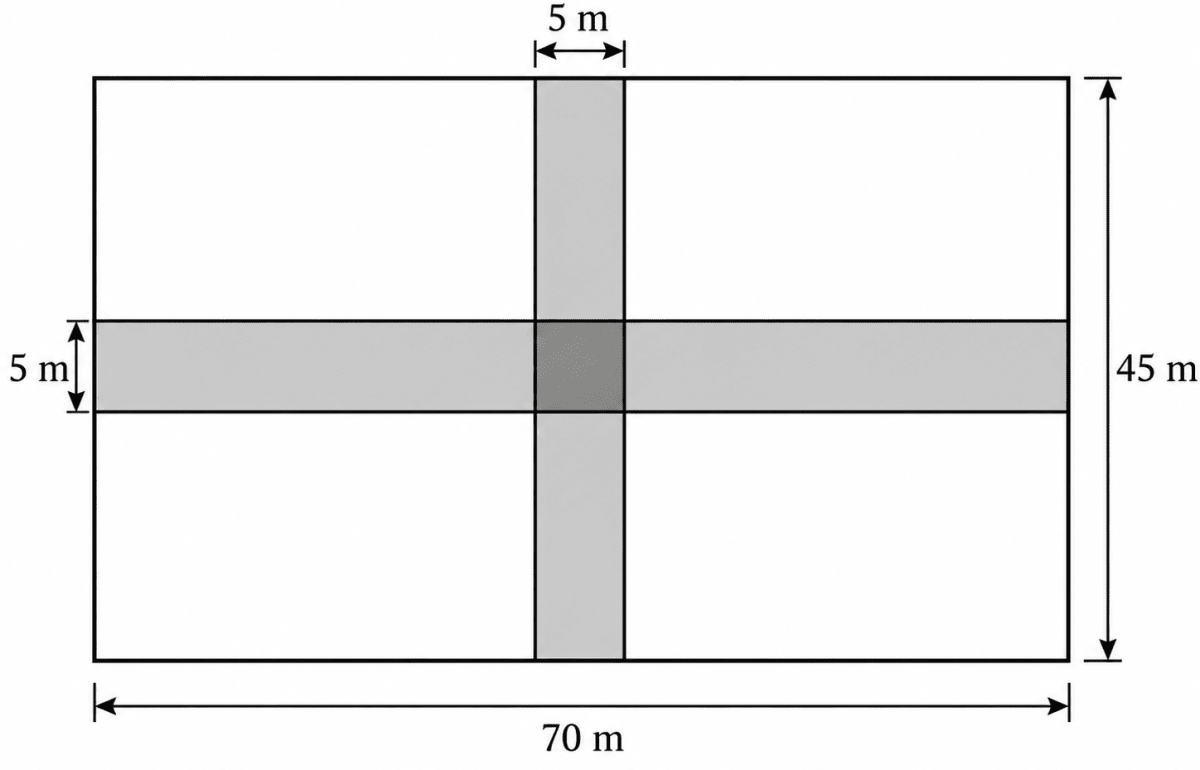
The area covered by the roads is shown shaded in the adjoining diagram.
Area of the shaded portion parallel to the length = length of the park x width of the road = 70 m x 5 m = 350 m2
Area of the shaded portion parallel to the breadth = breadth of the park x width of the road = 45 m x 5 m = 225 m2
Area of the dark shaded portion (common to both roads) = width of one road x width of the other road = 5 m x 5 m = 25 m2
∴ The area covered by the cross roads = area of shaded portion
= 350 m2 + 225 m2 - 25 m2
= 550 m2
Note that we subtract the area of the dark shaded portion because it has occurred twice – firstly when considering area parallel to length and secondly when considering area parallel to breadth.
Cost of constructing the roads = Area x rate of constructing
= 550 x ₹ 105
= ₹ 57,750
Hence, the area of the roads is 550 m2 and the cost of constructing the roads is ₹ 57,750.
A rectangular room is 10 m long and 7.5 m wide. Find the cost of covering the floor with carpet 1.25 m wide at ₹250 per metre.
Answer
Given,
Length of the room = 10 m
Breadth of the room = 7.5 m
Width of the carpet = 1.25 m
Rate of the carpet = ₹ 250 per metre
Area of the floor of the room = length x breadth = 10 m x 7.5 m = 75 m2
Area of the carpet required = area of the floor = 75 m2
∴ Length of the carpet required =
= m
= 60 m
Cost of the carpet = Length of the carpet x rate
= 60 x ₹ 250
= ₹ 15,000
Hence, the cost of covering the floor with carpet is ₹ 15,000.
Find the cost of flooring a room 6.5 m by 5 m with square tiles of side 25 cm at the rate of ₹94 per tile.
Answer
Given,
Length of the room = 6.5 m
Breadth of the room = 5 m
Side of each square tile = 25 cm
Rate = ₹ 94 per tile
Area of the floor of the room = length x breadth = 6.5 m x 5 m = 32.5 m2
= 32.5 x 10000 cm2 = 325000 cm2 [1 m2 = 10000 cm2]
Area of one tile = (side)2 = 25 cm x 25 cm = 625 cm2
∴ Number of tiles required to cover the floor =
=
= 520
Cost of flooring the room = Number of tiles x rate per tile
= 520 x ₹ 94
= ₹ 48,880
Hence, the cost of flooring the room is ₹ 48,880.
The floor of a room is in the shape of a square of side 4.8 m. The floor is to be covered with square tiles of perimeter 1.2 m. Find the cost of covering the floor if each tile costs ₹270.
Answer
Given,
Side of the square floor = 4.8 m = 4.8 x 100 cm = 480 cm
Perimeter of each square tile = 1.2 m = 1.2 x 100 cm = 120 cm
Cost of each tile = ₹ 270
Side of each tile = cm = 30 cm
Area of the floor = (side)2 = 480 cm x 480 cm = 230400 cm2
Area of one tile = (side)2 = 30 cm x 30 cm = 900 cm2
∴ Number of tiles required to cover the floor =
=
= 256
Cost of covering the floor = Number of tiles x cost of each tile
= 256 x ₹ 270
= ₹ 69,120
Hence, the cost of covering the floor is ₹ 69,120.
A rectangular plot of land is 50 m wide. The cost of fencing the plot at the rate of ₹180 per metre is ₹46,800. Find
(i) the length of the plot.
(ii) the cost of leveling the plot at the rate of ₹7.60 per m2.
Answer
Given,
Breadth of the plot () = 50 m
Total cost of fencing = ₹ 46,800
Rate of fencing = ₹ 180 per metre
(i) Length of the fence =
= m
= 260 m
∴ Perimeter of the plot = 260 m
Let the length of the plot be m.
As we know,
= perimeter
Hence, the length of the plot is 80 m.
(ii) Area of the plot = length x breadth
= 80 m x 50 m
= 4000 m2
Cost of leveling the plot = Area x rate of leveling
= 4000 x ₹ 7.60
= ₹ 30,400
Hence, the cost of leveling the plot is ₹ 30,400.
The area of a rectangular plot is 460 m2. If the length is 15% more than its breadth, find the perimeter of the plot.
Answer
Given,
Area of the plot = 460 m2
Let the breadth of the plot be m.
Length of the plot = + 15% of
As we know,
Area of a rectangle = length x breadth
∴ Breadth of the plot = 20 m
And, length of the plot = m = 23 m
Perimeter of the plot = 2 (length + breadth)
= 2 (23 + 20) m
= 2 x 43 m
= 86 m
Hence, the perimeter of the plot is 86 m.
Find the area of the following parallelogram:
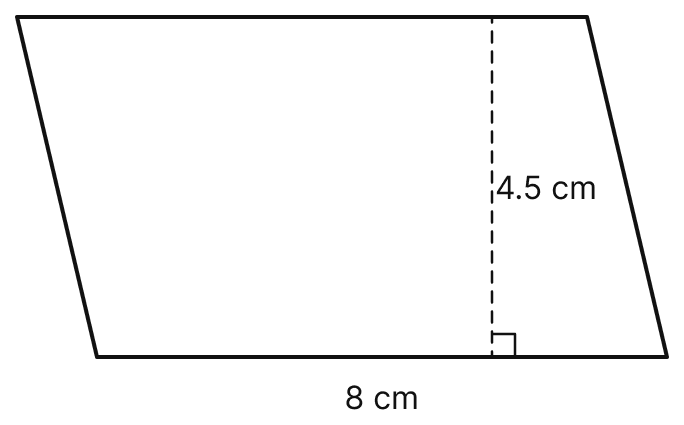
Answer
From the figure,
Base = 8 cm and height = 4.5 cm
Area of the parallelogram = base x height
= 8 cm x 4.5 cm
= 36 cm2
Hence, the area of the parallelogram is 36 cm2.
Find the area of the following parallelogram:
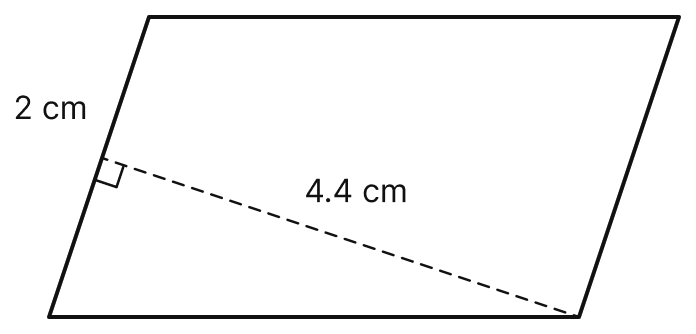
Answer
From the figure,
Base = 2 cm and height = 4.4 cm
Area of the parallelogram = base x height
= 2 cm x 4.4 cm
= 8.8 cm2
Hence, the area of the parallelogram is 8.8 cm2.
Find the area of the following parallelogram:
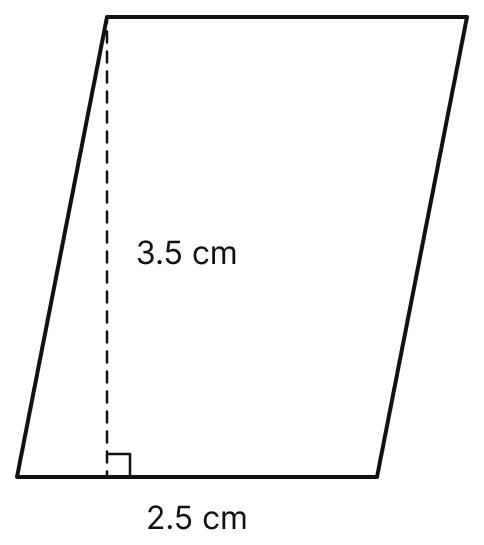
Answer
From the figure,
Base = 2.5 cm and height = 3.5 cm
Area of the parallelogram = base x height
= 2.5 cm x 3.5 cm
= 8.75 cm2
Hence, the area of the parallelogram is 8.75 cm2.
Find the area of the following triangle:
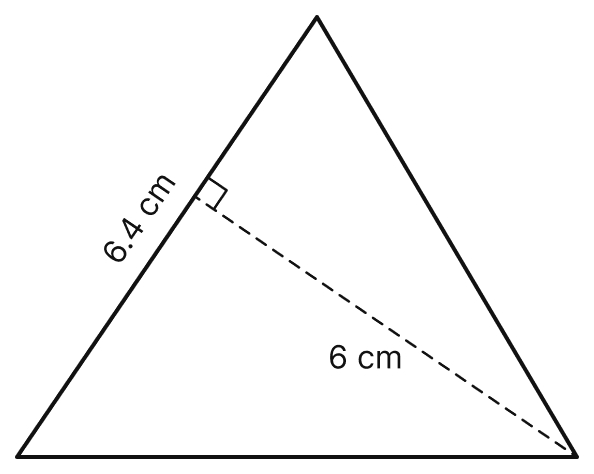
Answer
From the figure,
Base = 6.4 cm and corresponding height = 6 cm
Area of the triangle = x base x height
= x 6.4 cm x 6 cm
= 19.2 cm2
Hence, the area of the triangle is 19.2 cm2.
Find the area of the following triangle:
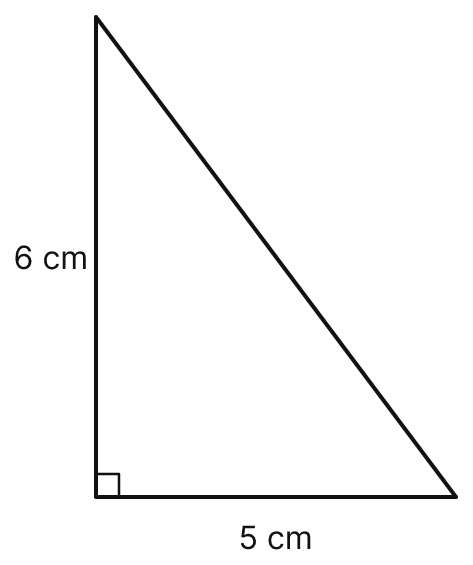
Answer
From the figure,
Base = 5 cm and height = 6 cm
Area of the triangle = x base x height
= x 5 cm x 6 cm
= 15 cm2
Hence, the area of the triangle is 15 cm2.
Find the area of the following triangle:
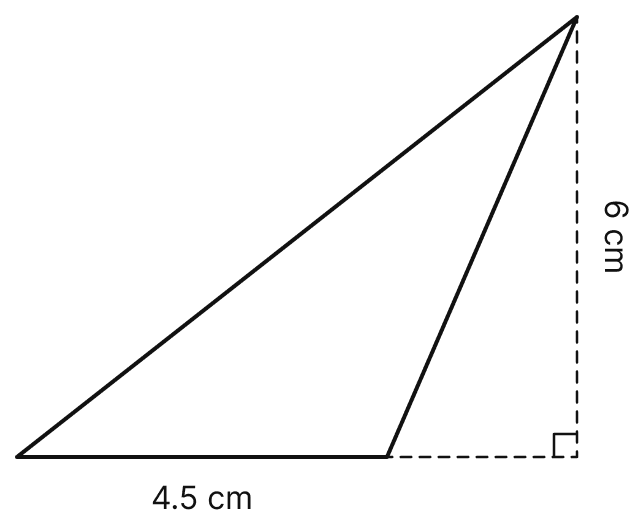
Answer
From the figure,
Base = 4.5 cm and height = 6 cm
Area of the triangle = x base x height
= x 4.5 cm x 6 cm
= 13.5 cm2
Hence, the area of the triangle is 13.5 cm2.
Find the missing values:
| Base | Height | Area of parallelogram | |
|---|---|---|---|
| (i) | 7.5 cm | 5.6 cm | .... |
| (ii) | 20 cm | .... | 246 cm2 |
| (iii) | .... | 15 cm | 154.5 cm2 |
| (iv) | .... | 8.4 cm | 48.72 cm2 |
Answer
As we know,
Area of a parallelogram = base x height
(i) Area of the parallelogram = 7.5 cm x 5.6 cm
= 42 cm2
Hence, the area of the parallelogram is 42 cm2.
(ii) Let the height be cm.
Hence, the height of the parallelogram is 12.3 cm.
(iii) Let the base be cm.
Hence, the base of the parallelogram is 10.3 cm.
(iv) Let the base be cm.
Hence, the base of the parallelogram is 5.8 cm.
Find the missing values:
| Base | Height | Area of triangle | |
|---|---|---|---|
| (i) | 23.2 m | 16.7 m | .... |
| (ii) | 15 cm | .... | 87 cm2 |
| (iii) | 22 mm | .... | 170.5 mm2 |
| (iv) | .... | 31.4 cm | 1256 cm2 |
Answer
As we know,
Area of a triangle = x base x height
(i) Area of the triangle = x 23.2 m x 16.7 m
= 11.6 m x 16.7 m
= 193.72 m2
Hence, the area of the triangle is 193.72 m2.
(ii) Let the height be cm.
Hence, the height of the triangle is 11.6 cm.
(iii) Let the height be mm.
Hence, the height of the triangle is 15.5 mm.
(iv) Let the base be cm.
Hence, the base of the triangle is 80 cm.
In the adjoining figure, ABCD is a parallelogram whose two adjacent sides are 6 cm and 4 cm. If the height corresponding to the base AB is 3 cm, find:
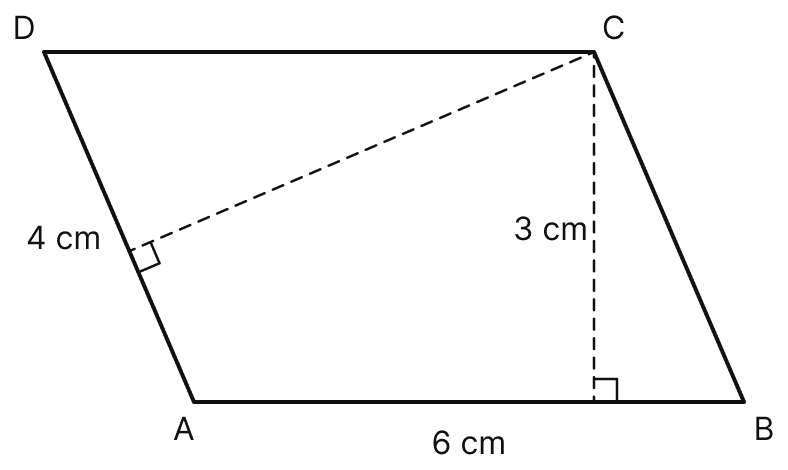
(i) the area of parallelogram ABCD
(ii) the height corresponding to the base AD.
Answer
Given,
AB = 6 cm and AD = 4 cm
Height corresponding to the base AB = 3 cm
(i) Taking AB as the base of the parallelogram, its height is 3 cm.
Area of parallelogram ABCD = base x height
= 6 cm x 3 cm
= 18 cm2
Hence, the area of parallelogram ABCD is 18 cm2.
(ii) Let the height corresponding to the base AD be cm.
Area of parallelogram ABCD = base x height = AD x
Hence, the height corresponding to the base AD is 4.5 cm.
In the adjoining figure, ABC is an isosceles triangle with AB = AC = 7.5 cm and BC = 9 cm. If the height AD from A to BC is 6 cm, find:
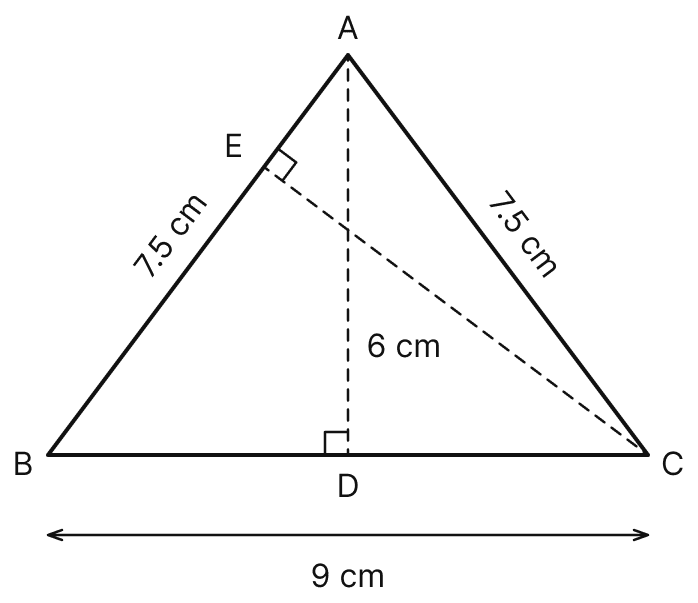
(i) the area of ΔABC
(ii) the height CE from C to AB.
Answer
Given,
AB = AC = 7.5 cm, BC = 9 cm and AD = 6 cm
(i) Area of ΔABC = x base x height
Hence, the area of ΔABC is 27 cm2.
(ii) In ΔABC, AB = base = 7.5 cm and height = CE
Area of ΔABC = x base x height = x AB x CE
Hence, the height CE from C to AB is 7.2 cm.
If the base of a right angled triangle is 8 cm and the hypotenuse is 17 cm, find its area.
Answer
Let ABC be a right-angled triangle at B i.e. ∠B = 90° and its base BC = 8 cm and hypotenuse AC = 17 cm.
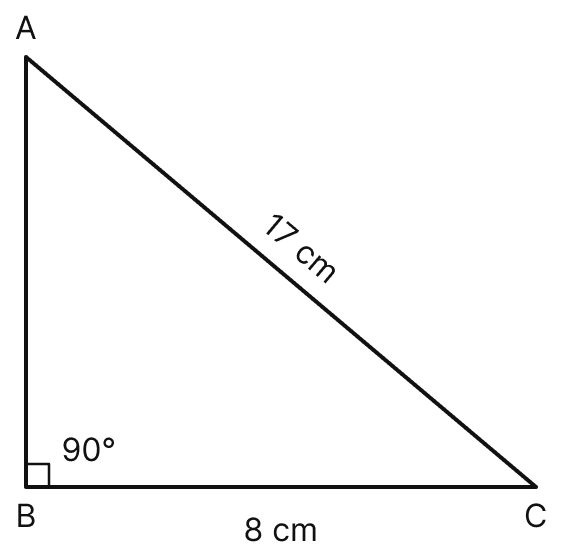
From ΔABC, by Pythagoras theorem, we get
(Hypotenuse)2 = (Base)2 + (Perpendicular)2
Area of ΔABC = x base x height
× 8 cm × 15 cm
= 60 cm2
Hence, the area of the triangle is 60 cm2.
In the adjoining figure, ΔABC is right angled at B. Its legs are 8 cm and 6 cm. Find the length of perpendicular BN on the side AC.
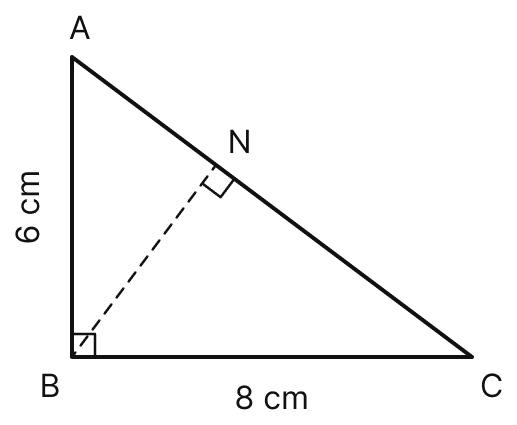
Answer
Given,
AB = 6 cm and BC = 8 cm, ∠B = 90°
As ΔABC is right angled at B, by Pythagoras theorem,
(Hypotenuse)2 = (Base)2 + (Perpendicular)2
Area of ΔABC = x base x height
In ΔABC, AC = base = 10 cm and height = BN
Area of ΔABC = x base x height = x AC x BN
⇒ x 10 x BN = 24
⇒ 5 x BN = 24
⇒ BN = = 4.8
Hence, the length of perpendicular BN on the side AC is 4.8 cm.
In the adjoining figure, area of ΔABE is equal to the area of parallelogram ABCD. If altitude EF is 16 cm long, find the length of the altitude of the parallelogram to the base AB of length 10 cm. What is the area of ΔAMD, where M is mid-point of side DC?
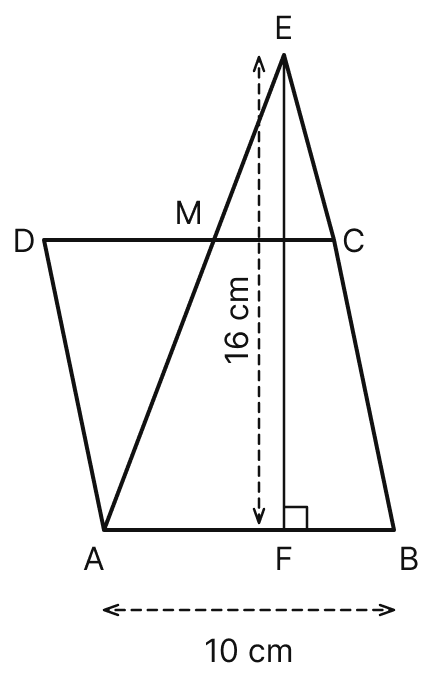
Answer
Given,
AB = 10 cm and EF = 16 cm
Area of ΔABE = x base x height
∴ Area of parallelogram ABCD = area of ΔABE = 80 cm2
Let the altitude of the parallelogram to the base AB be cm.
Area of parallelogram ABCD = base x height
⇒ 10 x = 80
⇒ = 8
∴ Altitude of the parallelogram to the base AB = 8 cm
Since ABCD is a parallelogram, DC = AB = 10 cm
As M is the mid-point of DC,
DM = x DC = x 10 cm = 5 cm
In ΔAMD, taking DM as base, the corresponding height is the distance between AB and DC, i.e., 8 cm.
∴ Area of ΔAMD = x DM x height
= x 5 cm x 8 cm
= 20 cm2
Hence, the length of the altitude of the parallelogram is 8 cm and the area of ΔAMD is 20 cm2.
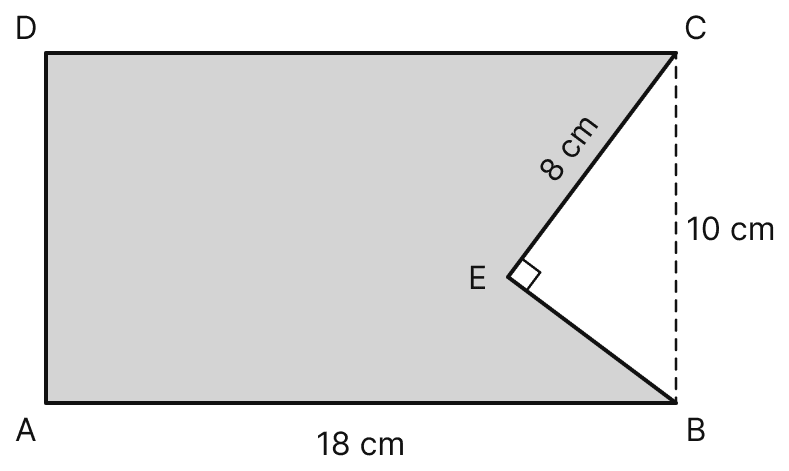
In the adjoining figure, ABCD is a rectangle of size 18 cm by 10 cm. In ΔBEC, ∠E = 90° and EC = 8 cm. Find the area of the shaded region.
Answer
Given,
AB = 18 cm and BC = 10 cm
In ΔBEC, ∠E = 90° and EC = 8 cm
As ΔBEC is right angled at E, by Pythagoras theorem,
(Hypotenuse)2 = (Base)2 + (Perpendicular)2
Area of ΔBEC = x base x height
Area of rectangle ABCD = length x breadth
= 18 cm x 10 cm
= 180 cm2
∴ Area of the shaded region = area of rectangle ABCD - area of ΔBEC
= 180 cm2 - 24 cm2
= 156 cm2
Hence, the area of the shaded region is 156 cm2.
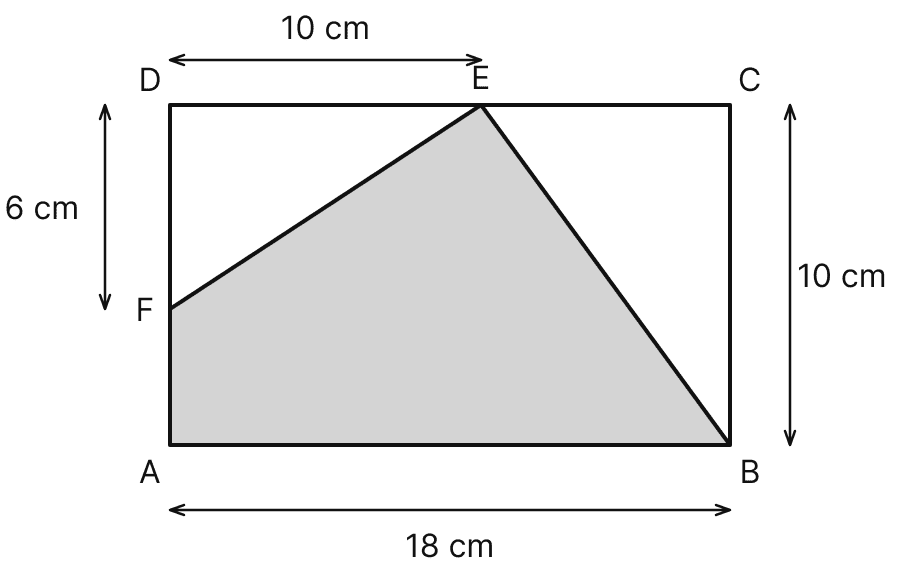
In the following figure, find the area of the shaded regions:
Answer
As ABCD is a rectangle, AB = DC = 18 cm and AD = BC = 10 cm.
From figure,
DE = 10 cm, DF = 6 cm
EC = DC - DE = 18 cm - 10 cm = 8 cm
As we know,
Area of a rectangle = length x breadth
Area of a triangle = x base x height
∴ Area of the shaded region
= area of rect. ABCD - area of ΔFDE - area of ΔECB
= (18 x 10 - x 10 x 6 - x 8 x 10) cm2
= (180 - 30 - 40) cm2
= 110 cm2
Hence, the area of the shaded region is 110 cm2.
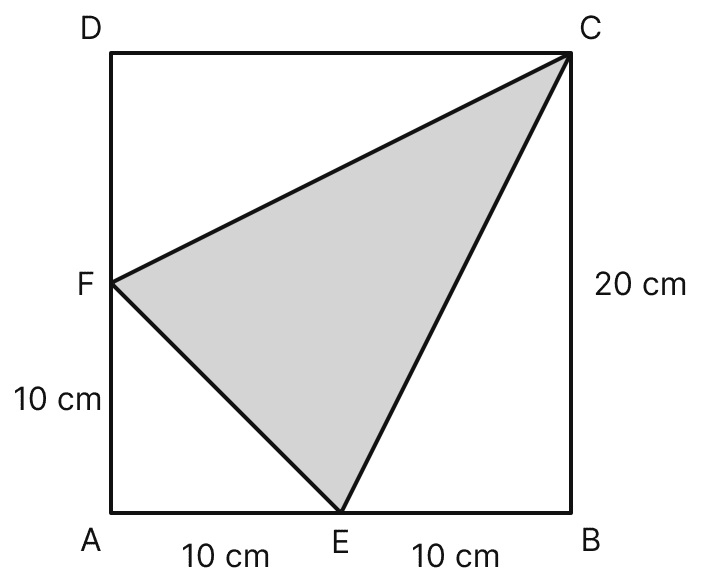
In the following figure, find the area of the shaded regions:
Answer
From figure,
AB = AE + EB = 10 cm + 10 cm = 20 cm
BC = 20 cm, so ABCD is a square of side 20 cm.
AF = 10 cm
FD = AD - AF = 20 cm - 10 cm = 10 cm
As we know,
Area of a square = (side)2
Area of a triangle = x base x height
∴ Area of the shaded region
= area of square ABCD - area of ΔFAE - area of ΔEBC - area of ΔFDC
= (20 x 20 - x 10 x 10 - x 10 x 20 - x 10 x 20) cm2
= (400 - 50 - 100 - 100) cm2
= 150 cm2
Hence, the area of the shaded region is 150 cm2.
Find the circumference of the circle with the following radius 7 cm.
Answer
As we know,
Circumference of a circle =
Given,
Radius () = 7 cm
Circumference of the circle = 2 x x 7 cm
= 2 x 22 cm
= 44 cm
Hence, the circumference of the circle is 44 cm.
Find the circumference of the circle with the following radius 21 cm.
Answer
As we know,
Circumference of a circle =
Given,
Radius () = 21 cm
Circumference of the circle = 2 x x 21 cm
= 2 x 22 x 3 cm
= 132 cm
Hence, the circumference of the circle is 132 cm.
Find the circumference of the circle with the following radius 28 mm.
Answer
As we know,
Circumference of a circle =
Given,
Radius () = 28 mm
Circumference of the circle = 2 x x 28 mm
= 2 x 22 x 4 mm
= 176 mm
Hence, the circumference of the circle is 176 mm.
Find the circumference of the circle with the following radius 3.5 cm.
Answer
As we know,
Circumference of a circle =
Given,
Radius () = 3.5 cm
Circumference of the circle = 2 x x 3.5 cm
= 2 x 22 x 0.5 cm
= 22 cm
Hence, the circumference of the circle is 22 cm.
Find the area of the circle, given that radius = 14 mm.
Answer
As we know,
Area of a circle =
Given,
Radius () = 14 mm
Area of the circle = x 14 x 14 mm2
= 22 x 2 x 14 mm2
= 616 mm2
Hence, the area of the circle is 616 mm2.
Find the area of the circle, given that diameter = 49 m.
Answer
As we know,
Area of a circle =
Given,
Diameter = 49 m
∴ Radius () = m
Hence, the area of the circle is 1886.5 m2.
Find the area of the circle, given that diameter = 9.8 m.
Answer
As we know,
Area of a circle =
Given,
Diameter = 9.8 m
∴ Radius () = m = 4.9 m
Area of the circle = x 4.9 x 4.9 m2
= 22 x 0.7 x 4.9 m2
= 75.46 m2
Hence, the area of the circle is 75.46 m2.
Find the area of the circle, given that radius = 5 cm.
Answer
As we know,
Area of a circle =
Given,
Radius () = 5 cm
Hence, the area of the circle is cm2.
Find the circumference and area of a circle of radius 20 cm. (use π = 3.14)
Answer
Given,
Radius of the circle () = 20 cm and π = 3.14
Circumference of the circle =
= 2 x 3.14 x 20 cm
= 125.6 cm
Area of the circle =
= 3.14 x 20 x 20 cm2
= 1256 cm2
Hence, the circumference and the area of the circle are 125.6 cm and 1256 cm2 respectively.
The minute hand of a tower clock is 1.4 m long. How far does the tip of the hand move in 1 hour?
Answer
Given,
Length of the minute hand = 1.4 m
In 1 hour, the minute hand completes one full round, so its tip moves along a circle of radius equal to the length of the minute hand.
∴ Radius of the circle () = 1.4 m
Distance moved by the tip in 1 hour = circumference of the circle
=
= 2 x x 1.4 m
= 2 x 22 x 0.2 m
= 8.8 m
Hence, the tip of the minute hand moves 8.8 m in 1 hour.
A gardener wants to fence a circular garden of diameter 21 m. Find the length of the rope he needs to purchase, if he makes 2 rounds of fence. Also find the cost of the rope, if it costs ₹40 per metre.
Answer
Given,
Diameter of the garden = 21 m
∴ Radius of the garden () = m
Rate of the rope = ₹ 40 per metre
Circumference of the garden =
= 2 x m
= 22 x 3 m
= 66 m
Length of the rope needed for 2 rounds = 2 x 66 m = 132 m
Cost of the rope = Length of the rope x rate
= 132 x ₹ 40
= ₹ 5,280
Hence, the length of the rope needed is 132 m and its cost is ₹ 5,280.
If the circumference of a circle exceeds its diameter by 30 cm, find the radius of the circle.
Answer
Let the radius of the circle be cm.
∴ Diameter = cm
Given,
Circumference of a circle exceeds its diameter by 30 cm.
As we know,
Circumference of a circle =
Hence, the radius of the circle is 7 cm.
Find the length of the diameter of a circle whose circumference is 44 cm.
Answer
Given,
Circumference of the circle = 44 cm
Let the diameter of the circle be cm.
As we know,
Circumference of a circle =
Hence, the length of the diameter of the circle is 14 cm.
The circumference of a circle is 31.4 cm. Find the radius and the area of the circle. (Take π = 3.14)
Answer
Given,
Circumference of the circle = 31.4 cm and π = 3.14
Let the radius of the circle be cm.
As we know,
Circumference of a circle =
Area of the circle =
= 3.14 x 5 x 5 cm2
= 78.5 cm2
Hence, the radius of the circle is 5 cm and its area is 78.5 cm2.
Find the radius and the circumference of a circle whose area is 144π cm2.
Answer
Given,
Area of the circle = 144π cm2
Let the radius of the circle be cm.
As we know,
Area of a circle =
∴ Radius of the circle = 12 cm
Circumference of the circle =
= 2 x π x 12 cm
= 24π cm
Hence, the radius of the circle is 12 cm and its circumference is 24π cm.
How many times will the wheel of a car rotate in a journey of 88 km, given that the diameter of the wheel is 56 cm?
Answer
Given,
Diameter of the wheel = 56 cm
∴ Radius of the wheel () = cm = 28 cm
Circumference of the wheel =
∴ The distance covered by the wheel in one revolution = 176 cm
Since the distance to be covered by the wheel = 88 km
= 88 x 1000 x 100 cm
= 88,00,000 cm
∴ The number of times the wheel would rotate =
=
= 50000
Hence, the wheel will rotate 50000 times.
From a square cardboard of side 21 cm, a circle of maximum area is cut out. Find the area of the cardboard left.
Answer
Given,
Side of the square cardboard = 21 cm
The diameter of the circle of maximum area that can be cut out of the square cardboard is equal to the side of the square.
∴ Diameter of the circle = 21 cm
⇒ Radius of the circle cm
Area of the square cardboard = (side)2
= 21 cm x 21 cm
= 441 cm2
Area of the circle =
∴ Area of the cardboard left = Area of the square cardboard - area of the circle
= 441 cm2 - 346.5 cm2
= 94.5 cm2
Hence, the area of the cardboard left is 94.5 cm2.
A piece of wire is bent in the shape of an equilateral triangle of side 4.4 cm. If this wire is rebent to form of a circle, find the radius and the area of the circle.
Answer
Given,
Side of the equilateral triangle = 4.4 cm
Length of the wire = perimeter of the equilateral triangle
= 3 x side
= 3 x 4.4 cm
= 13.2 cm
Let the radius of the circle be cm.
As we know,
Circumference of a circle =
As the wire is rebent into the shape of a circle,
circumference of the circle = length of the wire
Area of the circle =
= x 2.1 x 2.1 cm2
= 22 x 0.3 x 2.1 cm2
= 13.86 cm2
Hence, the radius of the circle is 2.1 cm and its area is 13.86 cm2.
A wire is in the form of a square of side 27.5 cm. It is straightened and bent into the shape of a circle. Find the area of the circle.
Answer
Given,
Side of the square = 27.5 cm
Length of the wire = perimeter of the square
= 4 x side
= 4 x 27.5 cm
= 110 cm
Let the radius of the circle be cm.
As we know,
Circumference of a circle =
As the wire is bent into the shape of a circle,
circumference of the circle = length of the wire
Area of the circle =
= x 17.5 x 17.5 cm2
= 22 x 2.5 x 17.5 cm2
= 962.5 cm2
Hence, the area of the circle is 962.5 cm2.
A wire is in the form of a rectangle 18.7 cm long and 14.3 cm wide. If this wire is reshaped and bent in the form of circle, find the radius and the area of the circle so formed.
Answer
Given,
Length of the rectangle = 18.7 cm
Breadth of the rectangle = 14.3 cm
Length of the wire = perimeter of the rectangle
= 2 (length + breadth)
= 2 (18.7 + 14.3) cm
= 2 x 33 cm
= 66 cm
Let the radius of the circle be cm.
As we know,
Circumference of a circle =
As the wire is bent into the shape of a circle,
circumference of the circle = length of the wire
Area of the circle =
= x 10.5 x 10.5 cm2
= 22 x 1.5 x 10.5 cm2
= 346.5 cm2
Hence, the radius of the circle is 10.5 cm and its area is 346.5 cm2.
The diameter of a circular park is 84 m. On its outside, there a 3.5 m wide road. Find the cost of constructing the road at ₹240 per m2.
Answer
Given,
Diameter of the circular park = 84 m
∴ Radius of the park () = m = 42 m
Width of the road = 3.5 m
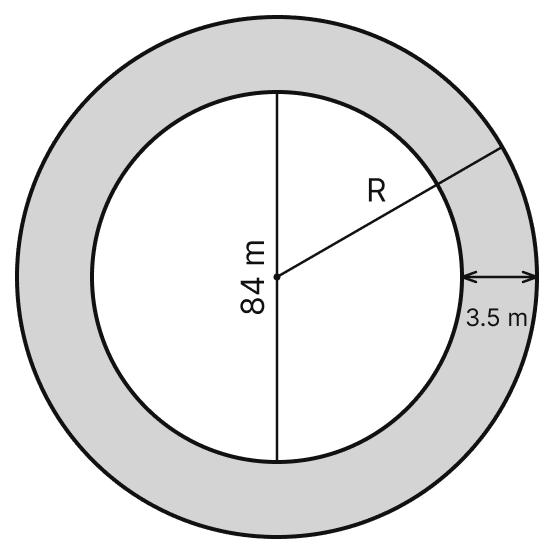
Let be the radius of the outer circle.
Then = 42 m + 3.5 m = 45.5 m = m
Area of the road =
Cost of constructing the road = Area x rate
= 962.5 x ₹ 240
= ₹ 2,31,000
Hence, the cost of constructing the road is ₹ 2,31,000.
A circular pond is surrounded by a 2 m wide circular path. If the outer circumference of the circular path is 44 m, find the inner circumference of the circular path. Also find the area of the path.
Answer
Given,
Width of the circular path = 2 m
Outer circumference of the circular path = 44 m
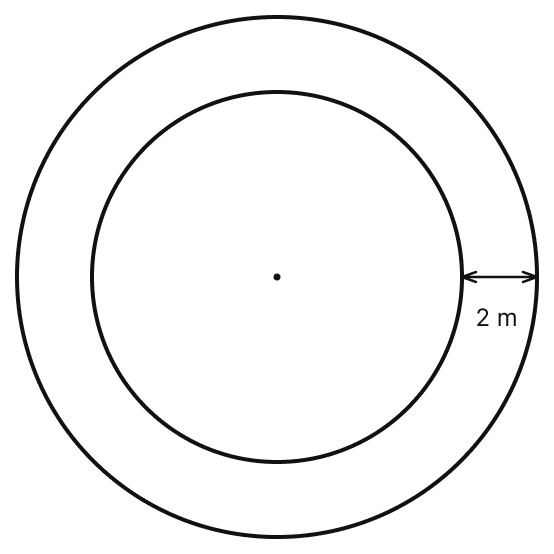
Let the radius of the outer circle be m.
Outer circumference =
∴ Radius of the inner circle () = Radius of the outer circle - width of the path
= 7 m - 2 m
= 5 m
Inner circumference of the circular path =
Area of the path =
Hence, the inner circumference of the circular path is m and the area of the path is m2.
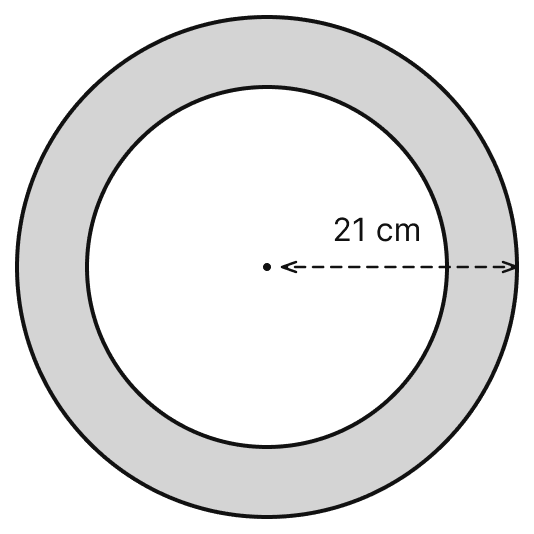
In the adjoining figure, the area enclosed between the concentric circles is 770 cm2. If the radius of the outer circle is 21 cm, calculate the radius of the inner circle.
Answer
Given,
Area enclosed between the concentric circles = 770 cm2
Radius of the outer circle () = 21 cm
Let the radius of the inner circle be cm.
Area enclosed between the circles =
Hence, the radius of the inner circle is 14 cm.
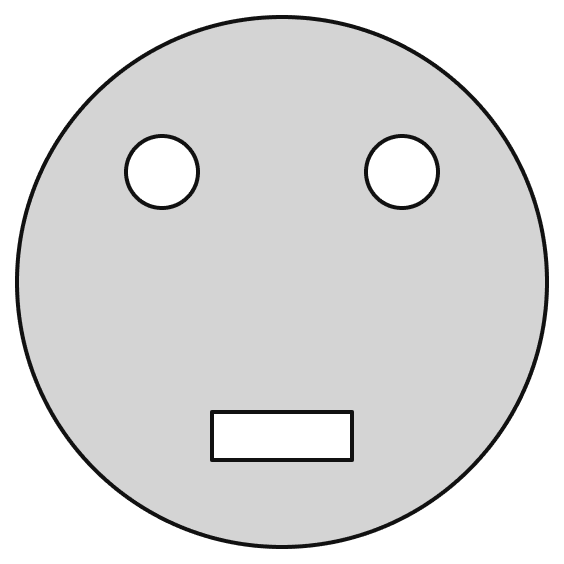
From a circular card sheet of radius 14 cm, two circles of radius 3.5 cm and a rectangle of length 3 cm and breadth 1 cm are removed (as shown in the adjoining figure). Find the area of the remaining sheet.
Answer
Given,
Radius of the circular card sheet () = 14 cm
Radius of each small circle () = 3.5 cm
Length of the rectangle = 3 cm and breadth = 1 cm
Area of the circular card sheet =
= x 14 x 14 cm2
= 616 cm2
Area of two small circles =
= 2 x x 3.5 x 3.5 cm2
= 2 x 38.5 cm2
= 77 cm2
Area of the rectangle = length x breadth = 3 cm x 1 cm = 3 cm2
∴ Area of the remaining sheet = Area of the card sheet - area of two circles - area of the rectangle
= 616 cm2 - 77 cm2 - 3 cm2
= 536 cm2
Hence, the area of the remaining sheet is 536 cm2.
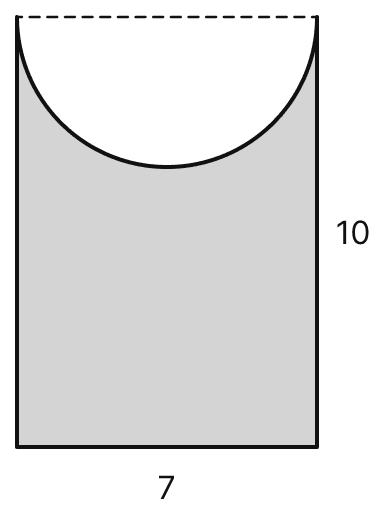
Calculate the length of the boundary and the area of the shaded region in the following diagram. All measurements are in centimetres. Unshaded part is a semicircle.
Answer
From the figure, the rectangle is 7 cm wide and 10 cm long, and the unshaded semicircle is drawn on the top side of 7 cm as diameter.
∴ Radius of the semicircle () = cm = 3.5 cm
Length of the semicircular arc =
× 3.5 cm
= 11 cm
The boundary of the shaded region consists of two sides of 10 cm each, the bottom side of 7 cm and the semicircular arc.
∴ Length of the boundary = (10 + 10 + 7 + 11) cm = 38 cm
Area of the rectangle = length x breadth = 10 cm x 7 cm = 70 cm2
Area of the semicircle =
= x 3.5 x 3.5 cm2
= 19.25 cm2
∴ Area of the shaded region = Area of the rectangle - area of the semicircle
= 70 cm2 - 19.25 cm2
= 50.75 cm2
Hence, the length of the boundary is 38 cm and the area of the shaded region is 50.75 cm2.
Calculate the length of the boundary and the area of the shaded region in the following diagram. All measurements are in centimetres. Four semicircles on a square.
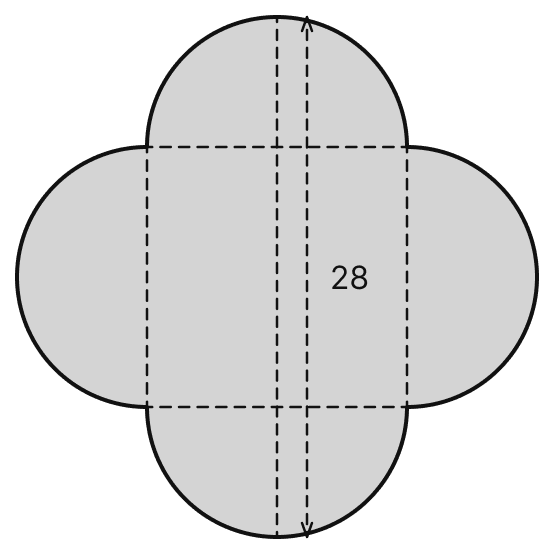
Answer
Let the side of the square be cm.
The diameter of each semicircle = side of the square = cm
∴ Radius of each semicircle = cm
From the figure,
radius of top semicircle + side of the square + radius of bottom semicircle = 28
∴ Side of the square = 14 cm and radius of each semicircle () = 7 cm
The boundary of the figure is made up of 4 semicircles of diameter 14 cm.
Length of each semicircular arc =
= x 14 cm
= 22 cm
∴ Length of the boundary = 4 x 22 cm = 88 cm
Area of the square = (side)2 = 14 cm x 14 cm = 196 cm2
Area of 4 semicircles =
= 2 x x 7 x 7 cm2
= 308 cm2
∴ Area of the shaded region = Area of the square + area of 4 semicircles
= 196 cm2 + 308 cm2
= 504 cm2
Hence, the length of the boundary is 88 cm and the area of the shaded region is 504 cm2.
Find the perimeter and the area of the shaded region in the following figure. All measurements all in centimetres.
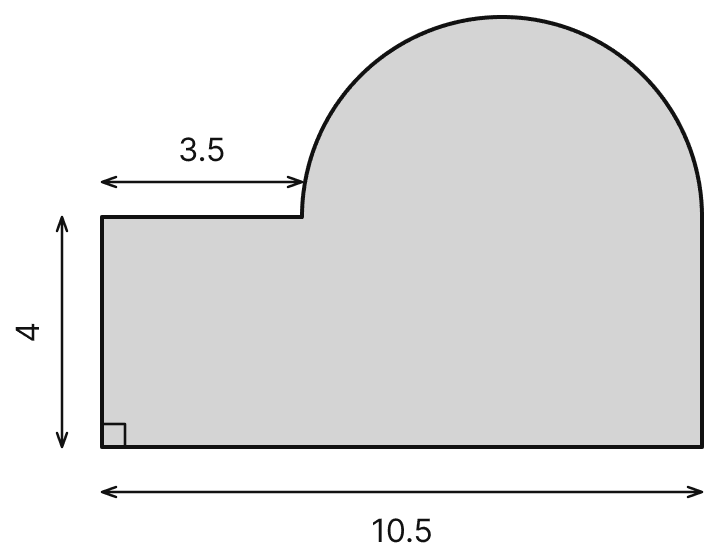
Answer
From the figure, the shaded region consists of a rectangle 10.5 cm long and 4 cm wide and a semicircle drawn on the top side.
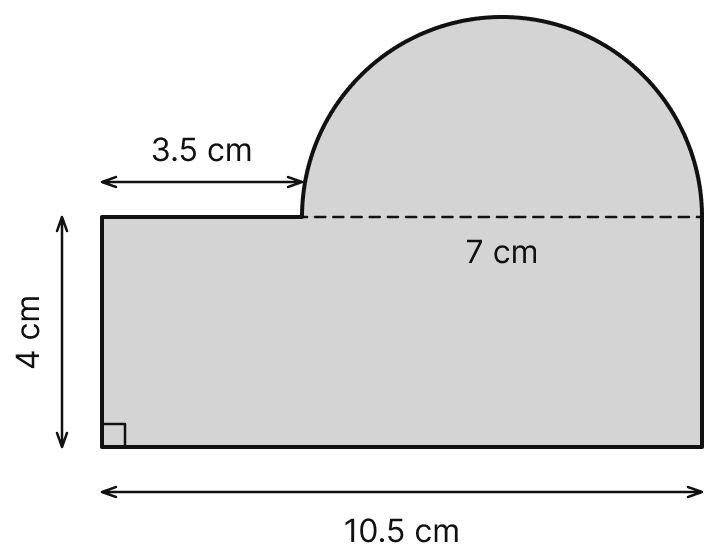
Diameter of the semicircle = 10.5 cm - 3.5 cm = 7 cm
∴ Radius of the semicircle () = cm = 3.5 cm
Length of the semicircular arc =
x 3.5 cm
= 11 cm
∴ Perimeter of the shaded region = (4 + 3.5 + 11 + 4 + 10.5) cm
= 33 cm
Area of the rectangle = length x breadth = 10.5 cm x 4 cm = 42 cm2
Area of the semicircle =
= x 3.5 x 3.5 cm2
= 19.25 cm2
∴ Area of the shaded region = Area of the rectangle + area of the semicircle
= 42 cm2 + 19.25 cm2
= 61.25 cm2
Hence, the perimeter of the shaded region is 33 cm and its area is 61.25 cm2.
Find the perimeter and the area of the shaded region in the following figure. All measurements all in centimetres.
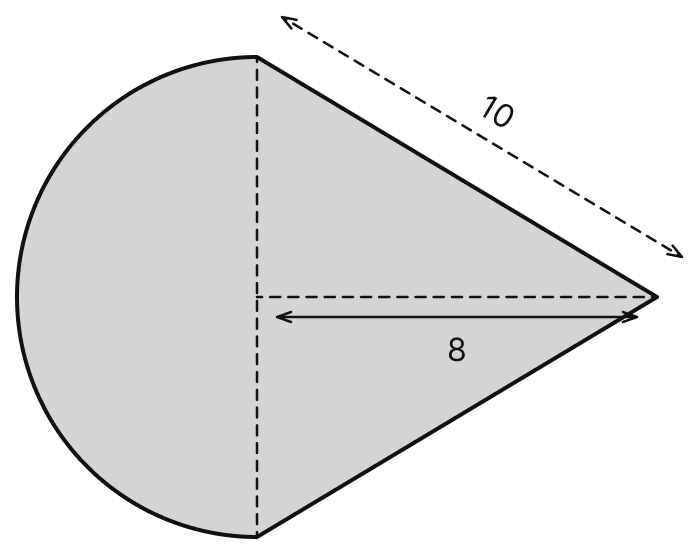
Answer
From the figure, the shaded region consists of a triangle and a semicircle drawn on its base as diameter.
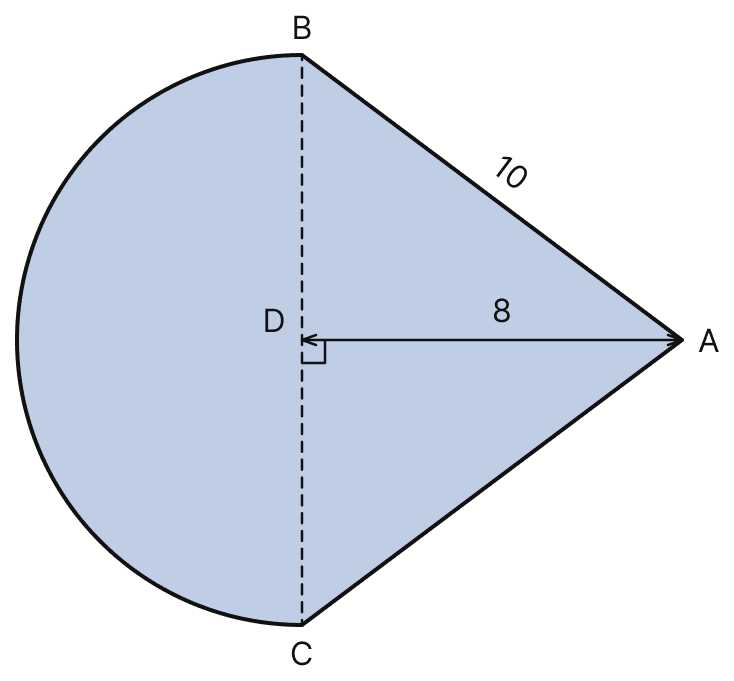
Let ABC be the triangle with AB = 10 cm and AD = 8 cm perpendicular to BC, where D is the centre of the semicircle.
∴ BD = DC (radii of the semicircle)
In right angled triangle ADB, by Pythagoras theorem,
(Hypotenuse)2 = (Base)2 + (Perpendicular)2
⇒ AB2 = AD2 + BD2
⇒ 102 = 82 + BD2
⇒ BD2 = 100 - 64 = 36
⇒ BD = cm = 6 cm
∴ DC = BD = 6 cm
∴ BC = BD + DC = 6 cm + 6 cm = 12 cm
∴ Diameter of the semicircle = 12 cm and its radius () = 6 cm
In right angled triangle ADC, by Pythagoras theorem,
(Hypotenuse)2 = (Base)2 + (Perpendicular)2
⇒ AC2 = AD2 + DC2
⇒ AC2 = 82 + 62 = 64 + 36 = 100
⇒ AC = cm = 10 cm
Length of the semicircular arc =
∴ Perimeter of the shaded region = AB + AC + semicircular arc
Area of ΔABC = x base x height
Area of the semicircle =
∴ Area of the shaded region = Area of ΔABC + area of the semicircle
Hence, the perimeter of the shaded region is cm and its area is cm2.
If a wire is bent in the shape of a square, the area of the square is 81 cm2. When the same wire is bent into the form of a semicircular arc bounded by its diameter, find the area of the shape so formed. (take π = )
Answer
Given,
Area of the square = 81 cm2
As we know,
Area of a square = (side)2
⇒ (side)2 = 81
⇒ side = cm = 9 cm
Length of the wire = perimeter of the square
= 4 x side
= 4 x 9 cm
= 36 cm
Let the radius of the semicircle be cm.
Perimeter of the semicircle (including its diameter) =
As the same wire is bent into the semicircle,
Area of the semicircle =
= x 7 x 7 cm2
= 77 cm2
Hence, the area of the shape so formed is 77 cm2.
Fill in the blanks:
(i) Perimeter of a regular polygon = ..... × length of a side.
(ii) The unit of measurement of area is .....
(iii) The perimeter of a rhombus is = 4 × .....
(iv) An area of 1 km2 = .... hectare
(v) If perimeter of a parallelogram is 40 cm and the length of one side is 12 cm, then the length of the adjacent side is .....
(vi) To find the cost of polishing a table-top, we need to find the ..... of the table-top.
(vii) The ratio of circumference to the diameter of a circle is ....
(viii) If the area of a triangular piece of cardboard is 90 cm2, then the length of the altitude corresponding to 20 cm long base is ... cm.
Answer
(i) All the sides of a regular polygon are equal.
Hence, perimeter of a regular polygon = number of sides × length of a side.
(ii) Area is measured by comparing it with a unit square.
Hence, the unit of measurement of area is square units.
(iii) All the four sides of a rhombus are equal.
Hence, the perimeter of a rhombus is = 4 × length of a side.
(iv) 1 km2 = 1000 m x 1000 m = 1000000 m2 and 1 hectare = 10000 m2
∴ 1 km2 = hectare = 100 hectare
Hence, an area of 1 km2 = 100 hectare.
(v) Let the length of the adjacent side be cm.
Perimeter of the parallelogram = 2 (sum of two adjacent sides) =
Hence, the length of the adjacent side is 8 cm.
(vi) Polishing is done over the whole surface of the table-top.
Hence, to find the cost of polishing a table-top, we need to find the area of the table-top.
(vii) As we know, = π
Hence, the ratio of circumference to the diameter of a circle is π.
(viii) Let the length of the altitude be cm.
Area of the triangle = x base x height
Hence, the length of the altitude corresponding to 20 cm long base is 9 cm.
State whether the following statements are true (T) or false (F):
(i) A diagonal of a rectangle divides it into two right angled triangles of equal areas.
(ii) A diagonal of a parallelogram divides it into two triangles of equal areas.
(iii) If perimeter of two parallelograms are equal, then their areas are also equal.
(iv) All parallelograms having equal areas have same perimeters.
(v) The area of a circle of diameter d is πd2.
(vi) Area of a parallelogram = product of lengths of its two adjacent sides.
Answer
(i) A diagonal of a rectangle divides it into two congruent right angled triangles, so their areas are equal.
Hence, the given statement is true (T).
(ii) A diagonal of a parallelogram divides it into two congruent triangles, so their areas are equal.
Hence, the given statement is true (T).
(iii) Two parallelograms with sides 6 cm, 4 cm and heights (on the 6 cm side) 3 cm and 2 cm have equal perimeters (20 cm each), but their areas are 18 cm2 and 12 cm2 respectively.
Hence, the given statement is false (F).
(iv) A rectangle 6 cm x 4 cm and a rectangle 12 cm x 2 cm both have area 24 cm2, but their perimeters are 20 cm and 28 cm respectively.
Hence, the given statement is false (F).
(v) Radius =
∴ Area of the circle = , not .
Hence, the given statement is false (F).
(vi) Area of a parallelogram = base x height, not the product of its two adjacent sides.
Hence, the given statement is false (F).
If the perimeter of a square is 24 cm, then its area is
16 cm2
24 cm2
36 cm2
36 m2
Answer
Given,
Perimeter of the square = 24 cm
⇒ Side of the square = cm = 6 cm
∴ Area of the square = (side)2
= (6 cm)2
= 36 cm2
Hence, option 3 is the correct option.
If the area of a parallelogram is 54 cm2 and the length of one side is 7.5 cm, then the corresponding height is
7.2 cm
14.4 cm
3.6 cm
13.5 cm
Answer
Given,
Area of the parallelogram = 54 cm2
Base = 7.5 cm
Let the corresponding height be cm.
As we know,
Area of a parallelogram = base x height
⇒ 7.5 x = 54
⇒ = 7.2
Hence, option 1 is the correct option.
If the base of a triangle is doubled and its height is halved, then the area of the resulting triangle
decreases
increases
doubles
remains same
Answer
Let the base of the triangle be and its height be .
As we know,
Area of a triangle = x base x height
∴ Original area of the triangle =
New base = and new height =
∴ New area of the triangle =
=
Since the new area is equal to the original area, the area remains same.
Hence, option 4 is the correct option.
If the height of a parallelogram is doubled and base tripled, then its area becomes
2 times
3 times
6 times
12 times
Answer
Let the base of the parallelogram be and its height be .
As we know,
Area of a parallelogram = base x height
∴ Original area of the parallelogram =
New base = and new height =
∴ New area of the parallelogram =
= 6 x original area
Hence, option 3 is the correct option.
The circumference of the circle with diameter 28 cm is
44 cm
88 cm
176 cm
616 cm
Answer
Given,
Diameter of the circle () = 28 cm
Circumference of the circle =
Hence, option 2 is the correct option.
The ratio of circumference to the area of a circle of radius units is
Answer
Circumference of the circle = and area of the circle =
∴ Ratio of circumference to the area =
Hence, option 1 is the correct option.
If the area of a circle is numerically equal to its circumference, then the radius of the circle is
1 unit
2 units
3 units
4 units
Answer
Let the radius of the circle be units.
Area of the circle = and circumference of the circle =
Given,
Area = circumference (numerically)
Dividing both sides by , we get
⇒ = 2
∴ Radius of the circle = 2 units
Hence, option 2 is the correct option.
The area of a circle of diameter is
Answer
Given,
Diameter of the circle =
∴ Radius of the circle
Area of the circle =
Hence, option 4 is the correct option.
If the ratio of the radii of two circles is 2 : 3, then the ratio of their circumferences is
2 : 3
3 : 2
4 : 9
9 : 4
Answer
Let the radii of the two circles be and .
As we know,
Circumference of a circle =
Circumference of the first circle =
Circumference of the second circle =
∴ Ratio of their circumferences =
= 2 : 3
Hence, option 1 is the correct option.
If the ratio of the radii of two circles is 3 : 5, then the ratio of their areas is
3 : 5
5 : 3
25 : 9
9 : 25
Answer
Let the radii of the two circles be and .
As we know,
Area of a circle =
Area of the first circle =
Area of the second circle =
∴ Ratio of their areas =
= 9 : 25
Hence, option 4 is the correct option.
The perimeter of a semicircle (including its diameter) of radius 7 cm is
22 cm
29 cm
36 cm
44 cm
Answer
Given,
Radius of the semicircle () = 7 cm
Perimeter of the semicircle = Length of semicircular arc + diameter
=
= x 7 cm + 2 x 7 cm
= 22 cm + 14 cm
= 36 cm
Hence, option 3 is the correct option.
Area of a rectangle and the area of a circle are equal. If the dimensions of the rectangle are 14 cm × 11 cm, then the radius of the circle is
21 cm
14 cm
10.5 cm
7 cm
Answer
Area of the rectangle = length x breadth = 14 cm x 11 cm = 154 cm2
Let the radius of the circle be cm.
As we know,
Area of a circle =
Given,
Area of the circle = area of the rectangle
Hence, option 4 is the correct option.
Statement I: Akriti has two wires of length 88 cm each. She bends one of them into a circle and another into a square. The area enclosed by the circular wire is greater than the square.
Statement II: Area of a circle = , where is the diameter of the circle.
Statement I is true but Statement II is false.
Statement I is false but Statement II is true.
Both Statement I and Statement II are true.
Both Statement I and Statement II are false.
Answer
Length of each wire = 88 cm
Let the radius of the circle be cm.
As we know,
Circumference of a circle =
Circumference of the circle = length of the wire
Area enclosed by the circular wire =
= x 14 x 14 cm2
= 616 cm2
Side of the square = cm = 22 cm
Area enclosed by the square = (side)2 = 22 cm x 22 cm = 484 cm2
Since 616 cm2 > 484 cm2, the area enclosed by the circular wire is greater than the square.
So, Statement I is true.
Radius of the circle =
∴ Area of the circle = π x
So, Statement II is true.
∴ Both Statement I and Statement II are true.
Hence, option 3 is the correct option.
Statement I: If the ratio of the length and breadth of a rectangle is 2 : 1, then its perimeter is , where is the breadth.
Statement II: Perimeter of a rectangle is the sum of all its 4 sides.
Statement I is true but Statement II is false.
Statement I is false but Statement II is true.
Both Statement I and Statement II are true.
Both Statement I and Statement II are false.
Answer
Given,
Length : breadth = 2 : 1
∴ Length = , where is the breadth.
Perimeter of the rectangle = 2 (length + breadth)
So, Statement I is true.
The perimeter of a closed plane figure is the length of its boundary. So, the perimeter of a rectangle is the sum of all its 4 sides.
So, Statement II is true.
∴ Both Statement I and Statement II are true.
Hence, option 3 is the correct option.
Statement I: A diagonal of a parallelogram divides it into two triangles of equal area.
Statement II: Area of a parallelogram = product of its diagonals.
Statement I is true but Statement II is false.
Statement I is false but Statement II is true.
Both Statement I and Statement II are true.
Both Statement I and Statement II are false.
Answer
A diagonal of a parallelogram divides it into two congruent triangles, so the two triangles have equal area.
So, Statement I is true.
Area of a parallelogram = base x height, not the product of its diagonals.
So, Statement II is false.
∴ Statement I is true but Statement II is false.
Hence, option 1 is the correct option.
Statement I: The hypotenuse of a right angled triangle is 10 cm. If the other two sides are in the ratio 3 : 4, then the area of the triangle is 12 cm2.
Statement II: Area of a triangle = × base × height.
Statement I is true but Statement II is false.
Statement I is false but Statement II is true.
Both Statement I and Statement II are true.
Both Statement I and Statement II are false.
Answer
Let the other two sides be cm and cm.
By Pythagoras theorem,
(Hypotenuse)2 = (Base)2 + (Perpendicular)2
∴ The other two sides are 3 x 2 cm = 6 cm and 4 x 2 cm = 8 cm.
Area of the triangle = x base x height
= x 6 cm x 8 cm
= 24 cm2
The area of the triangle is 24 cm2 and not 12 cm2.
So, Statement I is false.
Area of a triangle = x base x height.
So, Statement II is true.
∴ Statement I is false but Statement II is true.
Hence, option 2 is the correct option.
A 3 m wide path runs outside and around a rectangular park of length 125 m and breadth 65 m. Find the area of the path.
Answer
Given,
Length of the park = 125 m
Breadth of the park = 65 m
Width of the path = 3 m
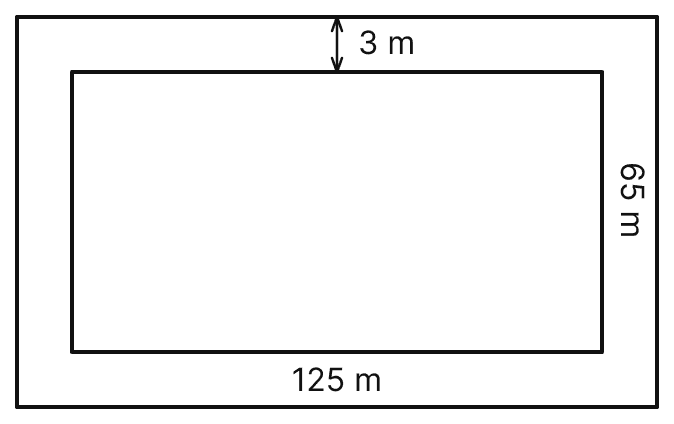
In the adjoining figure, the shaded portion shows the path.
Area of the park = length x breadth = 125 m x 65 m = 8125 m2
Length of the outer rectangle = 125 m + 3 m + 3 m = 131 m
Breadth of the outer rectangle = 65 m + 3 m + 3 m = 71 m
∴ Total area of the park and the path = length x breadth of the outer rectangle = 131 m x 71 m = 9301 m2
∴ Area of the path = total area of the park and the path - area of the park = 9301 m2 - 8125 m2 = 1176 m2
Hence, the area of the path is 1176 m2.
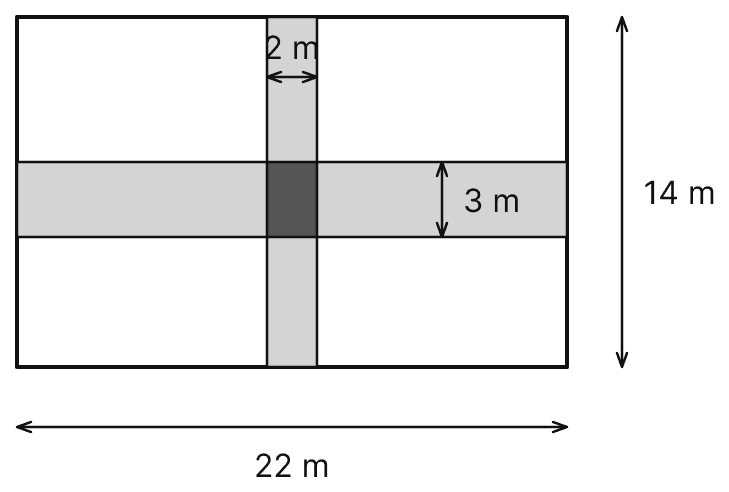
In the adjoining figure, all adjacent line segments are at right angles. Find:
(i) the area of the shaded region
(ii) the area of the unshaded region
Answer
From the figure,
Length of the rectangle = 22 m and breadth = 14 m
Width of the shaded strip parallel to the length = 3 m
Width of the shaded strip parallel to the breadth = 2 m
(i) Area of the shaded portion parallel to the length = length of the rectangle x width of the strip = 22 m x 3 m = 66 m2
Area of the shaded portion parallel to the breadth = breadth of the rectangle x width of the strip = 14 m x 2 m = 28 m2
Area of the dark shaded portion (common to both strips) = width of one strip x width of the other strip = 3 m x 2 m = 6 m2
∴ Area of the shaded region = 66 m2 + 28 m2 - 6 m2
= 88 m2
Note that we subtract the area of the dark shaded portion because it has occurred twice.
Hence, the area of the shaded region is 88 m2.
(ii) Area of the rectangle = length x breadth = 22 m x 14 m = 308 m2
∴ Area of the unshaded region = Area of the rectangle - area of the shaded region
= 308 m2 - 88 m2
= 220 m2
Hence, the area of the unshaded region is 220 m2.
Find the area of a triangle whose:
(i) base = 2 m, height = 1.5 m
(ii) base = 3.4 m and height = 90 cm
Answer
As we know,
Area of a triangle = x base x height
(i) Given,
Base = 2 m and height = 1.5 m
Area of the triangle = x 2 m x 1.5 m
= 1.5 m2
Hence, the area of the triangle is 1.5 m2.
(ii) Given,
Base = 3.4 m and height = 90 cm = m = 0.9 m
Area of the triangle = x 3.4 m x 0.9 m
= 1.7 m x 0.9 m
= 1.53 m2
Hence, the area of the triangle is 1.53 m2.
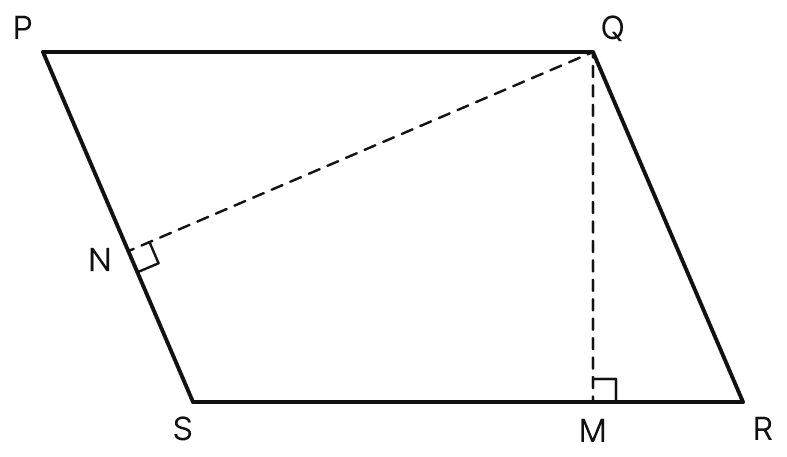
In the adjoining figure, PQRS is a parallelogram. QM is the height from Q to SR and QN is the height from Q to PS. If SR = 12 cm, PS = 8 cm and QM = 7.6 cm, find:
(i) the area of the parallelogram PQRS
(ii) the length of QN
Answer
Given,
SR = 12 cm, PS = 8 cm and QM = 7.6 cm
(i) Taking SR as the base of the parallelogram, its height is QM.
Area of the parallelogram PQRS = base x height
= SR x QM
= 12 cm x 7.6 cm
= 91.2 cm2
Hence, the area of the parallelogram PQRS is 91.2 cm2.
(ii) Taking PS as the base of the parallelogram, its height is QN.
Area of the parallelogram PQRS = base x height = PS x QN
⇒ 8 x QN = 91.2
⇒ QN = = 11.4
Hence, the length of QN is 11.4 cm.
From the adjoining figure, find
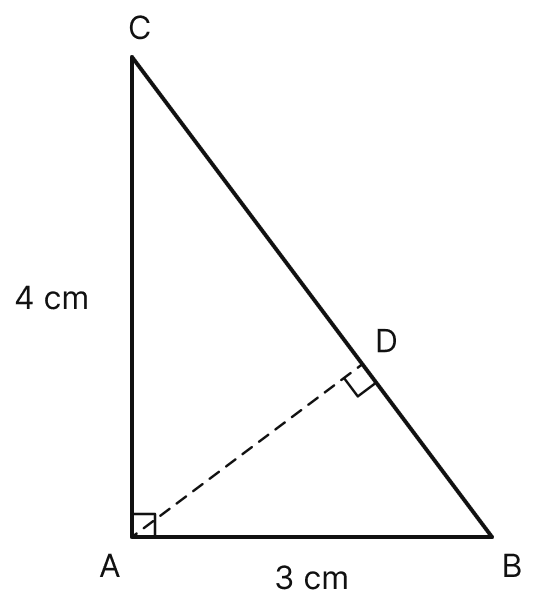
(i) the area of ΔABC
(ii) length of BC
(iii) the length of altitude from A to BC
Answer
From the figure,
ΔABC is right angled at A, AC = 4 cm and AB = 3 cm.
AD is the altitude from A to BC.
(i) Area of ΔABC = x base x height
Hence, the area of ΔABC is 6 cm2.
(ii) As ΔABC is right angled at A, by Pythagoras theorem,
(Hypotenuse)2 = (Base)2 + (Perpendicular)2
BC2 = AB2 + AC2
⇒ BC2 = 32 + 42 = 9 + 16 = 25
⇒ BC = cm = 5 cm
Hence, the length of BC is 5 cm.
(iii) In ΔABC, BC = base = 5 cm and height = AD
Area of ΔABC = x base x height
Hence, the length of altitude from A to BC is 2.4 cm.
In the adjoining figure, the area of the right angled triangle is 54 cm2. If one of its legs is 12 cm long, find its perimeter.
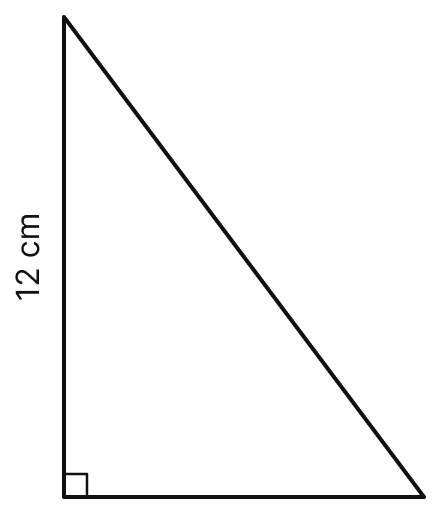
Answer
Given,
Area of the right angled triangle = 54 cm2
One leg = 12 cm
Let the other leg be cm.
Area of a right-angled triangle = x product of legs
∴ Other leg = 9 cm
Let the hypotenuse be cm.
By Pythagoras theorem,
(Hypotenuse)2 = (Base)2 + (Perpendicular)2
∴ Hypotenuse = 15 cm
Perimeter of the triangle = sum of its three sides = (12 + 9 + 15) cm = 36 cm
Hence, the perimeter of the triangle is 36 cm.
If the area of a circle is 78.5 cm2, find its circumference. (Take π = 3.14)
Answer
Given,
Area of the circle = 78.5 cm2 and π = 3.14
Let the radius of the circle be cm.
As we know,
Area of a circle =
Circumference of the circle =
= 2 x 3.14 x 5 cm
= 31.4 cm
Hence, the circumference of the circle is 31.4 cm.
Find the circumference of the circle whose area is 16 times the area of the circle with diameter 7 cm.
Answer
Given,
Diameter of the given circle = 7 cm
∴ Radius of the given circle = cm = 3.5 cm
Area of the given circle =
∴ Area of the required circle = 16 x 38.5 cm2 = 616 cm2
Let the radius of the required circle be cm.
Area of the required circle =
Circumference of the required circle =
= 2 x x 14 cm
= 88 cm
Hence, the circumference of the circle is 88 cm.
From a square cardboard, a circle of biggest area was cut out. If the area of the circle is 154 cm2, calculate the original area of the cardboard.
Answer
Given,
Area of the circle = 154 cm2
Let the radius of the circle be cm.
Area of the circle =
∴ Diameter of the circle = 2 x 7 cm = 14 cm
Since the circle of biggest area is cut out of the square cardboard,
side of the square cardboard = diameter of the circle = 14 cm
∴ Original area of the cardboard = (side)2
= 14 cm x 14 cm
= 196 cm2
Hence, the original area of the cardboard is 196 cm2.
A road 3.5 m wide surrounds a circular park whose circumference is 88 m. Find the cost of paving the road at the rate of ₹60 per square metre.
Answer
Given,
Circumference of the circular park = 88 m
Width of the road = 3.5 m
Rate of paving = ₹ 60 per m2
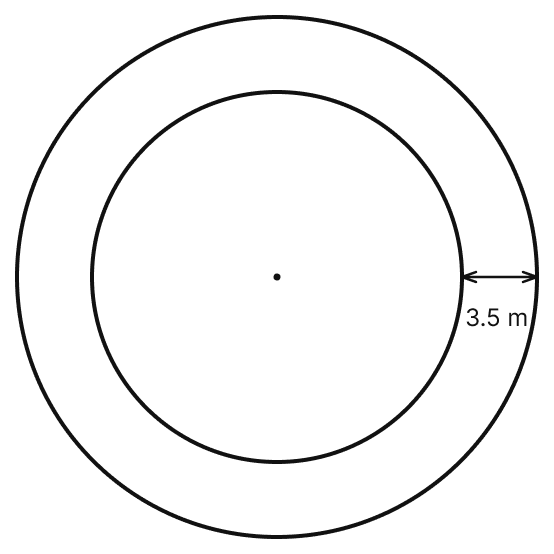
Let the radius of the park be m.
Circumference of the park =
Let be the radius of the outer circle.
Then = 14 m + 3.5 m = 17.5 m
Area of the road =
Cost of paving the road = Area x rate
= 346.5 x ₹ 60
= ₹ 20,790
Hence, the cost of paving the road is ₹ 20,790.
In the adjoining figure, ABCD is a square of side 14 cm. Find the area of the shaded region. Take π = .
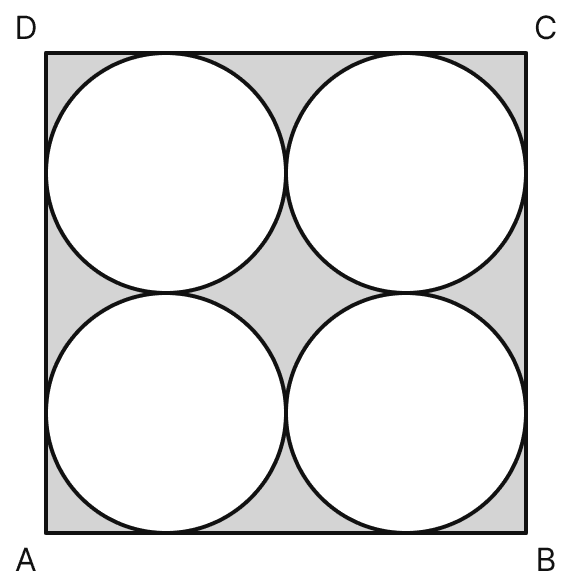
Answer
Given,
Side of the square ABCD = 14 cm
From the figure, four equal circles are placed in the square, two along each side.
∴ Diameter of each circle = cm = 7 cm
⇒ Radius of each circle cm = 3.5 cm
Area of the square ABCD = (side)2 = 14 cm x 14 cm = 196 cm2
Area of 4 circles =
= 4 x x 3.5 x 3.5 cm2
= 4 x 38.5 cm2
= 154 cm2
∴ Area of the shaded region = Area of the square - area of 4 circles
= 196 cm2 - 154 cm2
= 42 cm2
Hence, the area of the shaded region is 42 cm2.
The boundary of the shaded region in the given figure consists of three semicircles, the smaller being equal. If the diameter of the larger is 28 cm, find
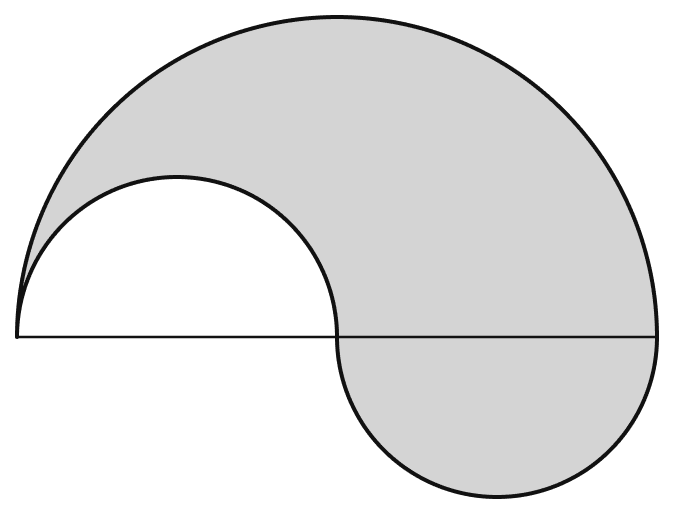
(i) the length of the boundary
(ii) the area of the shaded region
Answer
Given,
Diameter of the larger semicircle = 28 cm
∴ Radius of the larger semicircle () = 14 cm
Since the two smaller semicircles are equal and together make up the diameter of the larger semicircle,
diameter of each smaller semicircle = cm = 14 cm
∴ Radius of each smaller semicircle () = 7 cm
(i) As we know,
Length of a semicircular arc =
Length of the boundary = arc of the larger semicircle + arcs of the two smaller semicircles
=
= x 14 cm + 2 x x 7 cm
= 44 cm + 44 cm
= 88 cm
Hence, the length of the boundary is 88 cm.
(ii) From the figure, one smaller semicircle is cut out from the larger semicircle and the other smaller semicircle is added to it. As the two smaller semicircles are equal, the area removed is equal to the area added.
∴ Area of the shaded region = area of the larger semicircle
=
= x 14 x 14 cm2
= 308 cm2
Hence, the area of the shaded region is 308 cm2.
In the adjoining figure, ABDE is a parallelogram, find the area of the trapezium ACDE.
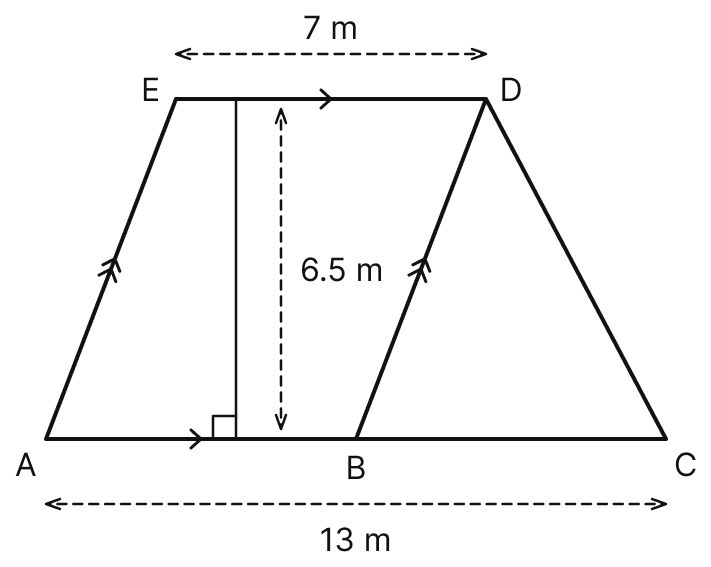
Answer
From the figure,
ED = 7 m, AC = 13 m and height of the trapezium = 6.5 m
Since ABDE is a parallelogram, AB = ED = 7 m
∴ BC = AC - AB = 13 m - 7 m = 6 m
Area of parallelogram ABDE = base x height
= 7 m x 6.5 m
= 45.5 m2
Area of ΔBCD = x base x height
= x 6 m x 6.5 m
= 19.5 m2
∴ Area of the trapezium ACDE = Area of parallelogram ABDE + area of ΔBCD
= 45.5 m2 + 19.5 m2
= 65 m2
Hence, the area of the trapezium ACDE is 65 m2.
A rectangular plot is to be fenced on three sides, leaving a side of 20 m uncovered. If the area of the plot is 320 m2, how many metres of fencing is required?
Answer
Given,
Length of the uncovered side = 20 m
Area of the plot = 320 m2
Let the other side of the plot be m.
Area of the plot = length x breadth
⇒ 20 x = 320
⇒ = 16
∴ Other side of the plot = 16 m
The three sides to be fenced are 20 m, 16 m and 16 m.
∴ Length of fencing required = (20 + 16 + 16) m = 52 m
Hence, 52 m of fencing is required.
In the adjoining figure, the length of the rectangle is 28 cm. Find the area of the shaded region.
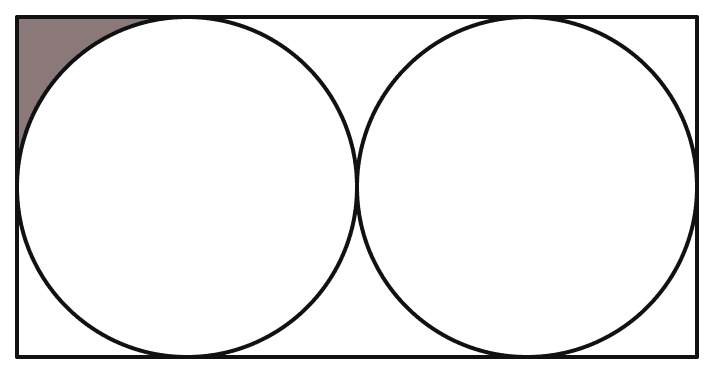
Answer
Given,
Length of the rectangle = 28 cm
From the figure, two equal circles touching each other are drawn in the rectangle, each touching the sides of the rectangle.
∴ Diameter of each circle = cm = 14 cm
⇒ Radius of each circle () = 7 cm
And, breadth of the rectangle = diameter of a circle = 14 cm
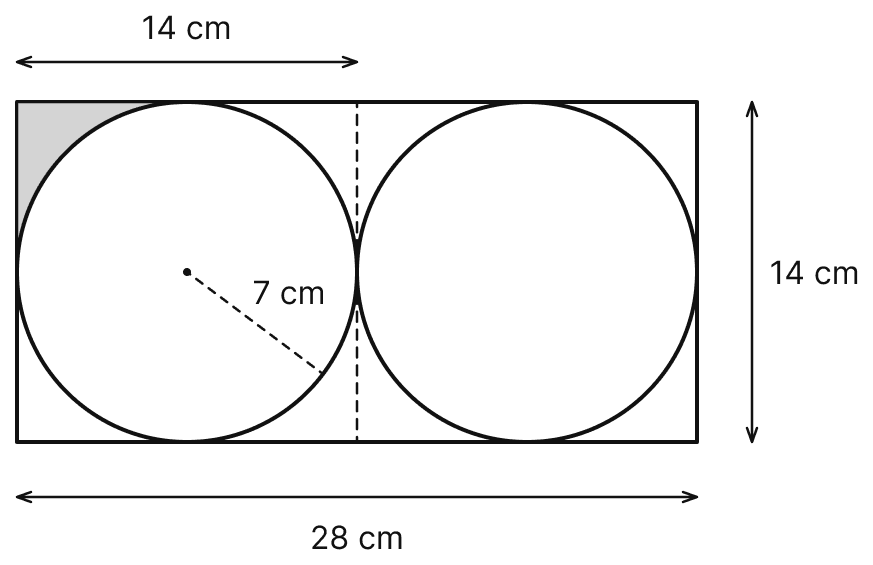
Each circle is inscribed in a square of side 14 cm.
Area of one square = (side)2 = 14 cm x 14 cm = 196 cm2
Area of one circle =
= x 7 x 7 cm2
= 154 cm2
∴ Area of the square not covered by the circle = 196 cm2 - 154 cm2 = 42 cm2
This area is made up of 4 equal corner pieces, and the shaded region is one such corner piece.
∴ Area of the shaded region = cm2 = 10.5 cm2
Hence, the area of the shaded region is 10.5 cm2.
In the adjoining figure, ABCD is a square of side 14 cm. A, B, C and D are centres of circular arcs of equal radius. Find the perimeter and the area of the shaded region.
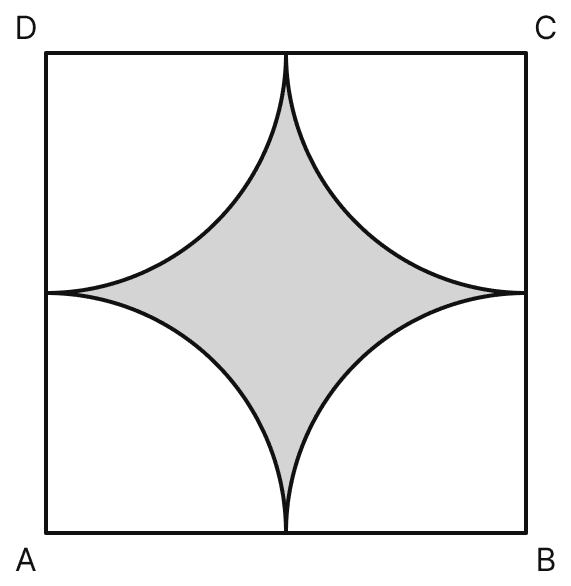
Answer
Given,
Side of the square ABCD = 14 cm
Since the four arcs are of equal radius and adjacent arcs meet on the sides of the square,
radius of each arc () = cm = 7 cm
Each arc is a quadrant (one-fourth of a circle) as the angle at each corner of the square is 90°.
Perimeter of the shaded region = 4 x length of each quadrant arc
= 4 x
= 2 x x 7 cm
= 44 cm
Four quadrants of the same radius together make one complete circle.
∴ Area of 4 quadrants =
= x 7 x 7 cm2
= 154 cm2
Area of the square = (side)2 = 14 cm x 14 cm = 196 cm2
∴ Area of the shaded region = Area of the square - area of 4 quadrants
= 196 cm2 - 154 cm2
= 42 cm2
Hence, the perimeter of the shaded region is 44 cm and its area is 42 cm2.