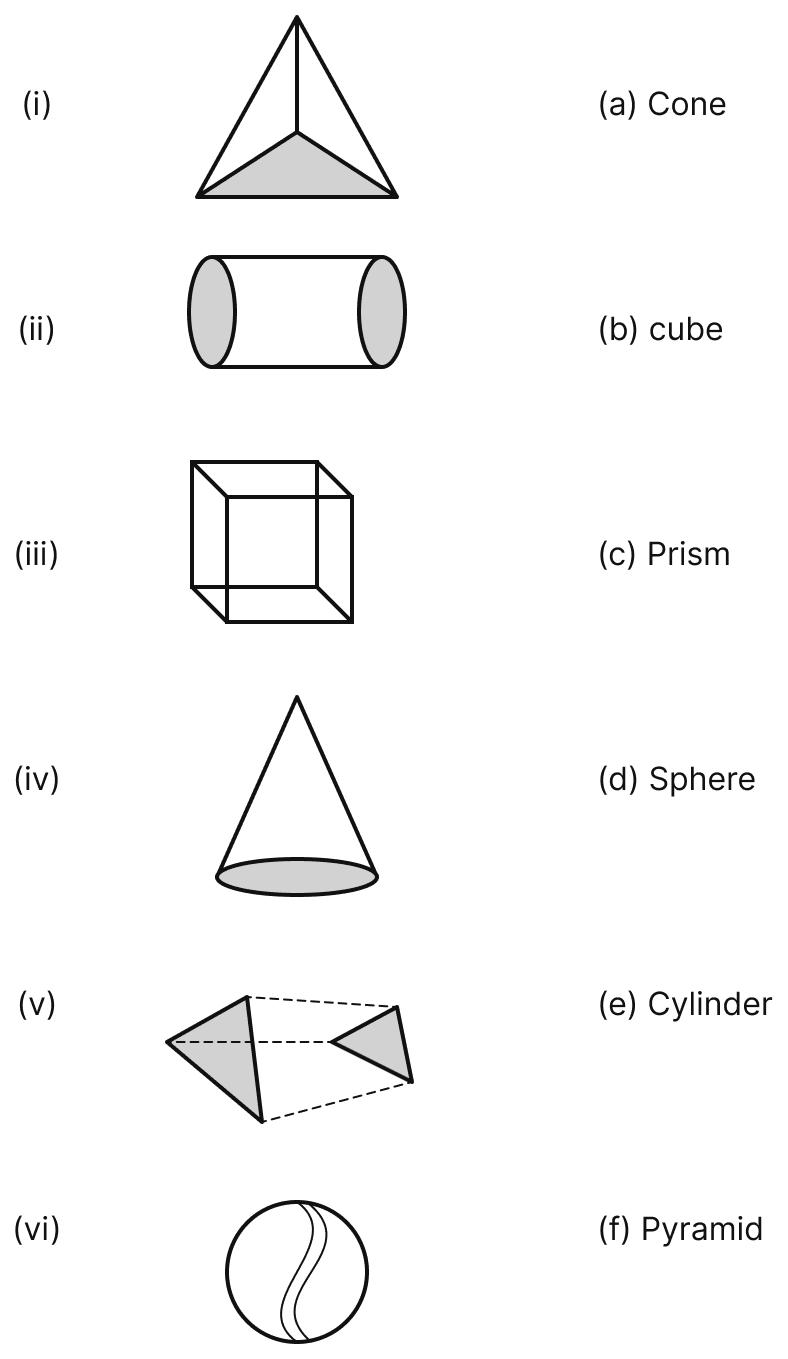
Match the following shapes with their names:
Answer
(i) The vertices of the base of the given solid are joined by edges to one common vertex, and all its other faces are triangular. So, it is a pyramid.
(ii) The given solid has 2 plane (circular) faces, one curved face and two curved edges. So, it is a cylinder.
(iii) The given solid has six equal square faces. So, it is a cube.
(iv) The given solid has one plane (circular) face, one curved face, one vertex and one curved edge. So, it is a cone.
(v) The given solid has two identical triangular faces with their corresponding sides parallel, and its other faces are rectangular. So, it is a prism.
(vi) The given solid has only one face, which is curved. So, it is a sphere.
Hence, (i) ↔ (f), (ii) ↔ (e), (iii) ↔ (b), (iv) ↔ (a), (v) ↔ (c) and (vi) ↔ (d).
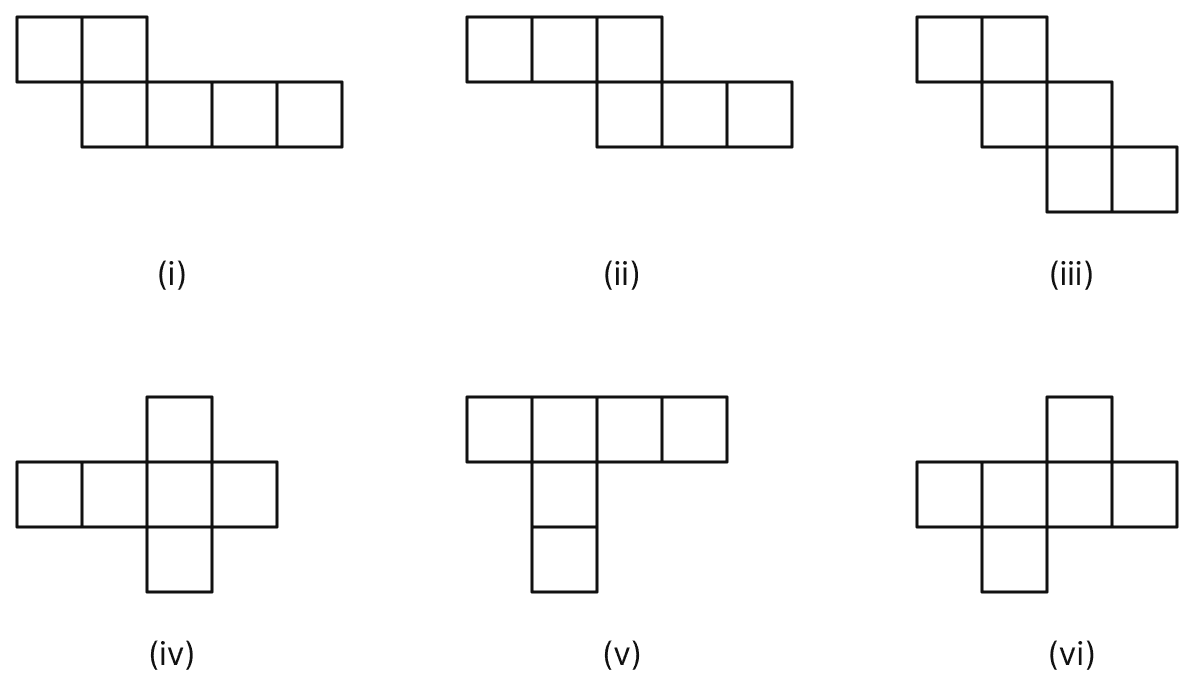
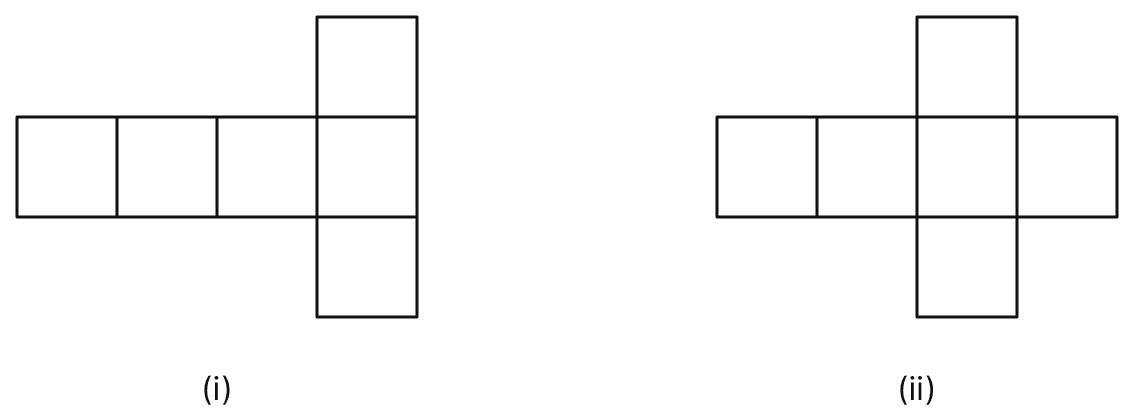
Identify the nets which can be folded to form a cube (cut out copies of the nets and try it):
Answer
A net of a cube is made up of six equal squares, which on folding form the six faces of the cube in such a way that no two squares overlap and no face of the cube is left open.
On folding the nets (ii), (iii), (iv) and (vi), each of the six squares forms a different face of the cube and a cube is obtained.
On folding the nets (i) and (v), two of the squares overlap each other and one face of the cube is left open. So, a cube cannot be formed from them.
Hence, the nets (ii), (iii), (iv) and (vi) can be folded to form a cube.
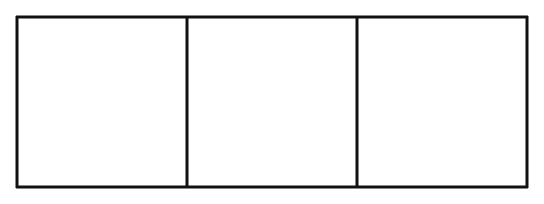
Here is an incomplete net for making a cube. Complete it in atleast two different ways. Remember that a cube has six faces. How many are there in the net here?
Answer
The given incomplete net has 3 squares.
A cube has six faces, so its net must have 6 squares.
Number of squares to be added = 6 - 3 = 3
These 3 squares must be attached to the given squares in such a way that, on folding, each square forms a different face of the cube, no two squares overlap and no face of the cube is left open.
Two different ways of completing the net are shown below:
Hence, there are three faces in the given net.
The dimensions of a cuboid are 5 cm, 3 cm and 2 cm. Draw three different isometric sketches of this cuboid with height
(i) 2 cm
(ii) 3 cm
(iii) 5 cm
Answer
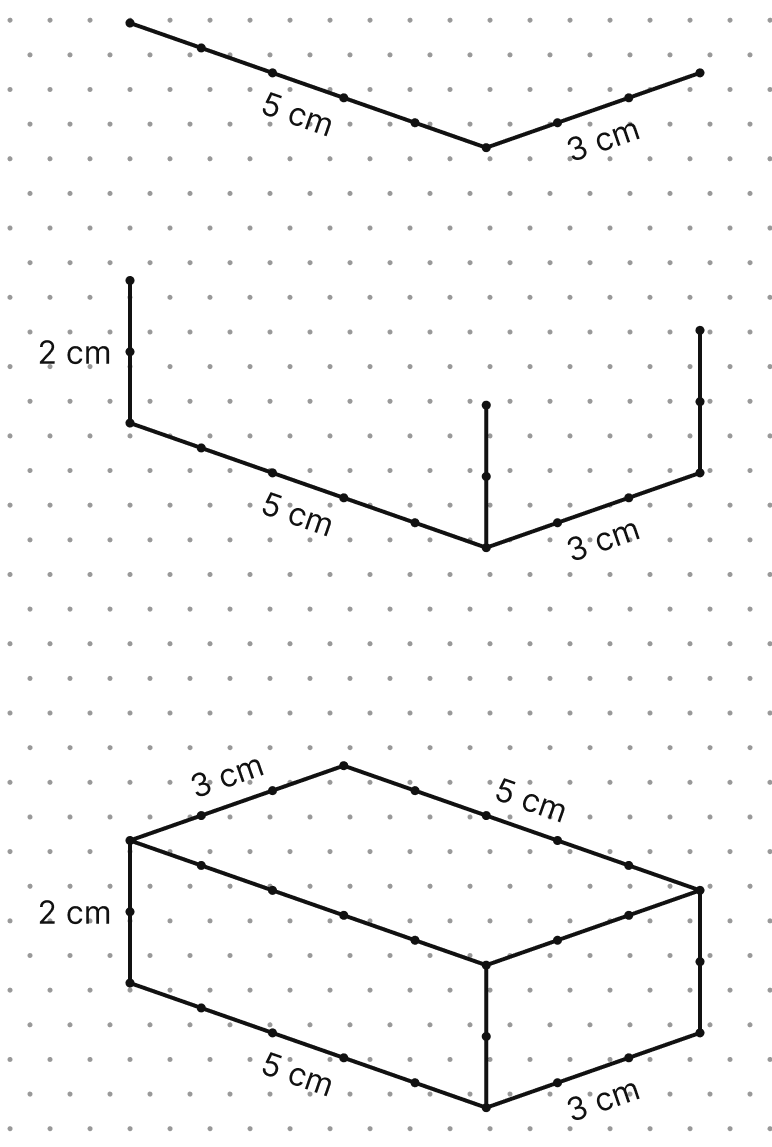
(i) When the height is 2 cm, the length = 5 cm and the breadth = 3 cm.
Steps of construction :
Take an isometric dot paper of side 1 cm.
Draw the base lines of the two front faces of length 5 cm and breadth 3 cm.
Draw three vertical lines each of height 2 cm, one on the middle vertex and the other two on the end points of these line segments.
For the top face, draw a parallelogram of length 5 cm and breadth 3 cm whose adjacent sides are formed by joining the top free ends of the three vertical line segments to get the required cuboid.
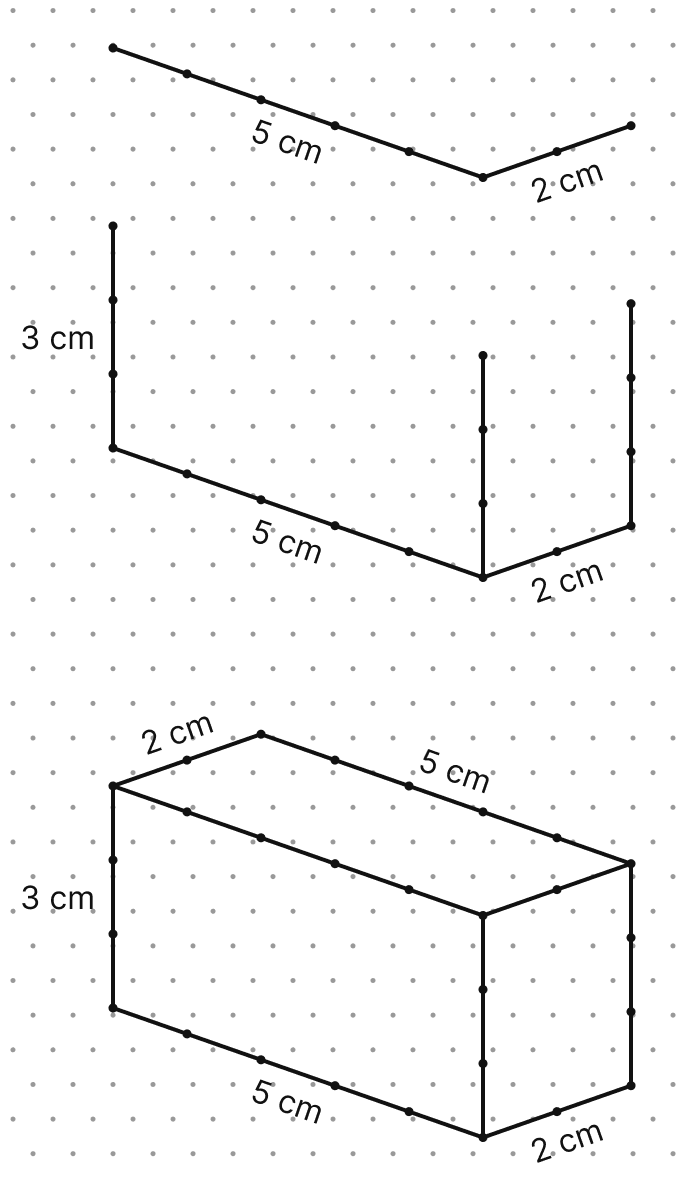
(ii) When the height is 3 cm, the length = 5 cm and the breadth = 2 cm.
Steps of construction :
Take an isometric dot paper of side 1 cm.
Draw the base lines of the two front faces of length 5 cm and breadth 2 cm.
Draw three vertical lines each of height 3 cm, one on the middle vertex and the other two on the end points of these line segments.
For the top face, draw a parallelogram of length 5 cm and breadth 2 cm whose adjacent sides are formed by joining the top free ends of the three vertical line segments to get the required cuboid.
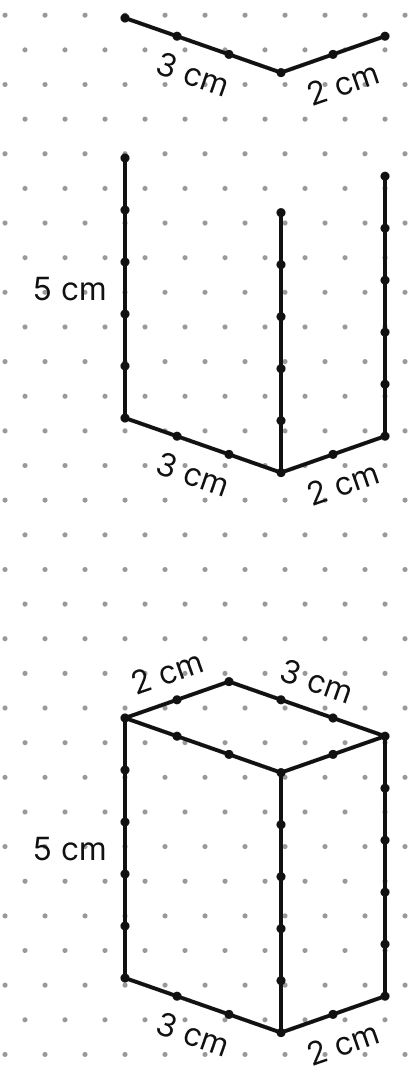
(iii) When the height is 5 cm, the length = 3 cm and the breadth = 2 cm.
Steps of construction :
Take an isometric dot paper of side 1 cm.
Draw the base lines of the two front faces of length 3 cm and breadth 2 cm.
Draw three vertical lines each of height 5 cm, one on the middle vertex and the other two on the end points of these line segments.
For the top face, draw a parallelogram of length 3 cm and breadth 2 cm whose adjacent sides are formed by joining the top free ends of the three vertical line segments to get the required cuboid.
Give (i) an oblique sketch (ii) an isometric sketch for the following:
A cube with an edge 4 cm long.
Answer
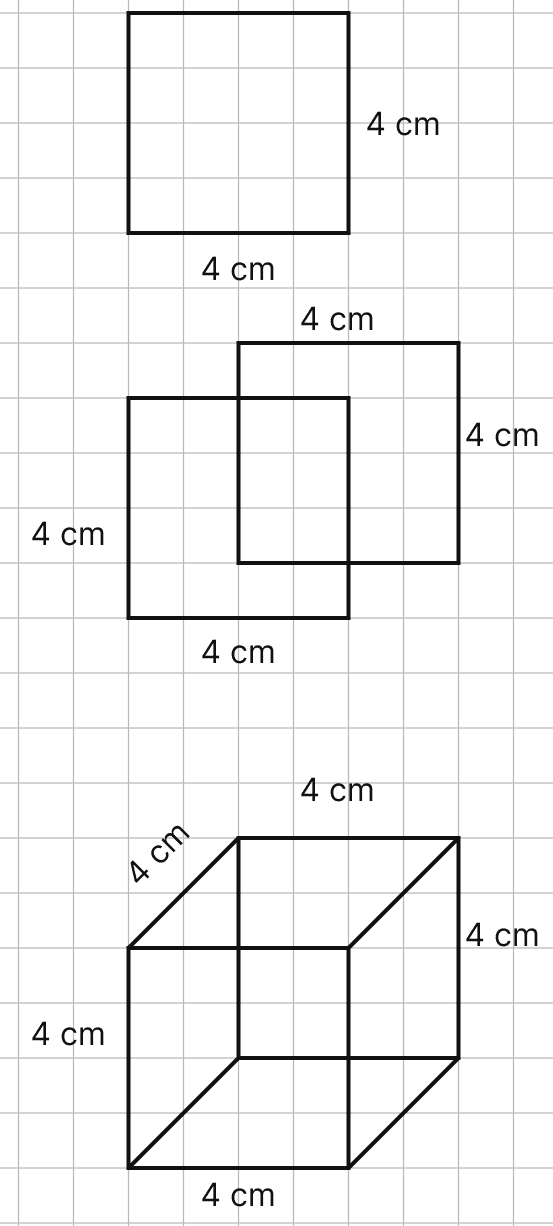
(i) Steps of construction :
Take a squared paper of side 1 cm.
Draw a square of side 4 cm to get the front face of the cube.
Draw the opposite face of the same size overlapping the first square, such that it is shifted equally to the right and upwards.
Join the corresponding corners of the two squares by oblique lines to get the required cube.
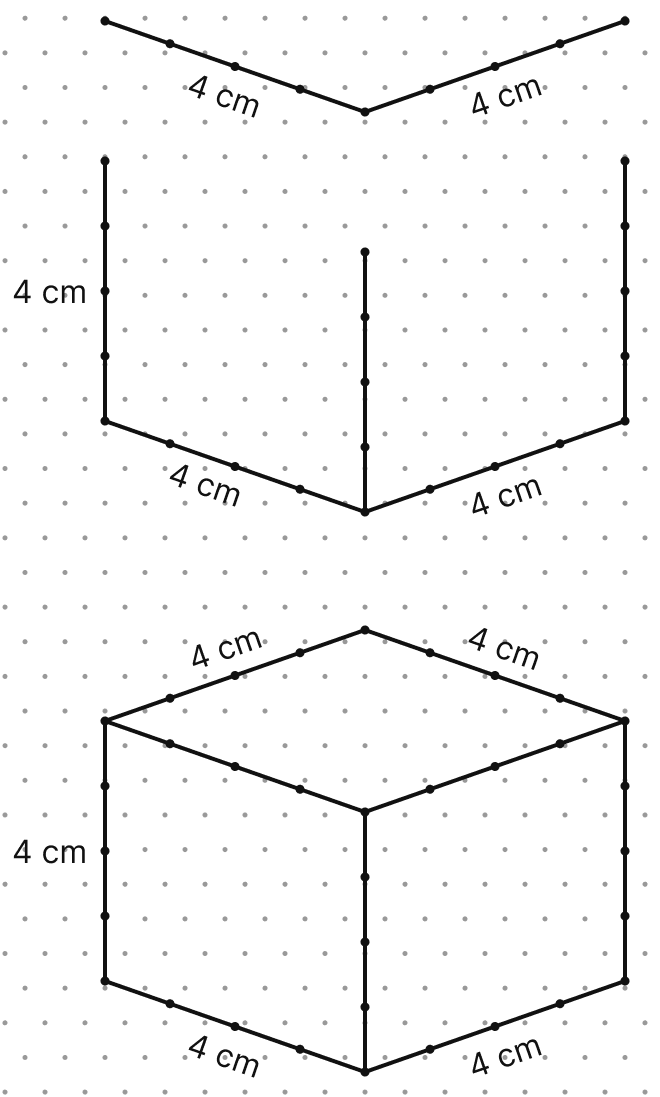
(ii) Steps of construction :
Take an isometric dot paper of side 1 cm.
Draw the base lines of the two front faces, each of length 4 cm.
Draw three vertical lines each of height 4 cm, one on the middle vertex and the other two on the end points of these line segments.
For the top face, draw a rhombus of side 4 cm whose adjacent sides are formed by joining the top free ends of the three vertical line segments to get the required cube.
Give (i) an oblique sketch (ii) an isometric sketch for the following:
A cuboid of length 6 cm, breadth 4 cm and height 3 cm.
Answer
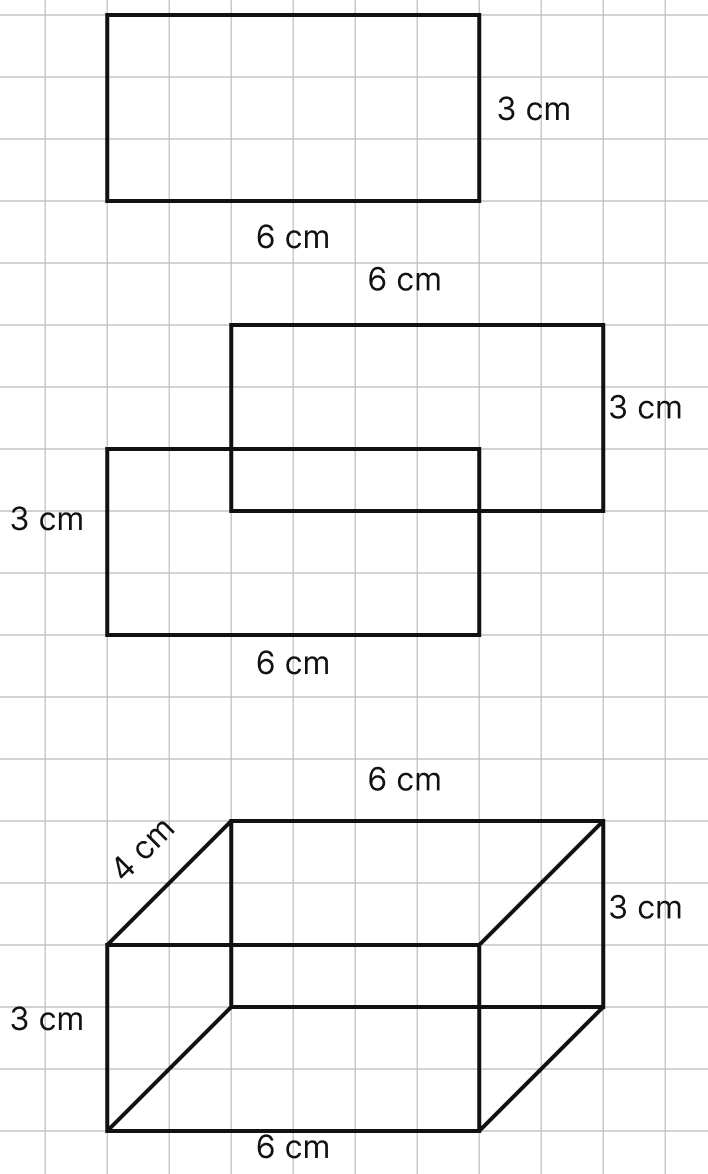
(i) Steps of construction :
Take a squared paper of side 1 cm.
Draw a rectangle of dimensions 6 cm × 3 cm to get the front face of the cuboid.
Draw the opposite face of the same size overlapping the first rectangle, such that it is shifted equally to the right and upwards.
Join the corresponding corners of the two rectangles by oblique lines to get the required cuboid.
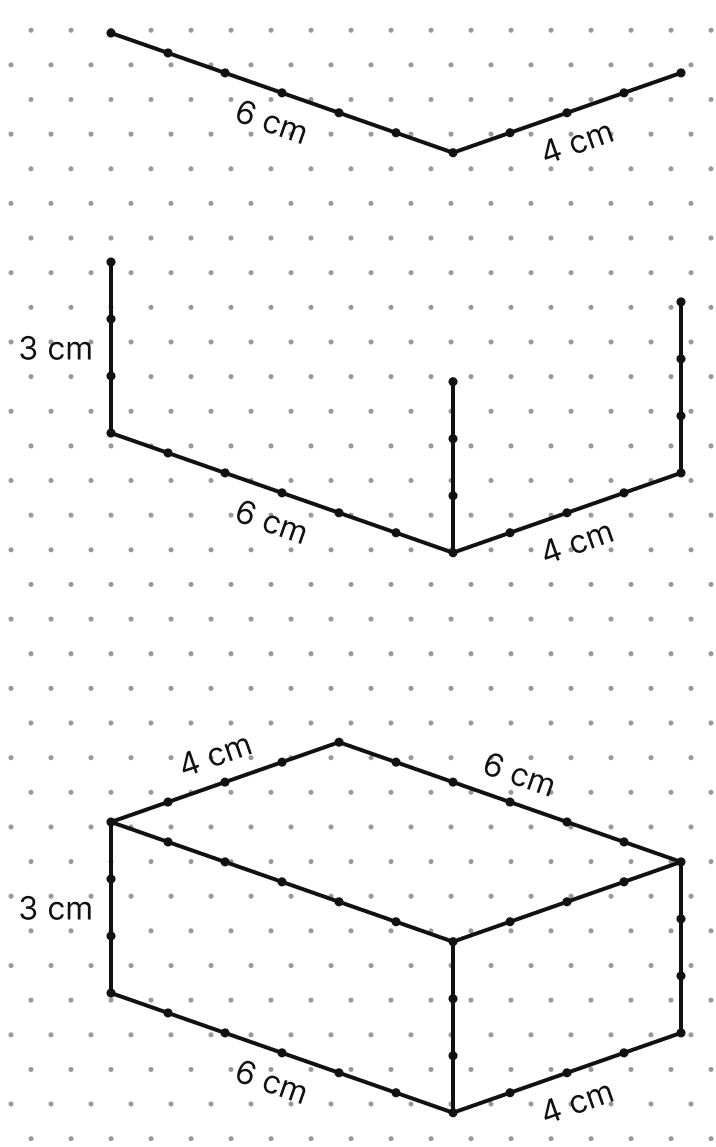
(ii) Steps of construction :
Take an isometric dot paper of side 1 cm.
Draw the base lines of the two front faces of length 6 cm and breadth 4 cm.
Draw three vertical lines each of height 3 cm, one on the middle vertex and the other two on the end points of these line segments.
For the top face, draw a parallelogram of length 6 cm and breadth 4 cm whose adjacent sides are formed by joining the top free ends of the three vertical line segments to get the required cuboid.
Count the number of cubes in the following structure:
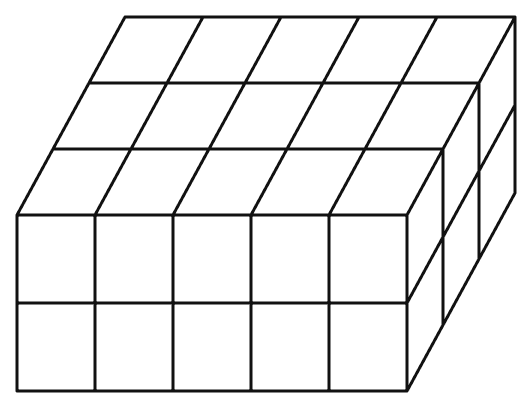
Answer
The structure has 5 cubes along the length, 3 cubes along the breadth and 2 cubes along the height.
∴ Number of cubes = 5 × 3 × 2 = 30
Hence, the number of cubes in the structure = 30.
Count the number of cubes in the following structure:
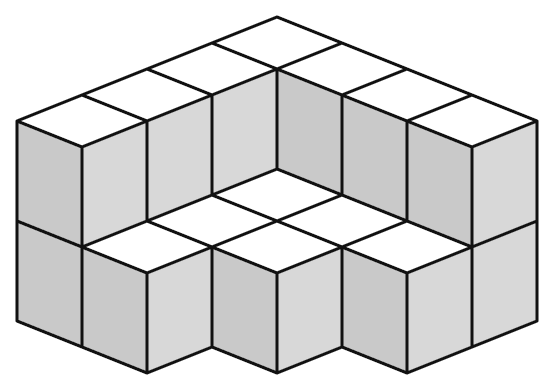
Answer
The structure has two layers.
The bottom layer would have 4 × 4 = 16 cubes, but 3 cubes are missing at the front corner.
∴ Number of cubes in the bottom layer = 16 - 3 = 13
The top layer has 4 cubes along the left wall and 3 more cubes along the right wall.
∴ Number of cubes in the top layer = 4 + 3 = 7
∴ Number of cubes in the structure = 13 + 7 = 20
Hence, the number of cubes in the structure = 20.
Count the number of cubes in the following structure:
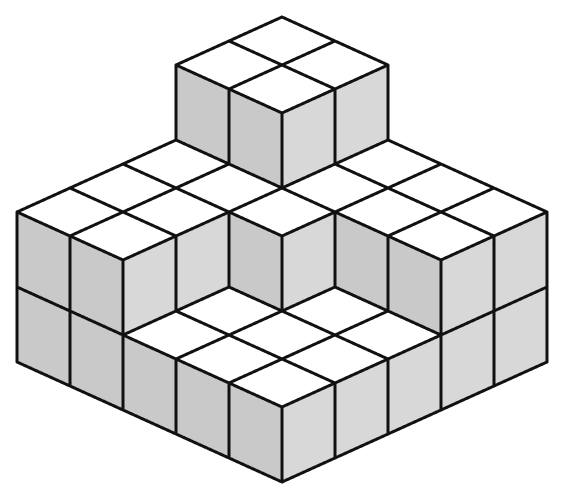
Answer
The structure has three layers.
The bottom layer has 5 cubes along the length and 5 cubes along the breadth.
∴ Number of cubes in the bottom layer = 5 × 5 = 25
The middle layer would have 5 × 5 = 25 cubes, but 8 cubes (3 + 3 + 2) are missing at the front corner.
∴ Number of cubes in the middle layer = 25 - 8 = 17
The top layer has 2 cubes along the length and 2 cubes along the breadth.
∴ Number of cubes in the top layer = 2 × 2 = 4
∴ Number of cubes in the structure = 25 + 17 + 4 = 46
Hence, the number of cubes in the structure = 46.
For the solid given below, the three views (1), (2) and (3) are given. Identify for the solid the corresponding top, front and side views:
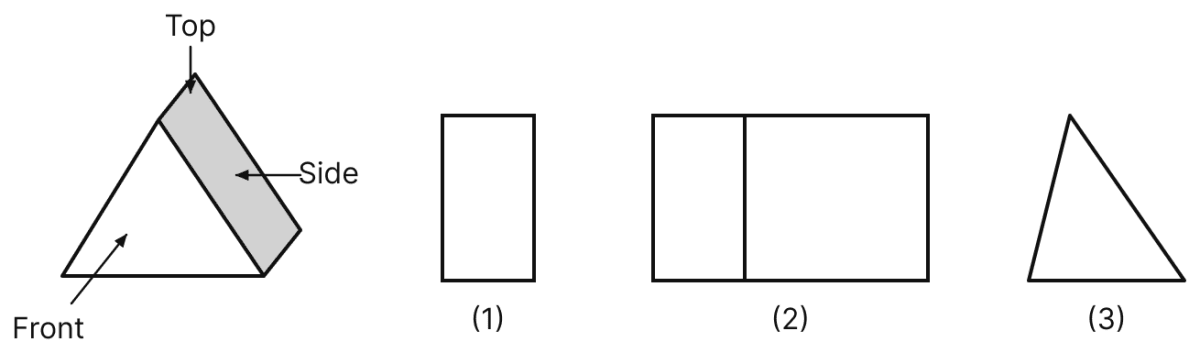
Answer
When seen from the front, the triangular face of the solid is seen, so the front view is a triangle.
When seen from the top, two rectangular faces of the solid are seen side by side, so the top view is a rectangle divided into two parts.
When seen from the side, one rectangular face is seen, so the side view is a single rectangle.
Hence, (1) is the side view, (2) is the top view and (3) is the front view.
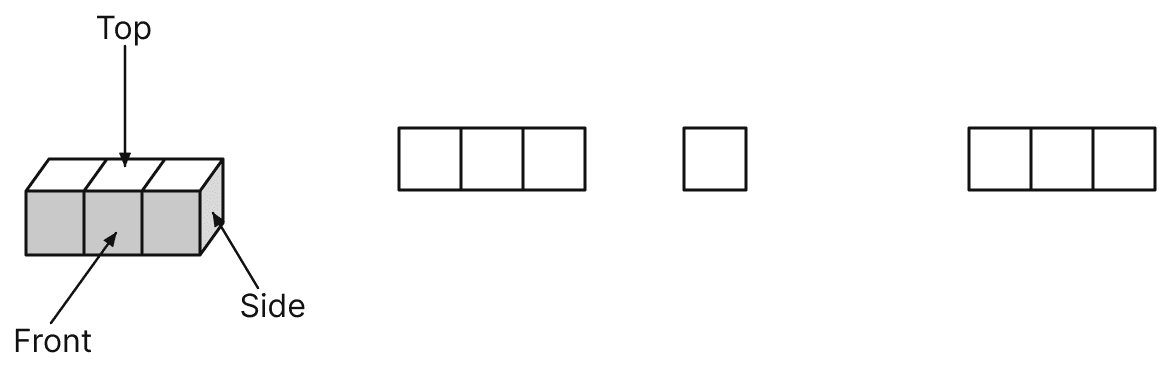
For the solid given below, the three views (1), (2) and (3) are given. Identify for the solid the corresponding top, front and side views:
Answer
The solid is made up of three cubes placed in a row.
When seen from the front or from the top, three squares in a row are seen, and when seen from the side, only one square is seen.
Hence, (1) is the front (or top) view, (2) is the side view and (3) is the top (or front) view.
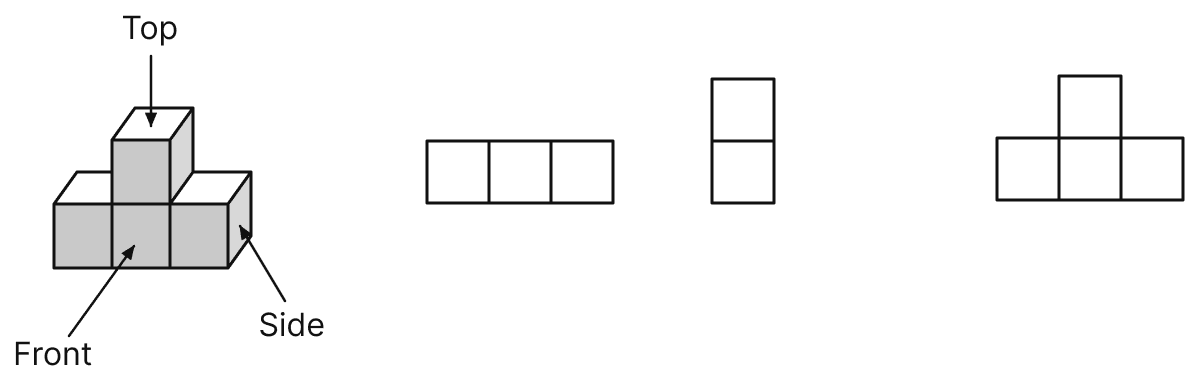
For the solid given below, the three views (1), (2) and (3) are given. Identify for the solid the corresponding top, front and side views:
Answer
When seen from the top, three squares in a row are seen.
When seen from the side, two squares, one above the other, are seen.
When seen from the front, three squares in a row with one square above the middle square are seen.
Hence, (1) is the top view, (2) is the side view and (3) is the front view.
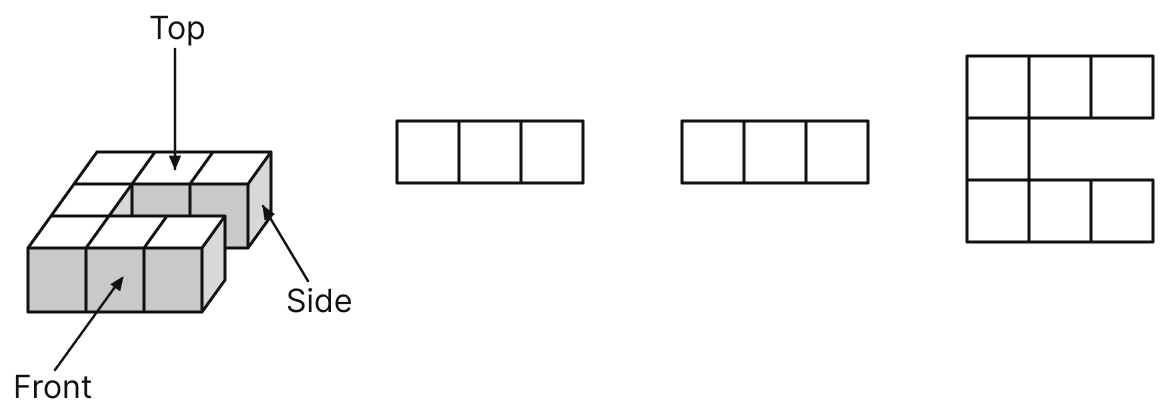
For the solid given below, the three views (1), (2) and (3) are given. Identify for the solid the corresponding top, front and side views:
Answer
When seen from the front or from the side, three squares in a row are seen.
When seen from the top, the two rows of three cubes and the cube joining them are seen.
Hence, (1) is the front (or side) view, (2) is the side (or front) view and (3) is the top view.
Fill in the blanks:
(i) A solid having no vertex and no edge is a ....
(ii) A solid that has congruent and parallel polygons as top and bottom faces and all other faces rectangular is known as .....
(iii) A pyramid having 4 equilateral triangles as its faces is known as .....
(iv) A solid having 3 faces (one curved and two circular), no vertex and two curved edges is known as ....
(v) A solid having a circular base and one vertex is called a ...
(vi) A triangular prism has .... faces, .... edges and ...... vertices.
(vii) A triangular pyramid has .... faces, .... edges and ...... vertices.
(viii) A square pyramid has .... faces, .... edges and ...... vertices.
(ix) The base of a triangular pyramid is a ...... .
(x) Out of .... faces of a triangular prism, ..... are rectangles and ...... are triangles.
(xi) Out of .... faces of a square pyramid, ..... are triangles and ...... is/are squares.
(xii) Out of .... faces of a rectangular pyramid, ..... are triangles and the base is a ... .
(xiii) A .... is a sort of skeleton - outline in 2-D, which on folding results in a 3-D shape.
Answer
(i) A sphere has one curved face. It has no vertex and no edge.
Hence, a solid having no vertex and no edge is a sphere.
(ii) A (right) prism is a solid which has two identical top and bottom faces with their corresponding sides parallel, and its other faces are rectangular.
Hence, a solid that has congruent and parallel polygons as top and bottom faces and all other faces rectangular is known as prism.
(iii) A tetrahedron is a special triangular pyramid whose all four faces are equilateral triangles of same size.
Hence, a pyramid having 4 equilateral triangles as its faces is known as tetrahedron.
(iv) A cylinder has 3 faces (2 circular, one curved) and two curved edges. It has no vertex.
Hence, a solid having 3 faces (one curved and two circular), no vertex and two curved edges is known as cylinder.
(v) A cone has one plane (circular) face, one curved face, one vertex and one curved edge.
Hence, a solid having a circular base and one vertex is called a cone.
(vi) A triangular prism has 2 triangular faces (its top and bottom) and 3 rectangular faces.
Number of faces = 2 + 3 = 5
It has 3 edges on its top, 3 edges on its bottom and 3 edges joining them.
Number of edges = 3 + 3 + 3 = 9
It has 3 vertices on its top and 3 vertices on its bottom.
Number of vertices = 3 + 3 = 6
Hence, a triangular prism has 5 faces, 9 edges and 6 vertices.
(vii) A triangular pyramid has 1 triangular base and 3 triangular faces meeting at the top.
Number of faces = 1 + 3 = 4
It has 3 edges along its base and 3 more edges joining the vertices of the base to the top vertex.
Number of edges = 3 + 3 = 6
It has 3 vertices at the corners of the base and 1 vertex at the top.
Number of vertices = 3 + 1 = 4
Hence, a triangular pyramid has 4 faces, 6 edges and 4 vertices.
(viii) A square pyramid has 1 square base and 4 triangular faces meeting at the top.
Number of faces = 1 + 4 = 5
It has 4 edges along its base and 4 more edges joining the vertices of the base to the top vertex.
Number of edges = 4 + 4 = 8
It has 4 vertices at the corners of the base and 1 vertex at the top.
Number of vertices = 4 + 1 = 5
Hence, a square pyramid has 5 faces, 8 edges and 5 vertices.
(ix) All the faces of a triangular pyramid, including its base, are triangles.
Hence, the base of a triangular pyramid is a triangle.
(x) A triangular prism has 5 faces, of which 3 are rectangular and 2 are triangular.
Hence, out of 5 faces of a triangular prism, 3 are rectangles and 2 are triangles.
(xi) A square pyramid has 5 faces, of which 4 are triangular and 1 is a square.
Hence, out of 5 faces of a square pyramid, 4 are triangles and 1 is a square.
(xii) A rectangular pyramid has 5 faces, of which 4 are triangular and 1 (the base) is rectangular.
Hence, out of 5 faces of a rectangular pyramid, 4 are triangles and the base is a rectangle.
(xiii) A net is a sort of skeleton - outline in 2-D, which on folding results in a 3-D shape.
Hence, the blank is filled with net.
State whether the following statements are true (T) or false (F):
(i) The faces of a prism are triangular.
(ii) A cube can be treated as a prism.
(iii) A pyramid has only one vertex.
(iv) All the faces, except the base, of a square pyramid are triangular.
(v) A tetrahedron has 3 triangular faces and 1 rectangular face.
(vi) A square pyramid has 5 faces and one vertex.
(vii) A cone has one vertex, two faces and one curved edge.
(viii) In an isometric sketch, the line segments of different lengths can represent the sides of a cube.
(ix) In an oblique sketch of a cuboid, the size of opposite faces must be different.
(x) The top, front and side views of a sphere are different.
Answer
(i) False
Reason:
A prism has two identical top and bottom faces (bases), and its other faces are rectangular. So, all the faces of a prism are not triangular.
(ii) True
Reason:
A cube has two identical top and bottom faces with their corresponding sides parallel, and its other faces are rectangular (squares). Cuboid and cube are special types of right prisms.
(iii) False
Reason:
In a pyramid, the vertices of the base are joined to one common vertex. So, a pyramid has the vertices of its base as well as the common vertex. For example, a triangular pyramid has 3 + 1 = 4 vertices.
(iv) True
Reason:
A square pyramid has 1 square face (base) and 4 triangular faces. So, all its faces, except the base, are triangular.
(v) False
Reason:
A tetrahedron is a special triangular pyramid whose all four faces are equilateral triangles of same size. So, it has 4 triangular faces and no rectangular face.
(vi) False
Reason:
A square pyramid has 5 faces (1 square and 4 triangles). It has 4 vertices at the corners of its base and 1 vertex at the top. So, it has 4 + 1 = 5 vertices and not one vertex.
(vii) True
Reason:
A cone has 2 faces (1 circular, one curved), one vertex and one curved edge.
(viii) False
Reason:
In an isometric sketch, the measurements of the sides are proportional to their actual lengths. As all the sides of a cube are equal, they are represented by line segments of equal lengths.
(ix) False
Reason:
In an oblique sketch of a cuboid, the front face and its opposite face are drawn of the same size. So, the sizes of the opposite faces are not different.
(x) False
Reason:
When a sphere is seen from the top, the front or the side, a circle of the same size is seen each time. So, the top, front and side views of a sphere are same.
A triangular prism has
4 vertices and 6 edges
6 vertices and 9 edges
6 vertices and 6 edges
9 vertices and 6 edges
Answer
A triangular prism has 2 triangular faces (its top and bottom) and 3 rectangular faces.
It has 3 vertices on its top and 3 vertices on its bottom.
Number of vertices = 3 + 3 = 6
It has 3 edges on its top, 3 edges on its bottom and 3 edges joining them.
Number of edges = 3 + 3 + 3 = 9
So, a triangular prism has 6 vertices and 9 edges.
Hence, option 2 is the correct option.
A square pyramid has
4 vertices and 4 faces
4 vertices and 5 faces
5 vertices and 4 faces
5 vertices and 5 faces
Answer
A square pyramid has 1 square base and 4 triangular faces.
Number of faces = 1 + 4 = 5
It has 4 vertices at the corners of the base and 1 vertex at the top.
Number of vertices = 4 + 1 = 5
Hence, option 4 is the correct option.
A solid having 4 (plane) faces, 4 vertices and 6 edges is called a
triangular prism
rectangular prism
triangular pyramid
rectangular pyramid
Answer
A triangular pyramid has a triangle as its base and 3 triangles as its other faces, so F = 1 + 3 = 4.
Its base has 3 vertices and it has one more vertex at the top, so V = 3 + 1 = 4.
It has 3 edges along its base and 3 more edges joining the vertices of the base to the top vertex, so E = 3 + 3 = 6.
So, the solid having 4 faces, 4 vertices and 6 edges is a triangular pyramid.
Hence, option 3 is the correct option.
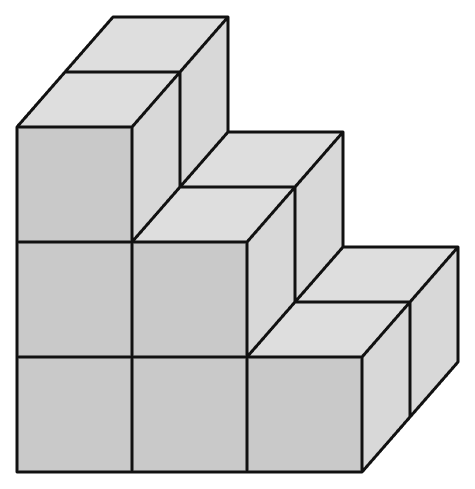
The number of cubes in the given structure is
12
10
9
8
Answer
In the front row, the three columns of cubes are 3, 2 and 1 cubes high.
Number of cubes in the front row = 3 + 2 + 1 = 6
There is one more row of 6 cubes, exactly like the front row, behind it.
∴ Number of cubes in the given structure = 6 + 6 = 12
Hence, option 1 is the correct option.
An isometric sheet is made up of dots forming
squares
rectangles
right-angled triangles
equilateral triangles
Answer
On an isometric sheet, the dots are arranged in such a way that on joining the neighbouring dots, the paper gets divided into small equilateral triangles.
So, an isometric sheet is made up of dots forming equilateral triangles.
Hence, option 4 is the correct option.
Question numbers 8 to 11 are based on the given figure in which unit cubes are put together to form a structure as shown.
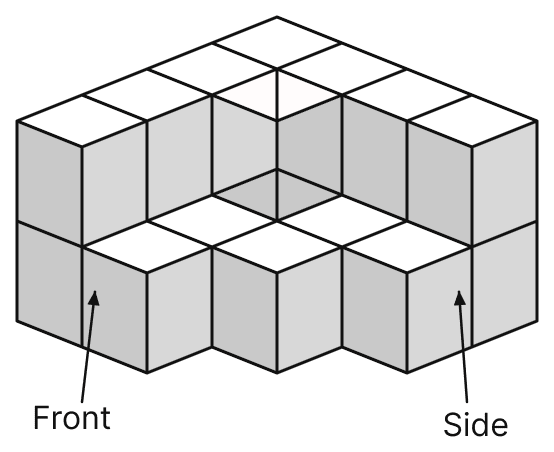
The number of unit cubes in the given structure is
13
20
21
22
Answer
The structure has two layers.
The bottom layer would have 4 × 4 = 16 unit cubes, but 3 unit cubes are missing at the front corner.
∴ Number of unit cubes in the bottom layer = 16 - 3 = 13
The top layer has 4 unit cubes along the left wall, 3 more unit cubes along the right wall and 1 unit cube in the inner corner between the two walls.
∴ Number of unit cubes in the top layer = 4 + 3 + 1 = 8
∴ Number of unit cubes in the given structure = 13 + 8 = 21
Hence, option 3 is the correct option.
The number of unit cubes to be added to make a cuboid of dimensions 4 unit × 4 unit × 2 unit is
11
12
13
14
Answer
Number of unit cubes in a cuboid of dimensions 4 unit × 4 unit × 2 unit = 4 × 4 × 2 = 32
Number of unit cubes in the given structure = 21
∴ Number of unit cubes to be added = 32 - 21 = 11
Hence, option 1 is the correct option.
If the structure is painted on the surface everywhere, then the number of unit cubes having no face painted is
0
1
2
11
Answer
The structure rests on the ground, so the bottom faces of the unit cubes of the bottom layer are not painted.
Every unit cube of the top layer has its top face painted.
So, a unit cube has no face painted only when it lies in the bottom layer, has a unit cube placed above it and is covered by unit cubes on all its four sides.
In the given structure, only the unit cube lying just below the top-layer cube in the inner corner is covered in this way.
∴ Number of unit cubes having no face painted = 1
Hence, option 2 is the correct option.
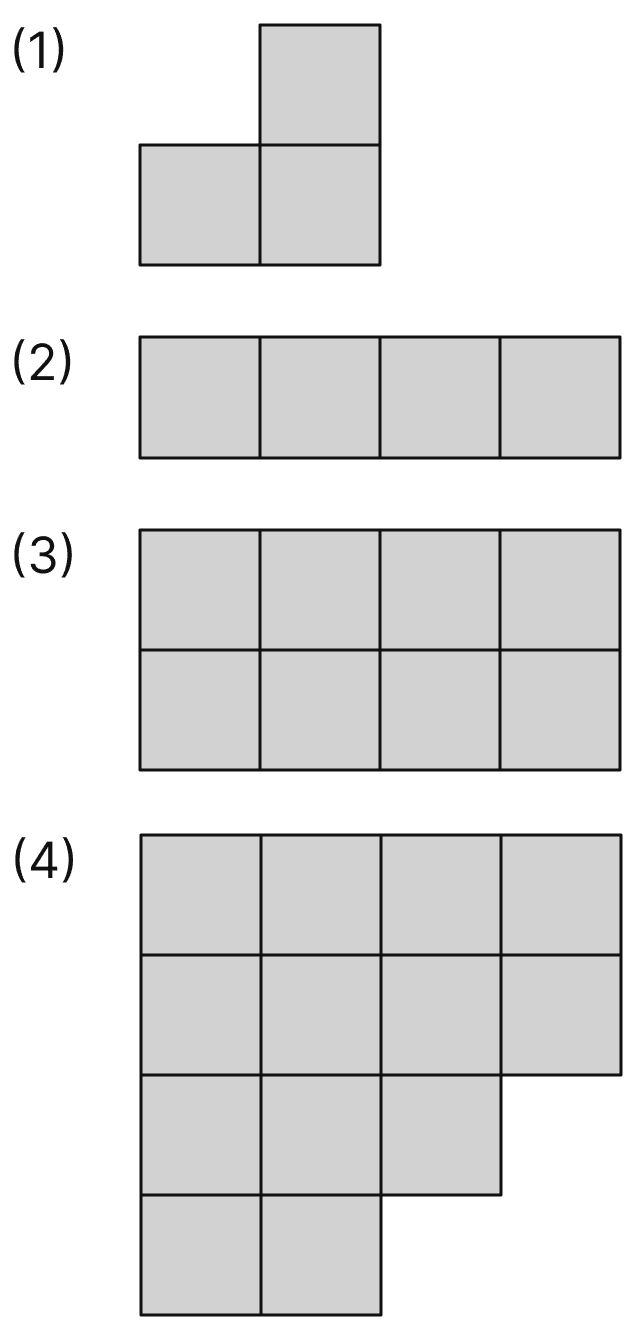
The side view of the given structure is
Answer
When seen from the side, the structure is 4 unit cubes long and 2 unit cubes high.
So, the side view of the given structure is made up of 2 rows of 4 squares each.
Hence, option 3 is the correct option.
Statement I: A triangular prism has 5 faces.
Statement II: A triangular prism has 5 vertices.
Statement I is true but Statement II is false.
Statement I is false but Statement II is true.
Both Statement I and Statement II are true.
Both Statement I and Statement II are false.
Answer
A triangular prism has 2 triangular faces and 3 rectangular faces.
Number of faces = 2 + 3 = 5
So, Statement I is true.
A triangular prism has 3 vertices on its top and 3 vertices on its bottom.
Number of vertices = 3 + 3 = 6
So, a triangular prism has 6 vertices and not 5 vertices.
So, Statement II is false.
∴ Statement I is true but Statement II is false.
Hence, option 1 is the correct option.
Statement I: In the given figure, there are 6 cubes.
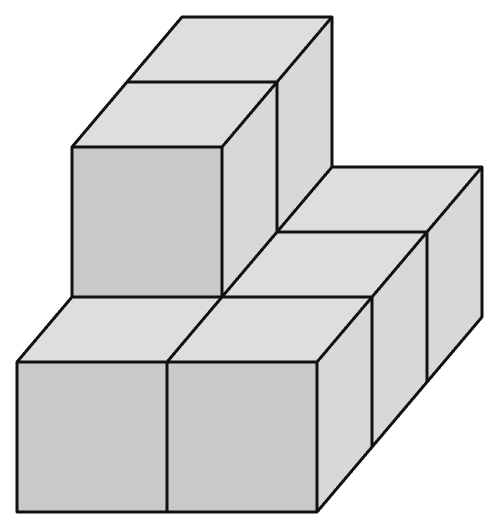
Statement II: A right cylinder has two circular faces and one curved face.
Statement I is true but Statement II is false.
Statement I is false but Statement II is true.
Both Statement I and Statement II are true.
Both Statement I and Statement II are false.
Answer
The given figure has two layers.
The bottom layer has 2 cubes from left to right and 3 cubes from front to back (two of the cubes on the left are hidden below the top layer).
∴ Number of cubes in the bottom layer = 2 × 3 = 6
The top layer has 2 cubes, placed one behind the other, on the second and third cubes of the left column.
∴ Number of cubes in the top layer = 2
∴ Number of cubes in the given figure = 6 + 2 = 8
So, there are 8 cubes and not 6 cubes.
So, Statement I is false.
A right circular cylinder has 2 plane (circular) faces, one curved face and two curved edges.
So, Statement II is true.
∴ Statement I is false but Statement II is true.
Hence, option 2 is the correct option.
Statement I: All cubes and cuboids have 6 faces each.
Statement II: All cubes and cuboids have 8 vertices each.
Statement I is true but Statement II is false.
Statement I is false but Statement II is true.
Both Statement I and Statement II are true.
Both Statement I and Statement II are false.
Answer
A cube has 6 square faces, 12 edges and 8 vertices.
A cuboid has 6 rectangular faces, 12 edges and 8 vertices.
So, all cubes and cuboids have 6 faces each and 8 vertices each.
∴ Both Statement I and Statement II are true.
Hence, option 3 is the correct option.
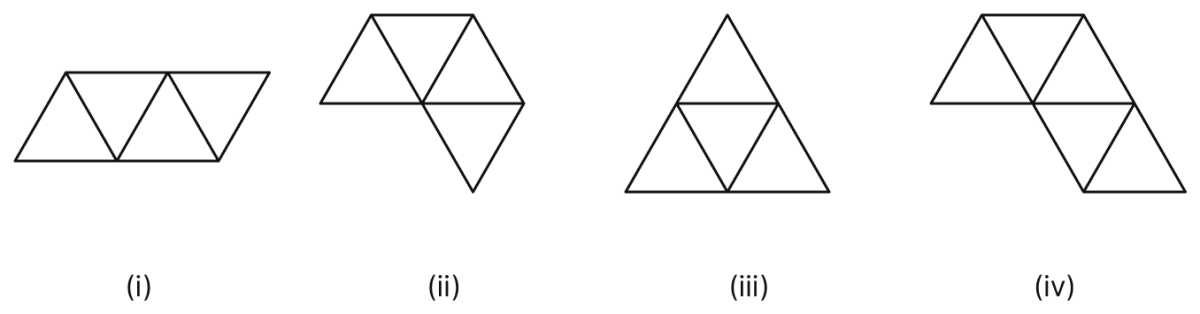
Identify the nets which can be used to make a tetrahedron (cut out copies of the nets and try it):
Answer
A tetrahedron has four faces, all of which are equilateral triangles of same size. So, its net is made up of four equal equilateral triangles, which on folding form the four faces in such a way that no two triangles overlap and no face is left open.
On folding the nets (i) and (iii), each of the four triangles forms a different face and a tetrahedron is obtained.
On folding the net (ii), two of the triangles overlap each other and one face is left open. So, a tetrahedron cannot be formed from it.
The net (iv) is made up of 5 triangles, but a tetrahedron has only 4 faces. So, a tetrahedron cannot be formed from it.
Hence, the nets (i) and (iii) can be used to make a tetrahedron.
If four cubes each with 2 cm edge are placed side by side, what would the dimensions of the resultant cuboid be?
Also draw (i) an oblique sketch (ii) an isometric sketch of the resultant cuboid?
Answer
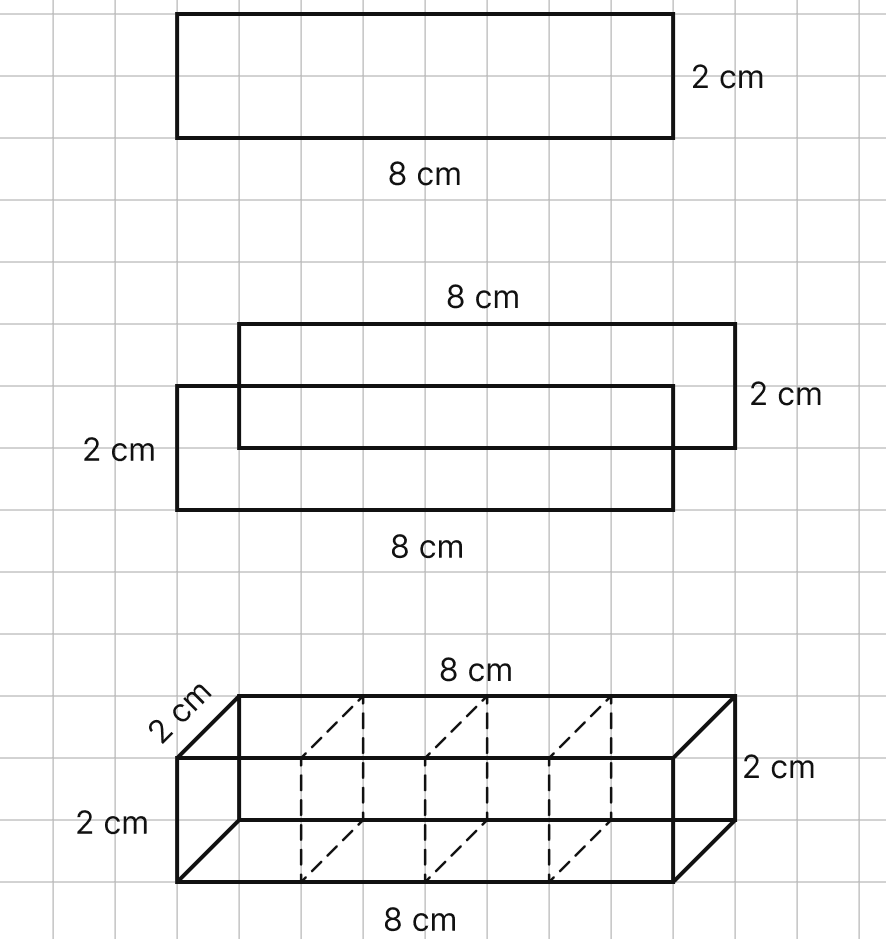
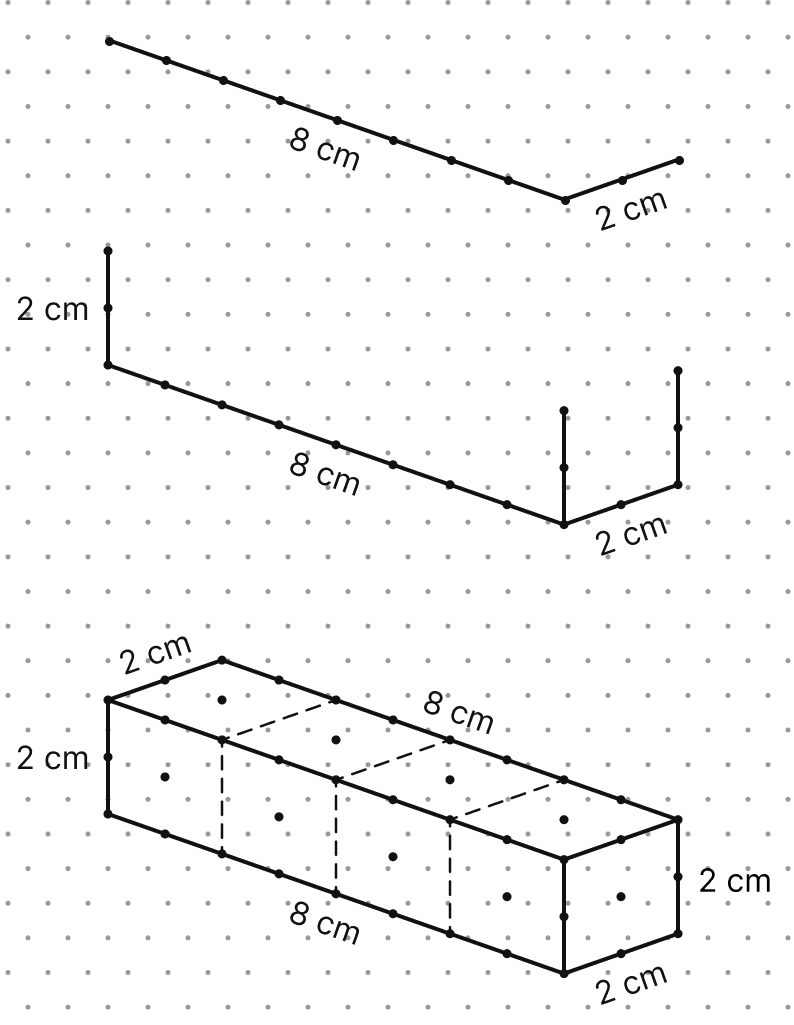
When four cubes each with 2 cm edge are placed side by side, the resultant cuboid has:
Length = 2 cm + 2 cm + 2 cm + 2 cm = 8 cm
Breadth = 2 cm
Height = 2 cm
Hence, the dimensions of the resultant cuboid are: length = 8 cm, breadth = 2 cm and height = 2 cm.
(i) Steps of construction :
Take a squared paper of side 1 cm.
Draw a rectangle of dimensions 8 cm × 2 cm to get the front face of the cuboid.
Draw the opposite face of the same size overlapping the first rectangle, such that it is shifted equally to the right and upwards.
Join the corresponding corners of the two rectangles by oblique lines to get the required cuboid.
(ii) Steps of construction :
Take an isometric dot paper of side 1 cm.
Draw the base lines of the two front faces of length 8 cm and breadth 2 cm.
Draw three vertical lines each of height 2 cm, one on the middle vertex and the other two on the end points of these line segments.
For the top face, draw a parallelogram of length 8 cm and breadth 2 cm whose adjacent sides are formed by joining the top free ends of the three vertical line segments to get the required cuboid.
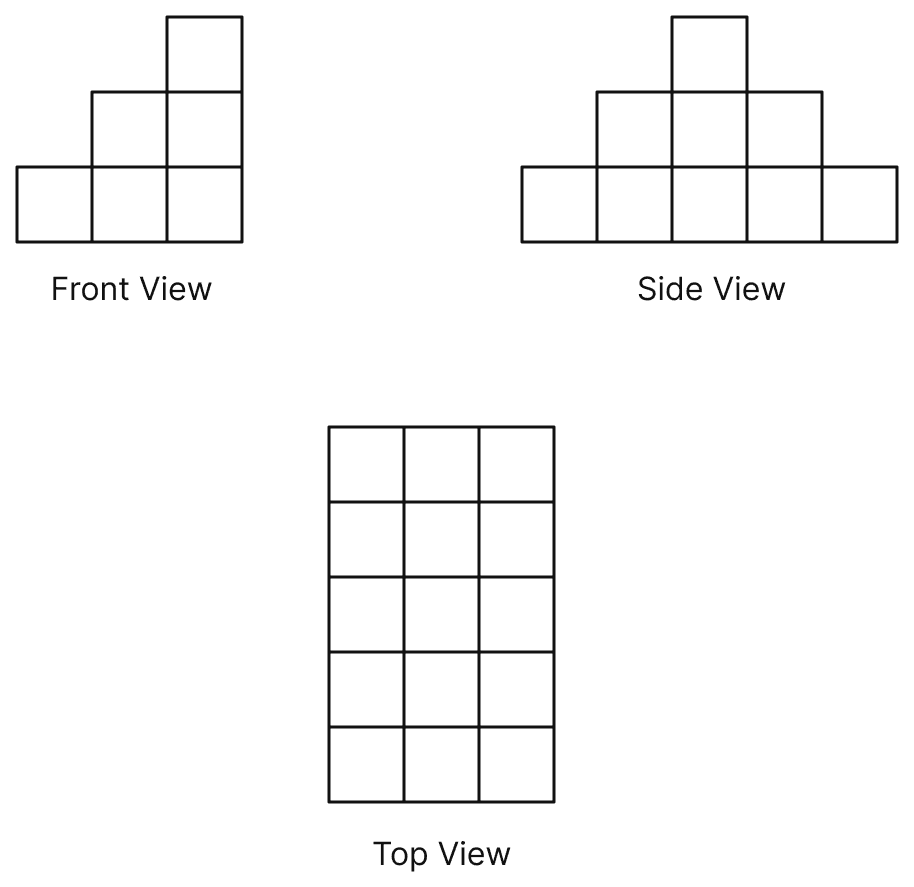
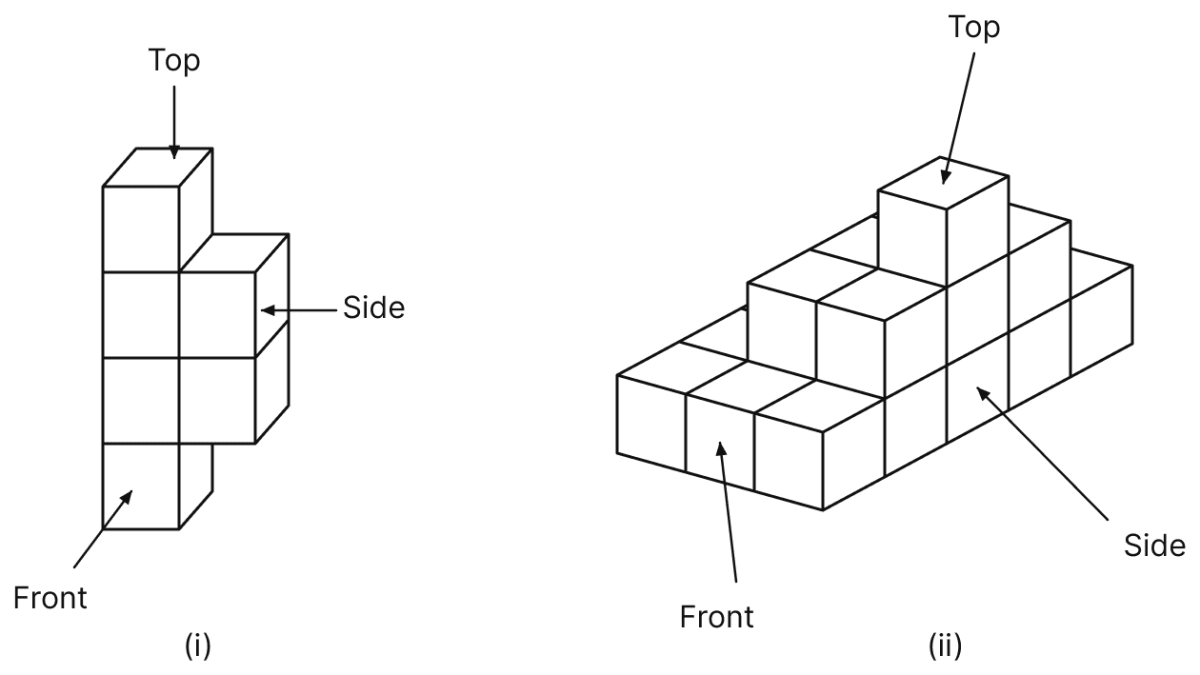
For the structures given below sketch the front, side and top view:
Answer
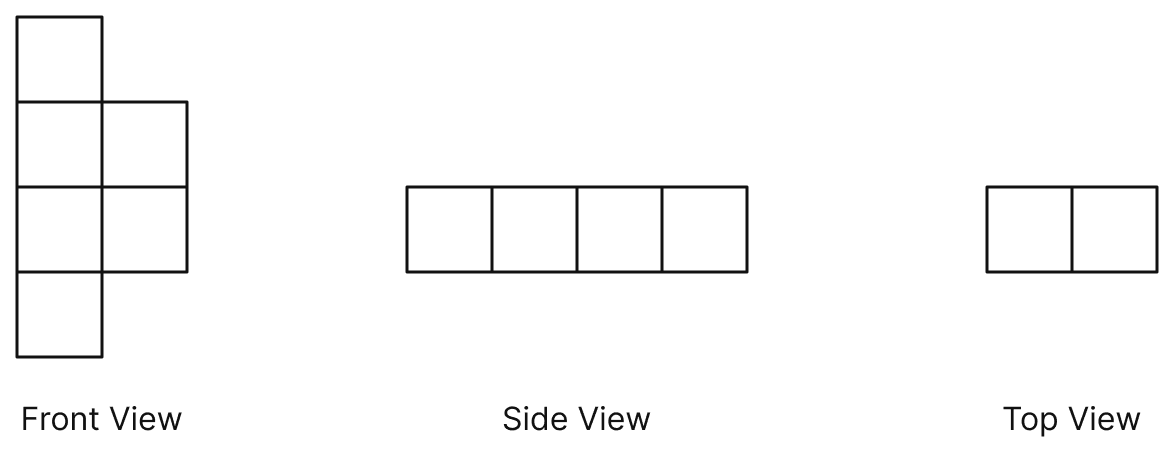
The front view of a structure is the shape seen when it is looked at from the front, the side view is the shape seen when it is looked at from the side and the top view is the shape seen when it is looked at from above. Each cube seen face-on appears as a square in these views.
(i) The front, side and top views of the given structure are shown below:
(ii) The front, side and top views of the given structure are shown below: