
The sum of −15 and +8 is
23
−7
7
−23
Answer
Sum of −15 and +8 = (−15) + (+8)
= −15 + 8
= −7
Hence, Option 2 is the correct option.
What is the product of (−5) and (−9)?
−45
45
−14
14
Answer
We know that,
The product of two negative integers is positive.
Product of (−5) and (−9) = (−5) × (−9)
= 45
Hence, Option 2 is the correct option.
The standard form of is
Answer
A rational number is in standard form when its denominator is positive and its numerator and denominator have no common factor other than 1.
H.C.F. of 18 and 24 = 6
Dividing the numerator and denominator by 6, we get :
Hence, Option 2 is the correct option.
If , then the cardinal number is
4
5
6
26
Answer
The cardinal number of a set is the number of distinct elements in it.
The elements of are and .
Hence, Option 2 is the correct option.
0.75 as a percentage is
7.5%
75%
0.075%
750%
Answer
To express a decimal as a percentage, we multiply it by 100%.
0.75 = 0.75 × 100% = 75%
Hence, Option 2 is the correct option.
The coefficient of in is
−5
5
Answer
So, the factor multiplying in is .
∴ Coefficient of in is .
Hence, Option 3 is the correct option.
The value of (23)3 is
−64
512
128
26
Answer
By formula,
⇒ (23)3 = 23 × 3
= 29
= 512
Hence, Option 2 is the correct option.
A binomial is
Answer
An algebraic expression containing exactly two unlike terms is called a binomial.
has two unlike terms, and 2, so it is a binomial.
has two like terms, which combine to give , a monomial.
has three terms, so it is a trinomial.
has one term, so it is a monomial.
Hence, Option 1 is the correct option.
The solution for is
Answer
Solving,
Hence, Option 3 is the correct option.
In a triangle, the sum of any two sides is
Equal to the third side
Less than the third side
Greater than the third side
Half the third side
Answer
In a triangle, the sum of the lengths of any two sides is always greater than the length of the third side.
Hence, Option 3 is the correct option.
If two angles are complementary and one is 40°, the other is
140°
50°
130°
90°
Answer
Two angles are complementary if their sum is 90°.
∴ Other angle = 90° − 40° = 50°
Hence, Option 2 is the correct option.
The side of a square park is 30 m. Its area is
60 m2
180 m2
900 m2
120 m2
Answer
By formula,
Area of a square = Side × Side
Substituting the values, we get :
Area of the park = 30 × 30
= 900 m2
Hence, Option 3 is the correct option.
Which solid has exactly one vertex and one circular face?
Cone
Cylinder
Sphere
Cube
Answer
A cone has one circular face (its base) and one vertex (its apex).
Hence, Option 1 is the correct option.
The mean of 7, 11, 13, 9, 10 is
9
10
11
12
Answer
Sum of all observations = 7 + 11 + 13 + 9 + 10
= 50
and, number of observations = 5
By formula,
Mean =
Substituting the values, we get :
Mean = = 10
Hence, Option 2 is the correct option.
Which of these is not a subset of {a, b, c}?
{a, b}
{b, c}
{ }
{a, d}
Answer
A set is a subset of {a, b, c} only if every element of it is an element of {a, b, c}.
{a, b} and {b, c} are subsets of {a, b, c}, and the empty set { } is a subset of every set.
The element of {a, d} is not an element of {a, b, c}.
{a, d} is not a subset of {a, b, c}.
Hence, Option 4 is the correct option.
Simplify using BODMAS:
(−6) + [8 − (−4)] × (−2) ÷ 4
Answer
By BODMAS, we solve the brackets first, then division, then multiplication and then addition.
⇒ (−6) + [8 − (−4)] × (−2) ÷ 4 = (−6) + [8 + 4] × (−2) ÷ 4
= (−6) + 12 × (−2) ÷ 4 [Solving the bracket]
= (−6) + 12 ×
= (−6) + 12 × [Division]
= (−6) + (−6) [Multiplication]
= −12 [Addition]
Hence, (−6) + [8 − (−4)] × (−2) ÷ 4 = −12.
Write four rational numbers equivalent to .
Answer
To get a rational number equivalent to a given rational number, we multiply its numerator and denominator by the same non-zero integer.
Multiplying the numerator and denominator by 2, 3, 4 and 5 in turn, we get :
Hence, four rational numbers equivalent to are and .
Compare and . Which is greater and by how much?
Answer
Writing with a positive denominator, we get :
=
Finding the L.C.M. of 9 and 6 by prime factorization method :
9 = 3 × 3
6 = 2 × 3
L.C.M. = Product of all the prime factors, each taken the greatest number of times it occurs
= 2 × 3 × 3
= 18
Converting both fractions to equivalent fractions with denominator 18, we get :
Since, −8 > −15,
Difference between the two numbers :
Hence, is greater than by .
Find the area of a parallelogram with base 18 cm and height 10 cm.
Answer
By formula,
Area of parallelogram = Base × Height
Substituting the values, we get :
Area of parallelogram = 18 × 10 = 180 cm2
Hence, the area of the parallelogram = 180 cm2.
Write the number of edges, vertices and faces of
(a) cube
(b) cuboid
Answer
(a) A cube has 6 square faces. Its faces meet in 12 edges, and its edges meet in 8 vertices (corners).
Hence, a cube has 12 edges, 8 vertices and 6 faces.
(b) A cuboid has 6 rectangular faces. Its faces meet in 12 edges, and its edges meet in 8 vertices (corners).
Hence, a cuboid has 12 edges, 8 vertices and 6 faces.
Find the mean proportional between 4 and 25.
Answer
Let the mean proportional between 4 and 25 be .
Then, 4, and 25 are in continued proportion, i.e. .
Product of means = Product of extremes
Hence, the mean proportional between 4 and 25 is 10.
A sum of ₹ 12,000 is lent at 6% per annum for 4 years. Find the simple interest and total amount.
Answer
Given,
Principal () = ₹ 12,000, Rate () = 6% p.a. and Time () = 4 years.
By formula,
Simple interest (S.I.) =
Substituting the values, we get :
S.I. = ₹
= ₹ 120 × 6 × 4
= ₹ 2,880
Amount = Principal + S.I.
= ₹ 12,000 + ₹ 2,880
= ₹ 14,880
Hence, the simple interest = ₹ 2,880 and the total amount = ₹ 14,880.
Express the ratio of 2 km to 500 m in simplest form.
Answer
To compare two quantities in a ratio, they must be in the same unit.
2 km = 2 × 1000 m
= 2000 m
∴ Ratio of 2 km to 500 m = 2000 m : 500 m
=
=
= 4 : 1
Hence, the ratio of 2 km to 500 m in simplest form is 4 : 1.
The total points scored by a team: Won 5 matches (+3 each), drew 2 (0 points), lost 3 (−1 each). Calculate final points.
Answer
Points for 5 matches won = 5 × (+3)
= 15
Points for 2 matches drawn = 2 × 0
= 0
Points for 3 matches lost = 3 × (−1)
= −3
Final points = 15 + 0 + (−3)
= 15 − 3
= 12
Hence, the final points scored by the team = 12.
The scores of 7 students: 8, 7, 9, 6, 8, 10, 7. Find the mean, median and mode.
Answer
Sum of all observations = 8 + 7 + 9 + 6 + 8 + 10 + 7
= 55
and, number of observations = 7
By formula,
Mean =
Substituting the values, we get :
Mean =
=
On arranging the given scores in ascending order, we get :
6, 7, 7, 8, 8, 9, 10
As the number of terms () is 7 and 7 is odd :
In the given data, the numbers 7 and 8 each appear maximum times, i.e. 2 times.
∴ Mode = 7 and 8
Hence, median = 8, modes = 7 and 8, and mean = .
If a car travels 35.8 km in 1 hour, how far will it travel in 4.5 hours?
Answer
Distance travelled in 1 hour = 35.8 km
∴ Distance travelled in 4.5 hours = 35.8 × 4.5 km
Multiplying without the decimal points, we get :
358 × 45 = 16110
Total number of decimal places in 35.8 and 4.5 = 1 + 1 = 2
∴ 35.8 × 4.5 = 161.10
= 161.1
Hence, the car will travel 161.1 km in 4.5 hours.
A rectangular room is 9 m long and 5 m wide. Tiles of size 30 cm × 20 cm are to be laid. How many tiles will be required?
Answer
Length of the room = 9 m
= 9 × 100 cm
= 900 cm
Breadth of the room = 5 m
= 5 × 100 cm
= 500 cm
By formula,
Area of a rectangle = Length × Breadth
Substituting the values, we get :
Area of the floor of the room = 900 × 500
= 450000 cm2
Area of one tile = 30 × 20
= 600 cm2
Number of tiles required =
=
= 750
Hence, 750 tiles will be required.
A recipe uses flour and sugar in the ratio 5 : 2. How much sugar is needed for 750 g flour?
Answer
Given,
Flour : Sugar = 5 : 2
So, for every 5 g of flour, 2 g of sugar is used.
∴ Sugar needed for 750 g flour = × 750
= 2 × 150
= 300 g
Hence, 300 g of sugar is needed for 750 g flour.
Find the complement and supplement of 53°.
Answer
Two angles are complementary if their sum is 90°, and supplementary if their sum is 180°.
Complement of 53° = 90° − 53° = 37°
Supplement of 53° = 180° − 53° = 127°
Hence, the complement of 53° = 37° and the supplement of 53° = 127°.
Write
(a) an equivalent set to {1, 3, 5}
(b) a proper subset of .
Answer
(a) Two sets are equivalent if they have the same number of elements.
Number of elements in {1, 3, 5} = 3
The set also has 3 elements.
Hence, an equivalent set to {1, 3, 5} is .
(b) A set is a proper subset of a set if every element of is in and has at least one element that is not in .
Every element of is in , and the elements and of are not in .
Hence, a proper subset of is .
Solve for :
.
Answer
Solving,
Hence, .
Find the values of angles and if line .
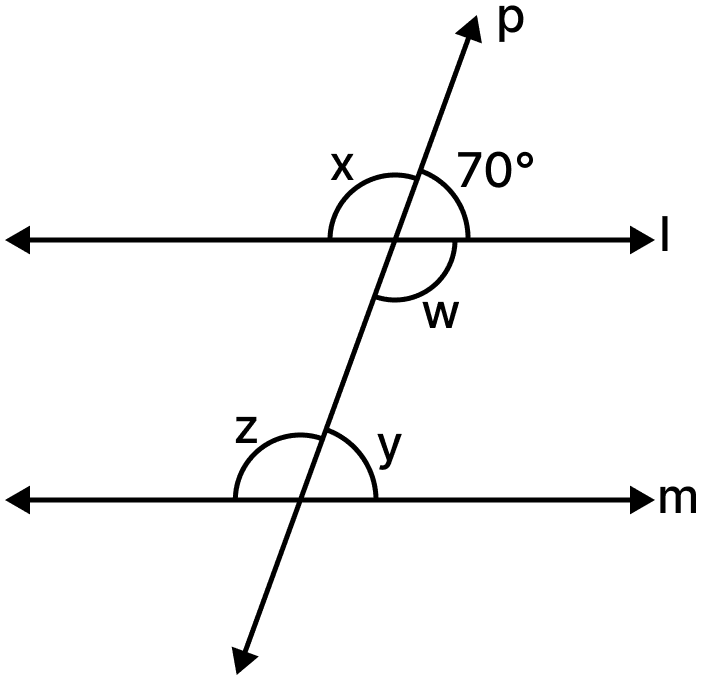
Answer
From figure,
The transversal cuts the parallel lines and . At line , the angles and 70° form a linear pair, so we get :
[Vertically opposite angles]
Since, ,
[Corresponding angles]
[Corresponding angles]
Hence, and .
In a triangle PQR, PQ = 6 cm, QR = 5 cm, RP = 7 cm. Can this triangle be constructed? Give reasons.
Answer
We know that,
In a triangle, the sum of the lengths of any two sides is greater than the length of the third side.
PQ + QR = 6 + 5 = 11 cm, and 11 cm > 7 cm (RP)
QR + RP = 5 + 7 = 12 cm, and 12 cm > 6 cm (PQ)
PQ + RP = 6 + 7 = 13 cm, and 13 cm > 5 cm (QR)
So, the sum of any two sides is greater than the third side.
Hence, yes, the triangle PQR can be constructed, as the sum of any two of its sides is greater than the third side.
In two triangles, if two sides and the included angle are equal, name the congruence criterion.
Answer
If two sides and the included angle of one triangle are equal to the corresponding two sides and the included angle of another triangle, then the two triangles are congruent. This is the Side-Angle-Side criterion.
Hence, the congruence criterion is S.A.S. (Side-Angle-Side).
List two capital English letters with only vertical line symmetry and two with rotational symmetry of order 2.
Answer
The letters A and M each have one vertical line of symmetry and no other line of symmetry.
The letters N and S look exactly the same after a rotation of 180° about their centre, and again after a full turn of 360°. So, each fits onto itself twice in a full turn, i.e. each has rotational symmetry of order 2.
Hence, A and M have only vertical line symmetry, and N and S have rotational symmetry of order 2.
Name the order of rotational symmetry of a regular hexagon and an equilateral triangle.
Answer
A regular hexagon fits onto itself after every rotation of 60° about its centre.
Number of times it fits onto itself in a full turn = 360° ÷ 60° = 6
An equilateral triangle fits onto itself after every rotation of 120° about its centre.
Number of times it fits onto itself in a full turn = 360° ÷ 120° = 3
Hence, the order of rotational symmetry of a regular hexagon is 6 and that of an equilateral triangle is 3.
Construct a triangle PQR where PQ = 5.5 cm, QR = 6 cm and ∠Q = 60°.
Answer
Steps of construction :
Draw a line segment QR = 6 cm.
With Q as centre and a convenient radius, draw an arc cutting QR at A. With A as centre and the same radius, draw an arc cutting the previous arc at B. Join QB and produce it to X. Then, ∠RQX = 60°.
With Q as centre and radius 5.5 cm, draw an arc cutting QX at P.
Join PR.
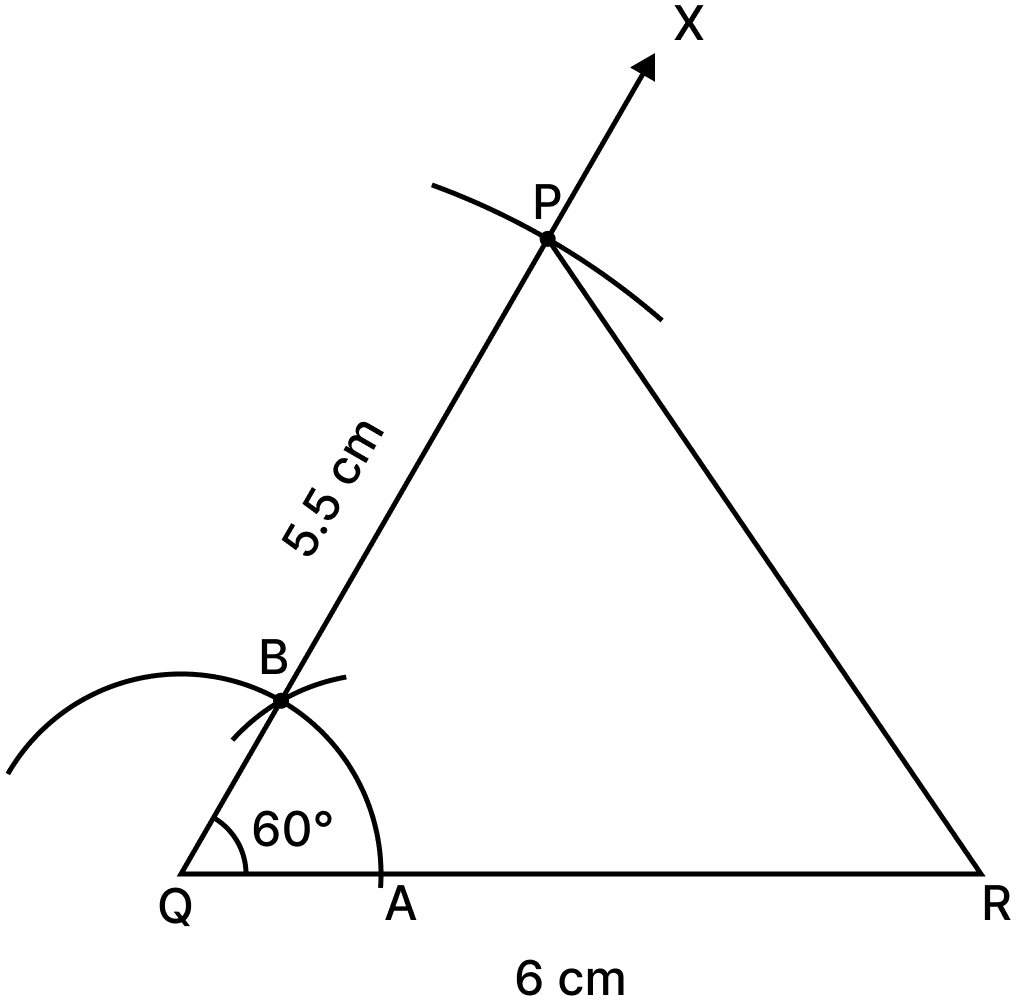
Hence, PQR is the required triangle.
Draw the top, front and side views of a cuboid.
Answer
A cuboid has a length, a breadth and a height.
When seen from the top, we see its top face, a rectangle with sides equal to the length and the breadth.
When seen from the front, we see its front face, a rectangle with sides equal to the length and the height.
When seen from the side, we see its side face, a rectangle with sides equal to the breadth and the height.
The cuboid and its three views are shown below :
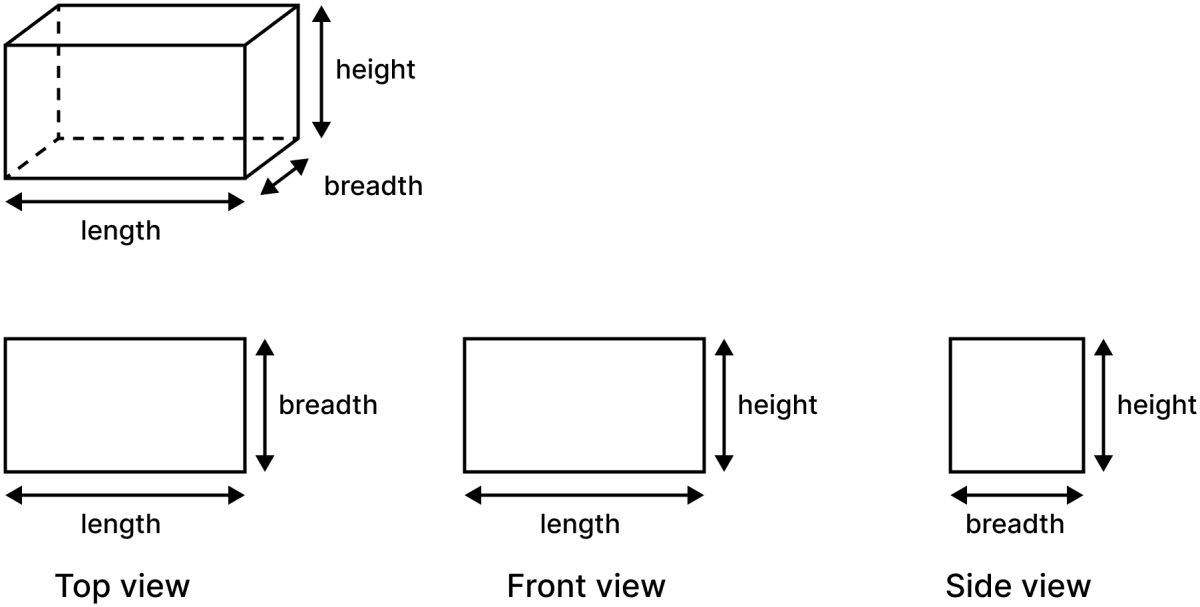
Hence, the top, front and side views of a cuboid are the three rectangles shown above.
The daily temperatures for a week were 25°C, 27°C, 26°C, 28°C, 27°C, 29°C, 27°C. Find the mean, mode and median.
Answer
Sum of all observations = 25 + 27 + 26 + 28 + 27 + 29 + 27
= 189
and, number of observations = 7
By formula,
Mean =
Substituting the values, we get :
Mean = = 27°C
In the given data, the temperature 27°C appears maximum times, i.e. 3 times.
∴ Mode = 27°C
On arranging the given temperatures in ascending order, we get :
25, 26, 27, 27, 27, 28, 29
As the number of terms () is 7 and 7 is odd,
By formula,
Hence, mean = 27°C, mode = 27°C and median = 27°C.
If the circumference of a circle exceeds its diameter by 30 cm, find the radius of the circle. Hence, find its area. (Take )
Answer
Let the radius of the circle be cm.
Then, diameter = cm and circumference = cm.
Given,
Circumference − Diameter = 30 cm
So, the radius of the circle = 7 cm.
By formula,
Area of circle =
Substituting the values, we get :
Area of circle = × 7 × 7
= 22 × 7
= 154 cm2
Hence, the radius of the circle = 7 cm and its area = 154 cm2.
What must be subtracted from to get ?
Answer
To find the expression that must be subtracted, we subtract from .
Hence, must be subtracted.
If a table is sold for ₹ 437 at a loss of 8%, find its cost price. At what price must it be sold to gain 10%?
Answer
Given,
Selling price (S.P.) = ₹ 437 and loss = 8%.
By formula,
C.P. = × S.P.
Substituting the values, we get :
C.P. = ₹ × 437
= ₹ × 437
= ₹
= ₹ 475
To gain 10%,
By formula,
S.P. = × C.P.
Substituting the values, we get :
S.P. = ₹ × 475
= ₹ × 475
= ₹
= ₹ 522.50
Hence, the cost price of the table = ₹ 475, and it must be sold for ₹ 522.50 to gain 10%.