
The sum of −12 and +7 is
19
−5
5
−19
Answer
Sum of −12 and +7 = (−12) + (+7)
= −12 + 7
= −5
Hence, Option 2 is the correct option.
What is the product of (−4) and (−6)?
−24
24
−10
10
Answer
We know that,
The product of two negative integers is positive.
Product of (−4) and (−6) = (−4) × (−6)
= 24
Hence, Option 2 is the correct option.
The value of [−12 ÷ (−3)] × (−2) is
−8
8
6
−6
Answer
Solving the bracket first, we get :
[−12 ÷ (−3)] × (−2) = 4 × (−2)
= −8
Hence, Option 1 is the correct option.
The sum of a number and its additive inverse is
The number itself
Its absolute value
Zero
Cannot be determined
Answer
Let the number be .
Then, its additive inverse is .
∴ Sum of the number and its additive inverse =
= 0
Hence, Option 3 is the correct option.
Which of these is equivalent to ?
All of these
Answer
Writing each fraction in its lowest terms, we get :
So, all the given fractions are equivalent to .
Hence, Option 4 is the correct option.
0.65 expressed as a percentage is
6.5%
65%
0.065%
650%
Answer
To express a decimal as a percentage, we multiply it by 100%.
0.65 = 0.65 × 100%
= 65%
Hence, Option 2 is the correct option.
The additive inverse of is
Answer
We know that,
The sum of a number and its additive inverse is 0.
∴ The additive inverse of is .
Hence, Option 2 is the correct option.
The value of (32)2 is:
27
81
729
243
Answer
By formula,
⇒ (32)2 = 32 × 2
= 34
= 3 × 3 × 3 × 3
= 81
Hence, Option 2 is the correct option.
Which of these sets is equivalent to {2, 4, 6}?
{0, 1, 2}
{1, 2, 4, 6}
Answer
Two sets are equivalent if they have the same number of elements.
Number of elements in {2, 4, 6} = 3
The set {0, 1, 2} also has 3 elements, while the sets and {1, 2, 4, 6} have 4 elements each and the set has 2 elements.
∴ {0, 1, 2} is equivalent to {2, 4, 6}.
Hence, Option 2 is the correct option.
A ratio that is equivalent to 5 : 7 is:
10 : 14
15 : 17
25 : 30
10 : 15
Answer
An equivalent ratio is obtained by multiplying both the terms of a ratio by the same non-zero number.
Multiplying both the terms of 5 : 7 by 2, we get :
5 : 7 = (5 × 2) : (7 × 2)
= 10 : 14
Hence, Option 1 is the correct option.
In a triangle, the sum of any two sides is
Equal to the third side
Greater than the third side
Less than the third side
Can't say
Answer
In a triangle, the sum of the lengths of any two sides is always greater than the length of the third side.
Hence, Option 2 is the correct option.
A solid with one vertex and one circular face is called
Cube
Cone
Cylinder
Sphere
Answer
A cone has one circular face (its base) and one vertex (its apex).
Hence, Option 2 is the correct option.
The perimeter of a square of side 7 cm is
49 cm2
14 cm
28 cm
21 cm
Answer
By formula,
Perimeter of a square = 4 × Side
Substituting the values, we get :
Perimeter of the square = 4 × 7
= 28 cm
Hence, Option 3 is the correct option.
The area of a triangle with base 12 cm and height 5 cm is
30 cm2
60 cm2
17 cm2
20 cm2
Answer
By formula,
Area of a triangle = × Base × Height
Substituting the values, we get :
Area of the triangle = × 12 × 5
= 6 × 5
= 30 cm2
Hence, Option 1 is the correct option.
Which of the following is the mode in 4, 5, 6, 6, 8, 9, 6?
4
5
6
8
Answer
On arranging the given data in ascending order, we get :
4, 5, 6, 6, 6, 8, 9
In the given data, the number 6 appears maximum times, i.e. 3 times.
∴ Mode = 6
Hence, Option 3 is the correct option.
Simplify:
(−8) × (−5) × (1 + 1)
Answer
Solving the bracket first, we get :
(−8) × (−5) × (1 + 1) = (−8) × (−5) × 2
= 40 × 2
= 80
Hence, (−8) × (−5) × (1 + 1) = 80.
Using properties of integers, verify: [−3 + (−5)] + (−7) = −3 + [(−5) + (−7)]. What is this property called?
Answer
L.H.S. = [−3 + (−5)] + (−7)
= (−8) + (−7)
= −15
R.H.S. = −3 + [(−5) + (−7)]
= −3 + (−12)
= −15
∴ L.H.S. = R.H.S.
Changing the grouping of the integers does not change their sum. This property is called the associative property of addition of integers.
Hence, [−3 + (−5)] + (−7) = −3 + [(−5) + (−7)] is verified, and the property is called the associative property of addition.
Write two rational numbers equivalent to .
Answer
To get a rational number equivalent to a given rational number, we multiply its numerator and denominator by the same non-zero integer.
Multiplying the numerator and denominator by 2 and then by 3, we get :
Hence, two rational numbers equivalent to are and .
Find the mean and median of: 12, 15, 13, 11, 15, 9
Answer
Sum of all observations = 12 + 15 + 13 + 11 + 15 + 9
= 75
and, number of observations = 6
By formula,
Mean =
Substituting the values, we get :
Mean =
= 12.5
On arranging the given data in ascending order, we get :
9, 11, 12, 13, 15, 15
Number of terms () is 6 (even).
By formula,
Hence, mean = 12.5 and median = 12.5.
By how much is −1 greater than −5?
Answer
To find by how much −1 is greater than −5, we subtract −5 from −1.
Required number = (−1) − (−5)
= −1 + 5
= 4
Hence, −1 is greater than −5 by 4.
Simplify and write your answer as a fraction in lowest terms:
Answer
Finding the L.C.M. of 5, 10 and 3 by prime factorization method :
5 = 5
10 = 2 × 5
3 = 3
L.C.M. = Product of all the prime factors, each taken the greatest number of times it occurs
= 2 × 3 × 5
= 30
Converting each fraction to an equivalent fraction with denominator 30, we get :
Since 19 and 30 have no common factor other than 1, is in its lowest terms.
Hence, .
Multiply 2.4 by 0.35, and state if the product is greater than both multiplicands.
Answer
Multiplying without the decimal points, we get :
24 × 35 = 840
Total number of decimal places in 2.4 and 0.35 = 1 + 2 = 3
So, we mark off 3 decimal places in the product from the right.
∴ 2.4 × 0.35 = 0.840
= 0.84
Since 0.84 > 0.35 but 0.84 < 2.4, the product is greater than 0.35 but less than 2.4.
Hence, 2.4 × 0.35 = 0.84; the product is greater than 0.35 but less than 2.4, so it is not greater than both the multiplicands.
Solve for :
Answer
Solving,
Hence, .
A box contains red and green sweets in the ratio 3 : 4. If there are 112 sweets in total, find the number of each.
Answer
Given,
Ratio of red sweets to green sweets = 3 : 4
Total number of sweets = 112
Sum of the terms of the ratio = 3 + 4 = 7
Number of red sweets = × 112
= 3 × 16
= 48
Number of green sweets = × 112
= 4 × 16
= 64
Hence, there are 48 red sweets and 64 green sweets.
Rina went to a grocery store and bought: 2.5 kg rice at ₹ 42.50 per kg, 1.75 kg sugar at ₹ 38.40 per kg, 0.8 litre oil at ₹ 105.25 per litre.
(a) What is the cost of each item?
(b) What is the total bill?
(c) If she gives ₹ 500, how much change does she get?
Answer
(a) Cost of an item = Quantity × Rate
Cost of 2.5 kg rice = 2.5 × ₹ 42.50
= ₹ 106.25
Cost of 1.75 kg sugar = 1.75 × ₹ 38.40
= ₹ 67.20
Cost of 0.8 litre oil = 0.8 × ₹ 105.25
= ₹ 84.20
Hence, the cost of rice = ₹ 106.25, the cost of sugar = ₹ 67.20 and the cost of oil = ₹ 84.20.
(b) Total bill = Cost of rice + Cost of sugar + Cost of oil
= ₹ 106.25 + ₹ 67.20 + ₹ 84.20
= ₹ 257.65
Hence, the total bill = ₹ 257.65.
(c) Change received = Amount given − Total bill
= ₹ 500 − ₹ 257.65
= ₹ 242.35
Hence, Rina gets a change of ₹ 242.35.
Express 0.00031 in standard form.
Answer
A number is in standard form when it is written as a number between 1 and 10 multiplied by a power of 10.
Hence, 0.00031 = 3.1 × 10⁻⁴.
Write the sets for:
(a) Prime numbers less than 10
(b) Even numbers between 1 and 9
Answer
(a) The prime numbers less than 10 are 2, 3, 5 and 7.
Hence, the required set = {2, 3, 5, 7}.
(b) The even numbers between 1 and 9 are 2, 4, 6 and 8.
Hence, the required set = {2, 4, 6, 8}.
In a triangle, if two angles are 45° and 65°, find the third angle.
Answer
Let the third angle be .
By angle sum property of triangle,
Hence, the third angle = 70°.
A ladder 13 m long reaches a window 5 m above ground. How far is the foot from the base of the wall?
Answer
Let AC be the ladder, A be the window, B be the base of the wall and C be the foot of the ladder, as shown in the figure below.
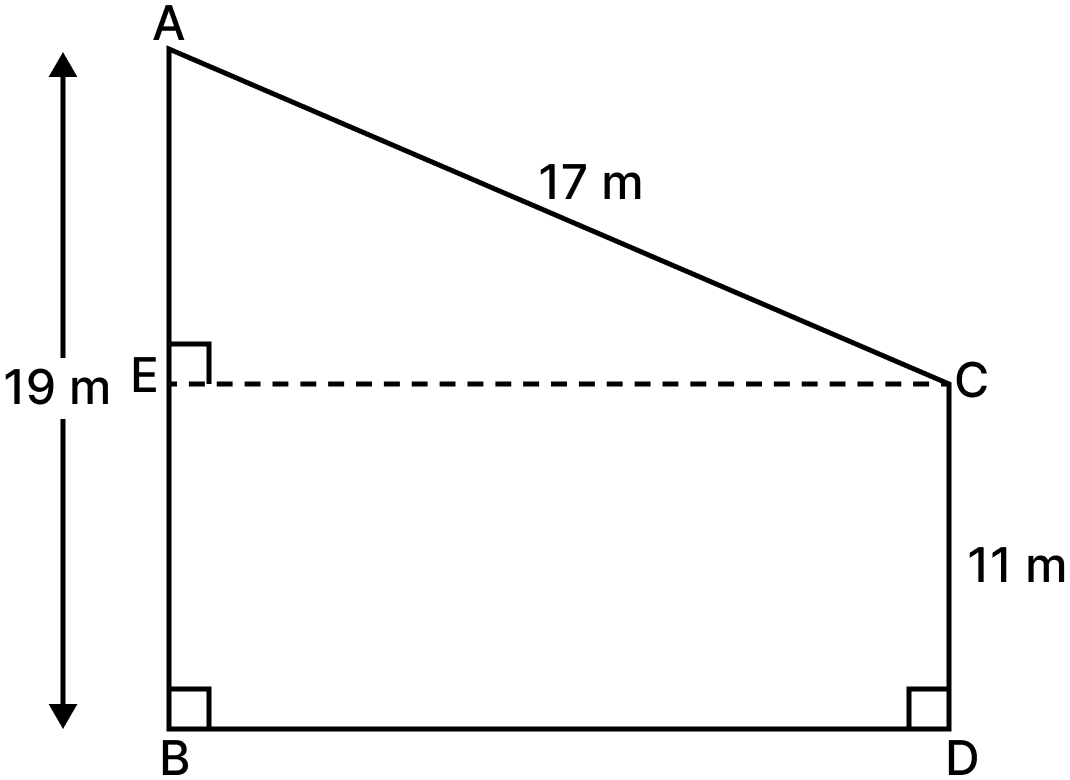
Given,
AC = 13 m and AB = 5 m.
In right angled △ ABC, by Pythagoras theorem,
⇒ AC2 = AB2 + BC2
⇒ 132 = 52 + BC2
⇒ 169 = 25 + BC2
⇒ BC2 = 169 − 25
⇒ BC2 = 144
⇒ BC =
⇒ BC = 12 m.
Hence, the foot of the ladder is 12 m from the base of the wall.
Is it possible to construct a triangle with sides 5 cm, 7 cm and 13 cm? Justify your answer.
Answer
We know that,
In a triangle, the sum of the lengths of any two sides is greater than the length of the third side.
Sum of the two smaller sides = 5 + 7 = 12 cm
Since, 12 cm < 13 cm,
i.e. 5 + 7 < 13
So, the sum of the two sides 5 cm and 7 cm is less than the third side 13 cm, and the given lengths do not satisfy the condition.
Hence, it is not possible to construct a triangle with sides 5 cm, 7 cm and 13 cm, as 5 + 7 < 13.
A man earns ₹ 16,000 per month and spends 25% on rent. How much is spent on rent?
Answer
Given,
Monthly income = ₹ 16,000
Amount spent on rent = 25% of ₹ 16,000
= ₹ × 16000
= ₹ 25 × 160
= ₹ 4,000
Hence, the amount spent on rent = ₹ 4,000.
A shirt is marked at ₹ 600, sold for ₹ 660. Find the percentage increase in price.
Answer
Given,
Marked price = ₹ 600 and selling price = ₹ 660.
Increase in price = ₹ 660 − ₹ 600
= ₹ 60
By formula,
Percentage increase = × 100%
Substituting the values, we get :
Percentage increase = × 100%
= %
= 10%
Hence, the percentage increase in price = 10%.
A sum of ₹ 7,200 is lent at 5% per annum for 3 years. Find the simple interest and the total amount.
Answer
Given,
Principal () = ₹ 7,200, Rate () = 5% p.a. and Time () = 3 years.
By formula,
Simple interest (S.I.) =
Substituting the values, we get :
S.I. = ₹
= ₹ 72 × 5 × 3
= ₹ 1,080
Amount = Principal + S.I.
= ₹ 7,200 + ₹ 1,080
= ₹ 8,280
Hence, the simple interest = ₹ 1,080 and the total amount = ₹ 8,280.
Which of these is a binomial:
Answer
An algebraic expression containing exactly two terms is called a binomial.
has one term, so it is a monomial.
has two terms, and 3, so it is a binomial.
and have three terms each, so they are trinomials.
Hence, Option 2 is the correct option.
Add:
.
Answer
Adding the given expressions and grouping the like terms, we get :
Hence, the required sum is .
Subtract the sum of and from the sum of and
Answer
Sum of and :
Sum of and :
Subtracting the first sum from the second sum, we get :
Hence, the required expression is .
The scores of 10 students: 42, 50, 45, 38, 50, 46, 44, 38, 42, 40. Prepare a frequency table, find the mode and mean.
Answer
On arranging the given scores in ascending order, we get :
38, 38, 40, 42, 42, 44, 45, 46, 50, 50
The frequency table for the given data is :
| Score | Frequency |
|---|---|
| 38 | 2 |
| 40 | 1 |
| 42 | 2 |
| 44 | 1 |
| 45 | 1 |
| 46 | 1 |
| 50 | 2 |
| Total | 10 |
From the table, the scores 38, 42 and 50 each occur maximum times, i.e. 2 times.
∴ Mode = 38, 42 and 50
Sum of all observations = 42 + 50 + 45 + 38 + 50 + 46 + 44 + 38 + 42 + 40
= 435
and, number of observations = 10
By formula,
Mean =
Substituting the values, we get :
Mean =
= 43.5
Hence, the modes are 38, 42 and 50, and the mean = 43.5.
A dice is rolled once. State the possible outcomes. Find the probability of getting
(a) an even number
(b) a number greater than 4
Answer
When a dice is rolled once, the possible outcomes are the numbers 1, 2, 3, 4, 5 and 6.
So, the total number of possible outcomes = 6
By formula,
Probability of an event =
(a) The event is getting an even number and the even numbers (outcomes) are 2, 4 and 6.
So, the number of outcomes favourable to the event getting an even number = 3
∴ P(getting an even number) =
Hence, the probability of getting an even number = .
(b) The event is getting a number greater than 4 and the numbers greater than 4 (outcomes) are 5 and 6.
So, the number of outcomes favourable to the event getting a number greater than 4 = 2
∴ P(getting a number greater than 4) =
Hence, the probability of getting a number greater than 4 = .
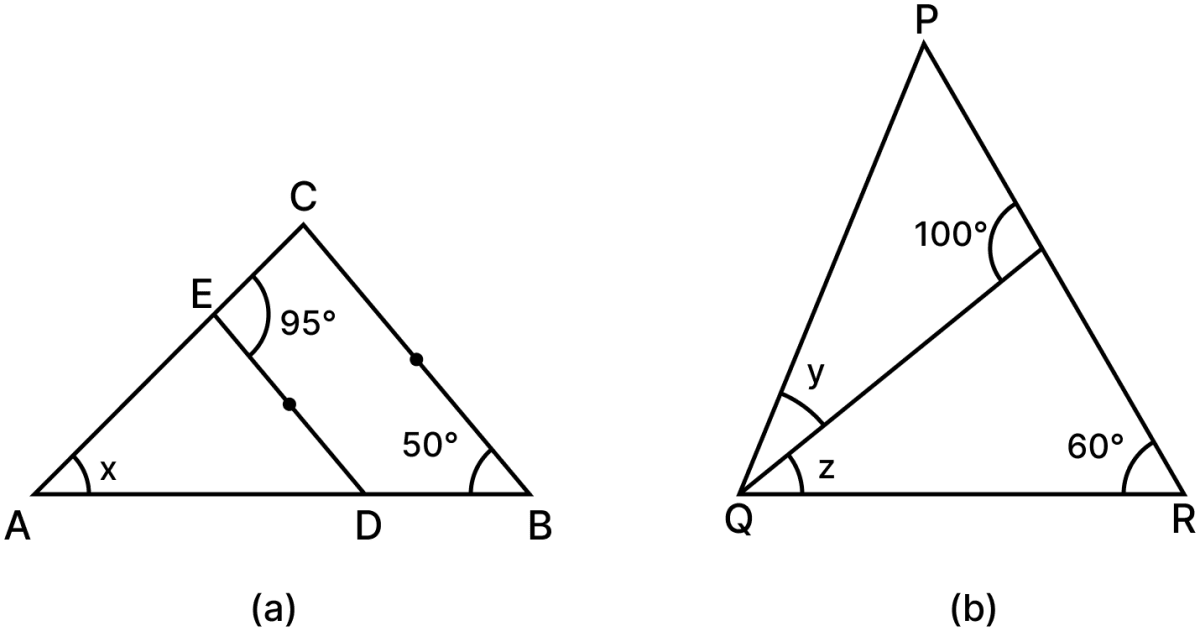
In the fig. (a) given below, . Find the value of . In the fig. (b) given below, . Find the values of and .
Answer
From fig. (a),
= 95°, = 50° and .
Since, lies on ,
Since, ,
= 50° [Corresponding angles]
In , by angle sum property of triangle,
Hence, in fig. (a), .
From fig. (b),
Let the line drawn from meet at .
Then, = 100°, = 60° and .
In , by angle sum property of triangle,
Since, lies on ,
= 180° [Linear pair]
⇒ 100° + = 180°
⇒ = 180° − 100°
⇒ = 80°
In , by angle sum property of triangle,
Hence, in fig. (b), and .
From a rope 15 m long, m is cut off, and of remaining is cut off again. Find the length of remaining part.
Answer
Given,
Length of the rope = 15 m
Length cut off the first time = m
So, the length left after the first cut = m.
Length cut off the second time = of m
= m
= m
Length of the remaining part = Length left after the first cut − Length cut off the second time
Hence, the length of the remaining part = m.
If and , then find .
Answer
Given,
........(1)
Given,
........(2)
Multiplying equations (1) and (2), we get :
Hence, .
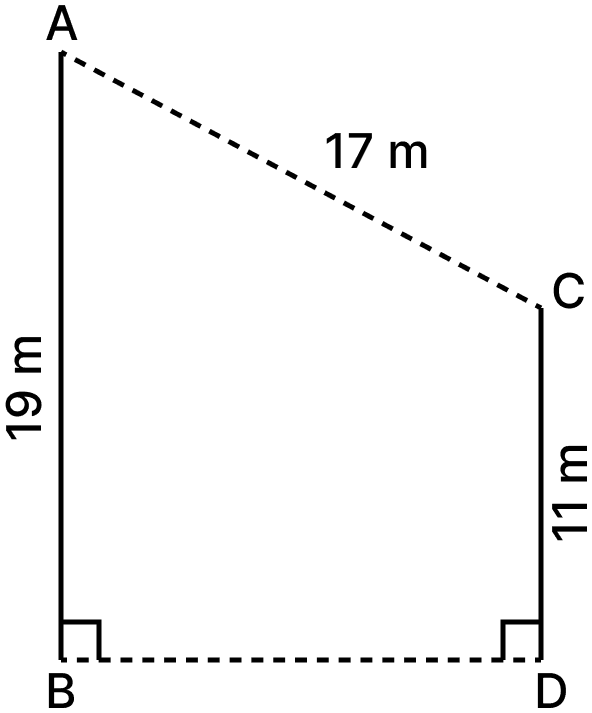
In the given figure, AB and CD are two vertical poles of heights 19 m and 11 m respectively. If the shortest distance between their tops is 17 m, how far apart are they?
Answer
From C, draw CE ⊥ AB, meeting AB at E, as shown in the figure below.
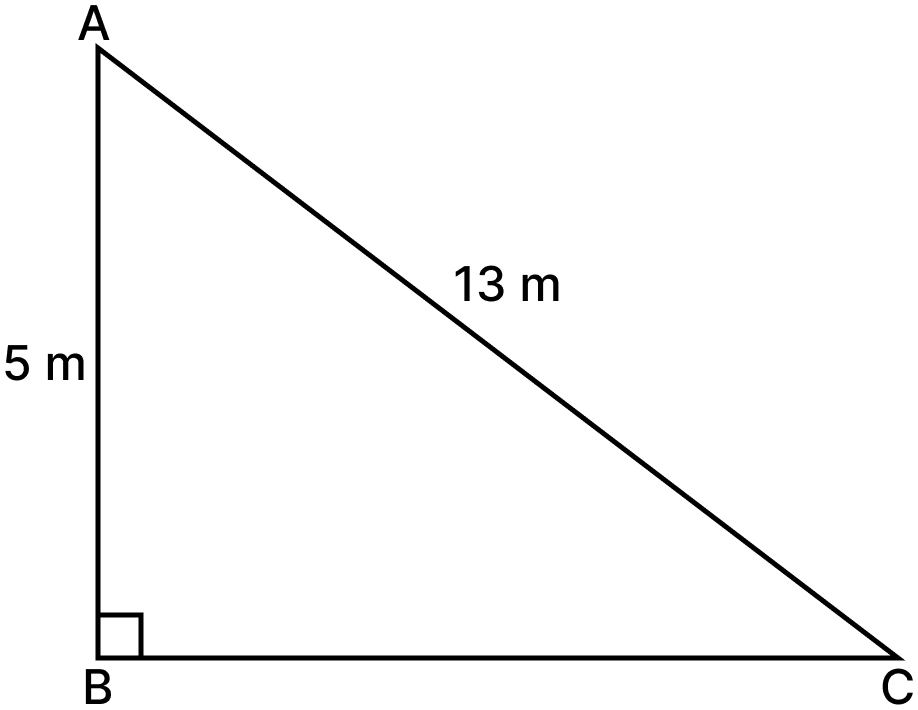
Since AB ⊥ BD, CD ⊥ BD and CE ⊥ AB, BDCE is a rectangle.
∴ EB = CD = 11 m and CE = BD.
⇒ AE = AB − EB
= 19 − 11
= 8 m
Given,
AC = 17 m.
In right angled △ AEC, by Pythagoras theorem,
⇒ AC2 = AE2 + CE2
⇒ 172 = 82 + CE2
⇒ 289 = 64 + CE2
⇒ CE2 = 289 − 64
⇒ CE2 = 225
⇒ CE =
⇒ CE = 15 m.
∴ BD = CE = 15 m.
Hence, the poles are 15 m apart.