
In the adjoining figure, if l ∥ m then the value of x is
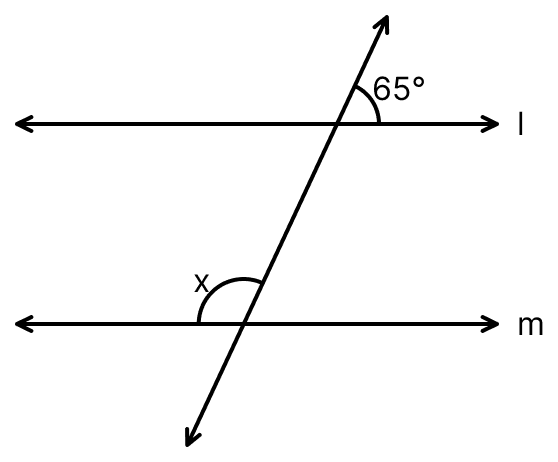
65°
105°
115°
125°
Answer
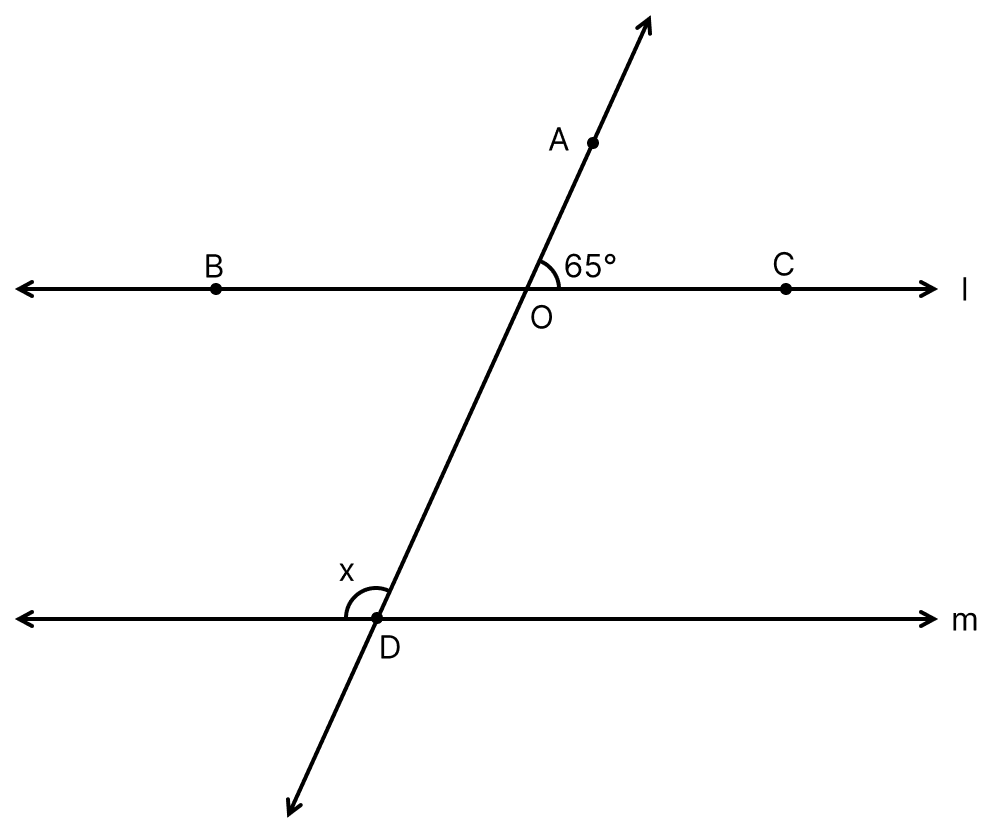
⇒ Since l ∥ m,
∠BOD = ∠AOC = 65° (Vertically opposite angles are equal)
Now, ∠BOD and x are co-interior angles, so they must be supplementary.
⇒ ∠BOD + x = 180°
⇒ 65° + x = 180°
⇒ x = 180° − 65° = 115°.
Hence, option 3 is the correct option.
A triangle whose two angles measure 40° and 100° is
scalene
isosceles
equilateral
right angled
Answer
⇒ The third angle = 180° − (40° + 100°) = 40°.
Two angles are equal (40° each), so the triangle is isosceles.
Hence, option 2 is the correct option.
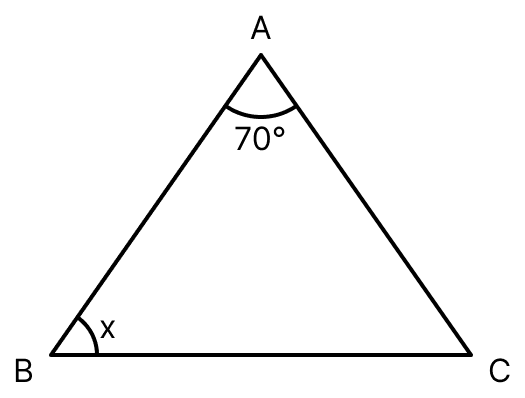
In the adjoining figure, AB = AC. Find the value of x.
Answer
Since AB = AC, the base angles are equal, so ∠B = ∠C = x.
By the angle sum property of △ABC,
⇒ ∠A + ∠B + ∠C = 180°
⇒ 70° + x + x = 180°
⇒ 2x = 110°
⇒ x = 55°
Hence, x = 55°.
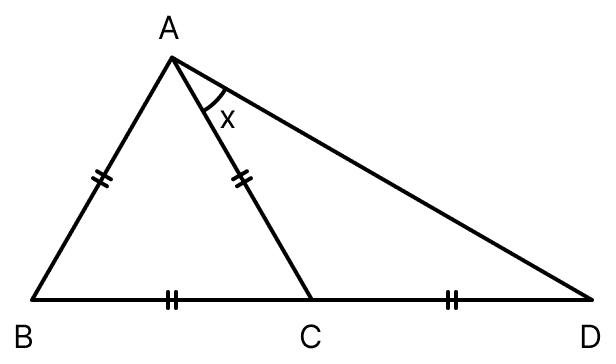
In the adjoining figure, AB = BC = AC = CD. Find the value of x.
Answer
Since AB = BC = AC, △ABC is equilateral, so each of its angles is 60°.
∴ ∠ACB = 60°.
Now ∠ACB and ∠ACD form a linear pair, so
⇒ ∠ACD + ∠ACB = 180°
⇒ ∠ACD + 60° = 180°
⇒ ∠ACD = 180° − 60° = 120°
In △ACD, AC = CD, so the base angles are equal: ∠CAD = ∠CDA = x.
By the angle sum property of △ACD,
⇒ ∠CAD + ∠CDA + ∠ACD = 180°
⇒ x + x + 120° = 180°
⇒ 2x = 60°
⇒ x = 30°
Hence, x = 30°.
If △PQR ≅ △EFD, write the parts of △EFD that correspond to:
(i) ∠Q
(ii)
(iii) ∠P
(iv)
Answer
Under the congruence △PQR ≅ △EFD, the vertices correspond as P ↔ E, Q ↔ F and R ↔ D.
(i) ∠Q corresponds to ∠F.
(ii) corresponds to .
(iii) ∠P corresponds to ∠E.
(iv) corresponds to .
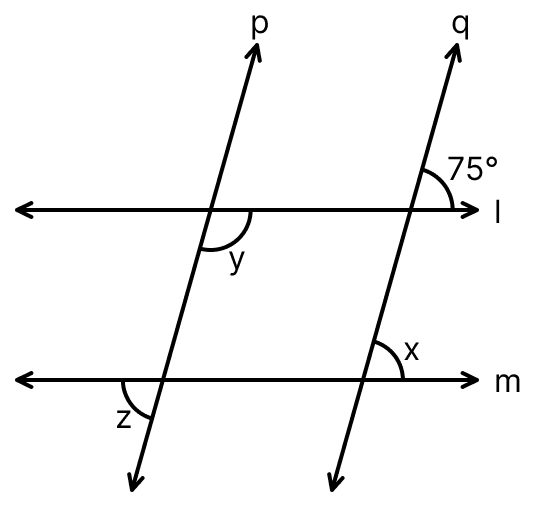
In the adjoining figure, l ∥ m and p ∥ q. Find the values of x, y and z.
Answer
Since l ∥ m, the angle x corresponds to the given 75°:
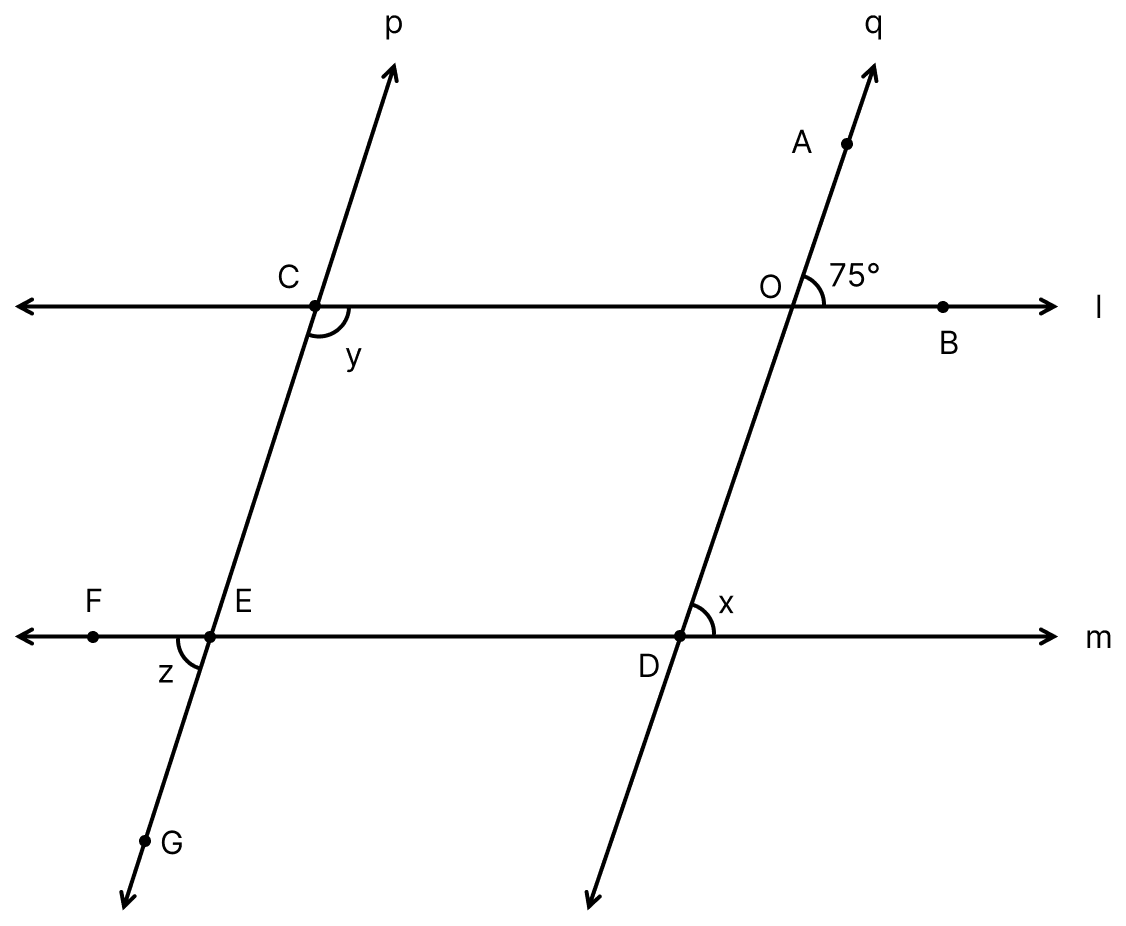
⇒ x = 75° (corresponding angles are equal)
∠COD = ∠AOB = 75° (vertically opposite angles are equal)
Now, l is a transversal to the parallel lines p and q. ∠COD and y lie between p and q, on the same side of l, so they are co-interior angles.
Co-interior angles are supplementary, i.e. their sum is 180°.
⇒ ∠COD + y = 180°
⇒ 75° + y = 180°
⇒ y = 180° − 75° = 105°
As, ∠CED = z (vertically opposite angles are equal)
Since l ∥ m, ∠CED and y are co-interior angles.
⇒ ∠CED + y = 180°
⇒ z + 105° = 180°
⇒ z = 75°
Hence, x = 75°, y = 105° and z = 75°.
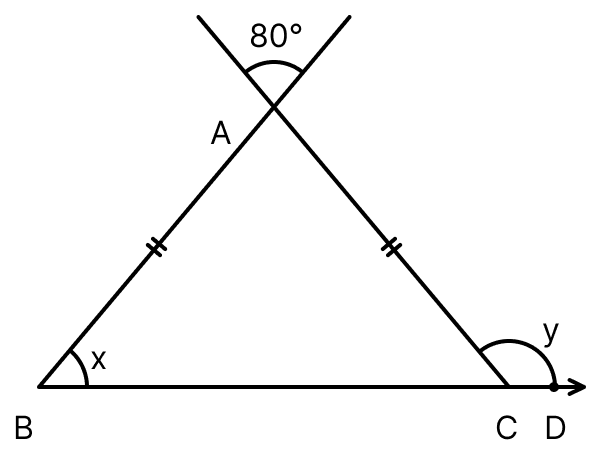
In the adjoining figure, AB = AC. Find the values of x and y.
Answer
Since AB = AC, the base angles are equal, so ∠ABC = ∠ACB = x.
From figure,
∠BAC = 80° (Vertically opposite angles are equal)
By the angle sum property of △ABC,
⇒ ∠BAC + ∠ABC + ∠ACB = 180°
⇒ 80° + x + x = 180°
⇒ 2x = 100°
⇒ x = 50°
Now ∠ACB and y form a linear pair,
⇒ ∠ACB + y = 180°
⇒ x + y = 180°
⇒ y = 180° − 50° = 130°
Hence, x = 50° and y = 130°.
If the lengths of two sides of a triangle are 5 cm and 7.5 cm then what can be the length of the third?
Answer
The third side must be less than the sum and greater than the difference of the other two sides.
Sum = 7.5 + 5 = 12.5 cm and difference = 7.5 − 5 = 2.5 cm.
Hence, the third side is greater than 2.5 cm and less than 12.5 cm.
An apple orchard is in the shape of a rectangle. If its length is 60 m and the length of one diagonal is 75 m, then find:
(i) breadth of the orchard
(ii) perimeter of the orchard
Answer
Let ABCD be the rectangular orchard with length AB = 60 m, diagonal AC = 75 m and breadth BC = b m.
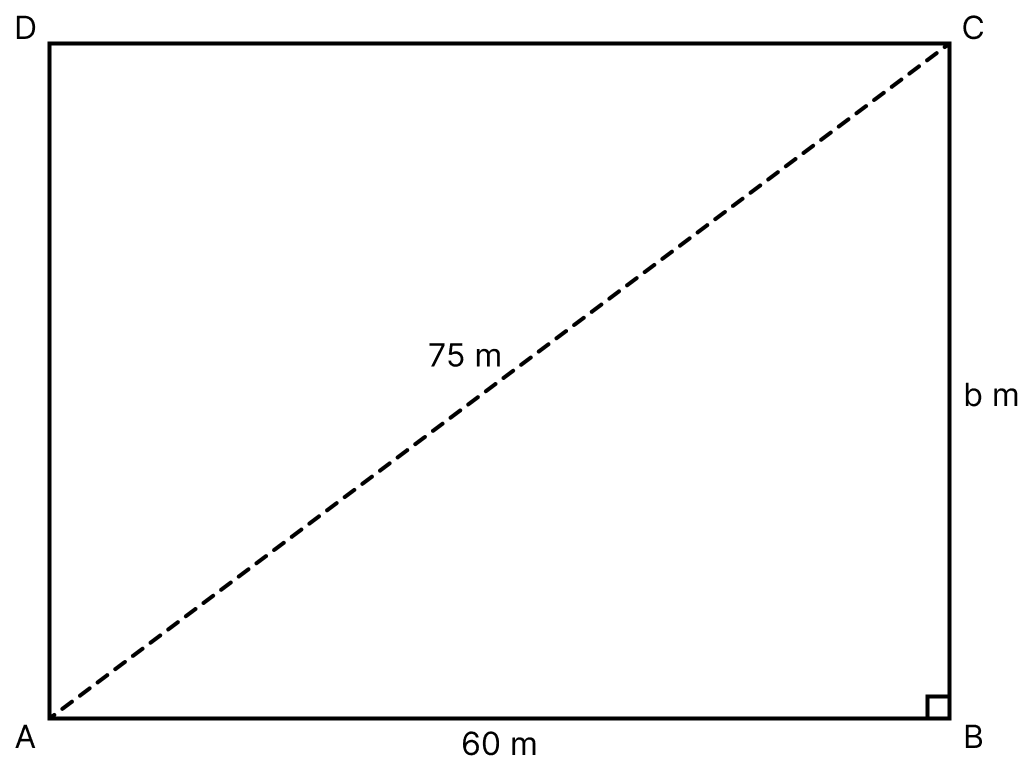
Given: AB = 60 m, AC = 75 m and ∠ABC = 90° (each angle of a rectangle is 90°).
(i) In right-angled △ABC, AC is the hypotenuse.
By Pythagoras theorem,
⇒ AC2 = AB2 + BC2
⇒ 752 = 602 + b2
⇒ 5625 = 3600 + b2
⇒ b2 = 5625 − 3600
⇒ b2 = 2025
⇒ b =
⇒ b = 45 m
Hence, the breadth of the orchard is 45 m.
(ii) By formula,
Perimeter of rectangle = 2(length + breadth)
⇒ Perimeter = 2(60 + 45)
⇒ Perimeter = 2 × 10⁵
⇒ Perimeter = 210 m
Hence, the perimeter of the orchard is 210 m.
In the adjoining figure, measures of some parts are given.
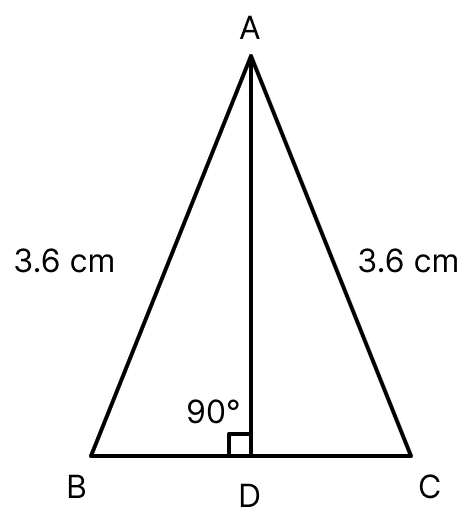
(i) State the three pairs of equal parts in △ABD and △ACD.
(ii) Is △ABD ≅ △ACD? Give reason.
(iii) Is D mid-point of BC? Why?
Answer
(i) The three pairs of equal parts in △ABD and △ACD are:
AB = AC (3.6 cm each)
AD = AD (common)
∠ADB = ∠ADC (90° each)
(ii) From part (i), the right angle, hypotenuse and one side of △ABD are equal to those of △ACD.
Hence, △ABD ≅ △ACD by the RHS rule of congruency.
(iii) Since △ABD ≅ △ACD, the corresponding sides BD and DC are equal, so D divides BC into two equal parts.
Hence, D is the mid-point of BC because BD = DC as corresponding parts of congruent triangles.