
Draw a line, say l, take a point P outside it. Through P, draw a line parallel to l using ruler and compass only.
Answer
Steps of construction :
Draw a line l and take a point P outside it.
Take any point Q on line l. Join P and Q.
With Q as centre and any suitable radius, draw an arc to meet l at C and QP at D.
With P as centre and the same radius (as taken in Step 3), draw an arc to meet PQ at E.
Measure the segment CD with compass.
With E as centre and radius equal to CD, draw an arc to cut the previous arc at F.
Draw a line m passing through P and F.
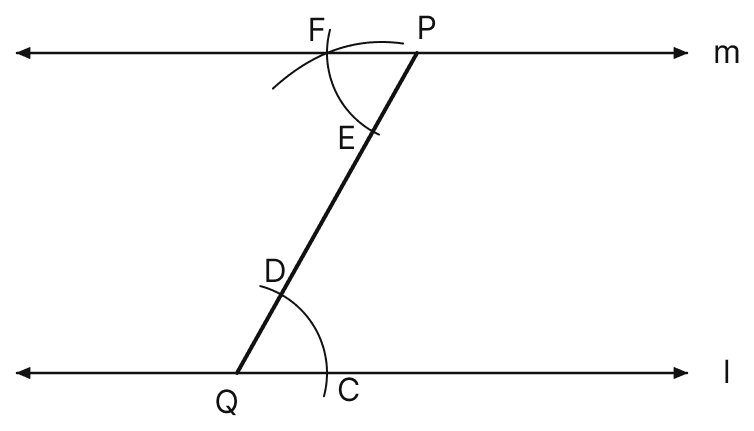
Here, ∠PQC = ∠QPF, which are alternate interior angles.
⇒ Line m is parallel to line l.
Hence, line m passing through P is the required line parallel to l.
Draw a line l. Draw a perpendicular to l at any point on l. On this perpendicular choose a point A, 3.5 cm away from line l. Through A, draw a line m parallel to l.
Answer
Steps of construction :
Draw a line l and mark a point B on it.
With B as centre, draw an arc of any suitable radius to cut l at C.
With C as centre and the same radius, draw another arc to cut the previous arc at D.
Again with D as centre and the same radius, draw one more arc to cut the first arc at E.
With D and E as centres, draw two arcs of equal radii (more than half of DE) to cut each other at F.
Join BF and produce it to any point X. Then, ∠XBC = 90°, i.e., BX is perpendicular to l.
With B as centre and radius 3.5 cm, draw an arc to cut BX at A.
With A as centre, draw an arc of any suitable radius to cut AB at G.
With G as centre and the same radius, draw another arc to cut the previous arc at H.
Again with H as centre and the same radius, draw one more arc to cut the first arc at K.
With H and K as centres, draw two arcs of equal radii (more than half of HK) to cut each other at L.
Join AL and produce it on both sides to get line m.
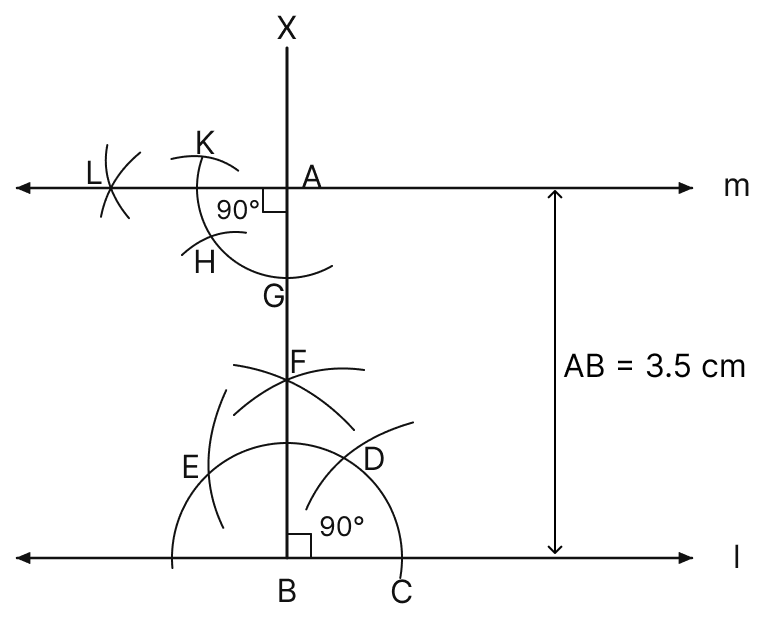
Here, ∠BAL = ∠XBC = 90°, which are alternate angles.
⇒ Line m is parallel to line l.
Hence, line m passing through A (which is 3.5 cm away from l) is the required line parallel to l.
Construct a triangle ABC, given that AB = 5 cm, BC = 6 cm and AC = 7 cm.
Answer
Given, in Δ ABC, AB = 5 cm, BC = 6 cm and AC = 7 cm.
Steps of construction :
Draw a line segment BC = 6 cm.
With B as centre, draw an arc of radius 5 cm and with C as centre draw another arc with radius 7 cm. Let these arcs meet at A.
Join AB and AC.
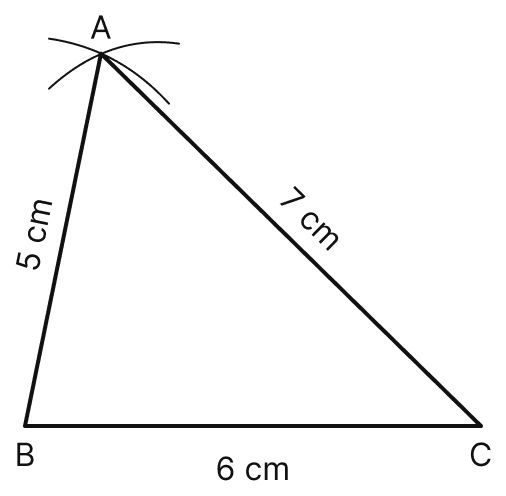
Hence, triangle ABC so obtained is the required triangle.
Construct a triangle ABC, given that AB = 4.5 cm, BC = 5 cm and AC = 6 cm.
Answer
Given, in Δ ABC, AB = 4.5 cm, BC = 5 cm and AC = 6 cm.
Steps of construction :
Draw a line segment BC = 5 cm.
With B as centre, draw an arc of radius 4.5 cm and with C as centre draw another arc with radius 6 cm. Let these arcs meet at A.
Join AB and AC.
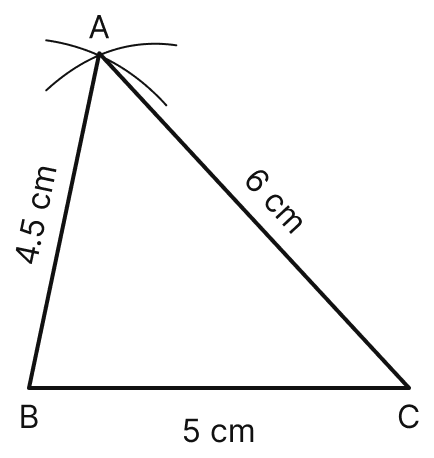
Hence, triangle ABC so obtained is the required triangle.
Construct a triangle PQR given that PQ = 5.4 cm, QR = PR = 4.7 cm. Name the triangle.
Answer
Given, in Δ PQR, PQ = 5.4 cm and QR = PR = 4.7 cm.
Steps of construction :
Draw a line segment PQ = 5.4 cm.
With P as centre, draw an arc of radius 4.7 cm and with Q as centre draw another arc with radius 4.7 cm. Let these arcs meet at R.
Join PR and QR.
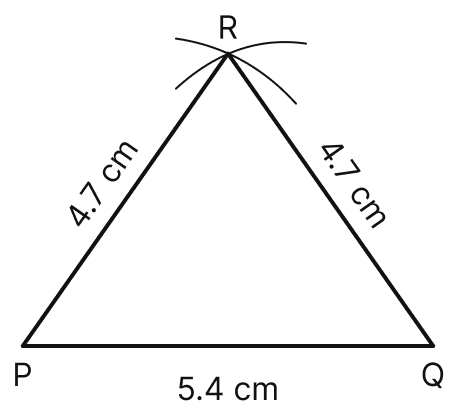
Hence, triangle PQR so obtained is the required triangle.
Since, QR = PR = 4.7 cm,
⇒ Two sides of the triangle are equal.
Hence, Δ PQR is an isosceles triangle.
Construct a triangle LMN such that length of each side is 5.3 cm. Name the triangle.
Answer
Given, in Δ LMN, LM = MN = NL = 5.3 cm.
Steps of construction :
Draw a line segment MN = 5.3 cm.
With M as centre, draw an arc of radius 5.3 cm.
With N as centre, draw another arc of radius 5.3 cm. Let the two arcs intersect each other at point L.
Join LM and LN.
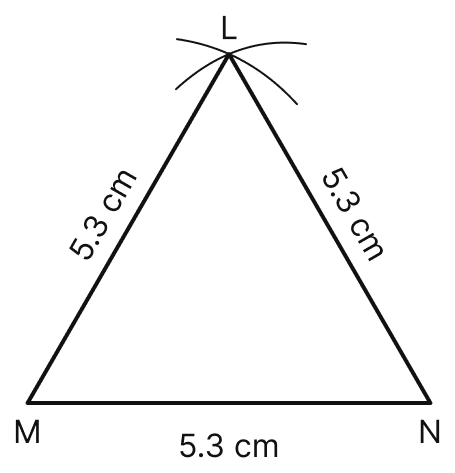
Hence, triangle LMN so obtained is the required triangle.
Since, all three sides of the triangle are equal,
Hence, Δ LMN is an equilateral triangle.
Construct a triangle ABC such that AB = 2.5 cm, BC = 6 cm and AC = 6.5 cm. Measure ∠ABC and name the triangle.
Answer
Given, in Δ ABC, AB = 2.5 cm, BC = 6 cm and AC = 6.5 cm.
Steps of construction :
Draw a line segment BC = 6 cm.
With B as centre, draw an arc of radius 2.5 cm and with C as centre draw another arc with radius 6.5 cm. Let these arcs meet at A.
Join AB and AC.
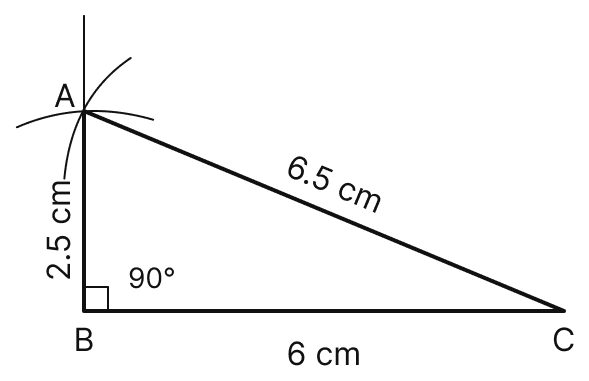
Hence, triangle ABC so obtained is the required triangle.
On measuring, we get :
∠ABC = 90°
Since, one angle of the triangle is 90°,
Hence, Δ ABC is a right angled triangle.
Construct a triangle PQR, given that PQ = 3 cm, QR = 5.5 cm and ∠PQR = 60°.
Answer
Given, in Δ PQR, PQ = 3 cm, QR = 5.5 cm and ∠PQR = 60°.
Steps of construction :
Draw a line segment QR = 5.5 cm.
With Q as centre, draw an arc of any suitable radius to cut QR at A.
With A as centre and the same radius, draw another arc to cut the previous arc at B.
Join QB and produce it to any point X. Then, ∠XQR = 60°.
With Q as centre, draw an arc of 3 cm radius, which cuts QX at P.
Join PR.
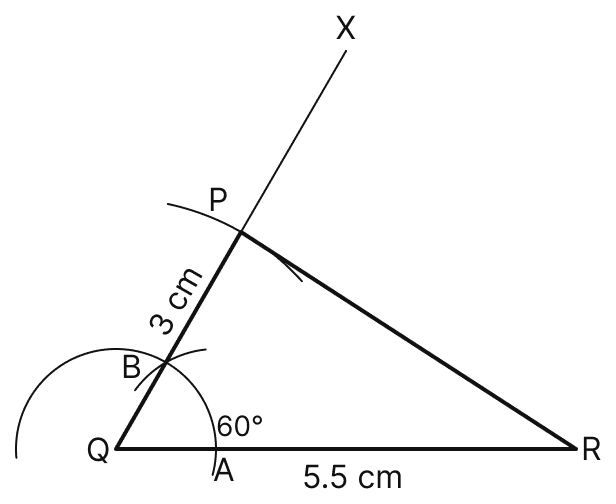
Hence, PQR is the required triangle.
Construct ΔDEF such that DE = 5 cm, DF = 3 cm and m∠EDF = 90°.
Answer
Given, in Δ DEF, DE = 5 cm, DF = 3 cm and ∠EDF = 90°.
Steps of construction :
Draw a line segment DE = 5 cm.
With D as centre, draw an arc of any suitable radius to cut DE at A.
With A as centre and the same radius, draw another arc to cut the previous arc at B.
Again with B as centre and the same radius, draw one more arc to cut the first arc at C.
With B and C as centres, draw two arcs of equal radii (more than half of BC) to cut each other at G.
Join DG and produce it to any point X. Then, ∠XDE = 90°.
With D as centre, draw an arc of 3 cm radius, which cuts DX at F.
Join EF.
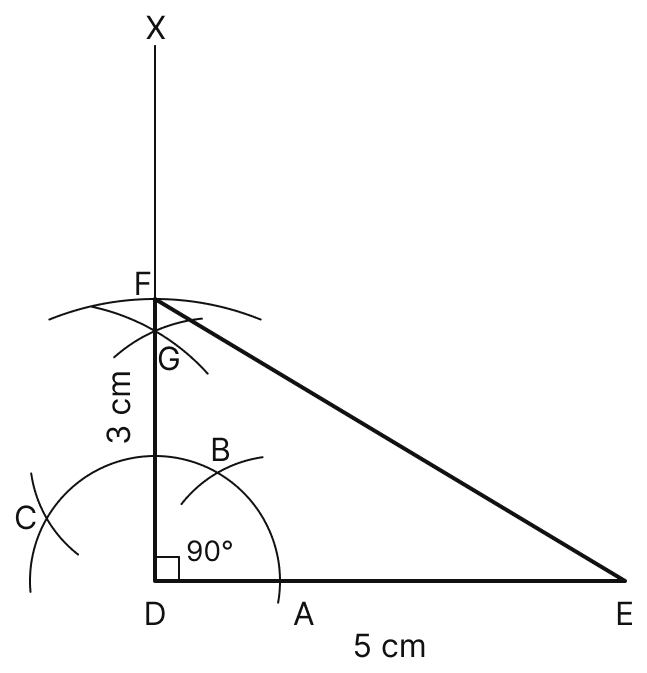
Hence, DEF is the required triangle.
Construct an isosceles triangle in which the length of each of its equal sides is 6.5 cm and the angle between them is 110°. Measure base angles.
Answer
Vertex angle is the angle between two equal sides.
Let the equal sides be AB = AC = 6.5 cm and vertex angle ∠BAC = 110°.
Steps of construction :
Draw a line segment AB = 6.5 cm.
At A, draw AP so that angle BAP = 110° (by using protractor).
With A as centre draw an arc of 6.5 cm radius, which cuts AP at C. Join C and B.
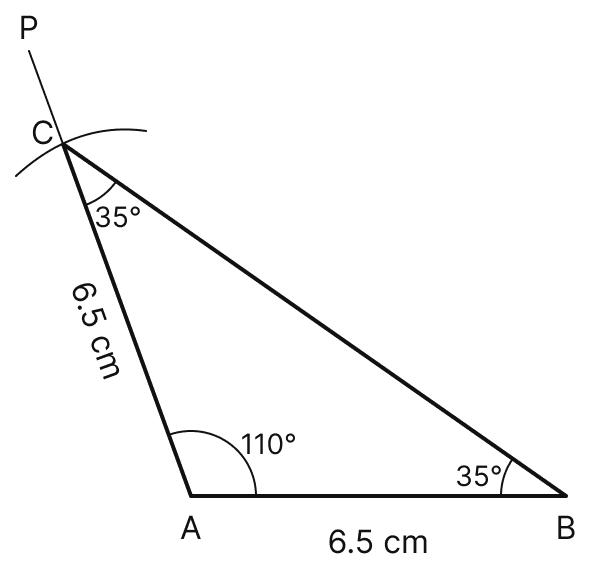
Hence, ABC is the required isosceles triangle.
On measuring, we get :
∠ABC = ∠ACB = 35°
Construct triangle XYZ if it is given that XY = 6 cm, ∠X = 30° and ∠Y = 100°.
Answer
Given, in Δ XYZ, XY = 6 cm, ∠X = 30° and ∠Y = 100°.
Steps of construction :
Draw a line segment XY = 6 cm.
With X as centre, draw an arc of any suitable radius to cut XY at A.
With A as centre and the same radius, draw another arc to cut the previous arc at B.
Join XB. Then, ∠YXB = 60°.
With A and B as centres and radius more than half of AB, draw two arcs which cut each other at C.
Join XC and produce it to any point P. Then, ∠YXP = ∠YXB = × 60° = 30°.
At Y, draw ∠XYQ = 100° (by using protractor).
Let rays XP and YQ meet at Z.
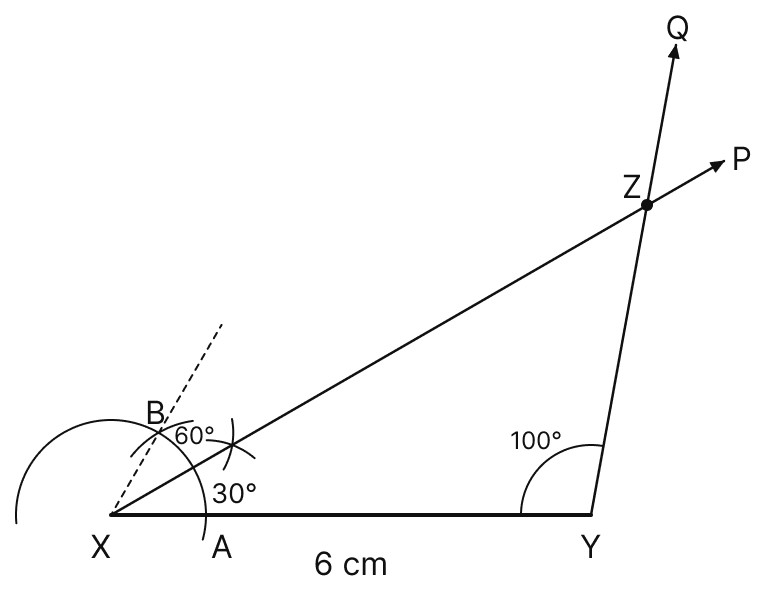
Hence, XYZ is the required triangle.
Construct a triangle PQR given that PQ = 4.9 cm, ∠P = 45° and ∠Q = 60°. Measure ∠R.
Answer
Given, in Δ PQR, PQ = 4.9 cm, ∠P = 45° and ∠Q = 60°.
Steps of construction :
Draw a line segment PQ = 4.9 cm.
With P as centre, draw an arc of any suitable radius to cut PQ at A.
With A as centre and the same radius, draw another arc to cut the previous arc at B.
Again with B as centre and the same radius, draw one more arc to cut the first arc at C.
With B and C as centres, draw two arcs of equal radii (more than half of BC) to cut each other at D.
Join PD. Then, ∠QPD = 90°.
Let PD cut the first arc at E.
With A and E as centres and radius more than half of AE, draw two arcs which cut each other at F.
Join PF and produce it to any point X. Then, ∠QPX = ∠QPD = × 90° = 45°.
With Q as centre, draw an arc of any suitable radius to cut QP at G.
With G as centre and the same radius, draw another arc to cut the previous arc at H.
Join QH and produce it to any point Y. Then, ∠PQY = 60°.
Let rays PX and QY meet at R.
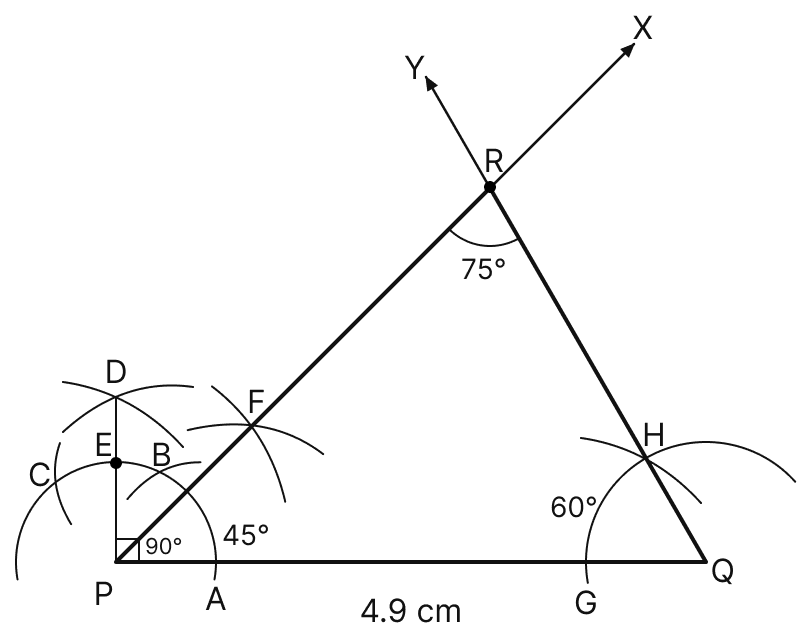
Hence, PQR is the required triangle.
On measuring, we get :
∠R = 75°
Construct a right angled triangle whose hypotenuse is 6 cm long and one of the legs is 4 cm long.
Answer
Let ABC be the right angled triangle with ∠B = 90°, leg BC = 4 cm and hypotenuse AC = 6 cm.
Steps of construction :
Draw a line segment BC = 4 cm.
With B as centre, draw an arc of any suitable radius to cut BC at D.
With D as centre and the same radius, draw another arc to cut the previous arc at E.
Again with E as centre and the same radius, draw one more arc to cut the first arc at F.
With E and F as centres, draw two arcs of equal radii (more than half of EF) to cut each other at G.
Join BG and produce it to any point P. Then, ∠CBP = 90°.
With C as centre and radius 6 cm, draw an arc to meet BP at A.
Join AC.
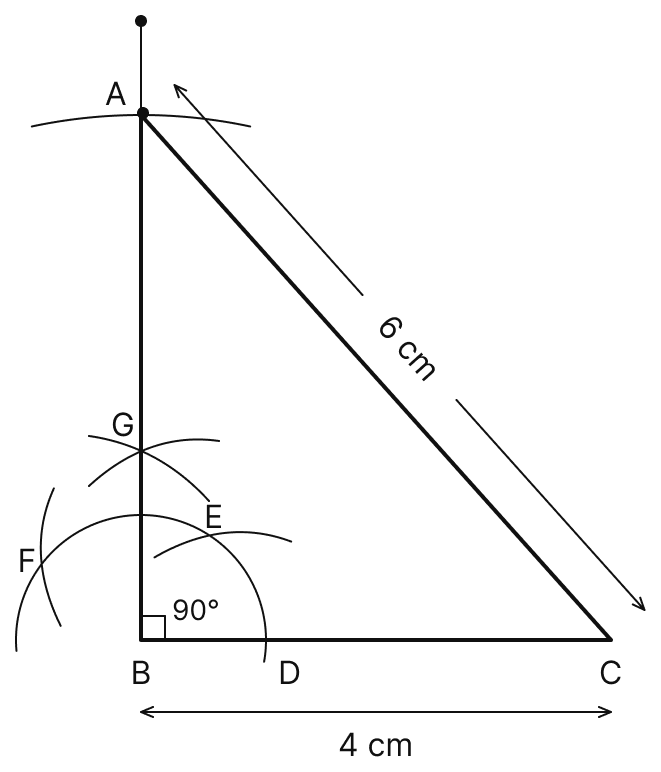
Hence, ABC is the required right angled triangle.
State whether the following statements are true or false. Justify your answer.
(i) A triangle with lengths of sides 2.5 cm, 3 cm and 6 cm can be constructed.
(ii) A triangle DEF with EF = 7.2 cm, m∠E = 110° and m∠F = 80° can be constructed.
(iii) If the measure of an acute angle and the length of hypotenuse of a right angled triangle are given, then the triangle can be constructed.
Answer
(i) A triangle can be constructed only if the sum of the lengths of any two sides is greater than the length of the third side.
Sum of lengths of two sides = 2.5 cm + 3 cm = 5.5 cm
⇒ 5.5 cm < 6 cm
∴ Sum of lengths of two sides is less than the length of the third side.
Hence, the given statement is false.
(ii) The sum of measures of all three angles of a triangle is 180°.
∠E + ∠F = 110° + 80° = 190°
⇒ ∠E + ∠F > 180°, which is not possible.
Hence, the given statement is false.
(iii) In a right angled triangle, one angle is 90°.
Let the given acute angle be x.
By angle sum property of triangle,
Third angle = 180° − 90° − x
∴ The measures of both acute angles become known and the hypotenuse is the side included between them.
So, the triangle can be constructed by ASA.
Hence, the given statement is true.
Draw a line AB and take a point C outside it. Through C, draw a line parallel to AB by using the concept of equal corresponding angles.
Answer
Steps of construction :
Draw a line AB and take a point C outside it.
Take any point D on AB. Join D and C and produce DC to any point E.
With D as centre and any suitable radius, draw an arc to meet DB at G and DC at H.
With C as centre and the same radius (as taken in Step 3), draw an arc to meet CE at K.
Measure the segment GH with compass.
With K as centre and radius equal to GH, draw an arc to cut the previous arc at L (on the same side of DE as B).
Draw a line XY passing through C and L.
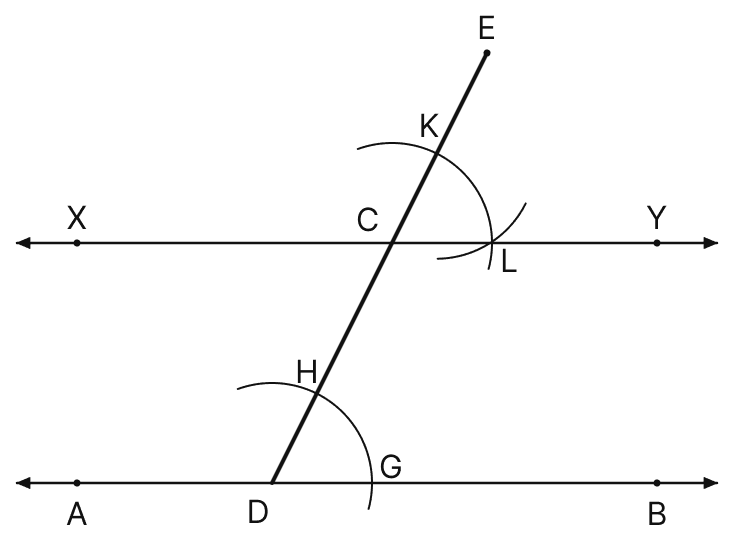
Here, ∠ECL = ∠CDB, which are corresponding angles.
⇒ Line XY is parallel to AB.
Hence, line XY is the required line through C and parallel to AB.
Draw a triangle PQR with PQ = 4 cm, QR = 3.5 cm and PR = 4 cm. What type of triangle is this?
Answer
Given, in Δ PQR, PQ = 4 cm, QR = 3.5 cm and PR = 4 cm.
Steps of construction :
Draw a line segment QR = 3.5 cm.
With Q as centre, draw an arc of radius 4 cm and with R as centre draw another arc with radius 4 cm. Let these arcs meet at P.
Join PQ and PR.
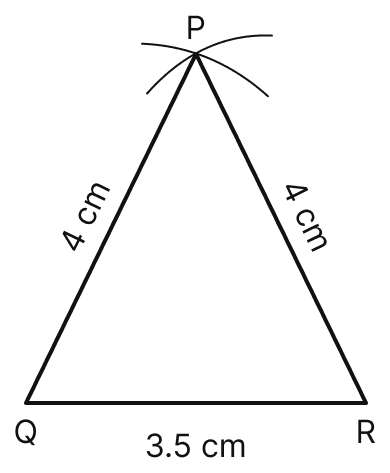
Hence, triangle PQR so obtained is the required triangle.
Since, PQ = PR = 4 cm,
⇒ Two sides of the triangle are equal.
Hence, Δ PQR is an isosceles triangle.
Construct a triangle ABC with BC = 7.5 cm, AC = 5 cm and m∠C = 60° by using ruler and compass only.
Answer
Given, in Δ ABC, BC = 7.5 cm, AC = 5 cm and ∠C = 60°.
Steps of construction :
Draw a line segment BC = 7.5 cm.
With C as centre, draw an arc of any suitable radius to cut CB at D.
With D as centre and the same radius, draw another arc to cut the previous arc at E.
Join CE and produce it to any point P. Then, ∠BCP = 60°.
With C as centre, draw an arc of 5 cm radius, which cuts CP at A.
Join AB.
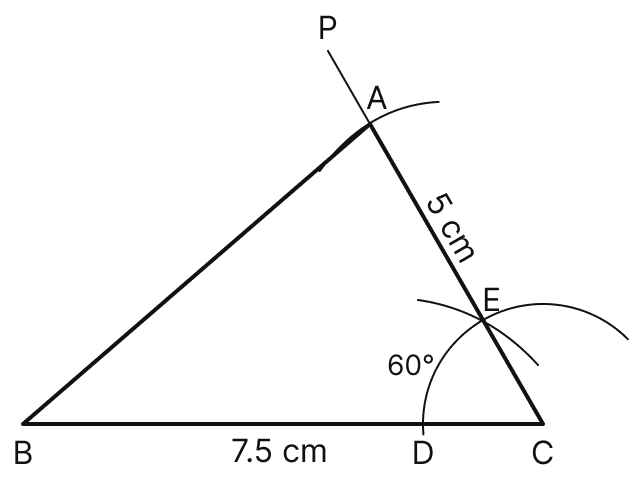
Hence, ABC is the required triangle.
Construct a triangle ABC, given m∠A = 60°, m∠B = 30° and AB = 5.8 cm by using ruler and compass only.
Answer
Given, in Δ ABC, AB = 5.8 cm, ∠A = 60° and ∠B = 30°.
Steps of construction :
Draw a line segment AB = 5.8 cm.
With A as centre, draw an arc of any suitable radius to cut AB at D.
With D as centre and the same radius, draw another arc to cut the previous arc at E.
Join AE and produce it to any point P. Then, ∠BAP = 60°.
With B as centre, draw an arc of any suitable radius to cut BA at F.
With F as centre and the same radius, draw another arc to cut the previous arc at G.
Join BG. Then, ∠ABG = 60°.
With F and G as centres and radius more than half of FG, draw two arcs which cut each other at H.
Join BH and produce it to any point Q. Then, ∠ABQ = ∠ABG = × 60° = 30°.
Let rays AP and BQ meet at C.
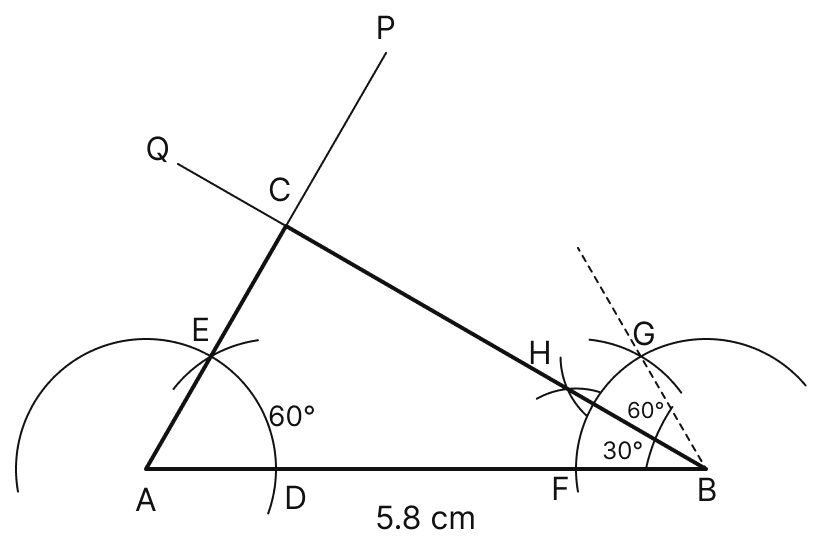
Hence, ABC is the required triangle.
Construct an isosceles right angled triangle ABC, with m∠ABC = 90° and AC = 6 cm.
Answer
Given, Δ ABC is an isosceles right angled triangle with ∠ABC = 90° and hypotenuse AC = 6 cm.
⇒ AB = BC
In an isosceles triangle, the angles opposite to equal sides are equal.
⇒ ∠BAC = ∠BCA
In Δ ABC,
∠BAC + ∠ABC + ∠BCA = 180° [Angle sum property of triangle]
⇒ ∠BAC + 90° + ∠BAC = 180°
⇒ 2∠BAC = 90°
⇒ ∠BAC = ∠BCA = 45°
Steps of construction :
Draw a line segment AC = 6 cm.
With A as centre, draw an arc of any suitable radius to cut AC at D.
With D as centre and the same radius, draw another arc to cut the previous arc at E.
Again with E as centre and the same radius, draw one more arc to cut the first arc at F.
With E and F as centres, draw two arcs of equal radii (more than half of EF) to cut each other at G.
Join AG. Then, ∠CAG = 90°.
Let AG cut the first arc at H.
With D and H as centres and radius more than half of DH, draw two arcs which cut each other at K.
Join AK and produce it to any point P. Then, ∠CAP = ∠CAG = × 90° = 45°.
With C as centre, draw an arc of any suitable radius to cut CA at L.
With L as centre and the same radius, draw another arc to cut the previous arc at M.
Again with M as centre and the same radius, draw one more arc to cut the first arc at N.
With M and N as centres, draw two arcs of equal radii (more than half of MN) to cut each other at R.
Join CR. Then, ∠ACR = 90°.
Let CR cut the first arc at S.
With L and S as centres and radius more than half of LS, draw two arcs which cut each other at T.
Join CT and produce it to any point Q. Then, ∠ACQ = ∠ACR = × 90° = 45°.
Let rays AP and CQ meet at B.
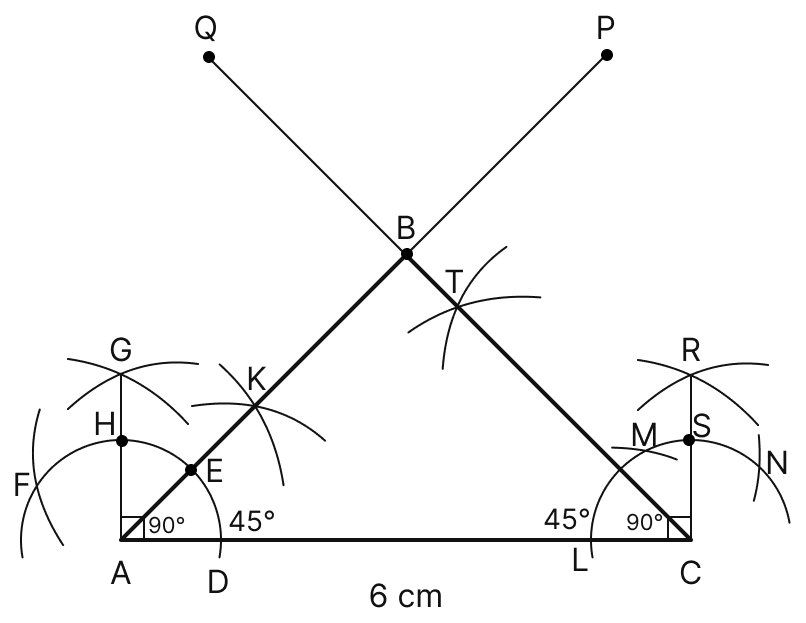
Hence, ABC is the required isosceles right angled triangle.
Construct a triangle ABC such that BC = 5.2 cm, AB = 4.8 cm and median CM = 3.6 cm.
Answer
Given,
In Δ ABC, BC = 5.2 cm, AB = 4.8 cm and median CM = 3.6 cm.
Since, CM is the median,
⇒ M is the mid-point of AB.
⇒ BM = MA = AB = × 4.8 cm = 2.4 cm
Steps of construction :
Draw a line segment BC = 5.2 cm.
With B as centre, draw an arc of radius 2.4 cm and with C as centre draw another arc with radius 3.6 cm. Let these arcs meet at M.
Join BM and CM.
Produce BM to any point X.
With M as centre and radius 2.4 cm, draw an arc to cut MX at A.
Join AC.
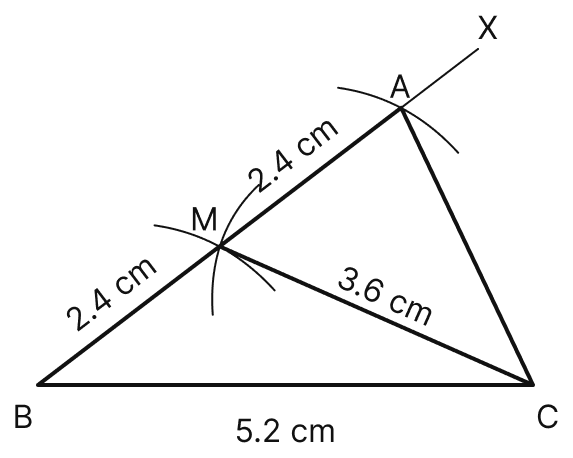
Here, AB = BM + MA = 2.4 cm + 2.4 cm = 4.8 cm and CM is the median.
Hence, ABC is the required triangle.
Construct an isosceles right angled triangle ABC such that its hypotenuse BC = 6 cm.
Answer
Given, Δ ABC is an isosceles right angled triangle with hypotenuse BC = 6 cm.
⇒ ∠BAC = 90° and AB = AC
In an isosceles triangle, the angles opposite to equal sides are equal.
⇒ ∠ABC = ∠ACB
In Δ ABC,
∠BAC + ∠ABC + ∠ACB = 180° [Angle sum property of triangle]
⇒ 90° + ∠ABC + ∠ABC = 180°
⇒ 2∠ABC = 90°
⇒ ∠ABC = ∠ACB = 45°
Steps of construction :
Draw a line segment BC = 6 cm.
With B as centre, draw an arc of any suitable radius to cut BC at D.
With D as centre and the same radius, draw another arc to cut the previous arc at E.
Again with E as centre and the same radius, draw one more arc to cut the first arc at F.
With E and F as centres, draw two arcs of equal radii (more than half of EF) to cut each other at G.
Join BG. Then, ∠CBG = 90°.
Let BG cut the first arc at H.
With D and H as centres and radius more than half of DH, draw two arcs which cut each other at K.
Join BK and produce it to any point P. Then, ∠CBP = ∠CBG = × 90° = 45°.
With C as centre, draw an arc of any suitable radius to cut CB at L.
With L as centre and the same radius, draw another arc to cut the previous arc at M.
Again with M as centre and the same radius, draw one more arc to cut the first arc at N.
With M and N as centres, draw two arcs of equal radii (more than half of MN) to cut each other at R.
Join CR. Then, ∠BCR = 90°.
Let CR cut the first arc at S.
With L and S as centres and radius more than half of LS, draw two arcs which cut each other at T.
Join CT and produce it to any point Q. Then, ∠BCQ = ∠BCR = × 90° = 45°.
Let rays BP and CQ meet at A.
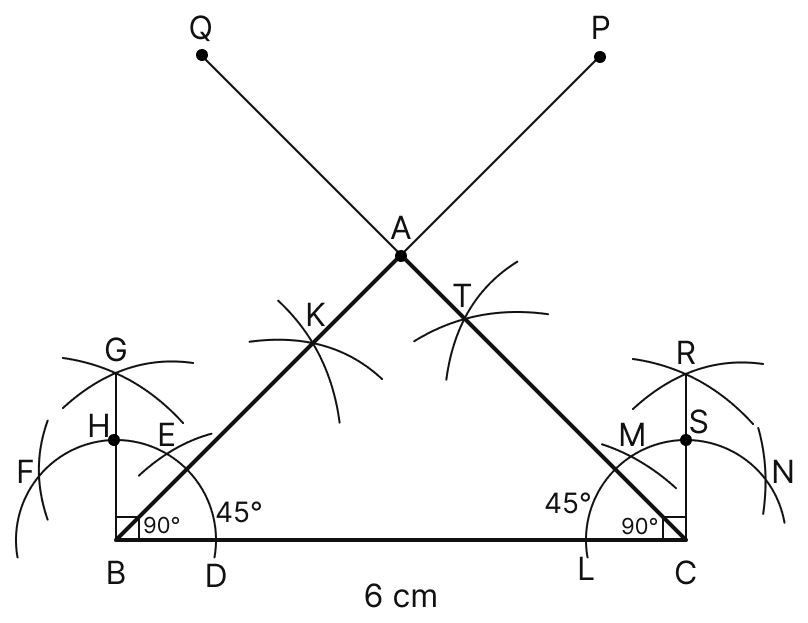
Hence, ABC is the required isosceles right angled triangle.