
The length of the diagonal of a rectangle having length l units and breadth b units is
- (l + b) units
- √l2 - b2 units
- (l2 + b2 - lb) units
- √l2 + b2 units
Answer
If we draw a diagonal in a rectangle, it forms a right-angled triangle.
By the Pythagorean theorem:
Diagonal2 = Length2 + Breadth2.
To find the diagonal, we take the square root.
∴ Diagonal2 = l2 + b2
Diagonal =
Hence, option 4 is the correct option.
The length of a rectangle is 12 cm and the length of its diagonal is 15 cm. The area of the rectangle is
- 72 cm2
- 96 cm2
- 108 cm2
- 120 cm2
Answer
First, let's find the breadth using the diagonal:
Diagonal =
⇒ Breadth =
⇒ Breadth = cm2
⇒ Breadth = cm2
⇒ Breadth = cm2
⇒ Breadth = 9 cm
Now, Area = Length x Breadth
= 12 cm x 9 cm
= 108 cm2
Hence, option 3 is the correct option.
The length of a rectangular field is thrice its breadth. If its perimeter is 560 m, then its length is
- 120 m
- 180 m
- 210 m
- 240 m
Answer
Let breadth = x
Then length = 3x
Perimeter = 560 m [Given]
We know the formula,
Perimeter = 2(Length + Breadth)
560 m = 2(3x + x)
560 m = 2(4x)
560 m = 8x
⇒ x = m
⇒ x = 70 m
∴ length = 3x = (3 x 70) m = 210 m
Hence, option 3 is the correct option.
The perimeter of a rhombus of each side measuring a units is
- a√2 units
- 4a units
- a2 units
- units
Answer
Like a square, all four sides of a rhombus are equal.
So, Perimeter = a + a + a + a = 4a units
Hence, option 2 is the correct option.
The length of each diagonal of a square of side a units is
- a√2 units
- 2a units
- 4a units
- 2 √2 a units
Answer
When we draw a diagonal, it splits the square into two identical right-angled triangles.
In any right-angled triangle, the square of the longest side (the hypotenuse) is equal to the sum of the squares of the other two sides.
Hypotenuse2 = Side12 + Side22
For our square, the diagonal (d) is the hypotenuse, and the two sides of the square are the other two sides of the triangle.
∴ d2 = a2 + a2 units
d2 = 2a2 units
d = units
d = a units
Hence, option 1 is the correct option.
The area of a square and that of a square drawn on its diagonal are in the ratio
- 1 : √2
- 1 : 2
- 1 : 2√2
- 1 : 4
Answer
Area of original square = a2
The side of the new square is the diagonal = a
Area of new square = (a)2
= 2a2
Ratio = a2 : 2a2 = 1 : 2
Hence, option 2 is the correct option.
An area of 1 are is equal to
- 1 m2
- 10 m2
- 100 m2
- 10000 m2
Answer
1 are is the area of a square whose sides are exactly 10 metres long.
To find the area of such a square, we multiply the length by the width:
Area = Side x Side
= 10 m x 10 m
= 100 m2
Hence, option 3 is the correct option.
The breadth of a rectangle having area A sq. units and length l units is
- units
- units
- units
- units
Answer
Given:
Area = A sq. units
Length = l units
We know the formula,
Area of rectangle = Length x Breadth
⇒ Breadth = units
⇒ Breadth = units
Looking at the provided options, no option correctly match the answer. So, none of the options is correct.
The length of each side of a square having area A sq. units is
- units
- units
- units
- units
Answer
Area of square = (Side)2
A sq. units = (Side)2
⇒ Side = units
Hence, option 3 is the correct option.
Height of an equilateral triangle with each side of length a units is
- a units
- units
- a units
- units
Answer
To find the height of an equilateral triangle, draw a perpendicular line (height, h) from the top vertex to the base. This divides the equilateral triangle into two identical right-angled triangles.
The hypotenuse is the side of the original triangle (a).
The base of this smaller right triangle is exactly half of the original base .
Using Pythagoras' theorem (a2 + b2 = c2)
Looking at the provided options, no option correctly match the answer. So, none of the options is correct.
Area of an equilateral triangle of side a units is
- sq. units
- sq. units
- sq. units
- sq. units
Answer
sq. units
This is the standard formula for the area of an equilateral triangle.
Hence, option 2 is the correct option.
The sides of a triangle measure 13 cm, 14 cm and 15 cm. Its area is
- 84 cm2
- 91 cm2
- 105 cm2
- 130 cm2
Answer
Given:
Sides: a = 13 cm, b = 14 cm, c = 15 cm
Semi-perimeter: s =
Area =
Hence, option 1 is the correct option.
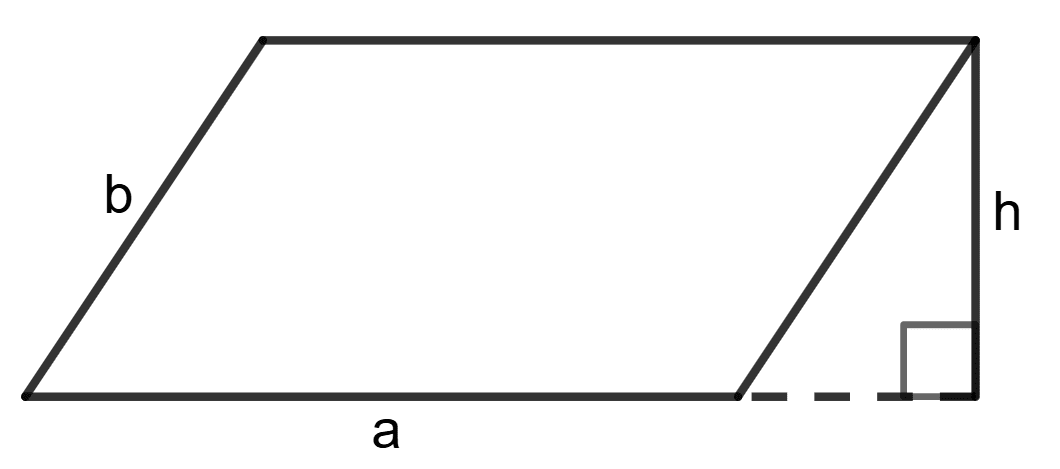
The area of the parallelogram shown in the figure given below, is equal to
- a x h
- h x h
Answer
For any parallelogram:
Area = base x height
From the figure,
base = a
height = h
So, Area = a x h
Hence, option 2 is the correct option.
The lengths of the diagonals of a rhombus are 14 cm and 24 cm respectively. Its area is
- 154 cm2
- 168 cm2
- 182 cm2
- 192 cm2
Answer
Given:
d1 = 14 cm, d2 = 24 cm
Area of rhombus = x d1 x d2
= x 14 cm x 24 cm
= x 336 cm2
= x 168 cm2
= 168 cm2
Hence, option 2 is the correct option.
The area of a ring formed between two concentric circles of radii R and r (where R > 1) is equal to
- π(R + r)
- 2π (R - r)
- π(R2 - r2)
- 2π(R2 + r2)
Answer
We find the area of the big circle (πR2) and subtract the area of the small circle (πr2).
i.e., πR2 - πr2
= π(R2 - r2)
Hence, option 3 is the correct option.
Fill in the blanks :
(i) The perimeter of a simple closed figure is the length of its ............... .
(ii) The ............... of a circle is called its circumference.
(iii) Pie (π) is the ratio of the circumference of any circle to its ............... .
(iv) The area of a simple closed figure is the measure of the ............... enclosed by it.
(v) An area of 1 hectare is equal to ............... m2.
(vi) A unit square grid sheet is a sheet containing horizontal and vertical lines forming squares, each of dimensions ............... .
(vii) In a triangle having sides of lengths a units, b units and c units respectively, if s = units, then s is called the ............... of the triangle.
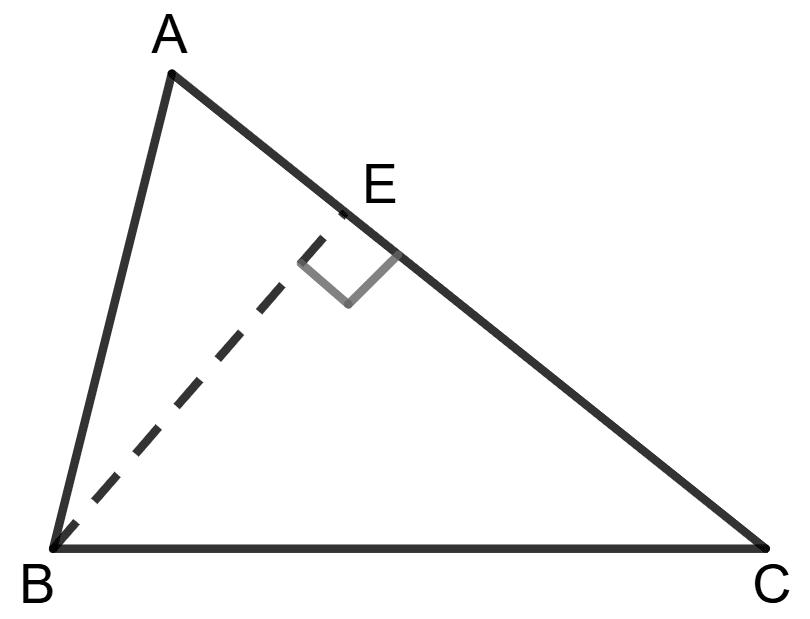
(viii) The area of a △ABC having BE ⊥ AC, is given by ............... .
(ix) Area of a right triangle is equal to ............... .
(x) The area of a triangle having sides of lengths a units, b units and c units respectively and semiperimeter s units is ............... sq. units.
(xi) The area of a parallelogram is equal to the product of the length of the side and the ............... height.
(xii) Area of a rhombus is equal to ............... .
(xiii) The region enclosed between two concentric circles of different radii is called a ............... .
Answer
(i) The perimeter of a simple closed figure is the length of its boundary.
(ii) The perimeter of a circle is called its circumference.
(iii) Pie (π) is the ratio of the circumference of any circle to its diameter.
(iv) The area of a simple closed figure is the measure of the surface enclosed by it.
(v) An area of 1 hectare is equal to 10000 m2.
(vi) A unit square grid sheet is a sheet containing horizontal and vertical lines forming squares, each of dimensions 1 cm x 1 cm.
(vii) In a triangle having sides of lengths a units, b units and c units respectively, if s = units, then s is called the semi perimeter of the triangle.
(viii) The area of a △ABC having BE ⊥ AC, is given by x AC x BE.
(ix) Area of a right triangle is equal to x base x height.
(x) The area of a triangle having sides of lengths a units, b units and c units respectively and semiperimeter s units is sq. units.
(xi) The area of a parallelogram is equal to the product of the length of the side and the corresponding height.
(xii) Area of a rhombus is equal to x (product of diagonals).
(xiii) The region enclosed between two concentric circles of different radii is called a ring.
Explanation
(i)
The perimeter is the total distance around the outside of a 2D shape. If we imagine walking along the edge of a park until we return to our starting point, the distance we covered is the length of its boundary.
(ii)
While we use the word "perimeter" for shapes with straight sides (like squares or pentagons), a circle is a special case because it is perfectly curved. Therefore, the perimeter of a circle has its own specific name: the circumference.
(iii)
π is a mathematical constant that represents a fixed ratio found in every circle. No matter how large or small the circle is, if we divide the circumference by the diameter (the distance across the center), we will always get approximately 3.14159...
π =
(iv)
While perimeter measures the "fence" around a shape, area measures the actual "field" or region inside that fence. It tells us how much flat surface the shape covers.
(v)
A hectare is a metric unit used primarily for measuring large plots of land. It is defined as the area of a square with sides of 100 meters.
Since Area = Side x Side:
= 100 m x 100 m
= 10000 m2
(vi)
A grid sheet is used to measure area by counting squares. A "unit" grid means each square has a side length of 1. Therefore, the dimensions of each small square are 1 unit x 1 unit (for example, 1 cm x 1 cm).
(vii)
In the study of triangles (specifically for Heron's Formula), we often need to use half of the total perimeter.
Perimeter = a + b + c
s =
The term "s" stands for semi-perimeter (where "semi" means half).
(viii)
The standard formula for the area of a triangle is x base x height
In the diagram, AC is the base because the altitude BE drops onto it at a 90° angle.
∴ The area of a △ABC = x AC x BE
(ix)
In a right-angled triangle, the two sides that meet at the 90° angle serve as the base and the height. To find the area, we simply multiply these two sides and divide by 2.
(x)
This specific formula is known as Heron’s Formula. It is used to calculate the area of any triangle when we know the lengths of all three sides but don't have the height. The value s is the semi-perimeter.
(xi)
For a parallelogram, the area is simply base x height. However, the height must be "corresponding," meaning it must be the perpendicular distance between the chosen base and the side opposite to it.
(xii)
A rhombus has a unique property where its diagonals bisect each other at right angles. Because of this symmetry, we can find its area by multiplying the lengths of the two diagonals (d1 and d2) and dividing by 2.
(xiii)
Concentric circles are circles that share the same center point but have different radii (like a bulls eye). The "doughnut" shaped space caught between the inner circle and the outer circle is mathematically called a ring.
Write true (T) or false (F) :
(i) For a circle, the ratio, = π
(ii) 1 m2 = 10,000 cm2.
(iii) Area of a parallelogram = x base x height.
(iv) Area of a right triangle is equal to the product of its legs.
(v) Area of a triangle with base x and corresponding height y is xy.
(vi) Area of a circle of radius 2r is 2πr2.
(vii) Area of a circle having diameter x is .
Answer
(i) False
Reason — The ratio of the circumference to the diameter is π . The ratio is actually the reciprocal, .
(ii) True
Reason — Since 1 m = 100 cm, then 1 m2 = (100 cm)2 = 10000 cm2.
(iii) False
Reason — The area of a parallelogram is simply base × height. The fraction is used for triangles, not parallelograms.
(iv) False
Reason — The area is half the product of its legs ( × leg1 × leg2). The product of the legs alone would give the area of a rectangle.
(v) True
Reason — Using the standard formula × base × height , if base is × and height is y,
the area is × x × y = .
(vi) False
Reason — Area of circle = π × (radius)2.
If the radius is 2r,
then Area = π × (radius)2
= π × (2r)2
= π × (4r2)
= 4πr2
(vii) False
Reason — If diameter = x, then radius = .
Area = π x (radius)2
= π x
=
Kunal pulled out a string from one of his shoes. He found that it was 66 cm long. He bent it into different shapes one by one.
(1) If Kunal formed an equilateral triangle from the shoe string, what will be the length of each side of the triangle formed ?
- 11 cm
- 13 cm
- 22 cm
- 33 cm
(2) If he formed a square from the string, the area of the square would be :
- 212.5 cm2
- 272.25 cm2
- 312.75 cm2
- 324 cm2
(3) He formed a circle from the string. Find the radius of the circle formed. [Use π = ]
- 7 cm
- 7.5 cm
- 9 cm
- 10.5 cm
(4) The area of the circle formed from the string will be : [Use π = ]
- 272.25 cm2
- 346.5 cm2
- 414.75 cm2
- 452 cm2
Answer
(1)
Length of the string = 66 cm
The total length of the string represents the perimeter of the shape.
An equilateral triangle has 3 equal sides.
Side =
Hence, option 3 is the correct option.
(2)
First, let's find the side of the square:
Side =
Now, let's calculate the area:
Area = Side x Side
= 16.5 cm x 16.5 cm
= 272.25 cm2
Hence, option 2 is the correct option.
(3)
The string length is the circumference:
C = 2πr
66 cm = 2 x x r
66 cm = x r
r = cm
r = cm
r = cm
r = 10.5 cm
Hence, option 4 is the correct option.
(4)
Area of circle = πr2
Using the radius r = 10.5 cm
= x (10.5 cm)2
= x (110.25) cm2
= x (15.75) cm2
= 346.5 cm2
Hence, option 2 is the correct option.
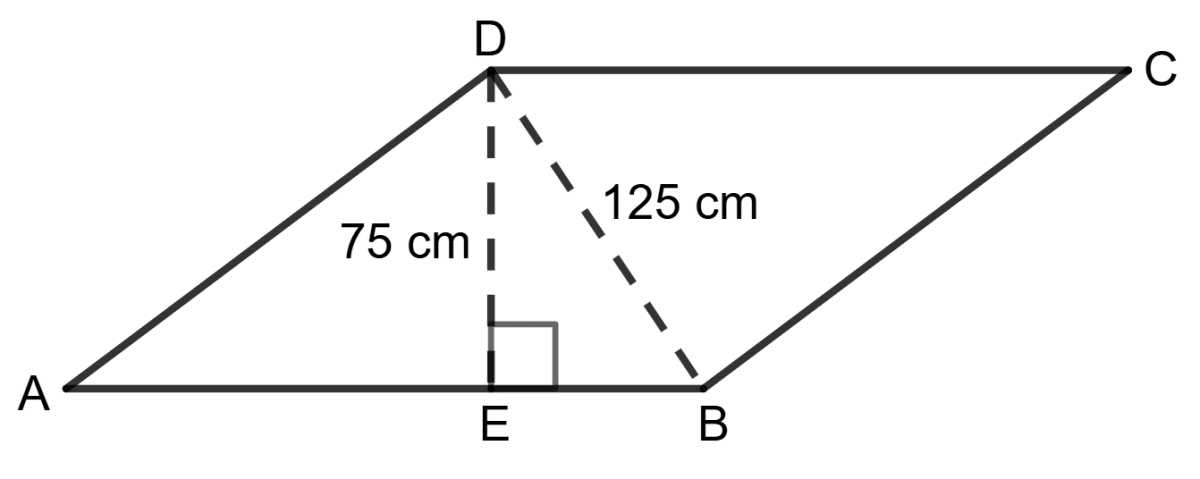
Radhey owns an agricultural field which is in the form of a rhombus ABCD. The length of each side of this field is 250 m. Radhey separated a part △DBE of this field for growing lentils by fixing a wire DE and another wire BD such that wires DE and BD are 75 m and 125 m respectively.
(1) The area of Radhey's field ABCD is :
- 15550 m2
- 17525 m2
- 18750 m2
- 20250 m2
(2) The length of the diagonal AC of the rhombus ABCD is equal to :
- 250 m
- 300 m
- 350 m
- 425 m
(3) The area of the field used by Radhey for sowing lentils is :
- 3750 m2
- 4225 m2
- 5250 m2
- 6225 m2
(4) What is the area of △DBC ?
- 8750 m2
- 9375 m2
- 7500 m2
- 6425 m2
Answer
Given:
AB = BC = CD = AD = 250 m
DE = 75 m, BD = 125 m
(1)
The area of ABCD = Base x Height
Here, the side AB acts as the base, and DE is the perpendicular height.
Area = AB x DE
= 250 m x 75 m
= 18750 m2
Hence, option 3 is the correct option.
(2)
We know that,
Area of rhombus ABCD = x d1 x d2
From the image, one diagonal BD = 125 m
Substituting the values in above, we get:
18750 m2 = x 125 m x d2
18750 m2 = x 62.5 m x d2
d2 =
d2 = 300 m
Hence, option 2 is the correct option.
(3)
The lentils are grown in △DBE.
In this right-angled triangle, we need the base EB.
Using Pythagoras' theorem in △DBE:
EB2 = BD2 - DE2
= (125 m)2 - (75 m)2
= (15625 - 5625) m2
= 10000 m2
EB = m2
EB = 100 m
Area of △DBC = x base x height
= x EB x DE
= x 100 m x 75 m
= x 50 m x 75 m
= 3750 m2
Hence, option 1 is the correct option.
(4)
A diagonal (BD) divides a rhombus into two triangles of equal area.
Area of △DBC = x Area of rhombus ABCD
= x 18750 m2
= x 9375 m2
= 9375 m2
Hence, option 2 is the correct option.
Assertion: Area of any parallelogram ABCD is AB x AD.
Reason: Area of a parallelogram is given by base x height.
- Both Assertion (A) and Reason (R) are true and Reason (R) is the correct explanation of Assertion (A).
- Both Assertion (A) and Reason (R) are true but Reason (R) is not the correct explanation of Assertion (A).
- Assertion (A) is true but Reason (R) is false.
- Assertion (A) is false but Reason (R) is true.
Answer
Assertion (A) is false but Reason (R) is true.
Explanation
In a parallelogram ABCD, AB and AD are two adjacent sides. The area is not simply the product of two sides unless the figure is a rectangle (where the sides meet at 90°).
For a general parallelogram, the area must be the product of a side and its perpendicular height, not another slanted side.
So, Assertion is false.
The fundamental formula for the area of any parallelogram is indeed Base x Height.
The height (altitude) must be the perpendicular distance between the base and the opposite side.
So, Reason is true.
Hence, option 4 is the correct option.
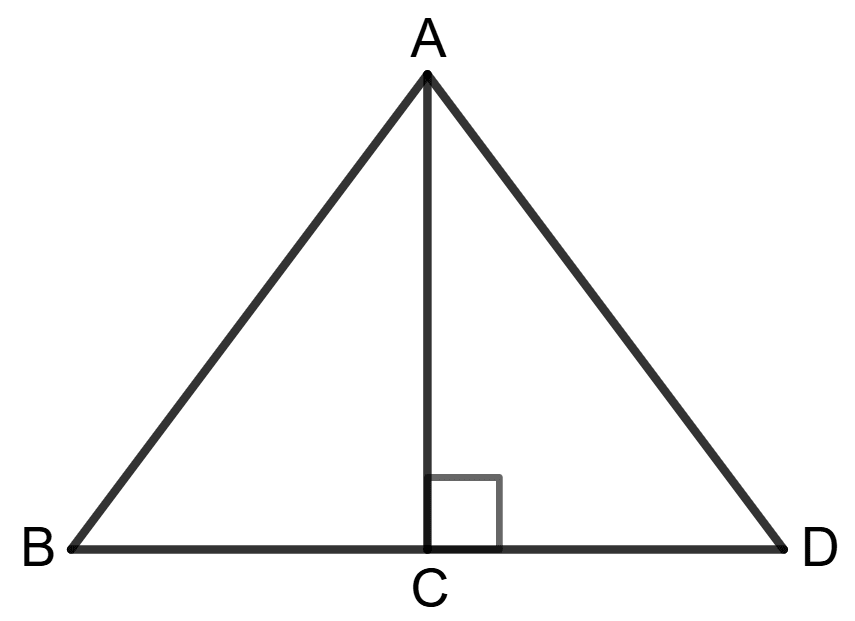
Assertion: In the figure, ratio of the area of △ABC to the area of △ACD is the same as the ratio of base BC of △ABC to the base CD of △ACD.
Reason: Area of a triangle is given by x base x height.
- Both Assertion (A) and Reason (R) are true and Reason (R) is the correct explanation of Assertion (A).
- Both Assertion (A) and Reason (R) are true but Reason (R) is not the correct explanation of Assertion (A).
- Assertion (A) is true but Reason (R) is false.
- Assertion (A) is false but Reason (R) is true.
Answer
Both Assertion (A) and Reason (R) are true and Reason (R) is the correct explanation of Assertion (A).
Explanation
In the provided figure, △ABC and △ACD share the same vertex A and their bases BC and CD lie on the same straight line BD. This means both triangles have the exact same perpendicular height (AC).
When triangles share the same height, the ratio of their areas is strictly determined by the ratio of their bases.
The Reason provides the mathematical foundation for this calculation.
The area of any triangle is x base x height
So, Reason is true.
Hence, option 1 is the correct option.
Assertion: Ratio of circumference of a circle to its radius is always 2π : 1.
Reason: For all practical purposes, we take the value of π as or 3.14.
- Both Assertion (A) and Reason (R) are true and Reason (R) is the correct explanation of Assertion (A).
- Both Assertion (A) and Reason (R) are true but Reason (R) is not the correct explanation of Assertion (A).
- Assertion (A) is true but Reason (R) is false.
- Assertion (A) is false but Reason (R) is true.
Answer
Both Assertion (A) and Reason (R) are true but Reason (R) is not the correct explanation of Assertion (A).
Explanation
The circumference (C) of a circle is calculated using the formula C = 2π r, where r is the radius. If we write the ratio of the circumference to the radius, it looks like this:
Ratio =
Ratio = 2π : 1
So, Assertion is true.
For practical calculations, we often take:
π ≈ or 3.14.
So, Reason is true.
But, the reason does not explain the assertion.
Hence, option 2 is the correct option.
Assertion: Two figures can have the same area but different perimeters.
Reason: If the areas of two figures are same, then they are always congruent.
- Both Assertion (A) and Reason (R) are true and Reason (R) is the correct explanation of Assertion (A).
- Both Assertion (A) and Reason (R) are true but Reason (R) is not the correct explanation of Assertion (A).
- Assertion (A) is true but Reason (R) is false.
- Assertion (A) is false but Reason (R) is true.
Answer
Assertion (A) is true but Reason (R) is false.
Explanation
It is entirely possible for two different shapes to cover the same amount of surface (Area) while having different boundary lengths (Perimeter).
For example, consider two rectangles:
Rectangle 1: Sides 4 cm and 9 cm. Area = 36 cm2, Perimeter = 2(4 + 9) = 26 cm.
Rectangle 2: Sides 6 cm and 6 cm (a square). Area = 36 cm2, Perimeter = 4(6) = 24 cm.
Both have the same area, but different perimeters. So, Assertion is true.
Congruent figures must have the same shape and same size. Same area alone does not guarantee congruency.
So, Reason is false.
Hence, option 3 is the correct option.
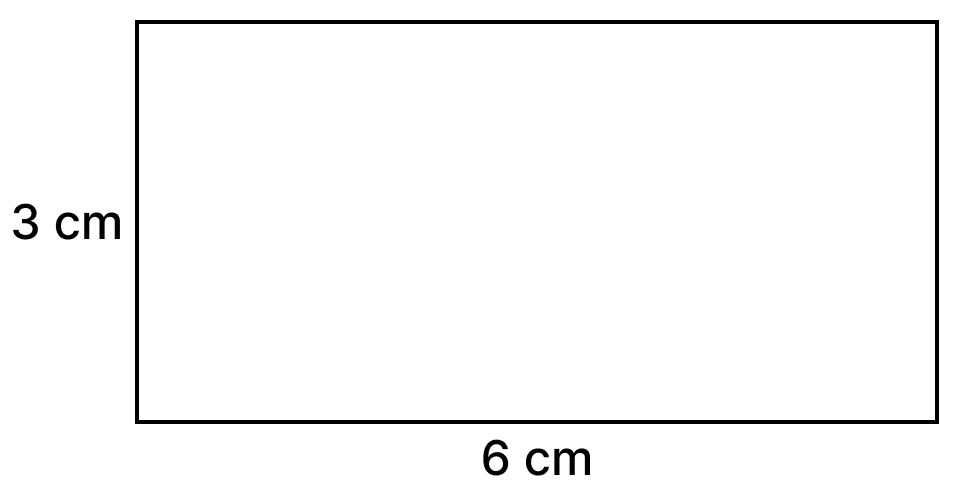
The given figure is a rectangle. If the length increases by 3 cm and breadth decreases by 1 cm, which of these statements is correct?
- The perimeter increases by 4 cm and the area remains the same.
- The perimeter remains the same and the area increases by 4 cm.
- The perimeter and the area both increase by 4 cm.
- The perimeter and the area both remain the same.
Answer
Original dimensions:
Length = 6 cm
Breadth = 3 cm
New dimensions:
Length increases by 3 cm → 9 cm
Breadth decreases by 1 cm → 2 cm
Original perimeter:
2(6 + 3) = 18 cm
New perimeter:
2(9 + 2) = 22 cm
Increase in perimeter:
22 − 18 = 4 cm
Original area:
6 × 3 = 18 cm2
New area:
9 × 2 = 18 cm2
Area remains the same.
Hence, option 1 is the correct option
Given below is the map of a society park.
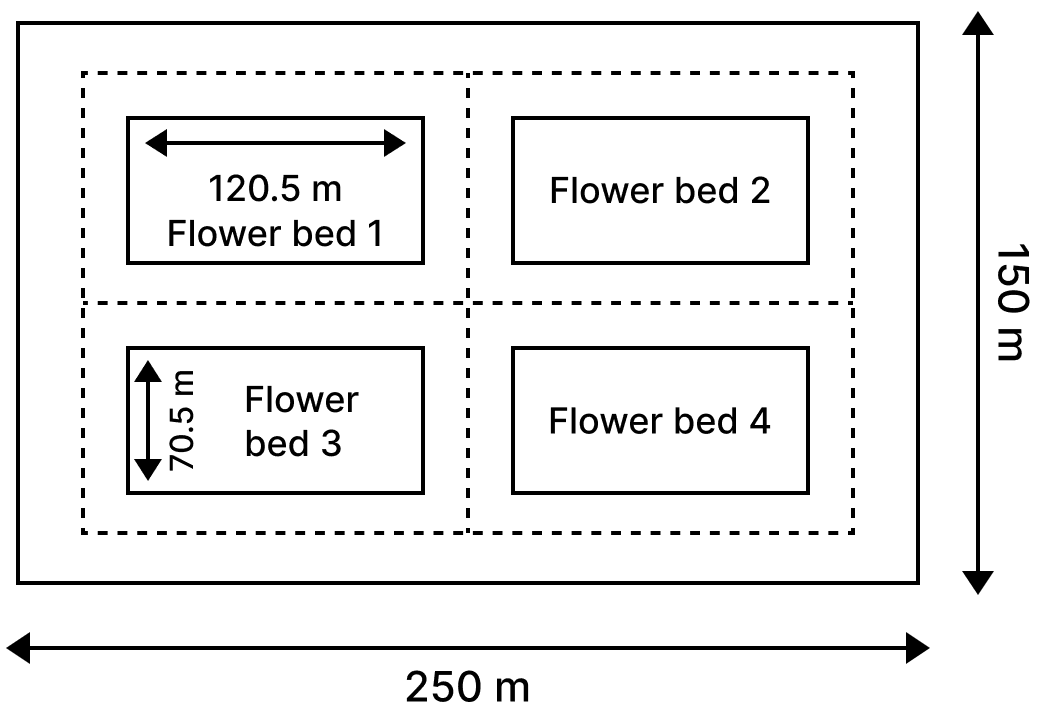
The park has four flower beds of equal area. The dotted line represents the path for running and jogging. What is the area of the running and jogging path?
- 3519 m2
- 3600 m2
- 8495.25 m2
- 37,500 m2
Answer
Outer rectangle dimensions:
Length = 250 m, Breadth = 150 m
Area of park:
250 m × 150 m = 37500 m2
Each flower bed:
Length = 120.5 m, Breadth = 70.5 m
Area of one flower bed:
120.5 m × 70.5 m = 8495.25 m2
There are 4 flower beds,
Area of 4 flower beds = 4 x Area of one flower bed
= 4 × 8495.25 m2
= 33981 m2
Area of running/jogging path = Area of park - Area of 4 flower beds
= 37500 m2 − 33981 m2
= 3519 m2
Hence, option 1 is the correct option
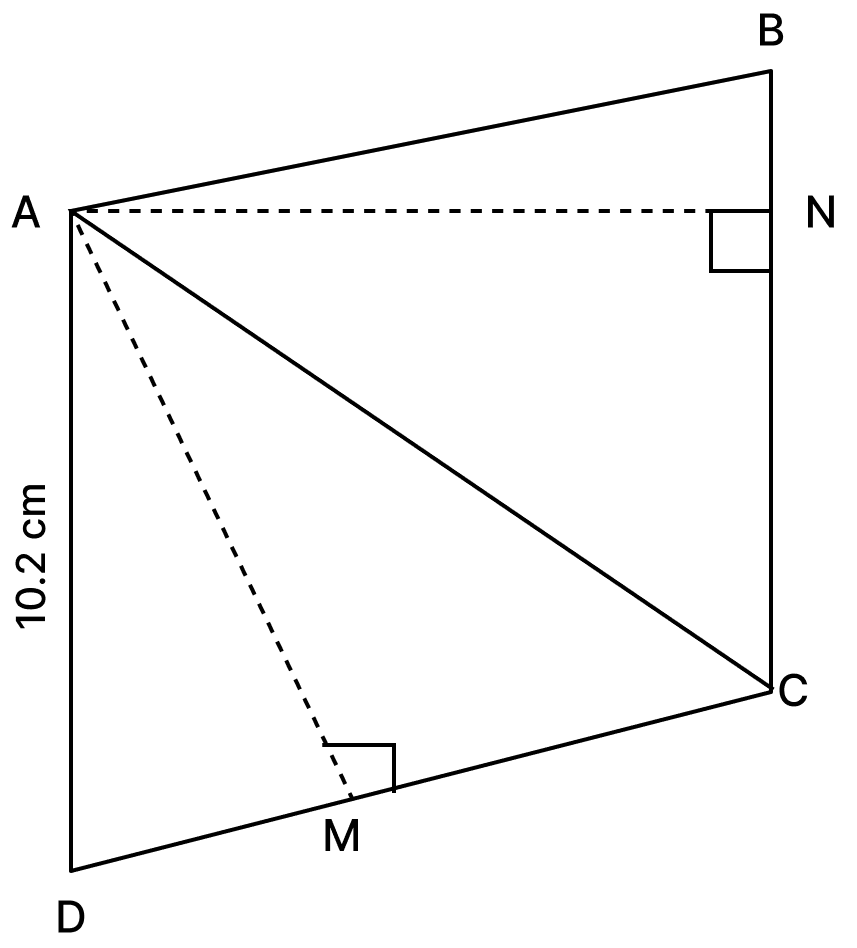
A parallelogram is given alongside. If AM = 9 cm and AN = 7.5 cm, which of these shows the area of the triangle ACD?
(8.5 × 9) cm2
(10.2 × 9) cm2
(10.2 × 9) cm2
(9 × 8.5) cm2
Answer
Area of parallelogram = Base x Height
CD x AM = BC x AN
Since opposite sides are equal, BC = AD = 10.2 cm. Substituting the known values:
CD x 9 cm = 10.2 cm x 7.5 cm
CD = cm
CD = 8.5 cm
The diagonal AC cuts the parallelogram into two triangles of equal area. For △ACD, the side CD acts as the base, and AM is its corresponding perpendicular height:
Area of △ACD = x base x height
= x CD x AM
= (8.5 x 9) cm2
Hence, option 1 is the correct option
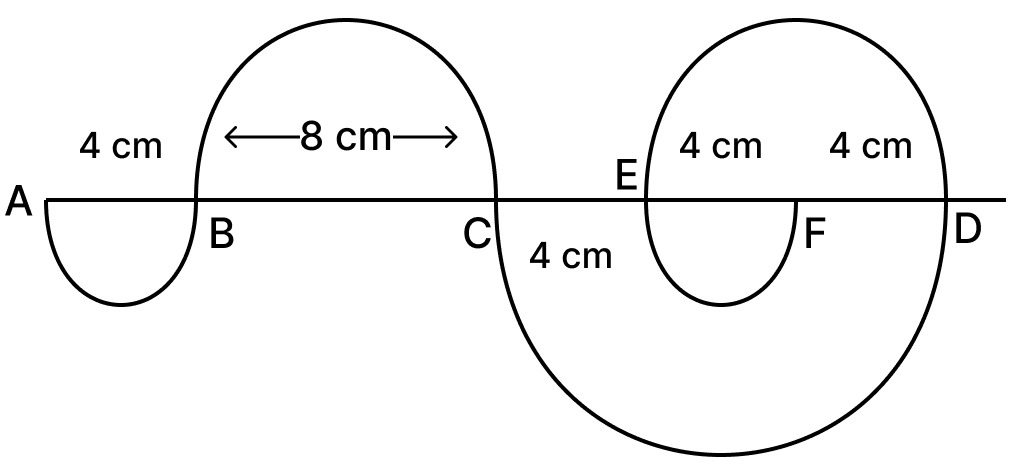
A wire is bent into the shape as shown. It is made up of 5 semi-circles. What is the length of the wire? (Take π = 3.14)
- 27 cm
- 56.52 cm
- 45 cm
- 27.92 cm
Answer
Given:
The wire is made up of 5 semicircles.
π = 3.14
Reading the diameters of the semicircles from the figure:
d1 = 4 cm, d2 = 8 cm, d3 = 12 cm, d4 = 8 cm, d5 = 4 cm
The length of the wire is the sum of the curved (arc) length of each semicircle.
Length of one semicircular arc = πr =
So, the radii of the semicircles are:
r1 = 2 cm, r2 = 4 cm, r3 = 6 cm, r4 = 4 cm, r5 = 2 cm
Length of wire = πr1 + πr2 + πr3 + πr4 + πr5
= π(r1 + r2 + r3 + r4 + r5) [Taking π common]
= π(2 cm + 4 cm + 6 cm + 4 cm + 2 cm) [Substituting the values]
= π x 18 cm
= 3.14 x 18 cm
= 56.52 cm
Length of the wire = 56.52 cm
Hence, option 2 is the correct option.
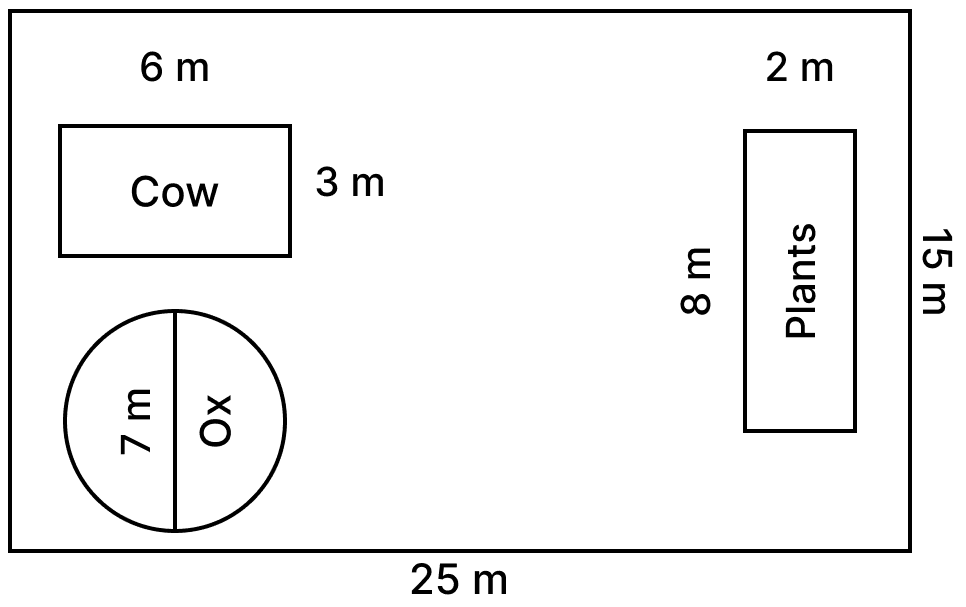
People of a village take good care of plants, trees and animals. They marked some land for their pets (cow and ox) and plants. The ratio of the areas kept for animals and plants together to the total area of the land is:
- 75 : 21
- 125 : 39
- 29 : 150
- 29 : 121
Answer
Given:
Total land is a rectangle of length 25 m and breadth 15 m.
Cow's enclosure is a rectangle of length 6 m and breadth 3 m.
Ox's enclosure is a circle of diameter 7 m.
Plants' enclosure is a rectangle of length 8 m and breadth 2 m.
π =
Total area of the land = length x breadth
= 25 m x 15 m [Substituting the values]
= 375 m2
Area kept for cow = length x breadth
= 6 m x 3 m
= 18 m2
Area kept for ox = πr2
[Circle of diameter 7 m, so radius r = = 3.5 m]
= x (3.5 m)2
= x 12.25 m2
= 38.5 m2
Area kept for plants = length x breadth
= 8 m x 2 m
= 16 m2
Total area for animals and plants = Area of cow + Area of ox + Area of plants
= 18 m2 + 38.5 m2 + 16 m2
= 72.5 m2
Required ratio = Area for animals and plants : Total area of land
= 72.5 : 375
= 145 : 750 [Multiplying both terms by 2]
= 29 : 150 [Dividing both terms by 5]
Ratio of areas for animals and plants to the total area = 29 : 150
Hence, option 3 is the correct option.
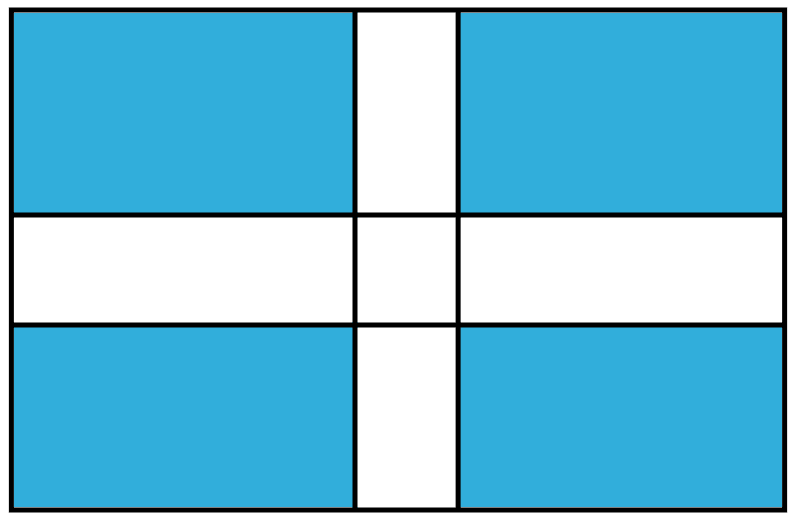
Aditi was decorating a cardboard of length 1 m 45 cm and breadth 80 cm by using fancy border of width 20 cm. She placed the borders, such that it cuts at rights angles, by overlapping through the centre of the board and parallel to its sides, as shown in the figure. She painted the remaining area of the board. How much area did she paint?
- 6700 cm2
- 7100 cm2
- 7500 cm2
- 15,700 cm2
Answer
Given:
Length of cardboard = 1 m 45 cm = 145 cm
Breadth of cardboard = 80 cm
Width of border = 20 cm
The two borders overlap at the centre, forming a cross.
Total area of the cardboard = length x breadth
= 145 cm x 80 cm [Substituting the values]
= 11600 cm2
Area of the horizontal border = length x width
= 145 cm x 20 cm
= 2900 cm2
Area of the vertical border = breadth x width
= 80 cm x 20 cm
= 1600 cm2
Area of the overlapping square at the centre = width x width
= 20 cm x 20 cm
= 400 cm2
Total area of the border (cross) = Horizontal border + Vertical border - Overlap
= 2900 cm2 + 1600 cm2 - 400 cm2
[The overlap is counted twice, so subtract it once]
= 4100 cm2
Painted area = Total area of cardboard - Area of the border
= 11600 cm2 - 4100 cm2
= 7500 cm2
Area painted by Aditi = 7500 cm2
Hence, option 3 is the correct option.
Ravi and Manoj were finding the perimeter and area of a square plot of land. Ravi calculated the area and Manoj calculated the perimeter of the plot. Coincidently, they both got the same answer. The length of the side of the plot is :
- 5 units
- 2 units
- 3 units
- 4 units
Answer
Given:
The plot is a square in which the area is equal to the perimeter.
Let the side of the square be 'a' units.
Area of square = a2
Perimeter of square = 4 x a
Since Ravi's area and Manoj's perimeter are equal,
a2 = 4 x a [Substituting the values]
⇒ = 4 [Dividing both sides by a]
⇒ a = 4
Length of the side of the plot = 4 units
Hence, option 4 is the correct option.
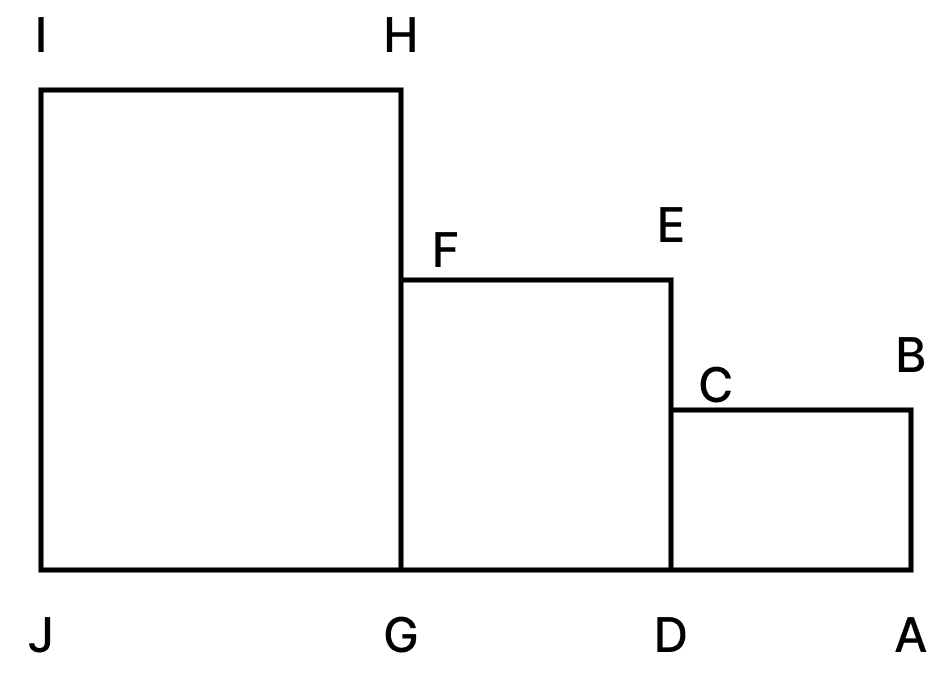
Karan drew the side view of the staircase of a building as shown here. In the drawing, ABCD is a rectangle of dimensions 8 cm × 3 cm, DEFG is a square whose side is equal to double of CD and GHIJ is a rectangle in which GH = 4 AB and HI = BC. The perimeter of the figure is:
- 72 cm
- 90 cm
- 45 cm
- 36 cm
Answer
Given:
ABCD is a rectangle of dimensions 8 cm x 3 cm.
So, BC = DA = 8 cm and AB = CD = 3 cm.
DEFG is a square whose side = 2 x CD.
GHIJ is a rectangle in which GH = 4 x AB and HI = x BC.
Side of square DEFG = 2 x CD
= 2 x 3 cm [Substituting the value]
= 6 cm
So, DE = EF = FG = GD = 6 cm
For rectangle GHIJ:
GH = 4 x AB = 4 x 3 cm = 12 cm
HI = x BC = x 8 cm = 10 cm
So, IJ = GH = 12 cm and JG = HI = 10 cm
The perimeter is the sum of all the outer sides of the staircase figure.
Perimeter = IJ + IH + HF + FE + EC + CB + BA + AJ
where,
HF = GH - FG [Vertical step from big rectangle down to square]
= 12 cm - 6 cm
= 6 cm
EC = DE - CD [Vertical step from square down to small rectangle]
= 6 cm - 3 cm
= 3 cm
AJ = DA + GD + JG [Full bottom edge]
= 8 cm + 6 cm + 10 cm
= 24 cm
Substituting all the values:
Perimeter = 12 cm + 10 cm + 6 cm + 6 cm + 3 cm + 8 cm + 3 cm + 24 cm
= 72 cm
Perimeter of the figure = 72 cm
Hence, option 1 is the correct option.