KnowledgeBoat Logo
|
OPEN IN APP

Chapter 23

Mensuration - Exercise 23(G)

Class - 7 RS Aggarwal Mathematics Solutions


Exercise 23(G)

Question 1

Find the area of a circle whose radius is :

(i) 2.8 m

(ii) 8.4 m

Answer

(i)

Given:

r = 2.8 m

Area of circle = πr2

=227×(2.8 m)2=227×(2.8 m×2.8 m)=227×7.84 m2=22×1.12 m2=24.64 m2= \dfrac{22}{7} \times (2.8 \text{ m})^2 \\[1em] = \dfrac{22}{7} \times (2.8 \text{ m} \times 2.8 \text{ m}) \\[1em] = \dfrac{22}{7} \times 7.84 \text{ m}^2 \\[1em] = 22 \times 1.12 \text{ m}^2 \\[1em] = 24.64 \text{ m}^2

Area of circle = 24.64 m2

(ii)

Given:

r = 8.4 m

Area of circle = πr2

=227×(8.4 m)2=227×(8.4 m×8.4 m)=227×70.56 m2=22×10.08 m2=221.76 m2= \dfrac{22}{7} \times (8.4 \text{ m})^2 \\[1em] = \dfrac{22}{7} \times (8.4 \text{ m} \times 8.4 \text{ m}) \\[1em] = \dfrac{22}{7} \times 70.56 \text{ m}^2 \\[1em] = 22 \times 10.08 \text{ m}^2 \\[1em] = 221.76 \text{ m}^2

Area of circle = 221.76 m2

Question 2

Find the area of a circle whose diameter is :

(i) 18.2 cm

(ii) 30.8 cm

Answer

(i)

Given:

d = 18.2 cm

Radius (r) = Diameter2\dfrac{\text{Diameter}}{2}

r = 18.22\dfrac{18.2}{2} cm = 9.1 cm

Area of circle = πr2

=227×(9.1 cm)2=227×(9.1 cm×9.1 cm)=227×82.81 cm2=22×11.83 cm2=260.26 cm2= \dfrac{22}{7} \times (9.1 \text{ cm})^2 \\[1em] = \dfrac{22}{7} \times (9.1 \text{ cm} \times 9.1 \text{ cm}) \\[1em] = \dfrac{22}{7} \times 82.81 \text{ cm}^2 \\[1em] = 22 \times 11.83 \text{ cm}^2 \\[1em] = 260.26 \text{ cm}^2

Area of circle = 260.26 cm2

(ii)

Given:

d = 30.8 cm

Radius (r) = Diameter2\dfrac{\text{Diameter}}{2}

r = 30.82\dfrac{30.8}{2} cm = 15.4 cm

Area of circle = πr2

=227×(15.4 cm)2=227×(15.4 cm×15.4 cm)=221×(2.2 cm×15.4 cm)=(22×2.2×15.4) cm2=745.36 cm2= \dfrac{22}{7} \times (15.4 \text{ cm})^2 \\[1em] = \dfrac{22}{7} \times (15.4 \text{ cm} \times 15.4 \text{ cm}) \\[1em] = \dfrac{22}{1} \times (2.2 \text{ cm} \times 15.4 \text{ cm}) \\[1em] = (22 \times 2.2 \times 15.4) \text{ cm}^2 \\[1em] = 745.36 \text{ cm}^2

Area of circle = 745.36 cm2

Question 3

Taking π = 3.14, find the area of a circle whose radius is :

(i) 10 cm

(ii) 15 m

Answer

(i)

Given:

r = 10 cm

Area of circle = πr2

= 3.14 x (10 cm)2

= 3.14 x 10 cm x 10 cm

= 3.14 x 100 cm2

= 314 cm2

Area of circle = 314 cm2

(ii)

Given:

r = 15 m

Area of circle = πr2

= 3.14 x (15 m)2

= 3.14 x 15 m x 15 m

= 3.14 x 225 m2

= 706.5 m2

Area of circle = 706.5 m2

Question 4

Find the radius and circumference of a circle whose area is :

(i) 55.44 m2

(ii) 186.34 cm2

Answer

(i)

Given:

Area = 55.44 m2

Area of circle = πr2

⇒ r = Areaπ\sqrt{\dfrac{\text{Area}}{\pi}}

r=55.44227 m2r=55.44×722 m2r=2.52×71 m2r=17.64 m2r=4.2 m\Rightarrow r = \sqrt{\dfrac{55.44}{\dfrac{22}{7}}} \text{ m}^2 \\[1em] \Rightarrow r = \sqrt{55.44 \times \dfrac{7}{22}} \text{ m}^2 \\[1em] \Rightarrow r = \sqrt{2.52 \times \dfrac{7}{1}} \text{ m}^2 \\[1em] \Rightarrow r = \sqrt{17.64} \text{ m}^2 \\[1em] \Rightarrow r = 4.2 \text{ m}

Circumference of circle = 2πr

=2×227×4.2 m=2×221×0.6 m=2×22×0.6 m=26.4 m= 2 \times \dfrac{22}{7} \times 4.2 \text{ m} \\[1em] = 2 \times \dfrac{22}{1} \times 0.6 \text{ m} \\[1em] = 2 \times 22 \times 0.6 \text{ m} \\[1em] = 26.4 \text{ m}

radius = 4.2 m, Circumference = 26.4 m

(ii)

Given:

Area = 186.34 cm2

Area of circle = πr2

⇒ r = Areaπ\sqrt{\dfrac{\text{Area}}{\pi}}

r=186.34227 cm2r=186.34×722 cm2r=8.47×71 cm2r=59.29 cm2r=7.7 cm\Rightarrow r = \sqrt{\dfrac{186.34}{\dfrac{22}{7}}} \text{ cm}^2 \\[1em] \Rightarrow r = \sqrt{186.34 \times \dfrac{7}{22}} \text{ cm}^2 \\[1em] \Rightarrow r = \sqrt{8.47 \times \dfrac{7}{1}} \text{ cm}^2 \\[1em] \Rightarrow r = \sqrt{59.29} \text{ cm}^2 \\[1em] \Rightarrow r = 7.7 \text{ cm}

Circumference of circle = 2πr

=2×227×7.7 cm=2×221×1.1 cm=2×22×1.1 cm=48.4 cm= 2 \times \dfrac{22}{7} \times 7.7 \text{ cm} \\[1em] = 2 \times \dfrac{22}{1} \times 1.1 \text{ cm} \\[1em] = 2 \times 22 \times 1.1 \text{ cm} \\[1em] = 48.4 \text{ cm}

radius = 7.7 cm, Circumference = 48.4 cm

Question 5

Taking π = 3.14, find the radius and circumference of a circle whose area is :

(i) 200.96 cm2

(ii) 379.94 m2

Answer

(i)

Given:

Area = 200.96 cm2

Area of circle = πr2

⇒ r = Areaπ\sqrt{\dfrac{\text{Area}}{\pi}}

r=200.963.14 cm2r=64 cm2r=8 cm\Rightarrow r = \sqrt{\dfrac{200.96}{3.14}} \text{ cm}^2 \\[1em] \Rightarrow r = \sqrt{64} \text{ cm}^2 \\[1em] \Rightarrow r = 8 \text{ cm}

Circumference of circle = 2πr

= 2 x 3.14 x 8 cm

= 50.24 cm

radius = 8 cm, Circumference = 50.24 cm

(ii)

Given:

Area = 379.94 m2

Area of circle = πr2

⇒ r = Areaπ\sqrt{\dfrac{\text{Area}}{\pi}}

r=379.943.14 m2r=121 m2r=11 m\Rightarrow r = \sqrt{\dfrac{379.94}{3.14}} \text{ m}^2 \\[1em] \Rightarrow r = \sqrt{121} \text{ m}^2 \\[1em] \Rightarrow r = 11 \text{ m}

Circumference of circle = 2πr

= 2 x 3.14 x 11 m

= 69.08 m

radius = 11 m, Circumference = 69.08 m

Question 6

In a rectangular plot of land 70 m long and 40 m broad, a circular garden of radius 17.5 m is developed. Find the cost of turfing the remaining portion at the rate of ₹ 28.50 per sq. metre.

Answer

To find the cost of turfing the remaining portion, we first calculate the areas of the rectangular plot and the circular garden.

In rectangle:

Length = 70 m \quad[Given]

Breadth = 40 m \quad[Given]

Area of rectangle = Length x Breadth

= 70 m x 40 m

= 2800 m2

Area of circular garden = πr2

radius (r) = 17.5 m \quad[Given]

=227×(17.5 m)2=227×(17.5 m×17.5 m)=221×(2.5 m×17.5 m)=(22×2.5×17.5) m2=962.5 m2= \dfrac{22}{7} \times (17.5 \text{ m})^2 \\[1em] = \dfrac{22}{7} \times (17.5 \text{ m} \times 17.5 \text{ m}) \\[1em] = \dfrac{22}{1} \times (2.5 \text{ m} \times 17.5 \text{ m}) \\[1em] = (22 \times 2.5 \times 17.5) \text{ m}^2 \\[1em] = 962.5 \text{ m}^2

Area of the Remaining portion = Area of rectangle - Area of circular garden

= 2800 m2 - 962.5 m2

= 1837.5 m2

Cost of Turfing = Remaining portion x Rate

Rate = ₹ 28.50 per sq. metre \quad[Given]

Substituting the values in above, we get:

Cost of Turfing = 1837.5 m2 x ₹ 28.50

= ₹ 52368.75

The cost of turfing the remaining portion is ₹ 52368.75.

Question 7

A wire when bent in the form of square, encloses an area of 146.41 cm2. If this wire is straightened and then bent to form a circle, what will be the area of the circle so formed?

Answer

Given:

Area of square = 146.41 cm2

We know the formula,

Area of square = (Side)2

146.41 cm2 = (Side)2

⇒ Side = 146.41\sqrt{146.41} cm2

⇒ Side = 12.1 cm

Let's find the perimeter (length of wire):

We know the formula,

Perimeter of square = 4 x Side

= 4 x 12.1 cm

= 48.4 cm

∴ Length of wire = 48.4 cm

Let's find the radius of the Circle:

When the wire is bent into a circle, its circumference is equal to the length of the wire (48.4 cm).

We know the formula,

Circumference of circle = 2πr

48.4 cm=2×227×r48.4 cm=447×rr=48.4×744 cmr=1.1×71 cmr=7.7 cm48.4 \text{ cm} = 2 \times \dfrac{22}{7} \times r \\[1em] 48.4 \text{ cm} = \dfrac{44}{7} \times r \\[1em] r = \dfrac{48.4 \times 7}{44}\text{ cm} \\[1em] r = \dfrac{1.1 \times 7}{1}\text{ cm} \\[1em] r = 7.7 \text{ cm} \\[1em]

Area of circle = πr2

=227×(7.7 m)2=227×(7.7 m×7.7 m)=221×(1.1 m×7.7 m)=(22×1.1×7.7) m2=186.34 m2= \dfrac{22}{7} \times (7.7 \text{ m})^2 \\[1em] = \dfrac{22}{7} \times (7.7 \text{ m} \times 7.7 \text{ m}) \\[1em] = \dfrac{22}{1} \times (1.1 \text{ m} \times 7.7 \text{ m}) \\[1em] = (22 \times 1.1 \times 7.7) \text{ m}^2 \\[1em] = 186.34 \text{ m}^2

The area of the circle formed is 186.34 cm2.

Question 8

From a rectangular cardboard sheet 145 cm long and 32 cm broad, 42 circular plates each of diameter 8 cm have been cut out. Find the area of the remaining portion of the sheet.

Answer

To find the area of the remaining portion, we subtract the total area of all the circular plates from the initial area of the rectangular sheet.

In rectangle:

Length = 145 cm \quad[Given]

Breadth = 32 cm \quad[Given]

Area of Sheet = Length x Breadth

= 145 cm x 32 cm

= 4640 cm2

Let's find area of One Circular Plate:

Area of one plate = πr2

Diameter = 8 cm \quad[Given]

radius = Diameter2=82 cm=4 cm\dfrac{\text{Diameter}}{2} = \dfrac{8}{2} \text{ cm} = 4 \text{ cm}

Substituting the values in above, we get:

=227×(4 cm)2=227×(4 cm×4 cm)=227×(16 cm2)=3527 cm2= \dfrac{22}{7} \times (4 \text{ cm})^2 \\[1em] = \dfrac{22}{7} \times (4 \text{ cm} \times 4 \text{ cm}) \\[1em] = \dfrac{22}{7} \times (16 \text{ cm}^2) \\[1em] = \dfrac{352}{7} \text{ cm}^2 \\[1em]

Total Area of all circular Plates = Number of plates x Area of one plate

=42×3527 cm2=6×3521 cm2=2112 cm2= 42 \times \dfrac{352}{7} \text{ cm}^2 \\[1em] = 6 \times \dfrac{352}{1} \text{ cm}^2 \\[1em] = 2112 \text{ cm}^2

Area of the Remaining Portion = Area of Sheet - Total Area of all circular Plates

= 4640 cm2 - 2112 cm2

= 2528 cm2

The area of the remaining portion of the sheet is 2528 cm2.

Question 9

A circle is inscribed in a square of area 784 cm2. Find the area of the circle.

Answer

To find the area of the circle inscribed in the square, we first need to determine the side of the square, which will be equal to the diameter of the circle.

Let's find the Side of the Square:

Area of the square = 784 cm2

We know the formula,

Area of the square = (Side)2

784 cm2 = (Side)2

⇒ Side = 784\sqrt{784} cm2

⇒ Side = 28 cm

∴ Diameter of circle = 28 cm

radius = Diameter2=282 cm=14 cm\dfrac{\text{Diameter}}{2} = \dfrac{28}{2} \text{ cm} = 14 \text{ cm}

Area of circle = πr2

=227×(14 cm)2=227×(14 cm×14 cm)=221×(2 cm×14 cm)=(22×28) cm2=616 cm2= \dfrac{22}{7} \times (14 \text{ cm})^2 \\[1em] = \dfrac{22}{7} \times (14 \text{ cm} \times 14 \text{ cm}) \\[1em] = \dfrac{22}{1} \times (2 \text{ cm} \times 14 \text{ cm}) \\[1em] = (22 \times 28) \text{ cm}^2 \\[1em] = 616 \text{ cm}^2

The area of the inscribed circle is 616 cm2.

Question 10

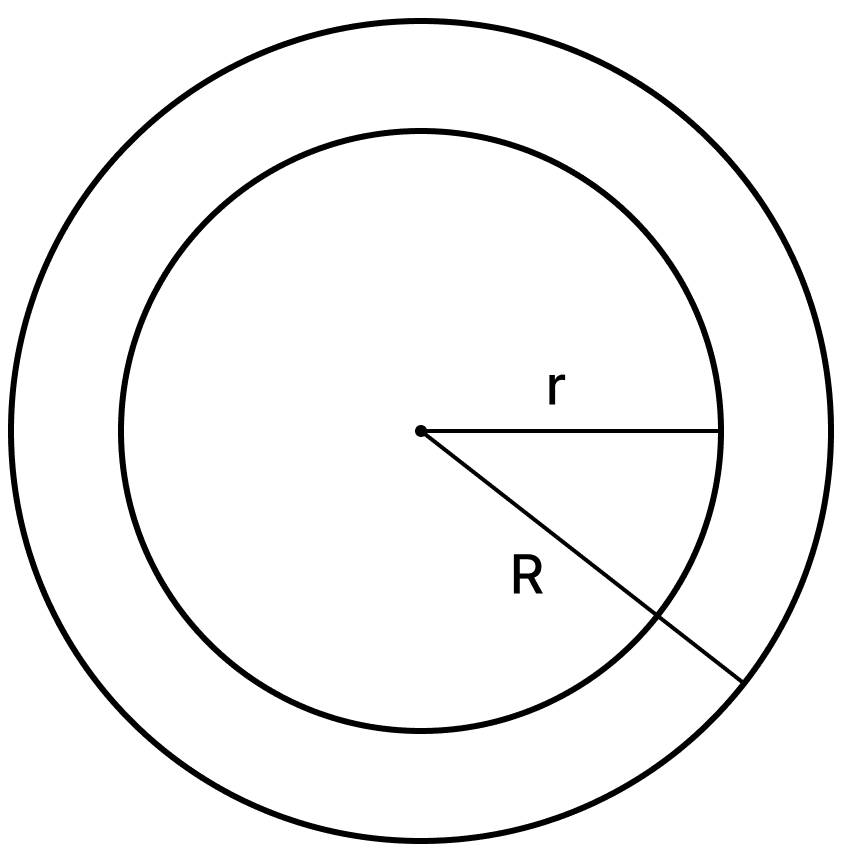
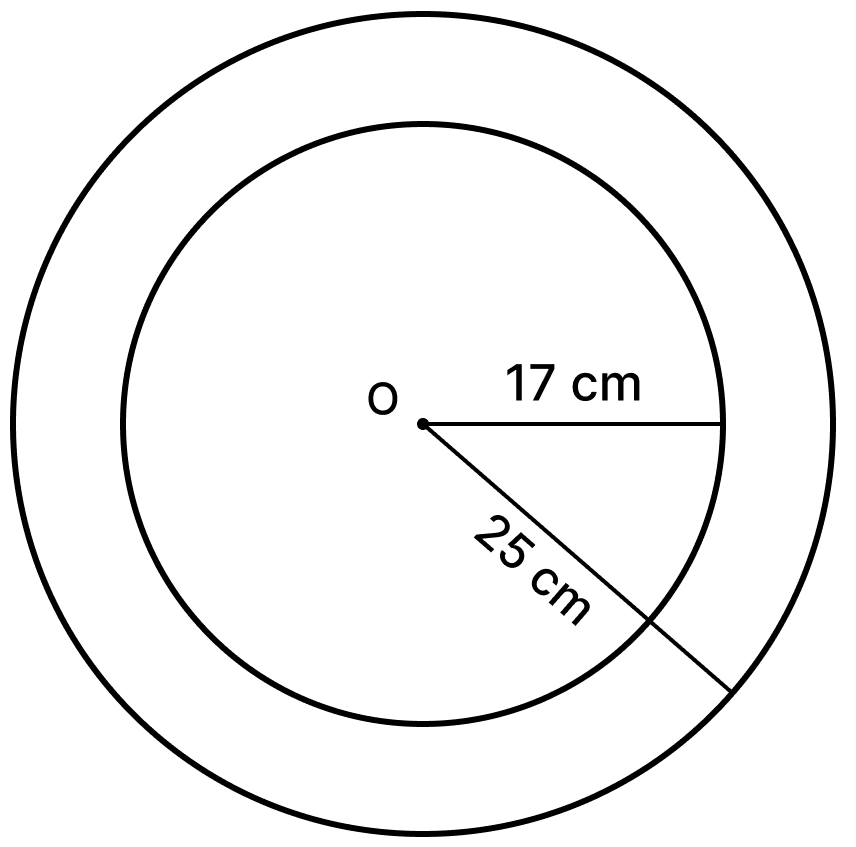
Find the area of the space enclosed by two concentric circles of radii 25 cm and 17 cm.

Answer

To find the area of the space enclosed between two concentric circles, we subtract the area of the smaller inner circle from the area of the larger outer circle.

Find the area of the space enclosed by two concentric circles of radii 25 cm and 17 cm. Mensuration, Foundation Mathematics R.S. Aggarwal ICSE Class 7.

Given:

Radius of the outer circle (R) = 25 cm

Radius of the inner circle (r) = 17 cm

The area of the space between the circles is given by:

Area = Area of Outer circle - Area of inner circle

Area = πR2 - πr2

=(227×(252)227×(172)) cm2=227×(252172) cm2=227×(625289) cm2=227×(336) cm2=221×(48) cm2=1056 cm2= \Big(\dfrac{22}{7} \times (25^2) - \dfrac{22}{7} \times (17^2)\Big) \text{ cm}^2 \\[1em] = \dfrac{22}{7} \times (25^2 - 17^2) \text{ cm}^2 \\[1em] = \dfrac{22}{7} \times (625 - 289) \text{ cm}^2 \\[1em] = \dfrac{22}{7} \times (336) \text{ cm}^2 \\[1em] = \dfrac{22}{1} \times (48) \text{ cm}^2 \\[1em] = 1056 \text{ cm}^2

The area of the space enclosed by the two concentric circles is 1056 cm2.

Question 11

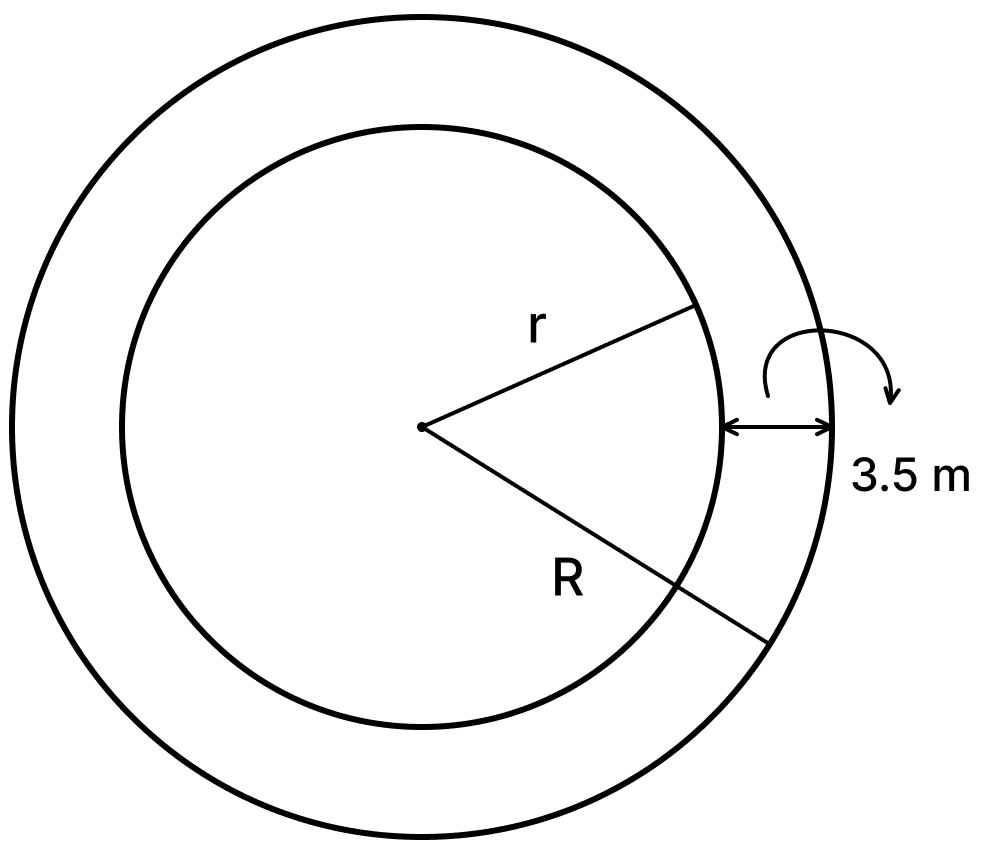
A path of width 3.5 m runs all around a circular pool having an area of 962.5 m2. Find the area of the path.

Answer

To find the area of a path around a circular boundary, we calculate the area of the outer circle and subtract the area of the inner circle.

A path of width 3.5 m runs all around a circular pool having an area of 962.5 m 2. Find the area of the path. Mensuration, Foundation Mathematics R.S. Aggarwal ICSE Class 7.

Let's find the radius of the pool (r):

Area of pool = πr2

962.5 m2=227×r2r2=962.5×722 m2r2=43.75×7 m2r2=306.25 m2r=306.25 m2r=17.5 m962.5 \text{ m}^2 = \dfrac{22}{7} \times r^2 \\[1em] r^2 = \dfrac{962.5 \times 7}{22} \text{ m}^2 \\[1em] r^2 = 43.75 \times 7 \text{ m}^2 \\[1em] r^2 = 306.25 \text{ m}^2 \\[1em] r = \sqrt{306.25} \text{ m}^2 \\[1em] r = 17.5 \text{ m}

Let's find the outer radius (R):

The path is around the pool, so we add the width to the inner radius.

R = (r + width) = (17.5 + 3.5) m = 21 m

Let's find the area of the path:

Area of the path = Area of outer circle - Area of pool

Area = πR2 - πr2

=(227×(212)227×(17.52)) m2=227×(21217.52) m2=227×(441306.25) m2=227×(134.75) m2=221×(19.25) m2=423.5 m2= \Big(\dfrac{22}{7} \times (21^2) - \dfrac{22}{7} \times (17.5^2)\Big) \text{ m}^2 \\[1em] = \dfrac{22}{7} \times (21^2 - 17.5^2) \text{ m}^2 \\[1em] = \dfrac{22}{7} \times (441 - 306.25) \text{ m}^2 \\[1em] = \dfrac{22}{7} \times (134.75) \text{ m}^2 \\[1em] = \dfrac{22}{1} \times (19.25) \text{ m}^2 \\[1em] = 423.5 \text{ m}^2

∴ The area of the path is 423.5 m2.

Question 12

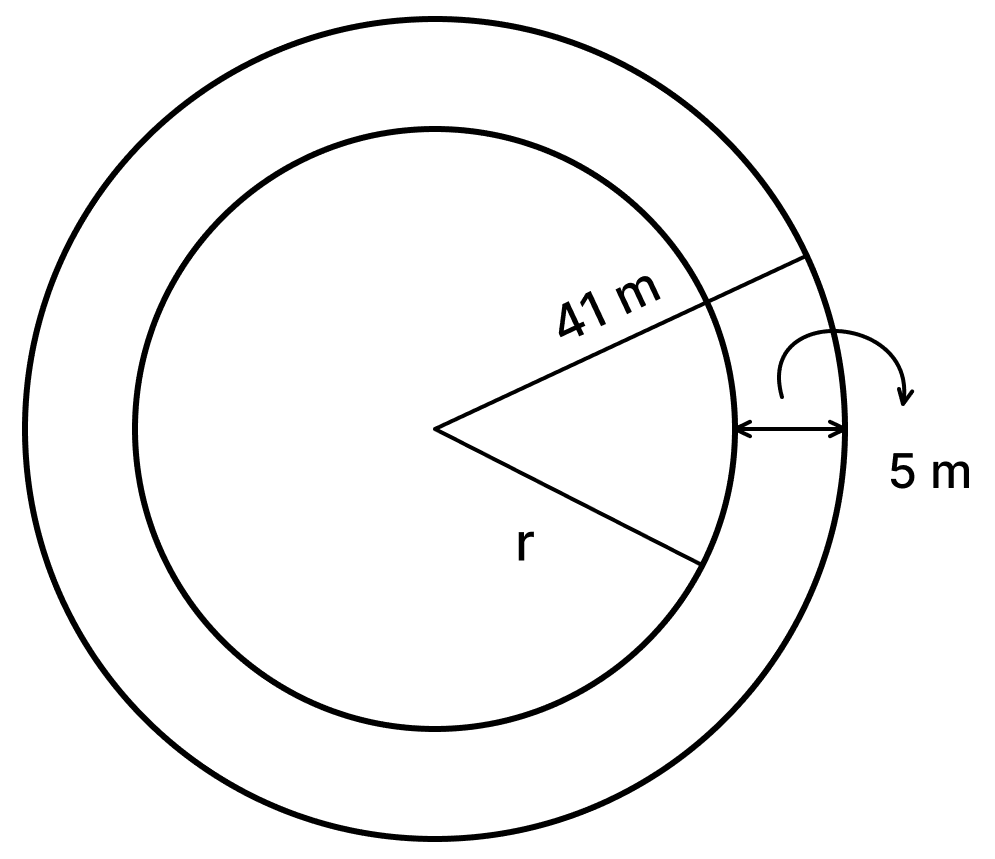
A circular field of radius 41 m has a circular path of uniform width 5 m along and inside its boundary. Find the cost of paving the path at ₹ 25 per sq. metre.

Answer

The path is inside the field, so the field radius is the outer radius (R).

A circular field of radius 41 m has a circular path of uniform width 5 m along and inside its boundary. Find the cost of paving the path at ₹ 25 per sq. metre. Mensuration, Foundation Mathematics R.S. Aggarwal ICSE Class 7.

Given:

Width of the path = 5 m

Rate of cost of paving the path = ₹ 25 per sq. metre

Outer radius (R) = 41 m

Inner radius (r) = (Outer radius - width) = (41 - 5) m = 36 m

Area of the path = Area of outer circle - Area of inner circle

Area of the path = πR2 - πr2

=(227×(412)227×(362)) m2=227×(412362) m2=227×(16811296) m2=227×(385) m2=221×(55) m2=1210 m2= \Big(\dfrac{22}{7} \times (41^2) - \dfrac{22}{7} \times (36^2)\Big) \text{ m}^2 \\[1em] = \dfrac{22}{7} \times (41^2 - 36^2) \text{ m}^2 \\[1em] = \dfrac{22}{7} \times (1681 - 1296) \text{ m}^2 \\[1em] = \dfrac{22}{7} \times (385) \text{ m}^2 \\[1em] = \dfrac{22}{1} \times (55) \text{ m}^2 \\[1em] = 1210 \text{ m}^2

Cost of paving the path = Area of the path x Rate

= 1210 m2 x ₹ 25

= ₹ 30250

∴ The cost of paving the path is ₹ 30250.

Question 13

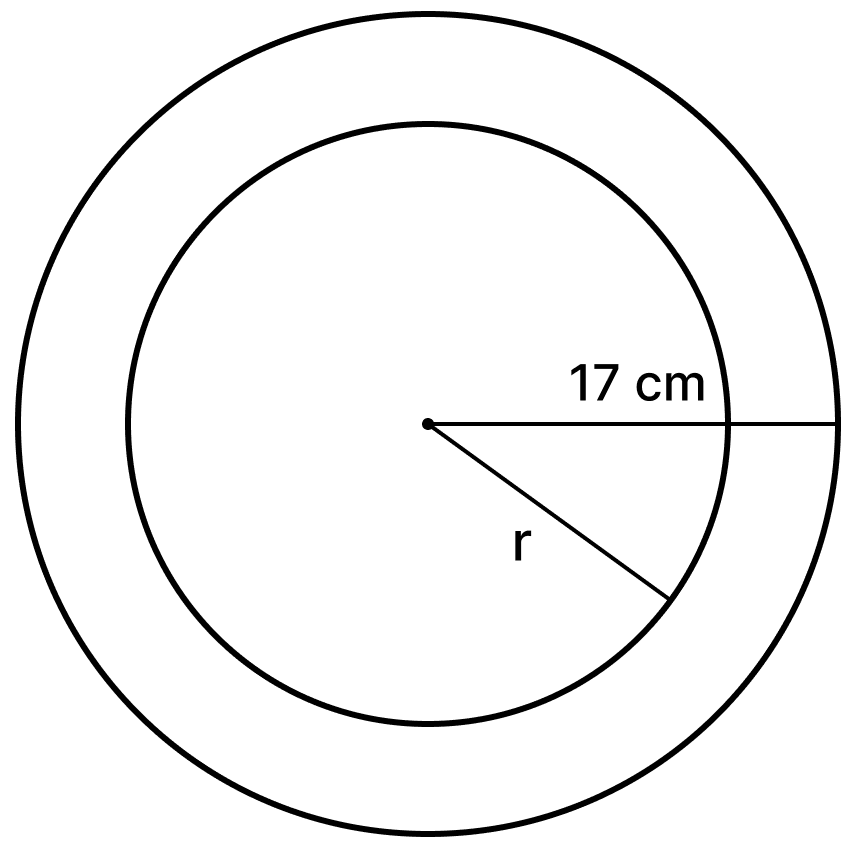
The area of a ring is 528 cm2 and the radius of the outer circle is 17 cm. Find :

(i) the radius of the smaller circle.

(ii) the width of the ring.

Answer

The area of a ring is 528 cm 2 and the radius of the outer circle is 17 cm. Find:. Mensuration, Foundation Mathematics R.S. Aggarwal ICSE Class 7.

Given:

Area of the ring = 528 cm2

Radius of the outer circle (R) = 17 cm

(i) Let's find the radius of the smaller circle:

Area of ring = Area of outer circle - Area of inner circle
Area of the path = πR2 - πr2

528 cm2=(227×(172)227×r2)528 cm2=227×(172r2)528×722 cm2=(289r2)(24×7) cm2=(289r2)168 cm2=(289r2)r2=(289168) cm2r2=121 cm2r=121 cm2r=11 cm528 \text{ cm}^2 = \Big(\dfrac{22}{7} \times (17^2) - \dfrac{22}{7} \times r^2 \Big) \\[1em] 528 \text{ cm}^2 = \dfrac{22}{7} \times (17^2 - r^2) \\[1em] \dfrac{528 \times 7}{22} \text{ cm}^2 = (289 - r^2) \\[1em] (24 \times 7) \text{ cm}^2 = (289 - r^2) \\[1em] 168 \text{ cm}^2 = (289 - r^2) \\[1em] r^2 = (289 - 168) \text{ cm}^2 \\[1em] r^2 = 121 \text{ cm}^2 \\[1em] r = \sqrt{121} \text{ cm}^2 \\[1em] r = 11 \text{ cm}

∴ The radius of the smaller circle is 11 cm.

(ii)

Let's find the width of the ring:

The width of the ring is the difference between the outer radius and the inner radius.

Width = (Outer radius - Inner radius) = (R - r) = (17 - 11) cm = 6 cm

∴ The width of the ring is 6 cm.

Question 14

The area of a circular garden is 5544 m2. Outside this garden, a path of uniform width is laid all around. The area of the path is 2002 m2. Find :

(i) the radius of the circular garden.

(ii) the width of the path.

Answer

To solve this, we use the area of the garden to find its radius, and then the combined area of the garden and path to find the outer radius.

The area of a circular garden is 5544 m 2. Outside this garden, a path of uniform width is laid all around. The area of the path is 2002 m 2. Find:. Mensuration, Foundation Mathematics R.S. Aggarwal ICSE Class 7.

(i) the radius of the circular garden.

Let the radius of the garden be r.

Area = πr2

5544 m2=227×r2r2=5544×722 m2r2=252×71 m2r2=1764 m2r=1764 m2r=42 m5544 \text{ m}^2 = \dfrac{22}{7} \times r^2 \\[1em] r^2 = \dfrac{5544 \times 7}{22} \text{ m}^2 \\[1em] r^2 = \dfrac{252 \times 7}{1} \text{ m}^2 \\[1em] r^2 = 1764 \text{ m}^2 \\[1em] r = \sqrt{1764} \text{ m}^2 \\[1em] r = 42 \text{ m}

∴ The radius of the circular garden is 42 m.

(ii) the width of the path.

To find the width, we first need the outer radius (R) of the path.

Total area = Area of garden + Area of path

= 5544 m2 + 2002 m2

= 7546 m2

Now, let's solve for the outer radius R:

Total area = πR2

7546 m2=227×R2R2=7546×722 m2R2=343×71 m2R2=2401 m2R=2401 m2R=49 m7546 \text{ m}^2 = \dfrac{22}{7} \times R^2 \\[1em] R^2 = \dfrac{7546 \times 7}{22} \text{ m}^2 \\[1em] R^2 = \dfrac{343 \times 7}{1} \text{ m}^2 \\[1em] R^2 = 2401 \text{ m}^2 \\[1em] R = \sqrt{2401} \text{ m}^2 \\[1em] R = 49 \text{ m}

Now, calculate the width of the path:

Width = (R - r) = (49 - 42) m = 7 m

∴ The width of the path is 7 m.

PrevNext