
Find the area of the parallelogram having :
(i) base = 14.5 cm, height = 2.4 cm
(ii) base = 3.8 m, height = 1.25 m
(iii) base = 75 cm, height = 1.4 m
Answer
(i)
Given:
base = 14.5 cm, height = 2.4 cm
Area of parallelogram = base x height
= 14.5 cm x 2.4 cm
= 34.8 cm2
Area of parallelogram = 34.8 cm2
(ii)
Given:
base = 3.8 m, height = 1.25 m
Area of parallelogram = base x height
= 3.8 m x 1.25 m
= 4.75 m2
Area of parallelogram = 4.75 m2
(iii) base = 75 cm, height = 1.4 m
Given:
base = 75 cm, height = 1.4 m
Converting base into m:
1 m = 100 cm
∴ 75 cm = 0.75 m
Area of parallelogram = base x height
= 0.75 m x 1.4 m
= 1.05 m2
Area of parallelogram = 1.05 m2
The height of a parallelogram is three-eighths of its base. If the area of the parallelogram is 96 cm2, find its height and base.
Answer
Given:
Area = 96 cm2
height is three-eighths of its base.
Let the base of the parallelogram be x cm.
∴ height = cm
We know the formula:
Area of parallelogram = base x height
96 cm2 = x cm x cm
96 cm2 = cm2
⇒ x2 =
⇒ x2 =
⇒ x2 = 256
⇒ x =
⇒ x = 16
∴ base = 16 cm
height =
height = 6 cm, base = 16 cm
ABCD is a parallelogram having adjacent sides AB = 35 cm and BC = 28 cm. If the distance between its longer sides is 8 cm, find :
(i) the area of the parallelogram
(ii) the distance between its shorter sides.
Answer
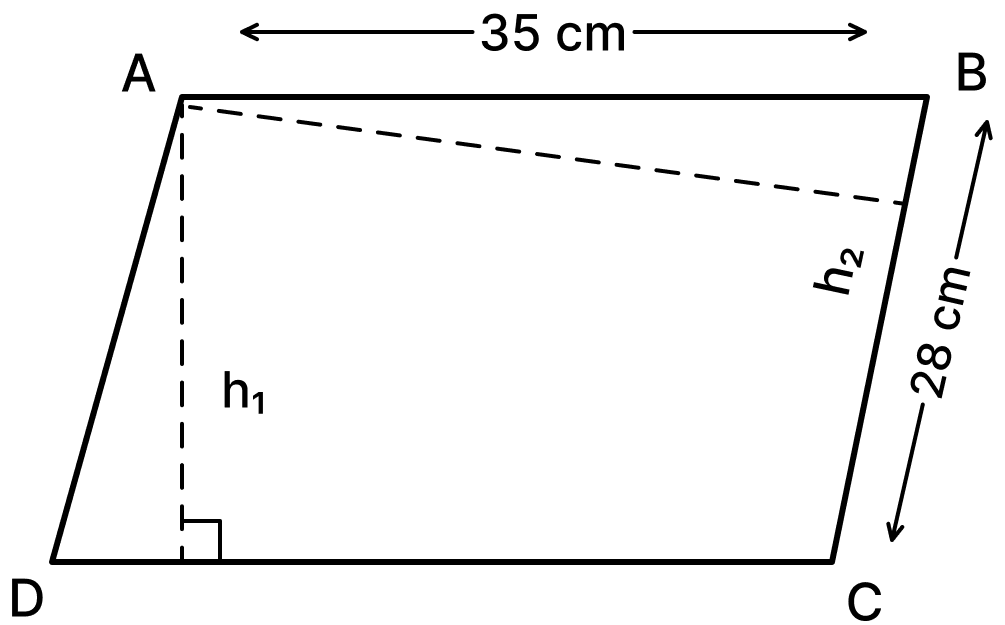
Given:
AB = 35 cm, BC = 28 cm
Distance between its longer sides = 8 cm
Since opposite sides of a parallelogram are equal,
∴ CD = 35 cm
AD = 28 cm
The "longer sides" are AB and CD, which both measure 35 cm. The distance between these sides is the height which is given as:
h1 = 8 cm.
(i) the area of the parallelogram
We know the formula:
Area of the parallelogram = base x height
= CD x h1
= 35 cm x 8 cm
= 280 cm2
∴ Area of parallelogram = 280 cm2
(ii) the distance between its shorter sides.
The "shorter sides" are BC and AD, which both measure 28 cm.
Let the distance between these sides be h2.
Since the area of the parallelogram is constant 280 cm2, we can use the shorter side as the base:
Area of the parallelogram = base x height
280 cm2 = BC x h2
280 cm2 = 28 cm x h2
⇒ h2 =
⇒ h2 = cm
⇒ h2 = 10 cm
∴ The distance between its shorter sides = 10 cm.
Find the area of rhombus whose diagonals are :
(i) 12 cm, 21 cm
(ii) 17.8 cm, 25 cm
Answer
(i)
Given:
d1 = 12 cm
d2 = 21 cm
Area of rhombus = x d1 x d2
= x 12 cm x 21 cm
= x 252 cm2
= x 126 cm2
= 126 cm2
∴ Area of rhombus = 126 cm2.
(ii) Given:
d1 = 17.8 cm
d2 = 25 cm
Area of rhombus = x d1 x d2
= x 17.8 cm x 25 cm
= x 445 cm2
= x 222.5 cm2
= 222.5 cm2
∴ Area of rhombus = 222.5 cm2.
Find the area of a rhombus having each side equal to 20 cm and one of its diagonals equal to 24 cm.
Answer
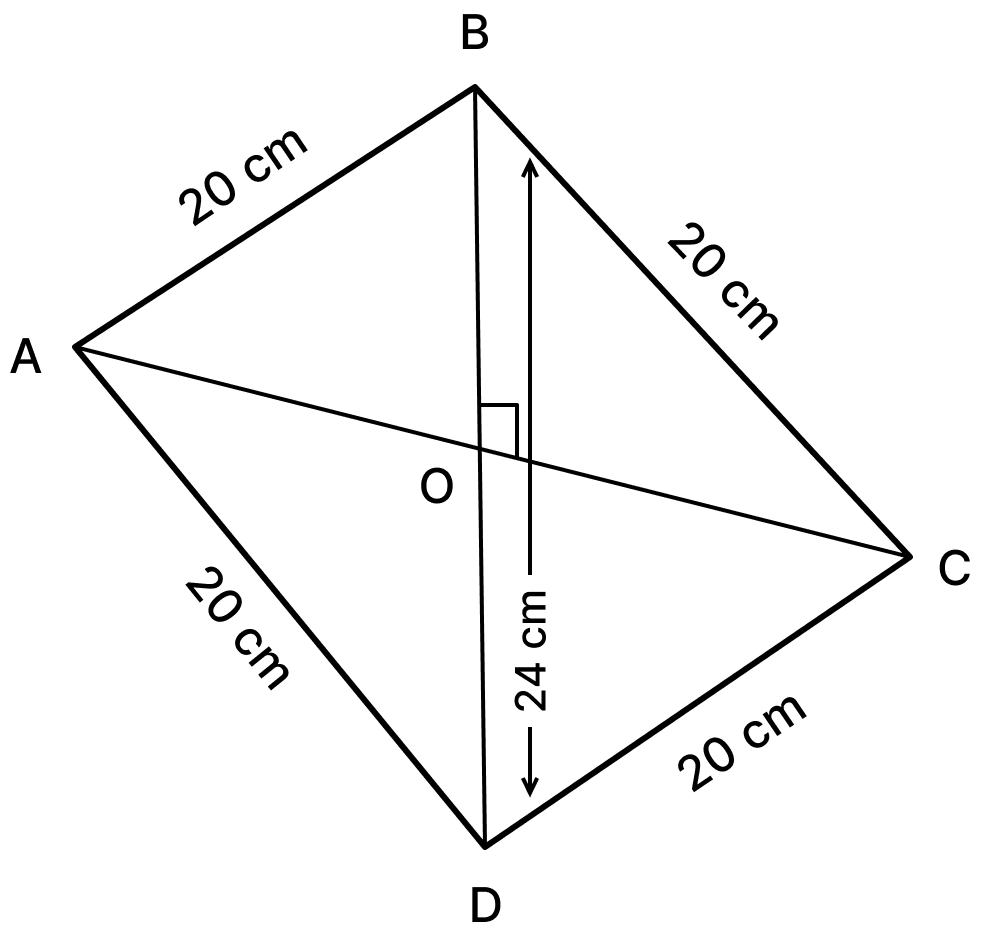
Let ABCD be the rhombus.
AB = BC = CD = DA = 20 cm
Diagonal (d1) AC = 24 cm
In a rhombus, the diagonals bisect each other at right angles 90°.
∴ AO = (AC) = (24) = 12 cm
∠AOB = 90°
Using Pythagorean Theorem in right angled △AOB, we have:
AB2 = AO2 + OB2
(20 cm)2 = (12 cm)2 + OB2
400 cm2 = 144 cm2 + OB2
⇒ OB2 = (400 - 144) cm2
⇒ OB2 = 256 cm2
⇒ OB = cm2
⇒ OB = 16 cm
Let's find the length of second diagonal d2:
d2 = BD = (2 x OB) = (2 x 16 cm) = 32 cm
∴ Area of a rhombus ABCD = x d1 x d2
= x AC x BD
= x 24 cm x 32 cm
= x 768 cm2
= 384 cm2
∴ Area of rhombus ABCD = 384 cm2.
The area of a rhombus is 234 cm2. If one of the diagonals is 19.5 cm long, find the length of the other diagonal.
Answer
Given:
Area = 234 cm2
d1 = 19.5 cm
d2 = ?
We know the formula:
Area of a rhombus = x d1 x d2
234 cm2 = x 19.5 cm x d2
234 cm2 = x d2
234 cm2 x 2 = 19.5 cm x d2
468 cm2 = 19.5 cm x d2
d2 =
d2 = 24
∴ The length of the other diagonal is 24 cm.
PQRS is a parallelogram whose adjacent sides PQ = 20 cm and QR = 21 cm one of its diagonals PR = 13 cm, find :
(i) the area of the parallelogram PQRS.
(ii) the distance between the longer sides.
(iii) the distance between the shorter sides.
Answer
Given:
PQ = 20 cm
QR = 21 cm
PR = 13 cm
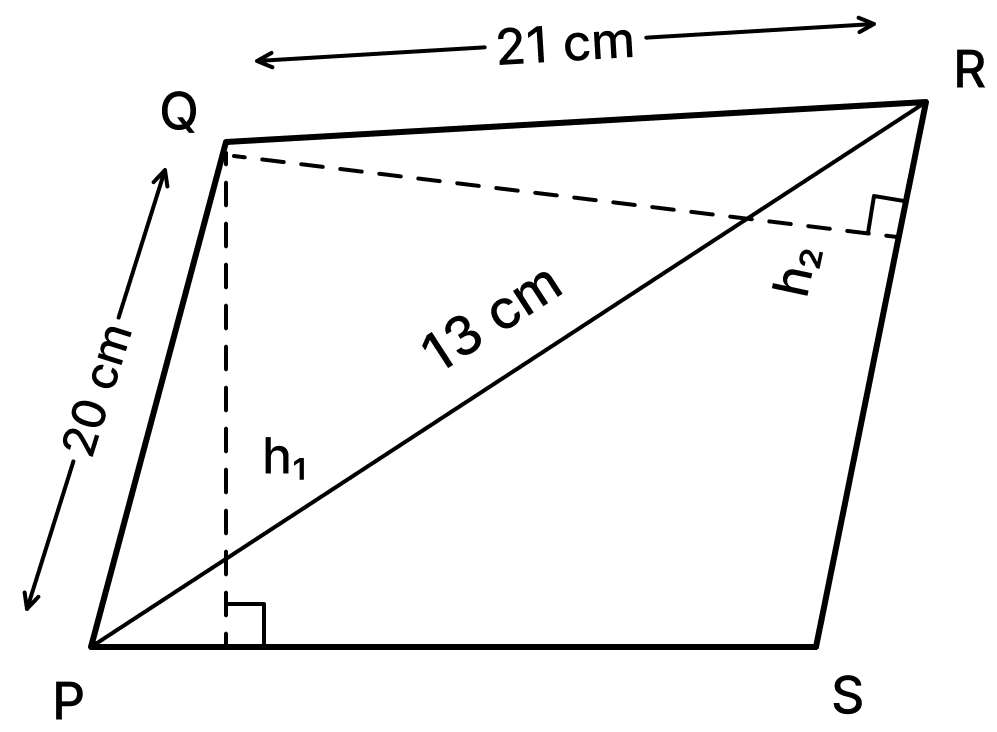
(i) the area of the parallelogram PQRS.
Since opposite sides of a parallelogram are equal,
∴ RS = 20 cm, SP = 21 cm
In △PQR we have:
a = PQ = 20 cm
b = QR = 21 cm
c = PR = 13 cm
semi-perimeter (s) = =
Now, let's find the area of △PQR:
Area of △PQR =
Area of parallelogram PQRS = 2 x Area of △PQR
= 2 x 126 cm2
= 252 cm2
∴ Area of parallelogram = 252 cm2.
(ii) the distance between the longer sides.
The "longer sides" are QR and PS, which both measure 21 cm.
Let the distance between these sides be h1.
Area of parallelogram PQRS = base x height
= 252 cm2 = QR x h1
= 252 cm2 = 21 cm x h1
⇒ h1 =
⇒ h1 = 12 cm
∴ The distance between the longer sides = 12 cm.
(iii) the distance between the shorter sides.
The "shorter sides" are PQ and RS, which both measure 20 cm.
Let the distance between these sides be h2
Area of parallelogram = base x height
= 252 cm2 = RS x h2
= 252 cm2 = 20 cm x h2
⇒ h2 =
⇒ h2 = 12.6 cm
∴ The distance between the shorter sides = 12.6 cm.
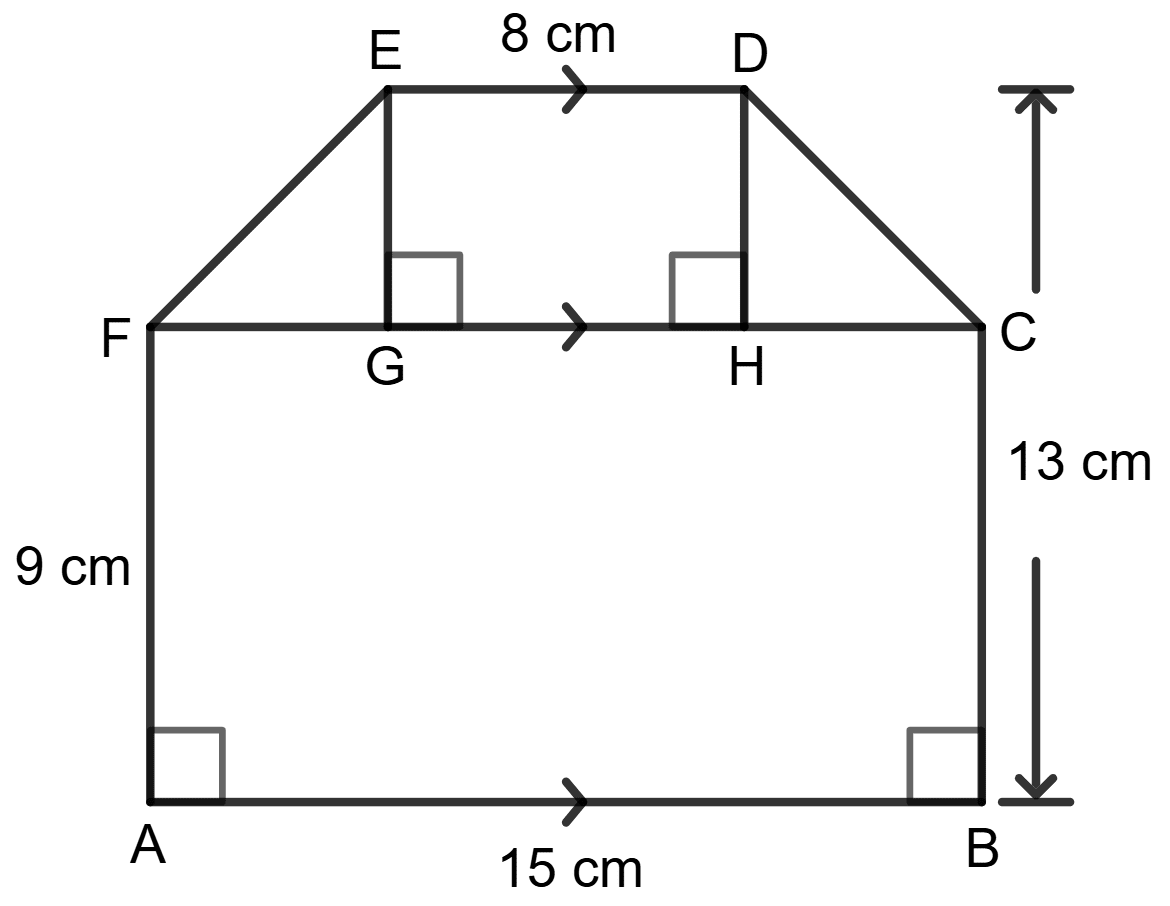
Find the area of the shaded region of the adjoining figure, it being given that ∠FAB = ∠CBA = 90°, ED || AB || FC, EG ⊥ FC, DH ⊥ FC, FG = HC, AB = 15 cm, AF = 9 cm, ED = 8 cm and distance between AB and ED = 13 cm.
Answer
To find the area of the shaded region, we split the figure into two parts: a rectangle (ABCF) and a trapezium (FCDE).
Let's find area of Rectangle ABCF:
AB = 15 cm, AF = 9 cm, ∠FAB = ∠CBA = 90°
Since ED || AB || FC, the figure ABCF has parallel opposite sides and right angles, making it a rectangle.
Length (AB) = 15 cm
Breadth (AF) = 9 cm
Area of rectangle ABCF = Length x Breadth
= 15 cm x 9 cm
= 135 cm2
Now let's find area of Trapezium FCDE:
ED = 8 cm
Since ABCF is a rectangle, the side FC is equal to AB:
Base 1 (FC) = 15 cm
Base 2 (ED) = 8 cm
The total distance between AB and ED is given as 13 cm.
Let's find the height of the trapezium (h):
h = Distance between AB and ED - AF
h = 13 cm - 9 cm
h = 4 cm
Area of trapezium FCDE = x (sum of parallel sides) x height
= x (FC + ED) x h
= x (15 + 8) cm x 4 cm
= x 23 cm x 4 cm
= x 92 cm2
= x 46 cm2
= 46 cm2
∴ Total Area of the Shaded Region = Area of Rectangle ABCF + Area of trapezium FCDE
= 135 cm2 + 46 cm2
= 181 cm2
∴ Area of the Shaded Region = 181 cm2.
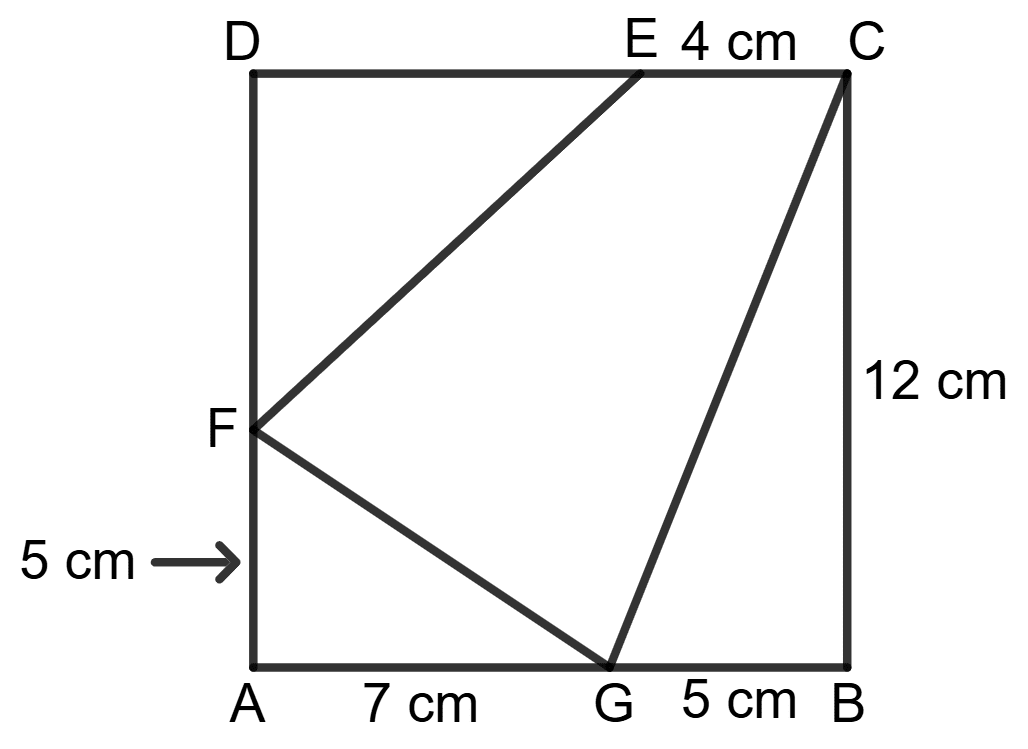
Find the area of the shaded region in the adjoining figure, it being given that ABCD is a square of side 12 cm, CE = 4cm, FA = 5cm and BG = 5 cm.
Answer
To find the area of the shaded region, subtract the areas of the three unshaded triangles from the total area of the square ABCD.
Let's find area of Square ABCD:
Side of the square = 12 cm [Given]
Area of the square = (Side)2
= (12)2
= (12 cm x 12 cm)
= 144 cm2
Now let's find areas of the Unshaded Triangles:
The area of a right-angled triangle is x base x height
(i) Area of △AFG:
Base AG = 7 cm, Height FA = 5 cm
Area of △AFG = x 7 cm x 5 cm
= x 35 cm2
= 17.5 cm2
(ii) Area of △BGC:
Base BG = 5 cm, Height BC = 12 cm
Area of △BGC = x 5 cm x 12 cm
= x 60 cm2
= 30 cm2
(iii) Area of △DEF:
Base DE = (DC - CE) = (12 - 4) cm = 8 cm
Height DF = (AD - FA) = (12 - 5) cm = 7 cm
Area of △DEF = x 8 cm x 7 cm
= x 56 cm2
= 28 cm2
∴ Total Area of the Shaded Region = Area of square ABCD - (Sum areas of the Unshaded Triangles)
= Area of square ABCD - (Area of △AFG + Area of △BGC + Area of △DEF)
= 144 cm2 - (17.5 + 30 + 28) cm2
= 144 cm2 - 75.5 cm2
= 68.5 cm2
∴ Area of the Shaded Region = 68.5 cm2.
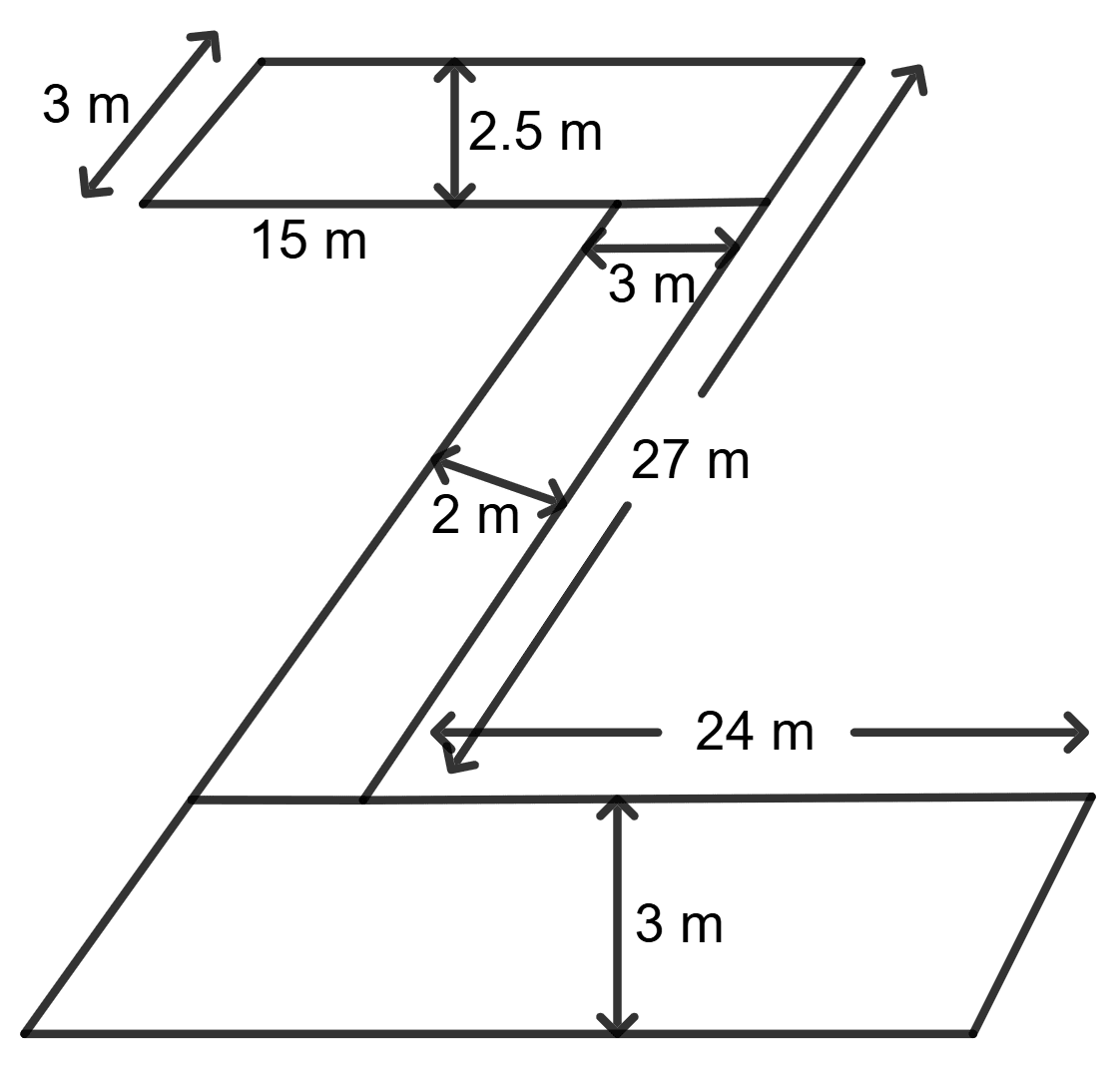
Find the area of the shaded region in the adjoining figure :
Answer
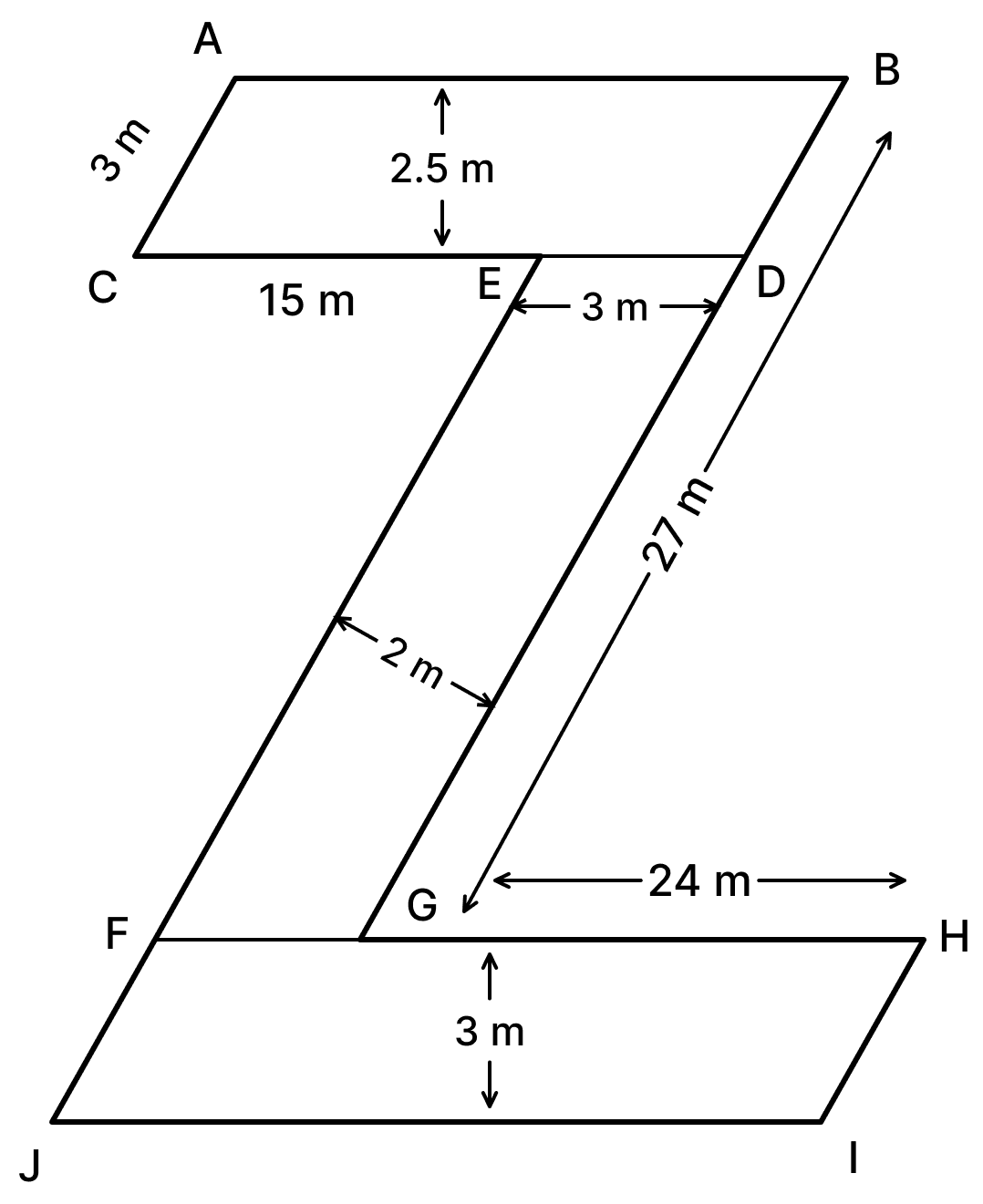
To find the total area of this Z-shaped shaded region, we divide it into three separate parallelograms: the top horizontal bar ABCD, the bottom horizontal bar FHIJ, and the middle slanted connector EDGF as shown below:
The area of parallelogram = base x height
(i) Area of the Top Parallelogram ABCD:
Base: CD = (CE + ED) = (15 + 3) m = 18 m
Height: 2.5 m
Area = (18 m x 2.5 m) = 45 m2
(ii) Area of the Middle Slanted Parallelogram EDGF:
Base: GD = (GB - DB) = (27 - 3) m = 24 m
Height: 2 m
Area = (24 m x 2 m) = 48 m2
(iii) Area of the Bottom Parallelogram FHIJ:
Base: FH = (FG + GH) = (3 + 24) m = 27 m
Height = 3 m
Area = (27 m x 3 m) = 81 m2
∴ Area of the Shaded Region = (Area of ABCD + Area of EDGF + Area of FHIJ)
= 45 m2 + 48 m2 + 81 m2
= 174 m2
Area of the Shaded Region = 174 m2.
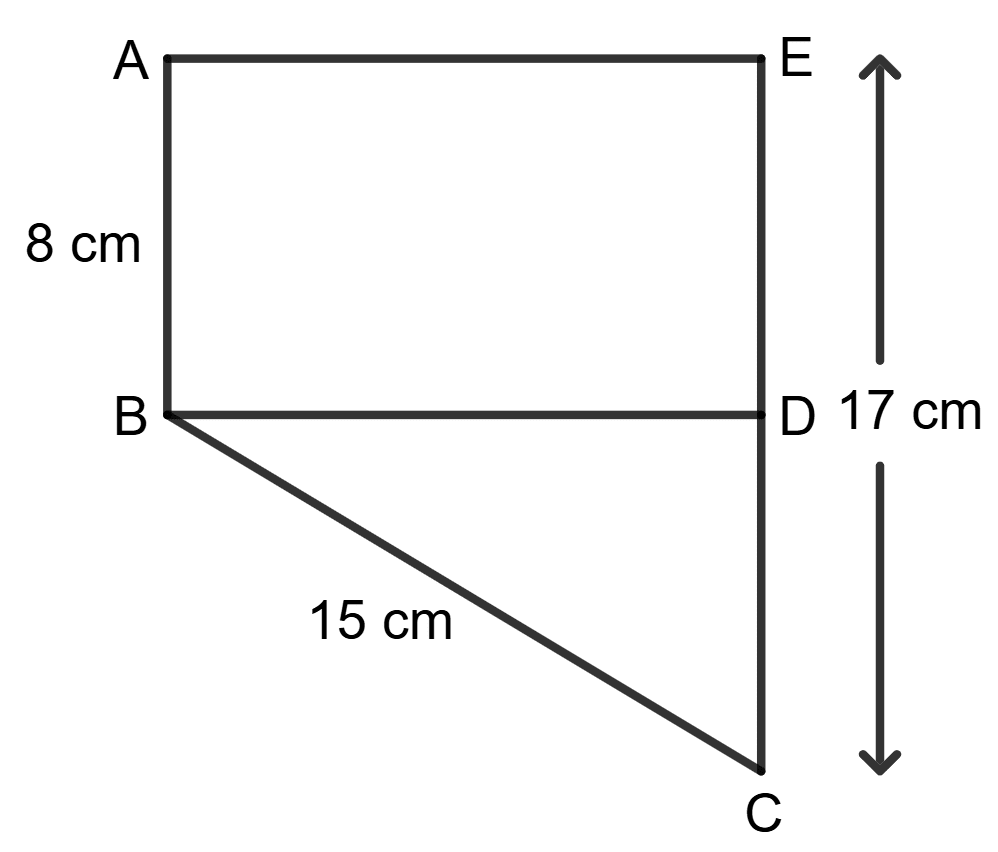
Find the area of the shaded region of each of the given figures :
(i)
(ii)
(iii)
(iv)
(v)
Answer
(i)
To find the area of the shaded region, we break the figure into rectangle (ABDE) and a right-angled triangle (BDC).
In right-angled triangle BDC:
height = CD = (CE - DE) = (17 - 8) cm = 9 cm
BC = 15 cm [Given]
Using Pythagoras theorem:
BD2 + CD2 = BC2
BD2 + (9 cm)2 = (15 cm)2
BD2 + 81 cm 2 = 225 cm2
BD2 = (225 - 81) cm2
BD2 = 144 cm2
BD = cm2
BD = 12 cm
Area of triangle BDC = x base x height
= x 12 cm x 9 cm
= x 108 cm2
= x 54 cm2
= 54 cm2
In rectangle ABDE:
Length = BD = 12 cm
Breadth = AB = 8 cm [Given]
Area of rectangle ABDE = Length x Breadth
= 12 cm x 8 cm
= 96 cm2
∴ Area of the Shaded Region = (Area of triangle BDC + Area of rectangle ABDE)
= 54 cm2 + 96 cm2
Area of shaded region = 150 cm2
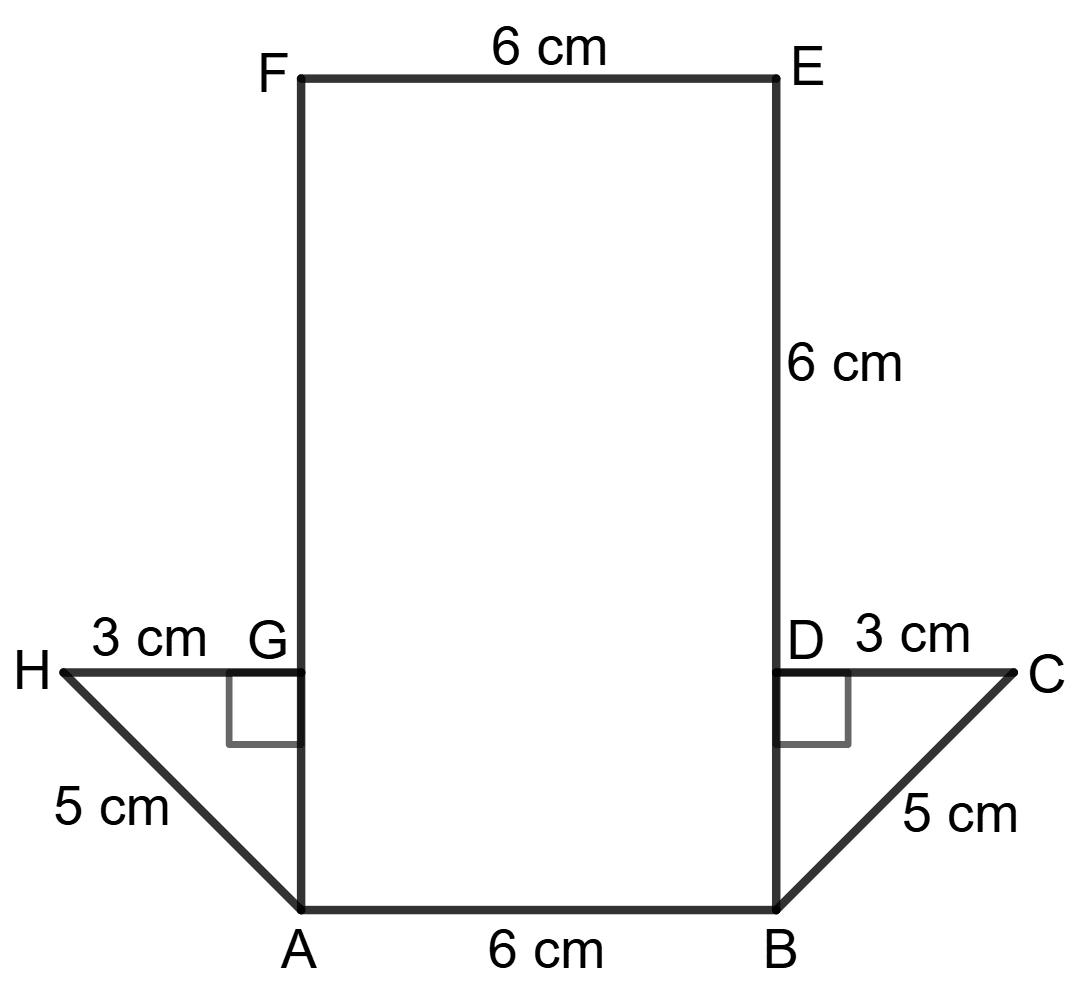
(ii)
To find the area of the shaded region, we break the figure into rectangle (ABEF) and two identical right-angled triangles (AGH and BCD).
In right-angled triangle AGH:
AH = 5 cm
GH = 3 cm
Using Pythagoras Theorem,
AG2 + GH2 = AH2
AG2 + (3 cm)2 = (5 cm)2
AG2 + 9 cm2 = 25 cm2
AG2 = (25 - 9) cm2
AG2 = 16 cm2
AG = cm2
AG = 4 cm
Since the triangles AGH and BCD are identical, their corresponding sides are equal.
∴ BD = 4 cm
Area of Triangles AGH and BCD:
Both triangles are identical with base 3 cm and height 4 cm.
Total Area of 2 Triangles = 2 x ( x base x height)
= 2 x ( x 3 cm x 4 cm)
= 2 x ( x 12 cm2)
= 2 x ( x 6 cm2)
= 2 x 6 cm2
= 12 cm2
In rectangle ABEF:
Length = BE = (BD + DE) = (4 + 6) cm = 10 cm
Breadth = EF = 6 cm
Area of rectangle ABEF = Length x Breadth
= 10 cm x 6 cm
= 60 cm2
∴ Area of the Shaded Region = (Area of 2 Triangles AGH and BCD + Area of rectangle ABEF)
= 12 cm2 + 60 cm2
Area of shaded region = 72 cm2
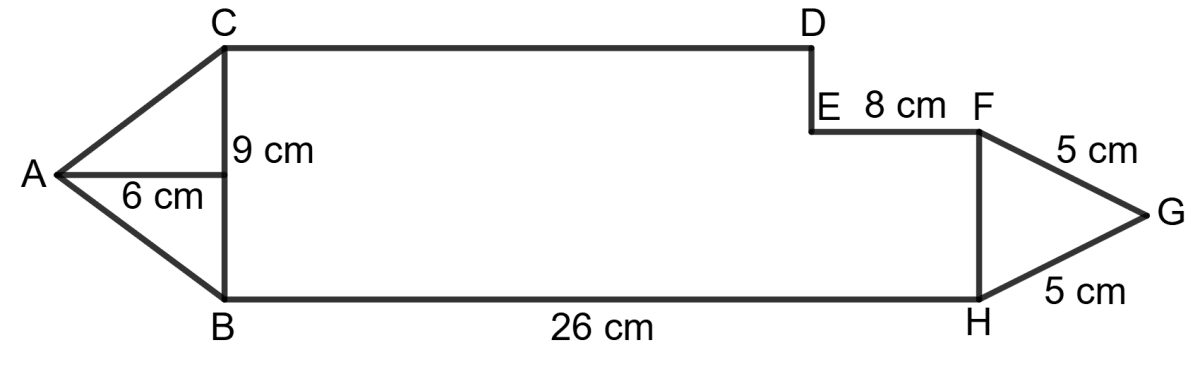
(iii)
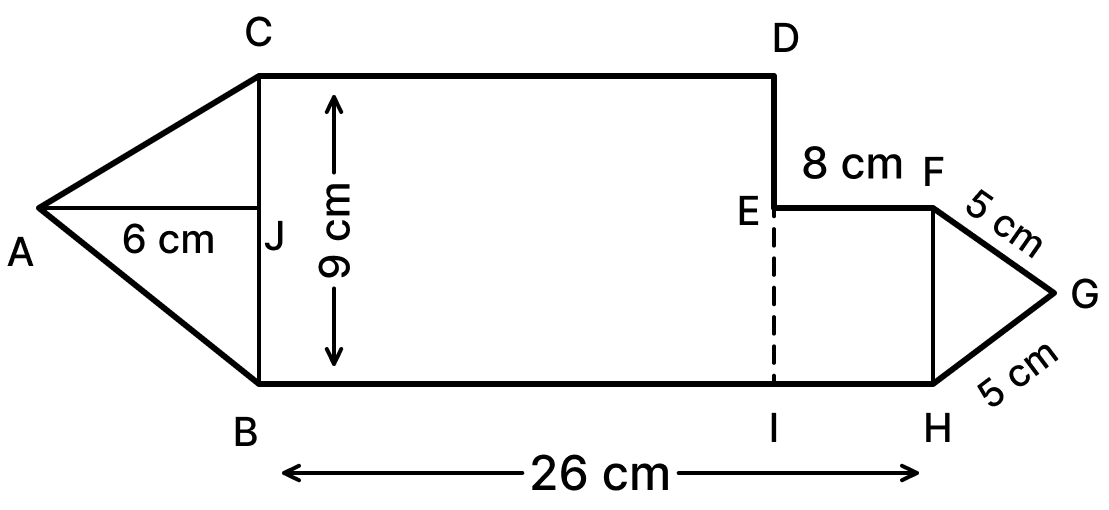
To find the area of the shaded region, we break the figure into the triangle on the left (ABC), the main central rectangle (BCDI), the smaller rectangle (EFHI), and the triangle on the right (FGH).
In △ABC:
Base: BC = 9 cm
Height: AJ = 6 cm
Area of △ABC = x base x height
= x 9 cm x 6 cm
= x 54 cm2
= x 27 cm2
= 27 cm2
In rectangle BCDI:
BH = 26 cm
Length of the small section: EF = 8 cm
Since the opposite sides of a triangle are equal, therefore IH = 8 cm
Length BI = (BH - IH) = (26 - 8) cm = 18 cm
Breadth: BC = 9 cm
Area of rectangle BCDI = length x breadth
= 18 cm x 9 cm
= 162 cm2
In △FGH:
FG = GH = FH = 5 cm
Area of △FGH =
In rectangle EFHI:
Length: EF = 8 cm
Breadth: FH = 5 cm
Area of rectangle EFHI = length x breadth
= 8 cm x 5 cm
= 40 cm2
∴ Area of the shaded region = Area of △ABC + Area of rectangle BCDI + Area of △FGH + Area of rectangle EFHI
= 27 cm2 + 162 cm2 + 10.8125 cm2 + 40 cm2
= 239.8125 cm2
Area of shaded region = 239.8125 cm2
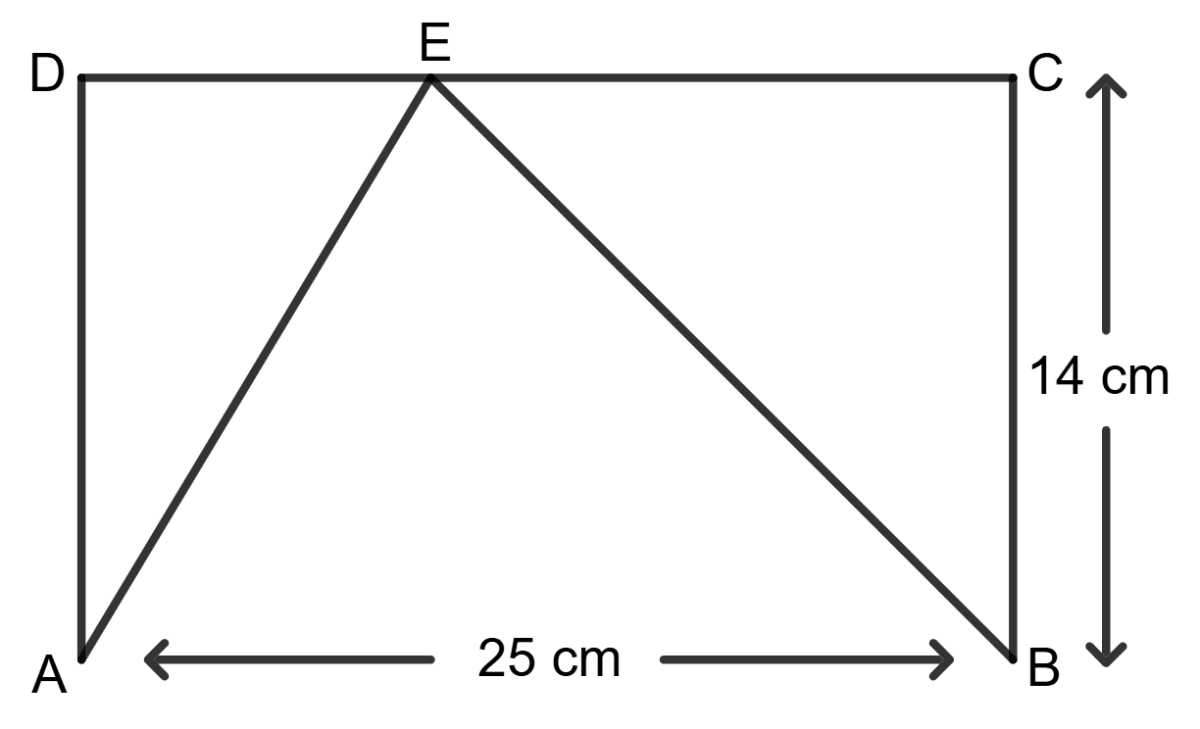
(iv)
To find the area of the shaded region, subtract the area of the unshaded triangle from the area of the rectangle.
In rectangle ABCD:
Length: AB = 25 cm
Breadth: BC = 14 cm
Area of rectangle ABCD = Length x Breadth
= 25 cm x 14 cm
= 350 cm2
In △ABE:
Triangle ABE share the same base as the rectangle (AB) and its vertex E lies on the opposite side CD.
This means the height of the triangle is the same as the width of the rectangle.
Base: AB = 25 cm
Height: EF = 14 cm
Area of △ABE = x base x height
= x 25 cm x 14 cm
= x 350 cm2
= x 175 cm2
= 175 cm2
∴ Area of shaded region = Area of rectangle ABCD - Area of △ABE
= 350 cm2 - 175 cm2
Area of shaded region = 175 cm2
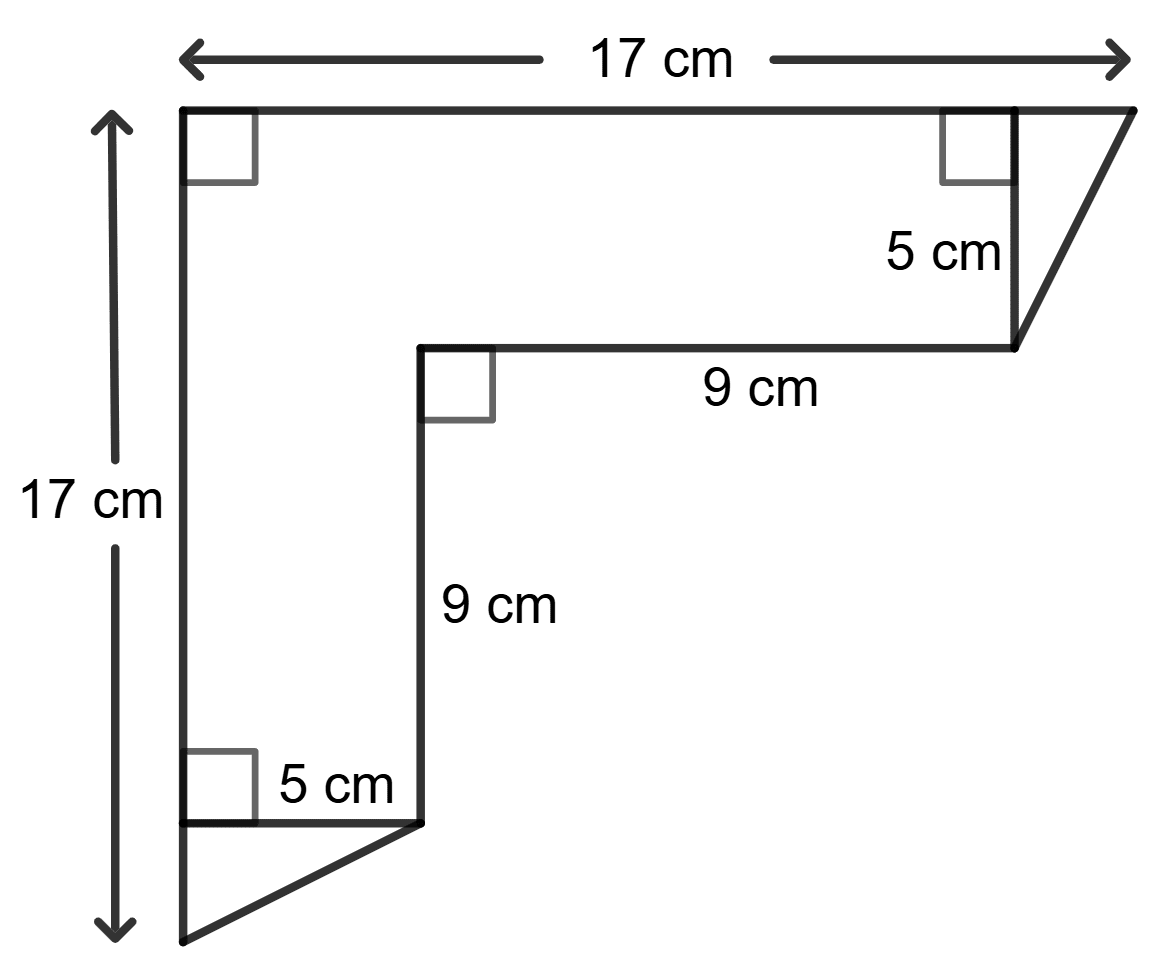
(v)
To find the area of the shaded region, we split the shape into two rectangles (ABCD and EFID) and two identical triangles (EFG and BCH).
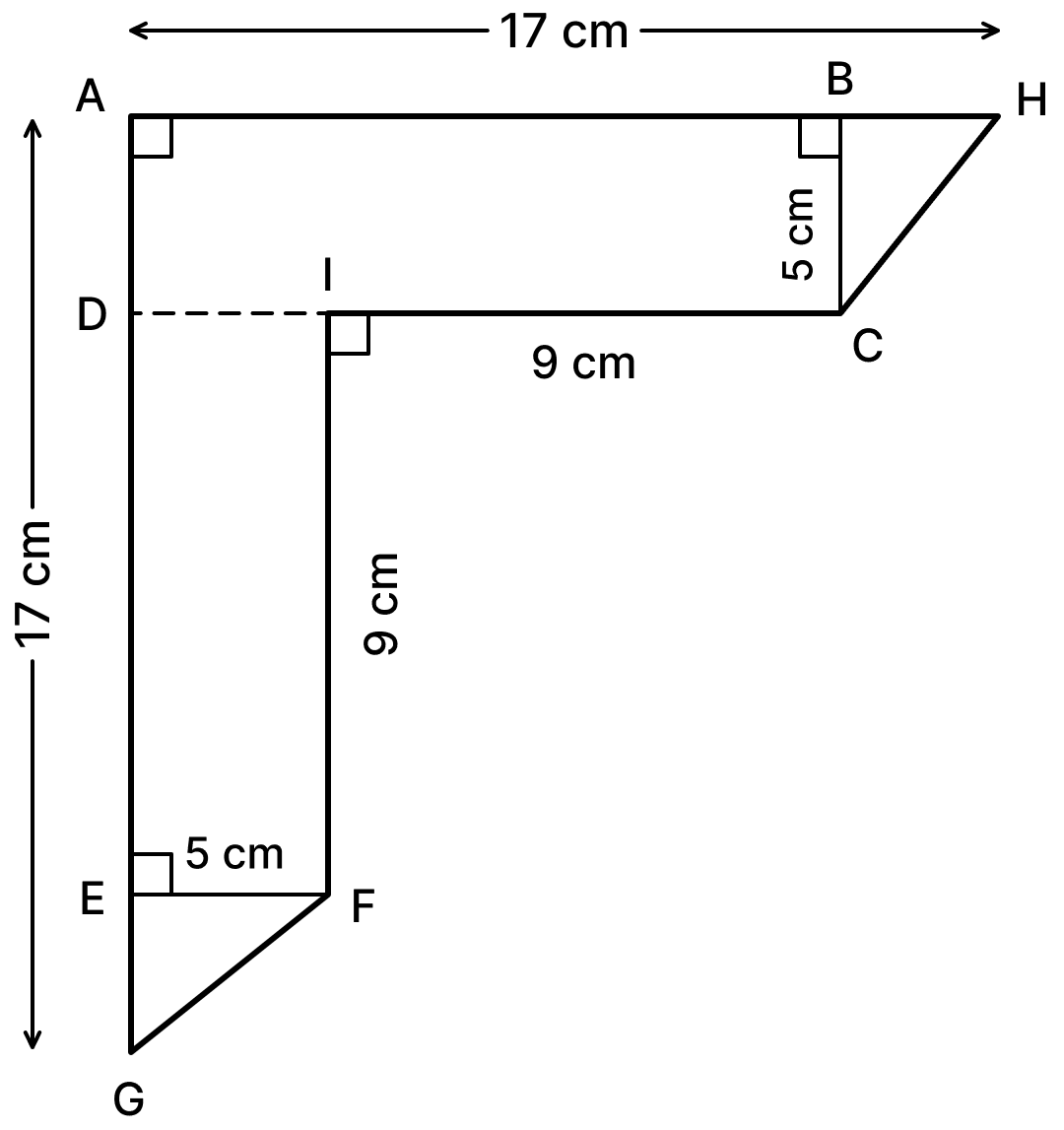
In rectangle EFID:
Length: IF = 9 cm
Breadth: EF = 5 cm
Area of rectangle EFID = Length x Breadth
= 9 cm x 5 cm
= 45 cm2
In rectangle ABCD:
Length: CD = (CI + ID) = (9 + 5) cm = 14 cm
Breadth: BC = 5 cm
Area of rectangle ABCD = Length x Breadth
= 14 cm x 5 cm
= 70 cm2
In right-angled △BCH:
Base: BH = (AH - AB) = (17 - 14) cm = 3 cm [AB = CD]
Height: BC = 5 cm [Given]
Area of △BCH = x base x height
= x 3 cm x 5 cm
= x 15 cm2
= x 7.5 cm2
= 7.5 cm2
Since △BCH and △EFG are identical, their areas are equal.
∴ Area of △EFG = 7.5 cm2
Area of Shaded Region = Area of rectangle ABCD + Area of rectangle EFID + Sum of area of △BCH and △EFG
= 70 cm2 + 45 cm2 + (7.5 cm2 + 7.5 cm2)
= 115 cm2 + 15 cm2
Area of shaded region = 130 cm2