Find the area of the triangle, having
(i) base = 16 cm, height = 7.5 cm
(ii) base = 5.6 m, height = 3.5 m
(iii) base = 6.4 m, height = 8 dm
(iv) base = 9.5 cm, height = 6 mm
Answer
(i)
Given:
base = 16 cm, height = 7.5 cm
We have the formula,
Area of the triangle = 1 2 \dfrac{1}{2} 2 1
= 1 2 \dfrac{1}{2} 2 1
= 1 1 \dfrac{1}{1} 1 1
= 60 cm2
Area of the triangle = 60 cm2
(ii)
Given:
base = 5.6 m, height = 3.5 m
We have the formula,
Area of the triangle = 1 2 \dfrac{1}{2} 2 1
= 1 2 \dfrac{1}{2} 2 1
= 1 1 \dfrac{1}{1} 1 1
= 9.8 m2
Area of the triangle = 9.8 m2
(iii)
Given:
base = 6.4 m, height = 8 dm
Converting base into dm:
1 m = 10 dm
∴ 6.4 m = 64 dm
We have the formula,
Area of the triangle = 1 2 \dfrac{1}{2} 2 1
= 1 2 \dfrac{1}{2} 2 1
= 1 1 \dfrac{1}{1} 1 1
= 256 dm2
Area of the triangle = 256 dm2
(iv)
Given:
base = 9.5 cm, height = 6 mm
Converting height into cm:
1 cm = 10 mm
∴ 6 mm = 0.6 cm
We have the formula,
Area of the triangle = 1 2 \dfrac{1}{2} 2 1
= 1 2 \dfrac{1}{2} 2 1
= 1 1 \dfrac{1}{1} 1 1
= 2.85 cm2
Area of the triangle = 2.85 cm2
Find the height of the triangle whose :
(i) area = 28.9 m2 base = 8.5 m
(ii) area = 56 dm2 base = 2.8 m
Answer
(i)
Given:
area = 28.9 m2 base = 8.5 m
We have the formula,
Area of the triangle = 1 2 \dfrac{1}{2} 2 1
= height = 2 × Area base = 2 × 28.9 m 2 8.5 m = 57.8 m 2 8.5 m = 6.8 m \phantom{=} \text{height} = \dfrac{2 \times \text{Area}}{\text{base}} \\[1em] = \dfrac{2 \times 28.9 \text{ m}^2}{8.5 \text{ m}} \\[1em] = \dfrac{57.8 \text{ m}^2}{8.5 \text{ m}} \\[1em] = 6.8 \text{ m} = height = base 2 × Area = 8.5 m 2 × 28.9 m 2 = 8.5 m 57.8 m 2 = 6.8 m
The height of the triangle = 6.8 m
(ii)
Given:
area = 56 dm2 base = 2.8 m
Converting base into dm:
1 m = 10 dm
∴ 2.8 m = 28 dm
We have the formula,
Area of the triangle = 1 2 \dfrac{1}{2} 2 1
= height = 2 × Area base = 2 × 56 dm 2 28 dm = 2 × 2 dm 2 1 dm = 4 dm \phantom{=} \text{height} = \dfrac{2 \times \text{Area}}{\text{base}} \\[1em] = \dfrac{2 \times 56 \text{ dm}^2}{28 \text{ dm}} \\[1em] = \dfrac{2 \times 2 \text{ dm}^2}{1 \text{ dm}} \\[1em] = 4 \text{ dm} = height = base 2 × Area = 28 dm 2 × 56 dm 2 = 1 dm 2 × 2 dm 2 = 4 dm
The height of the triangle = 4 dm
Find the base of the triangle whose :
(i) area = 4.2 m2 height = 2.4 m
(ii) area = 2.4 dm2 , height = 80 cm
Answer
(i)
Given:
area = 4.2 m2 height = 2.4 m
We have the formula,
Area of the triangle = 1 2 \dfrac{1}{2} 2 1
= base = 2 × Area height = 2 × 4.2 m 2 2.4 m = 1 × 4.2 m 2 1.2 m = 3.5 m \phantom{=} \text{base} = \dfrac{2 \times \text{Area}}{\text{height}} \\[1em] = \dfrac{2 \times 4.2 \text{ m}^2}{2.4 \text{ m}} \\[1em] = \dfrac{1 \times 4.2 \text{ m}^2}{1.2 \text{ m}} \\[1em] = 3.5 \text{ m} \\[1em] = base = height 2 × Area = 2.4 m 2 × 4.2 m 2 = 1.2 m 1 × 4.2 m 2 = 3.5 m
= 3.5 m
The base of the triangle = 3.5 m
(ii)
Given:
area = 2.4 dm2 , height = 80 cm
Converting area into cm:
1 dm2 = 100 cm2
∴ 2.4 dm2 = 240 cm2
We have the formula,
Area of the triangle = 1 2 \dfrac{1}{2} 2 1
= base = 2 × Area height = 2 × 240 cm 2 80 cm = 2 × 3 cm 2 1 cm = 6 cm \phantom{=} \text{base} = \dfrac{2 \times \text{Area}}{\text{height}} \\[1em] = \dfrac{2 \times 240 \text{ cm}^2}{80 \text{ cm}} \\[1em] = \dfrac{2 \times 3 \text{ cm}^2}{1 \text{ cm}} \\[1em] = 6 \text{ cm} = base = height 2 × Area = 80 cm 2 × 240 cm 2 = 1 cm 2 × 3 cm 2 = 6 cm
The base of the triangle = 6 cm
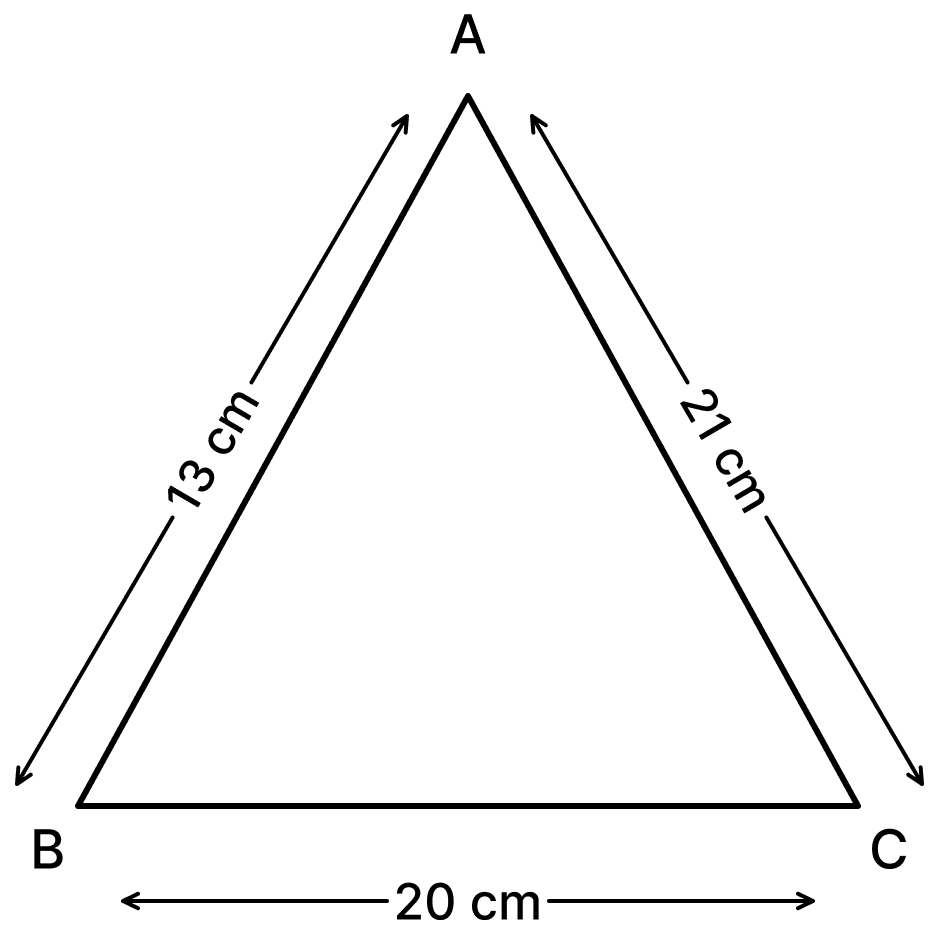
Find the area of the triangle whose sides are 13 cm, 20 cm and 21 cm. Also find the altitude of the triangle corresponding to the largest side.
Answer
Given:
Sides: a = 13 cm, b = 20 cm, c = 21 cm
s = 1 2 \dfrac{1}{2} 2 1
= 1 2 \dfrac{1}{2} 2 1
= 1 2 \dfrac{1}{2} 2 1
= 1 1 \dfrac{1}{1} 1 1
= 27 cm
Area of the triangle = s ( s − a ) ( s − b ) ( s − c ) \sqrt{s(s - a)(s - b)(s - c)} s ( s − a ) ( s − b ) ( s − c )
= 27 ( 27 − 13 ) ( 27 − 20 ) ( 27 − 21 ) cm 2 = 27 × 14 × 7 × 6 cm 2 = ( 3 × 3 × 3 ) × ( 2 × 7 ) × 7 × ( 2 × 3 ) cm 2 = 3 4 × 2 2 × 7 2 cm 2 = 3 2 × 2 × 7 cm 2 = 9 × 14 cm 2 = 126 cm 2 = \sqrt{27(27 - 13)(27 - 20)(27 - 21)} \text{ cm}^2 \\[1em] = \sqrt{27 \times 14 \times 7 \times 6} \text{ cm}^2 \\[1em] = \sqrt{(3 \times 3 \times 3) \times (2 \times 7) \times 7 \times (2 \times 3)} \text{ cm}^2 \\[1em] = \sqrt{3^4 \times 2^2 \times 7^2} \text{ cm}^2 \\[1em] = 3^2 \times 2 \times 7 \text{ cm}^2 \\[1em] = 9 \times 14 \text{ cm}^2 \\[1em] = 126 \text{ cm}^2 = 27 ( 27 − 13 ) ( 27 − 20 ) ( 27 − 21 ) cm 2 = 27 × 14 × 7 × 6 cm 2 = ( 3 × 3 × 3 ) × ( 2 × 7 ) × 7 × ( 2 × 3 ) cm 2 = 3 4 × 2 2 × 7 2 cm 2 = 3 2 × 2 × 7 cm 2 = 9 × 14 cm 2 = 126 cm 2
Largest side = 21 cm
Let the altitude corresponding to the largest side be h cm. Then
= Area = 1 2 × base × h 126 cm 2 = 1 2 × 21 × h ⇒ h = 126 × 2 21 cm ⇒ h = 6 × 2 cm ⇒ h = 12 cm \phantom{=} \text{Area} = \dfrac{1}{2} \times \text{base} \times h \\[1em] 126 \text{ cm}^2 = \dfrac{1}{2} \times 21 \times h \\[1em] \Rightarrow h = \dfrac{126 \times 2}{21} \text{ cm} \\[1em] \Rightarrow h = 6 \times 2 \text{ cm} \\[1em] \Rightarrow h = 12 \text{ cm} = Area = 2 1 × base × h 126 cm 2 = 2 1 × 21 × h ⇒ h = 21 126 × 2 cm ⇒ h = 6 × 2 cm ⇒ h = 12 cm
Area = 126 cm2 , The required height = 12 cm
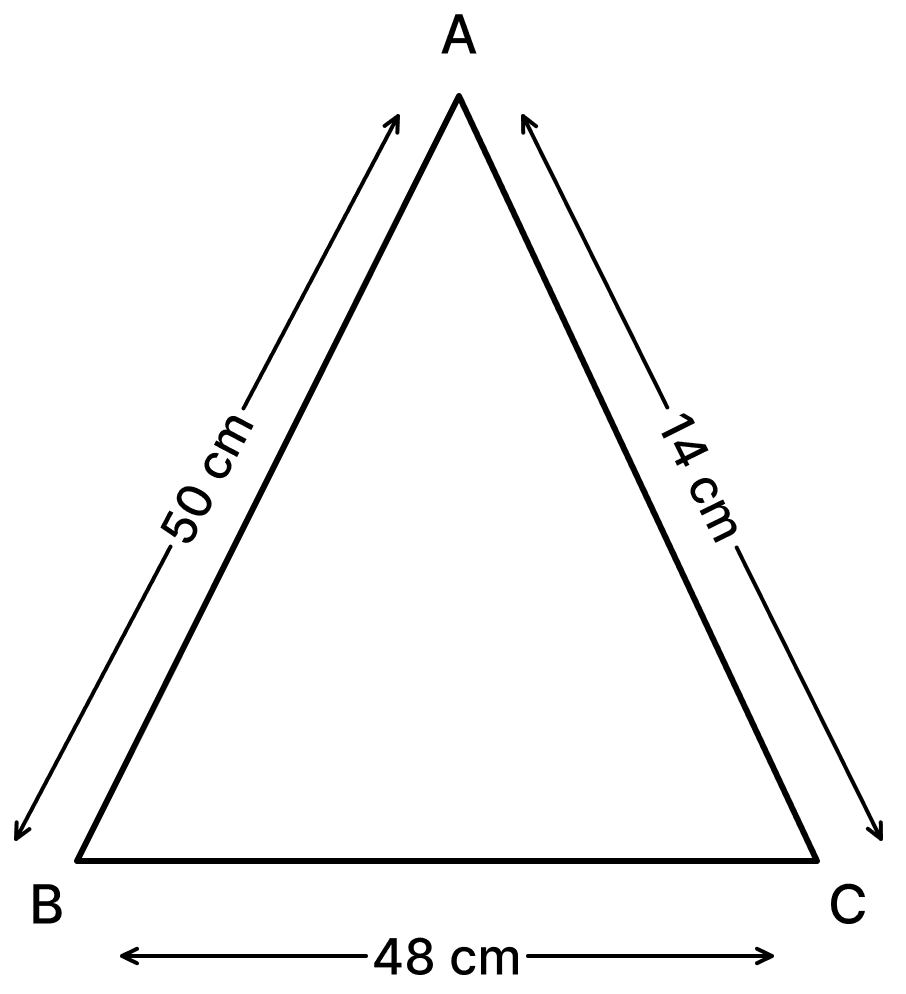
Find the area of the triangle whose sides are 50 cm, 48 cm and 14 cm. Find the height of the triangle corresponding to the side measuring 48 cm.
Answer
Given:
Sides: a = 50 cm, b = 48 cm, c = 14 cm
s = 1 2 \dfrac{1}{2} 2 1
= 1 2 \dfrac{1}{2} 2 1
= 1 2 \dfrac{1}{2} 2 1
= 1 1 \dfrac{1}{1} 1 1
= 56 cm
Area of the triangle = s ( s − a ) ( s − b ) ( s − c ) \sqrt{s(s - a)(s - b)(s - c)} s ( s − a ) ( s − b ) ( s − c )
= 56 ( 56 − 50 ) ( 56 − 48 ) ( 56 − 14 ) cm 2 = 56 × 6 × 8 × 42 cm 2 = ( 8 × 7 ) × ( 6 ) × 8 × ( 6 × 7 ) cm 2 = 8 2 × 7 2 × 6 2 cm 2 = 8 × 7 × 6 cm 2 = 336 cm 2 = \sqrt{56(56 - 50)(56 - 48)(56 - 14)} \text{ cm}^2 \\[1em] = \sqrt{56 \times 6 \times 8 \times 42} \text{ cm}^2 \\[1em] = \sqrt{(8 \times 7) \times (6) \times 8 \times (6 \times 7)} \text{ cm}^2 \\[1em] = \sqrt{8^2 \times 7^2 \times 6^2} \text{ cm}^2 \\[1em] = 8 \times 7 \times 6 \text{ cm}^2 \\[1em] = 336 \text{ cm}^2 \\[1em] = 56 ( 56 − 50 ) ( 56 − 48 ) ( 56 − 14 ) cm 2 = 56 × 6 × 8 × 42 cm 2 = ( 8 × 7 ) × ( 6 ) × 8 × ( 6 × 7 ) cm 2 = 8 2 × 7 2 × 6 2 cm 2 = 8 × 7 × 6 cm 2 = 336 cm 2
Let the altitude corresponding to the side of 48 cm be h cm. Then
= Area = 1 2 × base × h 336 cm 2 = 1 2 × 48 × h ⇒ h = 336 × 2 48 cm ⇒ h = 7 × 2 cm ⇒ h = 14 cm \phantom{=} \text{Area} = \dfrac{1}{2} \times \text{base} \times h \\[1em] 336 \text{ cm}^2 = \dfrac{1}{2} \times 48 \times h \\[1em] \Rightarrow h = \dfrac{336 \times 2}{48} \text{ cm} \\[1em] \Rightarrow h = 7 \times 2 \text{ cm} \\[1em] \Rightarrow h = 14 \text{ cm} = Area = 2 1 × base × h 336 cm 2 = 2 1 × 48 × h ⇒ h = 48 336 × 2 cm ⇒ h = 7 × 2 cm ⇒ h = 14 cm
Area = 336 cm2 , The required height = 14 cm
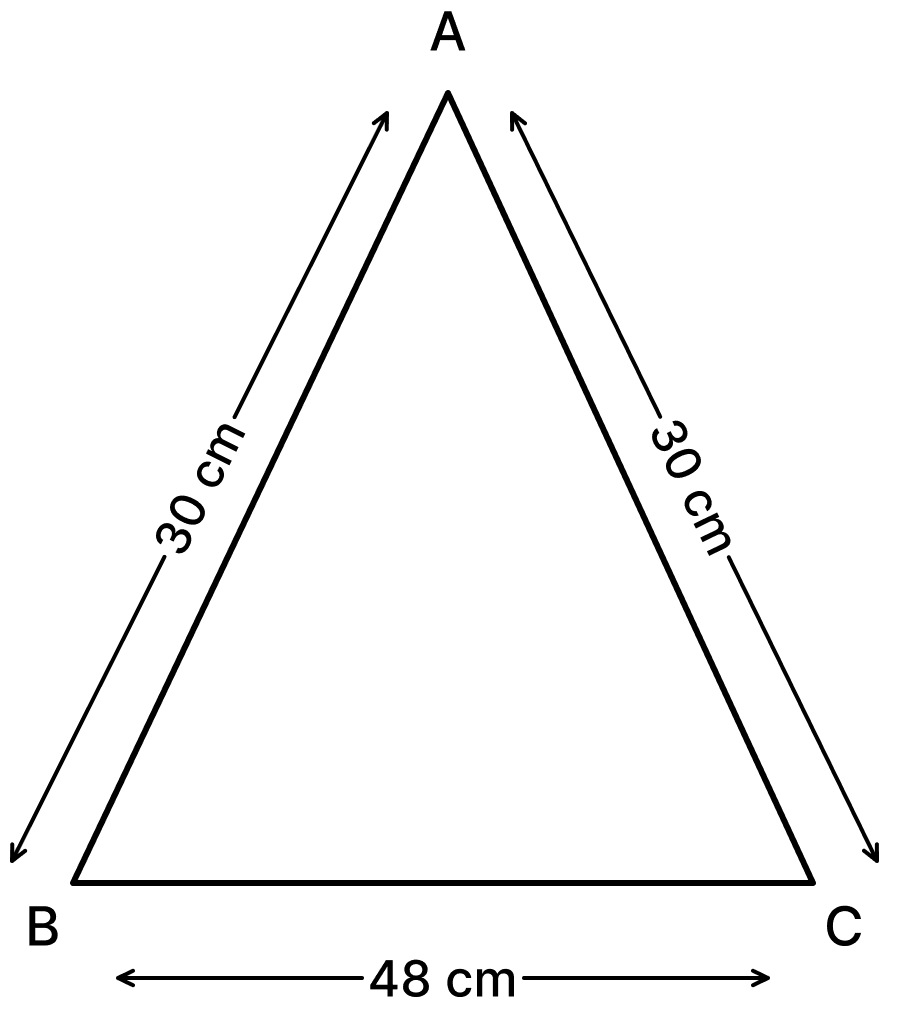
Find the area of an isosceles triangle in which each of the equal sides measures 30 cm and the third side is 48 cm long.
Answer
Given:
Sides: a = 30 cm, b = 30 cm, c = 48 cm
s = 1 2 \dfrac{1}{2} 2 1
= 1 2 \dfrac{1}{2} 2 1
= 1 2 \dfrac{1}{2} 2 1
= 1 1 \dfrac{1}{1} 1 1
= 54 cm
Area of the triangle = s ( s − a ) ( s − b ) ( s − c ) \sqrt{s(s - a)(s - b)(s - c)} s ( s − a ) ( s − b ) ( s − c )
= 54 ( 54 − 30 ) ( 54 − 30 ) ( 54 − 48 ) cm 2 = 54 × 24 × 24 × 6 cm 2 = ( 6 × 9 ) × 24 2 × 6 cm 2 = 6 2 × 3 2 × 24 2 cm 2 = 6 × 3 × 24 cm 2 = 432 cm 2 = \sqrt{54(54 - 30)(54 - 30)(54 - 48)} \text{ cm}^2 \\[1em] = \sqrt{54 \times 24 \times 24 \times 6} \text{ cm}^2 \\[1em] = \sqrt{(6 \times 9) \times 24^2 \times 6} \text{ cm}^2 \\[1em] = \sqrt{6^2 \times 3^2 \times 24^2} \text{ cm}^2 \\[1em] = 6 \times 3 \times 24 \text{ cm}^2 \\[1em] = 432 \text{ cm}^2 \\[1em] = 54 ( 54 − 30 ) ( 54 − 30 ) ( 54 − 48 ) cm 2 = 54 × 24 × 24 × 6 cm 2 = ( 6 × 9 ) × 2 4 2 × 6 cm 2 = 6 2 × 3 2 × 2 4 2 cm 2 = 6 × 3 × 24 cm 2 = 432 cm 2
The area of an isosceles triangle = 432 cm2
The base and the height of a triangle are in the ratio 5 : 3 and its area is 43.2 m2 . Find the base and the height of the triangle.
Answer
Given:
The ratio of height and base of a triangle = 5 : 3
Area of triangle = 43.2 m2
Let the Base (b) = 5x
Let the Height (h) = 3x
Area of triangle = 1 2 \dfrac{1}{2} 2 1
43.2 m2 = 1 2 \dfrac{1}{2} 2 1
43.2 m2 = 1 2 \dfrac{1}{2} 2 1 2 )
43.2 m2 = 15 x 2 2 \dfrac{15 x^2}{2} 2 15 x 2
43.2 m2 x 2 = 15x2
86.4 m2 = 15x2
⇒ x2 = 86.4 15 \dfrac{86.4}{15} 15 86.4 2
⇒ x2 = 5.76 m2
⇒ x = 5.76 \sqrt{5.76} 5.76 2
⇒ x = 2.4 m
Base = 5x = 5 x 2.4 m = 12 m
Height = 3x = 3 x 2.4 m = 7.2 m
Base = 12 m, Height = 7.2 m
Find the area and the height of an equilateral triangle whose each side measures. (Take √3 = 1.73 in each case) :
(i) 12 cm
(ii) 10 m
(iii) 6.4 m (Take √3 = 1.73 in each case)
Answer
(i)
Given:
Side(a) = 12 cm
Area of the triangle = 3 4 a 2 \dfrac{\sqrt{3}}{4}a^2 4 3 a 2
= 3 4 ( 12 2 ) cm 2 = 3 4 ( 144 ) cm 2 = 3 1 ( 36 ) cm 2 = 36 3 cm 2 = 36 × 1.73 cm 2 = 62.28 cm 2 = \dfrac{\sqrt{3}}{4}(12^2) \text{ cm}^2 \\[1em] = \dfrac{\sqrt{3}}{4}(144) \text{ cm}^2 \\[1em] = \dfrac{\sqrt{3}}{1}(36) \text{ cm}^2 \\[1em] = 36\sqrt{3} \text{ cm}^2 \\[1em] = 36 \times 1.73 \text{ cm}^2 \\[1em] = 62.28 \text{ cm}^2 = 4 3 ( 1 2 2 ) cm 2 = 4 3 ( 144 ) cm 2 = 1 3 ( 36 ) cm 2 = 36 3 cm 2 = 36 × 1.73 cm 2 = 62.28 cm 2
Height of the triangle = 3 2 a \dfrac{\sqrt{3}}{2}a 2 3 a
= 3 2 × 12 cm = 3 1 × 6 cm = 6 3 cm = 6 × 1.73 cm = 10.38 cm = \dfrac{\sqrt{3}}{2} \times 12 \text{ cm} \\[1em] = \dfrac{\sqrt{3}}{1} \times 6 \text{ cm} \\[1em] = 6\sqrt{3} \text{ cm} \\[1em] = 6 \times 1.73 \text{ cm} \\[1em] = 10.38 \text{ cm} = 2 3 × 12 cm = 1 3 × 6 cm = 6 3 cm = 6 × 1.73 cm = 10.38 cm
Area = 62.28 cm2 , Height = 10.38 cm
(ii)
Given:
Side(a) = 10 m
Area of the triangle = 3 4 a 2 \dfrac{\sqrt{3}}{4}a^2 4 3 a 2
= 3 4 ( 10 2 ) m 2 = 3 4 ( 100 ) m 2 = 3 1 ( 25 ) m 2 = 25 3 m 2 = 25 × 1.73 m 2 = 43.25 m 2 = \dfrac{\sqrt{3}}{4}(10^2) \text{ m}^2 \\[1em] = \dfrac{\sqrt{3}}{4}(100) \text{ m}^2 \\[1em] = \dfrac{\sqrt{3}}{1}(25) \text{ m}^2 \\[1em] = 25\sqrt{3} \text{ m}^2 \\[1em] = 25 \times 1.73 \text{ m}^2 \\[1em] = 43.25 \text{ m}^2 = 4 3 ( 1 0 2 ) m 2 = 4 3 ( 100 ) m 2 = 1 3 ( 25 ) m 2 = 25 3 m 2 = 25 × 1.73 m 2 = 43.25 m 2
Height of the triangle = 3 2 a \dfrac{\sqrt{3}}{2}a 2 3 a
= 3 2 × 10 m = 3 1 × 5 m = 5 3 m = 5 × 1.73 m = 8.65 m = \dfrac{\sqrt{3}}{2} \times 10 \text{ m} \\[1em] = \dfrac{\sqrt{3}}{1} \times 5 \text{ m} \\[1em] = 5\sqrt{3} \text{ m} \\[1em] = 5 \times 1.73 \text{ m} \\[1em] = 8.65 \text{ m} = 2 3 × 10 m = 1 3 × 5 m = 5 3 m = 5 × 1.73 m = 8.65 m
Area = 43.25 m2 , Height = 8.65 m
(iii)
Given:
Side(a) = 6.4 m
Area of the triangle = 3 4 a 2 \dfrac{\sqrt{3}}{4}a^2 4 3 a 2
= 3 4 ( 6.4 2 ) m 2 = 3 4 ( 40.96 ) m 2 = 3 1 ( 10.24 ) m 2 = 10.24 3 m 2 = 10.24 × 1.73 m 2 = 17.7152 m 2 = \dfrac{\sqrt{3}}{4}(6.4^2) \text{ m}^2 \\[1em] = \dfrac{\sqrt{3}}{4}(40.96) \text{ m}^2 \\[1em] = \dfrac{\sqrt{3}}{1}(10.24) \text{ m}^2 \\[1em] = 10.24\sqrt{3} \text{ m}^2 \\[1em] = 10.24 \times 1.73 \text{ m}^2 \\[1em] = 17.7152 \text{ m}^2 = 4 3 ( 6. 4 2 ) m 2 = 4 3 ( 40.96 ) m 2 = 1 3 ( 10.24 ) m 2 = 10.24 3 m 2 = 10.24 × 1.73 m 2 = 17.7152 m 2
Height of the triangle = 3 2 a \dfrac{\sqrt{3}}{2}a 2 3 a
= 3 2 × 6.4 m = 3 1 × 3.2 m = 3.2 3 m = 3.2 × 1.73 m = 5.536 m = \dfrac{\sqrt{3}}{2} \times 6.4 \text{ m} \\[1em] = \dfrac{\sqrt{3}}{1} \times 3.2 \text{ m} \\[1em] = 3.2\sqrt{3} \text{ m} \\[1em] = 3.2 \times 1.73 \text{ m} \\[1em] =5.536 \text{ m} = 2 3 × 6.4 m = 1 3 × 3.2 m = 3.2 3 m = 3.2 × 1.73 m = 5.536 m
Area = 17.7152 m2 , Height = 5.536 m
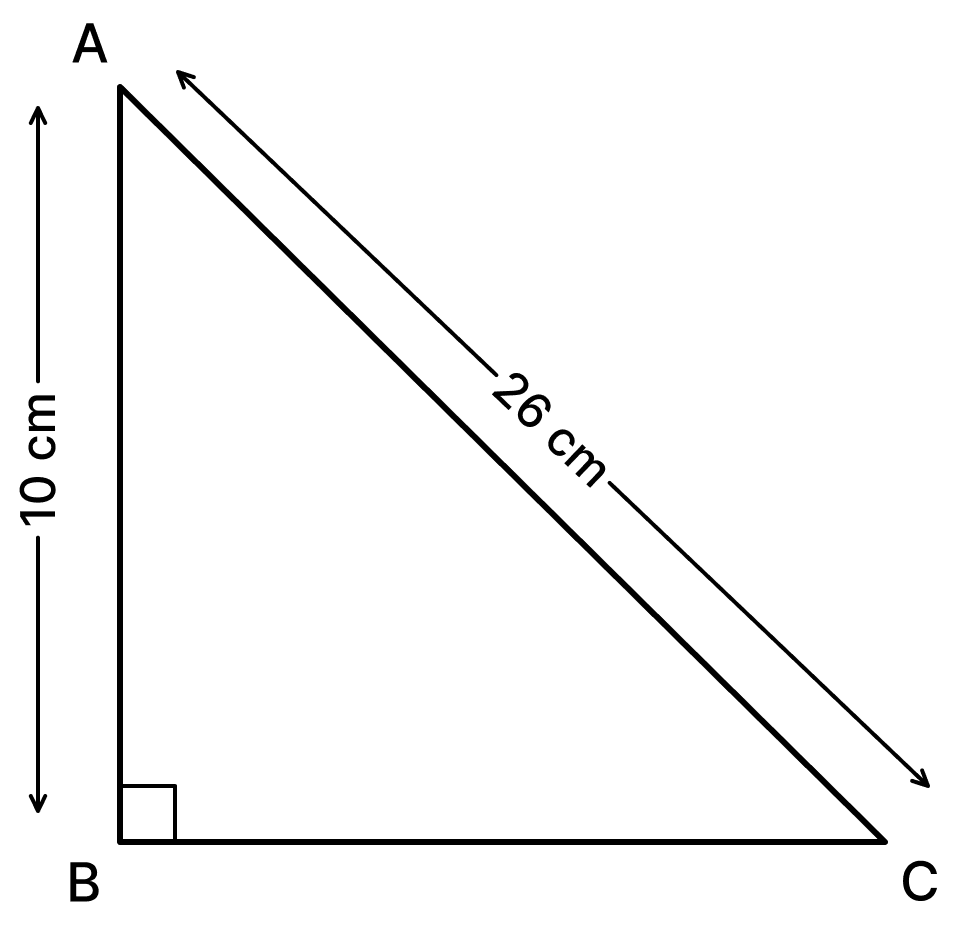
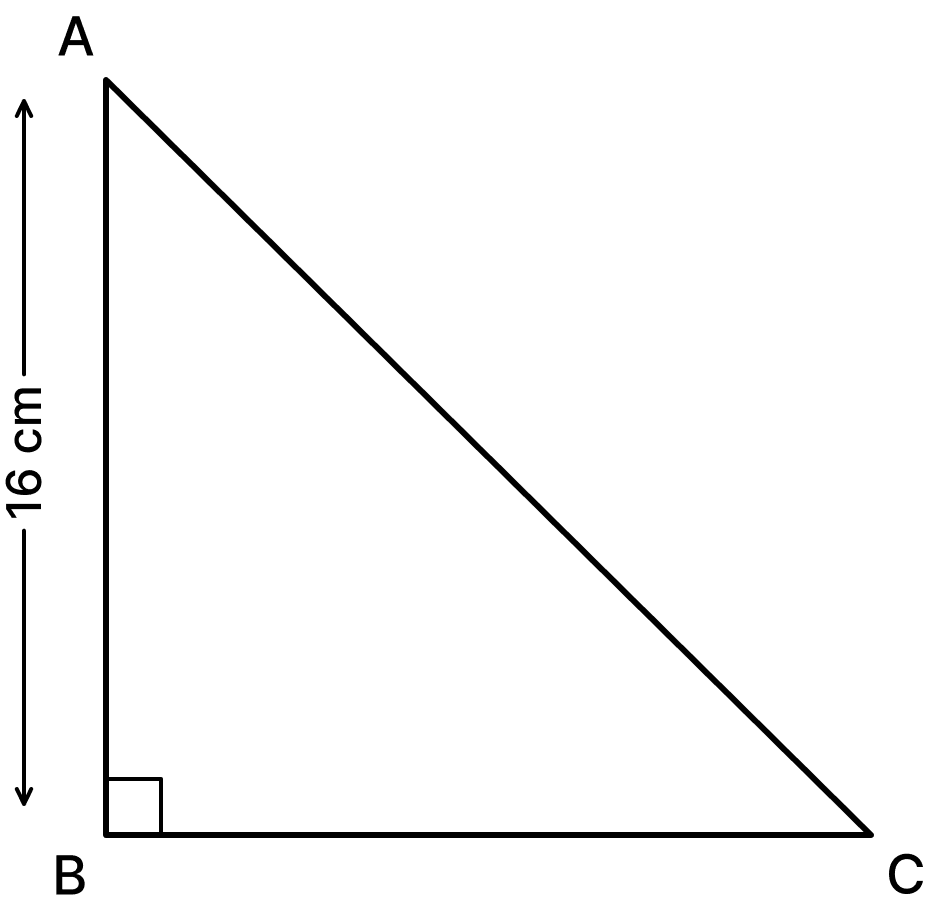
Find the area of a right triangle whose hypotenuse is 26 cm long and one of the sides containing the right angle measures 10 cm.
Answer
Let ABC be the right angle triangle.
Hypotenuse AC = 26 cm
One side AB = 10 cm
BC2 = AC2 - AB2
BC2 = 262 - 102
BC2 = 676 - 100
BC2 = 576
BC = 576 \sqrt{576} 576
BC = 24 cm
∴ Area of the triangle = 1 2 \dfrac{1}{2} 2 1
= 1 2 \dfrac{1}{2} 2 1
= 1 2 \dfrac{1}{2} 2 1 2
= 1 2 \dfrac{1}{2} 2 1 2
= 1 1 \dfrac{1}{1} 1 1 2
= 120 cm2
Area of the triangle = 120 cm2
The area of a right triangle is 240 cm2 and one of its legs is 16 cm long. Find the length of the other leg.
Answer
Given:
Area = 240 cm2
One leg (AB) = 16 cm
Let the other leg (BC) be x.
We know the formula:
∴ Area of the triangle = 1 2 \dfrac{1}{2} 2 1
240 cm2 = 1 2 \dfrac{1}{2} 2 1
240 cm2 = 1 2 \dfrac{1}{2} 2 1
240 cm2 = 1 1 \dfrac{1}{1} 1 1
⇒ x = 240 cm 2 8 cm \dfrac{240 \text{ cm}^2}{8 \text{ cm}} 8 cm 240 cm 2
⇒ x = 30 cm
∴ BC = 30 cm
Length of the other leg = 30 cm
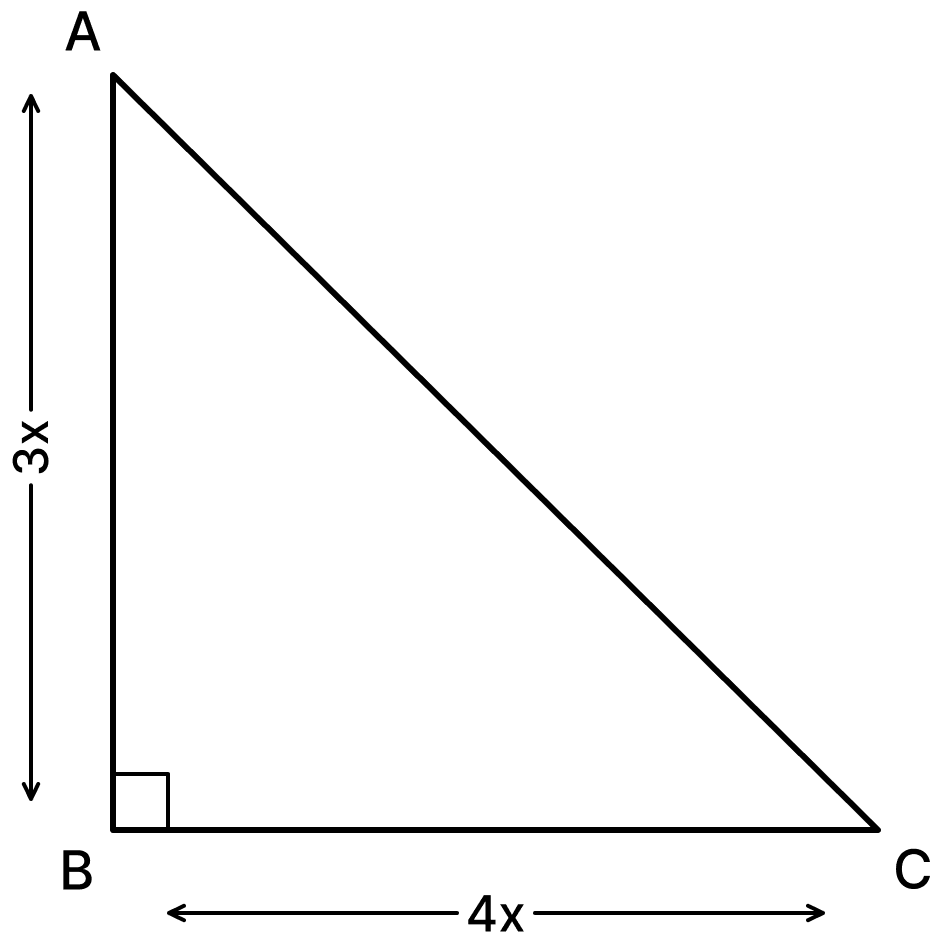
The legs of a right triangle are in the ratio 3 : 4 and its area is 1014 cm2 . Find its hypotenuse.
Answer
Given:
Area = 1014 cm2
Let the legs be 3x and 4x
Area of the triangle = 1 2 \dfrac{1}{2} 2 1
1014 cm2 = 1 2 \dfrac{1}{2} 2 1
1014 cm2 = 1 2 \dfrac{1}{2} 2 1 2 )
1014 cm2 = 1 1 \dfrac{1}{1} 1 1 2
⇒ x2 = 1014 6 \dfrac{1014}{6} 6 1014 2
⇒ x2 = 169 cm2
⇒ x = 169 \sqrt{169} 169 2
⇒ x = 13 cm
AB = 3x = 3 x 13 = 39 cm
BC = 4x = 4 x 13 = 52 cm
Hypotenuse2 = AB2 + BC2
AC2 = (392 + 522 ) cm2
AC2 = (1521 + 2704) cm2
AC2 = 4225 cm2
AC = 4225 \sqrt{4225} 4225 2
AC = 65 cm
Hypotenuse = 65 cm
The sides of a triangle are in the ratio 13 : 14 : 15 and its perimeter is 84 cm. Find the area of the triangle.
Answer
Let the sides be 13x, 14x and 15x
Perimeter of the triangle = 84 cm
Perimeter of the triangle = AB + BC + AC
84 cm = 13x + 14x + 15x
84 cm = 42x
⇒ x = 84 42 \dfrac{84}{42} 42 84
⇒ x = 2 cm
∴ AB = 13x = 13 x 2 = 26 cm
BC = 14x = 14 x 2 = 28 cm
AC = 15x = 15 x 2 = 30 cm
s = A B + B C + A C 2 \dfrac{AB + BC + AC}{2} 2 A B + BC + A C
s = ( 26 + 28 + 30 ) 2 \dfrac{(26 + 28 + 30)}{2} 2 ( 26 + 28 + 30 )
s = 84 2 \dfrac{84}{2} 2 84
s = 42 cm
Area of the triangle = s ( s − a ) ( s − b ) ( s − c ) \sqrt{s(s - a)(s - b)(s - c)} s ( s − a ) ( s − b ) ( s − c )
= 42 ( 42 − 26 ) ( 42 − 28 ) ( 42 − 30 ) cm 2 = 42 × 16 × 14 × 12 cm 2 = ( 14 × 3 ) × 16 × 14 × ( 4 × 3 ) cm 2 = 14 2 × 3 2 × 4 2 × 4 2 cm 2 = 14 × 3 × 4 × 4 cm 2 = 336 cm 2 = \sqrt{42(42 - 26)(42 - 28)(42 - 30)} \text{ cm}^2 \\[1em] = \sqrt{42 \times 16 \times 14 \times 12} \text{ cm}^2 \\[1em] = \sqrt{(14 \times 3) \times 16 \times 14 \times (4 \times 3)} \text{ cm}^2 \\[1em] = \sqrt{14^2 \times 3^2 \times 4^2 \times 4^2} \text{ cm}^2 \\[1em] = 14 \times 3 \times 4 \times 4 \text{ cm}^2 \\[1em] = 336 \text{ cm}^2 = 42 ( 42 − 26 ) ( 42 − 28 ) ( 42 − 30 ) cm 2 = 42 × 16 × 14 × 12 cm 2 = ( 14 × 3 ) × 16 × 14 × ( 4 × 3 ) cm 2 = 1 4 2 × 3 2 × 4 2 × 4 2 cm 2 = 14 × 3 × 4 × 4 cm 2 = 336 cm 2
Area of the triangle = 336 cm2
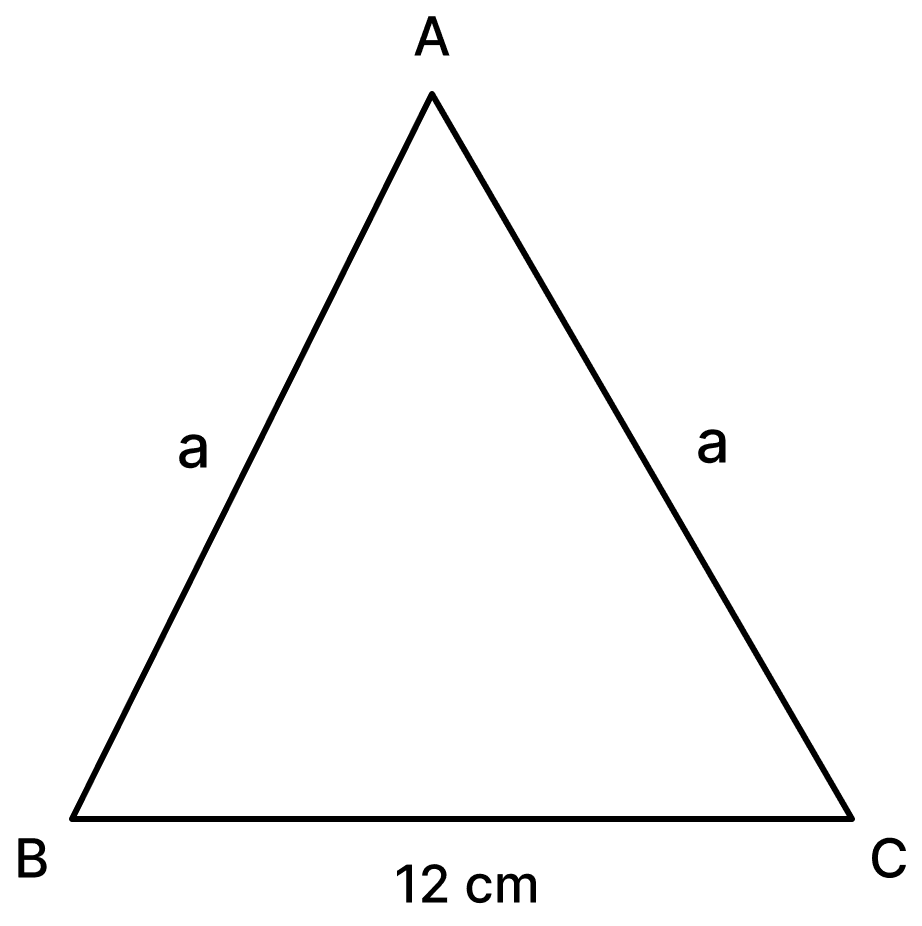
The base of an isosceles triangle is 12 cm and its perimeter is 32 cm. Find its area.
Answer
In an isosceles triangle, two sides are equal.
Let the equal sides be a and the base be b = 12 cm.
Perimeter = 32 cm
Perimeter of the triangle = AB + AC + BC
32 cm = a + a + 12
(32 - 12) cm = 2a
20 cm = 2a
⇒ a = 20 2 \dfrac{20}{2} 2 20
⇒ a = 10 cm
∴ AB = AC = 10 cm
The altitude to the base of an isosceles triangle bisects the base. Using the Pythagorean theorem on one of the right-angled halves:
= h 2 + ( b 2 ) 2 = a 2 h 2 + 6 2 = 10 2 h 2 + 36 = 100 h 2 = 100 − 36 h 2 = 64 h = 64 h = 8 \phantom{=} h^2 + \left(\dfrac{b}{2}\right)^2 = a^2 \\[1em] h^2 + 6^2 = 10^2 \\[1em] h^2 + 36 = 100 \\[1em] h^2 = 100 - 36 \\[1em] h^2 = 64 \\[1em] h = \sqrt{64} \\[1em] h = 8 = h 2 + ( 2 b ) 2 = a 2 h 2 + 6 2 = 1 0 2 h 2 + 36 = 100 h 2 = 100 − 36 h 2 = 64 h = 64 h = 8
Area of the triangle = 1 2 \dfrac{1}{2} 2 1
= 1 2 \dfrac{1}{2} 2 1 2
= 1 2 \dfrac{1}{2} 2 1 2
= 1 1 \dfrac{1}{1} 1 1 2
= 48 cm2
Area of the triangle = 48 cm2
The cost of painting the top surface of a triangular board at 80 paise per square metre is ₹ 176.40. If the height of the board measures 24.5 m, find its base.
Answer
Given:
Height = 24.5 m
Total Cost = ₹ 176.40
Rate = 80 paise per m2
Converting rate into rupees:
1 rupee = 100 paise
∴ 80 paise = ₹ 0.80 per m2
Area = Total Cost Rate \dfrac{\text{Total Cost}}{\text{Rate}} Rate Total Cost
= 176.40 0.80 \dfrac{176.40}{0.80} 0.80 176.40 2
= 220.5 m2
We know the formula:
Area of the triangle = 1 2 \dfrac{1}{2} 2 1
220.5 m2 = 1 2 \dfrac{1}{2} 2 1
220.5 m2 = 1 1 \dfrac{1}{1} 1 1
220.5 m2 = 12.25 x base
⇒ base = 220.5 m 2 12.25 m \dfrac{220.5 \text{ m}^2}{12.25 \text{ m}} 12.25 m 220.5 m 2
base = 18 m
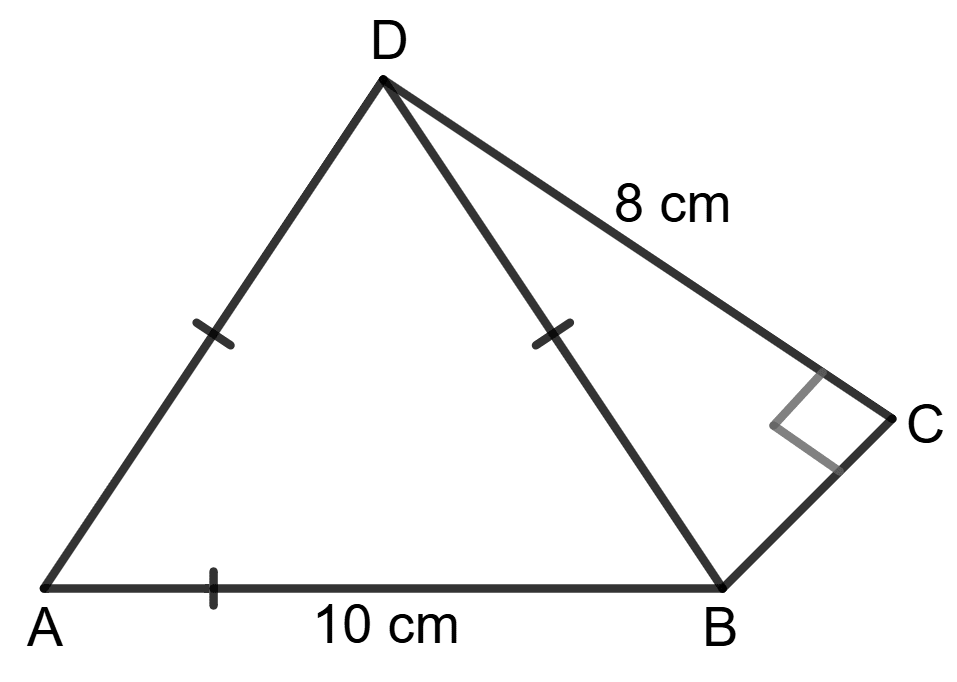
Calculate the area of the quadrilateral ABCD in which AB = BD = AD = 10 cm, ∠BCD = 90° and CD = 8 cm. (Take √3 = 1.732).
Answer
To find the area of the quadrilateral ABCD, we can split it into two triangles: the equilateral triangle △ABD and the right-angled triangle △BCD.
Given:
AB = BD = AD = 10 cm
∠BCD = 90°
CD = 8 cm
Since AB = BD = AD = 10 cm, △ABD is an equilateral triangle.
The formula for the area of an equilateral triangle is:
Area (△ABD) = 3 4 × ( side ) 2 \dfrac{\sqrt{3}}{4} \times (\text{side})^2 4 3 × ( side ) 2
= 1.732 4 × ( 10 ) 2 cm 2 = 1.732 4 × 100 cm 2 = 1.732 1 × 25 cm 2 = 43.25 cm 2 = \dfrac{1.732}{4} \times (10)^2 \text{ cm}^2 \\[1em] = \dfrac{1.732}{4} \times 100 \text{ cm}^2 \\[1em] = \dfrac{1.732}{1} \times 25 \text{ cm}^2 \\[1em] = 43.25 \text{ cm}^2 = 4 1.732 × ( 10 ) 2 cm 2 = 4 1.732 × 100 cm 2 = 1 1.732 × 25 cm 2 = 43.25 cm 2
Area of △BCD:
△BCD is a right-angled triangle at ∠C = 90°.
We know the hypotenuse BD = 10 cm and one side CD = 8 cm.
Let's find the base (BC) using Pythagoras' theorem:
BC2 + CD2 = BD2
BC2 + (8 cm)2 = (10 cm)2
BC2 + 64 cm2 = 100 cm2
BC2 = (100 - 64) cm2
BC2 = 36 cm2
BC = 36 \sqrt{36} 36 2
BC = 6 cm
Area(△BCD) = 1 2 \dfrac{1}{2} 2 1
= 1 2 × 6 × 8 cm 2 = 1 2 × 48 cm 2 = 1 1 × 24 cm 2 = 24 cm 2 = \dfrac{1}{2} \times 6 \times 8 \text{ cm}^2 \\[1em] = \dfrac{1}{2} \times 48 \text{ cm}^2 \\[1em] = \dfrac{1}{1} \times 24 \text{ cm}^2 \\[1em] = 24 \text{ cm}^2 = 2 1 × 6 × 8 cm 2 = 2 1 × 48 cm 2 = 1 1 × 24 cm 2 = 24 cm 2
Let's find total area of Quadrilateral ABCD:
Area of Quadrilateral ABCD = Area(△ABD) + Area(△BCD)
= 43.25 cm2 + 24 cm2
= 67.25 cm2
The total area of the quadrilateral = 67.25 cm2
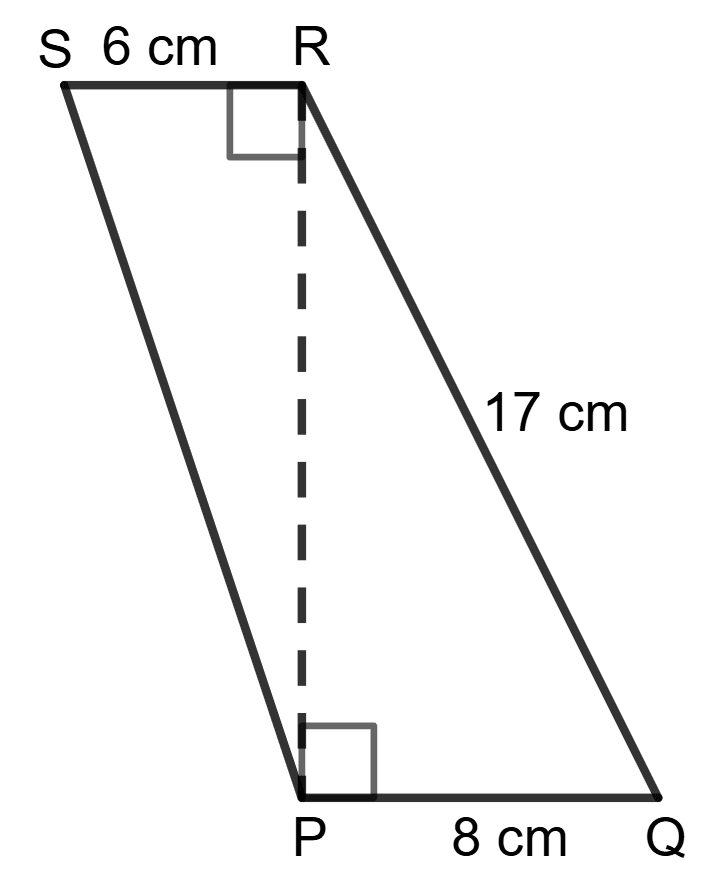
Calculate the area of the quadrilateral PQRS shown in the adjoining figure, it being given that PQ = 8 cm, RQ = 17 cm, ∠RPQ = 90°, RS = 6 cm and ∠PRS = 90°.
Answer
To calculate the area of the quadrilateral PQRS, we can split it into two right-angled triangles: △ PRS and △ PRQ.
Given:
PQ = 8 cm
RQ = 17 cm
∠RPQ = 90°
RS = 6 cm
∠PRS = 90°
Let's find PR which acts as the height for one triangle and the base for the other.
In the right-angled triangle △ PRQ, the right angle is at P (∠RPQ = 90°).
Using Pythagoras' theorem:
PR2 + PQ2 = RQ2
PR2 + (8 cm)2 = (17 cm)2
PR2 + 64 cm2 = 289 cm2
PR2 = 289 cm2 - 64 cm2
PR2 = 225 cm2
PR = 225 \sqrt{225} 225 2
PR = 15 cm
Let's find area of △PRQ:
Area of △PRQ = 1 2 \dfrac{1}{2} 2 1
= 1 2 \dfrac{1}{2} 2 1
= 1 2 \dfrac{1}{2} 2 1
= 1 2 \dfrac{1}{2} 2 1 2
= 1 1 \dfrac{1}{1} 1 1 2
= 60 cm2
Now, let's find area of △PRS:
Area of △PRS = 1 2 \dfrac{1}{2} 2 1
= 1 2 \dfrac{1}{2} 2 1
= 1 2 \dfrac{1}{2} 2 1
= 1 2 \dfrac{1}{2} 2 1 2
= 1 1 \dfrac{1}{1} 1 1 2
= 45 cm2
Let's find total Area of Quadrilateral PQRS:
Area of Quadrilateral PQRS = Area of △ PRQ + Area of △ PRS
= 60 cm2 + 45 cm2
= 105 cm2
The total area of the quadrilateral = 105 cm2
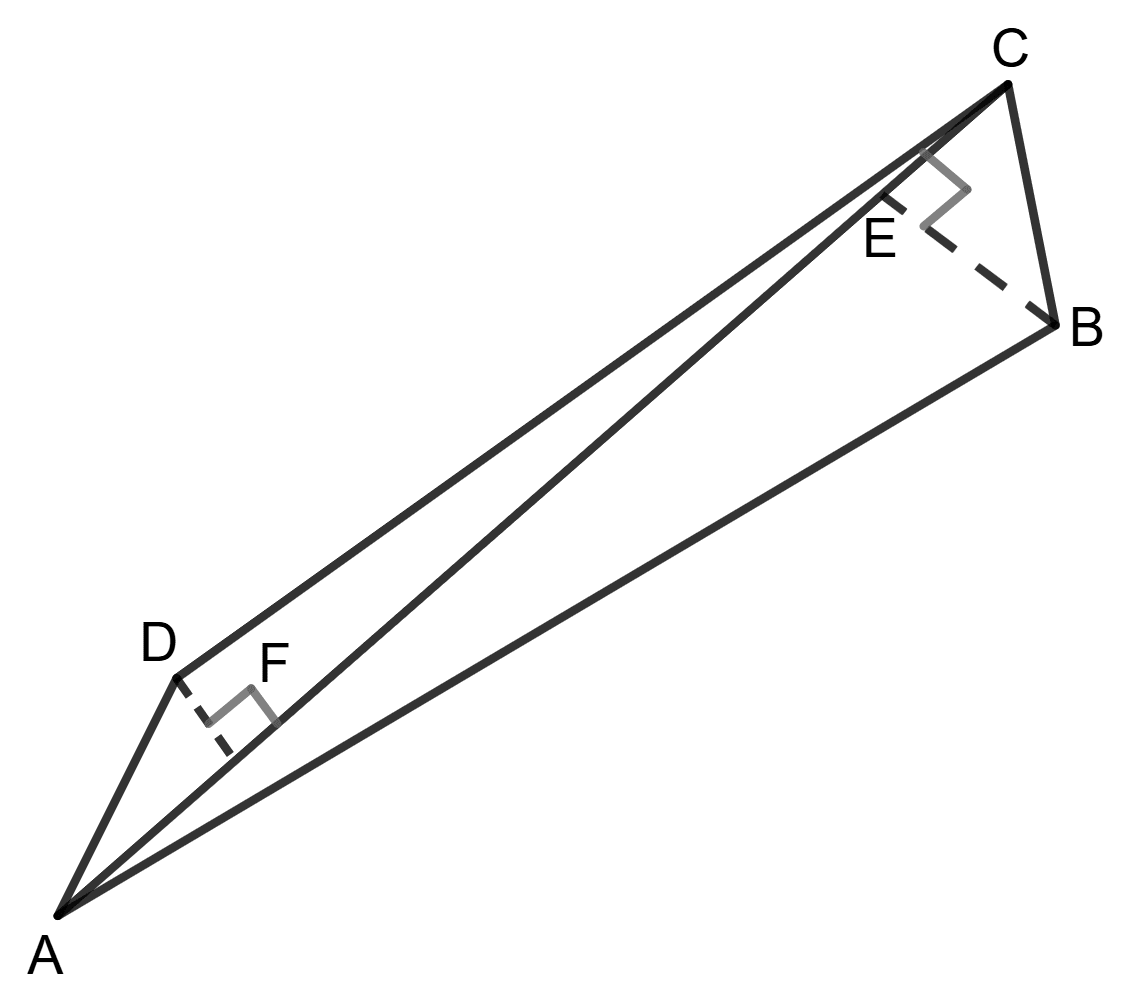
Find the area of a quadrilateral ABCD whose diagonal AC is 25 cm long and the lengths of perpendiculars from opposite vertices B and D on AC are BE = 3.6 cm and DF = 2.4 cm.
Answer
Given:
AC = 25 cm
BE = 3.6 cm
DF = 2.4 cm
To find the area of this quadrilateral, we treat it as two triangles sharing a common base (the diagonal AC).
Area of △ABC = 1 2 \dfrac{1}{2} 2 1
= 1 2 \dfrac{1}{2} 2 1
= 1 2 \dfrac{1}{2} 2 1
= 1 2 \dfrac{1}{2} 2 1 2
= 1 1 \dfrac{1}{1} 1 1 2
= 45 cm2
Area of △ACD = 1 2 \dfrac{1}{2} 2 1
= 1 2 \dfrac{1}{2} 2 1
= 1 2 \dfrac{1}{2} 2 1
= 1 2 \dfrac{1}{2} 2 1 2
= 1 1 \dfrac{1}{1} 1 1 2
= 30 cm2
Let's find the total area of quadrilateral ABCD:
Area of quadrilateral ABCD = Area of △ABC + Area of △ACD
= 45 cm2 + 30 cm2
= 75 cm2
The area of the quadrilateral ABCD = 75 cm2
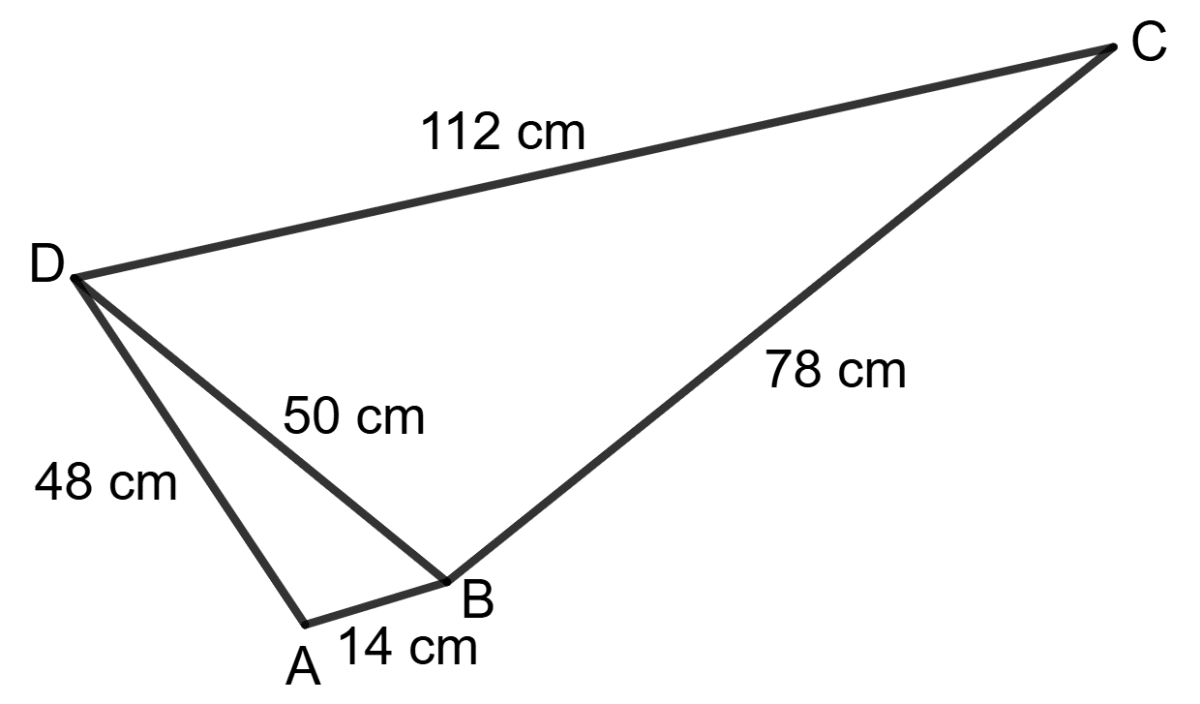
Find the area of the quadrilateral ABCD, given in the adjoining figure in which AB = 14 cm, BC = 78 cm, CD = 112 cm, BD = 50 cm and DA = 48 cm.
Answer
Given:
To find the area of the quadrilateral ABCD, we can split it into two triangles △ABD and △DBC.
Area of △ABD:
The sides of the triangle are a = 48 cm, b = 14 cm, c = 50 cm
Semi perimeter (s1) = a + b + c 2 = 48 + 14 + 50 2 cm = 112 2 cm = 56 cm \dfrac{a + b + c}{2} = \dfrac{48 + 14 + 50}{2} \text{ cm} = \dfrac{112}{2} \text{ cm} = 56 \text{ cm} 2 a + b + c = 2 48 + 14 + 50 cm = 2 112 cm = 56 cm
Area of △ABD = s 1 ( s 1 − a ) ( s 1 − b ) ( s 1 − c ) \sqrt{s1(s1 - a)(s1 - b)(s1 - c)} s 1 ( s 1 − a ) ( s 1 − b ) ( s 1 − c )
= 56 ( 56 − 48 ) ( 56 − 14 ) ( 56 − 50 ) cm 2 = 56 × 8 × 42 × 6 cm 2 = ( 7 × 8 ) × 8 × ( 7 × 6 ) × 6 cm 2 = 7 2 × 8 2 × 6 2 cm 2 = 7 × 8 × 6 cm 2 = 336 cm 2 = \sqrt{56(56 - 48)(56 - 14)(56 - 50)} \text{ cm}^2 \\[1em] = \sqrt{56 \times 8 \times 42 \times 6} \text{ cm}^2 \\[1em] = \sqrt{(7 \times 8) \times 8 \times (7 \times 6) \times 6} \text{ cm}^2 \\[1em] = \sqrt{7^2 \times 8^2 \times 6^2} \text{ cm}^2 \\[1em] = 7 \times 8 \times 6 \text{ cm}^2 \\[1em] = 336 \text{ cm}^2 = 56 ( 56 − 48 ) ( 56 − 14 ) ( 56 − 50 ) cm 2 = 56 × 8 × 42 × 6 cm 2 = ( 7 × 8 ) × 8 × ( 7 × 6 ) × 6 cm 2 = 7 2 × 8 2 × 6 2 cm 2 = 7 × 8 × 6 cm 2 = 336 cm 2
Area of △DBC:
The sides of the triangle are a = 50 cm, b = 78 cm, c = 112 cm
Semi perimeter (s2) = a + b + c 2 = 50 + 78 + 112 2 cm = 240 2 cm = 120 cm \dfrac{a + b + c}{2} = \dfrac{50 + 78 + 112}{2} \text{ cm} = \dfrac{240}{2} \text{ cm} = 120 \text{ cm} 2 a + b + c = 2 50 + 78 + 112 cm = 2 240 cm = 120 cm
Area of △DBC = s 2 ( s 2 − a ) ( s 2 − b ) ( s 2 − c ) \sqrt{s2(s2 - a)(s2 - b)(s2 - c)} s 2 ( s 2 − a ) ( s 2 − b ) ( s 2 − c )
= 120 ( 120 − 50 ) ( 120 − 78 ) ( 120 − 112 ) cm 2 = 120 × 70 × 42 × 8 cm 2 = ( 10 × 12 ) × ( 10 × 7 ) × ( 6 × 7 ) × 8 cm 2 = 10 2 × 7 2 × ( 12 × 6 × 8 ) cm 2 = 10 2 × 7 2 × 576 cm 2 = 10 × 7 × 24 cm 2 = 1680 cm 2 = \sqrt{120(120-50)(120-78)(120-112)} \text{ cm}^2 \\[1em] = \sqrt{120 \times 70 \times 42 \times 8} \text{ cm}^2 \\[1em] = \sqrt{(10 \times 12) \times (10 \times 7) \times (6 \times 7) \times 8} \text{ cm}^2 \\[1em] = \sqrt{10^2 \times 7^2 \times (12 \times 6 \times 8)} \text{ cm}^2 \\[1em] = \sqrt{10^2 \times 7^2 \times 576} \text{ cm}^2 \\[1em] = 10 \times 7 \times 24 \text{ cm}^2 \\[1em] = 1680\text{ cm}^2 = 120 ( 120 − 50 ) ( 120 − 78 ) ( 120 − 112 ) cm 2 = 120 × 70 × 42 × 8 cm 2 = ( 10 × 12 ) × ( 10 × 7 ) × ( 6 × 7 ) × 8 cm 2 = 1 0 2 × 7 2 × ( 12 × 6 × 8 ) cm 2 = 1 0 2 × 7 2 × 576 cm 2 = 10 × 7 × 24 cm 2 = 1680 cm 2
Let's find the total area of quadrilateral ABCD:
Area of quadrilateral ABCD = Area of △ABD + Area of △DBC
= 336 cm2 + 1680 cm2
= 2016 cm2
The area of the quadrilateral ABCD = 2016 cm2