
In a △ABC, if ∠A = 15° and ∠B = 55°, then ∠C is equal to
- 85°
- 95°
- 105°
- 110°
Answer
Given:
∠A = 15° and ∠B = 55°
∠A + ∠B + ∠C = 180° [Sum of the angles of a triangle]
15° + 55° + ∠C = 180°
70° + ∠C = 180°
∠C = 180° - 70°
∠C = 110°
Hence, option 4 is the correct option.
Two angles of a triangle are equal and the third angle is three times each equal angle. The largest angle of the triangle measures
- 104°
- 108°
- 112°
- 124°
Answer
Given:
Two angles of a triangle are equal.
Third angle is three times each equal angle.
Let each equal angle be x.
The third (largest) angle = 3x.
x + x + 3x = 180° [Sum of the angles of a triangle]
5x = 180°
x =
x = 36°
Largest angle = 3x = 3 x 36° = 108°
Hence, option 2 is the correct option.
Which of the following cannot be the angles of a triangle?
- 56°, 64°, 60°
- 42°, 67°, 81°
- 45°, 70°, 65°
- 63°, 35°, 82°
Answer
For three angles to form a triangle, their sum must be exactly 180°.
Let's check the options:
56° + 64° + 60° = 180°
42° + 67° + 81° = 190°
45° + 70° + 65° = 180°
63° + 35° + 82° = 180°
The angles in option 2 cannot be the angles of a triangle, because it sums up to 190°.
Hence, option 2 is the correct option.
An exterior angle of a triangle is 136°. If one of the two interior opposite angles is 69°, then the other interior opposite angle is
- 67°
- 75°
- 81°
- 99°
Answer
Given:
Exterior angle = 136°
One interior angle = 69°
Let the other interior angle be x.
x + 69° = 136° [Exterior angle = sum of interior opposite angles]
x = 136° - 69°
x = 67°
The other interior angle of a triangle is 67°.
Hence, option 1 is the correct option.
A triangle can have two
- straight angles
- obtuse angles
- right angles
- acute angles
Answer
A triangle cannot have two straight angles (180° each), as the total would exceed 180°.
A triangle cannot have two obtuse angles (> 90° each) or two right angles (90° each) because the sum of just those two would be ≥ 180°, leaving no room for the third angle.
Every triangle must have at least two acute angles (< 90°).
Hence, option 4 is the correct option.
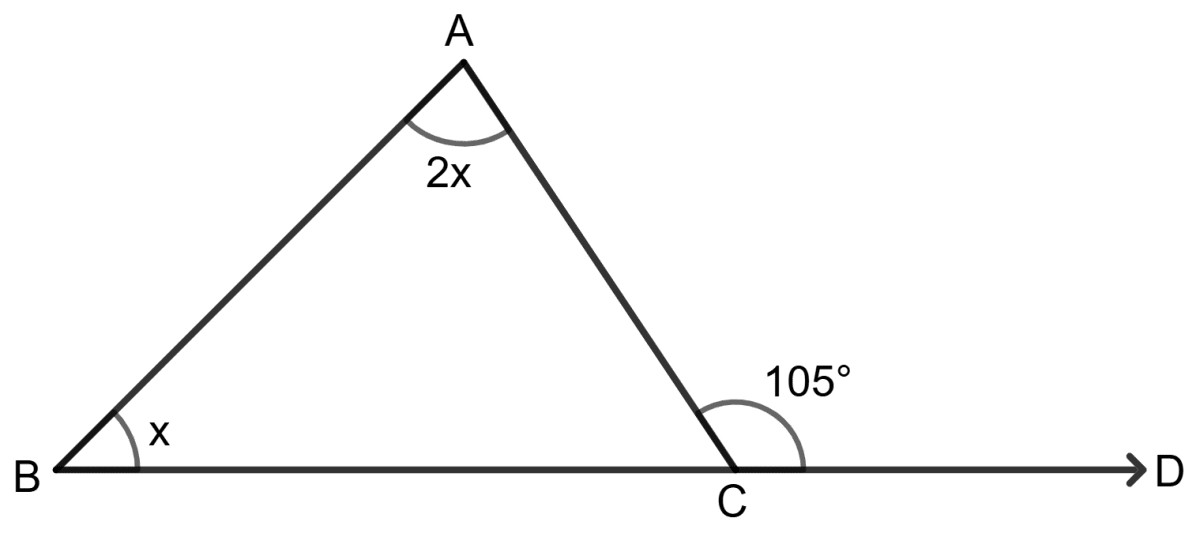
Find the value of x in the given figure.
- 25°
- 30°
- 35°
- 45°
Answer
From figure, we have:
Exterior angle: ∠ACD = 105°
Interior angles: ∠BAC = 2x and ∠ABC = x
∠ABC + ∠BAC = ∠ACD [Exterior angle = sum of interior opposite angles]
x + 2x = 105°
3x = 105°
x =
x = 35°
Hence, option 3 is the correct option.
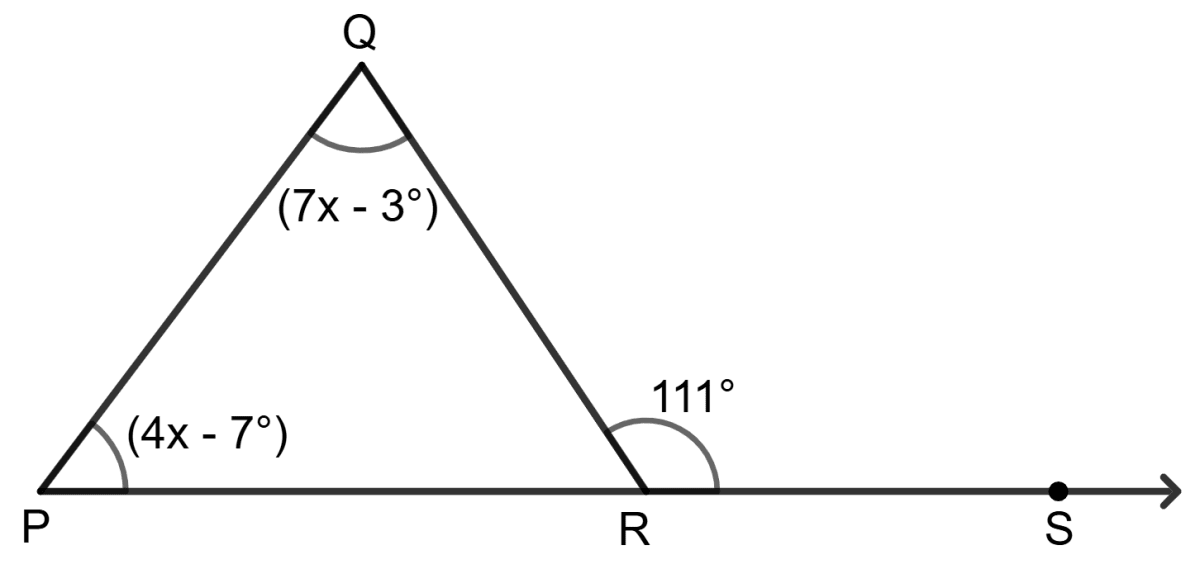
In the given figure, find the value of x.
- 7
- 9
- 11
- 13
Answer
From figure, we have:
Exterior angle: ∠QRS = 111°
Interior angles: ∠PQR = (7x - 3°) and ∠QPR = (4x - 7°)
∠PQR + ∠QPR = ∠QRS [Exterior angle = sum of interior opposite angles]
(7x - 3°) + (4x - 7°) = 111°
11x - 10° = 111°
11x = 111° + 10°
11x = 121°
x =
x = 11°
Hence, option 3 is the correct option.
Which of the following cannot be the sides of a right-angled triangle?
- 5 cm, 4 cm, 3 cm
- 12 cm, 5 cm, 13 cm
- 15 cm, 21 cm, 27 cm
- 37 cm, 35 cm, 12 cm
Answer
To be a right-angled triangle, the sides must satisfy the Pythagoras Theorem (a2 + b2 = c2), where c is the longest side.
Let's check the options:
42 + 32 = (16 + 9) = 25 and 52 = 25
122 + 52 = (144 + 25) = 169 and 132 = 169
152 + 212 = (225 + 441) = 666 and 272 = 729
352 + 122 = (1225 + 144) = 1369 and 372 = 1369
The sides in option 3 cannot be the sides of a right-angled triangle. Because, it does not satisfy a2 + b2 = c2.
Hence, option 3 is the correct option.
A 15 m long ladder is rested against a wall such that the foot of the ladder is 12 m away from the wall. How up on the wall is the upper end of the ladder?
- 6 m
- 8 m
- 9 m
- 10 m
Answer
Hypotenuse (Ladder) = 15 m
Base (Distance from wall) = 12 m
Height (Wall) = h
Using Pythagoras Theorem:
h2 + 122 = 152
h2 + 144 = 225
h2 = 225 - 144
h2 = 81
h =
h = 9 m
Hence, option 3 is the correct option.
The measure of one of the equal angles of an isosceles right-angled triangle is
- 30°
- 45°
- 60°
- 75°
Answer
In an isosceles right-angled triangle:
One angle is 90°.
The other two angles are equal. Let each be x.
x + x + 90° = 180° [Sum of the angles of a triangle]
2x + 90° = 180°
2x = 180° - 90°
2x = 90°
x =
x = 45°
Hence, option 2 is the correct option.
Fill in the blanks:
(i) In a scalene triangle the measures of all the three angles are ............... .
(ii) The longest side of a right-angled triangle is ............... .
(iii) If two angles of a triangle are 36° and 63°, then the third angle is ............... .
(iv) The sum of the two acute angles in a right-angled triangle is ............... .
(v) If the square of one side of a triangle is equal to the sum of the squares of the other two sides, then the triangle is ............... .
Answer
(i) In a scalene triangle the measures of all the three angles are different.
(ii) The longest side of a right-angled triangle is hypotenuse.
(iii) If two angles of a triangle are 36° and 63°, then the third angle is 81°.
(iv) The sum of the two acute angles in a right-angled triangle is 90°.
(v) If the square of one side of a triangle is equal to the sum of the squares of the other two sides, then the triangle is right-angled.
Explanation
(iii)
Given:
Two angles of a triangle are 36° and 63°.
Let the third angle be x.
36° + 63° + x = 180° [Angle sum property]
99° + x = 180°
x = 180° - 99°
x = 81°
(iv)
Since a right-angled triangle already has one 90° angle, the remaining two angles must add up to 90° to reach the 180° total.
Write true (T) or false (F):
(i) A triangle can have at most two angles greater than 90°.
(ii) A triangle can have all the three angles less than 60°
(iii) In a right triangle ABC, if AC2 + AB2 = BC2, then the right angle is ∠B.
(iv) A triangle having two of its angles measuring 30° and 70° is scalene.
(v) The sum of two acute angles of a right-angled triangle is 45°.
Answer
(i) False
Reason — A triangle can have at most one angle greater than 90°. If it had two obtuse angles (e.g., 91° and 91°), their sum alone would be 182°, which exceeds the Angle Sum Property limit of 180° for a triangle.
(ii) False
Reason — If all three angles were less than 60° (e.g., 59° each), their sum would be less than 177°. For a triangle to exist, the sum must be exactly 180°. In an acute triangle, at least one angle must be 60° or greater.
(iii) False
Reason — According to Pythagoras' Theorem, the side that is by itself in the equation () is the hypotenuse. The right angle is always opposite the hypotenuse. Since the hypotenuse is BC, the vertex opposite to it is A. Therefore, the right angle is ∠A.
(iv) True
Reason —
Given:
The two angles of triangle are 30° and 70°.
Let the third angle be x.
30° + 70° + x = 180° [Angle sum property]
100° + x = 180°
x = 180° - 100°
x = 80°
Since all three angles (30°, 70° and 80°) are different, all three sides must also be different lengths. A triangle with no equal sides is a scalene triangle.
(v) False
Reason — In a right-angled triangle, one angle is 90°.
Because the total sum is 180°, the other two acute angles must add up to 90° (180° - 90° = 90°). These two angles are complementary, not 45° unless the triangle is also isosceles.
Assertion: If one angle of a triangle is equal to the sum of other two, then the triangle is a right-angled triangle.
Reason: Sum of the angles of a triangle is 180°.
- Both Assertion (A) and Reason (R) are true and Reason (R) is the correct explanation of Assertion (A).
- Both Assertion (A) and Reason (R) are true and Reason (R) is not the correct explanation of Assertion (A).
- Assertion (A) is true but Reason (R) is false.
- Assertion (A) is false but Reason (R) is true.
Answer
Both Assertion (A) and Reason (R) are true and Reason (R) is the correct explanation of Assertion (A).
Explanation
Given:
Let the angles be x, y and z.
According to the given statement, One angle is equal to the sum of other two.
∴ x = y + z
We know that,
x + y + z = 180° [Angle sum property]
x + x = 180° [∵ x = y + z]
2x = 180°
x =
x = 90°
So, it is a right-angled triangle.
The statement in reason is correct according to angle sum property.
Both statements are true, and the Reason explains why the Assertion is true.
Hence, option 1 is the correct option.
Assertion: In the figure, AB2 + AC2 = BC2, then ∠A is an obtuse angle.
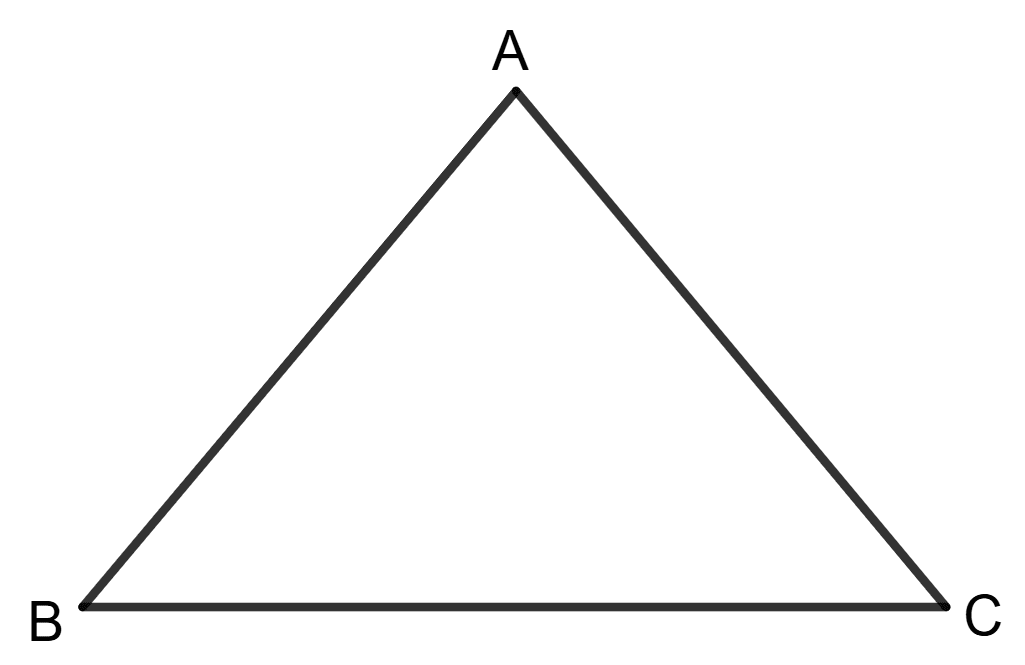
Reason: In a right triangle, the square of the hypotenuse equals the sum of the squares of its remaining two sides.
- Both Assertion (A) and Reason (R) are true and Reason (R) is the correct explanation of Assertion (A).
- Both Assertion (A) and Reason (R) are true and Reason (R) is not the correct explanation of Assertion (A).
- Assertion (A) is true but Reason (R) is false.
- Assertion (A) is false but Reason (R) is true.
Answer
Assertion (A) is false but Reason (R) is true.
Explanation
The equation AB2 + AC2 = BC2 is the Pythagoras Theorem. According to this theorem, the angle opposite to the longest side (BC) must be exactly 90° (a right angle), not an obtuse angle. Therefore, the Assertion is false.
The Reason is a correct statement of the Pythagoras theorem.
Hence, option 4 is the correct option.
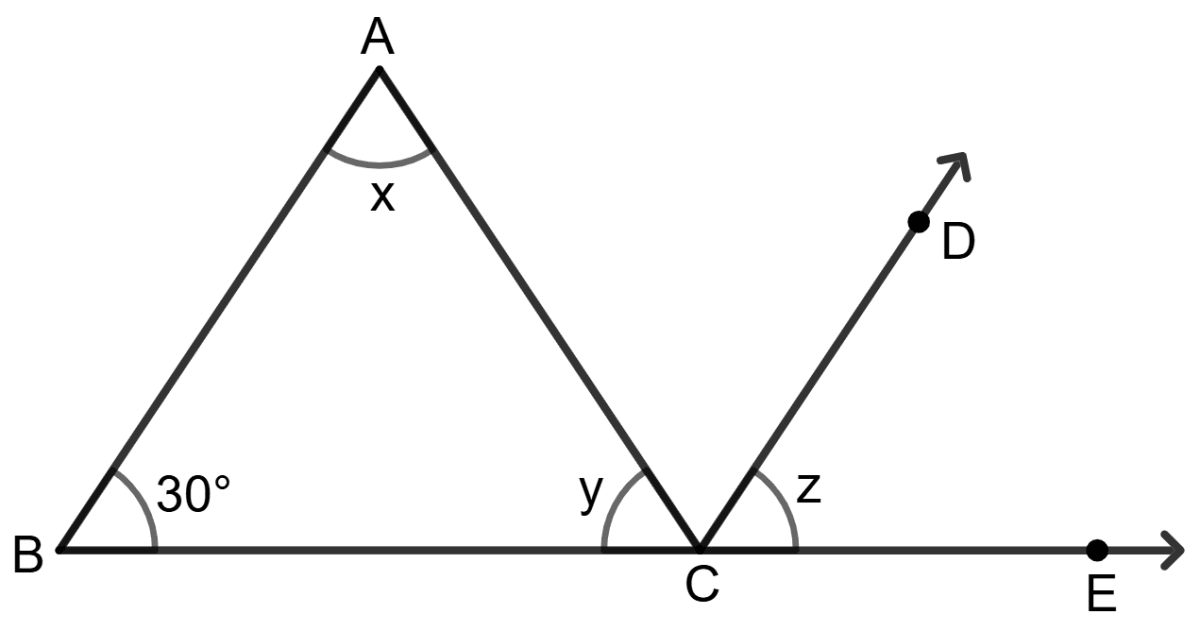
Assertion: In the figure, AB || DC and ∠ABC = 30°. The sum of measures of x, y and z is 180°.
Reason: When a side of a triangle is produced, then the exterior angle so formed is equal to sum of its any two interior angles.
- Both Assertion (A) and Reason (R) are true and Reason (R) is the correct explanation of Assertion (A).
- Both Assertion (A) and Reason (R) are true and Reason (R) is not the correct explanation of Assertion (A).
- Assertion (A) is true but Reason (R) is false.
- Assertion (A) is false but Reason (R) is true.
Answer
Assertion (A) is true but Reason (R) is false.
Explanation
In △ABC, x + 30° + y = 180° [Angle sum property]
Since AB || DC,
z = ∠ABC [Corresponding angles]
z = 30°
Again, x + y + z = 180°. So, the Assertion is true.
The exterior angle property states an exterior angle is equal to the sum of its two interior opposite angles. The phrase "any two interior angles" is mathematically incorrect.
Thus, the Reason is false.
Hence, option 3 is the correct option.
For the side lengths a - 3, 2a and a + 5 to form a triangle, which of these could be the value of a?
- 1
- 2
- 4
- 5
Answer
For three lengths to form a triangle:
(a − 3) + 2a > a + 5
3a − 3 > a + 5
2a > 8
a > 4
Also,
a − 3 > 0 ⇒ a > 3
So a must be greater than 4.
Among the options, only 5 satisfies this.
Hence, option 4 is the correct option.
For the lengths 20 cm and 21 cm to form a triangle, how can the third side length be calculated?
- 20 + 21
- 202 + 212
- Lies between (21 - 20) and (21 + 20)
- Lies between (202 - 212) and (202 + 212)
Answer
For any triangle:
Difference of two sides < third side < sum of two sides
Given sides:
20 cm and 21 cm
So the third side lies between:
21 − 20 and 21 + 20
Hence, option 3 is the correct option.
Consider the figure given below:
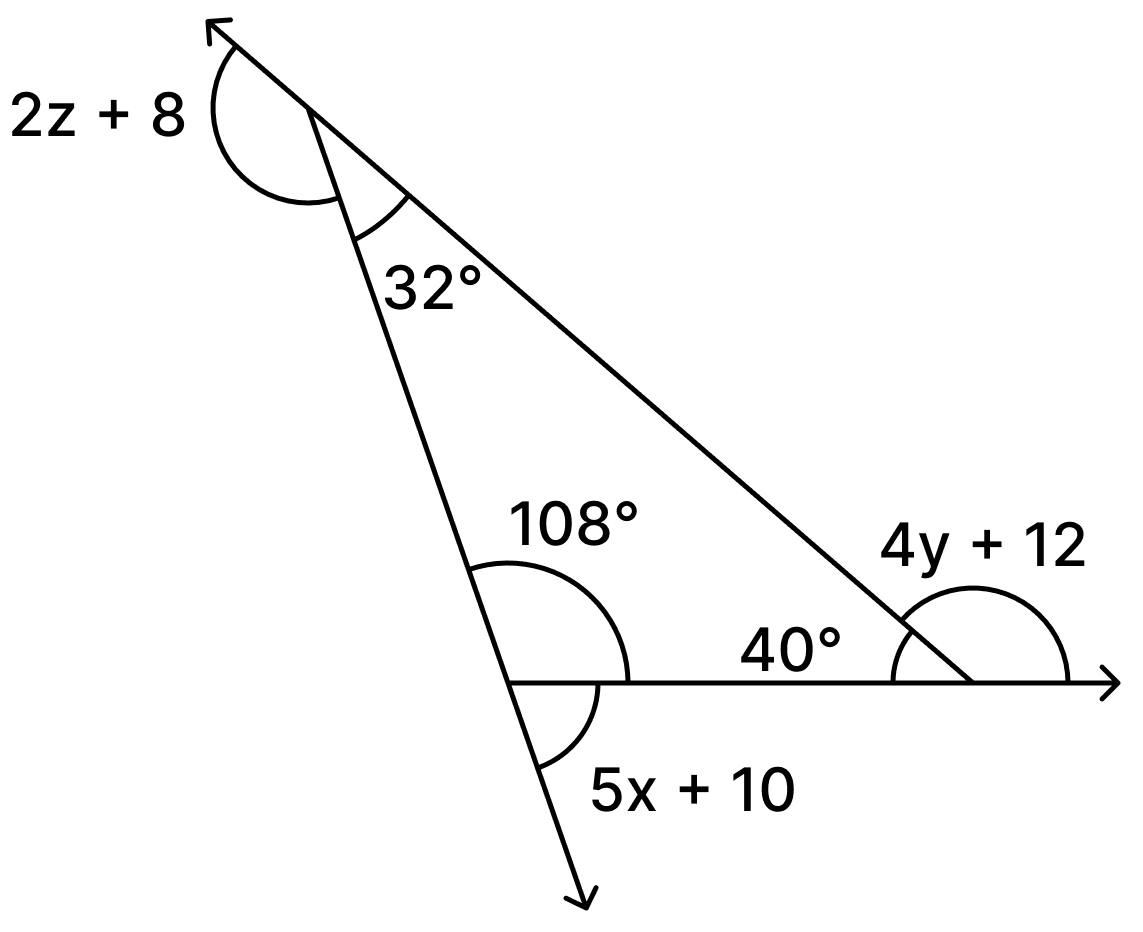
Which of these options represents the value of x + y + z?
- 76.5
- 102.4
- 104.4
- 56.4
Answer
From the figure:
Angles 108° and (5x+10) form a linear pair.
108° + (5x + 10)° = 180°
5x + 118° = 180°
5x = 180° - 118°
5x = 62°
x =
x = 12.4
Angles 40° and (4y+12) form a linear pair.
40° + (4y + 12)° = 180°
4y + 52° = 180°
4y = 180° - 52°
4y = 128°
y =
y = 32
Angles 32° and (2z+8) form a linear pair.
32° + (2z + 8)° = 180°
2z + 40° = 180°
2z = 180° - 40°
2z = 140°
z =
z = 70
Finding x + y + z:
x + y + z = 12.4 + 32 + 70
= 114.4
Among these options no option matches the answer. So, none of these options is correct.
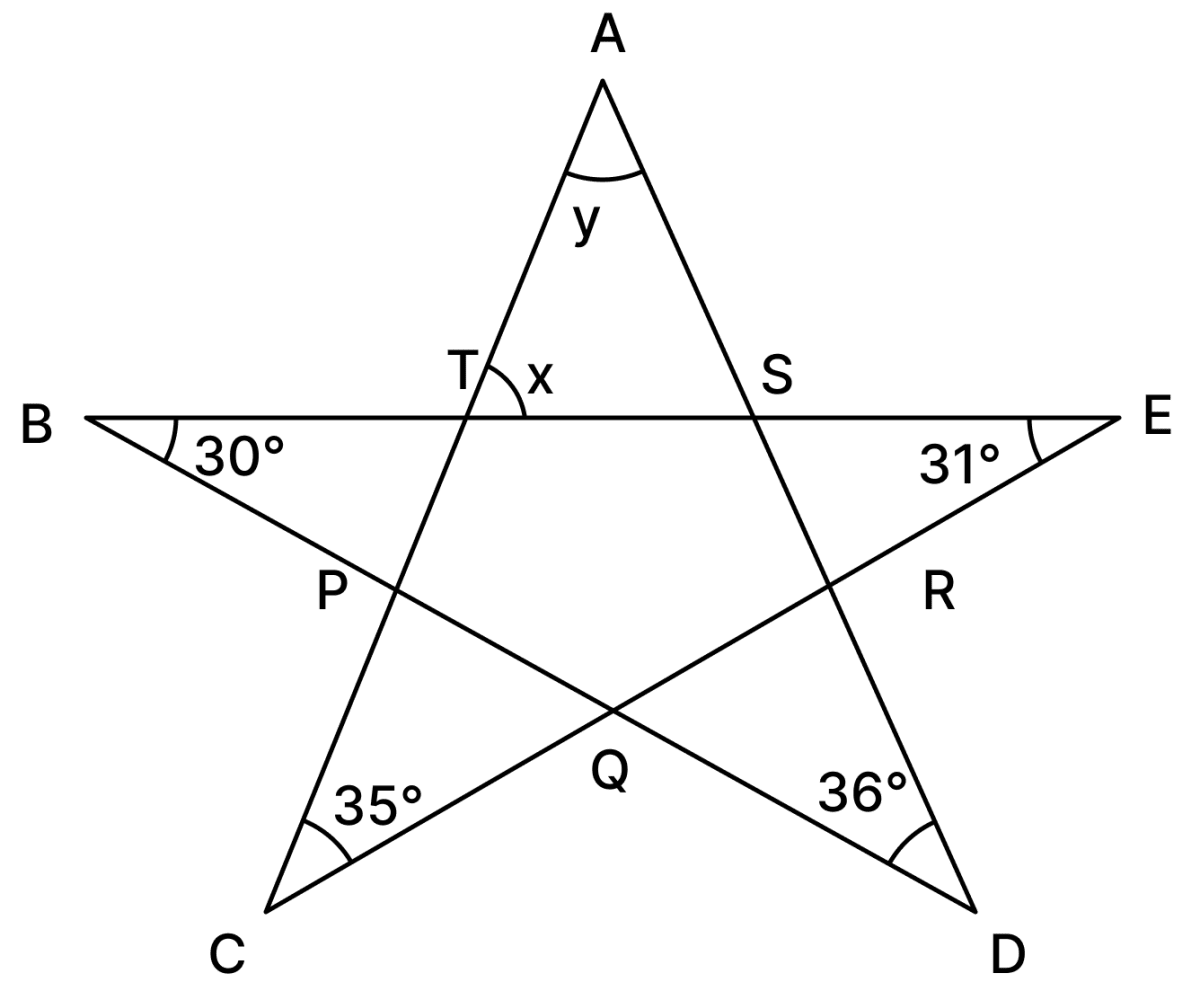
In the figure, the values of x and y respectively are:
- 47°, 66°
- 66°, 48°
- 68°, 47°
- 47°, 68°
Answer
From the figure,
In △BSD,
∠SBD + ∠BSD + ∠BDS = 180° [Sum of angles in a triangle]
30° + ∠BSD + 36° = 180°
66° + ∠BSD = 180°
∠BSD = 180° - 66°
∠BSD = 114°
∠BSD + ∠AST = 180° [Linear pair]
114° + ∠AST = 180°
∠AST = 180° - 114°
∠AST = 66°
In △CTE,
∠ECT + ∠CET + ∠CTE = 180° [Sum of angles in a triangle]
35° + 31° + ∠CTE = 180°
66° + ∠CTE = 180°
∠CTE = 180° - 66°
∠CTE = 114°
∠CTE + ∠ATS = 180° [Linear pair]
114° + ∠ATS = 180°
∠ATS = 180° - 114°
∠ATS = 66°
∠ATS = x
∴ x = 66°
In △ATS,
∠ATS + ∠SAT + ∠AST = 180°
x + y + ∠AST = 180°
66° + y + 66° = 180°
132° + y = 180°
y = 180° - 132°
y = 48°
⇒ x = 66° and y = 48°
Hence, option 2 is the correct option.
In the triangle shown, ∠RST = 2(∠QRS) and ∠PQS = 2(∠QSR).
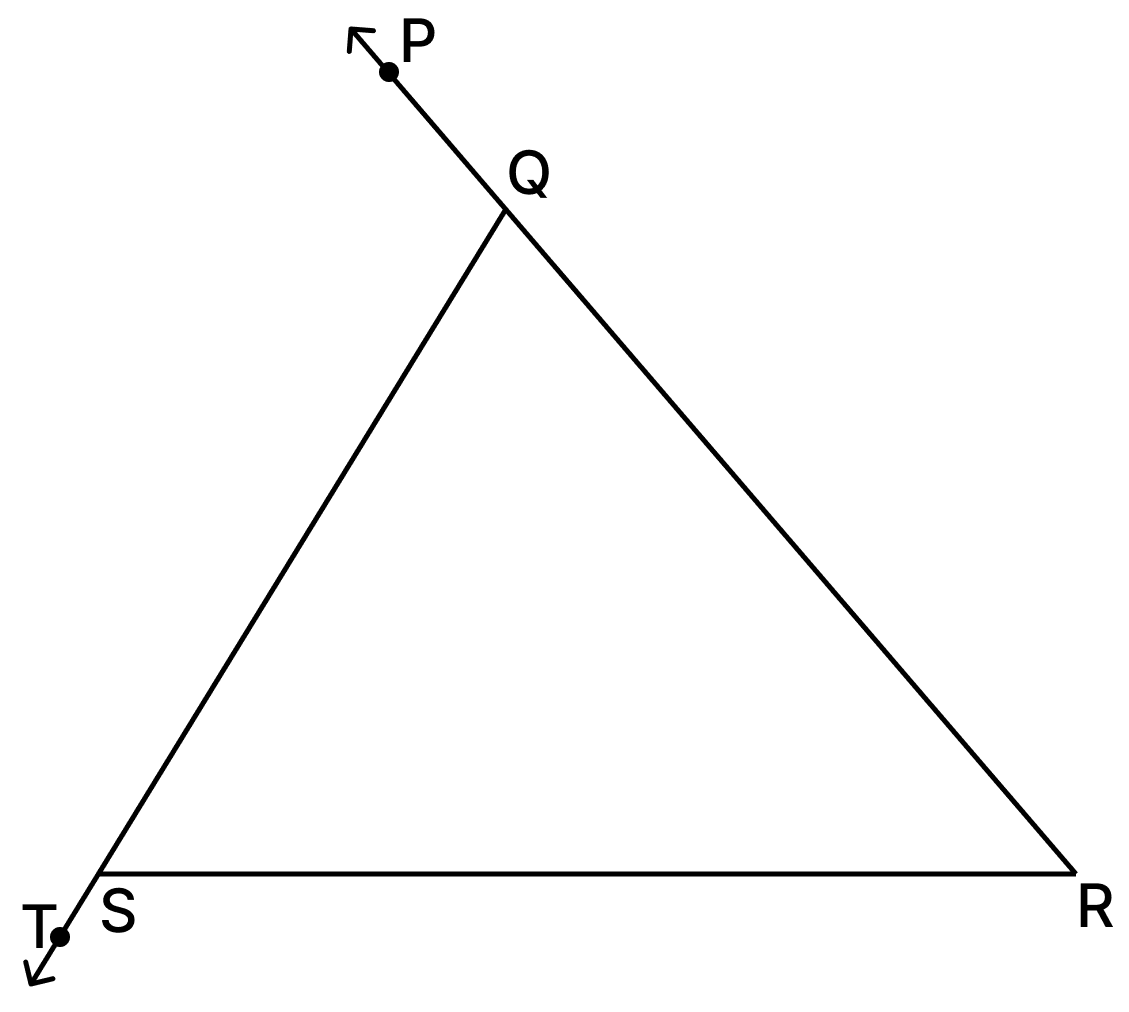
Which of the following is true about the triangle QRS?
- It is a scalene triangle
- It is an isosceles triangle
- It is an equilateral triangle
- It is a right-angled triangle
Answer
In the figure, QS is extended to T and RQ is extended to P, so ∠RST and ∠PQS are exterior angles of triangle QRS at vertices S and Q respectively.
Exterior angle at S:
∠RST = ∠RQS + ∠QRS
Given ∠RST = 2∠QRS:
∠RQS + ∠QRS = 2∠QRS
⇒ ∠RQS = ∠QRS
Exterior angle at Q:
∠PQS = ∠QRS + ∠QSR
Given ∠PQS = 2∠QSR:
∠QRS + ∠QSR = 2∠QSR
⇒ ∠QRS = ∠QSR
Combining the two results:
∠RQS = ∠QRS = ∠QSR
Since all three angles are equal (each = 60°), triangle QRS is equilateral.
Hence, option 3 is the correct option.
For a right-angled isosceles triangle, which of these statements should be true?
- The square on the hypotenuse is equal to twice the length of the square on one leg.
- The hypotenuse is equal to the sum of the legs.
- The square on the hypotenuse is equal to the sum of the legs.
- The hypotenuse is equal to twice the length of the square on one leg.
Answer
In a right-angled isosceles triangle, the two legs are equal.
Let each leg be a.
By the Pythagoras theorem:
(hypotenuse)2 = a2 + a2
= 2a2
So,
square on hypotenuse = 2 × (square on one leg)
Hence, option 1 is the correct option.
Study the following statements and select the correct option.
Statement-1: In an isosceles triangle if one of its equal angle is 52°, then the greatest angle is of measure 76°.
Statement-2: If an exterior angle of a triangle is a right angle, then each of its interior opposite angles are acute.
- Statement-1 is true but Statement-2 is false.
- Statement-1 is false but Statement-2 is true.
- Both Statement-1 and Statement-2 are true.
- Both Statement-1 and Statement-2 are false.
Answer
In an isosceles triangle, two angles are equal.
If each equal angle is 52°, then the third angle is:
180° - (52° + 52°)
= 180° - 104°
= 76°
The greatest angle is 76°
So, Statement–1 is true.
An exterior angle of a triangle equals the sum of the two interior opposite angles.
If the exterior angle is 90°, then:
sum of interior opposite angles = 90°
Hence, each of them must be less than 90°, i.e., acute.
So, Statement–2 is also true.
Hence, option 3 is the correct option.
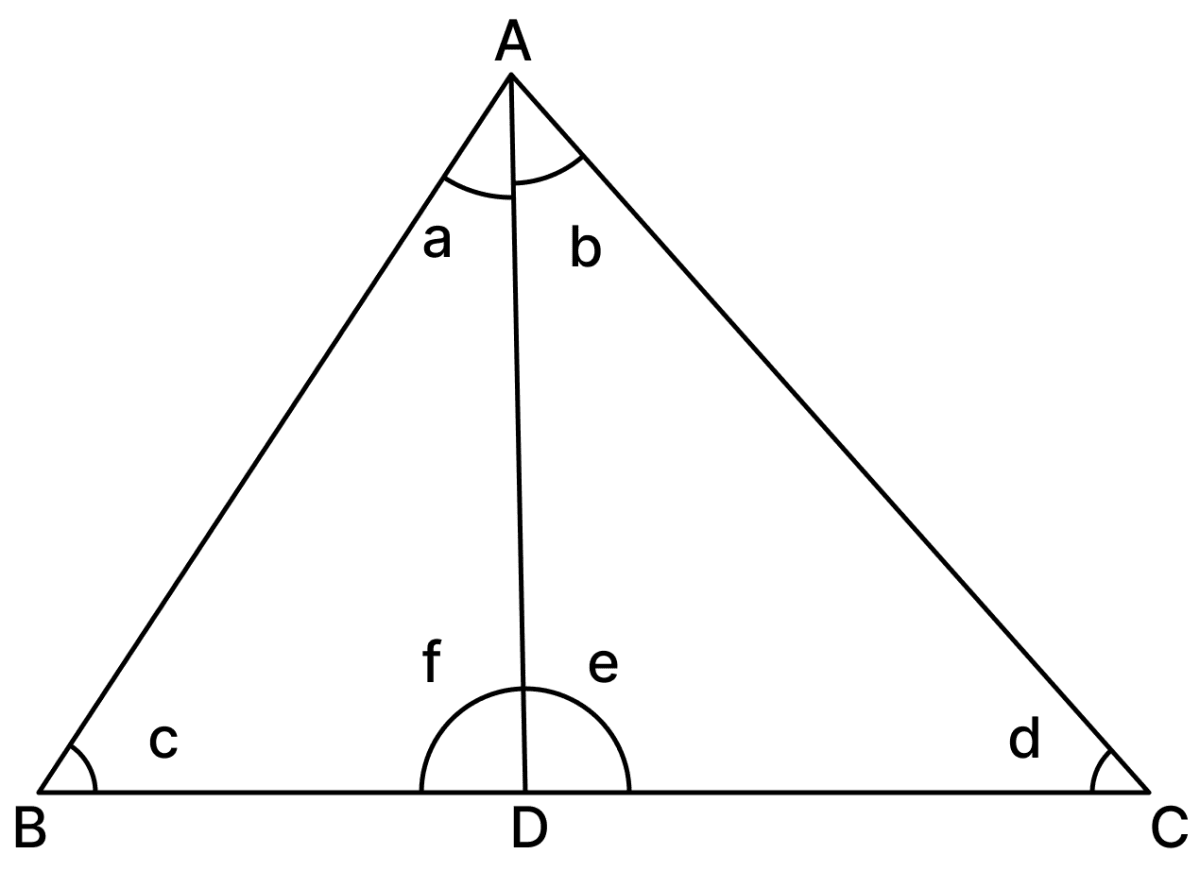
In the given figure, the value of a + b + c + d + e + f is:
- 180°
- 270°
- 360°
- 540°
Answer
In △ADB,
a + c + f = 180° ...(i) [Sum of angles in a triangle]
In △ADC,
b + e + d = 180° ...(ii) [Sum of angles in a triangle]
Adding (i) and (ii):
a + c + f + b + e + d = 180° + 180°
a + b + c + d + e + f = 360°
Hence, option 3 is the correct option.