
In a right-angled triangle, find the length of the hypotenuse, if the other two sides measure 12 cm and 35 cm.
Answer
Given:
The other two sides of the right-angled triangle are 12 cm and 35 cm.
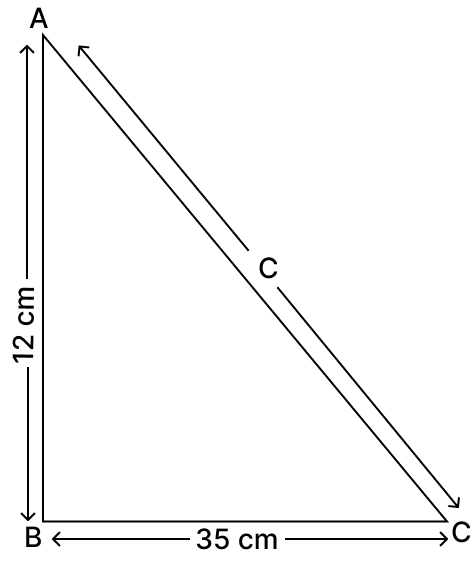
Let a = 12 and b = 35.
Let the hypotenuse be c.
c2 = a2 + b2 [Pythagoras' theorem]
c2 = (122 + 352) cm2
c2 = (144 + 1225) cm2
c2 = 1369 cm2
c = cm
c = 37 cm
∴ The length of the hypotenuse is 37 cm.
The length of one side of a right triangle is 24 cm and the length of its hypotenuse is 40 cm. Find the length of its third side.
Answer
Given:
The length of one side of a right triangle: a = 24 cm
The length of its hypotenuse: c = 40 cm
Let the length of its third side = b.
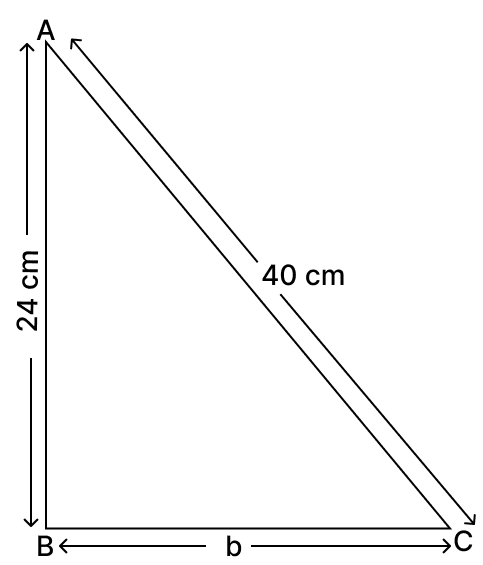
c2 = a2 + b2 [Pythagoras' theorem]
⇒ b2 = c2 - a2
b2 = (402 - 242) cm2
b2 = (1600 - 576) cm2
b2 = 1024 cm2
b = cm
b = 32 cm
∴ The length of the third side is 32 cm.
The two legs of a right triangle are equal and the square of its hypotenuse is 50 cm2. Find the length of each leg.
Answer
Given:
The two legs of a right triangle are equal: a = b
The square of its hypotenuse: c2 = 50 cm2
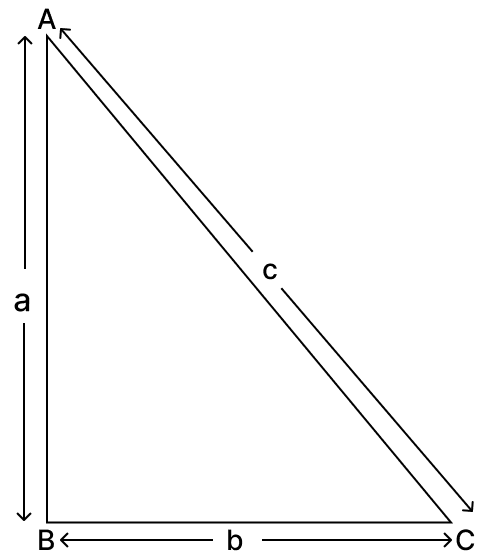
c2 = a2 + b2 [Pythagoras' theorem]
50 cm2 = a2 + a2 [∵ a = b]
50 cm2 = 2a2
⇒ a2 = cm2
a2 = 25 cm2
a = cm
a = 5 cm
∴ The length of each leg is 5 cm.
Given below are the lengths of the legs of right △ABC. In each case, find the length of the hypotenuse of △ABC:
(i) a = 32 cm, b = 60 cm
(ii) a = 28 m, b = 45 m
(iii) a = 32 cm, b = 24 cm
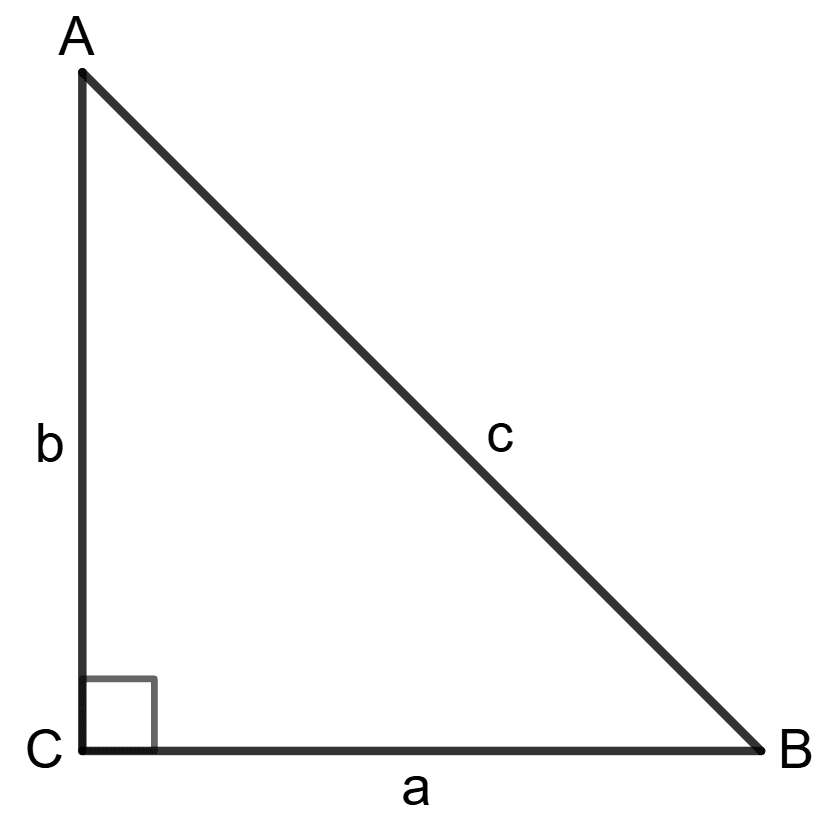
Answer
(i) a = 32 cm, b = 60 cm
Let the hypotenuse be c.
c2 = a2 + b2 [Pythagoras' theorem]
c2 = (322 + 602) cm2
c2 = (1024 + 3600) cm2
c2 = 4624 cm2
c = cm
c = 68 cm
∴ The length of the hypotenuse is 68 cm.
(ii) a = 28 m, b = 45 m
Let the hypotenuse be c.
c2 = a2 + b2 [Pythagoras' theorem]
c2 = (282 + 452) m2
c2 = (784 + 2025) m2
c2 = 2809 m2
c = m
c = 53 m
∴ The length of the hypotenuse is 53 m.
(iii) a = 32 cm, b = 24 cm
Let the hypotenuse be c.
c2 = a2 + b2 [Pythagoras' theorem]
c2 = (322 + 242) cm2
c2 = (1024 + 576) cm2
c2 = 1600 cm2
c = cm
c = 40 cm
∴ The length of the hypotenuse is 40 cm.
Given below are the lengths of the sides of △ABC. In each case, state whether △ABC is right-angled or not:
(i) AB = 40 cm, BC = 58 cm, CA = 44 cm
(ii) AB = 43 cm, BC = 35 cm, CA = 12 cm
(iii) AB = 55 cm, BC = 73 cm, CA = 48 cm
Answer
(i) AB = 40 cm, BC = 58 cm, CA = 44 cm
Hypotenuse = The longest side = BC
BC2 = AB2 + CA2
BC2 = (402 + 442) cm2
BC2 = (1600 + 1936) cm2
BC2 = 3536 cm2
But, BC2 = (58 cm)2 = 3364 cm2
Clearly, AB2 + CA2 ≠ BC2
∴ △ABC is not right-angled.
(ii) AB = 43 cm, BC = 35 cm, CA = 12 cm
Hypotenuse = The longest side = AB
AB2 = BC2 + CA2
AB2 = (352 + 122) cm2
AB2 = (1225 + 144) cm2
AB2 = 1369 cm2
But, AB2 = (43 cm)2 = 1849 cm2
Clearly, BC2 + CA2 ≠ AB2
∴ △ABC is not right-angled.
(iii) AB = 55 cm, BC = 73 cm, CA = 48 cm
Hypotenuse = The longest side = BC
BC2 = AB2 + CA2
BC2 = (552 + 482) cm2
BC2 = (3025 + 2304) cm2
BC2 = 5329 cm2
And, BC2 = (73 cm)2 = 5329 cm2
Clearly, BC2 = AB2 + CA2
∴ △ABC is a right-angled triangle.
A man travels 90 km due East and then 56 km due South. How far is he from the starting point?
Answer
Given:
A man travels 90 km due East and then 56 km due South.
Let O be the starting point of the man.
He moves from O to A due East such that OA = 90 km.
Then, he moves from A to B due South such that AB = 56 km.
Then, B is his final position. Join OB.
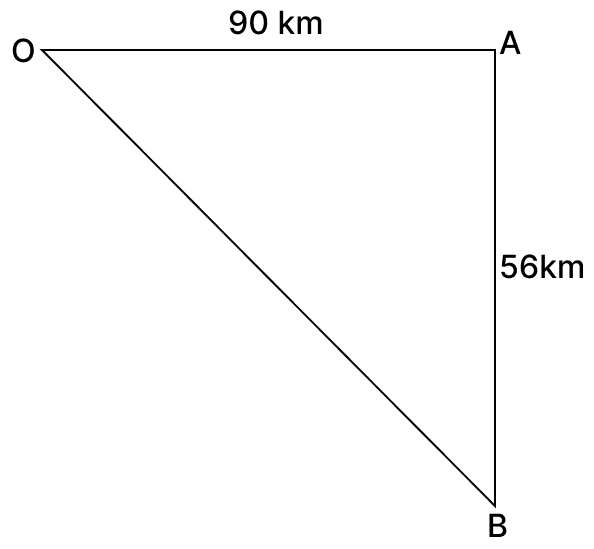
Now, in right △OAB, by Pythagoras Theorem, we have:
OB2 = OA2 + AB2
OB2 = (902 + 562) km2
OB2 = (8100 + 3136) km2
OB2 = 11236 km2
OB = km
OB = 106 km
∴ Distance of the man from the starting point = 106 km.
A long pole is made to stand against a wall in such a way that its foot is 16 m from the wall and its top reaches a window 12 m above the ground. Find the length of the pole.
Answer
Given:
Distance of the foot of the pole from the wall (base): BC = 16 m
Height of the window from the ground (height): AB = 12 m
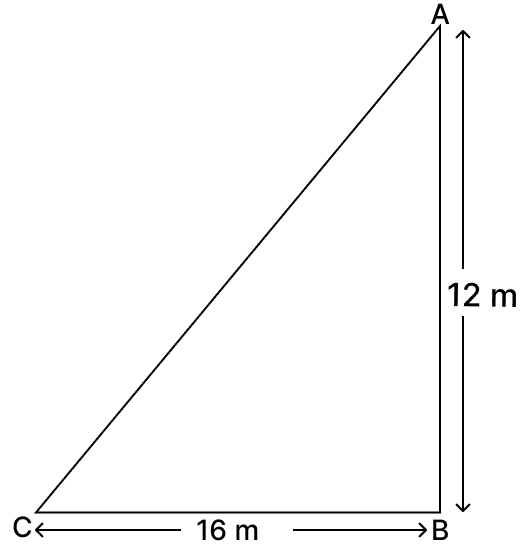
BC is the distance of the foot of the pole from the wall.
AB is the height of the window from the ground.
Let AC be the length of the pole.
Since the wall stands vertically to the ground, △ABC is a right-angled triangle with the right angle at B.
By Pythagoras Theorem, we have:
AC2 = AB2 + BC2
AC2 = (122 + 162) m2
AC2 = (144 + 256) m2
AC2 = 400 m2
AC = m
AC = 20 m
∴ The length of the pole is 20 m.
Find the length of the diagonal of a rectangle whose sides are 21 cm and 20 cm.
Answer
Given:
The sides of the rectangle are 21 cm and 20 cm.
Let ABCD be the rectangle where AB = 21 cm and BC = 20 cm.
Let AC be the diagonal.
Since every interior angle of a rectangle is a right angle (90°), △ABC is a right-angled triangle with the right angle at B. The diagonal AC acts as the hypotenuse.
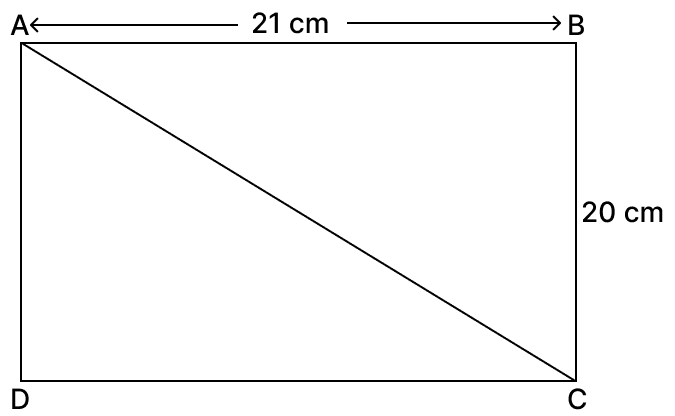
By Pythagoras Theorem, we have:
AC2 = AB2 + BC2
AC2 = (212 + 202) cm2
AC2 = (441 + 400) cm2
AC2 = 841 cm2
AC = cm
AC = 29 cm
∴ The length of the diagonal of the rectangle is 29 cm.
Fill in the blanks:
(i) In a right triangle, the square of the hypotenuse is equal to the ............... of the squares of the other two sides.
(ii) If the square of one side of a triangle is equal to the sum of the squares of the other two sides, then the triangle is ............... .
(iii) Of all the line segments that can be drawn to a given line from a given point outside it, the ............... is the shortest.
Answer
(i) In a right triangle, the square of the hypotenuse is equal to the sum of the squares of the other two sides.
(ii) If the square of one side of a triangle is equal to the sum of the squares of the other two sides, then the triangle is right-angled.
(iii) Of all the line segments that can be drawn to a given line from a given point outside it, the perpendicular is the shortest.
State Pythagoras' Theorem.
Answer
Pythagoras' Theorem states that:
In a right-angled triangle, the square of the length of the hypotenuse is equal to the sum of the squares of the lengths of the other two sides.