KnowledgeBoat Logo
|
OPEN IN APP

Chapter 18

Properties of Triangles

Class - 7 RS Aggarwal Mathematics Solutions


Exercise 18(A)

Question 1

Is it possible to form a triangle by three line segments of the following lengths?

(i) 8 cm, 6 cm, 15 cm

(ii) 6 cm, 8 cm, 14 cm

(iii) 5 cm, 6 cm, 10 cm

(iv) 5.6 cm, 4.4 cm, 9 cm

(v) 6 cm, 6 cm, 6 cm

(vi) 10 cm, 7 cm, 4 cm

Answer

(i) 8 cm, 6 cm, 15 cm

Sum of smaller line segments: 8 cm + 6 cm = 14 cm

The length of longest line segment = 15 cm

14 cm < 15 cm

The sum of two smaller line segments is not greater than the longest line segment.

∴ Triangle cannot be formed.

(ii) 6 cm, 8 cm, 14 cm

Sum of smaller line segments: 6 cm + 8 cm = 14 cm

The length of longest line segment = 14 cm

14 cm = 14 cm

The sum of two smaller line segments is not greater than the longest line segment.

∴ Triangle cannot be formed.

(iii) 5 cm, 6 cm, 10 cm

Sum of smaller line segments: 5 cm + 6 cm = 11 cm

The length of longest line segment = 10 cm

11 cm > 10 cm

The sum of two smaller line segments is greater than the longest line segment.

∴ Triangle can be formed.

(iv) 5.6 cm, 4.4 cm, 9 cm

Sum of smaller line segments: 5.6 cm + 4.4 cm = 10 cm

The length of longest line segment = 9 cm

10 cm > 9 cm

The sum of two smaller line segments is greater than the longest line segment.

∴ Triangle can be formed.

(v) 6 cm, 6 cm, 6 cm

Sum of smaller line segments: 6 cm + 6 cm = 12 cm

The length of longest line segment = 6 cm

12 cm > 6 cm

The sum of two smaller line segments is greater than the longest line segment.

∴ Triangle can be formed.

(vi) 10 cm, 7 cm, 4 cm

Sum of smaller line segments: 7 cm + 4 cm = 11 cm

The length of longest line segment = 10 cm

11 cm > 10 cm

The sum of the two smaller line segments is greater than the longest line segment.

∴ Triangle can be formed.

Question 2

Is it possible to have a triangle with angles of the following measures?

(i) 25°, 65°, 90°

(ii) 50°, 120°, 30°

(iii) 130°, 40°, 10°

(iv) 70°, 70°, 50°

(v) 30°, 90°, 90°

(vi) 60°, 50°, 60°

Answer

(i) 25°, 65°, 90°

Let's calculate the sum of the angles:

25° + 65° + 90° = 180°

The sum of the angles of a triangle is 180°.

∴ Triangle can be formed.

(ii) 50°, 120°, 30°

Let's calculate the sum of the angles:

50° + 120° + 30° = 200°

But the sum of the angles of a triangle is 180°.

Since 200° > 180°,

∴ Triangle cannot be formed.

(iii) 130°, 40°, 10°

Let's calculate the sum of the angles:

130° + 40° + 10° = 180°

The sum of the angles of a triangle is 180°.

∴ Triangle can be formed.

(iv) 70°, 70°, 50°

Let's calculate the sum of the angles:

70° + 70° + 50° = 190°

But the sum of the angles of a triangle is 180°.

Since 190° > 180°,

∴ Triangle cannot be formed.

(v) 30°, 90°, 90°

Let's calculate the sum of the angles:

30° + 90° + 90° = 210°

But the sum of the angles of a triangle is 180°.

Since 210° > 180°,

∴ Triangle cannot be formed.

(vi) 60°, 50°, 60°

Let's calculate the sum of the angles:

60° + 50° + 60° = 170°

But the sum of the angles of a triangle is 180°.

Since 170° < 180°,

∴ Triangle cannot be formed.

Question 3

In a △ABC, if ∠A = 72° and ∠B = 65°, find the measure of ∠C.

Answer

Given:

∠A = 72°, ∠B = 65°, ∠C = ?

The sum of all three angles of a triangle is 180°.

∴ ∠A + ∠B + ∠C = 180°

⇒ 72° + 65° + ∠C = 180°

⇒ 137° + ∠C = 180°

⇒ ∠C = 180° - 137°

⇒ ∠C = 43°

∴ The measure of ∠C is 43°.

Question 4

In a △PQR, if ∠P = 90° and ∠Q = ∠R, find the measure of each of the equal angles of the triangle.

Answer

Given:

∠P = 90° and ∠Q = ∠R

Let the measure of each of these equal angles be x.

The sum of all three angles of a triangle is 180°.

∴ ∠P + ∠Q + ∠R = 180°

Substituting the values in above, we get:

⇒ 90° + x + x = 180°

⇒ 90° + 2x = 180°

⇒ 2x = 180° - 90°

⇒ 2x = 90°

⇒ x = 902\dfrac{90^\circ}{2}

⇒ x = 45°

∴ The measure of ∠Q = 45° and ∠R = 45°

Question 5

The angles of a triangle are in the ratio 3 : 5 : 4. Find the measure of each of the angles.

Answer

Let the measure of given angles be 3x, 5x and 4x.

Since the sum of the angles of a triangle is 180°, we have:

3x + 5x + 4x = 180°

⇒ 12x = 180°

⇒ x = 18012\dfrac{180^\circ}{12}

⇒ x = 15°

Let's find the measure of each angle by substituting the value of x:

3x = 3 x 15° = 45°

5x = 5 x 15° = 75°

4x = 4 x 15° = 60°

∴ The three angles of a triangle are 45°, 75° and 60°.

Question 6

One angle of a triangle measures 30° and the other two angles are in the ratio 3 : 2. Find these angles.

Answer

Given:

First angle = 30°

The other two angles are in the ratio 3 : 2.

∴ Second angle = 3x

And

Third angle = 2x

Since the sum of the angles of a triangle is 180°, we have:

30° + 3x + 2x = 180°

⇒ 30° + 5x = 180°

⇒ 5x = 180° - 30°

⇒ 5x = 150°

⇒ x = 1505\dfrac{150^\circ}{5}

⇒ x = 30°

Let's find the measure of other two angles by substituting the value of x:

Second angle = 3x = 3 x 30° = 90°

Third angle = 2x = 2 x 30° = 60°

∴ The other two angles are 90° and 60°.

Question 7

In a right-angled triangle, the two acute angles are in the ratio 4 : 5. Find these angles.

Answer

Given:

The ratio of two acute angles = 4 : 5

∴ First acute angle = 4x

And

Second acute angle = 5x

As it is a right-angled triangle, one angle = 90°.

Since the sum of the angles of a triangle is 180°, we have:

90° + 4x + 5x = 180°

⇒ 90° + 9x = 180°

⇒ 9x = 180° - 90°

⇒ 9x = 90°

⇒ x = 909\dfrac{90^\circ}{9}

⇒ x = 10°

Let's find the measure of two acute angles by substituting the value of x:

First acute angle = 4x = 4 x 10° = 40°

Second acute angle = 5x = 5 x 10° = 50°

∴ The measure of two acute angles is 40° and 50°.

Question 8

One of the two equal angles of an isosceles triangle measures 65°. Find the measure of each angle of the triangle.

Answer

Given:

One of the two equal angles of an isosceles triangle = 65°

By the property of an isosceles triangle, two angles are equal.

∴ First equal angle = 65° = Second equal angle

Let the measure of the third angle be x.

Since the sum of the angles of a triangle is 180°, we have:

65° + 65° + x = 180°

⇒ 130° + x = 180°

⇒ x = 180° - 130°

⇒ x = 50°

∴ Third angle = 50°

∴ The measure of each angle of the triangle is 65°, 65° and 50°.

Question 9

Find the measure of each of the two equal angles of an isosceles right-angled triangle.

Answer

One angle in isosceles right-angled triangle = 90°

The other two angles are equal.

Let each equal angle be x.

Since the sum of the angles of a triangle is 180°, we have:

90° + x + x = 180°

⇒ 90° + 2x = 180°

⇒ 2x = 180° - 90°

⇒ 2x = 90°

⇒ x = 902\dfrac{90^\circ}{2}

⇒ x = 45°

∴ First equal angle = 45° and Second equal angle = 45°

∴ The measure of each of the two equal angles of an isosceles right-angled triangle is 45°.

Question 10

If all the three angles of a triangle are of the same measure, find the measure of each of the angles.

Answer

Given:

All three angles of a triangle are of the same measure.

Let the measure of each angle be x.

Since the sum of the angles of a triangle is 180°, we have:

x + x + x = 180°

⇒ 3x = 180°

⇒ x = 1803\dfrac{180^\circ}{3}

⇒ x = 60°

∴ The measure of each of the angles is 60°.

Question 11

In a right-angled triangle, if one of the acute angles measures 40°, find the measure of the other acute angle.

Answer

Given:

One acute angle = 40°

Since it is a right-angled triangle, one angle = 90°

Let the measure of the other acute angle be x.

Since the sum of the angles of a triangle is 180°, we have:

90° + 40° + x = 180°

⇒ 130° + x = 180°

⇒ x = 180° - 130°

⇒ x = 50°

∴ The measure of the other acute angle is 50°.

Question 12(i)

Find the unknown angles marked in the following figure:
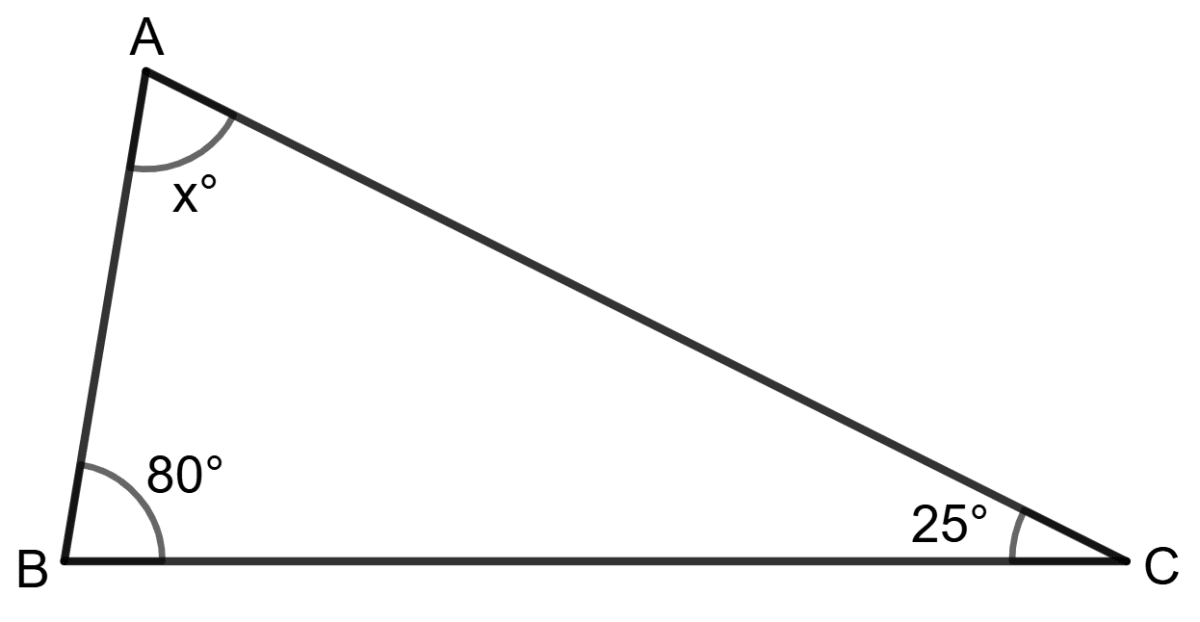
Find the unknown angles marked in each of the following figures: Properties of Triangles, Foundation Mathematics R.S. Aggarwal ICSE Class 7.

Answer

Given:

∠B = 80°, ∠C = 25°, ∠A = x°

∠B + ∠C + ∠A = 180° \quad[Sum of the angles of a triangle]

∴ 80° + 25° + x° = 180°

⇒ 105° + x° = 180°

⇒ x° = 180° - 105°

⇒ x° = 75°

∴ ∠A = 75°

Question 12(ii)

Find the unknown angles marked in the following figure:
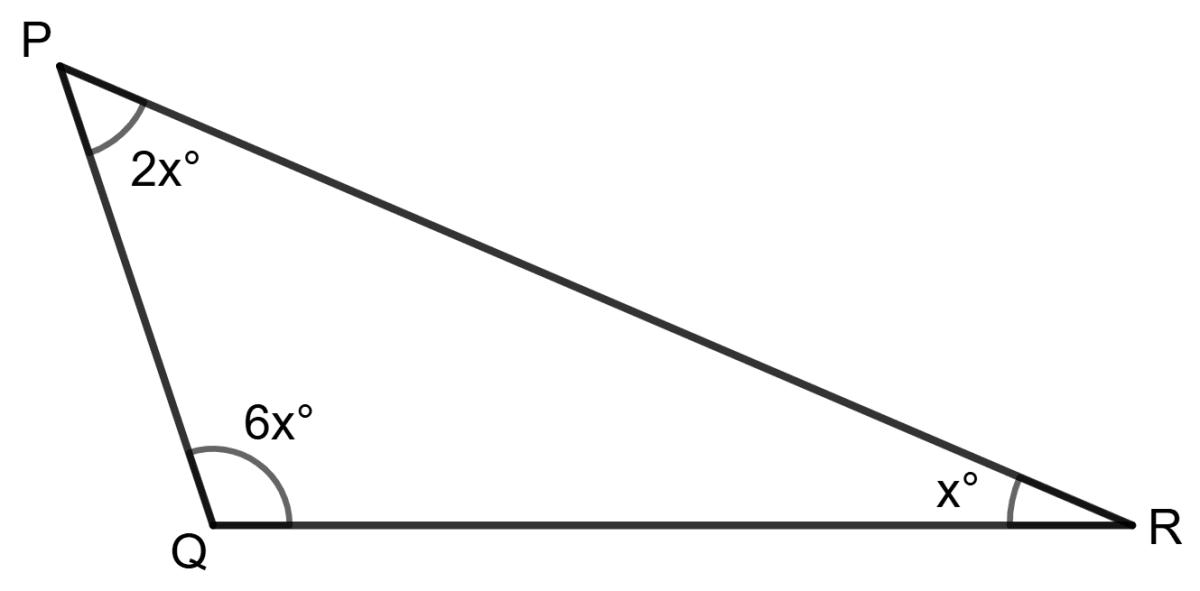
Find the unknown angles marked in each of the following figures: Properties of Triangles, Foundation Mathematics R.S. Aggarwal ICSE Class 7.

Answer

Given:

∠P = 2x°, ∠Q = 6x°, ∠R = x°

∠P + ∠Q + ∠R = 180° \quad[Sum of the angles of a triangle]

∴ 2x° + 6x° + x° = 180°

⇒ 9x° = 180°

⇒ x° = 1809\dfrac{180^\circ}{9}

⇒ x° = 20°

∠R = x° = 20°

∠P = 2x° = 2 x 20° = 40°

∠Q = 6x° = 6 x 20° = 120°

∴ ∠P = 40°, ∠Q = 120° and ∠R = 20°

Question 12(iii)

Find the unknown angles marked in the following figure:
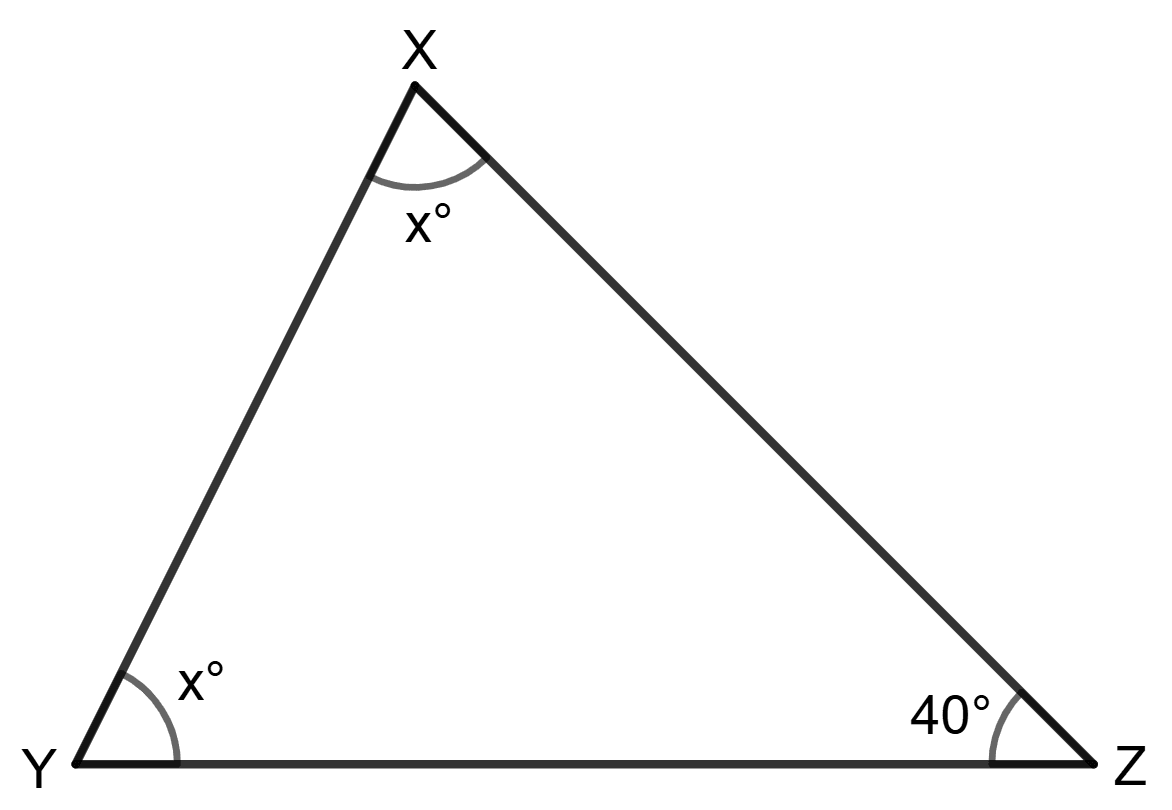
Find the unknown angles marked in each of the following figures: Properties of Triangles, Foundation Mathematics R.S. Aggarwal ICSE Class 7.

Answer

Given:

∠X = x°, ∠Y = x°, ∠Z = 40°

∠X + ∠Y + ∠Z = 180° \quad[Sum of the angles of a triangle]

∴ x° + x° + 40° = 180°

⇒ 2x° + 40° = 180°

⇒ 2x° = 180° - 40°

⇒ 2x° = 140°

⇒ x° = 1402\dfrac{140^\circ}{2}

⇒ x° = 70°

∴ ∠X = 70° and ∠Y = 70°

Question 12(iv)

Find the unknown angles marked in the following figure:
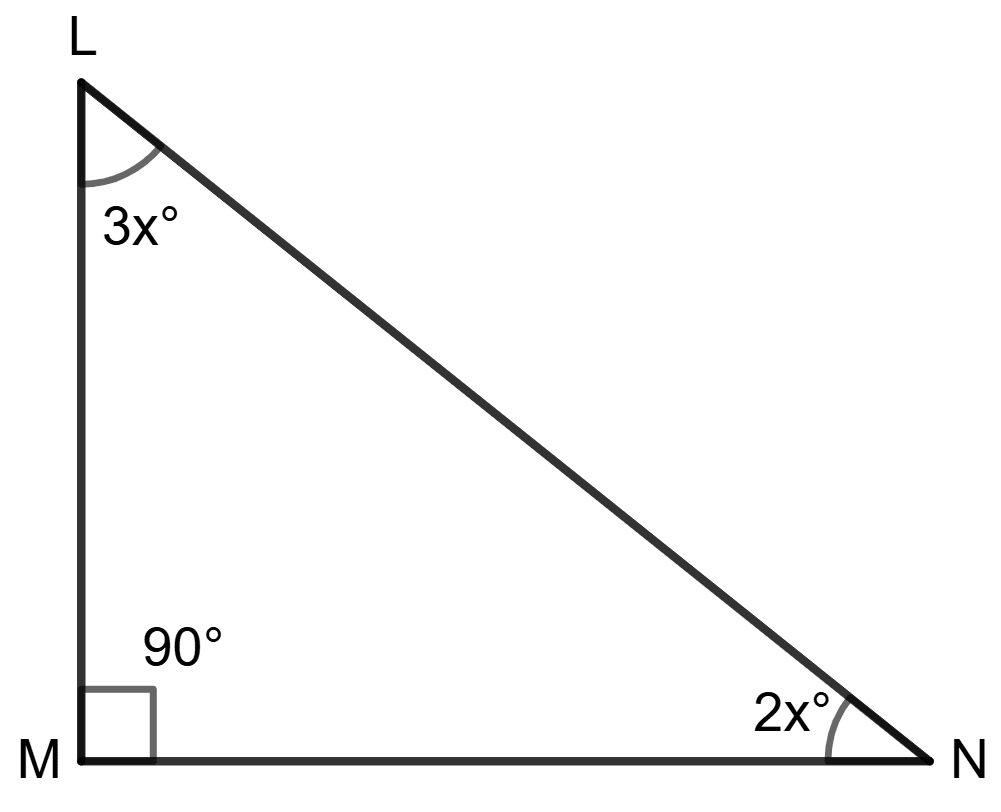
Find the unknown angles marked in each of the following figures: Properties of Triangles, Foundation Mathematics R.S. Aggarwal ICSE Class 7.

Answer

Given:

∠L = 3x°, ∠M = 90°, ∠N = 2x°

∠L + ∠M + ∠N = 180° \quad[Sum of the angles of a triangle]

∴ 3x° + 90° + 2x° = 180°

⇒ 5x° + 90° = 180°

⇒ 5x° = 180° - 90°

⇒ 5x° = 90°

⇒ x° = 905\dfrac{90^\circ}{5}

⇒ x° = 18°

∠L = 3x° = 3 x 18° = 54°

∠N = 2x° = 2 x 18° = 36°

∴ ∠L = 54° and ∠N = 36°

Question 12(v)

Find the unknown angles marked in the following figure:
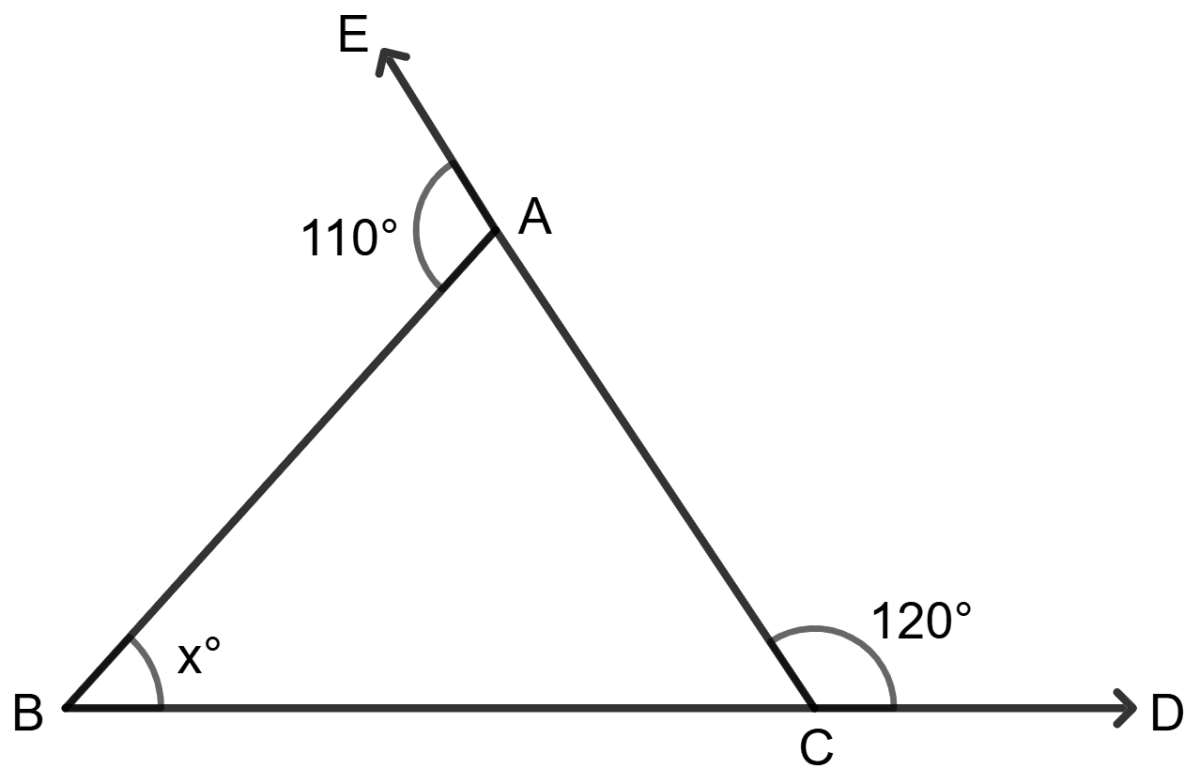
Find the unknown angles marked in each of the following figures: Properties of Triangles, Foundation Mathematics R.S. Aggarwal ICSE Class 7.

Answer

Given:

∠BAE = 110°, ∠ACD = 120°, ∠ABC = x°

Since, CE is a straight line:

∠BAE + ∠BAC = 180° \quad[Linear pair]

⇒ 110° + ∠BAC = 180° \quad[Substituting the value of ∠BAE]

⇒ ∠BAC = 180° - 110°

⇒ ∠BAC = 70°

Since BD is a straight line:

∠ACD + ∠ACB = 180° \quad[Linear pair]

⇒ 120° + ∠ACB = 180° \quad[Substituting the value of ∠ACD]

⇒ ∠ACB = 180° - 120°

⇒ ∠ACB = 60°

In △ABC, we have:

∠ABC + ∠BAC + ∠ACB = 180° \quad[Sum of the angles of a triangle]

∴ x° + 70° + 60° = 180°

⇒ x° + 130° = 180°

⇒ x° = 180° - 130°

⇒ x° = 50°

∴ ∠B = 50°

Question 12(vi)

Find the unknown angles marked in the following figure:
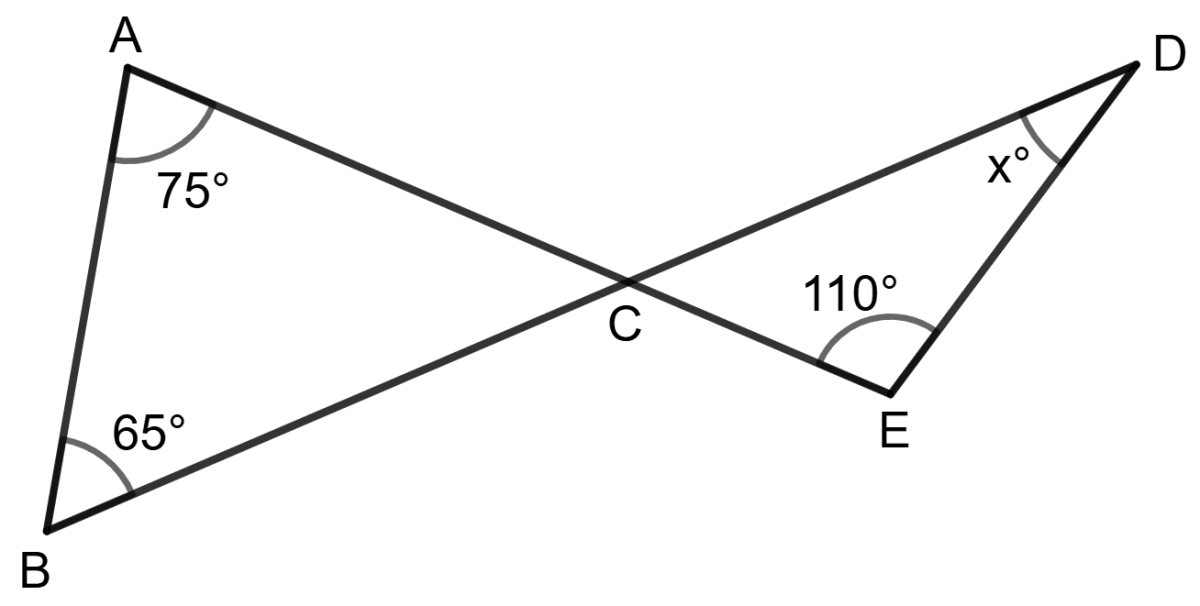
Find the unknown angles marked in each of the following figures: Properties of Triangles, Foundation Mathematics R.S. Aggarwal ICSE Class 7.

Answer

Given:

∠A = 75°, ∠B = 65°, ∠D = x°, ∠E = 110°

In △ABC, we have:

∠A + ∠B + ∠ACB = 180° \quad[Sum of the angles of a triangle]

∴ 75° + 65° + ∠ACB = 180°

⇒ 140° + ∠ACB = 180°

⇒ ∠ACB = 180° - 140°

⇒ ∠ACB = 40°

Now,

∠ACB = ∠DCE \quad[Vertically opposite angles are equal]

Now, in △CDE, we have:

∠DCE + ∠D + ∠E = 180° \quad[Sum of the angles of a triangle]

∴ 40° + x° + 110° = 180°

⇒ 150° + x° = 180°

⇒ x° = 180° - 150°

⇒ x° = 30°

∴ ∠D = 30°

Question 13(i)

In the following figure, one side of a triangle has been produced. Find all the angles of the triangle in each case.
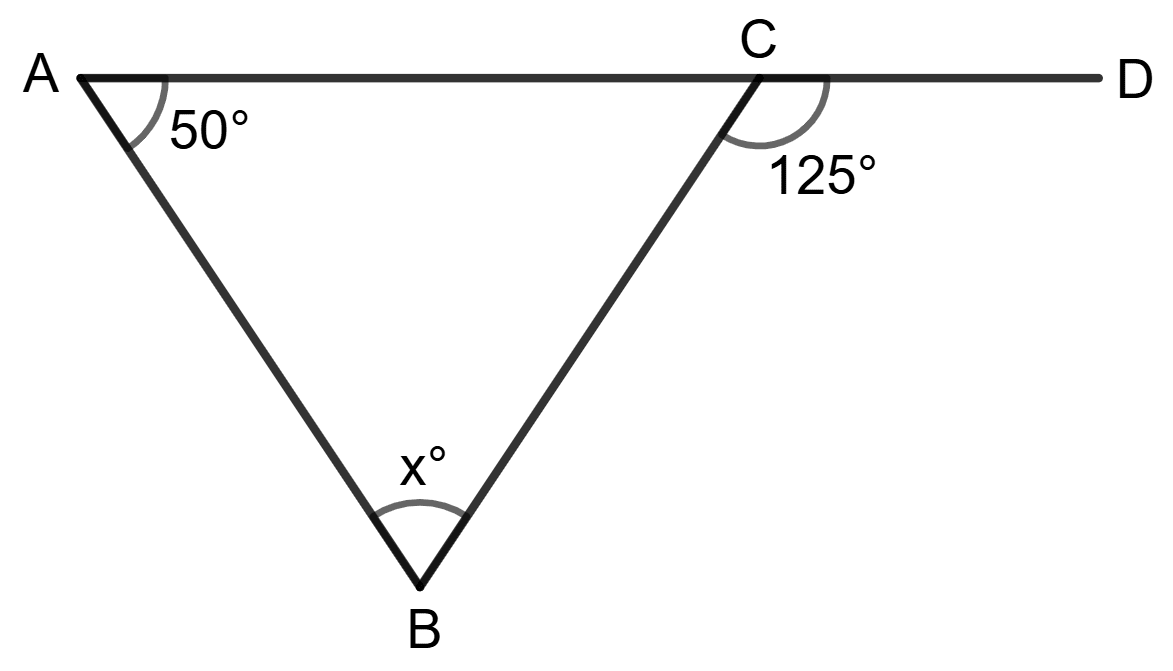
In each of the following figures, one side of a triangle has been produced. Find all the angles of the triangle in each case. Properties of Triangles, Foundation Mathematics R.S. Aggarwal ICSE Class 7.

Answer

Given interior angles:

∠A = 50°, ∠B = x°

Exterior angle: ∠BCD = 125°

According to exterior angle property, an exterior angle of a triangle is equal to the sum of its interior opposite angles.

∴ ∠A + ∠B = ∠BCD

⇒ 50° + x° = 125°

⇒ x° = 125° - 50°

⇒ x° = 75°

⇒ ∠B = 75°

In △ABC, we have:

∠A + ∠B + ∠C = 180° \quad[Sum of the angles of a triangle]

∴ 50° + 75° + ∠C = 180°

⇒ 125° + ∠C = 180°

⇒ ∠C = 180° - 125°

⇒ ∠C = 55°

∴ The angles of the triangle are ∠A = 50°, ∠B = 75°, ∠C = 55°

Question 13(ii)

In the following figure, one side of a triangle has been produced. Find all the angles of the triangle in each case.
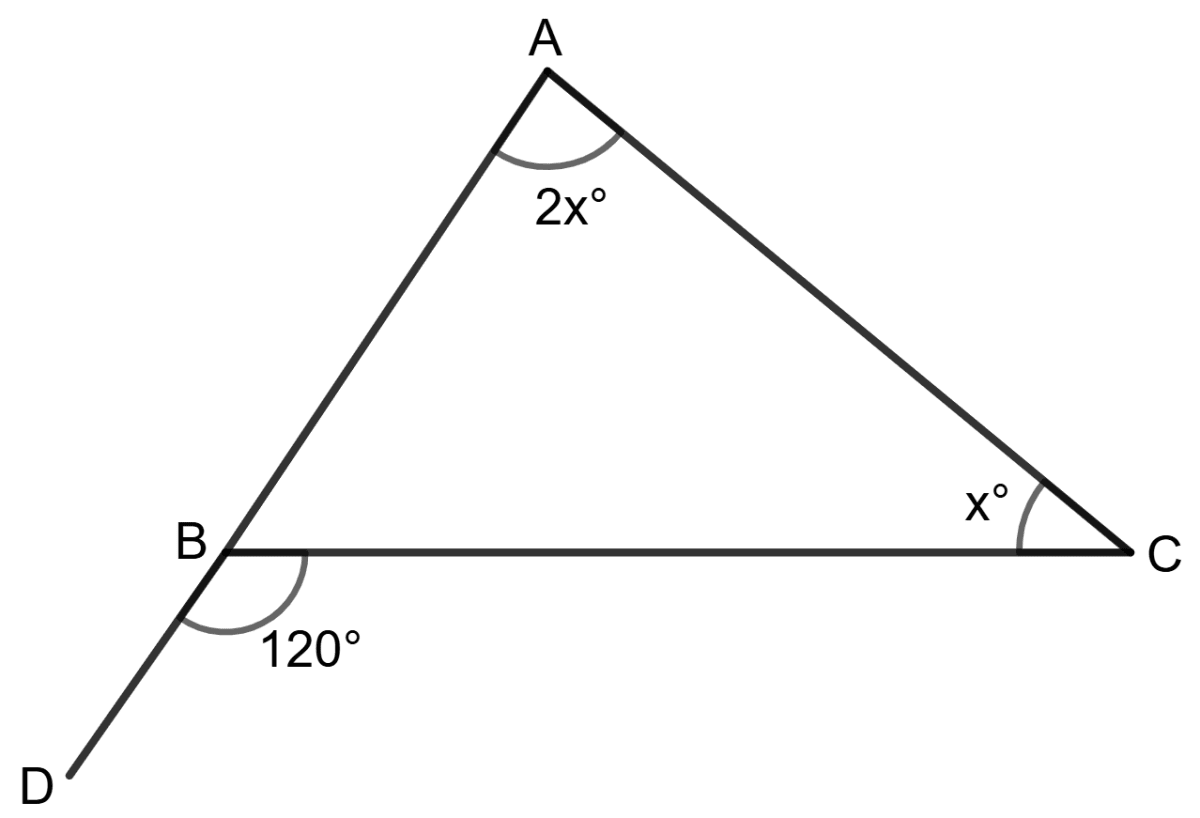
In each of the following figures, one side of a triangle has been produced. Find all the angles of the triangle in each case. Properties of Triangles, Foundation Mathematics R.S. Aggarwal ICSE Class 7.

Answer

Given interior angles:

∠A = 2x°, ∠C = x°

Exterior angle: ∠CBD = 120°

According to exterior angle property, an exterior angle of a triangle is equal to the sum of its interior opposite angles.

∴ ∠A + ∠C = ∠CBD

2x° + x° = 120°

3x° = 120°

x° = 1203\dfrac{120^\circ}{3}

x° = 40°

⇒ ∠A = 2x° = 2 x 40° = 80°

⇒ ∠C = x° = 40°

In △ABC, we have:

∠A + ∠B + ∠C = 180° \quad[Sum of the angles of a triangle]

∴ 80° + ∠B + 40° = 180°

⇒ 120° + ∠B = 180°

⇒ ∠B = 180° - 120°

⇒ ∠B = 60°

∴ The angles of the triangle are ∠A = 80°, ∠B = 60°, ∠C = 40°

Question 13(iii)

In the following figure, one side of a triangle has been produced. Find all the angles of the triangle in each case.
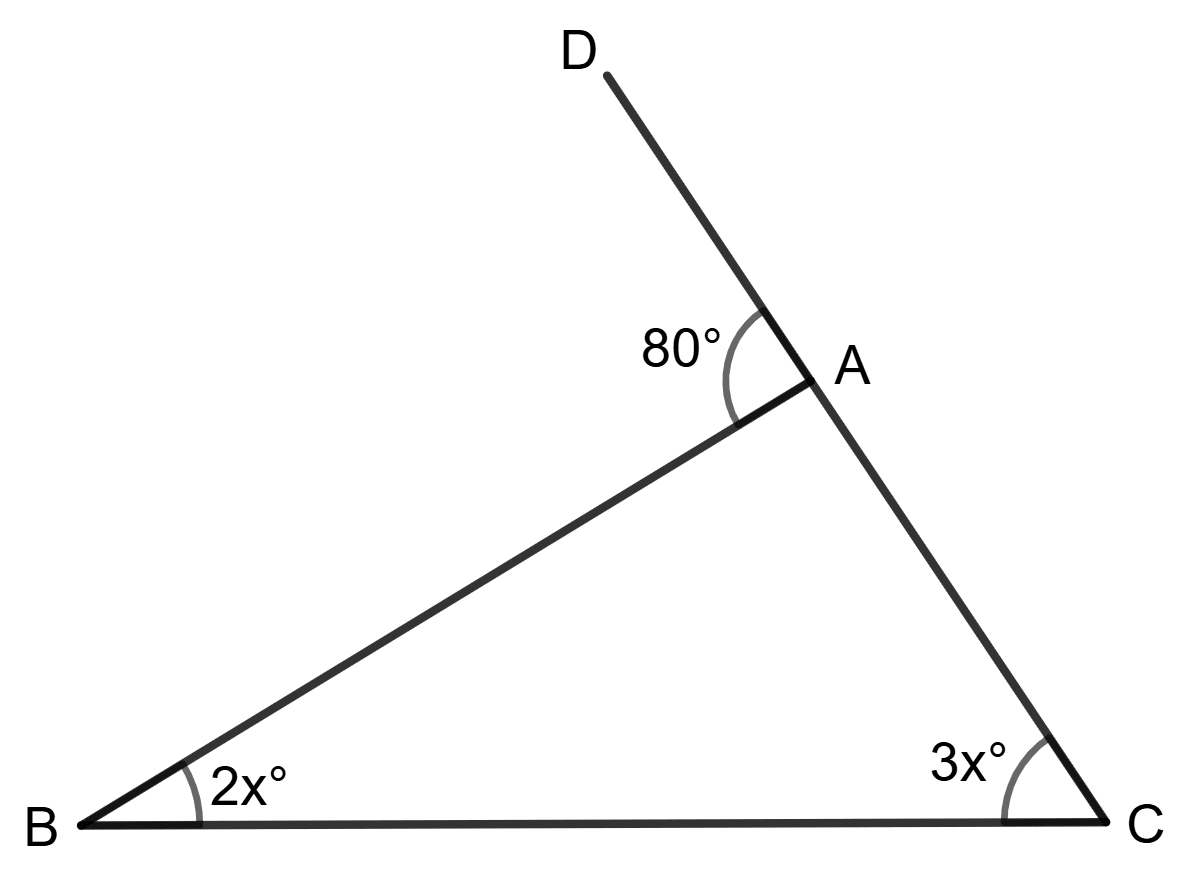
In each of the following figures, one side of a triangle has been produced. Find all the angles of the triangle in each case. Properties of Triangles, Foundation Mathematics R.S. Aggarwal ICSE Class 7.

Answer

Given interior angles:

∠B = 2x°, ∠C = 3x°

Exterior angle: ∠BAD = 80°

According to exterior angle property, an exterior angle of a triangle is equal to the sum of its interior opposite angles.

∴ ∠B + ∠C = ∠BAD

2x° + 3x° = 80°

5x° = 80°

x° = 805\dfrac{80^\circ}{5}

x° = 16°

⇒ ∠B = 2x° = (2 x 16°) = 32°

⇒ ∠C = 3x° = (3 x 16°) = 48°

In △ABC, we have:

∠A + ∠B + ∠C = 180° \quad[Sum of the angles of a triangle]

∴ ∠A + 32° + 48° = 180°

⇒ ∠A + 80° = 180°

⇒ ∠A = 180° - 80°

⇒ ∠A = 100°

∴ The angles of the triangle are ∠A = 100°, ∠B = 32°, ∠C = 48°

Question 13(iv)

In the following figure, one side of a triangle has been produced. Find all the angles of the triangle in each case.
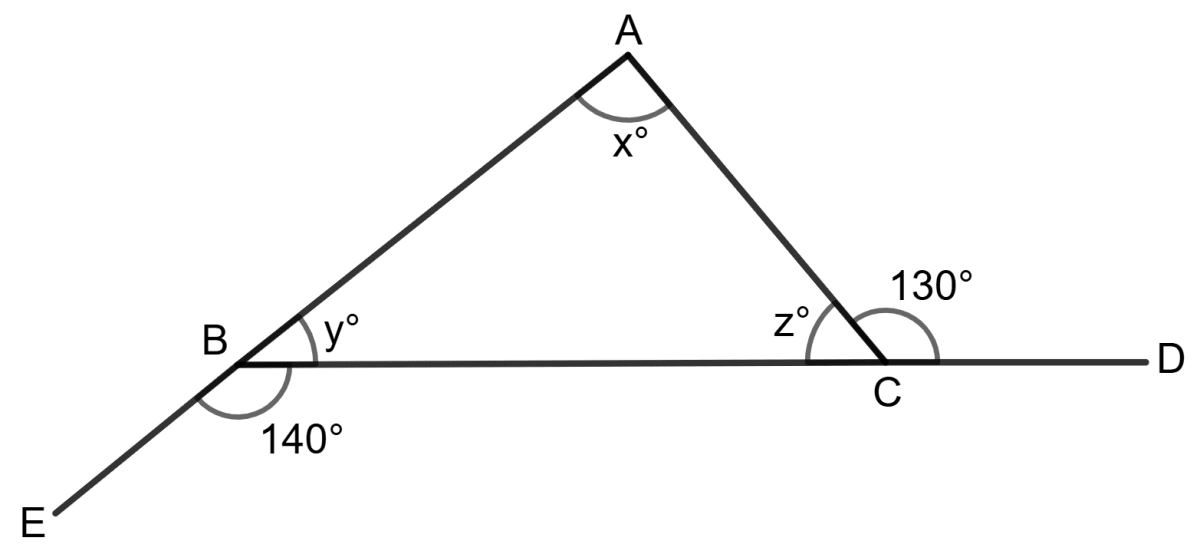
In each of the following figures, one side of a triangle has been produced. Find all the angles of the triangle in each case. Properties of Triangles, Foundation Mathematics R.S. Aggarwal ICSE Class 7.

Answer

Given interior angles:

∠A = x°, ∠B = y°, ∠C = z°

Exterior angle: ∠CBE = 140°, ∠ACD = 130°

Since AE is a straight line:

∠CBE + ∠CBA = 180° \quad[Linear pair]

⇒ 140° + y° = 180°

⇒ y° = 180° - 140°

⇒ y° = 40°

⇒ ∠B = 40°

Since BD is a straight line:

∠ACD + ∠ACB = 180°

⇒ 130° + z° = 180°

⇒ z° = 180° - 130°

⇒ z° = 50°

⇒ ∠C = 50°

In △ABC, we have:

∠A + ∠B + ∠C = 180° \quad[Sum of the angles of a triangle]

∴ x° + 40° + 50° = 180°

⇒ x° + 90° = 180°

⇒ x° = 180° - 90°

⇒ x° = 90°

⇒ ∠A = 90°

∴ The angles of the triangle are ∠A = 90°, ∠B = 40°, ∠C = 50°

Question 13(v)

In the following figure, one side of a triangle has been produced. Find all the angles of the triangle in each case.
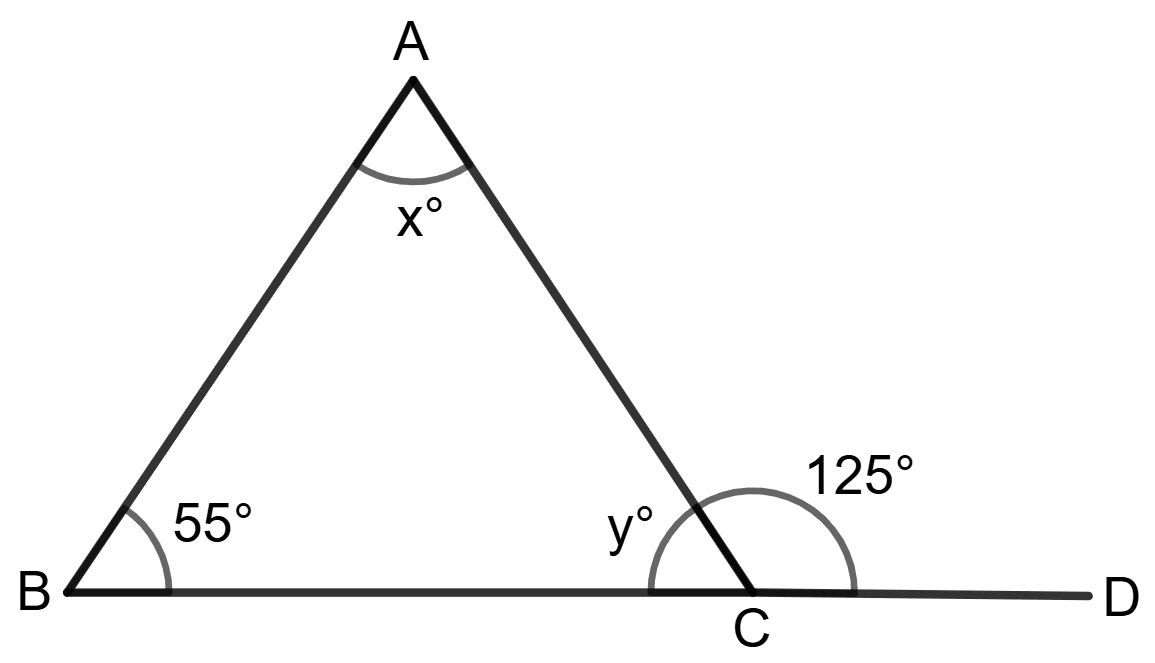
In each of the following figures, one side of a triangle has been produced. Find all the angles of the triangle in each case. Properties of Triangles, Foundation Mathematics R.S. Aggarwal ICSE Class 7.

Answer

Given interior angles:

∠A = x°, ∠B = 55°, ∠C = y°

Exterior angle: ∠ACD = 125°

According to exterior angle property, an exterior angle of a triangle is equal to the sum of its interior opposite angles.

∴ ∠A + ∠B = ∠ACD \quad[∠A and ∠B are opposite interior angles to ∠ACD]

⇒ x° + 55° = 125°

⇒ x° = 125° - 55°

⇒ x° = 70°

⇒ ∠A = x° = 70°

In △ABC, we have:

∠A + ∠B + ∠C = 180° \quad[Sum of the angles of a triangle]

∴ 70° + 55° + y° = 180°

⇒ 125° + y° = 180°

⇒ y° = 180° - 125°

⇒ y° = 55°

⇒ ∠C = y° = 55°

∴ The angles of the triangle are ∠A = 70°, ∠B = 55°, ∠C = 55°

Question 13(vi)

In the following figure, one side of a triangle has been produced. Find all the angles of the triangle in each case.
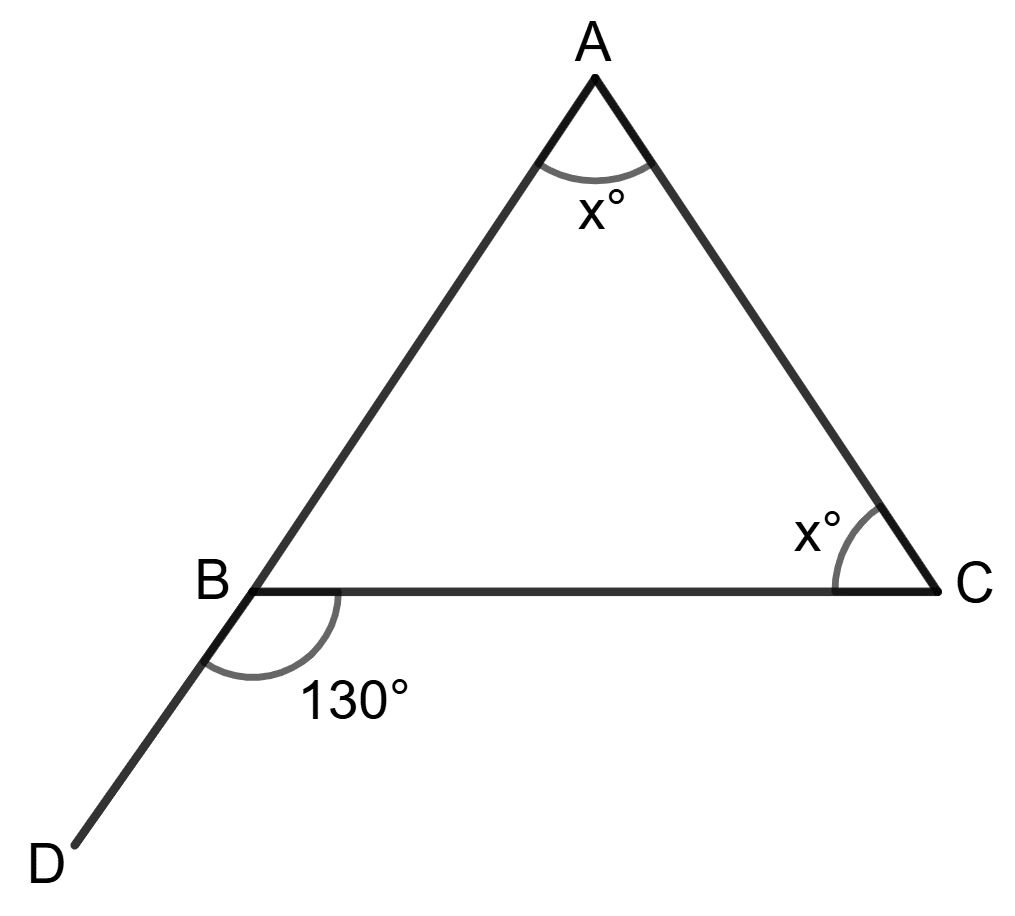
In each of the following figures, one side of a triangle has been produced. Find all the angles of the triangle in each case. Properties of Triangles, Foundation Mathematics R.S. Aggarwal ICSE Class 7.

Answer

Given interior angles:

∠A = x°, ∠C = x°

Exterior angle: ∠CBD = 130°

According to exterior angle property, an exterior angle of a triangle is equal to the sum of its interior opposite angles.

∴ ∠A + ∠C = ∠CBD

x° + x° = 130°

2x° = 130°

x° = 1302\dfrac{130^\circ}{2}

x° = 65°

⇒ ∠A = x° = 65°

⇒ ∠C = x° = 65°

In △ABC, we have:

∠A + ∠B + ∠C = 180° \quad[Sum of the angles of a triangle]

∴ 65° + ∠B + 65° = 180°

⇒ ∠B + 130° = 180°

⇒ ∠B = 180° - 130°

⇒ ∠B = 50°

∴ The angles of the triangle are ∠A = 65°, ∠B = 50°, ∠C = 65°

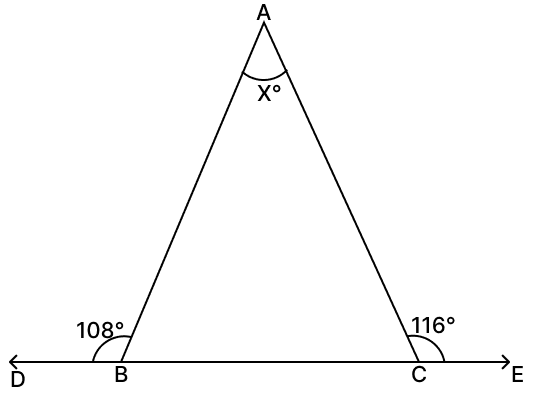
Question 14(i)

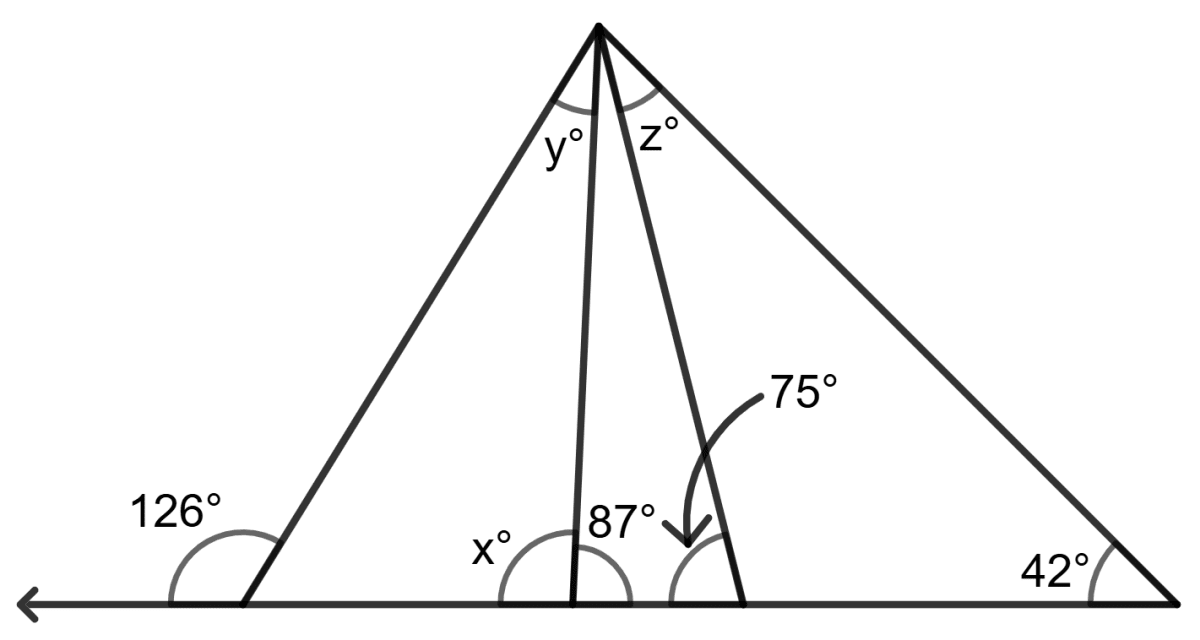
Calculate the size of each lettered angle in the following figure:
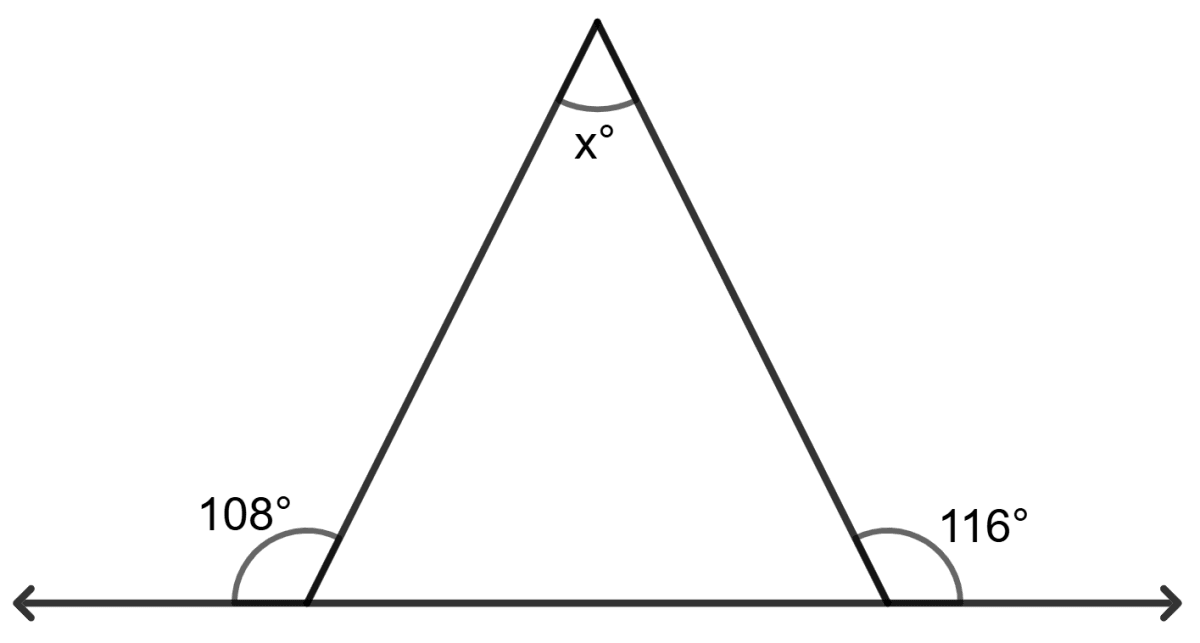
Calculate the size of each lettered angle in the following figures: Properties of Triangles, Foundation Mathematics R.S. Aggarwal ICSE Class 7.

Answer

From the figure, we have:

Calculate the size of each lettered angle in the following figure: Properties of Triangles, Foundation Mathematics R.S. Aggarwal ICSE Class 7.
∠BAC = x°, ∠ABD = 108° and ∠ACE = 116°

Since, DE is a straight line and AB is a transversal:

∠ABD + ∠ABC = 180° \quad[Linear pair]

⇒ 108° + ∠ABC = 180°

⇒ ∠ABC = 180° - 108°

⇒ ∠ABC = 72°

Since, DE is a straight line and AC is a transversal:

∠ACE + ∠ACB = 180° \quad[Linear pair]

⇒ 116° + ∠ACB = 180°

⇒ ∠ACB = 180° - 116°

⇒ ∠ACB = 64°

Now, consider △ABC:

∠ABC + ∠BAC + ∠ACB = 180° \quad[Sum of the angles of a triangle]

∴ 72° + x° + 64° = 180°

⇒ x° + 136° = 180°

⇒ x° = 180° - 136°

∴ x = 44°

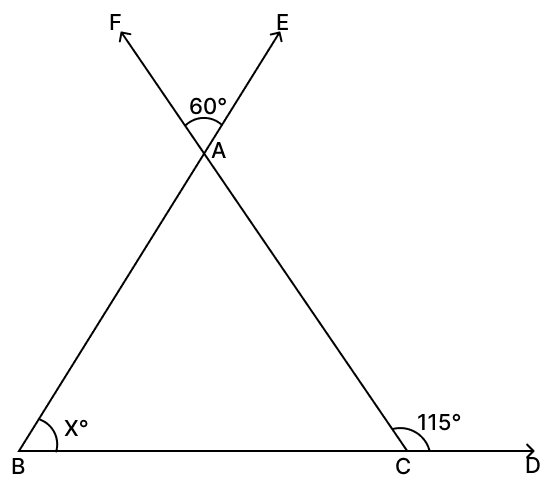
Question 14(ii)

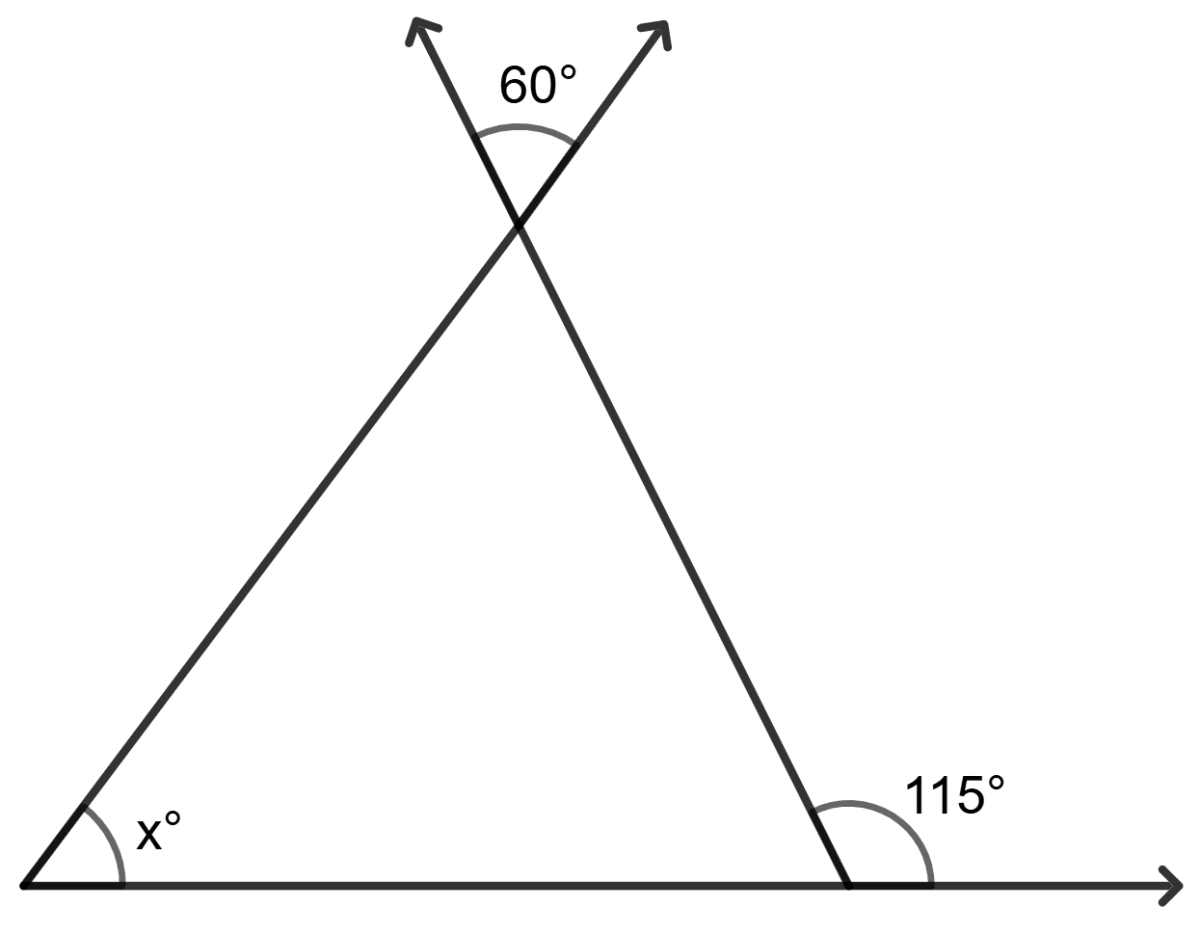
Calculate the size of each lettered angle in the following figure:
Calculate the size of each lettered angle in the following figures: Properties of Triangles, Foundation Mathematics R.S. Aggarwal ICSE Class 7.

Answer

From figure, we have:

Calculate the size of each lettered angle in the following figure: Properties of Triangles, Foundation Mathematics R.S. Aggarwal ICSE Class 7.
∠ABC = x°, ∠ACD = 115° and ∠FAE = 60°

∠BAC = ∠FAE \quad[Vertically opposite angles]

⇒ ∠BAC = 60°

x° + ∠BAC = ∠ACD \quad[Exterior angle = sum of interior opposite angles]

⇒ x° + 60° = 115°

⇒ x° = 115° - 60°

∴ x = 55°

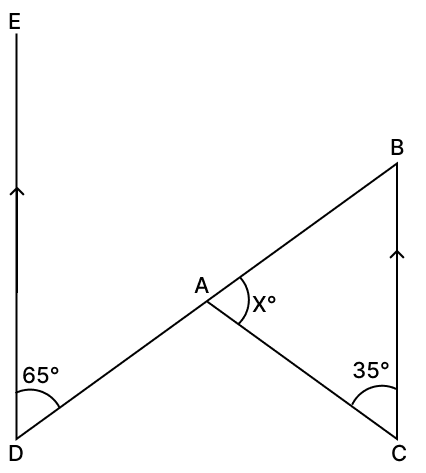
Question 14(iii)

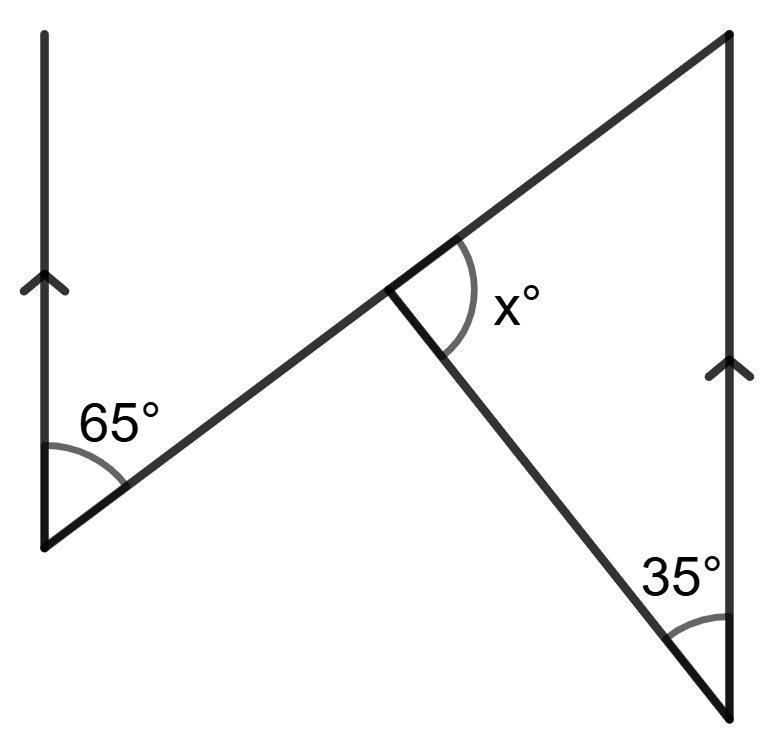
Calculate the size of each lettered angle in the following figure:
Calculate the size of each lettered angle in the following figures: Properties of Triangles, Foundation Mathematics R.S. Aggarwal ICSE Class 7.

Answer

From the figure, we have:

Calculate the size of each lettered angle in the following figure: Properties of Triangles, Foundation Mathematics R.S. Aggarwal ICSE Class 7.

∠ADE = 65°, ∠ACB = 35° and ∠BAC = x°

Since ED || BC and BD is a transversal:

∠ABC = ∠ADE \quad[Interior alternate angle]

⇒ ∠ABC = 65°

Now, consider △ABC:

∠ABC + ∠BAC + ∠ACB = 180° \quad[Sum of the angles of a triangle]

∴ 65° + x° + 35° = 180°

⇒ x + 100° = 180°

⇒ x = 180° - 100°

∴ x = 80°

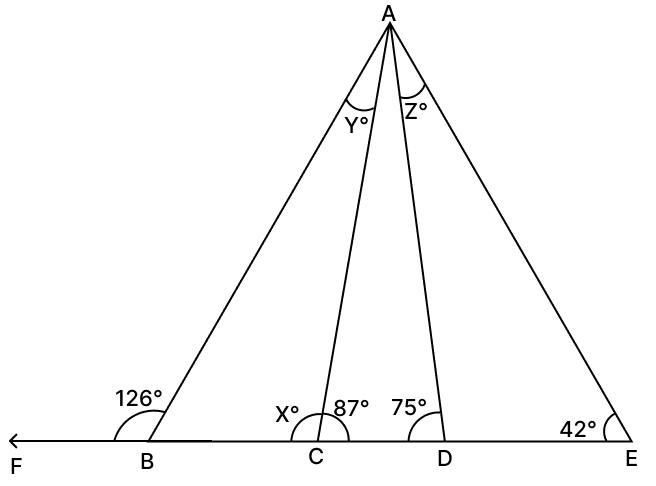
Question 14(iv)

Calculate the size of each lettered angle in the following figure:

Calculate the size of each lettered angle in the following figures: Properties of Triangles, Foundation Mathematics R.S. Aggarwal ICSE Class 7.

Answer

From the figure, we have:

Calculate the size of each lettered angle in the following figure: Properties of Triangles, Foundation Mathematics R.S. Aggarwal ICSE Class 7.

∠ACB = x°
∠ACD = 87°
∠ADC = 75°
∠AED = 42°
∠ABF = 126°
∠BAC = y°
∠EAD = z°

At vertex D:

75° = z° + ∠AED \quad[Exterior angle = sum of interior opposite angles]

⇒ 75° = z° + 42°

⇒ z° = 75° - 42°

⇒ z° = 33°

Since EF is a straight line:

∠ACB + ∠ACD = 180° \quad[Linear pair]

⇒ x° + 87° = 180°

⇒ x° = 180° - 87°

⇒ x° = 93°

At vertex B:

126° = x° + y° \quad[Exterior angle = sum of interior opposite angles]

⇒ 126° = 93° + y°

⇒ y° = 126° - 93°

⇒ y° = 33°

∴ x° = 93°, y° = 33°, z° = 33°

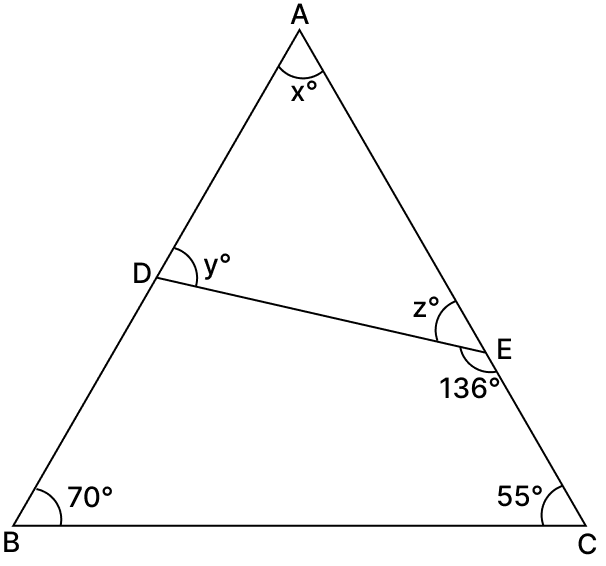
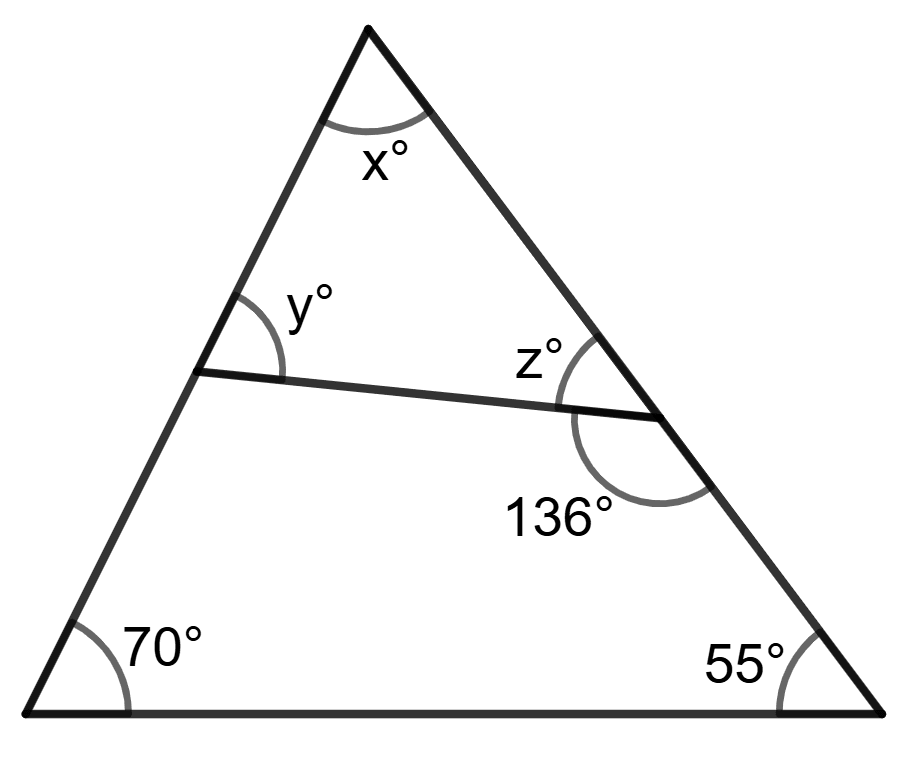
Question 14(v)

Calculate the size of each lettered angle in the following figure:

Calculate the size of each lettered angle in the following figures: Properties of Triangles, Foundation Mathematics R.S. Aggarwal ICSE Class 7.

Answer

From the figure, we have:

Calculate the size of each lettered angle in the following figure: Properties of Triangles, Foundation Mathematics R.S. Aggarwal ICSE Class 7.

∠ABC = 70°
∠ACB = 55°
∠BAC = x°
∠ADE = y°
∠AED = z°

Consider △ABC,

∠ABC + ∠BAC + ∠ACB = 180° \quad[Sum of the angles of a triangle]

∴ 70° + x° + 55° = 180°

x° + 125° = 180°

x° = 180° - 125°

x° = 55°

Now Consider △ADE,

x° + y° = 136° \quad[Exterior angle = sum of interior opposite angles]

⇒ 55° + y° = 136°

⇒ y° = 136° - 55°

⇒ y° = 81°

Since AC is a straight line:

z° + 136° = 180°

z° = 180° - 136°

z° = 44°

∴ x° = 55°, y° = 81°, z° = 44°

Question 15

Use the given figure to express:

(i) a in terms of b and f;

(ii) e in terms of f and g;

(iii) d in terms of a and e;

(iv) c in terms of e and g.
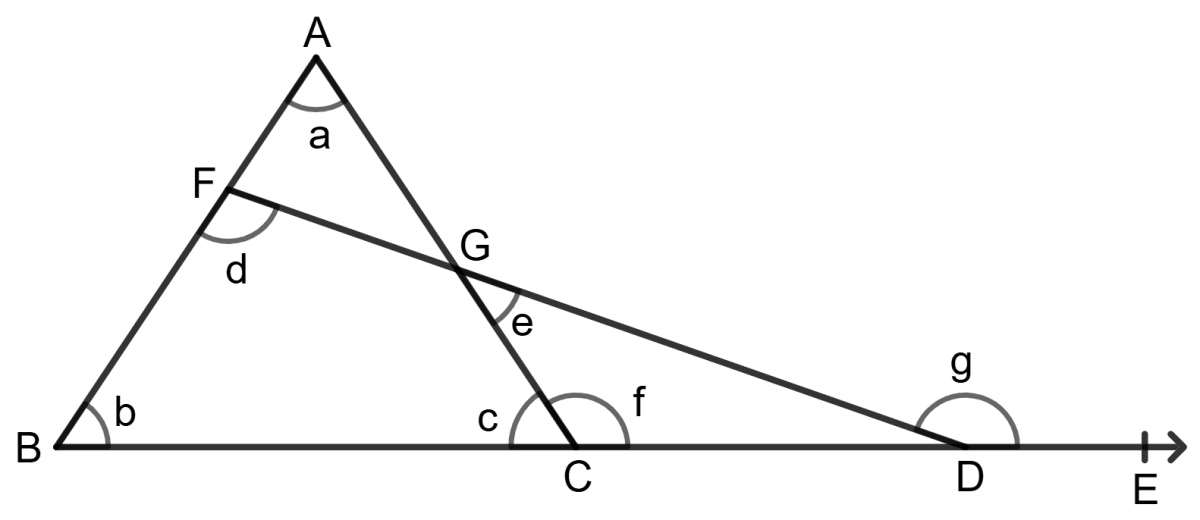
Use the given figure to express: Properties of Triangles, Foundation Mathematics R.S. Aggarwal ICSE Class 7.

Answer

(i)

Consider △ABC,

The angle f is an exterior angle at vertex C

Interior opposite angles are a and b

According to exterior angle property, an exterior angle of a triangle is equal to the sum of its interior opposite angles.

∴ a + b = f

a = f - b

(ii)

Consider △GCD,

The angle g is an exterior angle at vertex D

Interior opposite angles are e and f

According to exterior angle property, an exterior angle of a triangle is equal to the sum of its interior opposite angles.

∴ e + f = g

e = g - f

(iii)

Consider △AFG,

The angle d is an exterior angle at vertex F

Interior opposite angles are a and ∠AGF

∠AGF and e are vertically opposite angles, so ∠AGF = e.

According to exterior angle property, an exterior angle of a triangle is equal to the sum of its interior opposite angles.

∴ d = a + e

(iv)

Consider △GCD,

The angle c is an exterior angle at vertex C

The interior opposite angles are e and ∠GDC.

Since CE is a straight line:

∠GDC + ∠GDE = 180° \quad[Linear pair]

∠GDC + g = 180°

∠GDC = 180° - g

According to exterior angle property, an exterior angle of a triangle is equal to the sum of its interior opposite angles.

∴ c = e + ∠GDC

c = e + 180° - g

Question 16(i)

In the given figure, △ABC is an isosceles triangle in which AB = AC and ∠A = 50°. Find the measure of ∠B and ∠C.
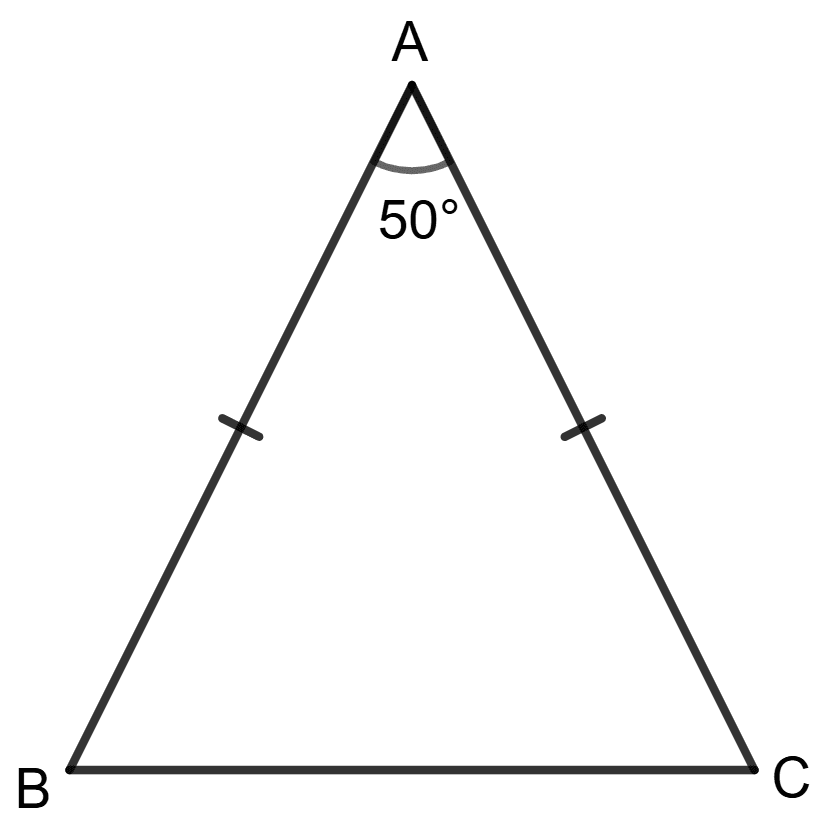
In the given figure, △ABC is an isosceles triangle in which AB = AC and ∠A = 50°. Properties of Triangles, Foundation Mathematics R.S. Aggarwal ICSE Class 7.

Answer

Given:

AB = AC

∠A = 50°

∠B = ∠C = x [∵ angles opposite to equal sides of a triangle are equal]

Consider △ABC,

∠A + ∠B + ∠C = 180° \quad[Sum of the angles of a triangle]

∴ 50° + x + x = 180°

⇒ 2x + 50° = 180°

⇒ 2x = 180° - 50°

⇒ 2x = 130°

⇒ x = 1302\dfrac{130^\circ}{2}

⇒ x = 65°

∴ ∠B = ∠C = 65°

Question 16(ii)

In the given figure, △PQR is an isosceles triangle in which PQ = PR and ∠Q = 70°. Find ∠P.
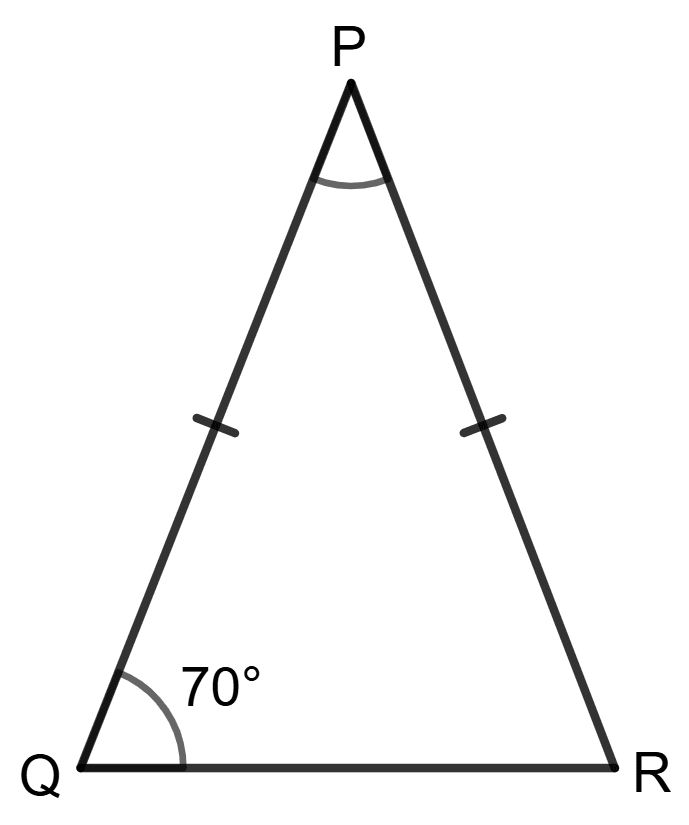
In the given figure, △PQR is an isosceles triangle in which PQ = PR and ∠Q = 70°. Find ∠P.  Properties of Triangles, Foundation Mathematics R.S. Aggarwal ICSE Class 7.

Answer

Given:

PQ = PR

∠Q = 70°

∠R = ∠Q [∵ angles opposite to equal sides of a triangle are equal]

⇒ ∠R = 70°

Consider △PQR,

∠P + ∠Q + ∠R = 180° \quad[Sum of the angles of a triangle]

∴ ∠P + 70° + 70° = 180°

⇒ ∠P + 140° = 180°

⇒ ∠P = 180° - 140°

∴ ∠P = 40°

Question 17

In the given figure, AB || CD. The line segments BC and AD intersect at O. Show that: z = x + y.
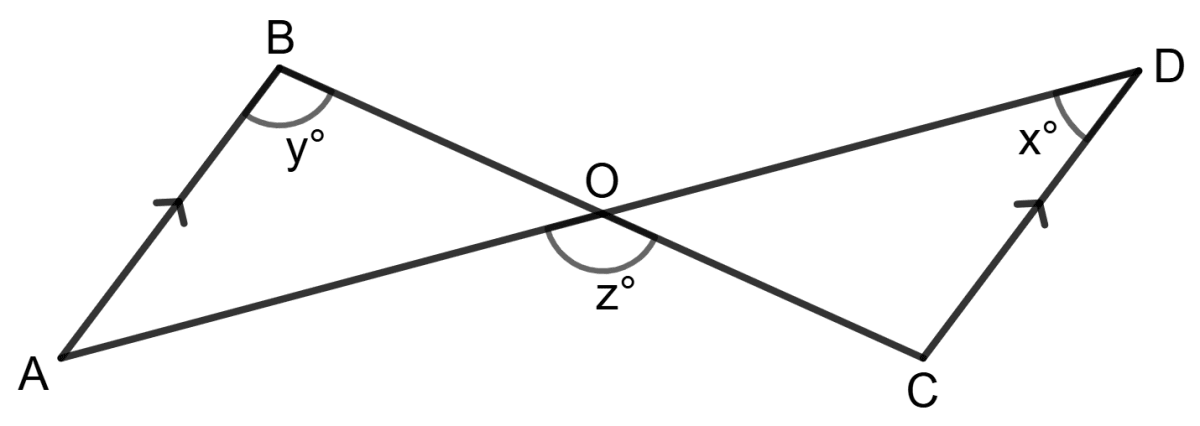
In the given figure, AB || CD. The line segments BC and AD intersect at O. Show that: z = x + y.  Properties of Triangles, Foundation Mathematics R.S. Aggarwal ICSE Class 7.

Answer

Given:

Since, AB || CD and BC is a transversal:

∠DCO = ∠ABO \quad[Interior alternate angles]

∴ ∠DCO = y°

Now, consider △OCD,

z° is an exterior angle to this triangle

∴ z° = ∠ODC + ∠DCO \quad[Exterior angle = sum of interior opposite angles]

z° = x° + y°

⇒ Hence proved

Question 18

Each base angle of an isosceles triangle is 15° more than its vertical angle. Find each angle of the triangle.

Answer

Let the measure of the vertical angle be x°.

According to the problem, each base angle is 15° more than the vertical angle.

Vertical angle = x°

First base angle = (x + 15)°

Second base angle = (x + 15)° (since base angles of an isosceles triangle are equal)
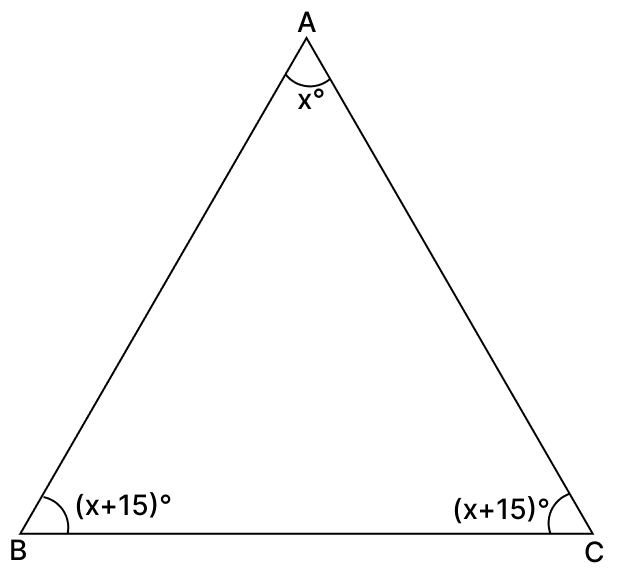
Each base angle of an isosceles triangle is 15° more than its vertical angle. Find each angle of the triangle. Properties of Triangles, Foundation Mathematics R.S. Aggarwal ICSE Class 7.

Consider △ABC,

∠A + ∠B + ∠C = 180° \quad[Sum of the angles of a triangle]

∴ x° + (x + 15)° + (x + 15)° = 180°

⇒ 3x° + 30° = 180°

⇒ 3x° = 180° - 30°

⇒ 3x° = 150°

⇒ x° = 1503\dfrac{150^\circ}{3}

⇒ x° = 50°

∠A = x° = 50°

∠B = (x + 15)° = (50 + 15)° = 65°

∠C = (x + 15)° = (50 + 15)° = 65°

∴ The angles of triangle are 50°, 65° and 65°.

Question 19

The vertical angle of an isosceles triangle is twice the sum of its base angles. Find each angle of the triangle.

Answer

In an isosceles triangle, the two base angles are equal.

Let the measure of each base angle be x.

First base angle = x

Second base angle = x

According to the problem, the vertical angle is twice the sum of its base angles:

Vertical angle = 2(x + x) = 2(2x) = 4x
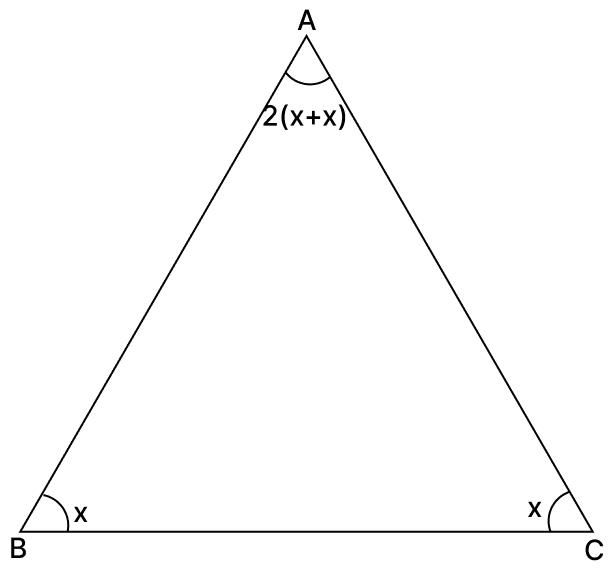
The vertical angle of an isosceles triangle is twice the sum of its base angles. Find each angle of the triangle. Properties of Triangles, Foundation Mathematics R.S. Aggarwal ICSE Class 7.

Consider △ABC,

∠A + ∠B + ∠C = 180° \quad[Sum of the angles of a triangle]

∴ 4x + x + x = 180°

⇒ 6x = 180°

⇒ x = 1806\dfrac{180^\circ}{6}

⇒ x = 30°

∠A = 4x = 4 x 30° = 120°

∠B = x = 30°

∠C = x = 30°

∴ The angles of triangle are 120°, 30° and 30°.

Question 20

In an isosceles triangle, each base angle is four times its vertical angle. Find each angle of the triangle.

Answer

Let the measure of the vertical angle be x°.

According to the problem, each base angle is four times the vertical angle.

Since base angles of an isosceles triangle are equal:

Vertical angle = x°

First base angle = 4x°

Second base angle = 4x°
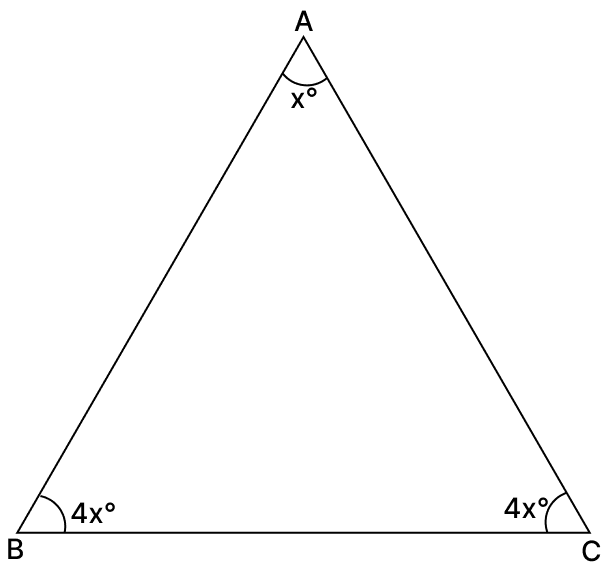
In an isosceles triangle, each base angle is four times its vertical angle. Find each angle of the triangle. Properties of Triangles, Foundation Mathematics R.S. Aggarwal ICSE Class 7.

Consider △ABC,

∠A + ∠B + ∠C = 180° \quad[Sum of the angles of a triangle]

∴ x° + 4x° + 4x° = 180°

⇒ 9x° = 180°

⇒ x° = 1809\dfrac{180^\circ}{9}

⇒ x° = 20°

∠A = x° = 20°

∠B = 4x° = 4 x 20° = 80°

∠C = 4x° = 4 x 20° = 80°

∴ The angles of the triangle are 20°, 80°, and 80°.

Question 21

The ratio between the base angle and the vertical angle of an isosceles triangle is 2 : 5. Find each angle of the triangle.

Answer

Given:

The ratio between a base angle and the vertical angle is 2 : 5.

In an isosceles triangle, the two base angles are equal.

First base angle: 2x

Second base angle: 2x

Vertical angle: 5x
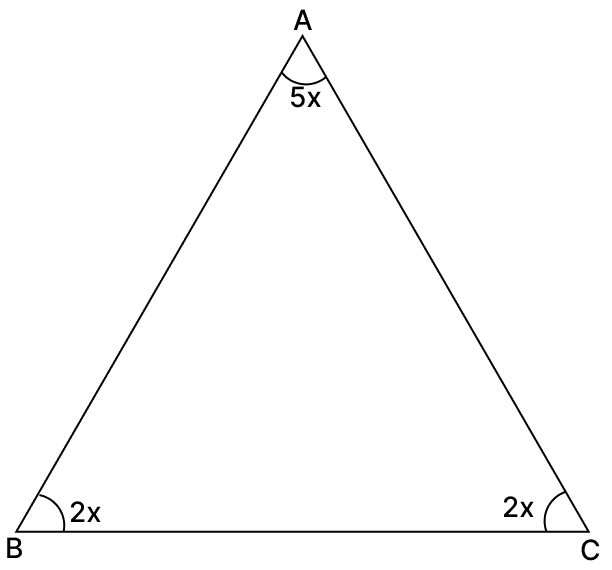
The ratio between the base angle and the vertical angle of an isosceles triangle is 2 : 5. Find each angle of the triangle. Properties of Triangles, Foundation Mathematics R.S. Aggarwal ICSE Class 7.

Consider △ABC,

∠A + ∠B + ∠C = 180° \quad[Sum of the angles of a triangle]

∴ 5x + 2x + 2x = 180°

⇒ 9x = 180°

⇒ x = 1809\dfrac{180^\circ}{9}

⇒ x = 20°

∠A = 5x = 5 x 20° = 100°

∠B = 2x = 2 x 20° = 40°

∠C = 2x = 2 x 20° = 40°

∴ The three angles of the triangle are 40°, 40°, and 100°.

Question 22

In the given figure, △ABC is an equilateral triangle whose side BC has been produced in both the directions to D and E respectively. Prove that ∠ACD = ∠ABE.
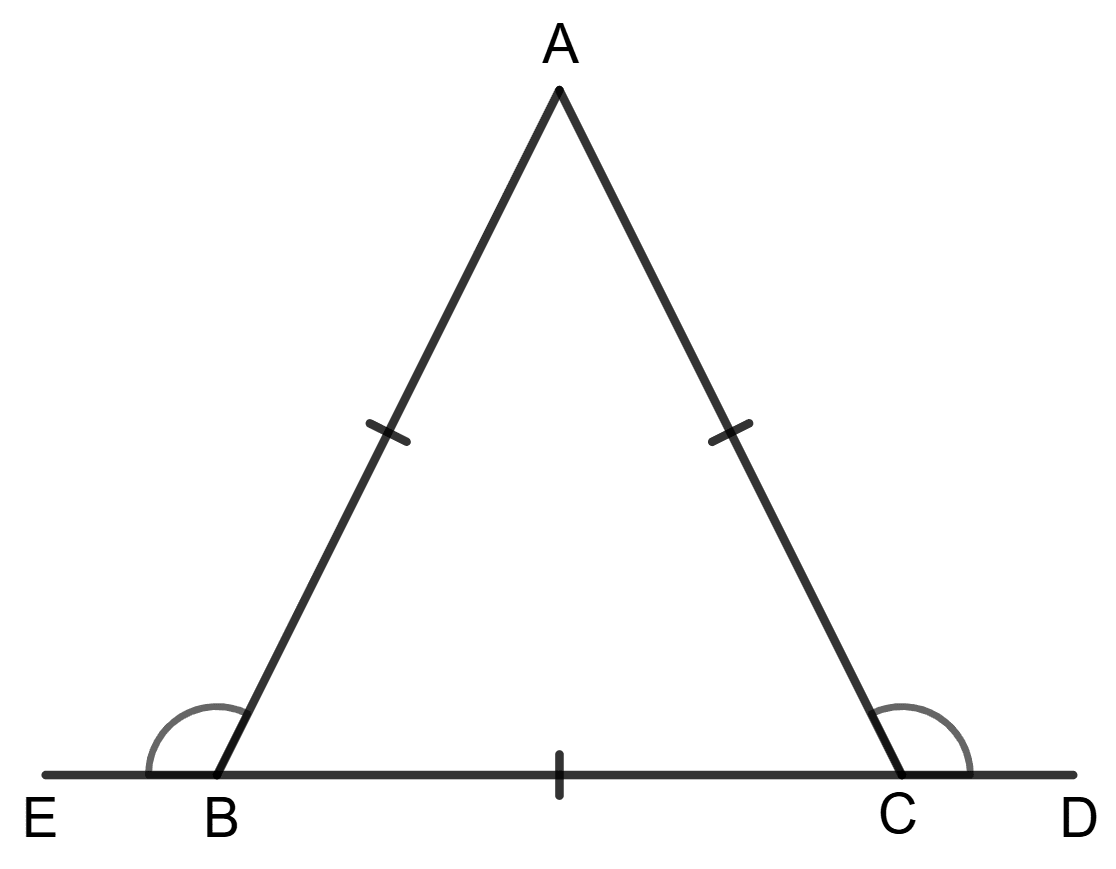
In the given figure, △ABC is an equilateral triangle whose side BC has been produced in both the directions to D and E respectively. Prove that ∠ACD = ∠ABE. Properties of Triangles, Foundation Mathematics R.S. Aggarwal ICSE Class 7.

Answer

Since △ABC is an equilateral triangle, all its interior angles are equal and each measures 60°.

∠ABC = 60°.

∠ACB = 60°.

At vertex B:

∠ABE + ∠ABC = 180° \quad[Linear pair]

⇒ ∠ABE + 60° = 180°

⇒ ∠ABE = 180° - 60°

⇒ ∠ABE = 120° .....(Equation 1)

At vertex C:

∠ACD + ∠ACB = 180° \quad[Linear pair]

⇒ ∠ACD + 60° = 180°

⇒ ∠ACD = 180° - 60°

⇒ ∠ACD = 120° .....(Equation 2)

Comparing Equation 1 and Equation 2:

∠ABE = 120°

∠ACD = 120°

∴ ∠ACD = ∠ABE

⇒ Hence proved

Question 23(i)

Find the unknown marked angles in the following figure:
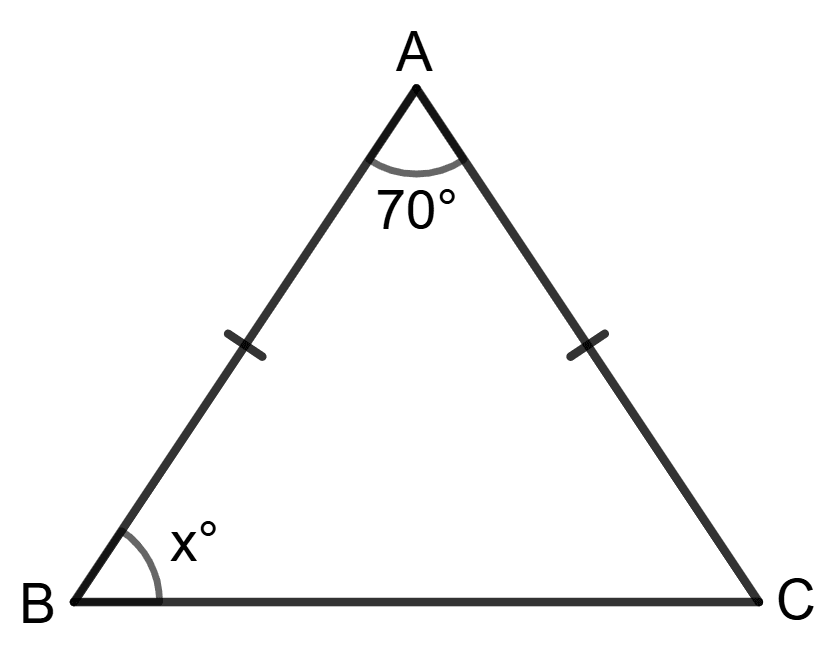
Find the unknown marked angles in each of the following figures: Properties of Triangles, Foundation Mathematics R.S. Aggarwal ICSE Class 7.

Answer

From figure, we have:

AB = AC

∠A = 70°

∠B = ∠C = x° [∵ angles opposite to equal sides of a triangle are equal]

∠A + ∠B + ∠C = 180° \quad[Sum of the angles of a triangle]

∴ 70° + x° + x° = 180°

⇒ 70° + 2x° = 180°

⇒ 2x° = 180° - 70°

⇒ 2x° = 110°

⇒ x° = 1102\dfrac{110^\circ}{2}

x° = 55°.

Question 23(ii)

Find the unknown marked angles in the following figure:
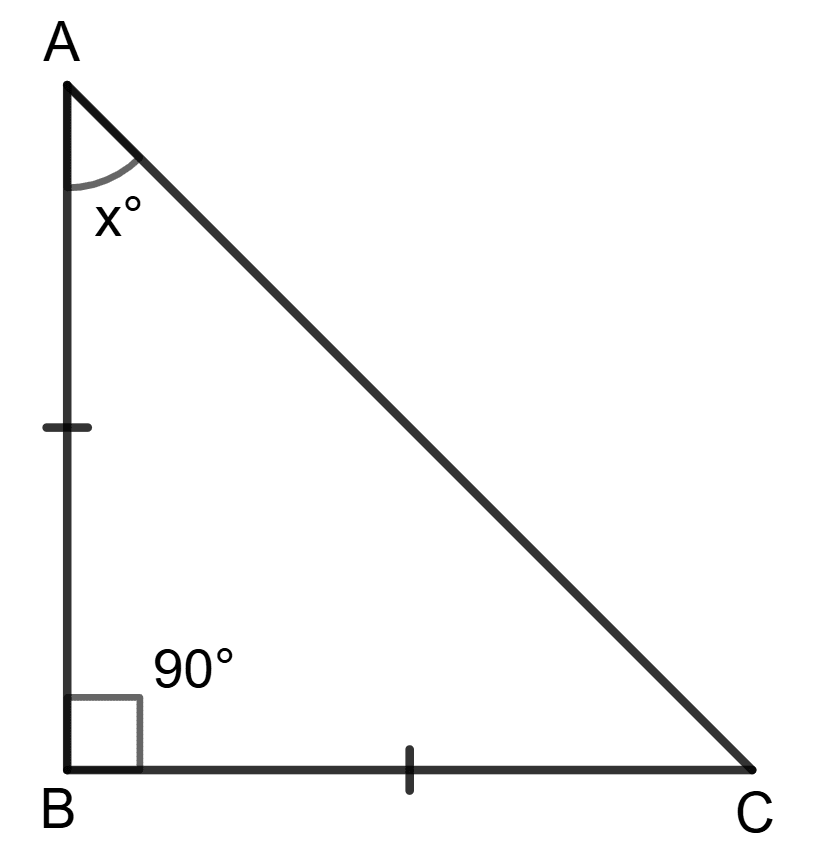
Find the unknown marked angles in each of the following figures: Properties of Triangles, Foundation Mathematics R.S. Aggarwal ICSE Class 7.

Answer

From figure, we have:

AB = BC

∠B = 90°

∠A = ∠C = x° [∵ angles opposite to equal sides of a triangle are equal]

∠A + ∠B + ∠C = 180° \quad[Sum of the angles of a triangle]

∴ x° + 90° + x° = 180°

⇒ 90° + 2x° = 180°

⇒ 2x° = 180° - 90°

⇒ 2x° = 90°

⇒ x° = 902\dfrac{90^\circ}{2}

x° = 45°.

Question 23(iii)

Find the unknown marked angles in the following figure:
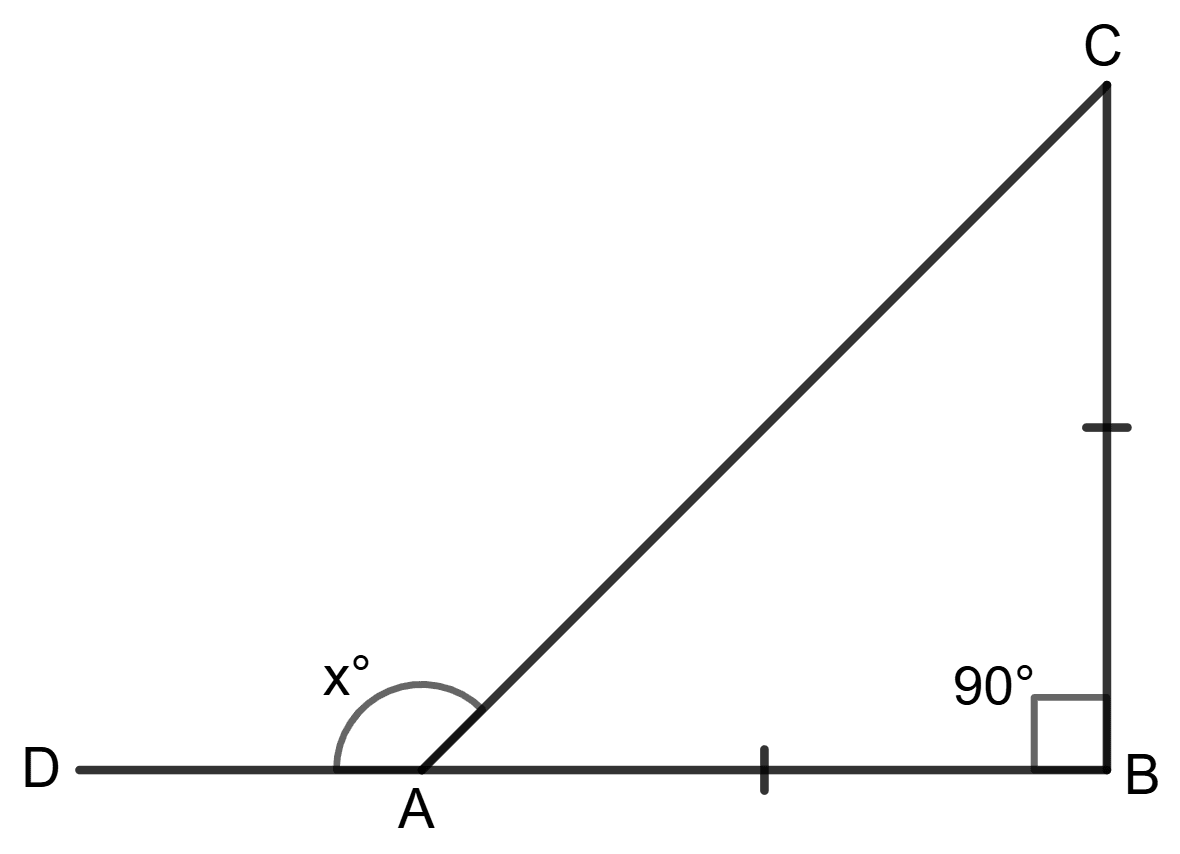
Find the unknown marked angles in each of the following figures: Properties of Triangles, Foundation Mathematics R.S. Aggarwal ICSE Class 7.

Answer

From figure, we have:

AB = BC

∠B = 90°

∠CAD = x°

∠CAB = ∠ACB [∵ angles opposite to equal sides of a triangle are equal]

∠ABC + ∠CAB + ∠ACB = 180° \quad[Sum of the angles of a triangle]

∴ 90° + ∠ACB + ∠ACB = 180° \quad[∵ ∠CAB = ∠ACB]

90° + 2∠ACB = 180°

2∠ACB = 180° - 90°

2∠ACB = 90°

∠ACB = 902\dfrac{90^\circ}{2}

∠ACB = 45°

⇒ ∠CAB = 45°

Since BD is a straight line and AC is a transversal:

∠CAD + ∠CAB = 180° \quad[Linear pair]

x° + 45° = 180°

x° = 180° - 45°

x° = 135°.

Question 23(iv)

Find the unknown marked angles in the following figure:
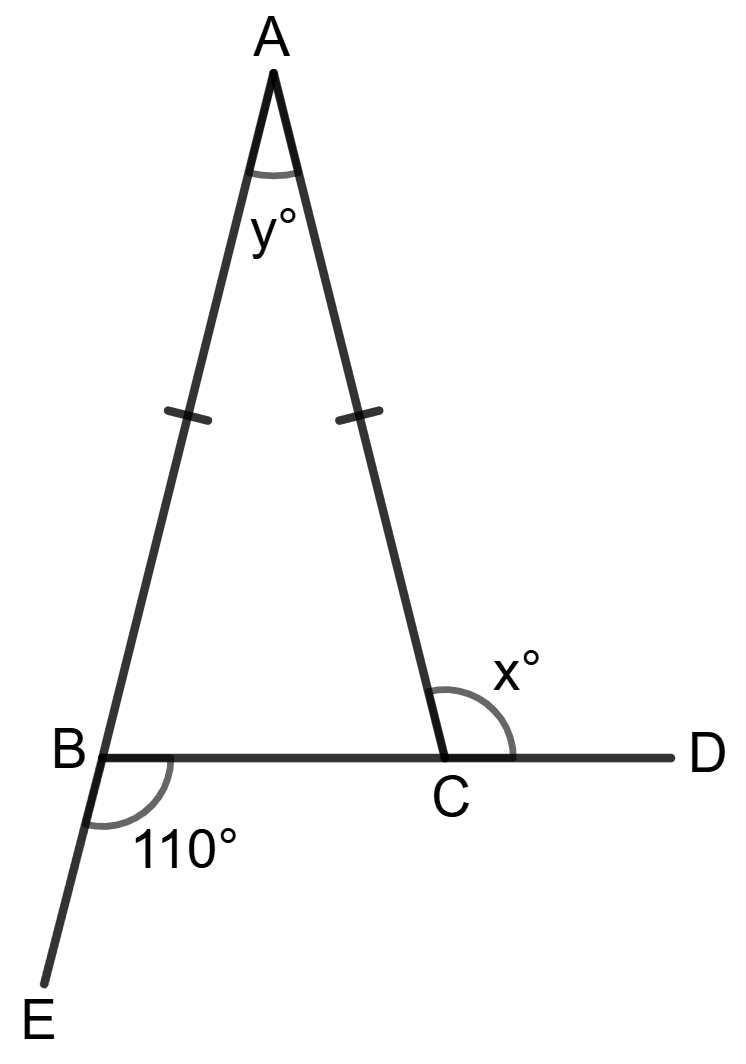
Find the unknown marked angles in each of the following figures: Properties of Triangles, Foundation Mathematics R.S. Aggarwal ICSE Class 7.

Answer

From figure, we have:

AB = BC

∠CBE = 110°

Since AE is a straight line and BD is a transversal:

∠ABC + ∠CBE = 180° \quad[Linear pair]

∠ABC + 110° = 180°

∠ABC = 180° - 110°

∠ABC = 70°

Since, AB = BC we have:

∠ACB = ∠ABC [∵ angles opposite to equal sides of a triangle are equal]

⇒ ∠ACB = 70°

In △ABC,

∠ABC + ∠CAB + ∠ACB = 180° \quad[Sum of the angles of a triangle]

∴ 70° + y° + 70° = 180°

⇒ 140° + y° = 180°

⇒ y° = 180° - 140°

⇒ y° = 40°

⇒ x° = y° + ∠ABC \quad[Exterior angle = sum of interior opposite angles]

⇒ x° = 40° + 70°

⇒ x° = 110°

x° = 110°, y° = 40°

Question 23(v)

Find the unknown marked angles in the following figure:
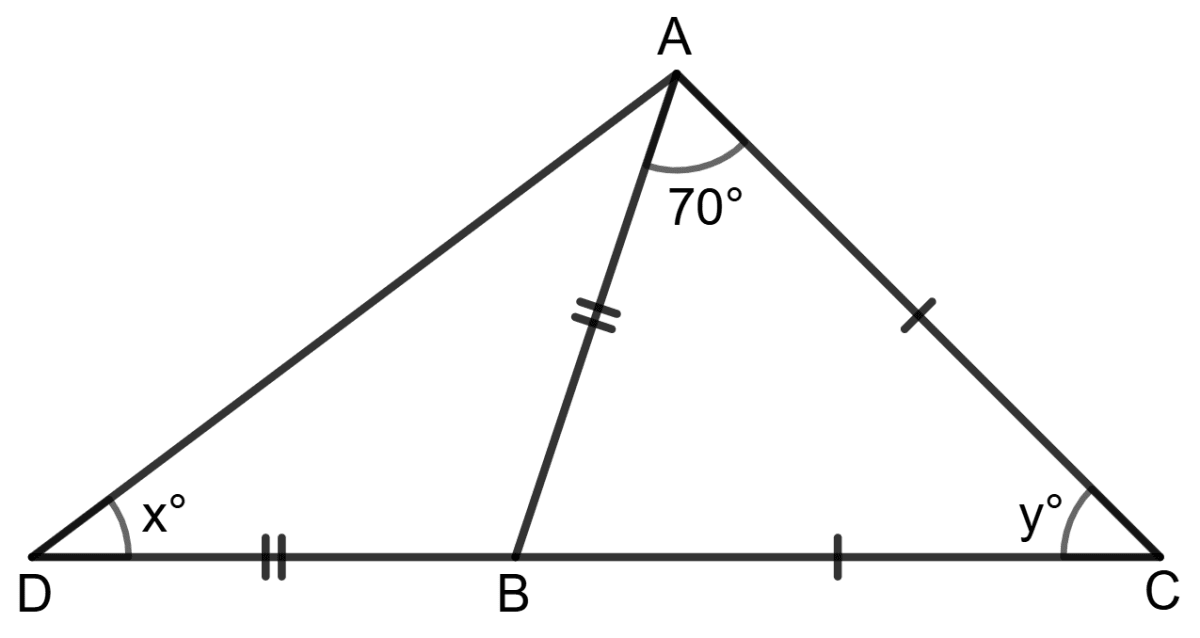
Find the unknown marked angles in each of the following figures: Properties of Triangles, Foundation Mathematics R.S. Aggarwal ICSE Class 7.

Answer

From figure,

∠CAB = 70°, ∠ACB = y° and ∠BDA = x°

Consider △ABC, we have:

AC = BC

∠ABC = ∠CAB [∵ angles opposite to equal sides of a triangle are equal]

⇒ ∠ABC = 70°

∠ABC + ∠CAB + ∠ACB = 180° \quad[Sum of the angles of a triangle]

∴ 70° + 70° + y° = 180°

⇒ 140° + y° = 180°

⇒ y° = 180° - 140°

⇒ y° = 40°

Consider △ABD, we have:

AB = BD

∠BDA = ∠BAD = x° [∵ angles opposite to equal sides of a triangle are equal]

∠BDA + ∠BAD = ∠ABC \quad[Exterior angle = sum of interior opposite angles]

⇒ x° + x° = 70°

⇒ 2x° = 70°

⇒ x° = 702\dfrac{70^\circ}{2}

⇒ x° = 35°

x° = 35°, y° = 40°

Question 23(vi)

Find the unknown marked angles in the following figure:
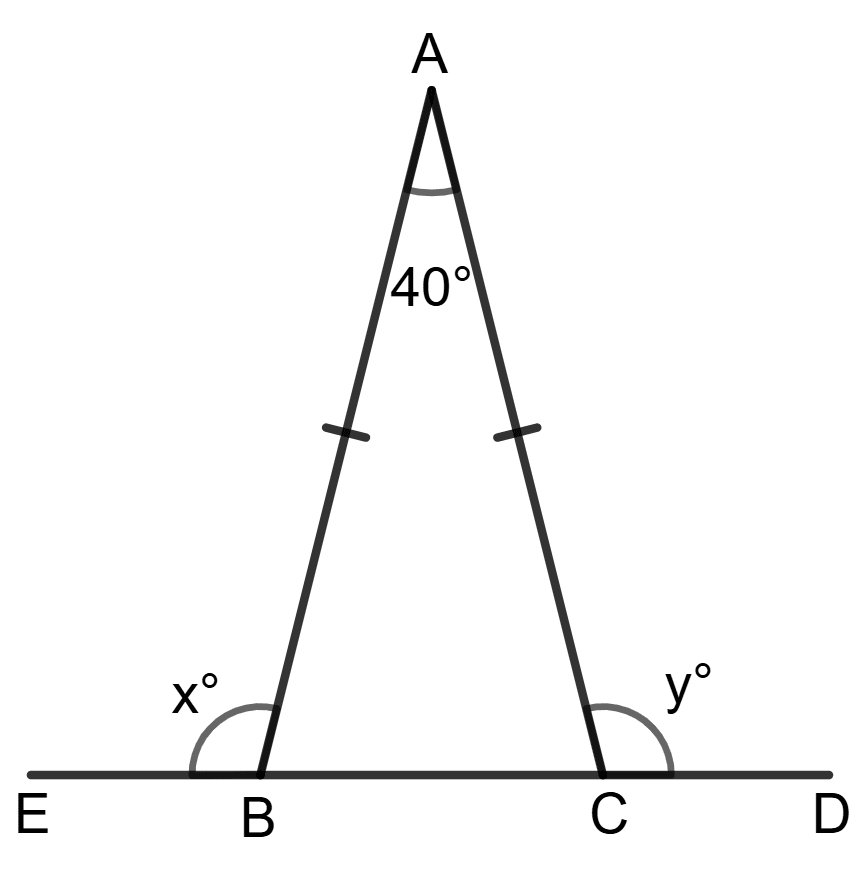
Find the unknown marked angles in each of the following figures: Properties of Triangles, Foundation Mathematics R.S. Aggarwal ICSE Class 7.

Answer

From figure, we have:

∠BAC = 40°, ∠ABE = x° and ∠ACD = y°

Consider △ABC, we have:

AB = AC

∠ABC = ∠ACB [∵ angles opposite to equal sides of a triangle are equal]

∠BAC + ∠ABC + ∠ACB = 180° \quad[Sum of the angles of a triangle]

∴ 40° + ∠ACB + ∠ACB = 180° \quad[∵ ∠ABC = ∠ACB]

40° + 2∠ACB = 180°

2∠ACB = 180° - 40°

2∠ACB = 140°

∠ACB = 1402\dfrac{140^\circ}{2}

∠ACB = 70°

⇒ ∠ABC = 70°

At vertex B,

x° = ∠ACB + ∠BAC \quad[Exterior angle = sum of interior opposite angles]

⇒ x° = 70° + 40°

⇒ x° = 110°

At vertex C:

y° = ∠BAC + ∠ABC \quad[Exterior angle = sum of interior opposite angles]

⇒ y° = 40° + 70°

⇒ y° = 110°

x° = 110°, y° = 110°

Exercise 18(B)

Question 1

In a right-angled triangle, find the length of the hypotenuse, if the other two sides measure 12 cm and 35 cm.

Answer

Given:

The other two sides of the right-angled triangle are 12 cm and 35 cm.

In a right-angled triangle, find the length of the hypotenuse, if the other two sides measure 12 cm and 35 cm. Properties of Triangles, Foundation Mathematics R.S. Aggarwal ICSE Class 7.

Let a = 12 and b = 35.

Let the hypotenuse be c.

c2 = a2 + b2 \quad[Pythagoras' theorem]

c2 = (122 + 352) cm2

c2 = (144 + 1225) cm2

c2 = 1369 cm2

c = 1369\sqrt{1369} cm

c = 37 cm

∴ The length of the hypotenuse is 37 cm.

Question 2

The length of one side of a right triangle is 24 cm and the length of its hypotenuse is 40 cm. Find the length of its third side.

Answer

Given:

The length of one side of a right triangle: a = 24 cm

The length of its hypotenuse: c = 40 cm

Let the length of its third side = b.

The length of one side of a right triangle is 24 cm and the length of its hypotenuse is 40 cm. Find the length of its third side. Properties of Triangles, Foundation Mathematics R.S. Aggarwal ICSE Class 7.

c2 = a2 + b2 \quad[Pythagoras' theorem]

⇒ b2 = c2 - a2

b2 = (402 - 242) cm2

b2 = (1600 - 576) cm2

b2 = 1024 cm2

b = 1024\sqrt{1024} cm

b = 32 cm

∴ The length of the third side is 32 cm.

Question 3

The two legs of a right triangle are equal and the square of its hypotenuse is 50 cm2. Find the length of each leg.

Answer

Given:

The two legs of a right triangle are equal: a = b

The square of its hypotenuse: c2 = 50 cm2

The two legs of a right triangle are equal and the square of its hypotenuse is 50 cm. Find the length of each leg. Properties of Triangles, Foundation Mathematics R.S. Aggarwal ICSE Class 7.

c2 = a2 + b2 \quad[Pythagoras' theorem]

50 cm2 = a2 + a2 \quad[∵ a = b]

50 cm2 = 2a2

⇒ a2 = 502\dfrac{50}{2} cm2

a2 = 25 cm2

a = 25\sqrt{25} cm

a = 5 cm

∴ The length of each leg is 5 cm.

Question 4

Given below are the lengths of the legs of right △ABC. In each case, find the length of the hypotenuse of △ABC:

(i) a = 32 cm, b = 60 cm

(ii) a = 28 m, b = 45 m

(iii) a = 32 cm, b = 24 cm

Given below are the lengths of the legs of right △ABC. In each case, find the length of the hypotenuse of △ABC: Properties of Triangles, Foundation Mathematics R.S. Aggarwal ICSE Class 7.

Answer

(i) a = 32 cm, b = 60 cm

Let the hypotenuse be c.

c2 = a2 + b2 \quad[Pythagoras' theorem]

c2 = (322 + 602) cm2

c2 = (1024 + 3600) cm2

c2 = 4624 cm2

c = 4624\sqrt{4624} cm

c = 68 cm

∴ The length of the hypotenuse is 68 cm.

(ii) a = 28 m, b = 45 m

Let the hypotenuse be c.

c2 = a2 + b2 \quad[Pythagoras' theorem]

c2 = (282 + 452) m2

c2 = (784 + 2025) m2

c2 = 2809 m2

c = 2809\sqrt{2809} m

c = 53 m

∴ The length of the hypotenuse is 53 m.

(iii) a = 32 cm, b = 24 cm

Let the hypotenuse be c.

c2 = a2 + b2 \quad[Pythagoras' theorem]

c2 = (322 + 242) cm2

c2 = (1024 + 576) cm2

c2 = 1600 cm2

c = 1600\sqrt{1600} cm

c = 40 cm

∴ The length of the hypotenuse is 40 cm.

Question 5

Given below are the lengths of the sides of △ABC. In each case, state whether △ABC is right-angled or not:

(i) AB = 40 cm, BC = 58 cm, CA = 44 cm

(ii) AB = 43 cm, BC = 35 cm, CA = 12 cm

(iii) AB = 55 cm, BC = 73 cm, CA = 48 cm

Answer

(i) AB = 40 cm, BC = 58 cm, CA = 44 cm

Hypotenuse = The longest side = BC

BC2 = AB2 + CA2

BC2 = (402 + 442) cm2

BC2 = (1600 + 1936) cm2

BC2 = 3536 cm2

But, BC2 = (58 cm)2 = 3364 cm2

Clearly, AB2 + CA2 \neq BC2

∴ △ABC is not right-angled.

(ii) AB = 43 cm, BC = 35 cm, CA = 12 cm

Hypotenuse = The longest side = AB

AB2 = BC2 + CA2

AB2 = (352 + 122) cm2

AB2 = (1225 + 144) cm2

AB2 = 1369 cm2

But, AB2 = (43 cm)2 = 1849 cm2

Clearly, BC2 + CA2 \neq AB2

∴ △ABC is not right-angled.

(iii) AB = 55 cm, BC = 73 cm, CA = 48 cm

Hypotenuse = The longest side = BC

BC2 = AB2 + CA2

BC2 = (552 + 482) cm2

BC2 = (3025 + 2304) cm2

BC2 = 5329 cm2

And, BC2 = (73 cm)2 = 5329 cm2

Clearly, BC2 = AB2 + CA2

∴ △ABC is a right-angled triangle.

Question 6

A man travels 90 km due East and then 56 km due South. How far is he from the starting point?

Answer

Given:

A man travels 90 km due East and then 56 km due South.

Let O be the starting point of the man.

He moves from O to A due East such that OA = 90 km.

Then, he moves from A to B due South such that AB = 56 km.

Then, B is his final position. Join OB.

A man travels 90 km due East and then 56 km due South. How far is he from the starting point Properties of Triangles, Foundation Mathematics R.S. Aggarwal ICSE Class 7.

Now, in right △OAB, by Pythagoras Theorem, we have:

OB2 = OA2 + AB2

OB2 = (902 + 562) km2

OB2 = (8100 + 3136) km2

OB2 = 11236 km2

OB = 11236\sqrt{11236} km

OB = 106 km

∴ Distance of the man from the starting point = 106 km.

Question 7

A long pole is made to stand against a wall in such a way that its foot is 16 m from the wall and its top reaches a window 12 m above the ground. Find the length of the pole.

Answer

Given:

Distance of the foot of the pole from the wall (base): BC = 16 m

Height of the window from the ground (height): AB = 12 m

A long pole is made to stand against a wall in such a way that its foot is 16 m from the wall and its top reaches a window 12 m above the ground. Find the length of the pole. Properties of Triangles, Foundation Mathematics R.S. Aggarwal ICSE Class 7.

BC is the distance of the foot of the pole from the wall.

AB is the height of the window from the ground.

Let AC be the length of the pole.

Since the wall stands vertically to the ground, △ABC is a right-angled triangle with the right angle at B.

By Pythagoras Theorem, we have:

AC2 = AB2 + BC2

AC2 = (122 + 162) m2

AC2 = (144 + 256) m2

AC2 = 400 m2

AC = 400\sqrt{400} m

AC = 20 m

∴ The length of the pole is 20 m.

Question 8

Find the length of the diagonal of a rectangle whose sides are 21 cm and 20 cm.

Answer

Given:

The sides of the rectangle are 21 cm and 20 cm.

Let ABCD be the rectangle where AB = 21 cm and BC = 20 cm.

Let AC be the diagonal.

Since every interior angle of a rectangle is a right angle (90°), △ABC is a right-angled triangle with the right angle at B. The diagonal AC acts as the hypotenuse.

Find the length of the diagonal of a rectangle whose sides are 21 cm and 20 cm. Properties of Triangles, Foundation Mathematics R.S. Aggarwal ICSE Class 7.

By Pythagoras Theorem, we have:

AC2 = AB2 + BC2

AC2 = (212 + 202) cm2

AC2 = (441 + 400) cm2

AC2 = 841 cm2

AC = 841\sqrt{841} cm

AC = 29 cm

∴ The length of the diagonal of the rectangle is 29 cm.

Question 9

Fill in the blanks:

(i) In a right triangle, the square of the hypotenuse is equal to the ............... of the squares of the other two sides.

(ii) If the square of one side of a triangle is equal to the sum of the squares of the other two sides, then the triangle is ............... .

(iii) Of all the line segments that can be drawn to a given line from a given point outside it, the ............... is the shortest.

Answer

(i) In a right triangle, the square of the hypotenuse is equal to the sum of the squares of the other two sides.

(ii) If the square of one side of a triangle is equal to the sum of the squares of the other two sides, then the triangle is right-angled.

(iii) Of all the line segments that can be drawn to a given line from a given point outside it, the perpendicular is the shortest.

Question 10

State Pythagoras' Theorem.

Answer

Pythagoras' Theorem states that:

In a right-angled triangle, the square of the length of the hypotenuse is equal to the sum of the squares of the lengths of the other two sides.

Exercise 18(C) - Multiple Choice Questions

Question 1

In a △ABC, if ∠A = 15° and ∠B = 55°, then ∠C is equal to

  1. 85°
  2. 95°
  3. 105°
  4. 110°

Answer

Given:

∠A = 15° and ∠B = 55°

∠A + ∠B + ∠C = 180° \quad[Sum of the angles of a triangle]

15° + 55° + ∠C = 180°

70° + ∠C = 180°

∠C = 180° - 70°

∠C = 110°

Hence, option 4 is the correct option.

Question 2

Two angles of a triangle are equal and the third angle is three times each equal angle. The largest angle of the triangle measures

  1. 104°
  2. 108°
  3. 112°
  4. 124°

Answer

Given:

Two angles of a triangle are equal.

Third angle is three times each equal angle.

Let each equal angle be x.

The third (largest) angle = 3x.

x + x + 3x = 180° \quad[Sum of the angles of a triangle]

5x = 180°

x = 1805\dfrac{180^\circ}{5}

x = 36°

Largest angle = 3x = 3 x 36° = 108°

Hence, option 2 is the correct option.

Question 3

Which of the following cannot be the angles of a triangle?

  1. 56°, 64°, 60°
  2. 42°, 67°, 81°
  3. 45°, 70°, 65°
  4. 63°, 35°, 82°

Answer

For three angles to form a triangle, their sum must be exactly 180°.

Let's check the options:

  1. 56° + 64° + 60° = 180°

  2. 42° + 67° + 81° = 190°

  3. 45° + 70° + 65° = 180°

  4. 63° + 35° + 82° = 180°

The angles in option 2 cannot be the angles of a triangle, because it sums up to 190°.

Hence, option 2 is the correct option.

Question 4

An exterior angle of a triangle is 136°. If one of the two interior opposite angles is 69°, then the other interior opposite angle is

  1. 67°
  2. 75°
  3. 81°
  4. 99°

Answer

Given:

Exterior angle = 136°

One interior angle = 69°

Let the other interior angle be x.

x + 69° = 136° \quad[Exterior angle = sum of interior opposite angles]

x = 136° - 69°

x = 67°

The other interior angle of a triangle is 67°.

Hence, option 1 is the correct option.

Question 5

A triangle can have two

  1. straight angles
  2. obtuse angles
  3. right angles
  4. acute angles

Answer

A triangle cannot have two straight angles (180° each), as the total would exceed 180°.

A triangle cannot have two obtuse angles (> 90° each) or two right angles (90° each) because the sum of just those two would be ≥ 180°, leaving no room for the third angle.

Every triangle must have at least two acute angles (< 90°).

Hence, option 4 is the correct option.

Question 6

Find the value of x in the given figure.

  1. 25°
  2. 30°
  3. 35°
  4. 45°
Find the value of x in the given figure. Properties of Triangles, Foundation Mathematics R.S. Aggarwal ICSE Class 7.

Answer

From figure, we have:

Exterior angle: ∠ACD = 105°

Interior angles: ∠BAC = 2x and ∠ABC = x

∠ABC + ∠BAC = ∠ACD \quad[Exterior angle = sum of interior opposite angles]

x + 2x = 105°

3x = 105°

x = 1053\dfrac{105^\circ}{3}

x = 35°

Hence, option 3 is the correct option.

Question 7

In the given figure, find the value of x.

  1. 7
  2. 9
  3. 11
  4. 13
In the given figure, find the value of x. Properties of Triangles, Foundation Mathematics R.S. Aggarwal ICSE Class 7.

Answer

From figure, we have:

Exterior angle: ∠QRS = 111°

Interior angles: ∠PQR = (7x - 3°) and ∠QPR = (4x - 7°)

∠PQR + ∠QPR = ∠QRS \quad[Exterior angle = sum of interior opposite angles]

(7x - 3°) + (4x - 7°) = 111°

11x - 10° = 111°

11x = 111° + 10°

11x = 121°

x = 12111\dfrac{121^\circ}{11}

x = 11°

Hence, option 3 is the correct option.

Question 8

Which of the following cannot be the sides of a right-angled triangle?

  1. 5 cm, 4 cm, 3 cm
  2. 12 cm, 5 cm, 13 cm
  3. 15 cm, 21 cm, 27 cm
  4. 37 cm, 35 cm, 12 cm

Answer

To be a right-angled triangle, the sides must satisfy the Pythagoras Theorem (a2 + b2 = c2), where c is the longest side.

Let's check the options:

  1. 42 + 32 = (16 + 9) = 25 and 52 = 25

  2. 122 + 52 = (144 + 25) = 169 and 132 = 169

  3. 152 + 212 = (225 + 441) = 666 and 272 = 729

  4. 352 + 122 = (1225 + 144) = 1369 and 372 = 1369

The sides in option 3 cannot be the sides of a right-angled triangle. Because, it does not satisfy a2 + b2 = c2.

Hence, option 3 is the correct option.

Question 9

A 15 m long ladder is rested against a wall such that the foot of the ladder is 12 m away from the wall. How up on the wall is the upper end of the ladder?

  1. 6 m
  2. 8 m
  3. 9 m
  4. 10 m

Answer

Hypotenuse (Ladder) = 15 m

Base (Distance from wall) = 12 m

Height (Wall) = h

Using Pythagoras Theorem:

h2 + 122 = 152

h2 + 144 = 225

h2 = 225 - 144

h2 = 81

h = 81\sqrt{81}

h = 9 m

Hence, option 3 is the correct option.

Question 10

The measure of one of the equal angles of an isosceles right-angled triangle is

  1. 30°
  2. 45°
  3. 60°
  4. 75°

Answer

In an isosceles right-angled triangle:

One angle is 90°.

The other two angles are equal. Let each be x.

x + x + 90° = 180° \quad[Sum of the angles of a triangle]

2x + 90° = 180°

2x = 180° - 90°

2x = 90°

x = 902\dfrac{90^\circ}{2}

x = 45°

Hence, option 2 is the correct option.

Exercise 18(C) - Mental Maths

Question 1

Fill in the blanks:

(i) In a scalene triangle the measures of all the three angles are ............... .

(ii) The longest side of a right-angled triangle is ............... .

(iii) If two angles of a triangle are 36° and 63°, then the third angle is ............... .

(iv) The sum of the two acute angles in a right-angled triangle is ............... .

(v) If the square of one side of a triangle is equal to the sum of the squares of the other two sides, then the triangle is ............... .

Answer

(i) In a scalene triangle the measures of all the three angles are different.

(ii) The longest side of a right-angled triangle is hypotenuse.

(iii) If two angles of a triangle are 36° and 63°, then the third angle is 81°.

(iv) The sum of the two acute angles in a right-angled triangle is 90°.

(v) If the square of one side of a triangle is equal to the sum of the squares of the other two sides, then the triangle is right-angled.

Explanation

(iii)

Given:

Two angles of a triangle are 36° and 63°.

Let the third angle be x.

36° + 63° + x = 180° \quad[Angle sum property]

99° + x = 180°

x = 180° - 99°

x = 81°

(iv)

Since a right-angled triangle already has one 90° angle, the remaining two angles must add up to 90° to reach the 180° total.

Question 2

Write true (T) or false (F):

(i) A triangle can have at most two angles greater than 90°.

(ii) A triangle can have all the three angles less than 60°

(iii) In a right triangle ABC, if AC2 + AB2 = BC2, then the right angle is ∠B.

(iv) A triangle having two of its angles measuring 30° and 70° is scalene.

(v) The sum of two acute angles of a right-angled triangle is 45°.

Answer

(i) False
Reason — A triangle can have at most one angle greater than 90°. If it had two obtuse angles (e.g., 91° and 91°), their sum alone would be 182°, which exceeds the Angle Sum Property limit of 180° for a triangle.

(ii) False
Reason — If all three angles were less than 60° (e.g., 59° each), their sum would be less than 177°. For a triangle to exist, the sum must be exactly 180°. In an acute triangle, at least one angle must be 60° or greater.

(iii) False
Reason — According to Pythagoras' Theorem, the side that is by itself in the equation (BC2BC^2) is the hypotenuse. The right angle is always opposite the hypotenuse. Since the hypotenuse is BC, the vertex opposite to it is A. Therefore, the right angle is ∠A.

(iv) True
Reason —

Given:

The two angles of triangle are 30° and 70°.

Let the third angle be x.

30° + 70° + x = 180° \quad[Angle sum property]

100° + x = 180°

x = 180° - 100°

x = 80°

Since all three angles (30°, 70° and 80°) are different, all three sides must also be different lengths. A triangle with no equal sides is a scalene triangle.

(v) False
Reason — In a right-angled triangle, one angle is 90°.
Because the total sum is 180°, the other two acute angles must add up to 90° (180° - 90° = 90°). These two angles are complementary, not 45° unless the triangle is also isosceles.

Exercise 18(C) - Assertions and Reasons

Question 1

Assertion: If one angle of a triangle is equal to the sum of other two, then the triangle is a right-angled triangle.

Reason: Sum of the angles of a triangle is 180°.

  1. Both Assertion (A) and Reason (R) are true and Reason (R) is the correct explanation of Assertion (A).
  2. Both Assertion (A) and Reason (R) are true and Reason (R) is not the correct explanation of Assertion (A).
  3. Assertion (A) is true but Reason (R) is false.
  4. Assertion (A) is false but Reason (R) is true.

Answer

Both Assertion (A) and Reason (R) are true and Reason (R) is the correct explanation of Assertion (A).

Explanation

Given:

Let the angles be x, y and z.

According to the given statement, One angle is equal to the sum of other two.

∴ x = y + z

We know that,

x + y + z = 180° \quad[Angle sum property]

x + x = 180° \quad[∵ x = y + z]

2x = 180°

x = 1802\dfrac{180^\circ}{2}

x = 90°

So, it is a right-angled triangle.

The statement in reason is correct according to angle sum property.

Both statements are true, and the Reason explains why the Assertion is true.

Hence, option 1 is the correct option.

Question 2

Assertion: In the figure, AB2 + AC2 = BC2, then ∠A is an obtuse angle.

In the figure, AB2 + AC2 = BC2, then ∠A is an obtuse angle. Properties of Triangles, Foundation Mathematics R.S. Aggarwal ICSE Class 7.

Reason: In a right triangle, the square of the hypotenuse equals the sum of the squares of its remaining two sides.

  1. Both Assertion (A) and Reason (R) are true and Reason (R) is the correct explanation of Assertion (A).
  2. Both Assertion (A) and Reason (R) are true and Reason (R) is not the correct explanation of Assertion (A).
  3. Assertion (A) is true but Reason (R) is false.
  4. Assertion (A) is false but Reason (R) is true.

Answer

Assertion (A) is false but Reason (R) is true.

Explanation

The equation AB2 + AC2 = BC2 is the Pythagoras Theorem. According to this theorem, the angle opposite to the longest side (BC) must be exactly 90° (a right angle), not an obtuse angle. Therefore, the Assertion is false.

The Reason is a correct statement of the Pythagoras theorem.

Hence, option 4 is the correct option.

Question 3

Assertion: In the figure, AB || DC and ∠ABC = 30°. The sum of measures of x, y and z is 180°.

Reason: When a side of a triangle is produced, then the exterior angle so formed is equal to sum of its any two interior angles.

When a side of a triangle is produced, then the exterior angle so formed is equal to sum of its any two interior angles. Properties of Triangles, Foundation Mathematics R.S. Aggarwal ICSE Class 7.
  1. Both Assertion (A) and Reason (R) are true and Reason (R) is the correct explanation of Assertion (A).
  2. Both Assertion (A) and Reason (R) are true and Reason (R) is not the correct explanation of Assertion (A).
  3. Assertion (A) is true but Reason (R) is false.
  4. Assertion (A) is false but Reason (R) is true.

Answer

Assertion (A) is true but Reason (R) is false.

Explanation

In △ABC, x + 30° + y = 180° \quad[Angle sum property]

Since AB || DC,

z = ∠ABC \quad[Corresponding angles]

z = 30°

Again, x + y + z = 180°. So, the Assertion is true.

The exterior angle property states an exterior angle is equal to the sum of its two interior opposite angles. The phrase "any two interior angles" is mathematically incorrect.

Thus, the Reason is false.

Hence, option 3 is the correct option.

PrevNext