KnowledgeBoat Logo
|
OPEN IN APP

Chapter 17

Lines and Angles

Class - 7 RS Aggarwal Mathematics Solutions


Exercise 17(A)

Question 1

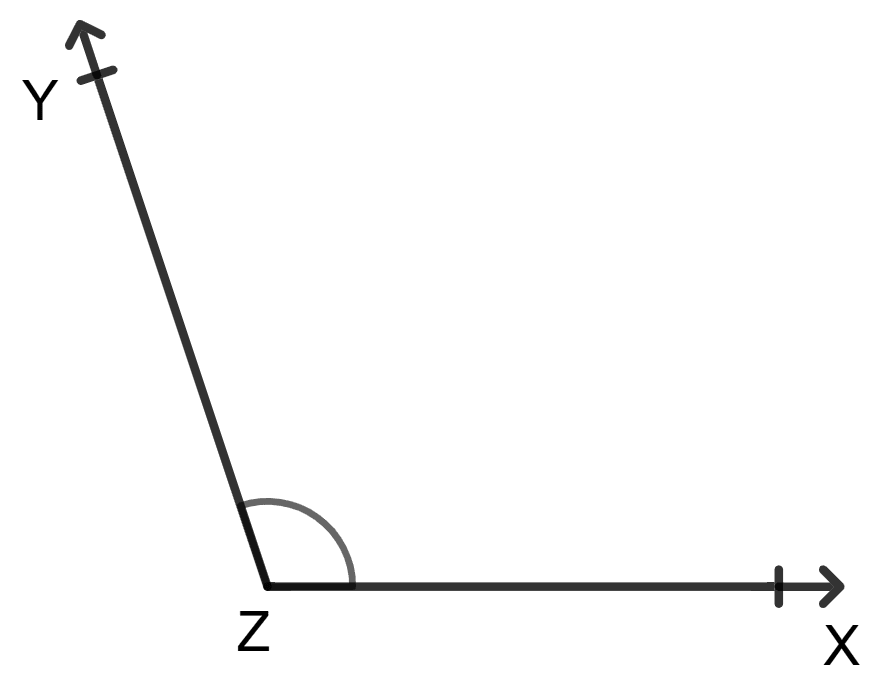
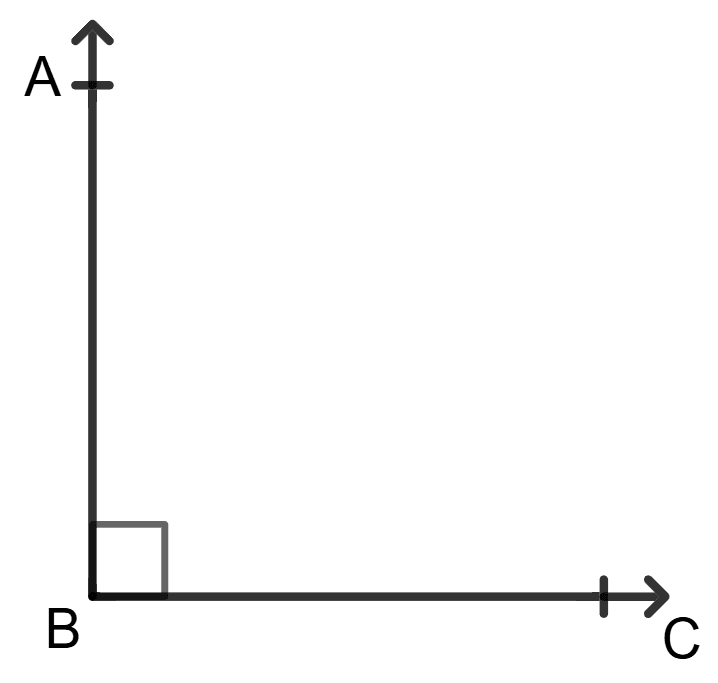
Name each of the following angles :

(i)
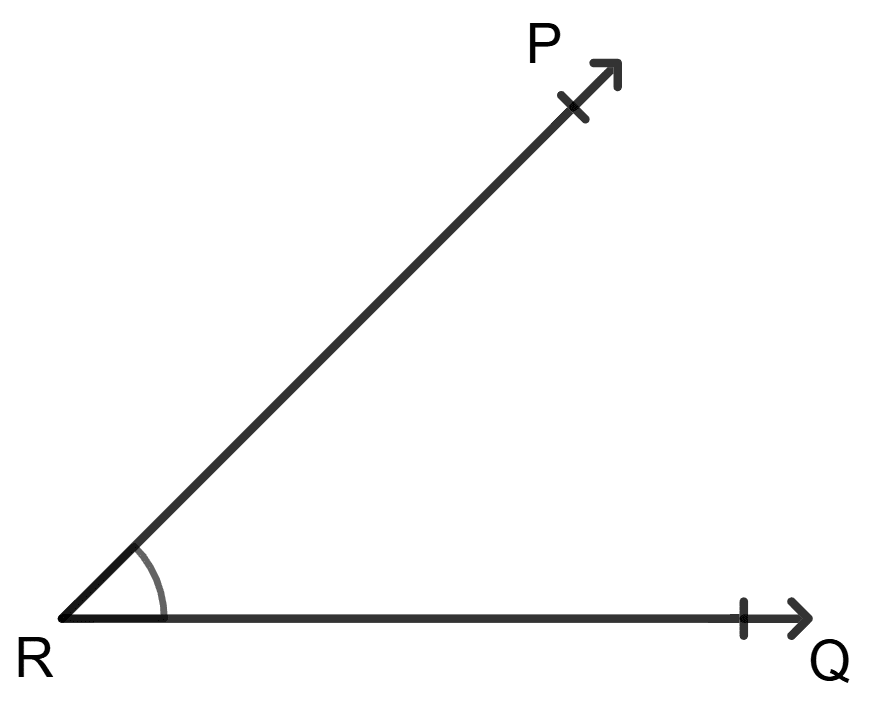
Name each of the following angles : Lines and Angles, Foundation Mathematics R.S. Aggarwal ICSE Class 7.

(ii)

Name each of the following angles : Lines and Angles, Foundation Mathematics R.S. Aggarwal ICSE Class 7.

(iii)

Name each of the following angles : Lines and Angles, Foundation Mathematics R.S. Aggarwal ICSE Class 7.

Answer

(i) The vertex is R, so the angle is named with R in the middle.

∠PRQ

(ii) The vertex is Z, so the angle is named with Z in the middle.

∠YZX

(iii) The vertex is B, so the angle is named with B in the middle.

∠ABC

Question 2

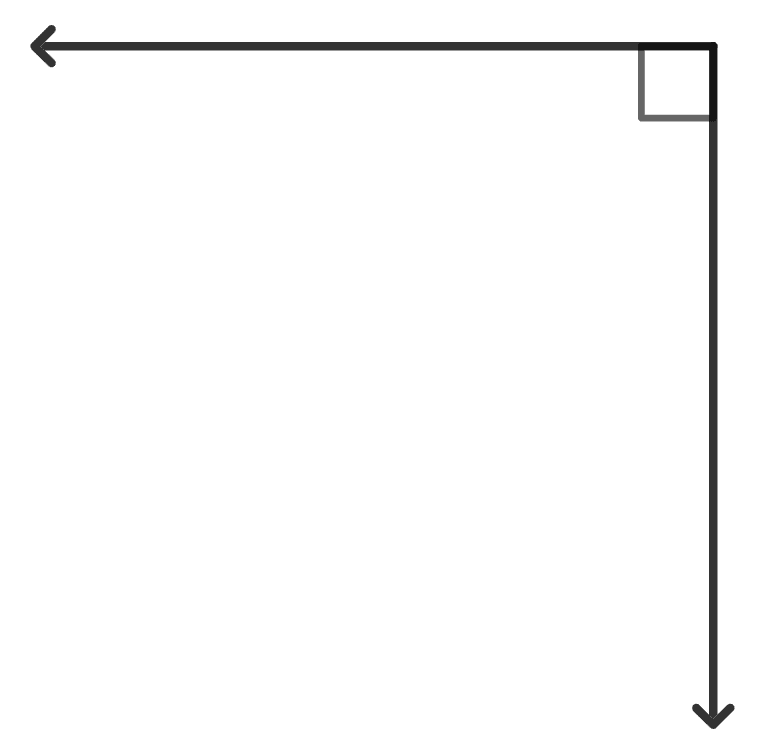
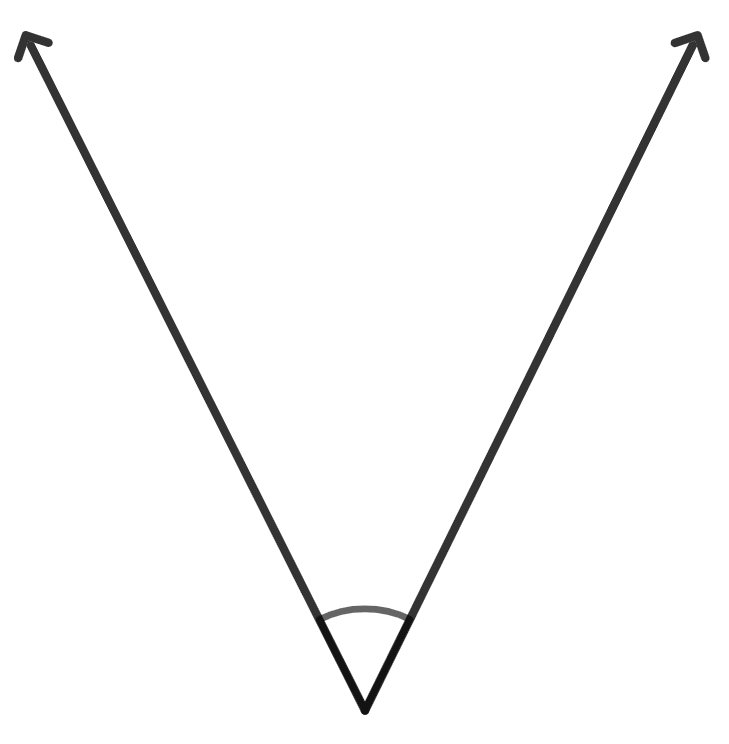
Classify each of the following marked angles as acute, right, obtuse, straight or a reflex angle :

(i)
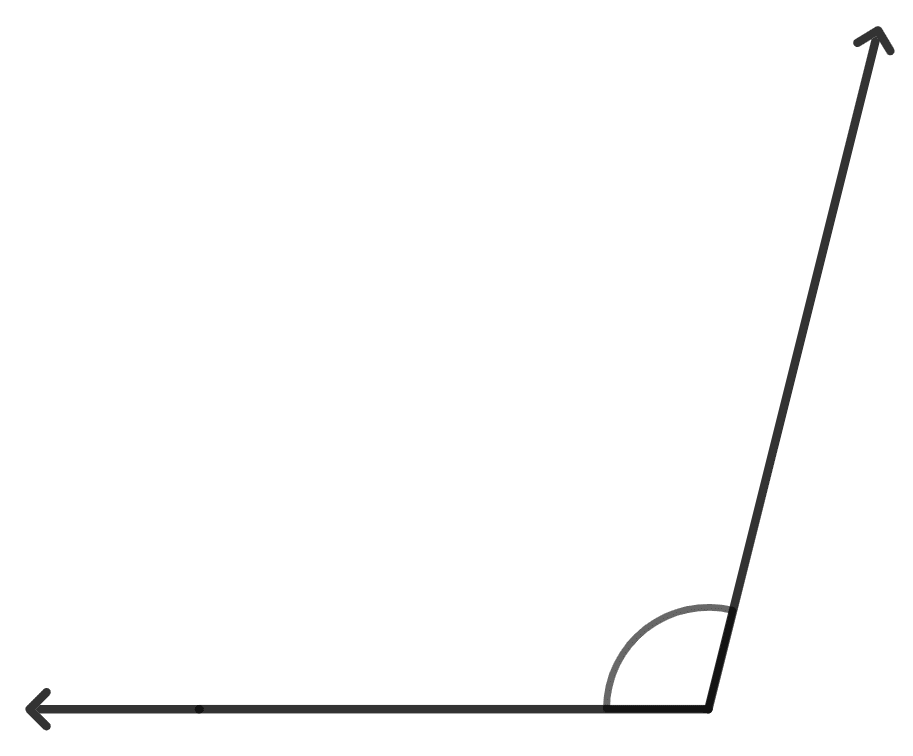
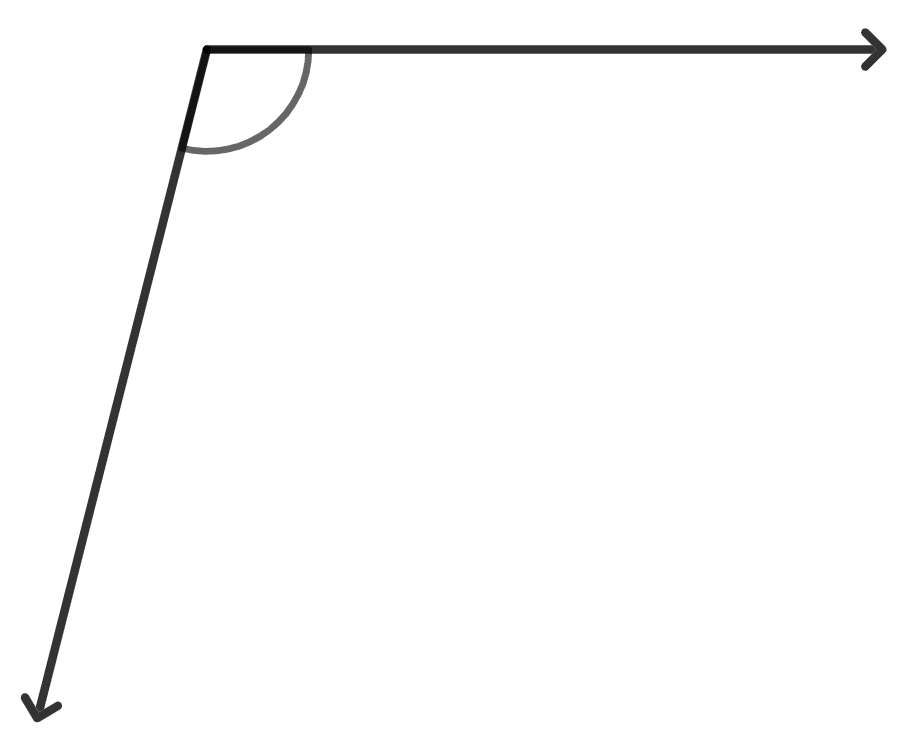
Classify each of the following marked angles as acute, right, obtuse, straight or a reflex angle : Lines and Angles, Foundation Mathematics R.S. Aggarwal ICSE Class 7.

(ii)

Classify each of the following marked angles as acute, right, obtuse, straight or a reflex angle : Lines and Angles, Foundation Mathematics R.S. Aggarwal ICSE Class 7.

(iii)

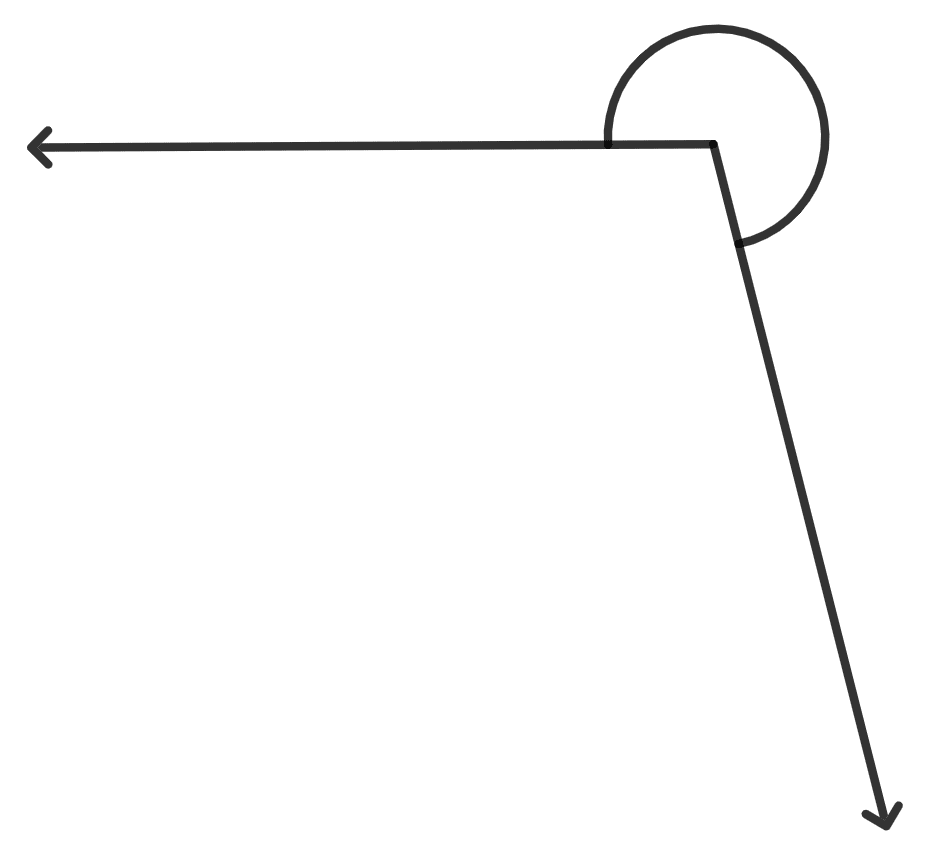
Classify each of the following marked angles as acute, right, obtuse, straight or a reflex angle : Lines and Angles, Foundation Mathematics R.S. Aggarwal ICSE Class 7.

(iv)

Classify each of the following marked angles as acute, right, obtuse, straight or a reflex angle : Lines and Angles, Foundation Mathematics R.S. Aggarwal ICSE Class 7.

(v)

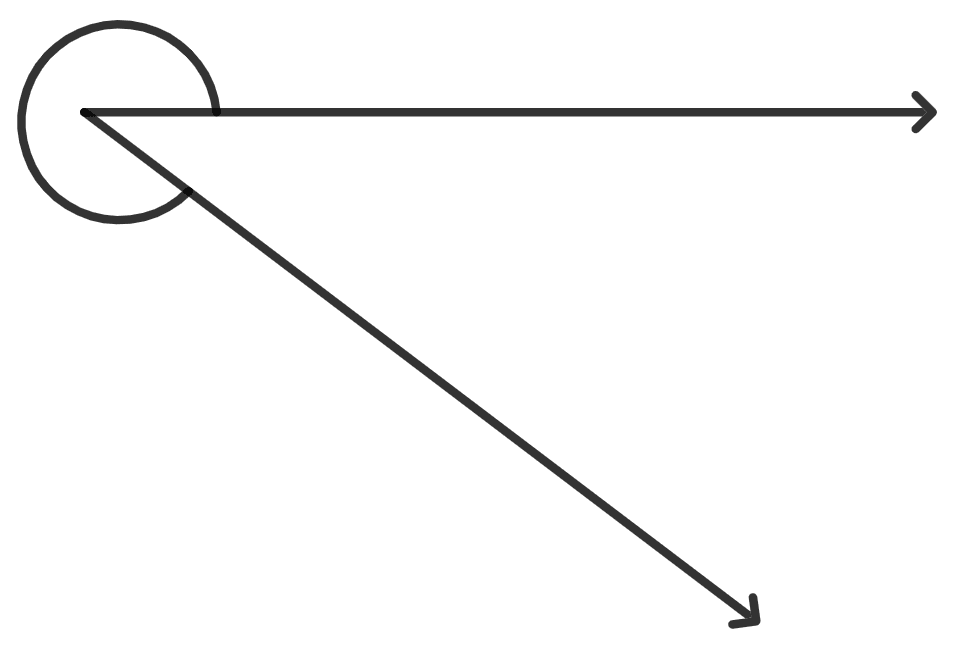
Classify each of the following marked angles as acute, right, obtuse, straight or a reflex angle : Lines and Angles, Foundation Mathematics R.S. Aggarwal ICSE Class 7.

(vi)

Classify each of the following marked angles as acute, right, obtuse, straight or a reflex angle : Lines and Angles, Foundation Mathematics R.S. Aggarwal ICSE Class 7.

Answer

(i) The angle is greater than 90° but less than 180°.

∴ It is an obtuse angle.

(ii) The angle is exactly 90°.

∴ It is a right angle.

(iii) The angle is less than 90°.

∴ It is an acute angle.

(iv) The angle is greater than 180° but less than 360°.

∴ It is a reflex angle.

(v) The angle is greater than 90° but less than 180°.

∴ It is an obtuse angle.

(vi) The angle is greater than 180° but less than 360°.

∴ It is a reflex angle.

Question 3

Classify each of the following as acute, obtuse or a reflex angle :

(i) 103°

(ii) 88°

(iii) 10°

(iv) 200°

(v) 89.5°

(vi) 105°

(vii) 176°

(viii) 182°

Answer

(i) 103°

The angle is more than 90° but less than 180°.

∴ It is an obtuse angle.

(ii) 88°

The angle is less than 90°.

∴ It is an acute angle.

(iii) 10°

The angle is less than 90°.

∴ It is an acute angle.

(iv) 200°

The angle is greater than 180° but less than 360°.

∴ It is a reflex angle.

(v) 89.5°

The angle is less than 90°.

∴ It is an acute angle.

(vi) 105°

The angle is more than 90° but less than 180°.

∴ It is an obtuse angle.

(vii) 176°

The angle is more than 90° but less than 180°.

∴ It is an obtuse angle.

(viii) 182°

The angle is greater than 180° but less than 360°.

∴ It is a reflex angle.

Question 4

An angle is 30° larger than a straight angle. Find the angle.

Answer

A straight angle measures exactly 180°.

According to the problem, the required angle is 30° more than a straight angle.

∴ Required angle = 180° + 30° = 210°

The required angle is 210°.

Question 5

At 5 o'clock the hands of a clock make an obtuse angle and a reflex angle. Find the measure of each of these angles.

Answer

A clock is a circle of 360°, divided into 12 hours. Therefore, each hour gap represents:

36012=30\dfrac{360^\circ}{12} = 30^\circ

Obtuse Angle:

At 5 o'clock, there are 5 hour gaps between the hands (from 12 to 5).

∴ 5 x 30° = 150°

Reflex Angle:

This is the larger outer angle between the two hands.

∴ 360° - 150° = 210°

The obtuse angle is 150° and the reflex angle is 210°.

Question 6

At 10 o'clock the hands of a clock make an acute angle and a reflex angle. Find the measure of each of these angles.

Answer

A clock is a circle of 360°, divided into 12 hours. Therefore, each hour gap represents:

36012=30\dfrac{360^\circ}{12} = 30^\circ

Acute Angle:

At 10 o'clock, the minute hand is at 12 and the hour hand is at 10. The shortest distance between them is 2 hour gaps (from 10 to 11, and 11 to 12).

∴ 2 x 30° = 60°

Reflex Angle:

This is the larger outer angle between the two hands.

∴ 360° - 60° = 300°

The acute angle is 60° and the reflex angle is 300°.

Question 7

How many degrees are there in :

(i) two right angles

(ii) 16\dfrac{1}{6} right angle

(iii) 1121\dfrac{1}{2} right angles

(iv) a straight angle

(v) 25\dfrac{2}{5} straight angle

Answer

(i) two right angles

One right angle = 90°

∴ Two right angles = 2 x 90° = 180°

Hence, the answer is 180°.

(ii) 16\dfrac{1}{6} right angle

Right angle = 90°

16\dfrac{1}{6} right angle = 16×90\dfrac{1}{6} \times 90^{\circ} = 15°

Hence, the answer is 15°.

(iii) 1121\dfrac{1}{2} right angles

Let's convert mixed to improper fraction:

112=321\dfrac{1}{2} = \dfrac{3}{2}

Right angle = 90°

32\dfrac{3}{2} right angles = 32×90\dfrac{3}{2} \times 90^{\circ}

= 31×45\dfrac{3}{1} \times 45^{\circ}

= 135°

Hence, the answer is 135°.

(iv) a straight angle

A straight angle is always 180°.

Hence, the answer is 180°.

(v) 25\dfrac{2}{5} straight angle

Straight angle = 180°

25\dfrac{2}{5} straight angle = 25×180\dfrac{2}{5} \times 180^{\circ}

= 21×36\dfrac{2}{1} \times 36^{\circ}

= 72°

Hence, the answer is 72°.

Question 8

Write the complement of each of the following angles :

(i) 46°

(ii) 90°

(iii) 35\dfrac{3}{5} of a right angle

(iv) (x + 12)°

(v) 34° 27'

(vi) 42° 36' 25"

Answer

(i) 46°

Complement of 46° = 90° − 46° = 44°

Hence, the answer is 44°.

(ii) 90°

Complement of 90° = 90° − 90° = 0°

Hence, the answer is 0°.

(iii) 35\dfrac{3}{5} of a right angle

First, let's find the angle:

35\dfrac{3}{5} of a right angle = 35×90\dfrac{3}{5} \times 90^{\circ}

= 31×18\dfrac{3}{1} \times 18^{\circ}

= 54°

Complement of 54° = 90° − 54° = 36°

Hence, the answer is 36°.

(iv) (x + 12)°

Complement of (x + 12)° = 90° − (x + 12)°

= 90° − x° - 12°

= 78° - x°

= (78 - x)°

Hence, the answer is (78 - x)°.

(v) 34° 27'

To subtract 27' from 0', we borrow 1° from the 90° and convert it into 60'.

Complement of 34° 27' = 90° − 34° 27'

= 89° 60' − 34° 27'

Thus,

896034275533\begin{array}{rcc} 89^\circ & 60' \\ -34^\circ & 27' \\ \hline 55^\circ & 33' \\ \hline \end{array}

Complement of 34° 27' = 55° 33'

Hence, the answer is 55° 33'.

(vi) 42° 36' 25"

To subtract 25'' and 36' from 0'' and 0', we borrow 1° from the 90° to get 60', and then borrow 1' from that to get 60'', leaving 89° and 59'.

Complement of 42° 36' 25" = 90° − 42° 36' 25"

= 89° 59' 60" − 42° 36' 25"

Thus,

90°=895960423625472335\begin{array}{rrrc} 90° = 89^\circ & 59' & 60'' \\ -42^\circ & 36' & 25'' \\ \hline 47^\circ & 23' & 35'' \\ \hline \end{array}

Complement of 42° 36' 25" = 47° 23' 35"

Hence, the answer is 47° 23' 35".

Question 9

Write the supplement of each of the following angles :

(i) 58°

(ii) 105°

(iii) 0.6 of a right angle

(iv) (x - 30)°

(v) 62° 56'

(vi) 83° 45' 30"

Answer

(i) 58°

Supplement of 58° = 180° − 58° = 122°

Hence, the answer is 122°.

(ii) 105°

Supplement of 105° = 180° − 105° = 75°

Hence, the answer is 75°.

(iii) 0.6 of a right angle

First, let's calculate the angle:

Right angle = 90°

∴ 0.6 of a right angle = 0.6 x 90° = 54°

Supplement of 54° = 180° − 54° = 126°

Hence, the answer is 126°.

(iv) (x - 30)°

Supplement of (x - 30)° = 180° − (x - 30)°

= 180° − x° + 30°

= 210° - x°

= (210 - x)°

Hence, the answer is (210 - x)°.

(v) 62° 56'

To subtract 56' from 0', we borrow 1° from the 180° and convert it into 60'.

Supplement of 62° 56' = 180° - 62° 56'

= 179° 60' - 62° 56'

Thus,

17960625611704\begin{array}{rr} 179^\circ & 60' \\ -62^\circ & 56' \\ \hline 117^\circ & 04' \\ \hline \end{array}

Supplement of 62° 56' = 117° 4'

Hence, the answer is 117° 4'.

(vi) 83° 45' 30"

To subtract 30'' and 45' from 00'' and 00', we borrow 1° from 180° to get 60', and then borrow 1' from that to get 60'', leaving 179° and 59'.

Supplement of 83° 45' 30" = 180° - 83° 45' 30"

= 179° 59' 60" - 83° 45' 30"

1795960834530961430\begin{array}{rrr} 179^\circ & 59' & 60'' \\ -83^\circ & 45' & 30'' \\ \hline 96^\circ & 14' & 30'' \\ \hline \end{array}

Supplement of 83° 45' 30" = 96° 14' 30"

Hence, the answer is 96° 14' 30".

Question 10

If x° and (x + 30)° are complements of each other, find the value of x.

Answer

Complementary angles sum = 90°

∴ x° + (x + 30)° = 90°

⇒ 2x° + 30° = 90°

⇒ 2x° = 90° - 30°

⇒ 2x° = 60°

⇒ x° = 602\dfrac{60^{\circ}}{2}

⇒ x° = 30°

Hence, the value of x is 30°.

Question 11

If z° and (z + 50)° are supplements of each other, find the value of z.

Answer

Supplementary angles sum = 180°

∴ z° + (z + 50)° = 180°

⇒ 2z° + 50° = 180°

⇒ 2z° = 180° - 50°

⇒ 2z° = 130°

⇒ z° = 1302\dfrac{130^{\circ}}{2}

⇒ z° = 65°

Hence, the value of z is 65°.

Question 12

Two complementary angles are in the ratio 4 : 5. Find the angles.

Answer

Let angles be (4x)° and (5x)°

Complementary angles sum = 90°

∴ 4x° + 5x° = 90°

⇒ 9x° = 90°

⇒ x° = 909\dfrac{90^{\circ}}{9}

⇒ x° = 10°

Angles:

(4x)° = (4 x 10)° = 40°

(5x)° = (5 x 10)° = 50°

Hence, the required angles are 40° and 50°.

Question 13

Two supplementary angles are in the ratio 7 : 8. Find the angles.

Answer

Let angles be (7x)° and (8x)°

Supplementary angles sum = 180°

∴ 7x° + 8x° = 180°

⇒ 15x° = 180°

⇒ x° = 18015\dfrac{180^{\circ}}{15}

⇒ x° = 12°

Angles:

(7x)° = (7 x 12)° = 84°

(8x)° = (8 x 12)° = 96°

Hence, the required angles are 84° and 96°.

Question 14

25% of an angle is the complement of 50°. Find the angle.

Answer

The complement of an angle is found by subtracting it from 90°.

∴ 90° − 50° = 40°

Let the required angle be x.

2525100×x=4014×x=40x=40×4x=16025% \text { of } x = 40^{\circ} \\[1em] \Rightarrow \dfrac{25}{100} \times x = 40^{\circ} \\[1em] \Rightarrow \dfrac{1}{4} \times x = 40^{\circ} \\[1em] \Rightarrow x = 40^{\circ} \times 4 \\[1em] \Rightarrow x = 160^{\circ}

Hence, the required angle is 160°.

Question 15

80% of an angle is the supplement of 140°. Find the angle.

Answer

The supplement of an angle is found by subtracting it from 180°.

∴ 180° − 140° = 40°

Let the required angle be y.

80% of y = 40°

8080100×y=4045×y=404y=40×54y=200y=2004y=5080% \text { of } y = 40^{\circ} \\[1em] \Rightarrow \dfrac{80}{100} \times y = 40^{\circ} \\[1em] \Rightarrow \dfrac{4}{5} \times y = 40^{\circ} \\[1em] \Rightarrow 4y = 40^{\circ} \times 5 \\[1em] \Rightarrow 4y = 200^{\circ} \\[1em] \Rightarrow y = \dfrac{200^{\circ}}{4} \\[1em] \Rightarrow y = 50^{\circ}

Hence, the required angle is 50°.

Question 16

An angle is double its complement. Find the angle.

Answer

Let the angle be x.

Its complement is (90° - x).

The problem states the angle is double its complement.

∴ x = 2(90° - x)

⇒ x = 180° - 2x

⇒ x + 2x = 180°

⇒ 3x = 180°

⇒ x = 1803\dfrac{180^{\circ}}{3}

⇒ x = 60°

Hence, the required angle is 60°.

Question 17

The measure of an angle is 20° more than its complement. Find the measure of the angle.

Answer

Let the angle be x.

Its complement is (90° - x).

The problem states the angle is 20° more than its complement.

∴ x = (90° - x) + 20°

⇒ x = 110° - x

⇒ x + x = 110°

⇒ 2x = 110°

⇒ x = 1102\dfrac{110^{\circ}}{2}

⇒ x = 55°

Hence, the required angle measures 55°.

Question 18

The measure of an angle is 30° less than its supplement. Find the measure of the angle.

Answer

Let the angle be x.

Its supplement is (180° - x).

The problem states the angle is 30° less than its supplement.

∴ x = (180° - x) - 30°

⇒ x = 150° - x

⇒ x + x = 150°

⇒ 2x = 150°

⇒ x = 1502\dfrac{150^{\circ}}{2}

⇒ x = 75°

Hence, the required angle measures 75°.

Question 19

Find an angle which is two-thirds of its complement.

Answer

Let the angle be x.

Its complement is (90 - x).

The problem states the angle is 23\dfrac{2}{3} of its complement.

∴ x = 23(90x)\dfrac{2}{3}(90^{\circ} - x)

⇒ 3x = 2(90° - x)

⇒ 3x = 180° - 2x

⇒ 3x + 2x = 180°

⇒ 5x = 180°

⇒ x = 1805\dfrac{180^{\circ}}{5}

⇒ x = 36°

Hence, the required angle measures 36°.

Question 20

Find an angle which is one-fifth of its supplement.

Answer

Let the angle be x.

Its supplement is (180° - x).

The problem states the angle is 15\dfrac{1}{5} of its supplement.

∴ x = 15(180x)\dfrac{1}{5}(180^{\circ} - x)

⇒ 5x = 180° - x

⇒ 5x + x = 180°

⇒ 6x = 180°

⇒ x = 1806\dfrac{180^{\circ}}{6}

⇒ x = 30°

Hence, the required angle measures 30°.

Question 21

Find an angle which is 5° more than four times its supplement.

Answer

Let the angle be x.

Its supplement is (180° - x).

The problem states that the angle is 5° more than four times its supplement.

∴ x = 4(180° - x) + 5

⇒ x = 720° - 4x + 5

⇒ x = 725° - 4x

⇒ x + 4x = 725°

⇒ 5x = 725°

⇒ x = 7255\dfrac{725^{\circ}}{5}

⇒ x = 145°

Hence, the required angle measures 145°.

Exercise 17(B)

Question 1

In the given figure, AOB is a straight line. Find the measure of ∠AOC.

Classify each of the following marked angles as acute, right, obtuse, straight or a reflex angle : Lines and Angles, Foundation Mathematics R.S. Aggarwal ICSE Class 7.

Answer

Since AOB is a straight line, we have:

∠AOC + ∠BOC = 180°

We know from the figure that ∠BOC = 45°

Substituting the value of ∠BOC in above, we get:

⇒ ∠AOC + 45° = 180°

⇒ ∠AOC = 180° - 45°

⇒ ∠AOC = 135°

Thus, the measure of ∠AOC is 135°.

Question 2

In the given figure, XOY is a straight line. Find

(i) ∠XOP

(ii) ∠YOP

Classify each of the following marked angles as acute, right, obtuse, straight or a reflex angle : Lines and Angles, Foundation Mathematics R.S. Aggarwal ICSE Class 7.

Answer

Since XOY is a straight line, we have:

∠XOP + ∠YOP = 180°

We know from the figure that ∠XOP = (x + 15)° and ∠YOP = (3x + 25)°

Substituting the value of ∠XOP and ∠YOP in above, we get:

⇒ (x + 15)° + (3x + 25)° = 180°

⇒ 4x° + 40° = 180°

⇒ 4x° = 180° - 40°

⇒ 4x° = 140°

⇒ x° = 1404\dfrac{140^{\circ}}{4}

⇒ x° = 35°

Now, let's find the measure of each angle by substituting the value of x:

(i) ∠XOP

∠XOP = (x + 15)°

= (35 + 15)°

= 50°

Thus, the measure of ∠XOP is 50°.

(ii) ∠YOP

∠YOP = (3x + 25)°

= (3(35) + 25)°

= (105 + 25)°

= 130°

Thus, the measure of ∠YOP is 130°.

Question 3

In the given figure, PQR is a straight line. Find the value of x.

In the given figure, PQR is a straight line. Find the value of x. Lines and Angles, Foundation Mathematics R.S. Aggarwal ICSE Class 7.

Answer

Since PQR is a straight line, we have:

∠PQA + ∠AQB + ∠BQC + ∠CQR = 180°

We know from the figure that,

∠PQA = 60°, ∠AQB = 15°, ∠BQC = x°, ∠CQR = 40°

Substituting the values in above, we get:

⇒ 60° + 15° + x° + 40° = 180°

⇒ 115° + x° = 180°

⇒ x° = 180° - 115°

⇒ x° = 65°

The value of x° is 65°.

Question 4

In the given figure BC is produced on both sides to points D and E respectively. Find the values of x and y.

In the given figure BC is produced on both sides to points D and E respectively. Find the values of x and y. Lines and Angles, Foundation Mathematics R.S. Aggarwal ICSE Class 7.

Answer

In the figure, DCE is a straight line.

At point B, the angles ∠ABD and ∠ABC form a linear pair.

∴ ∠ABD + ∠ABC = 180°

We know from the figure that ∠ABD = x° and ∠ABC = 115°

Substituting the values in above, we get:

⇒ x + 115° = 180°

⇒ x = 180° - 115°

⇒ x° = 65°

At point C, the angles ∠ACB and ∠ACE form a linear pair.

∴ ∠ACB + ∠ACE = 180°

We know from the figure that ∠ACB = y° and ∠ACE = 132°

Substituting the values in above, we get:

⇒ y° + 132° = 180°

⇒ y° = 180° - 132°

⇒ y° = 48°

The values are x° = 65° and y° = 48°.

Question 5

In the given figure, AOB is a straight line. If ∠BOC, ∠COD and ∠DOA be in the ratio 2 : 3 : 4, find the measure of each of these angles.

In the given figure, AOB is a straight line. If ∠BOC, ∠COD and ∠DOA be in the ratio 2 : 3 : 4, find the measure of each of these angles. Lines and Angles, Foundation Mathematics R.S. Aggarwal ICSE Class 7.

Answer

Given:

∠BOC = (2x)°

∠COD = (3x)°

∠DOA = (4x)°

Since, AOB is a straight line,

∴ ∠BOC + ∠COD + ∠DOA = 180°

Substituting the values in above, we get:

2x° + 3x° + 4x° = 180°

⇒ 9x° = 180°

⇒ x° = 1809\dfrac{180^{\circ}}{9}

⇒ x° = 20°

Let's find the measure of each angle by substituting the value of x:

∠BOC = (2x)° = (2 x 20)° = 40°

∠COD = (3x)° = (3 x 20)° = 60°

∠DOA = (4x)° = (4 x 20)° = 80°

∠BOC = 40°, ∠COD = 60° and ∠DOA = 80°.

Question 6

In the given figure, find the value of x.

In the given figure, find the value of x. Lines and Angles, Foundation Mathematics R.S. Aggarwal ICSE Class 7.

Answer

From the figure,

∠COB = 100°, ∠BOA = x°, ∠AOD = 150°, ∠DOC = 30°

At point O, all angles around a point add up to 360°

∴ ∠COB + ∠BOA + ∠AOD + ∠DOC = 360°

⇒ 100° + x° + 150° + 30° = 360°

⇒ 280° + x° = 360°

⇒ x° = 360° - 280°

⇒ x° = 80°

The value of x° is 80°.

Question 7

In the given figure, find the measure of each of the angles ∠AOB, ∠BOC, ∠COD and ∠DOA.

In the given figure, find the measure of each of the angles ∠AOB, ∠BOC, ∠COD and ∠DOA. Lines and Angles, Foundation Mathematics R.S. Aggarwal ICSE Class 7.

Answer

From the figure,

∠AOB = x°, ∠BOC = 2x°, ∠COD = 3x°, ∠DOA = 4x°

At point O, all angles around a point add up to 360°

∴ ∠AOB + ∠BOC + ∠COD + ∠DOA = 360°

⇒ x° + 2x° + 3x° + 4x° = 360°

⇒ 10x° = 360°

⇒ x° = 36010\dfrac{360^{\circ}}{10}

⇒ x° = 36°

Let's find the measure of each angle by substituting the value of x:

∠AOB = x° = 36°

∠BOC = 2x° = (2 x 36)° = 72°

∠COD = 3x° = (3 x 36)° = 108°

∠DOA = 4x° = (4 x 36)° = 144°

∠AOB = 36°, ∠BOC = 72°, ∠COD = 108° and ∠DOA = 144°.

Question 8

In the given figure, find the measure of each of the angles ∠DOE and ∠EOA.

In the given figure, find the measure of each of the angles ∠DOE and ∠EOA. Lines and Angles, Foundation Mathematics R.S. Aggarwal ICSE Class 7.

Answer

From the figure,

∠AOB = 90°, ∠BOC = 112°, ∠COD = 86°, ∠DOE = x°, ∠EOA = 3x°

At point O, all angles around a point add up to 360°

∴ ∠AOB + ∠BOC + ∠COD + ∠DOE + ∠EOA = 360°

⇒ 90° + 112° + 86° + x° + 3x° = 360°

⇒ 288° + 4x° = 360°

⇒ 4x° = 360° - 288°

⇒ 4x° = 72°

⇒ x° = 724\dfrac{72^{\circ}}{4}

⇒ x° = 18°

Let's find the measure of each angle by substituting the value of x:

∠DOE = x° = 18°

∠EOA = 3x° = (3 x 18)° = 54°

∠DOE = 18°, ∠EOA = 54°.

Question 9

In the given figure, find the value of x. What is the measure of ∠COD?

In the given figure, find the value of x. What is the measure of ∠COD. Lines and Angles, Foundation Mathematics R.S. Aggarwal ICSE Class 7.

Answer

From the figure,

∠AOB = (x - 5)°, ∠BOC = (2x - 5)°, ∠COD = (3x + 20)°, ∠DOA = 4x°

At point O, all angles around a point add up to 360°

∴ ∠AOB + ∠BOC + ∠COD + ∠DOA = 360°

⇒ (x - 5)° + (2x - 5)° + (3x + 20)° + 4x° = 360°

⇒ x° + 2x° + 3x° + 4x° - 5° - 5° + 20° = 360° \quad[Grouping like terms]

⇒ 10x° + 10° = 360°

⇒ 10x° = 360° - 10°

⇒ 10x° = 350°

⇒ x° = 35010\dfrac{350^{\circ}}{10}

⇒ x° = 35°

Let's find ∠COD by substituting the value of x:

∠COD = (3x + 20)° = (3(35) + 20)° = (105 + 20)° = 125°

The value of x° is 35°, and the measure of ∠COD is 125°.

Question 10

In the given figure, two straight lines AB and CD intersect at a point O. If ∠BOD = 40°, find the measure of each of the angles, ∠BOC, ∠AOC and ∠AOD.

In the given figure, two straight lines AB and CD intersect at a point O. If ∠BOD = 40°, find the measure of each of the angles, ∠BOC, ∠AOC and ∠AOD. Lines and Angles, Foundation Mathematics R.S. Aggarwal ICSE Class 7.

Answer

Given:

∠BOD = 40°

When two lines intersect, the angles opposite to each other are equal.

∠AOC = ∠BOD \quad [Vertically opposite angles]

∴ ∠AOC = 40°

Since AOB is a straight line, ∠BOC and ∠BOD form a linear pair and must sum to 180°

∠BOC + ∠BOD = 180°

Substituting the value of ∠BOD in above, we get:

⇒ ∠BOC + 40° = 180°

⇒ ∠BOC = 180° - 40°

⇒ ∠BOC = 140°

∠AOD = ∠BOC \quad [Vertically opposite angles]

∴ ∠AOD = 140°

∠AOC = 40°, ∠BOC = 140° and ∠AOD = 140°.

Question 11

In the given figure, two lines AB and CD intersect at a point O. If ∠AOC + ∠BOD = 70°, find the measure of ∠AOD.

In the given figure, two lines AB and CD intersect at a point O. If ∠AOC + ∠BOD = 70°, find the measure of ∠AOD. Lines and Angles, Foundation Mathematics R.S. Aggarwal ICSE Class 7.

Answer

In the given figure, two straight lines AB and CD intersect at point O.

When two lines intersect, the angles opposite to each other are equal:

∴ ∠AOC = ∠BOD \quad [Vertically opposite angles]

The question states that:

∠AOC + ∠BOD = 70°

Since they are equal, we can replace ∠BOD with ∠AOC in the equation:

⇒ ∠AOC + ∠AOC = 70°

⇒ 2∠AOC = 70°

⇒ ∠AOC = 702\dfrac{70^{\circ}}{2}

⇒ ∠AOC = 35°

So, ∠AOC = 35° and ∠BOD = 35°.

Since CD is a straight line, the angles ∠AOC and ∠AOD form a linear pair and must sum to 180°.

∴ ∠AOC + ∠AOD = 180°

⇒ 35° + ∠AOD = 180°

⇒ ∠AOD = 180° - 35°

⇒ ∠AOD = 145°

The measure of ∠AOD is 145°.

Question 12

In the given figure, the lines AB, CD and EF intersect at a point O. If ∠BOD = x°, ∠AOE = 2x° and ∠COF = 90°, find ∠AOE and ∠AOC.

In the given figure, the lines AB, CD and EF intersect at a point 0. If ∠BOD = x°, ∠AOE = 2x° and ∠COF = 90°, find ∠AOE and ∠AOC. Lines and Angles, Foundation Mathematics R.S. Aggarwal ICSE Class 7.

Answer

Given:

∠BOD = x°, ∠AOE = 2x°, ∠COF = 90°

In the figure, three straight lines (AB, CD, and EF) intersect at point O.

Therefore, vertically opposite angles are:

∠BOD = ∠AOC. Therefore, ∠AOC = x°

∠AOE = ∠BOF. Therefore, ∠BOF = 2x°

∠COF = ∠DOE. Therefore, ∠DOE = 90°

Since AB is a straight line, the angles ∠AOE, ∠EOD and ∠DOB lie on a straight line and their sum is 180°.

∴ ∠BOD + ∠DOE + ∠AOE = 180°

Substituting in the above equation, we get:

x°+ 90° + 2x = 180°

⇒ 3x° + 90° = 180°

⇒ 3x° = 180° - 90°

⇒ 3x° = 90°

⇒ x° = 903\dfrac{90^{\circ}}{3}

⇒ x° = 30°

Let's find ∠AOE and ∠AOC by substituting the value of x:

∠AOE = 2x° = (2 x 30)° = 60°

∠AOC = x° = 30°

∠AOE = 60° and ∠AOC = 30°.

Exercise 17(C)

Question 1

Two lines AB and CD are cut by a transversal EF, as shown in the figure. Identify the given pair of angles as adjacent angles, vertically opposite angles, alternate angles, corresponding angles or co-interior angles.

(i) ∠6 and ∠7

(ii) ∠3 and ∠4

(iii) ∠4 and ∠8

(iv) ∠1 and ∠5

(v) ∠3 and ∠5

(vi) ∠2 and ∠4

(vii) ∠4 and ∠5

(viii) ∠2 and ∠7

(ix) ∠3 and ∠6

(x) ∠4 and ∠6

(xi) ∠2 and ∠6

(xii) ∠1 and ∠4

Two lines AB and CD are cut by a transversal EF, as shown in the figure. Identify the given pair of angles as adjacent angles, vertically opposite angles, alternate angles, corresponding angles or co-interior angles. Lines and Angles, Foundation Mathematics R.S. Aggarwal ICSE Class 7.

Answer

(i) ∠6 and ∠7

These angles are opposite each other at the same intersection point formed by two intersecting lines CD and EF.

∴ These are vertically opposite angles.

(ii) ∠3 and ∠4

These angles share a common vertex and a common arm on line AB, and lie next to each other without overlapping.

∴ These are adjacent angles.

(iii) ∠4 and ∠8

These angles are in the same relative position (bottom-right) at each intersection.

∴ These are corresponding angles.

(iv) ∠1 and ∠5

These angles are in the "top-left" position at each intersection.

∴ These are corresponding angles.

(v) ∠3 and ∠5

These angles lie inside the two parallel lines and are on the same side of the transversal.

∴ These are co-interior angles.

(vi) ∠2 and ∠4

These angles share a common vertex and a common arm and lie next to each other without overlapping.

∴ These are adjacent angles.

(vii) ∠4 and ∠5

These angles lie between the two parallel lines but on opposite sides of the transversal.

∴ These are interior alternate angles.

(viii) ∠2 and ∠7

These angles lie outside the two parallel lines and on opposite sides of the transversal.

∴ These are exterior alternate angles.

(ix) ∠3 and ∠6

These angles lie between the two parallel lines but on opposite sides of the transversal.

∴ These are interior alternate angles.

(x) ∠4 and ∠6

These angles lie inside the two parallel lines and on the same side of the transversal.

∴ These are co-interior angles.

(xi) ∠2 and ∠6

These angles are in the same relative position (top-right) at different intersections.

∴ These are corresponding angles.

(xii) ∠1 and ∠4

These angles are opposite each other at the same intersection point formed by two intersecting lines AB and EF.

∴ These are vertically opposite angles.

Question 2

In the given figure, AB || CD and EF is a transversal. If ∠8 = 110°, find each one of the unknown angles, marked in the figure. Give reasons.

In the given figure, AB || CD and EF is a transversal. If ∠8 = 110°, find each one of the unknown angles, marked in the figure. Give reasons. Lines and Angles, Foundation Mathematics R.S. Aggarwal ICSE Class 7.

Answer

Given:

AB || CD

EF is a transversal

∠8 = 110°

Let's find angles at the bottom intersection (Point on CD):

∠5 = ∠8 \quad[Vertically opposite angles]

∴ ∠5 = 110°

Since CD is a straight line, the angles ∠7 and ∠8 form a linear pair and must sum to 180°.

∴ ∠7 + ∠8 = 180°

⇒ ∠7 + 110° = 180° \quad[Substituting the value of ∠8]

⇒ ∠7 = 180° - 110°

⇒ ∠7 = 70°

∠6 = ∠7 \quad[Vertically opposite angles]

∴ ∠6 = 70°

Let's find angles at the top intersection (Point on AB):

∠4 = ∠8 \quad[Corresponding angles]

∴ ∠4 = 110°

∠1 = ∠4 \quad[Vertically opposite angles]

∴ ∠1 = 110°

Since AB is a straight line, the angles ∠1 and ∠2 form a linear pair and must sum to 180°.

∴ ∠1 + ∠2 = 180°

⇒ 110° + ∠2 = 180° \quad[Substituting the value of ∠1]

⇒ ∠2 = 180° - 110°

⇒ ∠2 = 70°

∠3 = ∠2 \quad[Vertically opposite angles]

∴ ∠3 = 70°

∠5 = 110°, ∠6 = 70°, ∠7 = 70°, ∠1 = 110°, ∠2 = 70°, ∠3 = 70°, ∠4 = 110°

Question 3

In each of the following figures, AB || CD and EF is a transversal. Find each one of the unknown angles x, y, z in each case.

(i)

In each of the following figures, AB || CD and EF is a transversal. Find each one of the unknown angles x, y, z in each case. Lines and Angles, Foundation Mathematics R.S. Aggarwal ICSE Class 7.

(ii)

In each of the following figures, AB || CD and EF is a transversal. Find each one of the unknown angles x, y, z in each case. Lines and Angles, Foundation Mathematics R.S. Aggarwal ICSE Class 7.

(iii)

In each of the following figures, AB || CD and EF is a transversal. Find each one of the unknown angles x, y, z in each case. Lines and Angles, Foundation Mathematics R.S. Aggarwal ICSE Class 7.

Answer

Given:

AB || CD

EF is a transversal

(i)

x° = 55° \quad[Vertically opposite angles are equal]

y° and 55° angle are alternate interior angles i.e., these angles are on opposite sides of the transversal between the parallel lines. So, they are equal.

∴ y° = 55°

Since y° and z° form a linear pair on line CD they must sum to 180°.

∴ y° + z° = 180°

⇒ 55° + z° = 180° \quad[Substituting the value of y]

⇒ z° = 180° - 55°

⇒ z° = 125°

x° = 55°, y° = 55°, z° = 125°

(ii)

x° and 130° are corresponding angles i.e., these angles are in the same relative position at each intersection. So, they are equal.

∴ x° = 130°

Since x° and y° form a linear pair on line CD they must sum to 180°.

∴ x° + y° = 180°

⇒ 130° + y° = 180° \quad[Substituting the value of x]

⇒ y° = 180° - 130°

⇒ y° = 50°

z° = y° \quad[Corresponding angles]

∴ z° = 50°

x° = 130°, y° = 50°, z° = 50°

(iii)

From the figure,

z° = 40° \quad[Vertically opposite angles]

z° = y° \quad[Interior alternate angles]

∴ y° = 40°

Since x° and y° form a linear pair on line AB they must sum to 180°.

∴ x° + y° = 180°

⇒ x° + 40° = 180° \quad[Substituting the value of y]

⇒ x° = 180° - 40°

⇒ x° = 140°

x° = 140°, y° = 40°, z° = 40°

Question 4

In each of the following figures, AB || CD and EF is a transversal. Find the value of x in each case.

(i)

In each of the following figures, AB || CD and EF is a transversal. Find the value of x in each case. Lines and Angles, Foundation Mathematics R.S. Aggarwal ICSE Class 7.

(ii)

In each of the following figures, AB || CD and EF is a transversal. Find the value of x in each case. Lines and Angles, Foundation Mathematics R.S. Aggarwal ICSE Class 7.

(iii)

In each of the following figures, AB || CD and EF is a transversal. Find the value of x in each case. Lines and Angles, Foundation Mathematics R.S. Aggarwal ICSE Class 7.

Answer

(i)

From the figure,

The opposite angle of 5x° will be equal to 5x°. Because, they are vertically opposite angles.

Now, 5x° and 3x° are co-interior angles i.e., they lie inside the parallel lines on the same side of the transversal.

Co-interior angles are supplementary:

∴ 5x° + 3x° = 180°

⇒ 8x° = 180°

⇒ x° = 1808\dfrac{180^{\circ}}{8}

x° = 22.5°

(ii)

From the figure,

The opposite angle of 5x° will be equal to 5x°. Because, they are vertically opposite angles.

5x° and 4x° are co-interior angles i.e., they lie inside the parallel lines on the same side of the transversal.

Co-interior angles are supplementary:

∴ 5x° + 4x° = 180°

⇒ 9x° = 180°

⇒ x° = 1809\dfrac{180^{\circ}}{9}

x° = 20°

(iii)

From the figure,

140° and 4x° are corresponding angles i.e., they are in the same relative position at each intersection. Therefore, they are equal.

4x° = 140°

⇒ x° = 1404\dfrac{140^{\circ}}{4}

x° = 35°

Question 5

In the given figure, AB || CD. If ∠BAC = (3x + 15)° and ∠ACD = (2x + 45)°, find the value of x.

Also, find the measures of ∠BAC and ∠ACD.

In the given figure, AB || CD. If ∠BAC = (3x + 15)° and ∠ACD = (2x + 45)°, find the value of x. Lines and Angles, Foundation Mathematics R.S. Aggarwal ICSE Class 7.

Answer

Given:

AB || CD

∠BAC = (3x + 15)°

∠ACD = (2x + 45)°

∠BAC and ∠ACD lie inside the parallel lines on the same side of transversal AC. So, they are co-interior angles.

Co-interior angles are supplementary:

∴ (3x + 15)° + (2x + 45)° = 180°

⇒ 3x° + 2x° + 15° + 45° = 180°

⇒ 5x° + 60° = 180°

⇒ 5x° = 180° - 60°

⇒ 5x° = 120°

⇒ x° = 1205\dfrac{120^{\circ}}{5}

⇒ x° = 24°

Let's find each angle by substituting the value of x:

∠BAC = (3x + 15)° = (3(24) + 15)° = (72 + 15)° = 87°

∠ACD = (2x + 45)° = (2(24) + 45)° = (48 + 45)° = 93°

x° = 24°, ∠BAC = 87° and ∠ACD = 93°

Question 6

In the given figure, AB || CD. Find the value of x.

In the given figure, AB || CD. Find the value of x. Lines and Angles, Foundation Mathematics R.S. Aggarwal ICSE Class 7.

Answer

Draw a line EF through point M such that EF is parallel to both AB and CD.

In the given figure, AB || CD. Find the value of x. R.S. Aggarwal Mathematics Solutions ICSE Class 7.

From the figure,

∠PAB = 3x°, ∠OCD = 2x° and ∠PMO = 100°

For AB || ME:

∠AME = ∠PAB \quad[Corresponding angles]

∴ ∠AME = 3x° \quad[Substituting the value of ∠PAB]

For CD || ME:

∠CME = ∠OCD \quad[Corresponding angles]

∴ ∠CME = 2x° \quad[Substituting the value of ∠OCD]

As the line ME splits the 100° angle at point M into two parts:

∴ ∠AME + ∠CME = 100°

⇒ 3x° + 2x° = 100°

⇒ 5x° = 100°

⇒ x° = 1005\dfrac{100^{\circ}}{5}

x° = 20°

Question 7

In the given figure, AB || DC and BC || AD. Find the values of x, y and z.

In the given figure, AB || DC and BC || AD. Find the values of x, y and z. Lines and Angles, Foundation Mathematics R.S. Aggarwal ICSE Class 7.

Answer

From the figure,

∠ABC = 110°, ∠BCD = x°, ∠ADC = z°, ∠DCE = y°

Since AB || CD and BC || AD, the figure ABCD is a parallelogram.

Consider parallel lines AB and CD with BC acting as a transversal.

Angles ∠ABC and ∠BCD are co-interior angles.

Co-interior angles are supplementary:

∴ ∠ABC + ∠BCD = 180°

⇒ 110° + x° = 180° \quad [Substituting the values of ∠ABC and ∠BCD]

⇒ x° = 180° - 110°

⇒ x° = 70°

Angles ∠BCD (x°) and ∠DCE (y°) form a linear pair. So, they must sum to 180°.

∴ ∠BCD + ∠DCE = 180°

⇒ 70° + y° = 180° \quad [Substituting the values of ∠BCD and ∠DCE]

⇒ y° = 180° - 70°

⇒ y° = 110°

In a parallelogram, opposite angles are equal.

Angle z° is opposite to ∠ABC

∴ z° = ∠ABC

z° = 110° \quad [Substituting the values of ∠ABC]

x° = 70°, y° = 110° and z° = 110°

Question 8

In each of the figures given below, AB || CD. Find the unknown angles, giving reasons.

(i)

In each of the figures given below, AB || CD. Find the unknown angles, giving reasons. Lines and Angles, Foundation Mathematics R.S. Aggarwal ICSE Class 7.

(ii)

In each of the figures given below, AB || CD. Find the unknown angles, giving reasons. Lines and Angles, Foundation Mathematics R.S. Aggarwal ICSE Class 7.

(iii)

In each of the figures given below, AB || CD. Find the unknown angles, giving reasons. Lines and Angles, Foundation Mathematics R.S. Aggarwal ICSE Class 7.

(iv)

In each of the figures given below, AB || CD. Find the unknown angles, giving reasons. Lines and Angles, Foundation Mathematics R.S. Aggarwal ICSE Class 7.

(v)

In each of the figures given below, AB || CD. Find the unknown angles, giving reasons. Lines and Angles, Foundation Mathematics R.S. Aggarwal ICSE Class 7.

(vi)

In each of the figures given below, AB || CD. Find the unknown angles, giving reasons. Lines and Angles, Foundation Mathematics R.S. Aggarwal ICSE Class 7.

(vii)

In each of the figures given below, AB || CD. Find the unknown angles, giving reasons. Lines and Angles, Foundation Mathematics R.S. Aggarwal ICSE Class 7.

(viii)

In each of the figures given below, AB || CD. Find the unknown angles, giving reasons. Lines and Angles, Foundation Mathematics R.S. Aggarwal ICSE Class 7.

Answer

(i)

Given:

AB || CD

∠ECD = 75°

∠AEC = ∠ECD \quad[Alternate angles]

⇒ y° = ∠ECD

⇒ y° = 75° \quad[Substituting the value of ∠ECD]

Since, AB is a straight line:

∠BEC + ∠AEC = 180° \quad[Linear pair]

⇒ x° + y° = 180°

⇒ x° + 75° = 180° \quad[Substituting the value of y]

⇒ x° = 180° - 75°

⇒ x° = 105°

x° = 105° and y° = 75°

(ii)

Given:

AB || CD

∠EAB = 130°

∠BCD = 70°

Since, EF is a straight line:

∠EAB + ∠BAC = 180° \quad[Linear pair]

⇒ 130° + ∠BAC = 180° \quad[Substituting the value of ∠EAB]

⇒ ∠BAC = 180° - 130°

⇒ ∠BAC = 50°

∠DCF = ∠BAC \quad[Corresponding angles]

⇒ x° = ∠BAC

⇒ x° = 50° \quad[Substituting the value of ∠BAC]

Since EF is a straight line:

∠BCA + ∠BCF = 180° \quad[Linear pair]

⇒ y° + (x° + 70°) = 180°

⇒ y° + 50° + 70° = 180° \quad[Substituting the value of x]

⇒ y° + 120° = 180°

⇒ y° = 180° - 120°

⇒ y° = 60°

In △ABC, we know that the sum of interior angles is 180°.

∴ ∠BAC + ∠ABC + ∠BCA = 180°

⇒ 50° + z° + y° = 180°

⇒ 50° + z° + 60° = 180° \quad[Substituting the value of y]

⇒ z° + 110° = 180°

⇒ z° = 180° - 110°

⇒ z° = 70°

x° = 50°, y° = 60° and z° = 70°

(iii)

Given:

∠CQP = 120°

∠DRP = 115°

Since, CD is a straight line:

∠CQP + ∠PQR = 180° \quad[Linear pair]

⇒ 120° + ∠PQR = 180° \quad[Substituting the value of ∠CQP]

⇒ ∠PQR = 180° - 120°

⇒ ∠PQR = 60°

AB || CD and PQ is a transversal:

∠APQ = ∠PQR \quad[Alternate angles]

⇒ x° = ∠PQR

⇒ x° = 60° \quad[Substituting the value of ∠PQR]

Since, CD is a straight line:

∠PRD + ∠PRQ = 180° \quad[Linear pair]

⇒ 115° + ∠PRQ = 180° \quad[Substituting the value of ∠PRD]

⇒ ∠PRQ = 180° - 115°

⇒ ∠PRQ = 65°

AB || CD and PR is a transversal:

∠BPR = ∠PRQ \quad[Alternate angles]

⇒ z° = ∠PRQ

⇒ z° = 65° \quad[Substituting the value of ∠PRQ]

In △PQR, we know that the sum of interior angles is 180°.

∴ ∠PQR + ∠QPR + ∠PRQ = 180°

⇒ 60° + y° + 65° = 180°

⇒ y° + 125° = 180°

⇒ y° = 180° - 125°

⇒ y° = 55°

x° = 60°, y° = 55° and z° = 65°

(iv)

Given:

∠DCE = 100°

∠BCA = 30°

Since, AE is a straight line:

∠BCA + ∠BCD + ∠DCE = 180°

⇒ 30° + z° + 100° = 180°

⇒ z° + 130° = 180°

⇒ z° = 180° - 130°

⇒ z° = 50°

AB || CD and BC is a transversal:

∠ABC = ∠BCD \quad[Alternate angles]

⇒ x° = z°

⇒ x° = 50°

In △ABC, we know that the sum of interior angles is 180°.

∴ ∠ABC + ∠BAC + ∠BCA = 180°

⇒ x° + y° + 30° = 180°

⇒ 50° + y° + 30° = 180°

⇒ y° + 80° = 180°

⇒ y° = 180° - 80°

⇒ y° = 100°

x° = 50°, y° = 100° and z° = 50°

(v)

From figure,

∠BAD = 35°

∠ECD = 75°

AB || CD and AD is a transversal:

∠ADC = ∠BAD \quad[Alternate angles]

∠ADC = 35°

∴ ∠CDE = 35° \quad[Both are same angles i.e., ∠D]

In △CDE, we know that the sum of interior angles is 180°.

∴ ∠ECD + ∠CDE + ∠DEC = 180°

⇒ 75° + 35° + x° = 180°

⇒ x° + 110° = 180°

⇒ x° = 180° - 110°

x° = 70°

(vi)

Through M, draw a line EMF such that EF || AB || CD.

In each of the figures given below, AB || CD. Find the unknown angles, giving reasons. R.S. Aggarwal Mathematics Solutions ICSE Class 7.

This line splits the angle x into two parts:

Let ∠EMB = z° and ∠EMD = y°

Now, EF || CD and MD is a transversal.

∴ The sum of co-interior angles is 180°.

∴ ∠CDM + ∠DME = 180°

⇒ 130° + y° = 180°

⇒ y° = 180° - 130°

⇒ y° = 50°

Again, Now, EF || AB and MB is a transversal.

∴ The sum of co-interior angles is 180°.

∴ ∠ABM + ∠BME = 180°

⇒ 150° + z° = 180°

⇒ z° = 180° - 150°

⇒ z° = 30°

x° = y° + z°

⇒ x° = 50° + 30°

x° = 80°

(vii)

Through M, draw a line EMF such that EF || AB || CD.

In each of the figures given below, AB || CD. Find the unknown angles, giving reasons. R.S. Aggarwal Mathematics Solutions ICSE Class 7.

This line splits the angle at M into two parts:

Let ∠EMB = y° and ∠EMD = (90 - y)°

Now, EF || CD and MD is a transversal.

∴ The sum of co-interior angles is 180°.

∴ ∠CDM + ∠DME = 180°

⇒ 140° + (90 - y)° = 180°

⇒ 140° + 90° - y° = 180°

⇒ 230° - y° = 180°

⇒ y° = 230° - 180°

⇒ y° = 50°

Again, EF || AB and MB is a transversal.

∴ The sum of co-interior angles is 180°.

∴ ∠ABM + ∠BME = 180°

⇒ x° + y° = 180°

⇒ x° + 50° = 180°

⇒ x° = 180° - 50°

x° = 130°

(viii)

Through M, draw a line EMF such that EF || AB || CD.

In each of the figures given below, AB || CD. Find the unknown angles, giving reasons. R.S. Aggarwal Mathematics Solutions ICSE Class 7.

This line splits the angle at M into two parts:

Let ∠AME = y° and ∠CME = z°

Now, EF || AB and AM is a transversal.

∠AME = ∠BAM \quad[Alternate angles]

∴ y° = 40°

Again, EF || CD and CM is a transversal.

∠CME = ∠MCD \quad[Alternate angles]

∴ z° = 50°

x° = y° + z°

⇒ x° = 40° + 50°

x° = 90°

Question 9

In each of the following figures AB || CD. Find the unknown angles, giving reasons.

(i)

In each of the following figures AB || CD. Find the unknown angles, giving reasons. Lines and Angles, Foundation Mathematics R.S. Aggarwal ICSE Class 7.

(ii)

In each of the following figures AB || CD. Find the unknown angles, giving reasons. Lines and Angles, Foundation Mathematics R.S. Aggarwal ICSE Class 7.

Answer

(i)

Given:

AB || CD

Since, AB is a straight line:

x° + 100° = 180° \quad[Linear pair]

⇒ x° = 180° - 100°

⇒ x° = 80°

y° = 120° \quad[Vertically opposite angles]

AB || CD and GH is a transversal:

t° = x° \quad[Alternate angles]

∴ t° = 80°

Let the angle opposite to z° be p°.

In quadrilateral ABCD, sum of interior angles is 360°.

∴ 120° + 100° + 80° + p° = 360°

⇒ 300° + p° = 360°

⇒ p° = 360° - 300°

⇒ p° = 60°

z° = p° \quad[Alternate angles]

∴ z° = 60°

x° = 80°, y° = 120°, z° = 60° and t° = 80°

(ii)

Given:

AB || CD

t° = 120° \quad[Vertically opposite angles]

AB || CD and EF is a transversal:

y° = t° \quad[Alternate angles]

∴ y° = 120°

x° = 50° \quad[Exterior alternate angles]

Since, AB is a straight line:

x° + z° = 180° \quad[Linear pair]

⇒ 50° + z° = 180°

⇒ z° = 180° - 50°

⇒ z° = 130°

x° = 50°, y° = 120°, z° = 130° and t° = 120°

Question 10

In the given figure l || m and p || q. Find the angles x, y, z.

In the given figure l || m and p || q. Find the angles x, y, z. Lines and Angles, Foundation Mathematics R.S. Aggarwal ICSE Class 7.

Answer

Consider p || q and m is a transversal:

x° = 70° \quad[Alternate angles]

Since, m is a straight line:

x° + z° = 180° \quad[Linear pair]

⇒ 70° + z° = 180°

⇒ z° = 180° - 70°

⇒ z° = 110°

Now, consider l || m and p is a transversal:

y° = x° \quad[Alternate angles]

∴ y° = 70°

x° = 70°, y° = 70° and z° = 110°

Question 11

In the given figure, AB || CD || EF. Find x, y and z.

In the given figure, AB || CD || EF. Find x, y and z. Lines and Angles, Foundation Mathematics R.S. Aggarwal ICSE Class 7.

Answer

Consider AB || CD and AD is a transversal:

x° = 140° \quad[Alternate angles]

Since, x°, y° and 120° meet at same point D and form a complete angle:

x° + y° + 120° = 360°

⇒ 140° + y° + 120° = 360° \quad[Substituting the value of x]

⇒ 260° + y° = 360°

⇒ y° = 360° - 260°

⇒ y° = 100°

y° and z° are co-interior angles.

Co-interior angles are supplementary:

∴ y° + z° = 180°

⇒ 100° + z° = 180° \quad[Substituting the value of y]

⇒ z° = 180° - 100°

⇒ z° = 80°

x° = 140°, y° = 100° and z° = 80°

Question 12

In the given figure, AB || CD || EF and AD || BE. Find x, y and z.

In the given figure, AB || CD || EF and AD || BE. Find x, y and z. Lines and Angles, Foundation Mathematics R.S. Aggarwal ICSE Class 7.

Answer

Consider AB || CD and AD is a transversal:

y° = 115° \quad[Alternate angles]

∠BAD and ∠ABE are co-interior angles.

Since, line GB intersects at point B, therefore ∠ABE = (x° + 30°)

Co-interior angles are supplementary:

∴ ∠BAD + ∠ABE = 180°

⇒ 115° + x° + 30° = 180° \quad[Substituting the value of ∠ABE]

⇒ x° + 145° = 180°

⇒ x° = 180° - 145°

⇒ x° = 35°

Now, consider AB || EF and BE is a transversal:

∠BEF = ∠ABE \quad[Alternate angles]

⇒ ∠BEF = x° + 30° \quad[Substituting the value of ∠ABE]

⇒ ∠BEF = 35° + 30° \quad[Substituting the value of x]

⇒ ∠BEF = 65°

∴ z° = 65°

x° = 35°, y° = 115° and z° = 65°

Question 13

In the given figure, l || m || n and p || q || r. Find the angles x, y, z and t.

In the given figure, l || m || n and p || q || r. Find the angles x, y, z and t. Lines and Angles, Foundation Mathematics R.S. Aggarwal ICSE Class 7.

Answer

Consider, l || n:

x° and 100° are co-interior angles.

Co-interior angles are supplementary:

∴ x° + 100° = 180°

⇒ x° = 180° - 100°

⇒ x° = 80°

y° = x° \quad[Corresponding angles]

∴ y° = 80°

Consider p || r and n is a transversal:

z° = x° \quad[Alternate angles]

∴ z° = 80°

Now, consider l || m and r is a transversal:

t° = 100° \quad[Alternate angles]

x° = 80°, y° = 80°, z° = 80° and t° = 100°

Question 14

In the given figure, l || m and p || q. Find the angles x, y, z and t.

In the given figure, l || m || n and p || q || r. Find the angles x, y, z and t. Lines and Angles, Foundation Mathematics R.S. Aggarwal ICSE Class 7.

Answer

The angles at the top intersection point (where lines l, q and the vertical line meet) must sum to 360° because they form a complete circle.

270° + 40° + x° = 360°

⇒ 310° + x° = 360°

⇒ x° = 360° - 310°

⇒ x° = 50°

Consider p || q:

z° = x° \quad[Corresponding angles]

∴ z° = 50°

Similarly,

y° = 40° \quad[Corresponding angles]

Since, p is a straight line:

z° + t° = 180° \quad[Linear pair]

⇒ 50° + t° = 180° \quad[Substituting the value of z]

⇒ t° = 180° - 50°

⇒ t° = 130°

x° = 50°, y° = 40°, z° = 50° and t° = 130°

Question 15

In the given figure, AB || CD. Find the angles x, y and z.

In the given figure, AB || CD. Find the angles x, y and z. Lines and Angles, Foundation Mathematics R.S. Aggarwal ICSE Class 7.

Answer

From figure,

∠ECF = 90°, ∠CEF = 30°, ∠AFD = 80°

In △ECF, the sum of interior angles is 180°.

∴ ∠ECF + ∠CEF + ∠EFC = 180°

⇒ 90° + 30° + x° = 180°

⇒ 120° + x° = 180°

⇒ x° = 180° - 120°

⇒ x° = 60°

Consider, AB || CD:

z° and 80° are co-interior angles.

Co-interior angles are supplementary:

∴ z° + 80° = 180°

⇒ z° = 180° - 80°

⇒ z° = 100°

Since CD is a straight line, the sum of all angles on one side of a straight line at a point is 180°.

∴ x° + y° + 80° = 180°

⇒ 60° + y° + 80° = 180°

⇒ y° + 140° = 180°

⇒ y° = 180° - 140°

⇒ y° = 40°

x° = 60°, y° = 40° and z° = 100°

Question 16

In the given figure, l || m and p || q. Find the angles x, y and z.

In the given figure, l || m and p || q. Find the angles x, y and z. Lines and Angles, Foundation Mathematics R.S. Aggarwal ICSE Class 7.

Answer

Consider p || q and l is a transversal:

x° = 100° \quad[Alternate angles]

Consider l || m:

z° = 100° \quad[Corresponding angles]

Let the angle vertically opposite to y° be t°.

Now, t° and z° are co-interior:

∴ t° + z° = 180°

⇒ t° + 100° = 180°

⇒ t° = 180° - 100°

⇒ t° = 80°

y° = t° \quad[Vertically opposite angles]

∴ y° = 80°

x° = 100°, y° = 80° and z° = 100°

Question 17

In each of the following figures, two lines AB and CD are cut by a transversal EF. In each case, find whether AB || CD or not. Give reasons in support of your answer.

(i)

In each of the following figures, two lines AB and CD are cut by a transversal EF. In each case, find whether AB || CD or not. Give reasons in support of your answer. Lines and Angles, Foundation Mathematics R.S. Aggarwal ICSE Class 7.

(ii)

In each of the following figures, two lines AB and CD are cut by a transversal EF. In each case, find whether AB || CD or not. Give reasons in support of your answer. Lines and Angles, Foundation Mathematics R.S. Aggarwal ICSE Class 7.

(iii)

In each of the following figures, two lines AB and CD are cut by a transversal EF. In each case, find whether AB || CD or not. Give reasons in support of your answer. Lines and Angles, Foundation Mathematics R.S. Aggarwal ICSE Class 7.

(iv)

In each of the following figures, two lines AB and CD are cut by a transversal EF. In each case, find whether AB || CD or not. Give reasons in support of your answer. Lines and Angles, Foundation Mathematics R.S. Aggarwal ICSE Class 7.

(v)

In each of the following figures, two lines AB and CD are cut by a transversal EF. In each case, find whether AB || CD or not. Give reasons in support of your answer. Lines and Angles, Foundation Mathematics R.S. Aggarwal ICSE Class 7.

Answer

(i)

In the given figure,

The angle vertically opposite to 40° is 40°.

Now, consider the pair of co-interior angles: 130° and 40°.

Sum = 130° + 40° = 170°

Since the sum of co-interior angles is not 180°.

AB and CD are not parallel.

(ii)

At the first intersection, the interior angle adjacent to 100° is 180° - 100° = 80° (Linear pair).

This 80° angle and the given 80° angle at the second intersection are corresponding angles.

Since 80° = 80°, the corresponding angles are equal.

AB and CD are parallel.

(iii)

The sum of angle adjacent to 120° and 120° is 180° because they form linear pair.

So,

Adjacent angle = 180° - 120° = 60°

This 60° angle and the given 60° angle are exterior alternate angles.

Since 60° = 60°, the external alternate angles are equal.

AB and CD are parallel.

(iv)

From the figure we have,

AD is a transversal

∠BAD = 50° and ∠ADC = 40°

These form a pair of interior alternate angles.

But 50° \neq 40°

Since alternate angles are not equal,

AB and CD are not parallel.

(v)

The angles 75° and 100° are a pair of co-interior angles.

Co-interior angles are supplementary.

Sum = 75° + 100° = 175°

Since the sum of co-interior angles is not 180°,

AB and CD are not parallel.

Ex 17(D) - Multiple Choice

Question 1

The sum of all the angles at a point is

  1. 90°
  2. 180°
  3. 360°

Answer

Angles around a single point form a complete rotation, which is always 360°.

Hence, option 4 is the correct option.

Question 2

The sum of a linear pair of angles is

  1. 90°
  2. 180°
  3. 360°

Answer

A linear pair of angles sits on a straight line and the measure of a straight angle is 180°.

Hence, option 3 is the correct option.

Question 3

Vertically opposite angles

  1. are complementary
  2. are supplementary
  3. are equal
  4. form a linear pair

Answer

When two lines intersect, the angles opposite each other at the vertex are always equal.

Hence, option 3 is the correct option.

Question 4

When two parallel lines are cut by a transversal, then the co-interior angles are

  1. equal
  2. supplementary
  3. complementary
  4. always unequal

Answer

Co-interior angles are supplementary i.e., angles on the same side of the transversal, inside the parallel lines always add up to 180°.

Hence, option 2 is the correct option.

Question 5

A pair of complementary angles is

  1. 42° 16', 47° 34'
  2. 34° 10', 55° 50'
  3. 53° 27', 29° 33'
  4. 19° 26', 70° 36'

Answer

Evaluating all options:

Sum of minutes: 16' + 34' = 50'

Sum of degrees: 42° + 47° = 89°

Total: 89° 50'

Sum of minutes: 10' + 50' = 60' = 1°

Sum of degrees: 34° + 55° = 89°

Total: 89° + 1° = 90°

Sum of minutes: 27' + 33' = 60' = 1°

Sum of degrees: 53° + 29° = 82°

Total: 82° + 1° = 83°

Sum of minutes: 26' + 36' = 62' = 1° 2'

Sum of degrees: 19° + 70° = 89°

Total: 89° + 1° 2' = 90° 2'

Among all these, second option gave the result 90°.

Hence, option 2 is the correct option.

Question 6

The measures of two complementary angles are in the ratio 1 : 5. What is the measure of the smaller angle?

  1. 15°
  2. 20°
  3. 25°
  4. 30°

Answer

Let the angles be x and 5x

The question states that the angles are complementary:

∴ x + 5x = 90°

⇒ 6x = 90°

⇒ x = 906\dfrac{90^\circ}{6}

⇒ x = 15°

Hence, option 1 is the correct option.

Question 7

The measures of two supplementary angles are in the ratio 4 : 11. What is the measure of the greater angle?

  1. 106°
  2. 121°
  3. 132°
  4. 154°

Answer

Let the angles be 4x and 11x.

The question states that the angles are supplementary:

∴ 4x + 11x = 180°

⇒ 15x = 180°

⇒ x = 18015\dfrac{180^\circ}{15}

⇒ x = 12°

Greater angle = 11x = (11 x 12°) = 132°

Hence, option 3 is the correct option.

Question 8

An angle is 80° less than three times its supplement. The angle is

  1. 75°
  2. 85°
  3. 105°
  4. 115°

Answer

Let the supplement be s.

The angle is (3s - 80°)

Since they are supplementary:

(3s - 80°) + s = 180°

⇒ 4s - 80° = 180°

⇒ 4s = 180° + 80°

⇒ 4s = 260°

⇒ s = 2604\dfrac{260^\circ}{4}

⇒ s = 65°

The angle = 180° - 65° = 115°

Hence, option 4 is the correct option.

Question 9

The value of x in the given figure is

  1. 24°
  2. 28°
  3. 36°
  4. 42°
The value of x in the given figure is. Lines and Angles, Foundation Mathematics R.S. Aggarwal ICSE Class 7.

Answer

Angles meeting at a single point, always sum to 360°, as they complete one full rotation.

3x + 2x + x + 80° + 4x = 360°

⇒ 10x + 80° = 360°

⇒ 10x = 360° - 80°

⇒ 10x = 280°

⇒ x = 28010\dfrac{280^\circ}{10}

⇒ x = 28°

Hence, option 2 is the correct option.

Question 10

In the given figure, AB || CD. If ∠BNO = 128° and ∠COM = 56°, then ∠MON is

  1. 52°
  2. 64°
  3. 72°
  4. 84°
In the given figure, AB || CD. If ∠BNO = 128° and ∠COM = 56°, then ∠MON is. Lines and Angles, Foundation Mathematics R.S. Aggarwal ICSE Class 7.

Answer

Given:

AB || CD.

∠BNO = 128° and ∠COM = 56°

Consider AB || CD and OM is a transversal:

∠NOC = ∠BNO \quad[Alternate angles]

∴ ∠NOC = 128°

Now,

∠NOC = ∠COM + ∠MON

⇒ 128° = 56° + ∠MON

⇒ ∠MON = 128° - 56°

⇒ ∠MON = 72°

Hence, option 3 is the correct option.

Exercise 17(D) - Mental Maths

Question 1

Fill in the blanks :

(i) An angle whose measure is more than 180° but less than 360° is called a ............... .

(ii) A straight line that intersects two or more lines in a plane is called a ............... .

(iii) A pair of adjacent angles is said to be a ............... if these angles have one arm common and other arms as opposite rays.

(iv) Two intersecting lines make ............... pairs of vertically opposite angles.

(v) Two lines are said to be ............... to each other if they intersect at right angles.

Answer

(i) An angle whose measure is more than 180° but less than 360° is called a reflex angle.

(ii) A straight line that intersects two or more lines in a plane is called a transversal.

(iii) A pair of adjacent angles is said to be a linear pair if these angles have one arm common and other arms as opposite rays.

(iv) Two intersecting lines make two pairs of vertically opposite angles.

(v) Two lines are said to be perpendicular to each other if they intersect at right angles.

Question 2

Write true (T) or false (F) :

(i) An angle whose measure is 90° is called a straight angle.

(ii) The sum of the angles of a linear pair is 180°.

(iii) When two straight lines cut each other, the sum of any two adjacent angles formed is 180°.

(iv) A line which intersects two other lines at their point of intersection is called a transversal.

(v) When two parallel lines are cut by a transversal, then the exterior opposite angles are supplementary.

Answer

(i) False
Reason — An angle of 90° is called a right angle. A straight angle measures exactly 180°.

(ii) True
Reason — By definition, a linear pair consists of adjacent angles formed by intersecting lines, which together form a straight line.

(iii) True
Reason — Any two adjacent angles formed by the intersection of two straight lines form a linear pair, making them supplementary.

(iv) False
Reason — A transversal is a line that intersects two or more lines at distinct (different) points. If it passes through their point of intersection, the lines are simply concurrent.

(v) False
Reason — When parallel lines are cut by a transversal, exterior alternate angles are equal, not supplementary. However, co-exterior angles (exterior angles on the same side of the transversal) are supplementary.

Exercise 17(D) - Case Study Based Questions

Question 1

Mohit has a complex collection of lines drawn in a plane. He studies the angles formed due to the intersection of these lines. It is known that ∠DOH = 90°.

Mohit has a complex collection of lines drawn in a plane. He studies the angles formed due to the intersection of these lines. It is known that ∠DOH = 90°. Lines and Angles, Foundation Mathematics R.S. Aggarwal ICSE Class 7.

(1) Which of the following is a pair of vertically opposite angles ?

  1. ∠AOC, ∠BOG
  2. ∠BOG, ∠BOD
  3. ∠COE, ∠FOH
  4. ∠EOG, ∠FOH

(2) Which of the following is a pair of perpendicular lines ?

  1. AB, CD
  2. CD, GH
  3. AB, EF
  4. EF, GH

(3) Which of the following is a pair of complementary angles ?

  1. ∠AOC, ∠COE
  2. ∠COE, ∠EOG
  3. ∠EOG, ∠FOH
  4. ∠COG, ∠DOH

(4) Which of the following is a pair of supplementary angles ?

  1. ∠COE, ∠DOF
  2. ∠BOF, ∠AOH
  3. ∠AOE, ∠BOE
  4. ∠AOD, ∠BOG

Answer

(1)

Vertically opposite angles are formed when two straight lines intersect. In the diagram, line EF and line GH intersect at point O. This intersection creates the pair ∠EOG and ∠FOH, which are opposite each other.

Hence, option 4 is the correct option.

(2)

The problem states that ∠DOH = 90°. Perpendicular lines are lines that intersect at a right angle (90°). Since the angle between line CD and line GH is 90°, these two lines are perpendicular.

Hence, option 2 is the correct option.

(3)

Complementary angles are two angles whose sum is 90°.
Since ∠DOH = 90° and CD and GH are straight lines, the angle ∠COG which is vertically opposite to ∠DOH is also 90°.
∠COG is made up of two angles ∠COE and ∠EOG which are complementary angles.

Hence, option 2 is the correct option.

(4)

Supplementary angles are two angles that sum to 180°. These usually form a linear pair on a straight line. Angles ∠AOE and ∠BOE sit on the straight line AB. Therefore, their sum must be 180°.

Hence, option 3 is the correct option.

Exercise 17(D) - Assertions and Reasons

Question 1

Assertion: Two angles making a linear pair are always supplementary.

Reason: A pair of adjacent angles is said to be a linear pair, if these angles have one arm common and other arms as opposite rays.

  1. Both Assertion (A) and Reason (R) are true and Reason (R) is the correct explanation of Assertion (A).
  2. Both Assertion (A) and Reason (R) are true and Reason (R) is not the correct explanation of Assertion (A).
  3. Assertion (A) is true but Reason (R) is false.
  4. Assertion (A) is false but Reason (R) is true.

Answer

Both Assertion (A) and Reason (R) are true and Reason (R) is the correct explanation of Assertion (A).

Explanation

The assertion states that a linear pair of angles is always supplementary. This is mathematically true. In geometry, supplementary angles are two angles that sum up to exactly 180°.

The reason provides the geometric definition of a linear pair:

They must be adjacent (share a common vertex and a common arm).

Their non-common arms must be opposite rays, which means they form a single straight line.

Since the definition in the Reason is exactly why the Assertion is true, the Reason is the correct explanation for the Assertion.

Hence, option 1 is the correct option.

Question 2

Assertion: In the figure l || m, AD || BC and ∠A = 40°. The measure of ∠BCD is 140°.

Reason: If two parallel lines are cut by a transversal, then the pair of corresponding angles are equal and the co-interior angles are supplementary.

If two parallel lines are cut by a transversal, then the pair of corresponding angles are equal and the co-interior angles are supplementary. Lines and Angles, Foundation Mathematics R.S. Aggarwal ICSE Class 7.
  1. Both Assertion (A) and Reason (R) are true and Reason (R) is the correct explanation of Assertion (A).
  2. Both Assertion (A) and Reason (R) are true and Reason (R) is not the correct explanation of Assertion (A).
  3. Assertion (A) is true but Reason (R) is false.
  4. Assertion (A) is false but Reason (R) is true.

Answer

Both Assertion (A) and Reason (R) are true and Reason (R) is the correct explanation of Assertion (A).

Explanation

From the figure,

Consider, l || m and AD is the transversal:

∠ADC = ∠A \quad [alternate interior angles]

∴ ∠ADC = 40°

Now, consider AD || BC and m is a transversal:

∠ADC + ∠BCD = 180° \quad[Co-interior angles]

⇒ 40° + ∠BCD = 180°

⇒ ∠BCD = 180° - 40°

⇒ ∠BCD = 140°

The Assertion is true.

The reason states that if two parallel lines are cut by a transversal:

Corresponding angles are equal.

Co-interior angles are supplementary (180°).

These are fundamental properties of parallel lines.

The Reason is true and it is the correct explanation for how we calculated the value in the Assertion.

Hence, option 1 is the correct option.

Question 3

Assertion: The sum of two vertically opposite angles is 162°, then each of the angles is 81°.

Reason: Vertically opposite angles are supplementary.

  1. Both Assertion (A) and Reason (R) are true and Reason (R) is the correct explanation of Assertion (A).
  2. Both Assertion (A) and Reason (R) are true and Reason (R) is not the correct explanation of Assertion (A).
  3. Assertion (A) is true but Reason (R) is false.
  4. Assertion (A) is false but Reason (R) is true.

Answer

Assertion (A) is true but Reason (R) is false.

Explanation

The assertion states that if the sum of two vertically opposite angles is 162°, then each angle is 81°.

When two lines intersect, the vertically opposite angles formed are always equal.

Calculation:

Let each angle be x.

x + x = 162°

2x = 162°

x = 1622\dfrac{162^\circ}{2}

x = 81°

The Assertion is true.

The reason states that "Vertically opposite angles are supplementary."

Vertically opposite angles are equal, but they are only supplementary if the intersecting lines are perpendicular (forming four 90° angles). In a general case, vertically opposite angles are not supplementary.

The Reason is false.

Hence, option 3 is the correct option.

PrevNext