Answer the following questions:
(i) How many end points does a line segment AB have?
(ii) How many end points does a ray AB have?
(iii) How many end points does a line AB have?
Answer
(i) A line segment AB is a fixed portion of a line. It starts at point A and stops at point B.

∴ A line segment AB has 2 end points.
(ii) How many end points does a ray AB have?
A ray AB has a fixed starting point (the endpoint A) but extends infinitely in the direction of point B.

∴ A ray AB has one endpoint.
(iii) How many end points does a line AB have?
A line AB extends infinitely in both directions. Since it never stops, it has no starting or ending points.

∴ A line AB has no end points.
Which of the following has a definite length?
(i)
(ii)
(iii)
Answer
(i)
A ray starts at point A and extends infinitely in the direction of B. Because it never ends, we cannot measure its total length.
∴ It does not have a definite length.
(ii)
A line extends infinitely in both directions and it has no beginning and no end.
∴ It does not have a definite length.
(iii)
A line segment is the part of a line that connects two specific points (A and B). Because it is bounded by these two endpoints, it has a fixed, measurable distance.
∴ It has a definite length.
How many lines can be drawn to pass through two given fixed points P and Q?
Answer
There is exactly one unique line that can connect two distinct fixed points. If we try to draw another straight line through both P and Q, it will simply lie directly on top of the first one.
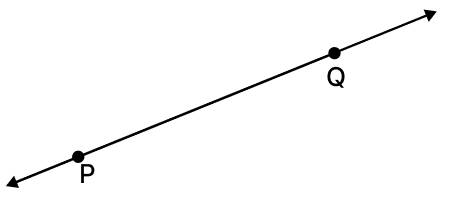
∴ Only one line can be drawn to pass through two given fixed points P and Q.
How many lines can be drawn to pass through a given point?
Answer
A single point acts like a center or a pivot. We can draw lines through it in every possible direction (360°) and since there is no second point to "lock" the line's direction, we can keep drawing them forever.
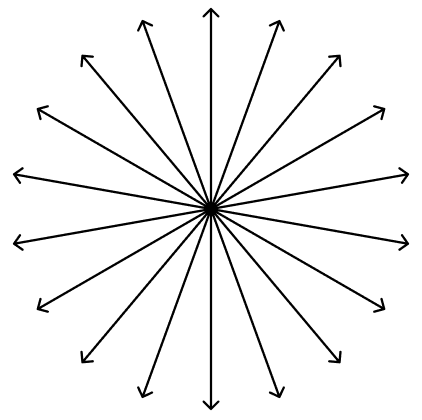
∴ Infinitely many lines can be drawn to pass through a given point.
A fixed point P is given. How many rays can be drawn with P as initial point?
Answer
If P is our initial point, we can shoot a ray out from it in any direction since there are an infinite number of directions in a plane.
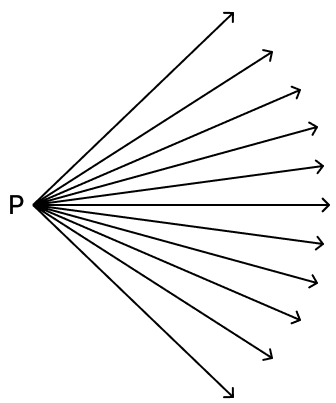
∴ Infinitely many rays can be drawn with P as initial point.
Draw a line segment of length 5.3 cm.
Answer
To draw this line segment, place a ruler on a piece of paper. Mark a point A at 0 cm and another point B at the third small division after the 5 cm mark. Connect these two points with a straight line.

∴ AB = 5.3 cm.
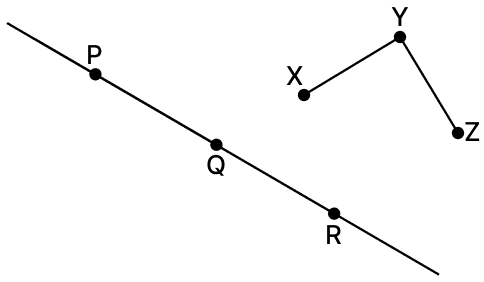
Mark six points P, Q, R, X, Y, Z such that P, Q, R are collinear and X, Y, Z are not collinear.
Answer
Collinear (P, Q, R): Draw a single straight line and place points P, Q, and R anywhere along that same line.
Non-collinear (X, Y, Z): Place points X and Y on a line, but place point Z somewhere else so it does not sit on the line connecting X and Y. These points will form a triangle if connected.
How many lines can be drawn through three:
(i) collinear points?
(ii) non-collinear points?
Answer
(i) By definition, collinear points are points that lie on the same straight line.
∴ One line can be drawn through three collinear points.
(ii) Non-collinear points are a set of three or more points that do not lie on the same straight line.
∴ Three lines can be drawn through three non-collinear points not on the same line.
What is the maximum and minimum number of points of intersection of three lines drawn in a plane?
Answer
Maximum is 3.
This occurs when no two lines are parallel and all three lines do not pass through the same point. Each line intersects the other two at two distinct points, forming a triangle.
Minimum is 0.
This occurs when all three lines are parallel to each other (L1 || L2 || L3). Since they never cross, there are zero points of intersection.
∴ Maximum points = 3, Minimum points = 0.
Number of lines that can pass through any given point is
- 0
- 1
- 2
- infinite
Answer
From a single point, a line can be drawn in any direction, so infinitely many lines are possible.
Hence, option 4 is the correct option.
Two planes intersect in
- a point
- a line
- a pair of lines
- a pair of parallel lines
Answer
When two planes meet, their common part is always a straight line.
Hence, option 2 is the correct option.
Two lines which never meet are called
- concurrent lines
- parallel lines
- intersecting lines
- rays
Answer
Parallel lines always remain at equal distance and never intersect.
Hence, option 2 is the correct option.
Number of lines that can be drawn passing through two given points in a plane is
- 0
- 1
- 2
- infinite
Answer
Only one unique straight line can pass through two fixed points.
Hence, option 2 is the correct option.
In how many points do two intersecting lines meet?
- 0
- 1
- 2
- infinite
Answer
Intersecting lines cross each other at exactly one point.
Hence, option 2 is the correct option.
Fill in the blanks:
(i) A ............... has no dimensions.
(ii) A line segment extended endlessly in one direction is called a ............... .
(iii) The points lying on the same line are said to be ............... .
(iv) The point at which three or more lines lying in a plane, intersect is called ............... .
(v) A smooth flat surface which extends endlessly in all the directions is called a ............... .
Answer
(i) A point has no dimensions.
(ii) A line segment extended endlessly in one direction is called a ray.
(iii) The points lying on the same line are said to be collinear.
(iv) The point at which three or more lines lying in a plane, intersect is called the point of concurrence.
(v) A smooth flat surface which extends endlessly in all the directions is called a plane.
Write true (T) or false (F):
(i) Two points are always collinear.
(ii) A line has no end points.
(iii) A ray extends endlessly.
(iv) Two lines in a plane always intersect.
(v) Only one line can be drawn passing through two given points in a plane.
Answer
(i) True
Reason — Any two points in space can always be connected by a single unique straight line. Therefore, they are always collinear by default.
(ii) True
Reason — A line is defined as extending infinitely in both directions. Since it never stops, it cannot have any endpoints.
(iii) True
Reason — A ray has one starting point but extends infinitely in the other direction.
(iv) False
Reason — Two lines in a plane only intersect if they are not parallel. Parallel lines stay at the same distance apart and will never meet.
(v) True
Reason — While many lines can pass through a single point, once we have two fixed points, they "lock" the direction, allowing only one unique straight line to pass through both.
Vasu is given a diagram which contains various lines named l, m, n, p and q.

(1) Which of the following is not a pair of intersecting lines ?
- p and q
- p and n
- l and n
- m and l
(2) Which of the following forms a set of concurrent lines ?
- l, p, n
- m, q, n
- l, n, q
- q, m, p
(3) Which of the following is a pair of parallel lines ?
- l and m
- n and p
- q and l
- m and q
(4) How many lines can be drawn passing through the point of intersection of the lines q and n?
- 0
- 1
- 2
- infinite
Answer
(1)
Lines p and n are running side-by-side and maintain the same distance apart. They are parallel lines, so they will never intersect. All other pairs (p and q, l and n, m and l) clearly cross each other at some point.
Hence, option 2 is the correct option.
(2)
Concurrent lines are three or more lines that all pass through the exact same point. In the diagram, lines q, m, and p all meet at a single shared intersection point in the center-right area.
Hence, option 4 is the correct option.
(3)
Lines n and p are drawn such that they will never meet, no matter how far they are extended. Therefore n and p are parallel lines.
Hence, option 2 is the correct option.
(4)
The intersection of q and n is a single point. Based on the fundamental rules of geometry, an infinite number of lines can be drawn through any single point in a plane.
Hence, option 4 is the correct option.
Assertion: In the figure, l is a line and AB is a line segment.

Reason: A line segment is the part of a line between two points.
- Both Assertion (A) and Reason (R) are true and Reason (R) is the correct explanation of Assertion (A).
- Both Assertion (A) and Reason (R) are true and Reason (R) is not the correct explanation of Assertion (A).
- Assertion (A) is true but Reason (R) is false.
- Assertion (A) is false but Reason (R) is true.
Answer
Both Assertion (A) and Reason (R) are true and Reason (R) is the correct explanation of Assertion (A).
Explanation
Figure l has arrows on both ends, which is the geometric symbol for a line (extending infinitely).
Figure AB has two distinct endpoints, which is the definition of a line segment. So, the Assertion is true.
The statement in Reason is mathematically correct definition of a line segment and it perfectly explains why AB is called a line segment.
Hence, option 1 is the correct option.
Assertion: In the figure, the three lines, l, m and n are concurrent.
Reason: The maximum number of points of intersection of three lines drawn in a plane is 3.

- Both Assertion (A) and Reason (R) are true and Reason (R) is the correct explanation of Assertion (A).
- Both Assertion (A) and Reason (R) are true and Reason (R) is not the correct explanation of Assertion (A).
- Assertion (A) is true but Reason (R) is false.
- Assertion (A) is false but Reason (R) is true.
Answer
Assertion (A) is false but Reason (R) is true.
Explanation
Concurrent lines must all pass through the same single point. In the figure, the lines intersect at three different points (A, B, and C), forming a triangle. Therefore, they are not concurrent.
The Assertion is false.
If three lines are not parallel and not concurrent, they intersect at exactly 3 points (A with B, B with C, and C with A). This is the maximum possible.
The Reason is true.
Hence, option 4 is the correct option.