
Which of the following geometrical figures has exactly one line of symmetry?
A rectangle
A semicircle
A regular pentagon
A rhombus
Answer
A rectangle has 2 lines of symmetry, i.e., horizontal and vertical.
A semicircle has 1 line of symmetry, i.e., the perpendicular bisector of its diameter.
A regular pentagon has 5 lines of symmetry.
A rhombus has 2 lines of symmetry (along its diagonals).
Hence, Option 2 is the correct option.
Which of the following geometrical figures has exactly two lines of symmetry?
A square
A parallelogram
An isosceles trapezium
A rectangle
Answer
A square has 4 lines of symmetry.
A parallelogram has 0 lines of symmetry.
An isosceles trapezium has 1 line of symmetry.
A rectangle has 2 lines of symmetry.
Hence, Option 4 is the correct option.
An equilateral triangle has three lines of symmetry, an isosceles triangle will have:
No line of symmetry
One line of symmetry
Two lines of symmetry
Three lines of symmetry
Answer
An isosceles triangle has two equal sides and two equal angles. It possesses exactly one line of symmetry, which passes through the vertex angle and the midpoint of the base.
Hence, Option 2 is the correct option.
State the type(s) of symmetry possessed by the following figure. Explain each type of symmetry for the figure.
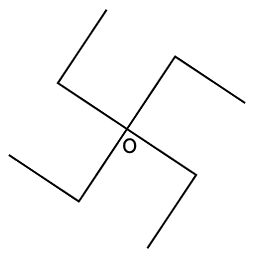
Answer
(1) Linear Symmetry — No linear symmetry.
(2) Point Symmetry — Possesses point symmetry with the centre O as the centre of symmetry.
(3) Rotational Symmetry — Possesses a rotational symmetry of order 4 about the point O.
State the type(s) of symmetry possessed by the following figure. Explain each type of symmetry for the figure.

Answer
(1) Linear Symmetry — No linear symmetry.
(2) Point Symmetry — Possesses point symmetry with the centre O as the centre of symmetry.
(3) Rotational Symmetry — Possesses a rotational symmetry of order 2 about the point O.
State the type(s) of symmetry possessed by the following figure. Explain each type of symmetry for the figure.
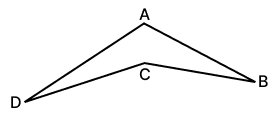
Answer
(1) Linear Symmetry — One line of symmetry, i.e., the vertical line passing through vertices A and C.
(2) Point Symmetry — No point symmetry.
(3) Rotational Symmetry — No rotational symmetry.
State the type(s) of symmetry possessed by the following figure. Explain each type of symmetry for the figure.
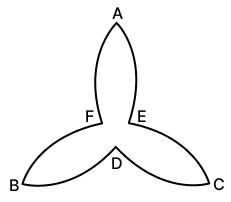
Answer
(1) Linear Symmetry — Three lines of symmetry, i.e., AD, BE and CF.
(2) Point Symmetry — No point symmetry.
(3) Rotational Symmetry — Possesses rotational symmetry of order 3 about the centre D.
State the type(s) of symmetry possessed by the following figure. Explain each type of symmetry for the figure.
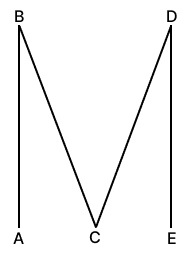
Answer
(1) Linear Symmetry — One line of symmetry, i.e., the line parallel to AB passing through the point C.
(2) Point Symmetry — No point symmetry.
(3) Rotational Symmetry — No rotational symmetry.
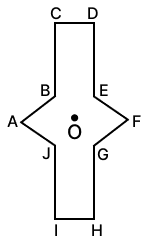
State the type(s) of symmetry possessed by the following figure. Explain each type of symmetry for the figure.
Answer
(1) Linear Symmetry — Two lines of symmetry, i.e., one vertical and one horizontal line passing through the centre O.
(2) Point Symmetry — Possesses point symmetry with the centre O as the centre of symmetry.
(3) Rotational Symmetry — Possesses rotational symmetry of order 2 about the centre O.
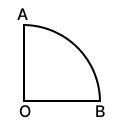
State the type(s) of symmetry possessed by the following figure. Explain each type of symmetry for the figure.
Answer
(1) Linear Symmetry — One line of symmetry, i.e., the bisector of the angle AOB.
(2) Point Symmetry — No point symmetry.
(3) Rotational Symmetry — No rotational symmetry.
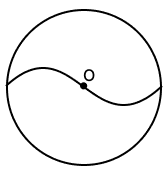
State the type(s) of symmetry possessed by the following figure. Explain each type of symmetry for the figure.
Answer
(1) Linear Symmetry — No linear symmetry.
(2) Point Symmetry — Possesses point symmetry with the centre O as the centre of symmetry.
(3) Rotational Symmetry — Possesses a rotational symmetry of order 2 about the point O.
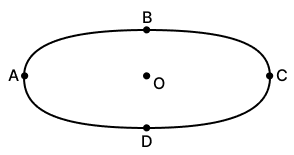
State the type(s) of symmetry possessed by the following figure. Explain each type of symmetry for the figure.
Answer
(1) Linear Symmetry — Two lines of symmetry, i.e., (i) the line joining points A and C and (ii) the line joining points B and D.
(2) Point Symmetry — The point O of intersection of the lines AC and BD is the centre of symmetry.
(3) Rotational Symmetry — Possesses a rotational symmetry of order 2 about the point O.
State the type(s) of symmetry possessed by the following figure. Explain each type of symmetry for the figure.
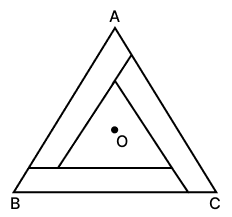
Answer
(1) Linear Symmetry — No linear symmetry.
(2) Point Symmetry — No point symmetry.
(3) Rotational Symmetry — Possesses rotational symmetry of order 3 about the centre O.