
A line segment is symmetrical about
- any line perpendicular to it.
- any line passing through its mid-point
- any line parallel to it.
- its perpendicular bisector.
Answer
A line segment has two lines of symmetry: itself and its perpendicular bisector. Among the options, only the perpendicular bisector is listed.
Hence, Option 4 is the correct option.
A scalene triangle has
- no line of symmetry
- one line of symmetry
- two lines of symmetry
- three lines of symmetry
Answer
In a scalene triangle, all sides and angles are unequal, so there is no line that can divide it into two identical mirror images.
Hence, Option 1 is the correct option.
The lines of symmetry of a rhombus are
- perpendicular bisector of each of its sides
- its two diagonals
- the lines joining the mid points of its opposite sides
- its sides
Answer
Folding a rhombus along its diagonals results in the opposite halves matching perfectly.
Hence, Option 2 is the correct option.
A circle has
- no line of symmetry
- one line of symmetry
- two lines of symmetry
- an unlimited number of lines of symmetry
Answer
Any straight line passing through the centre of a circle (a diameter) is a line of symmetry.
Hence, Option 4 is the correct option.
The line of symmetry of a rectangle are
- its four sides
- its two diagonals
- the bisectors of its four interior angles
- the lines joining the midpoints of its opposite sides.
Answer
A rectangle is symmetrical about the vertical and horizontal lines passing through the midpoints of its sides.
Hence, Option 4 is the correct option.
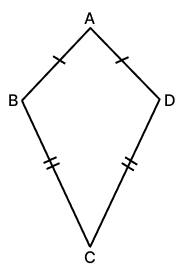
ABCD is a kite in which AB = AD and CB = CD. The kite is symmetrical about
- the diagonal AC
- the diagonal BD
- both the diagonals AC and BD
- the lines joining the mid-points of its opposite sides.
Answer
In a kite, the diagonal connecting the vertices where equal sides meet (AC) acts as the axis of symmetry.
Hence, Option 1 is the correct option.
In △ABC, AB = AC and AD ⊥ BC, BE ⊥ CA and CF ⊥ AB. Then, △ABC is symmetrical about
- AD
- BE
- CF
- BC
Answer
Since the triangle is isosceles (AB = AC), it has one line of symmetry which is the altitude drawn from the vertex angle to the base (AD).
Hence, Option 1 is the correct option.
Which amongst the following letters has the highest number of lines of symmetry?
- A
- K
- X
- N
Answer
'A' has 1, 'K' has 1, 'N' has 0, and 'X' has 2 (horizontal and vertical) lines of symmetry.
Hence, Option 3 is the correct option.
Which of the following letters of the English alphabet does not possess a point symmetry?
- C
- N
- S
- X
Answer
'N', 'S', and 'X' look the same when rotated through 180°. 'C' does not.
Hence, Option 1 is the correct option.
An equilateral triangle has a rotational symmetry of the order
- 1
- 2
- 3
- 4
Answer
An equilateral triangle maps onto itself at 120°, 240° and 360° rotations.
Hence, Option 3 is the correct option.
An isosceles triangle possesses
- linear symmetry
- point symmetry
- rotational symmetry
- all of these
Answer
It has one line of symmetry but does not look the same if rotated or turned upside down.
Hence, Option 1 is the correct option.
A regular pentagon does not possess
- linear symmetry
- point symmetry
- rotational symmetry
- all of these
Answer
A regular pentagon has an odd number of sides (5). In regular polygons, point symmetry (which is the same as rotational symmetry of order 2) only exists if the number of sides is even.
Hence, Option 2 is the correct option.
A parallelogram does not possess
- linear symmetry
- point symmetry
- rotational symmetry
- all of these
Answer
A general parallelogram cannot be folded to create mirror images, though it does have point and rotational symmetry.
Hence, Option 1 is the correct option.
An equilateral triangle does not possess
- linear symmetry
- point symmetry
- rotational symmetry
- none of these
Answer
Rotating an equilateral triangle leaves it pointing downward, so it does not match its original position.
Hence, Option 2 is the correct option.
Which of the following letters of English alphabet has a rotational symmetry?
- C
- K
- N
- T
Answer
'N' has rotational symmetry of order 2 (180° rotation). 'C', 'K', and 'T' only look the same after a full 360° turn.
Hence, Option 3 is the correct option.
Fill in the blanks :
(i) A circle has ............... lines of symmetry.
(ii) The letter S does not possess ............... symmetry.
(iii) A semi-circle is symmetrical about the ............... of its diameter.
(iv) The letter H has ............... line(s) of symmetry.
(v) A quadrilateral having 4 lines of symmetry as well as rotational symmetry of order 4 is ............... .
Answer
(i) A circle has infinite lines of symmetry.
(ii) The letter S does not posses linear symmetry.
(iii) A semi-circle is symmetrical about the perpendicular bisector of its diameter.
(iv) The letter H has two line(s) of symmetry.
(v) A quadrilateral having 4 lines of symmetry as well as rotational symmetry of order 4 is square.
Explanation
(i) Every diameter of a circle acts as a fold line that splits it into two identical halves. Since we can draw infinitely many diameters, there are infinitely many lines of symmetry.
(ii) If we try to fold the letter S vertically or horizontally, the curves point in opposite directions. It only looks the same if we rotate it 180° (rotational symmetry).
(iii) For a semicircle, the only way to get matching halves is to fold it exactly down the middle of the flat edge (the diameter).
(iv) The letter H is balanced both left-to-right and top-to-bottom, giving it two axes of reflection.
(v) While a rectangle has rotational symmetry of order 2 and two lines of symmetry, only a square reaches "perfection" with 4 lines (including diagonals) and a matching rotational order of 4.
Write true (T) or false (F) :
(i) A kite possesses a linear symmetry but no rotational symmetry.
(ii) The order of rotational symmetry of a regular hexagon is 6.
(iii) A parallelogram does not have any line of symmetry.
(iv) A square has a point symmetry but rhombus does not.
(v) The letter N does not possess a rotational symmetry.
Answer
(i) True
Reason — A kite has exactly one line of symmetry i.e., the diagonal connecting the vertices of the equal sides. However, it does not look like its original self at any point during a rotation until it completes a full 360° turn.
(ii) True
Reason — For any regular polygon, the order of rotational symmetry is equal to the number of its sides. Since a regular hexagon has 6 equal sides and angles, it maps onto itself 6 times in one full rotation.
(iii) True
Reason — A general parallelogram cannot be folded along any line to produce two matching halves. While it has rotational symmetry, it lacks linear symmetry.
(iv) False
Reason — Both a square and a rhombus possess point symmetry. Any figure that looks the same after a 180° rotation (upside down) has point symmetry. Since both shapes map onto themselves after a half-turn, they both have it.
(v) False
Reason — The letter N possesses rotational symmetry of order 2. If we rotate the letter N by 180°, it looks exactly the same as it did in its starting position.
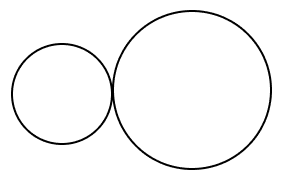
Assertion: Order of rotational symmetry for the given figure is 4.
Reason: A figure is said to possess rotational symmetry if it fits on itself more than once while being rotated through 360°.
- Both Assertion (A) and Reason (R) are true and Reason (R) is the correct explanation of Assertion (A).
- Both Assertion (A) and Reason (R) are true and Reason (R) is not the correct explanation of Assertion (A).
- Assertion (A) is true but Reason (R) is false.
- Assertion (A) is false but Reason (R) is true.
Answer
Assertion (A) is false but Reason (R) is true.
Explanation
The given figure consists of two circles touching each other. To look exactly the same, you would need to rotate it by 180° (half-turn) or 360° (full turn). This means the figure fits on itself twice in one full rotation. Therefore, the order of rotational symmetry is 2, not 4.
So, Assertion is false.
The statement given in the reason is correct and is the standard mathematical definition of rotational symmetry.
So, Reason is true.
Hence, option 4 is the correct option.
Assertion: The number of lines of symmetry of a regular polygon is equal to its number of vertices.
Reason: A figure that possesses point symmetry always has line symmetry.
- Both Assertion (A) and Reason (R) are true and Reason (R) is the correct explanation of Assertion (A).
- Both Assertion (A) and Reason (R) are true and Reason (R) is not the correct explanation of Assertion (A).
- Assertion (A) is true but Reason (R) is false.
- Assertion (A) is false but Reason (R) is true.
Answer
Assertion (A) is true but Reason (R) is false.
Explanation
For any regular polygon (like an equilateral triangle, square, or regular pentagon), the number of lines of symmetry is equal to the number of sides, which is also equal to the number of vertices.
For example, a square has 4 vertices and 4 lines of symmetry.
So, Assertion is true.
Point symmetry is rotational symmetry of order 2 (looking the same upside down). However, a figure can have point symmetry without having any lines of symmetry.
A classic example is the letter 'S' or a parallelogram. You can rotate them 180° to match, but you cannot fold them to get mirror images.
So, Reason is false.
Hence, option 3 is the correct option.
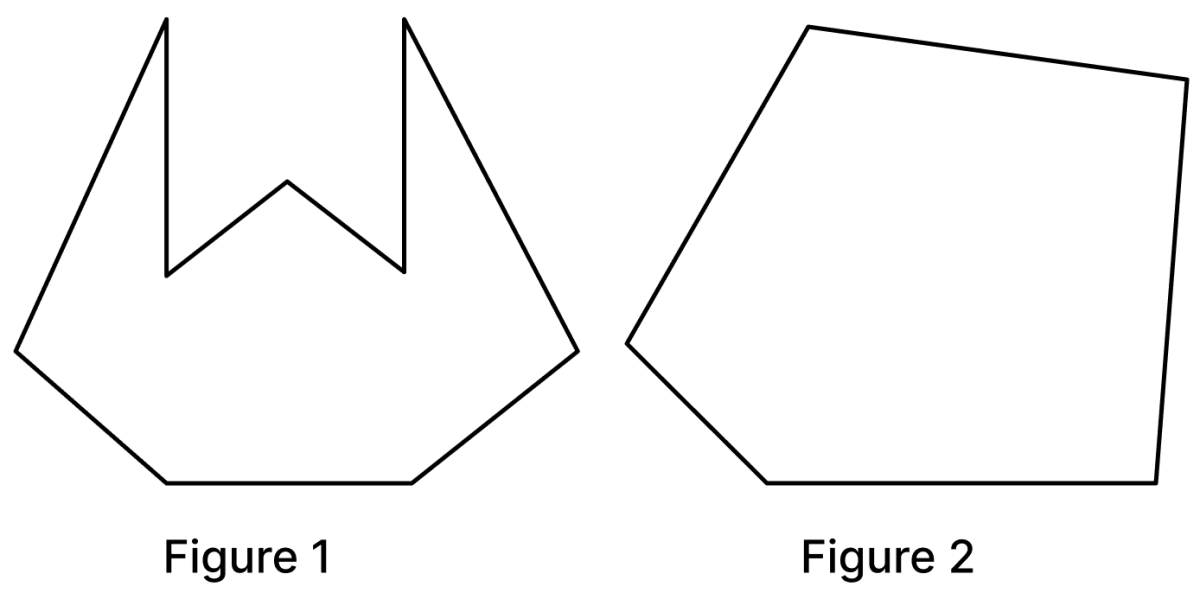
Consider the figures shown.
A student made the following conclusions after observing the figures.
Conclusion I: Figure 1 is symmetric as there is a line about which it can be folded so that the two parts coincide.
Conclusion II: Figure 2 is not symmetric as there is no line about which it can be folded so that the two parts coincide.
Which of the above conclusion(s) is/are correct?
- Only conclusion I
- Only conclusion II
- Both conclusion I and conclusion II
- Neither conclusion I nor conclusion II
Answer
A figure is said to be symmetric about a line if that line divides the figure into two parts that coincide when folded along it. Such a line is called the line of symmetry (or axis of symmetry).
Figure 1: A vertical line drawn through the middle of the figure divides it into two parts that coincide perfectly when folded along it. So, Figure 1 is symmetric.
Hence, Conclusion I is correct.
Figure 2: It is an irregular pentagon-like shape. There is no line about which it can be folded so that the two parts coincide. So, Figure 2 is not symmetric.
Hence, Conclusion II is also correct.
Hence, Option 3 is the correct option.
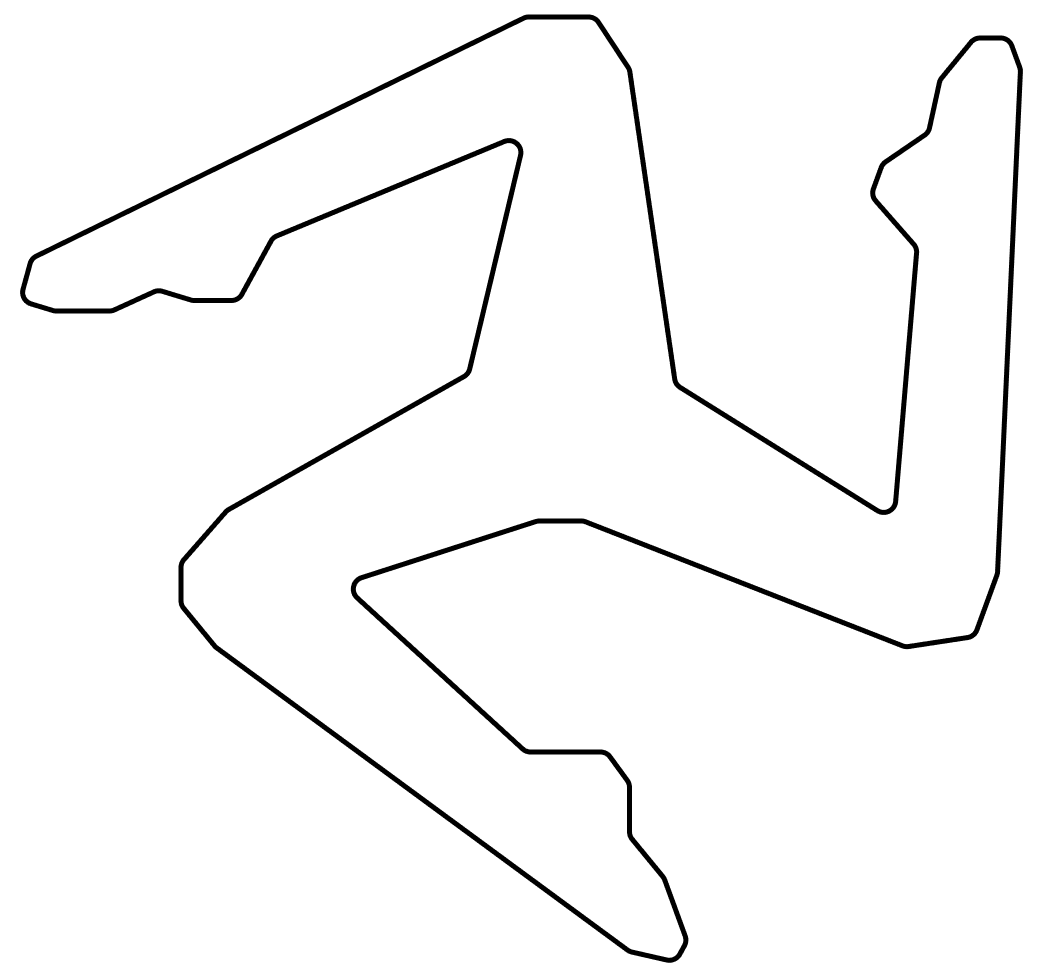
The number of lines of symmetry and order of rotational symmetry respectively in the given figure are:
- 3, 0
- 3, 3
- 0, 3
- 0, 0
Answer
The figure consists of three identical arms arranged equally around its centre.
There is no line about which the figure can be folded so that the two parts coincide.
So, the number of lines of symmetry is 0.
But it has rotational symmetry of order 3 because after rotating it by 120°, 240° and 360°, the figure matches itself.
So, the order of rotational symmetry is 3.
Hence, Option 3 is the correct option.
Match the following:
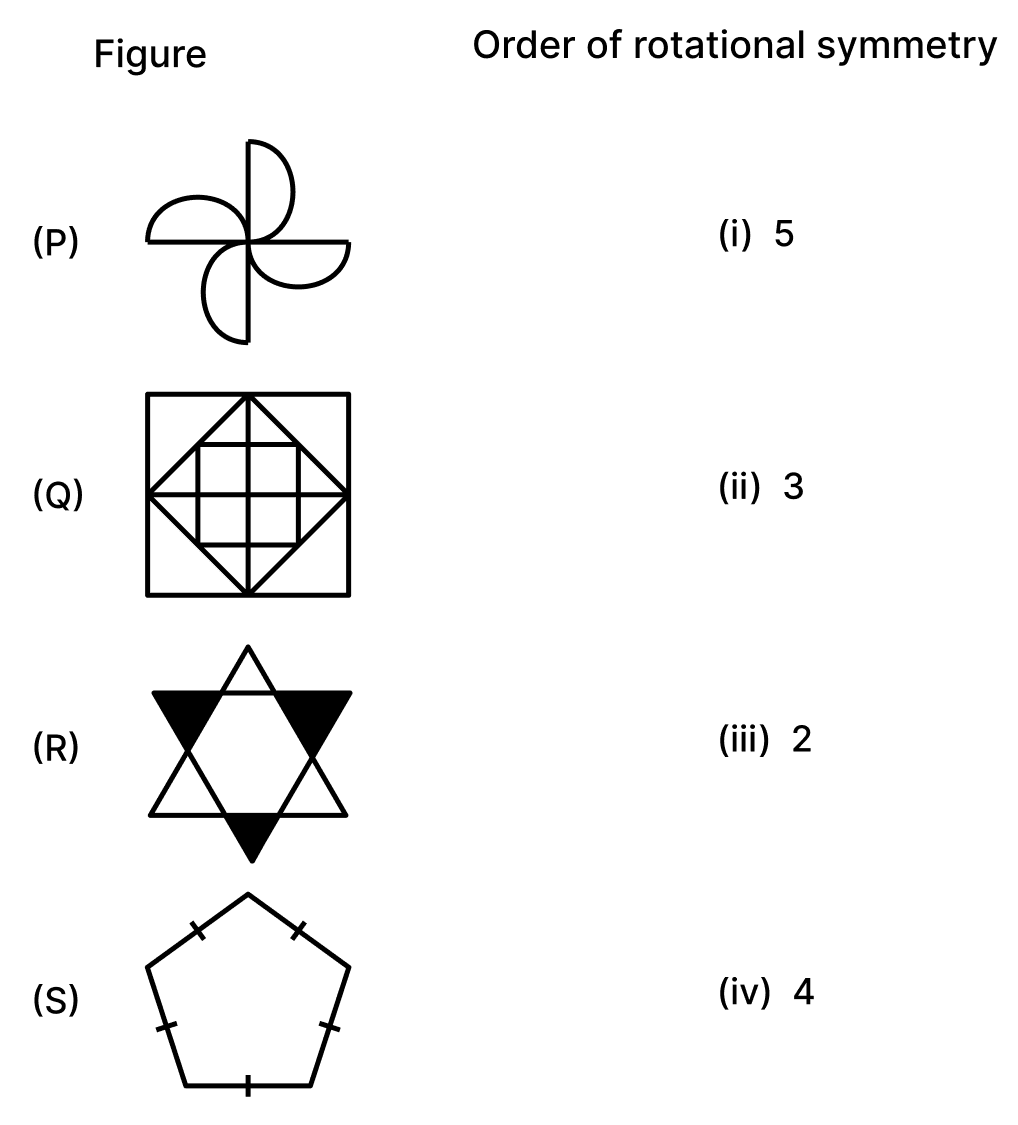
| Figure | Order of rotational symmetry |
|---|---|
| (P) | (i) 5 |
| (Q) | (ii) 3 |
| (R) | (iii) 2 |
| (S) | (iv) 4 |
- (P) → (iv), (Q) → (i), (R) → (ii), (S) → (iii)
- (P) → (iv), (Q) → (iii), (R) → (ii), (S) → (i)
- (P) → (ii), (Q) → (iv), (R) → (iii), (S) → (i)
- (P) → (ii), (Q) → (i), (R) → (iv), (S) → (iii)
Answer
The order of rotational symmetry of a figure is the number of times the figure fits onto itself in the process of rotation through 360°.
(P) Pinwheel: The pinwheel has 4 curved arms placed at equal angles around its centre. It maps onto itself after rotations of 90°, 180°, 270° and 360°.
So, the order of rotational symmetry is 4. Hence, (P) → (iv).
(Q): The given figure maps onto itself only after rotations of 180° and 360°.
So, the order of rotational symmetry is 2. Hence, (Q) → (iii).
(R): The given figure maps onto itself after rotations of 120°, 240° and 360°.
So, the order of rotational symmetry is 3. Hence, (R) → (ii).
(S) Regular pentagon: A regular pentagon has 5 equal sides and 5 equal angles. It maps onto itself after rotations of 72°, 144°, 216°, 288° and 360°.
So, the order of rotational symmetry is 5. Hence, (S) → (i).
Hence, Option 2 is the correct option.
A regular hexagon is cut along one of its line of symmetry as shown.
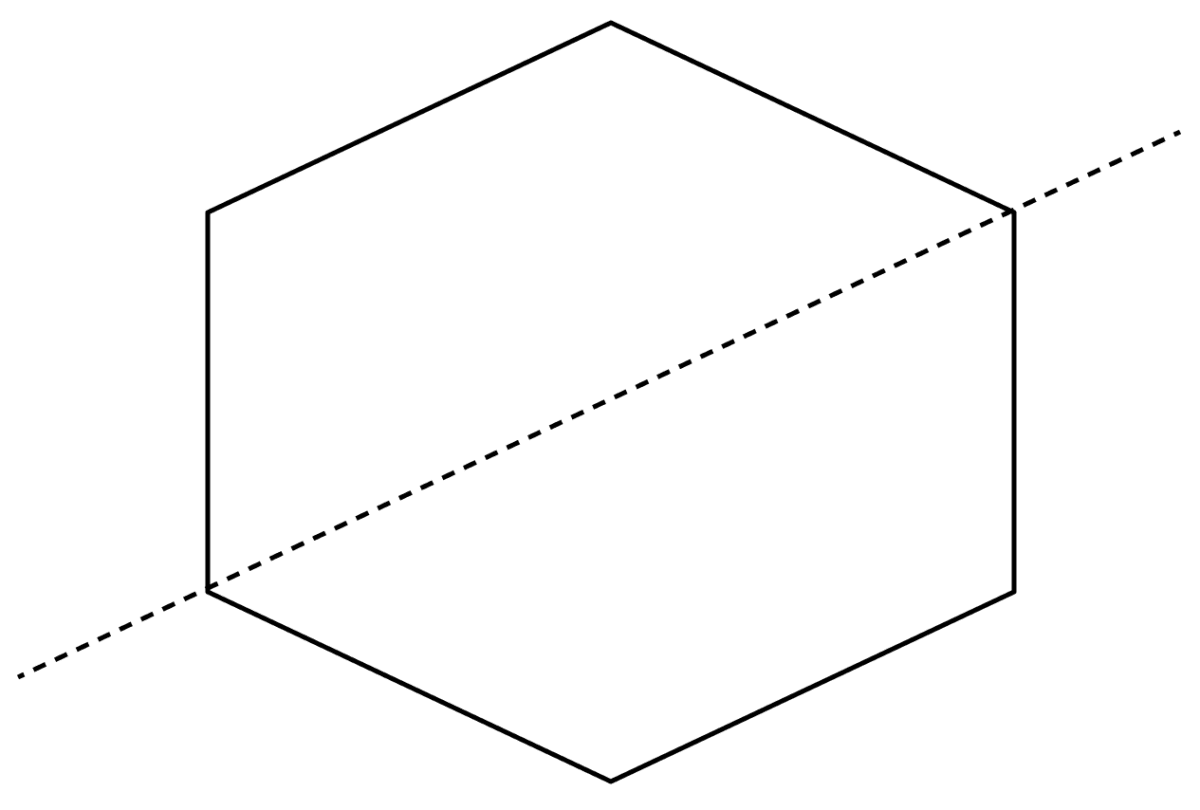
Is it true that the angle of rotation of the new figure is half of the previous figure?
- No
- Yes
- Cannot say anything
- None of these
Answer
A regular hexagon has rotational symmetry of order 6.
So, the angle of rotation of the regular hexagon = = 60°.
When the regular hexagon is cut along one of its lines of symmetry (the one passing through two opposite vertices), the new figure obtained is an isosceles trapezium.
The isosceles trapezium has only one line of symmetry and no rotational symmetry, i.e., it maps onto itself only after a complete rotation of 360°.
So, the angle of rotation of the new figure = 360°.
Half of the angle of rotation of the previous figure = = 30°.
Since 360° ≠ 30°, the angle of rotation of the new figure is not half of the previous figure.
Hence, Option 1 is the correct option.