
When a coin was tossed 200 times, we obtained
Head : 118 times and Tail : 82 times.
When the coin is tossed at random, what is the probability of getting
(i) a head?
(ii) a tail?
Answer
Total number of trials = 200.
Number of heads obtained = 118
Number of tails obtained = 82
(i) P (getting a head) =
∴ Probability of getting a head =
(ii) P (getting a tail) =
∴ Probability of getting a tail =
A die is rolled 150 times and the outcomes are noted which are tabulated as shown below :
| Outcome | 1 | 2 | 3 | 4 | 5 | 6 |
|---|---|---|---|---|---|---|
| Frequency | 29 | 17 | 24 | 19 | 33 | 28 |
When a die is rolled at random, find the probability of getting a :
(i) 1
(ii) 4
(iii) 5
Answer
Total number of trials = 150.
(i) Number of times 1 is obtained = 29.
P (getting 1) =
=
∴ Probability of getting 1 =
(ii) Number of times 4 is obtained = 19.
P (getting 4) =
= .
∴ Probability of getting 4 =
(iii) Number of times 5 is obtained = 33.
P (getting 5) =
∴ Probability of getting 5 =
Five cards numbered 1 to 5 are placed in a bag. A card is drawn from the bag 30 times. Each time, the number on the drawn card is noted and the card drawn is replaced. The outcomes are tabulated as shown below :
| Outcome | 1 | 2 | 3 | 4 | 5 |
|---|---|---|---|---|---|
| Frequency | 4 | 10 | 7 | 5 | 4 |
If a card is now drawn at random, find the probability that the card drawn bears the number :
(i) 2
(ii) 3
(iii) 5
Answer
Total number of trials = 30.
(i) Number of times 2 is obtained = 10.
P (getting 2) =
∴ Probability of getting 2 =
(ii) Number of times 3 is obtained = 7.
P (getting 3) =
= .
∴ Probability of getting 3 =
(iii) Number of times 5 is obtained = 4.
P (getting 5) =
∴ Probability of getting 5 =
Two coins are tossed simultaneously 100 times. We obtained :
Two Heads : 23 times; One Head : 56 times; Zero Head : 21 times.
When two coins are tossed at random, what is the probability of getting:
(i) Two Heads?
(ii) One Head?
(iii) Zero Head?
Answer
Total number of trials = 100.
(i) Number of times two heads obtained = 23.
P (getting two heads) =
= .
∴ Probability of getting two heads =
(ii) Number of times one head obtained = 56.
P (getting one head) =
∴ Probability of getting one head =
(iii) Number of times zero head obtained = 21.
P (getting zero head) =
= .
∴ Probability of getting zero head =
In a survery of 200 employees of a company, it was found that 89 liked the lunch packs provided by the company while the rest did not. Out of these employees, if one employee is chosen at random, what is the probability that the chosen employee:
(i) likes the lunch pack?
(ii) dislikes the lunch pack?
Answer
Total number of employees surveyed = 200.
Number of employees who liked the lunch packs = 89.
Number of employees who disliked the lunch packs = 200 − 89 = 111.
(i) P (chosen employee likes the lunch packs) =
=
∴ Probability that the chosen employee likes the lunch packs =
(ii) P (chosen employee dislikes the lunch packs) =
=
∴ Probability that the chosen employee dislikes the lunch packs =
Assertion : A coin is tossed 16 times and the outcomes are recorded as below :
H T T H T H H H T T H T H T T H
The probability of occurrence of a head is 50%.
Reason : When a coin is tossed, there are two possible outcomes—Head and Tail.
- Both Assertion (A) and Reason (R) are true and Reason (R) is the correct explanation of Assertion (A).
- Both Assertion (A) and Reason (R) are true but Reason (R) is not the correct explanation of Assertion (A).
- Assertion (A) is true but Reason (R) is false.
- Assertion (A) is false but Reason (R) is true.
Answer
Both Assertion (A) and Reason (R) are true but Reason (R) is not the correct explanation of Assertion (A).
Explanation
Total number of trials = 16.
Number of times head occurs = 8.
∴ P (getting a head) =
= 50%
So, the Assertion is true.
When a coin is tossed, the two possible outcomes are Head and Tail.
So, the Reason is also true.
However, the Reason only states the possible outcomes when a coin is tossed and does not explain how the empirical probability of getting a head is calculated from the given data. Hence, R is not the correct explanation of A.
Hence, option 2 is the correct option.
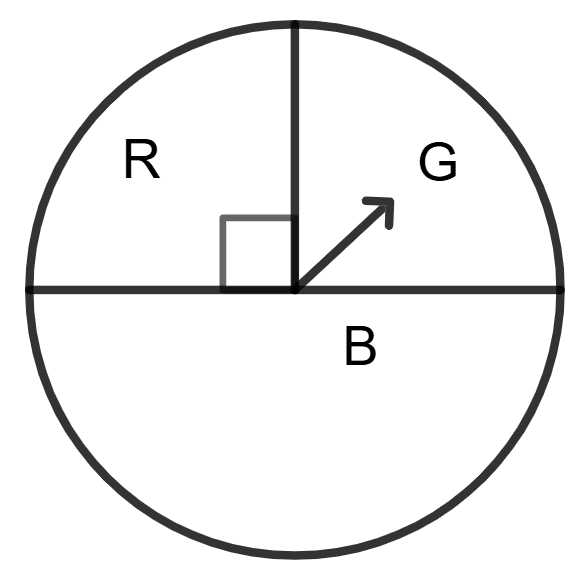
Assertion : When a spinner with three colours Red (R), Green (G) and Black (B) as shown is rotated, red and green colours have equal probability to show up with arrow.
Reason : The probability of occurrence of an event E is given by
- Both Assertion (A) and Reason (R) are true and Reason (R) is the correct explanation of Assertion (A).
- Both Assertion (A) and Reason (R) are true but Reason (R) is not the correct explanation of Assertion (A).
- Assertion (A) is true but Reason (R) is false.
- Assertion (A) is false but Reason (R) is true.
Answer
Assertion (A) is true but Reason (R) is false.
Explanation
From the spinner, Red (R) and Green (G) cover equal regions of the circle. So, when the spinner is rotated, red and green colours have equal probability to show up with the arrow.
Hence, the Assertion is true.
The correct formula for the probability of occurrence of an event E is :
The formula given in the Reason is inverted, so the Reason is false.
Hence, option 3 is the correct option.