
Which of the following is a finite set?
- Set of all natural numbers greater than 500.
- Set of all integers less than 5.
- Set of all even prime numbers.
- Set of all multiples of 3.
Answer
The only even prime number is 2. Therefore, the set is {2}, which has a countable (finite) number of elements. All other options describe infinite sets (natural numbers > 500, integers < 5, and multiples of 3).
Hence, option 3 is the correct option.
Which of the following is a pair of disjoint sets?
- A = {even natural numbers} and B = {prime numbers}
- C = {multiples of 2} and D = {multiples of 3}
- E = {factors of 24} and F = {factors of 9}
- G = {letters in the word 'RHYTHM'} and H = {Vowels in English Alphabet}
Answer
Disjoint sets have no common elements. The set G = {R, H, Y, T, M} and H = {a, e, i, o, u} share nothing. In all other options, there is at least one common element (e.g., 2 is both even and prime).
Hence, option 4 is the correct option.
The cardinal number of the set A, defined as A = Set of all prime numbers less than 100, is
- -20
- 22
- 24
- 25
Answer
The prime numbers less than 100 are: 2, 3, 5, 7, 11, 13, 17, 19, 23, 29, 31, 37, 41, 43, 47, 53, 59, 61, 67, 71, 73, 79, 83, 89, 97. Counting them gives a total of 25.
Hence, option 4 is the correct option.
The number of proper subsets of the set {α, β, Φ, θ, η} is
- 24
- 25
- 31
- 32
Answer
The number of proper subsets for a set with n elements is 2n-1.
Here, n=5,
so 25-1 = 24 = 32 - 1 = 31
Hence, option 3 is the correct option.
The sets {a, b, c} and {x, y, z} are
- overlapping sets
- equal sets
- singleton sets
- equivalent sets
Answer
Equivalent sets have the same number of elements (the same cardinal number). Both sets have exactly 3 elements (n=3). They are not "equal" because the elements themselves are different.
Hence, option 4 is the correct option.
A = {x : x is a prime number} and B = {x : x is an even natural number}. Then A ∩ B is
- an empty set
- a singleton set
- an infinite set
- equal to A
Answer
A ∩ B represents numbers that are both prime and even natural numbers. The only number that fits this is 2. Since the resulting set is {2}, it contains exactly one element, making it a singleton set.
Hence, option 2 is the correct option.
If A = {x : x ∈ N, 5 ≤ x < 10} and B = {1, 2, 3, 4, 5}, then n(A - B) is equal to
- 1
- 2
- 4
- 5
Answer
First, write the sets in roster form:
A = {5, 6, 7, 8, 9}
B = {1, 2, 3, 4, 5}
A - B = {5, 6, 7, 8, 9} - {1, 2, 3, 4, 5} = {6, 7, 8, 9} (Elements in A not in B).
The count n(A - B) = 4.
Hence, option 3 is the correct option.
If X = {x : x is a multiple of 5} and Y = {x : x is a multiple of 7}, then X ∩ Y is
- Φ
- {x : x is a multiple of 2}
- {5, 7}
- {x : x is a multiple of 35}
Answer
The intersection of multiples of two numbers is the set of multiples of their Least Common Multiple (LCM). Since 5 and 7 are co-prime, their LCM is 35.
Hence, option 4 is the correct option.
{Φ} is a / an
- empty set
- infinite set
- singleton set
- universal set
Answer
An empty set is denoted by { } or Φ. However, {Φ} is a set that contains the empty set as an element. Since it contains one element, it is a singleton set.
Hence, option 3 is the correct option.
If A is any set and U is the universal set, then the complement of A is
- Φ
- A
- U - A
- U
Answer
By definition, the complement of set A (A') consists of all elements in the Universal set U that are not in A. This is mathematically written as U - A.
Hence, option 3 is the correct option.
n(A - B) is equal to
- n(A) - n(B)
- n(A) - n(A ∪ B)
- n(A ∪ B) - n(A ∩ B)
- n(A) - n(A ∩ B)
Answer
To find the number of elements only in A, you take the total number of elements in A and subtract the elements it shares with B (the intersection).
Hence, option 4 is the correct option.
Fill in the blanks :
(i) In a ............... form, we list the properties satisfied by each element of the set.
(ii) A void set is usually denoted by ............... .
(iii) If A ⊆ X, then X is called a ............... of A.
(iv) Two finite sets having the same number of elements are said to be ............... .
(v) n(A ∪ B) + n(A ∩ B) = ............... .
Answer
(i) In a set-builder form, we list the properties satisfied by each element of the set.
(ii) A void set is usually denoted by ϕ.
(iii) If A ⊆ X, then X is called a superset of A.
(iv) Two finite sets having the same number of elements are said to be equivalent.
(v) n(A ∪ B) + n(A ∩ B) = n(A) + n(B).
Write true (T) or false (F):
(i) The number of proper subsets of a set containing n elements is 2n.
(ii) Any set A and its complement are equivalent sets.
(iii) The complement of a set is a subset of U.
(iv) If n(A ∩ B) = Φ, then n(B - A) = n(B)
(v) If two sets A and B are disjoint, then n(A ∪ B) = n(A) + n(B)
Answer
(i) False
Reason — The total number of subsets of a set containing n elements is 2n. However, a proper subset must be smaller than the set itself (it cannot be the set itself). Therefore, the number of proper subsets is 2n-1.
(ii) False
Reason — For two sets to be equivalent, they must have the same number of elements (n(A) = n(A')). This is only true if the set A contains exactly half the elements of the Universal set U. In most cases, the number of elements in a set and its complement are different.
(iii) True
Reason — By definition, the complement of a set A (A') consists of all elements that are in the Universal set (U) but not in A. Since every element of A' is an element of U, A' is a subset of U (A' ⊆ U).
(iv) True
Reason — The term n(B - A) represents the elements in B that are not in A. The formula is n(B) - n(A ∩ B). If n(A ∩ B) = 0 (meaning the sets are disjoint), then n(B) - 0 = n(B).
(v) True
Reason — For any two sets, n(A ∪ B) = n(A) + n(B) - n(A ∩ B). If sets A and B are disjoint, their intersection is empty (n(A ∩ B) = 0), which simplifies the formula to n(A ∪ B) = n(A) + n(B).
Sid is given a few sets. These are represented as A, B, C, D, E, F and G on a plain sheet of paper as a Venn Diagram.
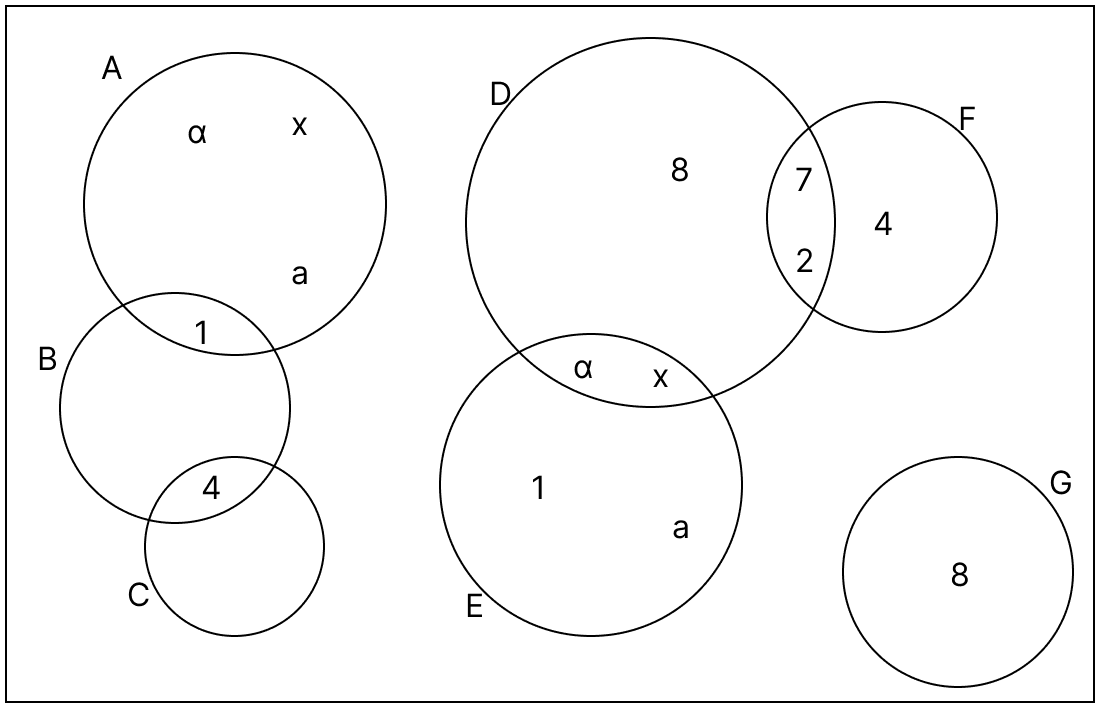
(1) How many empty sets are there in the given Venn Diagram ?
- 3
- 2
- 1
- 0
(2) How many singleton sets are there in the given Venn Diagram ?
- 0
- 1
- 2
- 3
(3) How many pairs of equivalent sets are there in the given Venn Diagram ?
- 1
- 2
- 3
- 4
(4) How many pairs of equal sets are there in the given Venn Diagram ?
- 0
- 1
- 2
- 3
Answer
Sets in the diagram are:
A = {α, x, a, 1}
B = {1, 4}
C = {4}
D = {8, 7, 2, α, x}
E = {α, x, a, 1}
F = {7, 2, 4}
G = {8}
(1) An empty set has no elements.
Looking at the list above all sets A, B, C, D, E, F, and G contain at least one element. Therefore there are no empty sets.
Hence, option 4 is the correct option.
(2) A singleton set contains exactly one element.
C = {4}
G = {8}
Total singleton sets = 2
Hence, option 3 is the correct option.
(3) Equivalent sets have the same number of elements (n(A) = n(B)).
Pairs with same number of elements:
A and E (4 elements)
C and G (1 element)
Total pairs = 2
Hence, option 2 is the correct option.
(4) Equal sets must have the exact same elements.
Pairs with same elements:
A and E = {α, x, a, 1}
Hence, option 2 is the correct option.
In a class there are 27 students. Out of these 14 study Psychology and 19 study Geography. There are 11 students who study both Psychology and Geography.
(1) How many students study Psychology but not Geography ?
- 3
- 4
- 5
- 6
(2) How many students study Geography but not Psychology ?
- 7
- 8
- 9
- 11
(3) How many students study neither Psychology nor Geography ?
- 8
- 7
- 6
- 5
(4) What is the difference between the number of students who study Psychology only and those who study Geography only ?
- 4
- 5
- 6
- 7
Answer
Given:
Total students: n(U) = 27
Students studying Psychology: n(P) = 14
Students studying Geography: n(G) = 19
Students studying both: n(P ∩ G) = 11
(1) This represents the number of students who study Psychology only.
We use the formula:
n(P - G) = n(P) - n(P ∩ G)
Substituting the values in above, we get:
n(P - G) = 14 - 11
n(P - G) = 3
Number of students who study Psychology but not Geography = 3.
Hence, option 1 is the correct option.
(2) This represents the number of students who study Geography only.
We use the formula:
n(G - P) = n(G) - n(P ∩ G)
Substituting the values in above, we get:
n(G - P) = 19 - 11
n(G - P) = 8
Number of students who study Geography but not Psychology = 8.
Hence, option 2 is the correct option.
(3) First, find the total students who study at least one subject (n(P ∪ G)):
n(P ∪ G) = n(P) + n(G) - n(P ∩ G)
Substituting the values in above, we get:
n(P ∪ G) = 14 + 19 - 11
n(P ∪ G) = 33 - 11
n(P ∪ G) = 22
So, 22 students study either of two subjects.
To find students who study neither Psychology nor Geography, we use formula:
Students who study neither Psychology nor Geography = Total students - Students who study either of two subjects
Students who study neither Psychology nor Geography = 27 - 22
Students who study neither Psychology nor Geography = 5
Hence, option 4 is the correct option.
(4) Difference between the number of students who study Psychology only and those who study Geography only = ?
Number of students who study Psychology only = 3.
Number of students who study Geography only = 8.
Difference = 8 - 3 = 5
Difference between the number of students who study Psychology only and those who study Geography only = 5.
Hence, option 2 is the correct option.
Assertion: The collection of all tall girls of your class is not a set.
Reason: A well defined collection of objects is called a set.
- Both Assertion (A) and Reason (R) are true and Reason (R) is the correct explanation of Assertion (A).
- Both Assertion (A) and Reason (R) are true but Reason (R) is not the correct explanation of Assertion (A).
- Assertion (A) is true but Reason (R) is false.
- Assertion (A) is false but Reason (R) is true.
Answer
Both Assertion (A) and Reason (R) are true and Reason (R) is the correct explanation of Assertion (A).
Explanation
Assertion is true. In set theory, a collection must be "well-defined." The term "tall" is relative and subjective (someone 5'6" might be tall to one person but short to another). Because there is no fixed criteria, it is not a set.
The reason correctly states the definition of a set (a well-defined collection of objects), which explains why the assertion is true.
Hence, option 1 is the correct option.
Assertion: Let P = {x : x is a factor of 24} and Q = {x : x is a factor of 30}.
P ∩ Q = {1, 2, 3, 6}.
Reason: The intersection of two sets A and B is the set of all those elements of A which are not in B.
- Both Assertion (A) and Reason (R) are true and Reason (R) is the correct explanation of Assertion (A).
- Both Assertion (A) and Reason (R) are true but Reason (R) is not the correct explanation of Assertion (A).
- Assertion (A) is true but Reason (R) is false.
- Assertion (A) is false but Reason (R) is true.
Answer
Assertion (A) is true but Reason (R) is false.
Explanation
P = Factors of 24: {1, 2, 3, 4, 6, 8, 12, 24}
Q = Factors of 30: {1, 2, 3, 5, 6, 10, 15, 30}
Common elements (P ∩ Q ) = {1, 2, 3, 6}
So the assertion is true.
Reason is false. The definition provided in the reason actually describes the Difference of Sets (A - B). The intersection (A ∩ B) is the set of elements that are common to both A and B.
Hence, option 3 is the correct option.
If A ∩ Bc = ∅, then:
- A = B
- B ≠ A
- A is proper subset of B
- None of these
Answer
Given:
A ∩ Bc = ∅
We know that A ∩ Bc is the set of all elements which belong to A but do not belong to B, that is, A ∩ Bc = A − B.
So, A − B = ∅, which means there is no element of A that does not lie in B.
Hence, every element of A is in B, that is, A ⊆ B (A is a subset of B).
Now, let us examine each option:
Option 1: A = B is true only when every element of B is also in A. The given condition does not guarantee this.
Option 2: B ≠ A may or may not hold; the given condition does not force B and A to be different.
Option 3: A is a proper subset of B holds only when A ⊆ B and A ≠ B. The given condition does not exclude the possibility A = B.
Since the condition A ∩ Bc = ∅ only tells us that A ⊆ B and does not confirm any of the three options above, none of them is definitely correct.
∴ None of the given options is correct.
Hence, option 4 is the correct option.
Ac − Bc is equal to:
- B − A
- A − B
- A = B
- None of these
Answer
Given expression: Ac − Bc
We know that for any two sets X and Y, X − Y is the set of all those elements which are in X but not in Y, that is:
X − Y = X ∩ Yc [Definition of difference of sets]
Step 1: Apply the above rule to Ac − Bc
Ac − Bc = Ac ∩ (Bc)c
Step 2: Simplify (Bc)c
(Bc)c = B [Complement of complement of a set is the set itself]
So, Ac − Bc = Ac ∩ B
Step 3: Rewrite the expression
Ac ∩ B = B ∩ Ac [Intersection is commutative]
= B − A [∵ X ∩ Yc = X − Y]
∴ Ac − Bc = B − A.
Hence, option 1 is the correct option.
The sets A and B have 6 and 9 elements respectively, such that A is a proper subset of B, then the total number of elements in A ∩ B are:
- 6
- 9
- 3
- 15
Answer
Given:
n(A) = 6, n(B) = 9 and A ⊂ B (A is a proper subset of B).
Since A is a proper subset of B, every element of A is also an element of B.
So, the common elements between A and B are exactly the elements of A itself.
Therefore, A ∩ B = A.
Taking the cardinal number on both sides, we get:
n(A ∩ B) = n(A) = 6
∴ The total number of elements in A ∩ B is 6.
Hence, option 1 is the correct option.
The sets A and B have 5 and 9 elements respectively, such that A is proper subset of B, then the total number of elements in A ∪ B are:
- 5
- 9
- 14
- 4
Answer
Given:
n(A) = 5, n(B) = 9 and A ⊂ B (A is a proper subset of B).
Since A is a proper subset of B, every element of A is also in B.
So, when we take the union of A and B, no new element is added by A that is not already in B.
Therefore, A ∪ B = B.
Taking the cardinal number on both sides, we get:
n(A ∪ B) = n(B) = 9
∴ The total number of elements in A ∪ B is 9.
Hence, option 2 is the correct option.
Which set is the subset of all given sets?
- {1}
- {0}
- ∅
- {0, 1, 6, 7}
Answer
We know that the empty set (∅) is a subset of every set. [Property of empty set]
Let us check each option:
Option 1: {1} is not a subset of a set that does not contain 1 (for example, {2, 3}). So it is not a subset of all sets.
Option 2: {0} is not a subset of a set that does not contain 0 (for example, {1, 2}). So it is not a subset of all sets.
Option 3: ∅ has no element at all, so the condition "every element of ∅ is in the other set" is satisfied for every set. Hence, ∅ is a subset of all sets.
Option 4: {0, 1, 6, 7} is not a subset of a set like {0, 1}, since 6 and 7 are not in {0, 1}.
∴ The empty set ∅ is the subset of all given sets.
Hence, option 3 is the correct option.
The members of the set S = {x | x is the square of an integer and x < 100} is:
- {0, 2, 4, 5, 9, 58, 49, 56, 99, 12}
- {0, 1, 4, 9, 16, 25, 36, 49, 64, 81}
- {1, 4, 9, 16, 25, 36, 64, 81, 85, 99}
- {0, 1, 4, 9, 16, 25, 36, 49, 64, 121}
Answer
Given:
S = {x | x is the square of an integer and x < 100}
We need to list all squares of integers that are less than 100.
The squares of integers are obtained by squaring 0, ±1, ±2, ±3, … . Since (−n)2 = n2, we only need to consider 0, 1, 2, 3, … .
Step 1: Compute the squares one by one and keep those less than 100
02 = 0 (< 100)
12 = 1 (< 100)
22 = 4 (< 100)
32 = 9 (< 100)
42 = 16 (< 100)
52 = 25 (< 100)
62 = 36 (< 100)
72 = 49 (< 100)
82 = 64 (< 100)
92 = 81 (< 100)
102 = 100 (not less than 100)
Step 2: Write the set S in roster form
S = {0, 1, 4, 9, 16, 25, 36, 49, 64, 81}
∴ The members of the set S are {0, 1, 4, 9, 16, 25, 36, 49, 64, 81}.
Hence, option 2 is the correct option.