Let A and B be two sets such that n(A) = 52, n(B) = 60 and n(A ∩ B) = 16. Draw a Venn diagram and find :
(i) n(A ∪ B)
(ii) n(A - B)
(iii) n(B - A)
Answer
Given:
n(A) = 52
n(B) = 60
n(A ∩ B) = 16
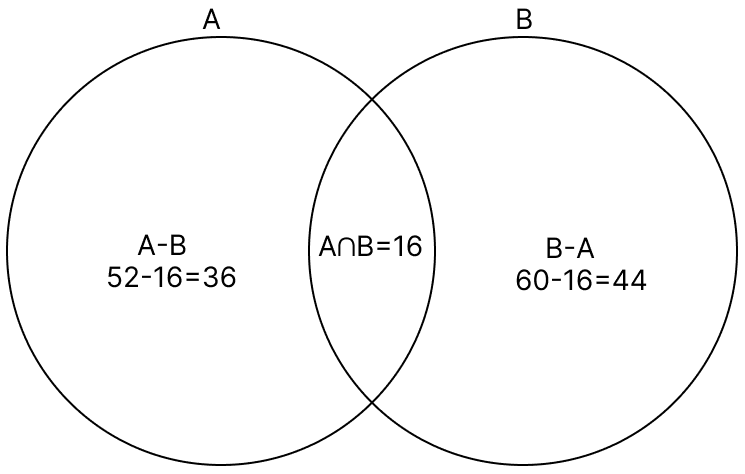
(i) n(A ∪ B)
The number of elements in the union of two sets is found using the formula:
n(A ∪ B) = n(A) + n(B) - n(A ∩ B)
Substituting the values in above, we get:
n(A ∪ B) = 52 + 60 - 16
n(A ∪ B) = 112 - 16
∴ n(A ∪ B) = 96
(ii) n(A - B)
The number of elements that belong to A but not to B is found by subtracting the intersection from n(A):
n(A - B) = n(A) - n(A ∩ B)
Substituting the values in above, we get:
n(A - B) = 52 - 16
∴ n(A - B) = 36
(iii) n(B - A)
The number of elements that belong to B but not to A is found by subtracting the intersection from n(B):
n(B - A) = n(B) - n(A ∩ B)
Substituting the values in above, we get:
n(B - A) = 60 - 16
∴ n(B - A) = 44
Let P and Q be two sets such that n(P ∪ Q) = 70, n(P) = 45 and n(Q) = 38. Draw a Venn diagram and find :
(i) n(P ∩ Q)
(ii) n(P - Q)
(iii) n(Q - P)
Answer
Given:
n(P ∪ Q) = 70
n(P) = 45
n(Q) = 38
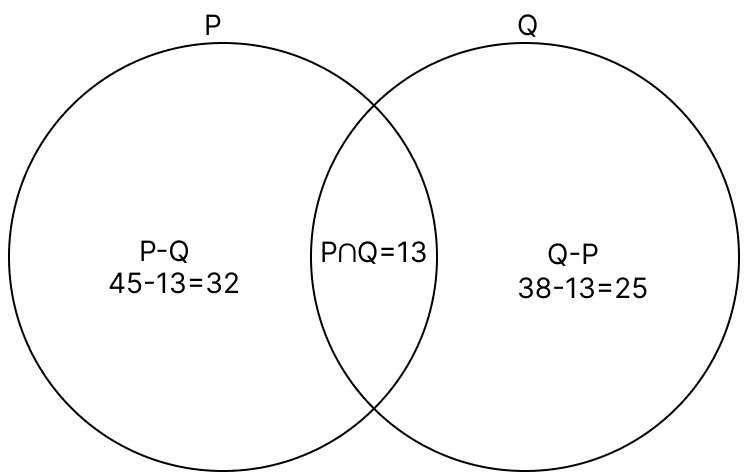
(i) n(P ∩ Q)
To find the number of elements in the intersection, we use the formula:
n(P ∪ Q) = n(P) + n(Q) - n(P ∩ Q)
Rearranging to solve for the intersection:
n(P ∩ Q) = n(P) + n(Q) - n(P ∪ Q)
Substituting the values in above, we get:
n(P ∩ Q) = 45 + 38 - 70
n(P ∩ Q) = 83 - 70
∴ n(P ∩ Q) = 13
(ii) n(P - Q)
This represents elements that are in set P but not in set Q.
We use the formula:
n(P - Q) = n(P) - n(P ∩ Q)
Substituting the values in above, we get:
n(P - Q) = 45 - 13
∴ n(P - Q) = 32
(iii) n(Q - P)
This represents elements that are in set Q but not in set P.
We use the formula:
n(Q - P) = n(Q) - n(P ∩ Q)
Substituting the values in above, we get:
n(Q - P) = 38 - 13
∴ n(Q - P) = 25
In a city, there are 25 Hindi medium schools, 18 English medium schools and 7 schools have both the mediums. Find
(i) how many schools are there in all in the city ;
(ii) how many schools have Hindi medium only ;
(iii) how many schools have English medium only.
Answer
Given:
Total Hindi medium schools: n(H) = 25
Total English medium schools: n(E) = 18
Schools with both mediums: n(H ∩ E) = 7
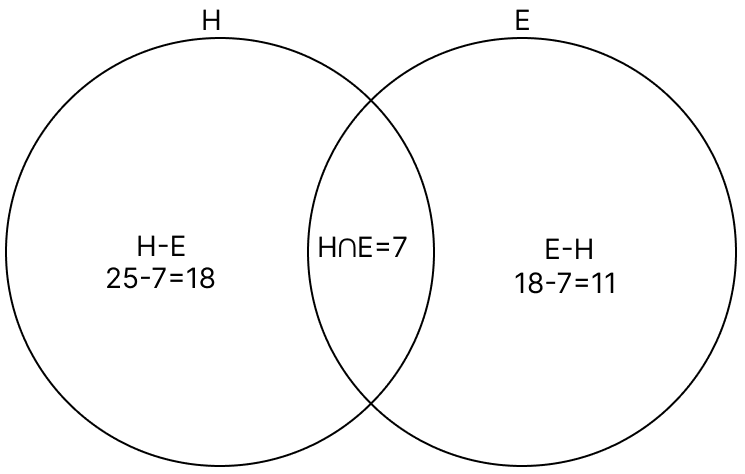
(i) how many schools are there in all in the city
This represents the union of the two sets, n(H ∪ E).
We know the formula:
n(H ∪ E) = n(H) + n(E) - n(H ∩ E)
Substituting the values in above, we get:
n(H ∪ E) = 25 + 18 - 7
n(H ∪ E) = 43 - 7
n(H ∪ E) = 36
∴ There are 36 schools in all in the city.
(ii) how many schools have Hindi medium only
This represents the set H - E, consisting of schools that are Hindi medium but not English medium.
We use the formula:
n(H - E) = n(H) - n(H ∩ E)
Substituting the values in above, we get:
n(H - E) = 25 - 7
n(H - E) = 18
∴ 18 schools have Hindi medium only.
(iii) how many schools have English medium only.
This represents the set E - H, consisting of schools that are English medium but not Hindi medium.
We use the formula:
n(E - H) = n(E) - n(H ∩ E)
Substituting the values in above, we get:
n(E - H) = 18 - 7
n(E - H) = 11
∴ 11 schools have English medium only.
There is a group of 50 persons who can speak English or Tamil or both. Out of these persons, 37 can speak English and 30 can speak Tamil.
(i) How many can speak both English and Tamil?
(ii) How many can speak English only?
(iii) How many can speak Tamil only?
Answer
Given:
Total persons in the group: n(E ∪ T) = 50
Persons who can speak English: n(E) = 37
Persons who can speak Tamil: n(T) = 30
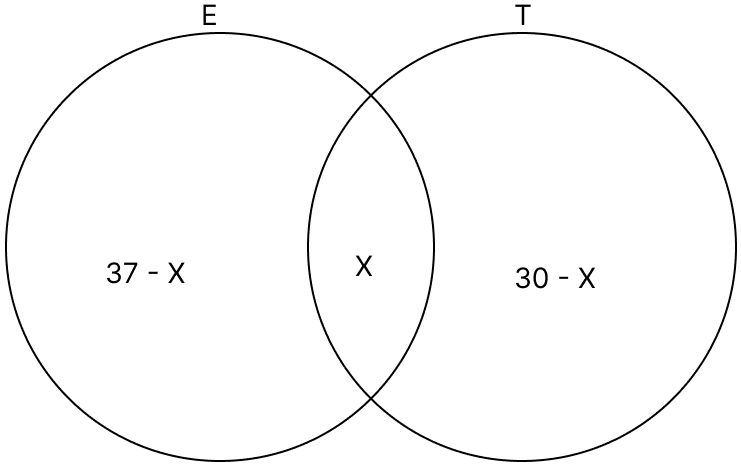
(i) How many can speak both English and Tamil?
This represents the intersection of the two sets, n(E ∩ T).
We use the formula:
n(E ∩ T) = n(E) + n(T) - n(E ∪ T)
Substituting the values in above, we get:
n(E ∩ T) = 37 + 30 - 50
n(E ∩ T) = 67 - 50
n(E ∩ T) = 17
∴ 17 persons can speak both English and Tamil.
(ii) How many can speak English only?
This represents the set E - T, consisting of people who speak English but not Tamil.
We use the formula:
n(E - T) = n(E) - n(E ∩ T)
Substituting the values in above, we get:
n(E - T) = 37 - 17
n(E - T) = 20
∴ 20 persons can speak English only.
(iii) How many can speak Tamil only?
This represents the set T - E, consisting of people who speak Tamil but not English.
We use the formula:
n(T - E) = n(T) - n(E ∩ T)
Substituting the values in above, we get:
n(T - E) = 30 - 17
n(T - E) = 13
∴ 13 persons can speak Tamil only.
In a class of 40 students, each one plays either Tennis or Badminton or both. If 28 play Tennis and 26 play Badminton, find
(i) how many play both the games;
(ii) how many play Tennis only;
(iii) how many play Badminton only.
Answer
Given:
Total students in the class: n(T ∪ B) = 40
Students who play Tennis: n(T) = 28
Students who play Badminton: n(B) = 26
(i) how many play both the games
This represents the intersection of the two sets, n(T ∩ B).
We use the formula:
n(T ∩ B) = n(T) + n(B) - n(T ∪ B)
Substituting the values in above, we get:
n(T ∩ B) = 28 + 26 - 40
n(T ∩ B) = 54 - 40
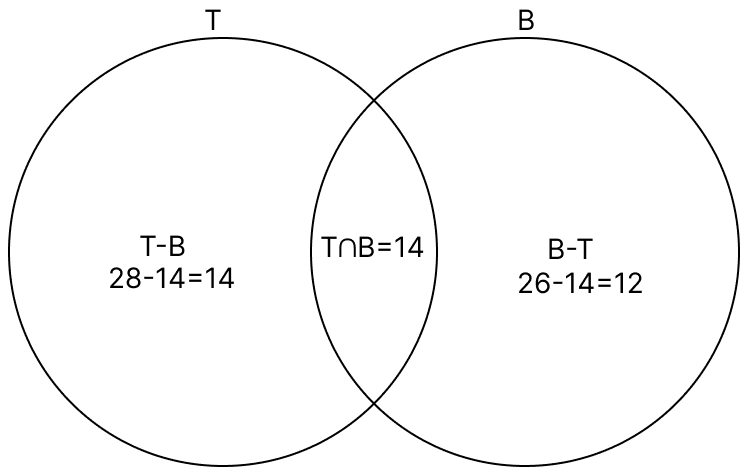
n(T ∩ B) = 14
∴ 14 students play both the games.
(ii) how many play Tennis only
This represents the set T - B, consisting of students who play Tennis but do not play Badminton.
We use the formula:
n(T - B) = n(T) - n(T ∩ B)
Substituting the values in above, we get:
n(T - B) = 28 - 14
n(T - B) = 14
∴ 14 students play Tennis only.
(iii) how many play Badminton only
This represents the set B - T, consisting of students who play Badminton but do not play Tennis.
We use the formula:
n(B - T) = n(B) - n(T ∩ B)
Substituting the values in above, we get:
n(B - T) = 26 - 14
n(B - T) = 12
∴ 12 students play Badminton only.
The Venn diagram is shown below:
In a class of 45 pupils, 21 play chess, 23 play cards and 5 play both the games. Find
(i) how many do not play any of the games;
(ii) how many play chess only;
(iii) how many play cards only.
Answer
Total pupils in the class: n(U) = 45
Pupils who play chess: n(C) = 21
Pupils who play cards: n(D) = 23
Pupils who play both games: n(C ∩ D) = 5
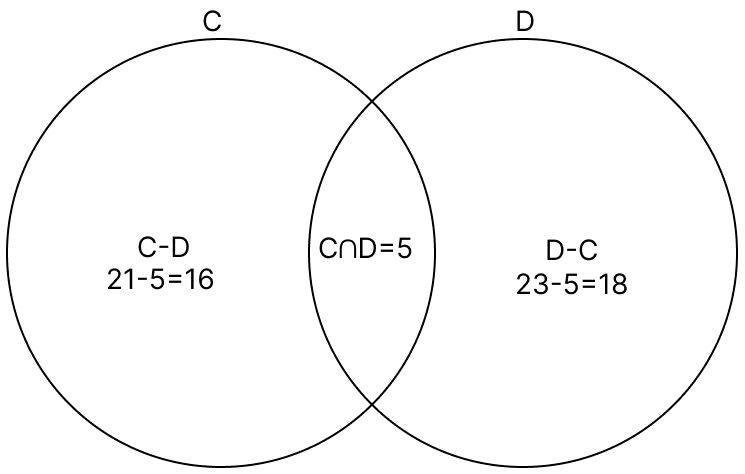
(i) how many do not play any of the games
First find n(C ∪ D):
n(C ∪ D) = n(C) + n (D) - n(C ∩ D)
Substituting the values in above, we get:
n(C ∪ D) = 21 + 23 - 5
n(C ∪ D) = 44 - 5
n(C ∪ D) = 39
∴ 39 pupils play both the games.
Pupils who do not play any of the games = n(U) - n(C ∪ D)
Substituting the values in above, we get:
Pupils who do not play any of the games = 45 - 39 = 6
∴ Number of pupils who do not play any of the games = 6.
(ii) how many play chess only
This represents the set C - D, consisting of pupils who play chess but not cards.
We use the formula:
n(C - D) = n(C) - n(C ∩ D)
Substituting the values in above, we get:
n(C - D) = 21 - 5
n(C - D) = 16
∴ 16 pupils play chess only.
(iii) how many play cards only
This represents the set D - C, consisting of pupils who play cards but not chess.
We use the formula:
n(D - C) = n(D) - n(C ∩ D)
Substituting the values in above, we get:
n(D - C) = 23 - 5
n(D - C) = 18
∴ 18 pupils play cards only.
In a group of 36 girls, each one can either stitch or weave or can do both. If 25 girls can stitch and 17 can stitch only, how many can weave only?
Answer
Given:
Total number of girls: n(S ∪ W) = 36
Girls who can stitch: n(S) = 25
Girls who can stitch only: n(S - W) = 17
Girls who can weave only: n(W - S) = ?
First find how many can do both, we use the formula:
n(S - W) = n(S) - n(S ∩ W)
Substituting the values in above, we get:
17 = 25 - n(S ∩ W)
⇒ n(S ∩ W) = 25 - 17
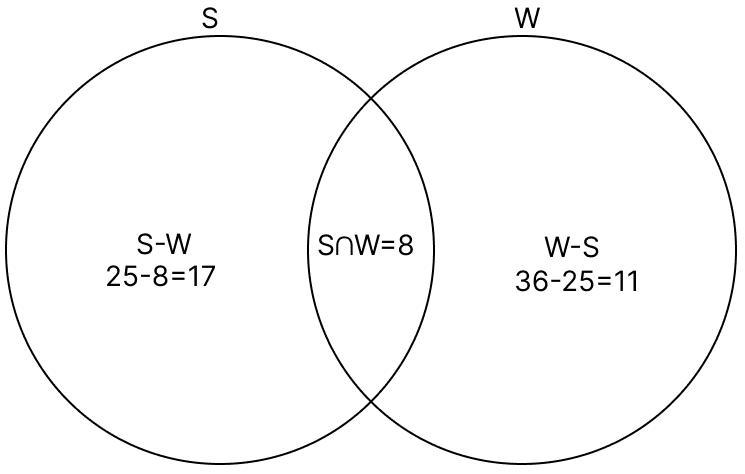
⇒ n(S ∩ W) = 8
So, 8 girls can do both.
Since every girl in the group of 36 does at least one activity, the total is the sum of "stitch only," "weave only," and "both."
n(S ∪ W) = n(S - W) + n(W - S) + n(S ∩ W)
n(W - S) = n(S ∪ W) - n(S - W) - n(S ∩ W) [Solving for n(W - S)]
Substituting the values in above, we get:
n(W - S) = 36 - 17 - 8
n(W - S) = 36 - 25
n(W - S) = 11
∴ 11 girls can weave only.
The Venn diagram is shown below:
In a group of 24 children, each one plays cricket or hockey or both. If 16 play cricket and 12 play cricket only, find how many play hockey only.
Answer
Given:
Total number of children: n(C ∪ H) = 24
Children who play cricket : n(C) = 16
Children who play cricket only: n(C - H) = 12
Children who play hockey only: n(W - C) = ?
First find how many children play both using the formula:
n(C ∩ H) = n(C) - n(C - H)
Substituting the values in above, we get:
n(C ∩ H) = 16 - 12
n(C ∩ H) = 4
So, 4 children play both cricket and hockey.
Since every child in the group of 24 plays at least one game, the total is the sum of “cricket only,” “hockey only,” and “both.”
n(C ∪ H) = n(C - H) + n(H - C) + n(C ∩ H)
n(H - C) = n(C ∪ H) - n(C - H) - n(C ∩ H) [Solving for n(H - C)]
Substituting the values in above, we get:
n(H - C) = 24 - 12 - 4
n(H - C) = 24 - 16
n(H - C) = 8
∴ Number of children who play hockey only = 8.
The Venn diagram is shown below:
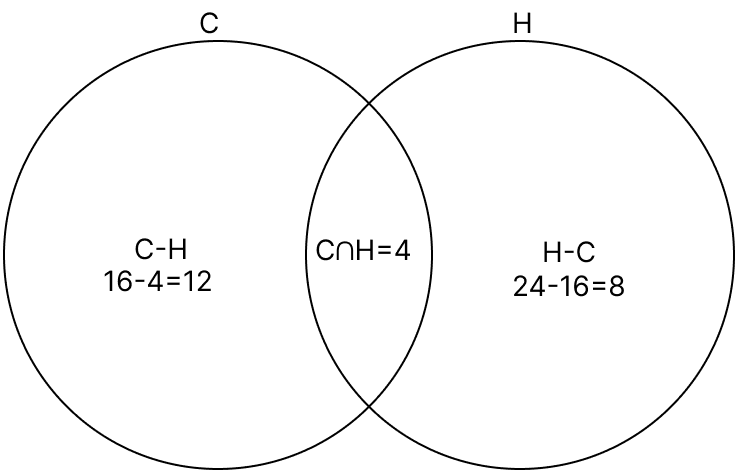
In a group of 40 persons, 10 drink tea but not coffee and 26 drink tea. How many drink coffee but not tea?
Answer
Given:
Total number of persons: n(T ∪ C) = 40
Persons who drink tea: n(T) = 26
Persons who drink tea but not coffee: n(T - C) = 10
Persons who drink coffee only = n(C - T) = ?
First find number of persons who drink both tea and coffee by using the formula:
n(T ∩ C) = n(T) - n(T - C)
Substituting the values in above, we get:
n(T ∩ C) = 26 - 10
n(T ∩ C) = 16
So, 16 persons drink both tea and coffee.
Since every person in the group of 40 drinks at least one of the two beverages, the total is the sum of “tea only,” “coffee only,” and “both.”
n(T ∪ C) = n(T - C) + n(C - T) + n(T ∩ C)
n(C - T) = n(T ∪ C) - n(T - C) - n(T ∩ C) [Solving for n(C - T)]
Substituting the values in above, we get:
n(C - T) = 40 - 10 - 16
n(C - T) = 40 - 26
n(C - T) = 14
∴ Number of persons who drink coffee but not tea = 14.
The Venn diagram is shown below:
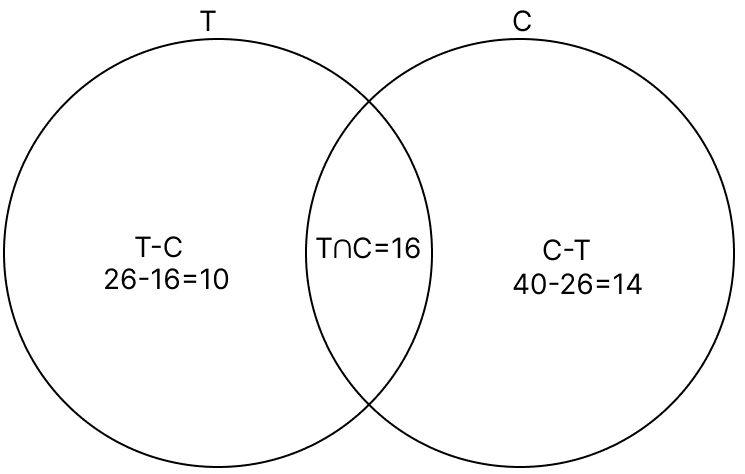
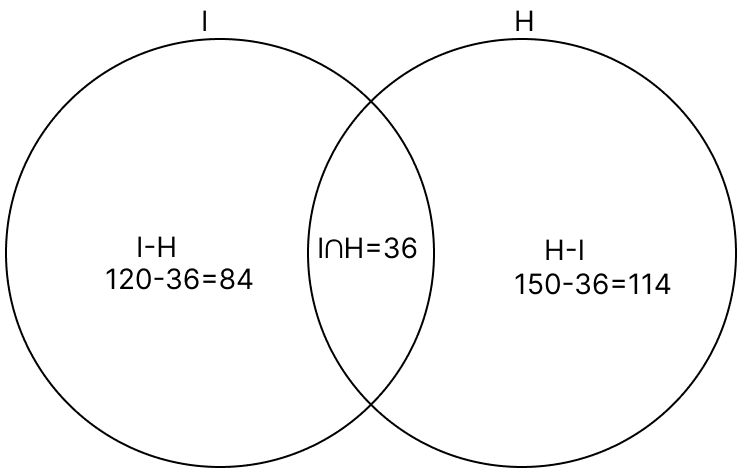
All the people in a locality read the daily newspaper Indian Express or Hindustan Times or both. If 120 read Indian Express and 150 read Hindustan Times and 36 read both, find :
(i) how many people are there in the locality;
(ii) how many people read only Indian Express.
Answer
Given:
People who read Indian Express: n(I) = 120
People who read Hindustan Times: n(H) = 150
People who read both: n(I ∩ H) = 36
(i) how many people are there in the locality
Since every person in the locality reads at least one of the two papers, the total population is equal to the union of the two sets, n(I ∪ H).
n(I ∪ H) = n(I) + n(H) − n(I ∩ H)
Substituting the values in above, we get:
n(I ∪ H) = 120 + 150 - 36
n(I ∪ H) = 270 - 36
n(I ∪ H) = 234
∴ Total people in the locality = 234.
(ii) how many people read only Indian Express
This represents the set I - H, consisting of people who read Indian Express but do not read Hindustan Times.
n(I - H) = n(I) - n(I ∩ H)
Substituting the values in above, we get:
n(I - H) = 120 - 36
n(I - H) = 84
∴ People who read only Indian Express = 84.
The Venn diagram is shown below: